In short
Keep Candles’ founder Harry Dole explains why the luxury candle brand quit social media (fully off since Jan 2021) and grew anyway through storytelling, community, newsletter, and carefully chosen in-person retail touchpoints.
Guest background
Harry Dole is founder and creative director of Keep Candles (started 2015). He grew up in France/Italy with hotelier parents, studied in the U.S., worked at Google/YouTube in business/finance as “data scientist” emerged, and co-founded the company with Stephen (a former YouTube colleague).
Key claims
Social platforms optimized for algorithms and “watch time”/engagement conflict with their purpose of connection. Instagram was a “negative mindset” first date; they feared “privileged douchebag” backlash but got many positive newsletter replies. They avoid metrics that don’t reflect mission.
Notable examples
Kickstarter launch in 2015; subscription “keepers” (few thousand) share rituals; vertical integration (in-house wax/fragrance, glass, boxes, packaging) for near–zero waste and regenerative aims.
Written by AI. May contain mistakes. Listen to the episode to check what was said.
Chapters
Tap a time to open that second in VOHarry Dole's Journey and Keep Candles
1:10 to 3:50
Harry shares his background and the journey of creating Keep Candles.
“My parents were hoteliers in France, so I grew up with that experience.”
The Vision and Mission of Keep Candles
3:50 to 6:50
Discussion on Keep Candles' mission to create a regenerative and sustainable product.
“better than how you left them or how you found them.”
Personal Connections to Candles
6:50 to 9:30
Harry and Andres discuss the emotional and personal significance of candles.
“It's very hard in the way our current economy is structured to reach that North Star, but that's where we're incrementally, bit by bit, aiming to get closer and closer to.”
Marketing Through Storytelling and Community
9:30 to 14:00
Exploration of Keep Candles' unique marketing strategy focused on storytelling and community engagement.
“And the idea of having it sullied because in the back, it's actually a super dirty supply chain or something like that.”
Creating Magical Customer Experiences
14:00 to 15:00
Learn how the brand focuses on creating special experiences for customers.
“are going to smell our candles and it's in an environment that fits our values or that otherwise creates a really positive entry point, a positive association that we're also excited about.”
The Decision to Leave Social Media
15:00 to 17:06
Discover the reasoning behind the company's departure from social media.
“and hopefully they also want to tell their friends about us.”
The Impact of The Social Dilemma
17:06 to 19:35
Understand how the documentary influenced the company's social media strategy.
“But it's a really fascinating documentary, and it was saying really what Stephen and I felt, but we just didn't have as deep a knowledge or deep a vocabulary, to be honest, as them in terms of how to express it.”
Challenges of Algorithm-Driven Storytelling
19:35 to 21:07
Explore the difficulties of crafting authentic stories in the age of algorithms.
“I'm forgetting now, but yeah, we got off.”
The Value of Meaningful Engagement
21:07 to 23:14
Learn about the pitfalls of chasing metrics over genuine customer relationships.
“They're these things that are just a bit, have a bit more friction in the data tracking than paid media on social media, for example.”
Reconsidering Social Media Necessity
23:14 to 25:40
Reflect on the necessity of social media for businesses and alternative strategies.
“You get like tens of thousands of emails or maybe more than that.”
Show all 11 chapters
Closing Thoughts and Contact Information
25:40 to 28:00
Find out how to reach the brand and learn about their products.
“You don't have to just go to every single social media platform and spend all your marketing budget in making those algorithms work for you.”
Transcript
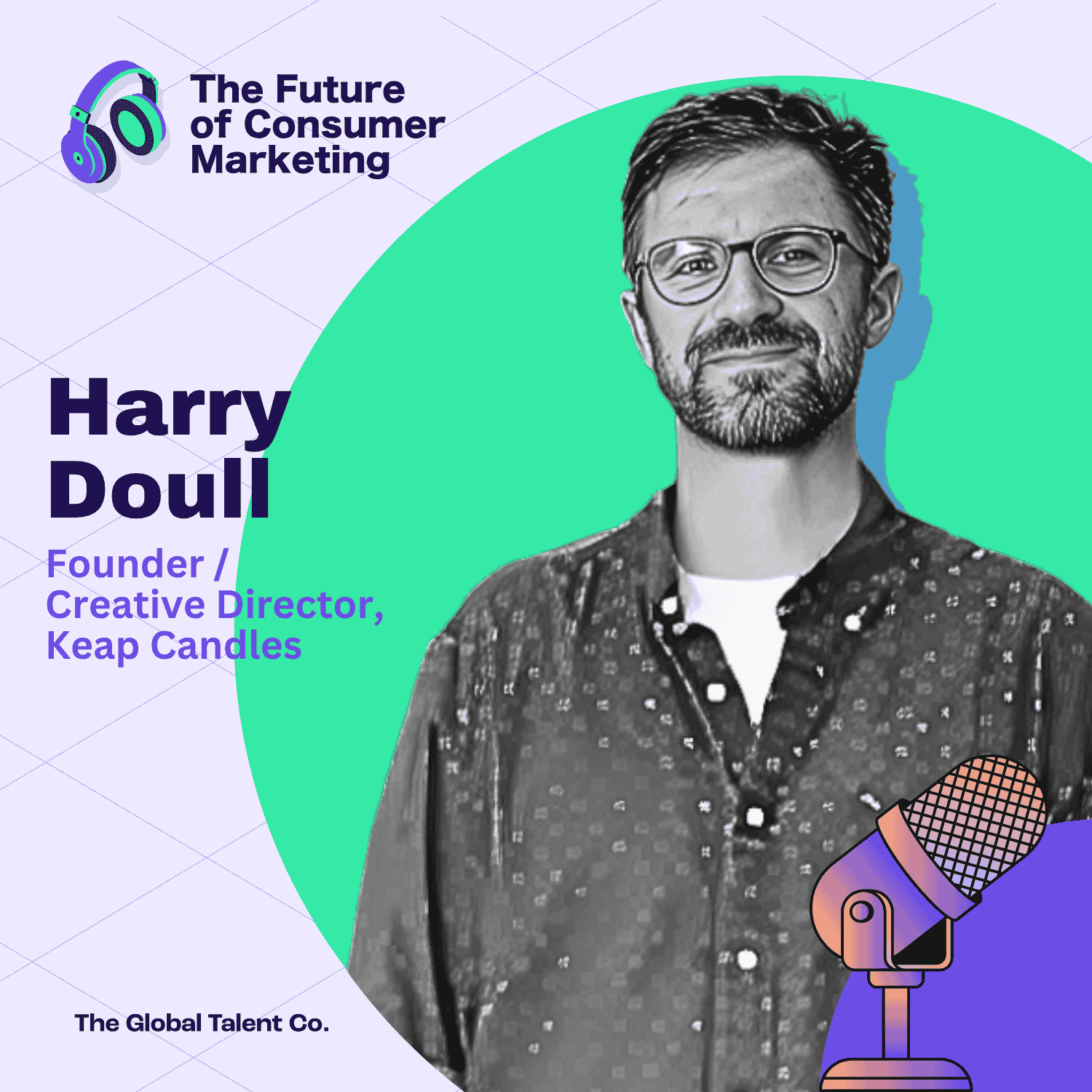
Automatic transcript. May contain errors.0:00Hey, everybody, and thank you for listening. My name is Andres Figueira, and I'm going to be your host for the day. This show is brought to you by the Global Talent Company, a company that's helping growing teams hire exceptional remote talent from Argentina, South Africa, and anywhere, really. So what we do is that we connect companies with world-class professionals who bring skill, reliability, and global perspective to every role. If your team's looking to grow with proven remote talent, just head on over to theglobaltalent.co and see how we can help. And today, with me here, I am speaking with Harry Dole, founder and creative director of Keep Candles, a company that proudly crafts candles that are masterfully scented, virtually zero waste, and that help to build towards a regenerative future.
0:44So, Harry, how's it going, man? A pleasure to have you here. What's up, Andreas? Great to be here. Thanks for having me. Harry, so that we can get this podcast started and maybe then just give the audience a bit more context as to who you are and what Keep Candles actually is. Would you be able to tell us a bit of how you got here, how Keep Candles started? Yeah, of course. I started Keep Candles in 2015. A little bit about me. I have a pretty nonlinear career path. My parents were hoteliers in France, so I grew up with that experience. They actually moved to Italy when I was in high school. So grew up in France and Italy, then came to the U.S.
1:21for university and spent, after a few detours, ended up at Google slash YouTube and worked there for a while. As the term data scientist was just starting to come up, it wasn't yet a fully accepted thing. So I was on the verge of data analyst and data scientist, you could say. The focus more on the business and finance side of Google slash YouTube. And, yeah, I started the company with one of my closest friends, Stephen, who was also working with me at YouTube. And a lot of people joke that, like, whoa, Google the candles, that is such a non—doesn't really make sense on the face of it. And it doesn't make sense.
2:02There weren't, like, that many synergies, honestly, between that previous job and what I'm doing now. But it was related in that I think we were feeling—even though I met some great people at Google, learned so much. I'm really grateful that I had to have that experience. We're also feeling a certain disconnection, both through the sort of short-term quarterly profits-driven and increasingly quarterly profits-driven approach to work that we were seeing. And also this nagging kind of feeling around watch time being the metric that was being optimized for YouTube. This is a long time ago, so it was when it was just starting to be used as the metric that everything was focused on.
2:44And I don't think we really had the vocabulary or quite the awareness to say what it was exactly that was bugging us. But we found in candles a refuge. We were roommates also, and every night we'd go home, light candles. We talked about candles all the time and started really discussing why candles were so special to us. And we then took perfumery courses. we then visited some contract manufacturers to see what was going on we made our own candles at home and gradually we were just in too deep and we had to go fully in it and we started with a kickstarter campaign in 2015 that that did really well and that gave us the start to get going and build a wonderful community around making candles that as you say combine really the highest quality scents designed by some of the world's best master perfumers with a pretty radical approach to circular design and with the ultimate aim of a regenerative vision as we talk.
3:40The idea that everything that we impact and touch is left better off than before it came into contact with us, if that makes sense. Of course. That is like such a noble cause, just making sure that things are better than how you left them or how you found them. It's just crazy. I think it's a very nice way to view life and business as well. And Harry, when you mentioned that you had a Kickstarter campaign for the candles. In that campaign, what was like the differentiator or what caused people to want to invest in the business that makes it different from any other candle store? Well, I should say the company has changed a lot since that first Hickory campaign.
4:18That was 10 years ago. So my answer of what makes us different today is a little bit different than what made us different back then. The Martley candle market has also changed a lot since then. There's just been massive growth and proliferation of brands since then. Back then, it was about, at the time, we actually put an emphasis on providing master perfumer sense in a more affordable way. We were still in that kind of early wave of direct-to-consumer businesses at the time. And we approached that path with the idea that we wouldn't raise venture capital. and it was in those days where it was really in the dying days of when social media you could build a social media following organically and without paid media and just through great storytelling that there was this feels so long ago but you could do that like them and and we were really thinking about yeah about really bringing the beauty of the highest levels of perfumery that we got to learn through our courses to a bigger a broader audience i think since then a lot of changes have happened.
5:22Our prices have gone up a lot because we learned the economic reality of this industry and of these products. And I would say we're definitely a luxury product now. I wouldn't hide away from that. And really where what has been a constant is our pursuit of sustainability and breaking new ground in that realm. Most candles, especially luxury candles, are pretty much all made by a few contract manufacturers. And so they all use the same, every brand is using the same materials basically. Us having our own production in-house, we're vertically integrated. We just have so much more control on not just the raw materials of our wax and fragrance, but also our glass, our boxes, our packaging.
6:03We really get to pick every single item and put the kind of care that we wanted as super candle nerds in our candles. And I could say more, but I'll pause there. No, but I really like that because the fact that you have everything integrated in-house, it allows you to really choose and make sure that what you're creating, it aligns with the vision that you have for Keep Candles, which it is for it being regenerative. And my understanding is that you're looking for sustainability and to create a product that doesn't affect the world negatively, as there is so many nowadays that just are being created for the sake of selling.
6:38If that's not the mission for Keep Candles, please correct me, but that's the vibe I'm getting. Yeah, no, I think that's accurate. And to be clear, we have this regenerative vision. We talk about it as a vision and approach. We're not currently regenerative. It's very hard in the way our current economy is structured to reach that North Star, but that's where we're incrementally, bit by bit, aiming to get closer and closer to. And yeah, really, we actually think of our purpose as being about connection, though. It's about connection to the natural world, our loved ones, and our own spirit. And the idea of regeneration cuts across all of that.
7:15But we definitely see just in how our customers use our candles. One feature of kind of our business is that it's centered around a subscription. So we have a group of a few thousand what we call keepers who get a candle either every other month or on some other regular cadence. And they share with us their rituals and how they use candles. And really, I think that's been one of the most humbling and like makes me like almost want to cry just even thinking about it just hearing how it helps how the candles act as a supporting companion in people finding presence and setting an intention and doing what they want it's the opposite of scrolling on your phone when you light a candle it's typically associated with i'm lighting a candle so that i can focus on my art or on my work or on my children or on my partner or on cleaning my house and taking or taking care of myself.
8:10And the candle, the flame of the candle sort of sits there as a gentle reminder that this is what you decided to do for yourself, rather than try and pull you in into what someone else is trying to have you focus on. So I think, especially as the way technology is evolving, I've re-fallen in love like a second time with candles in a different way. And so yeah, that's our purpose of the company is really around connection. And I think we differentiate ourselves a lot through some of the things we've done around sustainability. Wow, that that that is so nice, Harry. And I must say that it actually hits home with me because I found love for candles less than a year ago, actually.
8:48And it's because my grandmother, may she rest in peace, she used to be like I'm originally from Venezuela and she was over there and I'm living in Argentina right now. But she used to light a candle every single time that we were expecting or working for something to happen, like a job application or you had an exam that she needed to pass, she would always light a candle for good luck. And so have that, what's it called? That moment of actually manifesting that you want something to happen. And she really, she, that, that tradition rubbed off on me. And now every time I'm anxious about something that I want to happen, I'll light a candle in her honor and, and to give me the moment of presence and to just say, okay, I want this to happen.
9:30I'll just close my eyes for a moment, disconnect and then just keep working at it but so much so that i even got a tattoo of a candle man wow that's really beautiful on this that's that's so cool to hear and yeah i think i relate to candles in a very similar way in my own different way obviously than your very personal story but i think that that's become definitely one of my favorite parts is just hearing these stories from so many people and we try and really make the our candles the way they're made the way the people who are making them are treated, the materials we use and how the ecosystems, the places that where they're coming from, that it's all feels aligned that you're not like having this potentially intense spiritual moment that's really important to you.
10:12And the idea of having it sullied because in the back, it's actually a super dirty supply chain or something like that. That's my nightmare. And so I don't want that. That's my truth right now. Like I'm buying candles from wherever I can find them. If I had something like Keith Candles here in Argentina, it would be so much, it would be much more special. I'd love for us to come down to Argentina. That sounds really nice. And Harry, would you be able to tell me a bit more about how you guys are able to market this, such a special message with your candles? Like how are you able to get your consumers to understand this is the intention you have behind the creation of this product?
10:47Yeah, I would say the way we, our marketing department is not called marketing. We call it storytelling and community. And then within community, we also have a big partnerships bucket. So in some ways, it's storytelling, community, and partnerships. And we really think of it as, number one, building relationships. And number two, or it's not a hierarchy, they're really side by side, is storytelling, telling great stories. and we have just this wealth of great stories because we get to see and like touch literally the stuff that we're making for you and talk to the producers of the ingredients we use we just have all this context and we've only scratched like the tiniest surface of telling all those stories to our customers there's so much more i want to do there and then on the relationship side it's a lot of things we do we have a very popular newsletter that's our main outlet for kind of keeping in touch with people from our end.
11:40We put a lot of investment into our customer service. We're known for having really personal customer service that just people don't expect to get from any e-commerce company. And we try and also have as many like in-person interactions as we can in lots of ways. And then a really big thing that's just so important for us, and we're also over the last few years gotten more known for this, is really putting a lot of effort into knowing our customers. We're, we have a famous, like famous, like talking as if we're like some big company, we're like a tidy company. We're like, it's popular with our small community, but we have an annual survey that we do every summer that is really long.
12:20To be honest, I'm shocked that anyone spends the time to fill it, but we get hundreds of people that fill it every year and it's super touching. And we get feedback from the people filling it that they love the questions and they love actually the reflections that they got to do in the process. And it just gives us such a better handle on how people are experiencing our products and how people, what else is going on in their lives around, not everything, but around the practices that involve our candles or involve our company in some way. And that informs a lot of our, so much of what we do on storytelling, on partnerships.
12:59And then for us, we really thought about once we know our customer, we know what the value that we provide that's different where are the places where we can have a really positive first contact with people and we found that instagram which was where we initially thought things would happen for us was a terrible first date place because in practice and you think about how we use instagram it's typically 2 a.m in our beds or like 6 a.m in our beds like scrolling through a feed and it's like lots of a mix of like candy and rage and maybe not for everyone but that was my experience and it's very uh it's you're you get in a negative mindset and so then when you discover something new for the first time you're not in really the best place to be your best self and meanwhile when people smell our candles because that's a key thing that determined for our product it's all about the smell or almost all about the smell in terms of whether really someone wants to go for it.
13:59And so we wanted to find touch points where people are going to smell our candles and it's in an environment that fits our values or that otherwise creates a really positive entry point, a positive association that we're also excited about. So we work with a lot of hospitality and gift stores that are very carefully chosen that where we know that it's going to be a really personal experience, that it's going to be something very, it's going to feel like a special discovery. And it is because you can't just find us on Amazon or at Walmart or something like that. And yeah, we want that first, we really focused on making that first touch point magical and a great introduction.
14:42And then we just, we then, it's on our end to then create a really positive customer experience through our products, through our packaging, through our storytelling, through our customer service. And so retention is also a big focus, has been a big focus of this past decade for us and just making it so that people really love what they're doing. They don't want to leave us and hopefully they also want to tell their friends about us. Wow. So you're creating customer fidelity by having an excellent product. But what I'm loving from what I'm hearing is the fact that you're placing yourself strategically in the consumer journey.
15:14And the first touch point is at a place where they will actually appreciate what you have to offer. It's not like I was scrolling and just found this random ad for candles when I needed one. it's more wow where the where does this scent come from it's smelling good and then they'll go ask and they'll tell them like yeah you can look at it here or something like that is that like the intention and the idea that that is way better said than i said it thanks how just how just summarizing in my mind because i'm loving the product you have man and with it being 10 a 10 year old company it means you've been here a while so you probably have learned a lot of what you want what you don't where this is taking you and that it aligns to your mission totally lots of spaghetti thrown at the wrong walls and things that we try that we realize that's not for us or it doesn't work so yeah it has taken a while for us to figure out and we're still figuring we it's not like we've nailed it down and figured everything out we're still experimenting obviously that that's good because as long as you're experimenting it means you always have the possibility of finding something new that works better so as long as you keep on testing it It's cool.
16:16It's cool. And then, Harry, so you're not using Instagram, and I would assume that you're not using any social platforms then, like TikTok or influencer-based marketing, nothing like that? No, nothing like that. Though we just, we are starting a program. So I should recap for your listeners. We got off social media entirely in January 2021. Almost five years now that we've been completely off social media. We'd been discussing it for two years, roughly. and we almost got off in 2019 or 2018, I can't remember, and ended up deciding let's not, but then it kept coming back. And then I think January 2021 was not that long after The Social Dilemma came out.
16:59I don't know if you've seen that Netflix documentary. Yes, I know which one it is. It's a documentary, for those who haven't seen it, that interviews some ex-Facebook, ex-Google, I think ex-Twitter employees who started this thing called the Center for Humane Technology that has been focused on trying to remedy the harms of social media and is now actually focused on remedying the harms of AI and trying to channel us towards a direction where AI doesn't destroy us, basically. But it's a really fascinating documentary, and it was saying really what Stephen and I felt, but we just didn't have as deep a knowledge or deep a vocabulary, to be honest, as them in terms of how to express it.
17:40And it really pushed us further into the idea that it wasn't right for us. I think it felt very misaligned with our purpose of connection and thinking about how the dynamics of the platform, which I would say when we joined in 2015, we didn't really feel that way. The platform very gradually with each change involved more and more in this direction that we didn't see as serving our needs of connection. and I will say like for some people I don't want to say like everyone should get off social media take their business off social media obviously I think it can be the right thing for you and if you love it I'm super happy to hear that and you should definitely keep doing the thing you love for us it was really not giving us joy and we were finding feeling like we'd start our own company but now we had this boss that really sucked that we had to work for and it wasn't that we weren't creating community increasingly the communication the storytelling we were doing which was something really enjoyable for us to share with our customers and share with the audience that the platform was making it was working in such a way that we weren't really telling a story for our audience we were telling our story for an algorithm and the more that happened the more we felt a tension that became irreconcilable between we either tell the story that we want to tell and the algorithm is going to be like nah or we tell the story the algorithm wants and it's going to be inauthentic.
19:00It's going to be a kind of us turning ourselves into something we're not. And even, I think there were many other reasons. Also, it wasn't working for us. I think many businesses, especially small businesses, think they have to be on social media as a kind of, not for any real reason, just like you should, that you're not serious if you're not on it or something. Or if you're a millennial like me, it's very associated with our identity that we grew up with this stuff. We're good at this stuff, but actually maybe you just don't need it for your, that's not really a good reason to like keep doing it.
19:31It's not working for you and you don't like it. And yeah, we, there was another thing on that note. Yeah. I'm forgetting now, but yeah, we got off. It felt amazing. We communicated it to our customers in our newsletter. We put a sort of, on Instagram, we put a message saying, we're no longer here. Send us an email, follow our newsletter. and then on our newsletter that still to this day is by far the most number of responses we ever got to a newsletter i forget it was like 150 or 200 i don't remember it was so many responses every single one was positive and like celebratory and people saying man this is so cool i wish more companies did this which was not what we expected we were very scared and we were like oh man maybe people we had all sorts of like narratives in our mind fear narratives in our mind that like maybe people would think we're such like privileged douchebags who are like doing this because you can for whatever reason.
20:28And I don't know, we had all these things that completely didn't materialize. And I think it's brought us more, much more in alignment with where we want our company to go. And it's allowed us to focus all that time and energy we're spending and money on creating an Instagram feed, then has gone to some of these other things that we both enjoy more, they get better business results. One aside there is actually, as a marketer is interesting, is that a lot of the things we're doing are not as easy to track. You can't get like live real-time metrics of the work you're doing. You often have to wait a bit longer to get tracking, or you can get a rough estimate.
21:07They're these things that are just a bit, have a bit more friction in the data tracking than paid media on social media, for example. But I think there's a big bias in, to be honest, the whole knowledge economy in many places around working only on things that can be tracked really accurately. Oftentimes, as myself being a data analyst, I learned that there's just a lot of times where the goal you actually want, you can't actually track exactly how you're doing. You have to use a number of proxies that are that thing, but not quite. And you need to remember that when looking at that data, that's not quite the thing you're trying to do.
21:45And make sure that you're not going into optimizing for a goal that's not actually your goal. And I don't know if that's like too abstract, but no, but like I get it. It's like you're trying to increase or make better these metrics that just work as signals and don't actually signify the mission or the final goal you have. And you can just get lost in that because I do feel from hearing you speak, Harry, that social media nowadays, it's like a status quo that everybody just needs to have it. And then you're chasing these empty metrics and inflated variables that is yeah you got virality and a million people saw your product but it's a million people who could be in the philippines where you don't actually sell so it doesn't actually turn into a conversion or actually benefit the business so i totally understand why you would stray away from that and it's so cool that you got your consumer support and that they all love the fact that you guys dropped from social platforms and everything like that because I would also expect or think that they wouldn't be too happy.
22:43So that's a nice surprise. Yeah. No, thank you for framing that way. You really covered it. I think it makes me think of something that was just this week came up as a possibility that we discussed, but it's, I don't know if on this podcast, you ever discussed email giveaways where companies partner together and there's like a gambling incentive. If you sign up to all these emails, You might get like a super big prize. One person will get this big prize. In our very early days, we did a few of those. And what we learned was even when the companies were well aligned with us, which wasn't always the case, you end up with all these emails.
23:21You get like tens of thousands of emails or maybe more than that. And we would tend to be like, wow, we got 100 ,000 emails. So awesome. And then the reality is when you look closely at it, like zero customers. Like 100 ,000 just pure spam, essentially. Many of these are real people, but they didn't join you because they're interested in your story. They're joining you because it's free gambling and they get a chance to win a big prize. And so you got them in the wrong way. And what we found is it's not just no value, it's actually negative value because of the way email clients work and how your open rates will collapse.
23:57And you'll get punished for that by Gmail and Yappamail and all these places. And actually, you'll find that even the people who wanted to read your stuff no longer receive it anymore. It's true. It's true. So you're trying to chase the approval of these systems and algorithms that don't actually match what you're looking for. And then you're in this endless race for something that you don't even care about. Like every time I hear you speak of the reasons you guys have for dropping from social media, I'm like, should I do it? No, exactly. I think it depends on the business and it depends on who you are and what you want.
24:31And there's no one size for this kind of thing. But I found since it was actually after the Trump inauguration this year, I got out of the blue, all these people calling me, asking me like small business owners, asking me about leaving social media and sharing their fears. And I did find like the main, each business was different, but the main themes were that people, these business owners felt scared. But it was more of a, when you do something that no one else is doing, that aspect of it is scary. Not like necessarily rooted in some kind of like argument or calculation around what will happen.
25:07Of course, it's like imposter syndrome. I'm not sure if I should, I'm the first one. Yeah, exactly. That feels scary. I definitely think that's a scary thing for most of us. and um but people but but these people also clearly didn't want to be on it and they were only doing it out of a sense of essentially i should like a duty or an obligation that's imposed from some kind of up there yeah i would encourage kind of people to reconsider if that's how you feel listening to this i would encourage you to just consider it just from what's it doing for your business what's it doing for you and go from there that's amazing it's like there is another option You don't have to just go to every single social media platform and spend all your marketing budget in making those algorithms work for you.
25:51But you could just do something that resounds more with your public and your consumers. And that way you get a more organic following. I don't want to say following since we're dropping from social media, but it's like the audience you have and the people who are interested will increase. And I think especially B2B businesses, obviously it's a huge group, so I don't want to generalize completely, but I think most B2B businesses, social media is probably not that important to their business or isn't really what's driving their business. Yeah, interesting topic. It's true. No, I like that. It's a lot of food for thought because it is a topic that isn't addressed in this perspective nowadays.
26:27It's more from the, why don't you have it, create it, you need to do it. And it's a bit of pressure all around, so I get that. You need to post at least three times a day, Andres. Oh my goodness, if I hear that one more time, I'm going to delete all the apps on my phone, not just social media. But Harry, I'm just noticing that we're already at time, but I did want to give you the chance before we finish the episode to let anybody in the audience who's hearing us know how they can reach out and learn about KeepCandles, how they can buy some of your products if they're, if I'm not mistaken, you guys are in the States, right?
26:59Only in the States. Yeah, so we ship nationwide in the United States. unfortunately not currently internationally you can find us at keepcandles.com it's spelled k-e-a as in apple p as in peter candles.com and join our newsletter on our website and yeah we have that's where that's where you can find our candles basically and yeah we love if you have questions our email is the lab at keepcandles.com and just love to hear from you especially if you have questions about getting off your business off social media i'm always happy to meet people who are interested in that, say I get in touch. I love that.
27:36I love that. You can even start doing just speeches about the success story of dropping from social media because it's always the other way around. But really appreciate that, Harry, you being so open and telling us where you're coming from with all that Keep Candles has become. And to anybody in the audience, you just heard where you can find out more about these candles. K-E-A-P-Candles.com. Amazing. Perfect. Perfect. So thank you so much, Harry, for coming on the episode, bro. It really has been a pleasure. Thanks so much, Andres. Pleasure, pleasure meeting you. Likewise. And to anybody in the audience, thank you so much for being here, listening to us.
28:12And just hope that you keep returning to see the different personalities that we talk to and the different industries that we learn about.
From the publisher
In this episode of The Future of Consumer Marketing, host Andres Figueira interviews Harry Doull, Founder and Creative Director of Keap Candles. Keap Candles is building a luxury candle brand that combines master perfumer-level scent design with radical circular design and a regenerative vision. What makes this conversation particularly compelling is Harry's counterintuitive marketing playbook: in January 2021, Keap completely abandoned social media - a decision that has strengthened rather than weakened their business. Through subscription-based customer relationships, strategic retail partnerships, and exceptional storytelling via newsletter, they've built a loyal community of "keepers" who value presence and connection over scrolling and distraction.
Topics Discussed:- The decision to completely exit social media platforms in 2021
- Building a subscription-first business model for consumable luxury goods
- Using annual customer surveys as product development and marketing intelligence
- Strategic retail placement as first-touch marketing rather than mass distribution
- Creating alignment between company values and marketing channels
- Vertical integration as a competitive advantage in sustainable manufacturing
- Newsletter as primary customer relationship tool
- Avoiding vanity metrics and email list inflation tactics