In short
Cornbread Hemp’s push for more regulation in the U.S. hemp industry, framed around consumer trust, underage protection, and compliant marketing.
Guest backgrounds
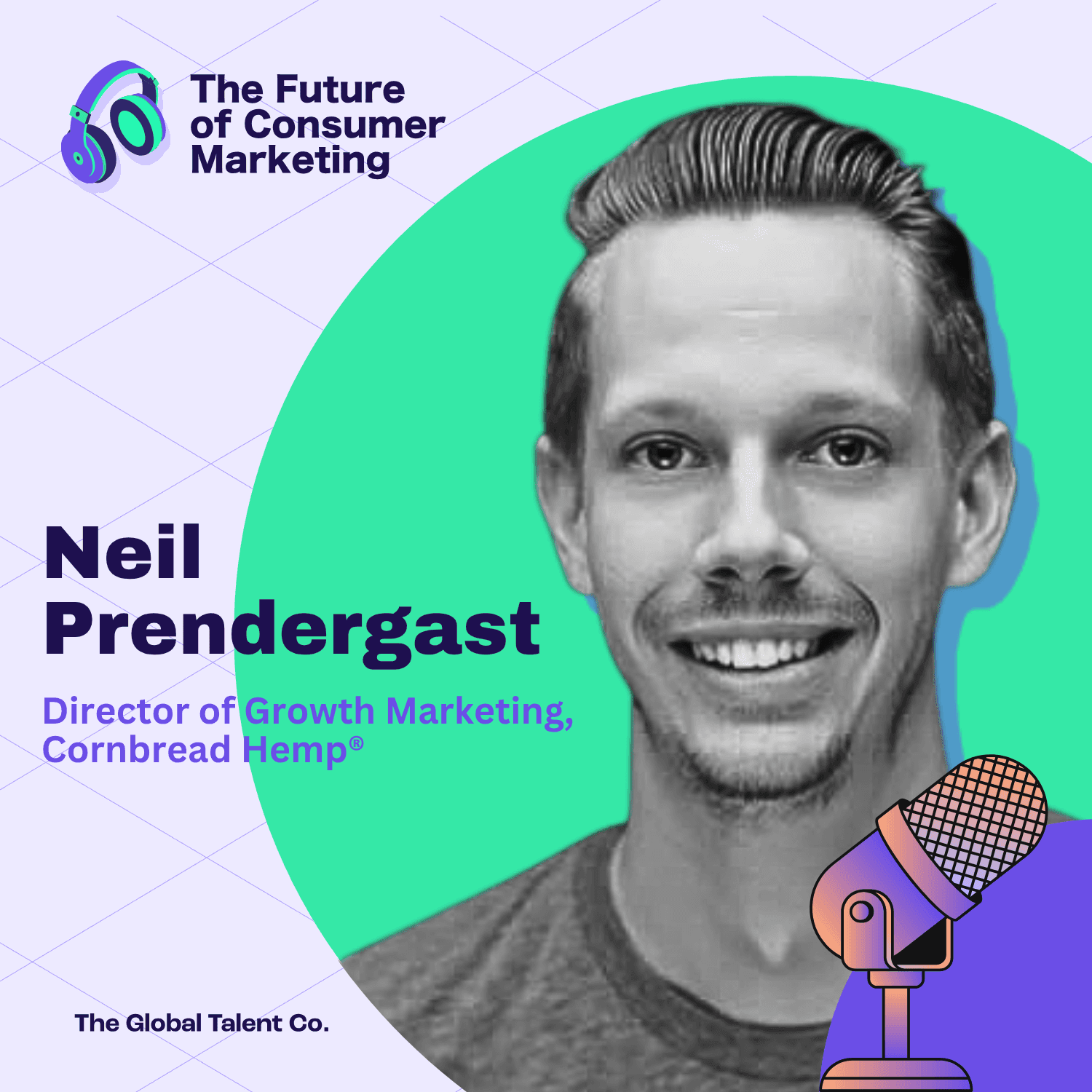
Neil Prendergast, Director of Growth Marketing at Cornbread Hemp (family-owned, founded 2019 in Louisville, KY by cousins Jim Higdon and Eric Zipperly). Cornbread’s co-founder Jim previously worked in journalism covering cannabis policy; the company is vertically integrated in Louisville.
Key claims
Cornbread wants regulation because it reduces “gray area” risk. The brand avoids synthetic cannabinoids and uses naturally derived delta-9. Non-beverage products are USDA organic. Their “flower only, full spectrum” extraction removes stalks/stems and processes only hemp flower. They verify age for every order using Blue Check (about 95–97% ID match); if verification fails, they email to confirm or don’t ship.
Notable examples
Native mobile ads in games via Apple Oven (e.g., Candy Crush) drove fast customer acquisition; Snapchat underperformed; Snapchat and X were tested with mixed results.
Written by AI. May contain mistakes. Listen to the episode to check what was said.
Chapters
Tap a time to open that second in VOThe Origin of Cornbread Hemp
0:00 to 1:08
Learn about the founding story of Cornbread Hemp and its focus on wellness.
“The company started with a small seed investment of about$100 ,000.”
The Origin of Cornbread Hemp
1:12 to 1:27
Learn about the founding story of Cornbread Hemp and its focus on wellness.
“South Africa, and anywhere around the world with leading tech companies worldwide.”
Growth and Challenges in the Hemp Industry
1:27 to 4:48
Explore the growth of Cornbread Hemp and the challenges in marketing hemp products.
“a company that is in the process of creating the most and best quality CBD and THC products in the market.”
Building Trust with Consumers
4:48 to 11:03
Understand how Cornbread Hemp builds trust with its consumers through product quality.
“So that's been our newest entrant into the product space that we launched back in April.”
Navigating Advertising Regulations
11:03 to 14:00
Discover the unique advertising challenges faced by hemp companies and how they adapt.
“It's about, you know, really just giving people like other alternatives to seek relief.”
Understanding Mobile Advertising Trends
14:00 to 15:20
Explore how shifting consumer behavior impacts advertising strategies.
“When we look at our traffic and the proportions between desktop, tablet, and mobile, increasingly, our customers are viewing our site and shopping in a more mobile environment.”
Innovative Marketing through Gaming Ads
15:20 to 17:09
Learn about unique ad placements in mobile games and their effectiveness.
“And most of our users that we've acquired here have still been older Americans.”
Ensuring Compliance in the Hemp Industry
17:09 to 20:12
Discuss the importance of age verification and compliance in hemp sales.
“verify their id or we don't ship the product um because as you know hemp products become you know, more popular.”
Advocating for Regulation in the Hemp Market
20:12 to 21:21
Discover why brands support regulation for better market stability and safety.
“Because in all honesty, the regulations, some people or the more informal industries might not be so avid about it because they feel they might get like the short end of the stick once it's regulated.”
Lessons from Failed Marketing Channels
21:21 to 23:24
Identify channels that may not yield the desired results and why.
“And Neil, I love the fact of what you mentioned of the app love and candy crush, the ads within the apps.”
Show all 14 chapters
Leveraging AI for Marketing Insights
23:24 to 27:30
Explore how AI tools can enhance marketing strategies and performance analysis.
“So we are, I would say we're pretty flexible in terms of our working accommodation.”
Advice for Marketers in Regulated Industries
27:30 to 28:05
Get insights on navigating marketing challenges in regulated markets.
Navigating the Hemp Industry as a Marketer
28:05 to 28:48
Learn how to balance creativity and data in marketing within regulated industries.
“at creative and trying to analyze more of the quantitative elements, but then balancing that out with more of the data side and reporting.”
Advice for Marketers in Regulated Industries
28:48 to 31:58
Get insights on navigating marketing challenges in regulated markets.
“And Neil, I know we're almost at time, but I would love to ask you one final question.”
Transcript
Automatic transcript. May contain errors.0:00The company started with a small seed investment of about$100 ,000. How do you get people to trust, to know it's going to work, to know it doesn't have anything extra that they might not be aware about? We don't use any synthetic cannabinoids at all in our products. Traditional advertising channels are a bit off limits for regulated companies, right? We tend to get lumped into recreational drugs. We are a wellness-focused brand, and really built on older Americans that were just looking for relief. Kids are curious, and they want to try things, and let's even take vapes. They get their hands on them.
0:36The biggest concern, and frankly, rightfully so, is protecting underage. For every order that passes through our site, verify the age of the user. What would have been some advice that you would have loved to know when you started? Lean on legacy folks at the company as much as possible, and really understand and map out risks with decision making.
1:03Hey, everybody, and thank you for listening. My name is Andres Figueira, and I'll be your podcast host for the day. This show is brought to you by the Global Talent Company, a company that's connecting top remote professionals from Argentina, South Africa, and anywhere around the world with leading tech companies worldwide. So if your team is looking to hire world-class South American or South African talent, Just head on over to theglobaltalent.co and see how we can help. And today with me here, I'm speaking with Neil Prendergast, the Director of Growth Marketing at Cornbread Hemp, a company that is in the process of creating the most and best quality CBD and THC products in the market.
1:44Is that correct, Neil? Well said. Yeah, there's definitely a little bit of behind-the-scenes magic and some process stuff that goes into that, but at a high level, that was spot on. Amazing, amazing. And Neil, just so that we can put the audience a bit more in context, would you be able to give us the background of what Cornbread Hemp is, what you specifically do there, and the story it has behind it? Absolutely. So Cornbread Hemp is, I would say, one of the newer entrants into the fast-growing hemp consumer space in the U.S. So Cornbread was founded back in 2019 and founded in Louisville, Kentucky, by two cousins, so a family-owned business, Jim Higdon and Eric Zipperly.
2:36very interesting founding story. So, you know, obviously 2018, we had the farm appropriations bill that passed and essentially allowed for brands like us to operate. So, you know, we're allowed to cultivate and grow hemp. We're allowed to, you know, extract cannabinoids from the product and put it into oils, tinctures, topicals, gummies, all the products that you find on Cornbread's website, so long as they don't exceed 0.3 % THC by dry weight. So when the pandemic happened in 2019, 2020, Jim, who has a background in journalism and was covering a wide variety of issues related to cannabis from things happening in D.C., deregulation, and decided to move back to Louisville and write a book called The Cornbread Mafia.
3:44Now, Jim's family and Eric's family are both from a very rural part of Kentucky. But in the, you know, 80s, 90s, there was a group of farmers based in Kentucky that got busted with, I think it was at least over somewhere close to a ton. I don't know the exact amount of cannabis. Okay. And yeah, it was a really interesting story for Jim to kind of go back in and do journalism and research on to write this book. but it really opened up the history buff, I would say, in Jim and the fact that, wow, the state of Kentucky has a very rich and very deep history of hemp cultivation that goes back almost 250 years.
4:36Oh my goodness, okay. Eric at the time was working in Nashville as an accountant, also did the same thing, decided to go back to Kentucky. And then Cornbread Hemp was born. The company started with a small seed investment of about$100 ,000 and grew from a tiny company with a small subset of products to essentially a$50 million D2C e-commerce business this year with products that, again, expand from gummies, oils, tinctures, topicals, and now beverages. So that's been our newest entrant into the product space that we launched back in April. But yeah, it's been a fun and wild journey. And I think the things that really set us apart are the approach on advocacy, I think number one, in terms of being on the forefront of conversations happening at the state and federal level, both on hemp and cannabis policy, but also tying it back to agricultural and roots of farming in Kentucky.
5:52We are one of the only businesses that are fully vertically integrated in our space. With the exception of beverages now, because we have to use a canner to bottle and process. But pre-beverage, everything from our plant genetics to farming to extraction to product manufacturing is all done in-house at our facility in Louisville. Wow, that's amazing, man. And this story is crazy because I feel like it just started with this whole green rush of the cannabis being accepted broadly around the world. And with the pandemic, like here in Argentina, it's been medicinalized not so long ago, about three to four years ago.
6:34And you can start seeing in the market the same thing. Like there are places that are selling high quality cannabis and gummies and CBD oils and tinctures. It's crazy. crazy and i would love to know neil um how are you able with such a controlled substance and with these products being a bit different to what people are used to know from the hemp industry how do you build consumer trust with let's say you guys brought this seltzer out it's new how do you how do you get people to trust to know it's going to work to know it doesn't have anything extra that they might not be aware about yeah i think it starts with our brand principles and really like the first step in terms of you know principles that we would stick to when when developing and manufacturing our products so um all of our all of our products except for our beverages due to the extraction process needed for a beverage product versus like a gummy or an oil all of our non-beverage products are also usda certified organic wow that's amazing so we're one of i don't want to say we're the only but i know that we are one of the only brands in the space we also do our um we make our um our extracts much differently than a lot of other brands do so if you you know are familiar with our vertical you hear certain terms that are floated around a lot You hear whole plant or you hear flower only and also broad spectrum versus full spectrum.
8:14So we are a flower only, full spectrum hemp and CBD brand. So what does that mean? That means that rather than, you know, when it comes to cultivation, you know, just chopping our plants at the root and throwing all of that into a chipper, refining that down into pellets, we actually remove all of the hemp flowers from our plants. So we rid the stalks, the sticks, the stems, everything. So we are only processing the flour, which is the part of the plant that is most rich in terms of the ingredient and material that consumers want in a premium product. So what does that mean? you're getting the broad spectrum of terpenes and cannabinoids, etc.
9:05And you're getting both CBD and THC as part of that extract. So you're getting a little bit more of a comprehensive range of benefits than if you were going with a whole plant CBD-only product that requires more processing to actually build that extract. Of course, because you've got to separate the THC and the CBD, of course. Exactly. So you end up with something that has a better taste, something that is a little bit more pure, on top of the fact that we don't use any synthetics at all. So the other terms that you hear floating around are delta-9 derivatives, delta-8 derivatives, more so in the THC space.
9:50but all of our like THC products use naturally derived Delta 9. So we don't use any synthetic cannabinoids at all in our products, like any synthetic flavors, colorings, everything, it's all natural in our products. So I think as a consumer, when, you know, back in the early days, we were doing a lot of brand storytelling and really trying to stand out in a market that was frankly crowded with a lot of brands that were leveraging more synthetics and they were also you know with this you know a lot of lawmakers refer to it as a loophole with the THC carve out okay but you know with products that now you can say okay well this does still contain 0.3 percent THC or less by dry weight now you have all these brands that are using synthetics and they're marketing their products as you know almost alternatives to the recreational cannabis market um it's like you know you're gonna get really stoned like you're gonna and that's not our brand at all and that's not our target consumer we are a wellness focused brand um really built on older americans that were just looking for relief yeah that that's what i was picturing as you're telling me the story it's like i understand if you guys just adhere to the minimum amount that you're allowed to use or like the max amount then if it's broader spectrum an older person might enjoy a product from core bread hemp since it's not i would just want to for lack of a better expression take them to the moon and it's just that they'll be a lot more tranquil in their house not being paranoid or just feeling the thc too much exactly it's about you know relaxation it's about mental health.
11:43It's about, you know, really just giving people like other alternatives to seek relief. Like, you know, a lot of people that I think are early adopters of our product already use like natural supplements. They already are, you know, a little bit more active. They may be retired, but, you know, they probably take vitamins and supplements. Maybe they take prescription drugs and they're just looking for ways to like enhance their wellness routine or maybe wind off of some of the pharmaceuticals that they may be taking to help find relief with various issues. Of course. Of course. And Neil, my understanding, because I'm in Argentina, so I'm not that sure, but I believe traditional advertising channels are a bit off limits for regulated companies, right?
12:30Like for you guys to market your own product, you got to use a bit more of an alternative rather than just normal commercials on primetime television, right? Absolutely. So really, and it's an interesting question, Anders, because really where we get lumped in with a lot of traditional marketing and advertising channels, specifically for online and D2C brands like Meta or Google, for example, they have policies around CBD and hemp products. But oftentimes for brands like us, especially that sell products other than topicals, we tend to get lumped into recreational drugs because there's a real and, you know, this isn't to, you know, knock the the advertising industry at all.
13:20Like it's very confusing even, you know, for the average layman to understand some of the differences between, you know, what are the federal laws and regulations around cannabis and what are the federal laws and regulations around hemp derived products. So, yeah, that's to say we've, you know, we've had to get pretty creative in terms of how we've been able to grow our business. Fortunately, we found some avenues to be able to advertise on traditional channels like Google and Meta, although we occasionally run into some headwinds there. But really where we've been growing our business, I would say, is on some of these newer channels that really, I think, capture where a lot of consumers, regardless of age at this point, are consuming media.
14:13When we look at our traffic and the proportions between desktop, tablet, and mobile, increasingly, our customers are viewing our site and shopping in a more mobile environment. And advertising in native mobile spaces has been, at least in the last, I would say, 12 months, one of our biggest unlocks for us. So we work with a service called Apple Oven that does native advertising, video, static placements in games like Candy Crush, like other freemium mobile applications. And if your audience is a bit older and you put it in Candy Crush, that must be like a beautiful formula. I know what my aunt's funny enough, you mentioned that it is.
15:02So we, you know, when we launched, I thought like, okay, this is going to be like a really cool opportunity to maybe position our products in front of people more our age, right? Like mid thirties, like into forties. And most of our users that we've acquired here have still been older Americans. and my mom called me about a week after we launched on Apple Oven and she's like hey I'm playing this paint with numbers game and I just saw a cornbread ad and I was like well it's working and yeah it's been cool like we it's it's really grown I would say like it's the fastest channel that I've scaled at cornbread but also that I've like probably scaled in my career in terms of the amount of net new customers that we were bringing through our acquisition funnel and really being able to acquire those cheaper than even, let's say, like a meta or another paid channel.
16:05So it's been a really cool unlock. And for a brand in our vertical, the only thing that we need to do and keep mind of is having a disclaimer on our videos, like letting the person know, hey, this is a hemp derived product intended for users above the age of 21. We have an age gate that goes to like a separate landing page. But the thing I didn't mention earlier on the back end, we also for every order that passes through our site, verify the age of the user. Wow, that's amazing. Yeah. So we work with a company called Blue Check and essentially they use a ton of, you know, data sources to try to do like id match based on like name and address and okay etc and they have about a 95 97 match rate um so as long as they clear that we automatically ship an order if for whatever reason we can't identify a customer we send them a series of emails to verify their id or we don't ship the product um because as you know hemp products become you know, more popular.
17:17I'm sure as you've seen, states are starting to crack down on it. And the biggest concern, and frankly, rightfully so, is, you know, protecting underage, you know, kids and people from getting, you know, THC and other products in the hands of minors. And we do everything. Yeah, we do everything in our power to do that online. In retail, we're mostly drinks focused. We are in a couple of like smaller health food chains for some of our gummy products, but that is something we also take very seriously. Okay. No, and that's amazing, man. And I love how the fact of such an unexpected channel as the app loving campaign that you mentioned works so well.
18:03That's so cool. Cause it's like these new and innovative ways to learn how to market. Yeah. And, and the fact that you guys are covering your backs, making sure that you do the proper kyc before you sell to a customer to make sure they're not underage is what i believe is gonna allow cornbread hemp to keep on going and and become like a legacy brand in the space because with the whole um decriminalization of of like marijuana hemp cannabis now in these industries kids are curious and they want to try things and and let's even take i don't know vapes they get their hands on them while being under 18.
18:38And that is a very intense issue. So it's so cool that you guys are safeguarding that and making sure because it's super important in these regulated markets. Absolutely. And we're a brand really from the work that Jim does as our co-founder. He's boots on the ground with a lot of policy initiatives as they come up, both in our home state of Kentucky, but also elsewhere in markets like California and Texas and at the federal level, you know, from a brand position, we want regulation, right? Like it's only going to help us grow in and do things right. And as our business has grown, as the industry has grown, there's been so much gray area to operate in.
19:27And really like what we're trying to do as a brand is take a position of power and advocacy to say, hey, regardless of what side of the political aisle you're on, there's all common issues and concerns within this industry. Let's come together and come up with ways that we can align and solve for things that everyone wants. Because no one wants to see the industry go away, particularly Americans who can have access to these products. It's an issue that most Americans support, but it's also key to farmers in America, other small businesses. There's ways to protect consumers. There's a way to protect everyone's interests, but have common sense regulation, and that's really what we push for at Cornbread.
20:21That is so cool, man. That is beautiful. Because in all honesty, the regulations, some people or the more informal industries might not be so avid about it because they feel they might get like the short end of the stick once it's regulated. But if you get the proper framework to build a business on, that'll just avoid it being need to close down in the future if something goes wrong, or if they say, hey, this gray area is now, this is the limit and you had passed it because it was gray before. Like I feel it's something that really allows you guys to develop. So super cool. Yeah, we want to take the position to face challenges and questions and concerns head on rather than what a lot of, I would say more so traditional tech startups do where it's let's break the rules now and ask for forgiveness and kind of kick the regulatory conversation down the road.
21:12Tech industry. Given our industry. Here's a bit more risky to do that. Exactly. Exactly, exactly. And Neil, I love the fact of what you mentioned of the app love and candy crush, the ads within the apps. Do you have an example or a story you could tell us of a channel that didn't work at all? Like you say, hey, I thought this would be a good idea and actually prefer to pivot because it's not panning out as we intended. There are a few. I think one that we've tested really in the last, I would say, the past three months has been Snapchat. Part of the reason being like, hey, within reason and within certain messaging and creative guidelines, all of which we adhere to anyway, being a wellness brand, we were allowed to get up and running on Snapchat.
22:08chat and for whatever reason we just weren't seeing the down funnel conversion that we needed to see to justify the cost that we were putting in to acquire new customers and i'm you know not sure if it was you know audience misalignment or what because we were you know going pretty broad which is you know what we like to do whenever we launch a new channel and then refine our our targeting down a bit. But yeah, we were running for probably two, three months and just couldn't make it work. X has been another one that's been a little bit up and down for us. But I know they've gone through a lot of changes recently with their algorithm and certain creatives that are driving performance, much more interesting insights on video now.
23:00So that may be an area that we re-explore going into next year outside app loving though in terms of winners funny enough that we're doing this on a podcast podcast has been probably my most surprising channel in terms of being able to drive that new customer acquisition and revenue performance at an efficient acquisition cost for us okay no and i imagine because it's like a very long ad that somebody listens because they want to and you're explaining everything the brand does so how can one not fall in love with what cornbread represents if they're hearing this because it really is a super good way to inform the public that doesn't know anything about you guys very nice okay and neil in terms of you told me that um like you guys are completely vertical is your team completely located in the states like are you guys all in house or do you manage like a remote type of role within the company?
23:57Yeah, it's really interesting. So we are, I would say we're pretty flexible in terms of our working accommodation. So, you know, because of I, prior to 2020, for example, I was living in New York City. I was still working at another company that had started remote, but had gone remote for their local employees due to the pandemic. And when I joined Cornbread, I was a fully remote employee. There was another growth manager that we had based out in Los Angeles. But we do have a large contingent of in-house employees that are based in Louisville. So we have a couple of folks in marketing that are based there.
24:41And then all of our operations, product, fulfillment, packaging. So marketing is a little bit more spread out. I'm in Philadelphia. I have a colleague in in Charlotte I have another colleague out in Los Angeles a colleague in Florida so and I do imagine by the nature of the product since it's such a hands-on thing you got to do you have a lot of operational people that are there in Kentucky like obviously okay okay that is so nice and Neil are you guys leveraging AI in any certain way that that like I don't even know how you guys could be using it I imagine you are but I just love doing this question because everybody's just finding a different type of workaround for it yeah ai has been especially in the marketing side of things has been a a definite hot topic of of discussion like outside of marketing we've done some like you know chat bots through like gorgeous for like our cx team and some some minor things like that but on the marketing side really where we're leveraging it is through bots and apps that are built in certain softwares that we use anyway.
25:51So one that we leverage a lot specifically for some ad insight and performance, but really diving into the creative, like why is this ad working? Why is this ad not working? Is Motion. And within Motion, they have a couple of almost open source bots that developers have built within the motion platform. And one of which is a bot that will look at your ad creatives, look at your headlines, and look actually at your historical performance in meta and come up with suggestions on tweaks to headlines, tweaks to creative. So we've been utilizing that a little bit, particularly on just the need for smaller tests and iterations just to keep campaigns fresh on social.
26:46And then outside of that, the one area that I'm really interested in using AI is for data and performance insights. Yes. Haven't been able to crack that yet. And our data structure is a bit complex given the nature of our business and multiple landing page domains, multiple Shopify stores. like it gets a little crazy but that's where i'm keen on you know trying to understand how how ai can work a bit better for us from a performance insight standpoint of course because it can actually do a lot of leg work by analyzing the whole bunch of data you guys must have and provide those insights without somebody needing to actually go into it and look through every single metric that is happening obviously it is new but ai helps with that um like with those more mundane tasks and just leave i feel at least more of the creative area at freedom so that people can spend more time there than in the in the regular things you got to do all day yeah and that's i mean that's kind of the the inherent i think push pull in in um performance marketing is like you know when you're a director of growth or even a growth marketing manager, it's this constant looking at creative and trying to analyze more of the quantitative elements, but then balancing that out with more of the data side and reporting.
28:14It's like we kind of sit between executing and driving business on our channels versus being that resource to infer brand and creative as well. So definitely fun and exciting and an interesting position to be in. No, I can only imagine. And more in this industry since it's something that's so – I feel it's been a while that it's up and coming, but it hasn't stopped growing steadily. And I feel that it will just keep on growing as it gets more regulations as we talked about before. And Neil, I know we're almost at time, but I would love to ask you one final question. And this is more for the audience than for ourselves.
28:56But if you were a marketer that is starting with a brand in a regulated industry such as yours, what would have been some advice that you would have loved to know when you started? Oh, man, that's a little bit of a difficult question. I think. Sorry, didn't mean to put you on the spot. No, no, it's really interesting because I think of this a lot, too, when I am faced with a problem. him and I'm like you know could I have maybe like seen this coming like months ago like with a series of decisions and I would say lean on lean on like legacy folks at the company as much as possible and really understand like what have you tested what is the goal like what are the unique things within your vertical that that make it challenging right so like obviously if you're working in gambling or alcohol or pharmaceuticals is another industry that is insane when it comes to all of the different regulations and things that you can be flagged for.
30:03But take as much time, focus on that as possible and really understand and map out risks with decision making. um because like anything from updating a website without double checking copy and you are you know a brand for example that sells thc products and thc appears on a page that is being scraped by an ad bot you may get shut down oh good wow the other thing i would suggest too is just be be creative I think a lot of brands, like if you look at ourselves and some of our top competitors, like if you're just reviewing the meta ads library or just browsing ads, I think a lot of brands tend to leverage certain creative styles and messaging from each other because we're all trying to figure out what we can say and what we can't say without getting in trouble.
31:03So it's like a recycling of the same slogan by everybody. Not exactly. Everyone puts their own unique spin on it, but that's all to say, for us at Cornbread, we have a couple of just key brand and product tenants that we're always going to leverage, right? like premium quality, third-party lab tested, USDA organic. And those are different brand and product USPs that you can tell in your own brand voice in a way that helps you stand out a little bit from the market. And that's something that you should be free to test and learn. Like this is such an early vertical for advertising and digital spaces that I don't think that there really is like a winning formula.
31:58So it's about, you know, finding quick wins and continuing to double down and iterate on things until they don't work and then move on to something else. Okay. I love that. I love that. And then for anybody who heard from the audience, let's just make sure that we do evaluate the risks of everything we do so that we can minimize those. Yeah, you don't want any ad accounts going down before key holiday shopping periods and things like that. Just in case anybody here who's listening is over the age of 21 and is interested in trying out any of the products that Cornbread Hemp does have to offer, how would they go about looking you guys up and maybe trying something out and ordering?
32:41Absolutely. So you can find us across the United States online. We are also in select retailers, particularly if you're in the Kentucky DMA and bordering states. You can find some of our beverages at Total Wine and a couple of other locations. But easiest hassle-free way to find us is at cornbreadhemp.com. First-time customers can save up to 30 % on their first order and up to 44 % if you subscribe. um so we also have a subscription program 20 perpetual discount on on products and free shipping you can get stuff delivered bi-weekly monthly at your convenience that is so cool man i'll i'll let my friends in florida who live there know so they can try the cornbread hemp products out yeah absolutely i mean seltzers in florida like with the sunshine and a walk on the beach Like it doesn't, doesn't get better than that.
33:43Oh my goodness. It doesn't. It really doesn't. But yeah, Neil, thank you so much for hopping on the show. It has been super interesting. And I know the audience is going to love this episode as well. Love it. Thanks so much for having me. No problem, man.
From the publisher
In this episode of The Future of Consumer Marketing, host Andrés Figueira interviews Neil Prendergast, Senior Director of Growth Marketing at Cornbread Hemp. Founded in 2019 by two Kentucky cousins with deep roots in the state's 250-year hemp cultivation history, Cornbread Hemp has scaled from a $100,000 seed investment to a $50 million DTC e-commerce business. Operating in one of the most heavily regulated consumer categories, Cornbread Hemp has had to pioneer creative marketing approaches that circumvent traditional advertising restrictions while building consumer trust in a market crowded with lower-quality competitors. Through native mobile advertising, podcast sponsorships, and rigorous quality standards including USDA organic certification and flower-only extraction, they've carved out a premium wellness position in the hemp and CBD space.
Topics Discussed:- Navigating advertising restrictions in highly regulated consumer categories
- Scaling native mobile advertising through in-game placements
- Building brand differentiation through manufacturing process and quality certifications
- Leveraging podcast advertising for complex product education
- Implementing age verification systems to protect brand integrity
- Testing and evaluating new advertising channels in restricted markets
- Using AI tools for creative optimization and performance analysis
- Balancing advocacy and policy engagement as a marketing strategy