Ask ChatGPT
 Give First
23 Sep 2025 · 25m · 14 chapters
AI First leadership and how companies should scale using generative AI; includes book “AI First: the playbook for a future-proof business and brand,” plus skills for individuals/knowledge workers and debate about AI’s impact on education.
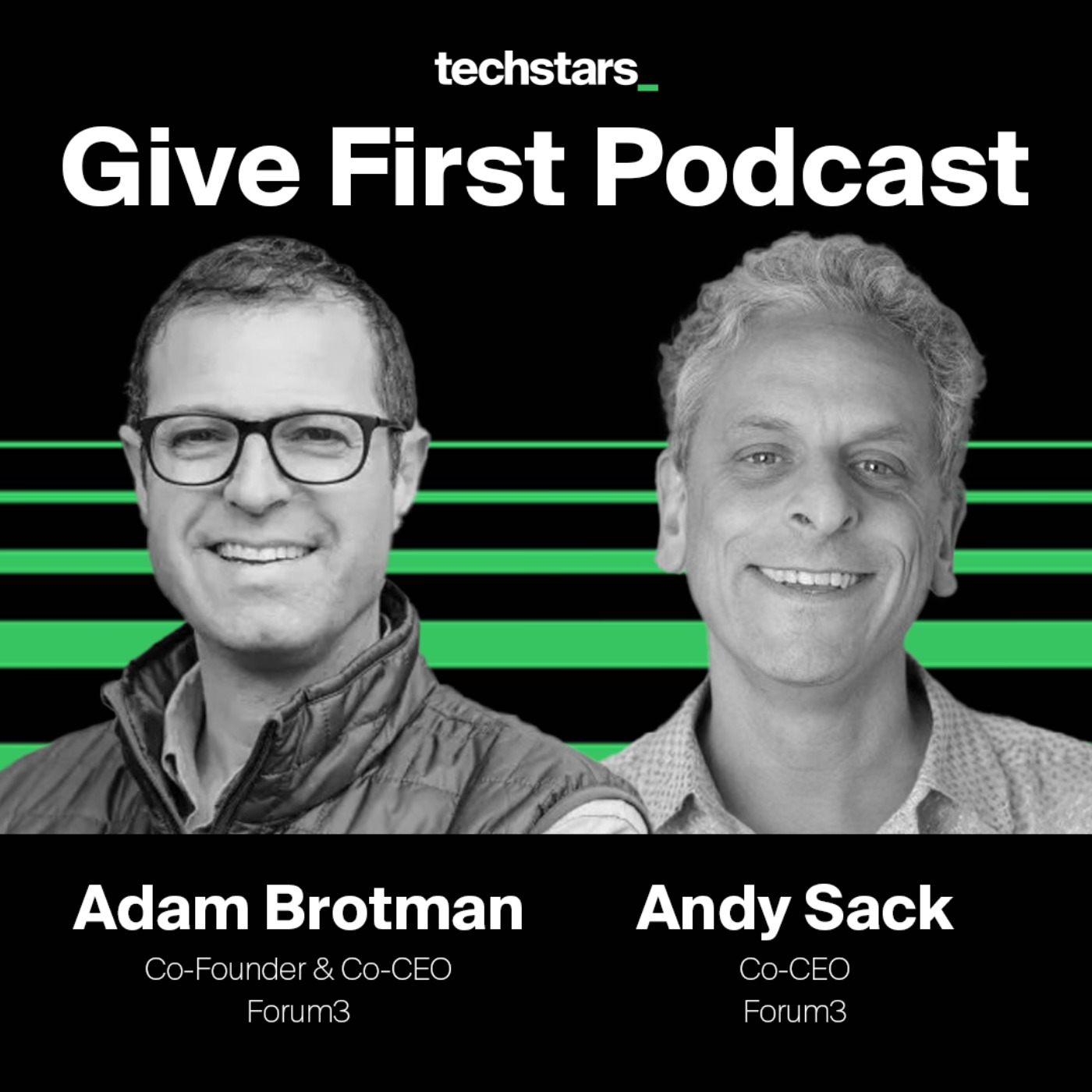
Andy Sack, former Techstars Managing Director; Techstars Seattle 2012; only MD to fund three unicorns in one class of 10. Now co-founder/partner at Forum 3, a strategic consulting and applied AI firm for consumer brands. Adam Brotman, former Starbucks Chief Digital Officer (built Starbucks app, digital strategy, payments, loyalty); later president/co-CEO at J.Crew; co-founded Forum 3.
AI is not a single application but an “Ironman suit” augmenting every knowledge-worker function; AI-first companies start with AI-first leaders who redesign workflows and lead by example; AI can enable much smaller teams to achieve far higher revenue per employee.
pivot after ChatGPT in Nov 2022; case-study interviews with top AI leaders including Reid Hoffman (PayPal Mafia, LinkedIn co-founder, OpenAI; Inflection AI); “10x effect” on knowledge workers; education concerns about writing skill atrophy and the need for iterative prompting/communication.
Written by AI. May contain mistakes.
Discussion on the Give First philosophy and its importance in entrepreneurship.
“This is David Cohen, and I'm here with my amazing co-host, Brad Feld.”
Andy Sack shares his journey with Techstars and his achievements in funding unicorns.
“I want to welcome a good friend, Andy Sack and Adam Brotman to the Give First podcast.”
Adam Brotman discusses his career, including his time at Starbucks and J.Crew.
“I mean, all the classes were great, but that was the vintage year that has set that mark.”
Discussion on the founding of Forum 3 and the decision to pivot towards AI.
“And Andy and I kind of converged our kind of crossed our streams when we formed Forum 3 and said, like, look, let's go help consumer brands with their transformation of their culture and of how they go to market.”
Exploration of the book title 'AI First' and the thought process behind it.
“But now it's got this AI wrapper around everything we do that integrates into everything we do.”
Discussion on insights from the book, including the role of AI in transforming work.
“And I was like, OK, that's a fine title.”
Reid Hoffman shares insights on the transformative potential of AI in healthcare.
“In fact, we talked to in the book in particular, we have a, you know, every chapter tended to sort of center on a case study or an interview of the top AI leader.”
Discussion on AI's impact on creativity and learning in children.
“And I'd say, we're starting to enter into it now.”
Discuss the decline of traditional navigation skills due to technology.
“I mean, I think, you know, where everyone on this call is old enough to remember that we went to parties where we were like, hey, where's the party?”
Explore how AI impacts writing skills and the need for iteration in learning.
“I think they're like the ability to conceive of the output from the get-go.”
Identify characteristics and importance of AI first leaders in business.
“And I think that number is probably creeping up, but it's much smaller than at least Adam and I, given how insanely powerful the tool is, we would expect.”
Discuss the potential for investment in AI-driven companies and the changing landscape.
“You're going to start to see, oh, okay, here's a 10-person billion-dollar company.”
Highlight the AI First podcast and its focus on AI executives and discussions.
“We have our own podcast called AI First.”
Wrap up discussion with insights on writing a book and AI's impact on startups.
“Well, really excited to get everybody out there checking out the book AI First.”

Get the gist, explore an idea or ask about something said.
 Claude
On Give First, what are the key points of this episode?
Searching your listeningAutomatic transcript. May contain errors.
0:00David Cohen: On this episode of the Give First podcast, you're going to hear from Andy Sack, former Techstars Managing Director and member of our MD Alumni Network. He's the only MD to have ever funded three unicorns in one class of 10 companies. Pretty incredible. As well as his partner, Adam Brotman, who's the former chief digital officer of a little company called Starbucks. We're going to talk about AI, what it means to be AI first, and how those companies need an AI first leader or CEO. that's coming up right now on the Give First podcast.
0:35David Cohen: Hi, everyone. This is David Cohen, and I'm here with my amazing co-host, Brad Feld. Hey, Brad. And this is the Give First podcast. In the startup world, Give First means simply trying to help anyone, especially entrepreneurs, without any expectation of getting anything back. So we'll be talking to mentors and founders about what Give First looks like in action and how it makes great entrepreneurship possible. We polled everyone and they said consistently that their favorite part of the show was the legal mumbo jumbo. So here it is. The following discussion is an expression of personal opinion and does not represent the opinion of Techstars or any company we discuss.
1:09David Cohen: Our conversations for informational purposes only, including any mention of securities or funds. This is not legal business investment or tax advice and is not intended for use by any investor. Certain of Techstars funds own or may own in the future securities and some of the companies discussed in this podcast. Got it?
1:30David Cohen: All right. I want to welcome a good friend, Andy Sack and Adam Brotman to the Give First podcast. We're here to talk a little bit about AI. Maybe you've heard about it, some stuff going on with AI in general. And these guys have written an awesome new book called AI First, the playbook for a future-proof business and brand. I wanted to first make sure people know who you guys are and Andy a lot of people probably uh know you or your name around the Techstars network you obviously were involved for a really long time um we're great friends and you had the one class and Techstars had three unicorns in one class which is always an amazing stat that's never been met or matched by anybody um and so you know talk a little bit about your trajectory Andy quickly with with Techstars and sort of what you're up to these days I feel like That graduating senior who goes back to his high school and sees his swim record still up on the bulletin on the board waiting for it to be broken.
2:32So I'm excited for that to happen. Yes, the class of Techstar Seattle 2012 was an awesome. I mean, all the classes were great, but that was the vintage year that has set that mark. What am I up to today? I am in business with my dear friend, Adam Brotman. Our business is called Forum 3. And Forum 3 is a strategic consulting and applied AI firm focused predominantly on midsize and large size consumer companies.
3:09David Cohen: And I think Techstars is maybe looking to do some stuff with you guys in that business. Oh, I think we're not just talking. about it we might actually be doing it cool Adam give us a little background on you and and sort of how you got plugged in with this character over here Andy yeah I've known Andy for almost 25 years now actually about 25 years now and met him in YEO when we were both young entrepreneurs and it's it's been a long time desire for both of us to do something together and we you know For people that don't know who I am, why would you? I was the chief digital officer of Starbucks for the majority of my career where we built the Starbucks app and digital strategy and payment and loyalty programs.
4:02And I went on to be the president and co-CEO at J.Crew and have spent my whole life thinking about the intersection of digital marketing, branding, and technology for consumer brands specifically. And it's my passion. And Andy and I kind of converged our kind of crossed our streams when we formed Forum 3 and said, like, look, let's go help consumer brands with their transformation of their culture and of how they go to market. And we were doing so when we first got together. It was originally around, you know, taking our combined 25, I guess combined 50 years of business expertise around digital transformation.
4:48And then in November of 2022, we were already in business together. We had clients like Starbucks and Anheuser-Busch and others. And we were off to the races as a strategic advisory firm, building software, doing consulting when ChatGPT came to our attention. And we stopped and your tech star folks will appreciate this, you know, decided to pivot. And Andy was teaching me how to think about these things. And it was the best call we ever made as a company. And from there, you know, we ended up getting quickly up to speed on AI and writing this book on AI and transformed our whole business to integrate AI into what we do.
5:32So we're still the same Forum 3 strategic advisory firm that is a combination of services and software to help consumer brands. But now it's got this AI wrapper around everything we do that integrates into everything we do.
5:45David Cohen: Yeah, which is sort of it's funny. That's kind of what software is, too. Right. It sort of tends to integrate into everything you do. And I sort of view this as, you know, the whole move to AI reminds me a lot of like, oh, the Internet or, you know, mobile. right? It's not a vertical. It is what the thing is in the future, right? And so it's awesome that you've written this book. I always love to dig into the title of the book, AI First, the playbook for a future-proof business and brand. Tell me quickly what's behind that title. I know you take a lot of time to pick the title. Well, I mean, that question is a provocative question.
6:25I really wanted the title of the book to be the holy shit moment. And I proposed that to Harvard Business Press. And our compromise was they allowed it to be the title of the first chapter. And really the process of writing the book and really the Chachubit, when Chachubit 3.5 came out that November of 22. It was a holy shit moment for Adam and I. I mean, I'm clearly older than the average tech stars founder these days. When we talk about 25 years that we've known each other in 50 years of collective business experience. I mean, AI and our journey really since that pivot has been a holy shit moment.
7:21And I think it's a holy shit moment for society at large. I think it would be a better title. We ended up settling on AI First because it's more Harvard Business Press. And my rebellious entrepreneurial roots have been tamed. And I was like, OK, that's a fine title. And AI First works. It's effective in communicating. You know, there was the digital first when the Internet came out. Then there was the mobile era and you were mobile first. And now there's really there's an AI first era that's upon us. So, you know, figuring out how to future proof and not get squashed by the LLMs as a startup is something that is non-trivial.
8:13It's a little tricky because the pace of the AI innovation is unlike anything we've ever seen.
8:20David Cohen: That's definitely true. Well, Adam, I'd love to hear from you maybe one of the key takeaways from the book that people could expect if they check it out. But also, even if they don't, it's probably going to be helpful to people listening. So maybe start with you. What's a big takeaway for you from this work? You know, there's a couple of key takeaways, one of which I like to talk about is how AI first companies start with AI first leaders. But Andy does a great job of talking about that. So I'm going to leave that one to Andy if he wants to talk about and talk about a second insight, which is how, you know, that AI is really about how you as an individual use it to augment what you do as like an Ironman suit.
9:08And I think we all sort of know that now, or I guess we should say not all, but many of us know that now. When you think about the last two years since ChatGVT has come out two and a half years, whatever it's been, a lot of people, they misunderstood AI, and they still do on some levels, as thinking about it as something that is a specific application. And even though it's been hyped up as Gen AI, people are still thinking that the way they should think about this is how do I integrate it into my product? Or how do I integrate it into some application that's going to have like production level surface area across all my customers or all my employees?
9:53When in reality, the majority of the power of the technology is how it can transform the way every knowledge worker, every function at the company does work. It's actually, you know, if you start to think of it at the foundation of how you make decisions faster, better, how you communicate faster, better, and you realize that it goes across every function, that was the big insight. In fact, we talked to in the book in particular, we have a, you know, every chapter tended to sort of center on a case study or an interview of the top AI leader. There are a few chapters that were just free forming where we were sort of thinking about things.
10:31And the chapter around the inside I just mentioned was a chapter with Reid Hoffman. And we went to go speak to Reid. Andy and I did. We flew to his office on Sandhole Road. And it was time to meet with Reid. And we kept waiting for a few minutes. And we didn't mind because it was exciting to talk to Reid about AI, given his background. Reid Hoffman, PayPal Mafia, LinkedIn co-founder of OpenAI, which a lot of people didn't know. And he had also co-founded a company called Inflection AI that ultimately kind of became Microsoft's AI strategy. So we were like, this guy knows what he's talking about.
11:09Let's talk to Reed. He kept us waiting a few minutes, which we didn't mind. And he said, I'm sorry, I kept you waiting. We were, I was talking to the Pope and we were like, the Pope? Like, what were you talking to the Pope about? If you don't mind asking. So I was talking about AI and about how, you know, this is, you put this, the power of call it, you know, really intelligent medical Q &A in the hands of billions of people who have no access to primary care information or physicians. You can really save a lot of lives. And instead of thinking about all the Doomer stuff, which is very important to think about, and instead of thinking about all the whiz-bang applications this stuff can do, it can really help people just in their individual one-on-one way.
11:56And that led to a conversation with Reed about how generative AI, when it's in the hands of everybody, particularly in a couple of years from now, when everybody has almost super intelligent AI at their fingertips, that that's going to 10x. He called it the 10x effect on every knowledge worker. And he was talking about that being three, four years from when we talked to him. And I'd say, we're starting to enter into it now. Like when you, you know, the models that just came out from OpenAI, when you get underneath what the GPT-5 Pro can do in terms of coding and in terms of research and in terms of insights and analysis, it's your, if you really know how to use these tools, I think Reed was right that like, we're going to enter in an era where it's going to 10x everybody's ability to do their job.
12:52and that's going to become fairly democratized. So that was a big insight from the book was, you know, think about the individual Ironman suit aspect of this. Don't just think about the Liz Vang application. It's definitely so true.
13:05David Cohen: I mean, I'm using this stuff and it is, even in my very specific domain or venture capital, it's more knowledgeable than anybody can be anywhere near that quickly. um so just you know trying to do a deal where you're assigning an economic interest in something you know that's very specific in venture capital terms super easy to sort of yep here's the answer here's the result it almost um you know a lot of people are talking about today that that you know especially as it relates to kids in school right it's sort of does that impact their ability to be free thinkers and i think it just moves them up a level right to the creativity human relationship relationships, you know, what's new in their world versus like just having to understand these root, you know, concepts.
13:54David Cohen: But what do you think about that whole debate? I don't know if either of you has thoughts on it. It's causing people to think less and just rely more on this type of system. I mean, I think, you know, where everyone on this call is old enough to remember that we went to parties where we were like, hey, where's the party? And we would actually have to get a pen and paper out and take notes. And we were given instructions, driving instructions to take a left at the start at the first stop sign and a right at the Elm tree. And then, you know, and if we got lost, we would stop at gas stations and Google Maps came along and, you know, my favorite software pieces of software from the old era are Excel and Google Maps.
14:38Um, and you know, my kids never had that experience of, of stopping at gas stations and asking for directions. And I think in general, the, that navigation ability of the mind, um, that skill atrophied, um, in the same way that it atrophied when the calculator came out. And so I think, uh, with AI, I think it's a legitimate concern. Like I had a whole conversation with my son who just graduated from college about writing, the skill of writing. Do you need to write a lot? And basically every college student, every high school student is using ChetGPT or their favorite LLM to write essays. And so you need to actually have the skill and work through writing a paragraph to actually read and process what the LLMs put out.
15:39And there's a lively debate. I think you do. I actually think that teachers should insist that writing is one of those skills that you don't want to lose and that to be a good consumer of the written word and a paragraph, you actually need to have struggled and written a bunch. And so that's not going to happen unless you actually have teachers go, okay, everyone get your pen and paper out in this class. We're going to spend an hour and you're going to write a paragraph. um you you won't write five page essays in an hour but unless you force students to do that I think that skill will atrophy and I think that's a skill that is important um uh without that you that that writing skill will atrophy I think what it taught what with AI though there's a whole there are a whole bunch of skills that that young people and for that matter entrepreneurs there are new skills that become more important in working with AI.
16:39What are some of those skills? I think they're like the ability to conceive of the output from the get-go. I think working iteratively. I mean, the tools are still a little janky, but like this whole notion of iterating your way very quickly, and that's applicable clearly to startups. And, but it's, you know, that's, that's the new way of working because it used to just take so long to, to do everything that you would never do the iteration cycles. Yeah.
17:11David Cohen: If you can't write, you know, you also can't, it probably means you can't communicate clearly, succinctly, and that's a prompting skill too, right? So you're going to need that skill as well to iterate as you talked about. So in school, you know, it will get to the stage where you can't just the current the current state of the art of anti-AI, you know, and finding students are cheating with it or whatever is to look for M dashes. That's about it. I'm sure that I'm sure that chat CPT will stop doing that pretty soon because of that. But go back to what Adam mentioned, Andy, you know, the sort of AI native founders, AI native CEOs.
17:49David Cohen: That sounds like another key insight from the book. Talk a bit about that. Yeah, I mean, I think AI first companies start with AI first leaders. And it goes back, frankly, to the holy shit moment. We look in our business for the business executives who have had the holy shit moment. And the holy shit moment is basically like, wow, this tool is insane. It is not software. It's an alien intelligence. And it can make me more productive and, oh, my God, I need to redesign every aspect of the way in which my company is operating because we're dealing with existing companies. And so it requires the leader to both give permission to the workforce, to an encouragement, lead by example, recognize that this tool is smarter than themselves and have the curiosity to start playing with the tools to make those changes in workflow and see the opportunities.
19:07And so having spoken to hundreds of businesses, and I'm talking about existing businesses doing more than, I don't know, more than 20 million in revenue, I would say the market has changed a lot in the last 90 days, but roughly speaking, it would basically break down to the number of AI first leaders was very small, less than 5%. It was like 3%. And I think that number is probably creeping up, but it's much smaller than at least Adam and I, given how insanely powerful the tool is, we would expect. So that gap between where businesses are and the tool, I think AI first leaders will seize that. I think entrepreneurs will seize that and will build great businesses.
20:01And so I think you're going to see a whole new wave of entrepreneurship with AI first leaders who are basically building companies with much smaller capital footprint, much smaller human footprint, and much larger revenue per employee on the orders of magnitude that we couldn't have conceived of when you started Techstars and when we started our careers.
20:26David Cohen: Yeah, I think we totally agree with that, that there's going to be an enormous amount of disruption there always is but you know when when people sort of rethink how you build a company you know who you have to hire how much you have to spend on things uh you know just even going after incumbents you know with this sort of ai first approach uh feels like a really interesting moment to be an investor uh but of course everyone is thinking that way and you know i think the you the experience that people have, right? You're going to start to see, oh, okay, here's a 10-person billion-dollar company.
21:03David Cohen: Okay, here's a five-person billion-dollar company. Here's a one-person billion-dollar company. I'm just really curious when we're going to have our first zero-person billion-dollar company, right? When some system just figures out what to do. If the goal is collect money, they'll figure out something to do to do that. And it'll be super interesting to see how fast that happens. So do you think it's a great time to be an investor? I mean, I think the, do I think it's a great time to be an investor? I think the market landscape of venture dollars pursuing deals is huge. And in many ways, rounds are creeping up.
21:47And yet I think there's this tremendous opportunity for bands of five people to do insane things with less capital. And so I think that's going to take time to play out. So and that's going to take time both for entrepreneurs to figure out and investors. So like, you know, I don't know if it's a great time to be an investor. It's definitely a great time to be an entrepreneur.
22:11David Cohen: But those are usually correlated in my experience, right? You've got a wave of disruption coming. you've got multiple things driving that that's true that's true right it's like sort of oh you know the internet happened or or you know app stores yeah the wave of innovation right yeah so um i think we're going to see you know five ten years from now just different kinds of companies have been built differently they operate differently as you said much more efficiently and uh it's an exciting time to be as you said an entrepreneur or investor just involved in any of it So you guys also have your own podcast, I think, by the same name, AI First.
22:46David Cohen: Is that right? We do. We do. We have our own podcast called AI First. We have a community for predominantly AI First executives and people with questions about operating in an AI First way. Super. Well, really excited to get everybody out there checking out the book AI First. Thanks for writing it because I know a lot of this is like people are a little bit late to the party. I know there's people listening that feel like they're late to the party. I think everybody is late to the party, right? There's no shame in it. So I think it's really useful to have your experience in business combined with your sort of passion for this and sort of the people you got to interview.
23:27David Cohen: Sounds like some amazing people. So thanks for writing it. Thanks for being on the show. And I wish you all the best. Thanks, David. And thank you for giving a small plug to the book, AI First. I'll give a plug to Techstars, which is I think it's a great time to start an AI company and go into Techstars because I think the community of Techstars, of entrepreneurs and mentors like that human capital and that human community is more powerful today than with AI than it was before. So, yeah, super happy to be on the Give First podcast. Thanks, guys. Great to see you all. Thanks for having us. Thanks a lot for listening to the show today.
24:10David Cohen: We'd love to hear your feedback, ideas, or who you'd like to hear next on Give First. And please leave a rating and review, ideally a good one. And reach out anytime to podcasts at techstars.com or on Twitter, I'm at David Cohen. See you next time. Don't forget, Give First.
In this episode of the Give First podcast, David Cohen sits down with longtime Techstars friend Andy Sack and former Starbucks Chief Digital Officer Adam Brotman, co-CEOs of Forum3 and co-authors of AI First: The Playbook for a Future-Proof Business and Brand.
They explore why AI isn’t just another vertical, but the foundation of how companies will be built, operated, and scaled in the years ahead. Andy and Adam share insights from their work on what it means to be an “AI-native” founder, why iteration and prompting are becoming core entrepreneurial skills, and how disruption could lead to billion-dollar companies run by just a handful of people.
The conversation covers practical takeaways for entrepreneurs, lessons from their entrepreneurial journeys, and why adopting an AI-first mindset may be the difference between thriving and being left behind in the next wave of innovation.
Get Andy and Adam’s book ➡️ https://www.amazon.com/dp/B0D8TZDR74?ref=KC_GS_GB_US
Follow Andy Sack on LinkedIn ➡️ https://www.linkedin.com/in/andysack/
Follow Adam Brotman on LinkedIn ➡️ https://www.linkedin.com/in/adambrotman/
Hosted on Acast. See acast.com/privacy for more information.