Ask ChatGPT
 Give First
17 Feb 2026 · 24m · 14 chapters
Founder mental wellness—how to avoid burnout while maintaining peak performance; “hustle culture is trash,” “burn bright, not out,” and shattering silence around mental health in tech startups.
72% of founders face mental health challenges; burnout shows up when you’re loathe to do what you love, procrastinating, and losing inspiration; asking for help is strength; investors who align with your values won’t treat therapy as weakness; small daily “micro wins” and rest/harmony enable progress.
Jeff Johnson’s chapter; investor Will Allen (ex-NFL) and founder stories like Nick Marich (Linktree exit then burnout) and Shayla Hauser (IPO-prep derailed by NASDAQ crash); Mitch Wainer’s sprinting leading to serious health issue.
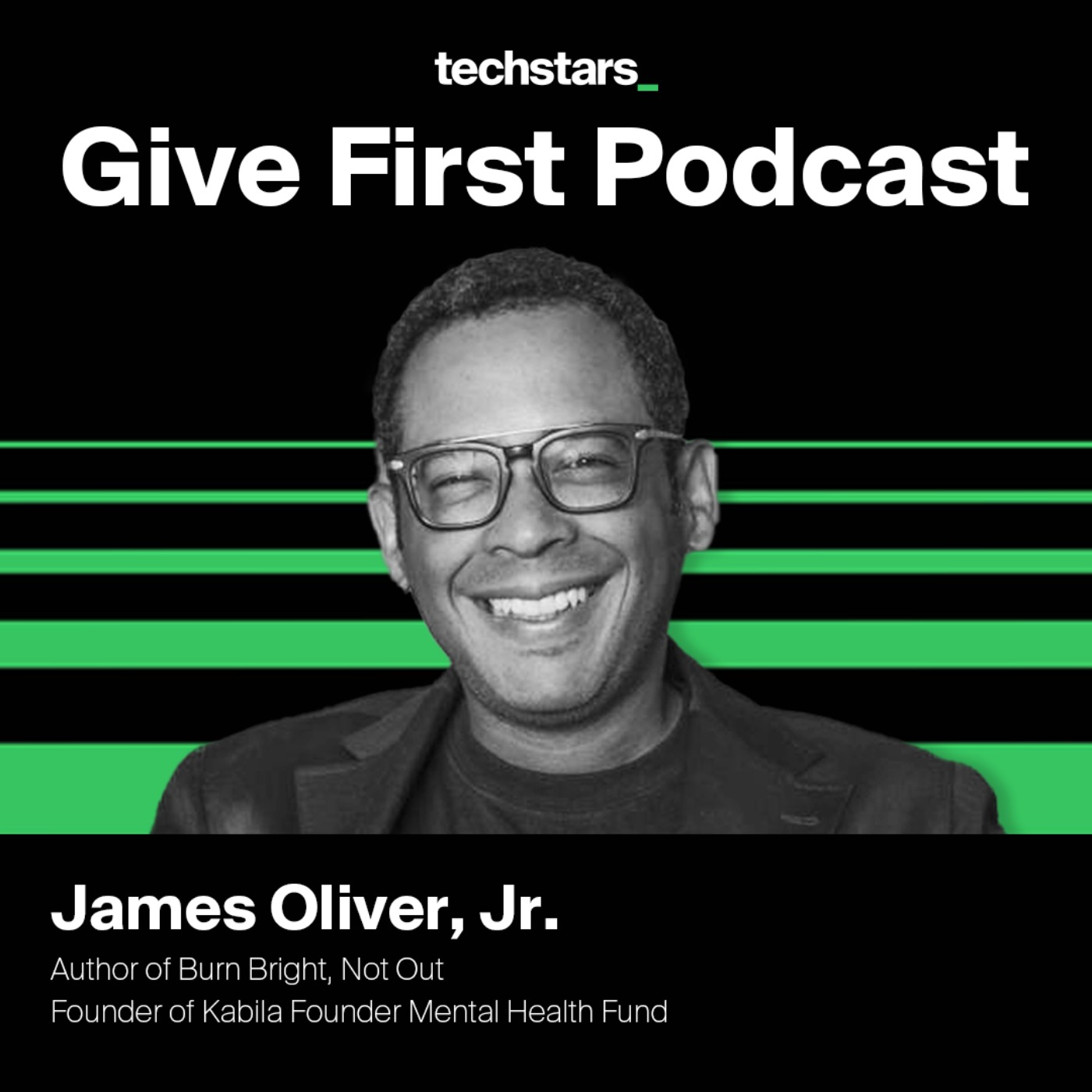
James Oliver Jr., co-founder of “world’s cutest twins,” husband and father of 13-year-old twins; founder of the Kabila Founder Mental Health Fund (pays for therapy), Techstars alum; author of Burn Bright, Not Out; also involved with Kabila Ventures.
Written by AI. May contain mistakes.
Discussion on the significance of mental health for founders and the stigma surrounding it.
“This is David Cohen, and I'm here with my amazing co-host, Brad Feld.”
James shares his background and the inception of the Kabila Founder Mental Health Fund.
“You've got an awesome new book that's out, Burn Bright, Not Out, which I want to talk about.”
Emphasizing the need for accessible mental health resources for founders and sharing personal experiences.
“amazing wife, also now the founder of the Kabila Founder Mental Health Fund, which pays for mental therapy for founders who want it, but may not have the resources to afford it for whatever reason.”
Discussion on fundraising efforts for the Kabila Fund and the support received from the community.
“Like there's this really interesting relationship between the black community and mental therapy community.”
Insights on how investors can positively influence founder mental health and wellness.
“And, you know, because I myself, you know, have a therapist and my wife is, you know, she has the best mental health hygiene on anybody I know.”
Discussion about the book 'Burn Bright, Not Out' and its purpose in addressing mental health challenges.
“And because, you know, doing that was actually really negatively affecting my mental health.”
Exploring the impactful stories shared in the book that highlight mental health challenges among founders.
“And you, you've been through some of that and you want to share, you know, that opportunity with others.”
Discussion on the lessons learned from the stories in the book regarding progress and mental wellness.
“you know, if they show up in certain ways around mental health and wellness to investors, they will be frowned upon.”
Learn about the importance of celebrating small victories in personal and professional growth.
“And it's not just because of those stories I mentioned, but it's because the money goes back to the nonprofit, which actually addresses the problem.”
Understand the pitfalls of hustle culture and the need for balance in work and life.
“It's the showing up consistently every single day to make progress.”
Discover the importance of resting and pacing oneself in the demanding startup environment.
“I think, you know, obviously hustle can be a good thing.”
Learn how to differentiate between burnout and a thriving work life.
“I hear Brad talk about this all the time.”
Explore how resources and support can improve mental health for entrepreneurs.
“So we're going to be looking at a whole range of options and resources we want to make available for founders, not just mental therapy.”
Explore how resources and support can improve mental health for entrepreneurs.
“So I just want to say thanks for doing it.”

Get the gist, explore an idea or ask about something said.
 Claude
On Give First, what are the key points of this episode?
Searching your listeningAutomatic transcript. May contain errors.
0:00David Cohen: Today on the Give First Podcast, we're going to be diving into a topic that I think will hit home for almost everybody listening. It's that thin, blurry line between being a high achiever and being highly exhausted. We've all been there, you know, waking up on a Monday morning, feeling like it's already Friday afternoon and staring at a to-do list that feels like a mountain, not a plan. And we're told to grind it out and hustle, you know, be the first one in, be the last one out. But what happens when the light at the end of the tunnel is actually just us burning out? my guest today is james oliver jr he says there's a better way he's a become a good friend he's a fantastic entrepreneur father author of the transformative book burn bright not out which looks to destigmatize founder mental wellness mental health he spent years decoding how we can maintain peak performance without sacrificing our mental health or our joy and he's here to teach us how to move from treading water to making waves that's coming up next on the give first podcast
1:01David Cohen: Hi, everyone. This is David Cohen, and I'm here with my amazing co-host, Brad Feld. Hey, Brad. And this is the Give First podcast. In the startup world, Give First means simply trying to help anyone, especially entrepreneurs, without any expectation of getting anything back. So we'll be talking to mentors and founders about what Give First looks like in action and how it makes great entrepreneurship possible. We polled everyone and they said consistently that their favorite part of the show was the legal mumbo jumbo. So here it is. The following discussion is an expression of personal opinion and does not represent the opinion of Techstars or any company we discuss.
1:35David Cohen: Our conversations for informational purposes only, including any mention of securities or funds. This is not legal business investment or tax advice and is not intended for use by any investor. Certain of Techstars funds own or may own in the future securities and some of the companies discussed in this podcast. got it all right welcome back james to the give first podcast great to see you how are you i'm doing amazing good to see you my friend you do such awesome work i can't wait to talk about it and uh we don't get to do this enough you know we we text a lot and i know that old voxer thing you know the og tools and uh you know talk about talk about your startup and all that and yeah Once in a while, we get to hang out and chat, so I'm really excited to do that.
2:22David Cohen: There's a lot to talk about. You've got several things going on. You've got an awesome new book that's out, Burn Bright, Not Out, which I want to talk about. You've got all your work around founders and mental health, Parentpreneur Foundation, Kabila. There's just so much stuff going on in your world. So where should we start? Tell us a little bit about you and how you got to where you are today and what you care about. Let's start there. Yeah, and I appreciate that. I'd like to introduce myself as co-founder of the world's cutest twins, husband to an amazing wife, also now the founder of the Kabila Founder Mental Health Fund, which pays for mental therapy for founders who want it, but may not have the resources to afford it for whatever reason.
3:08And also kind of similar in the background is the launching of Kabila Ventures. But anyway, we can talk more about that to whatever extent you want to later.
3:18David Cohen: Well, yeah. I mean, I want to get to all these things. You're also a Techstars alum. Yes, I am. I've known you even longer than that. So go way back. Absolutely. No, absolutely.
3:35So back when I was working on the Parentpreneur Foundation stuff, and you and Brad were super influential with that after George Floyd was murdered, We spin that up to help black founders who are parents just be better parents and better entrepreneurs. And one of the things that I did there that was really impactful was we paid for about 400 mental therapy sessions for the folks in that community. And if anybody knows anything about black folks, black folks historically don't go to the therapist. Like there's this really interesting relationship between the black community and mental therapy community.
4:13And just in general, we just don't. It's stigmatized. They typically will go to the pastor, go see a pastor at church. But in that community, when I would drop a type form every so often and say, hey, we got five slots, first come, first serve, they would fill up like that. And then they would come back and tell me about how it was so helpful. and at that time we were working with you know better help to do that we were paying for the sessions and so I was like okay this is great so once I started the Kabila Founder Mental Health Fund I'm like you know we it's time to like double and triple down on this and so you know I went through VC Lab you know raising Kabila Ventures and you know I was having some progress I was making pretty good progress with that and you know then the like the political landscape changed and it was just getting harder and harder and harder.
5:06And, you know, because I myself, you know, have a therapist and my wife is, you know, she has the best mental health hygiene on anybody I know. So, you know, just by virtue of being married to her, it's been great because, you know, more self-aware and just having more meaningful conversations with her about, around mental health and wellness. But I realized that, you know, raising for the fund was really negatively impacted my mental health. And I went back to, there was a slide in my fund deck. It said, you know, founder value add. And I, you know, I jokingly say like, when have VCs added a lot of value to founders?
5:49Come on now. Some do, some do, some do. I'm joking. But, but, you know, all jokes aside, like for me at the time, it felt like kind of a throwaway slide because everybody's going to say, you know, they're going to connect, you know, the founders to investors and, you know, all this stuff. But I was like, one of the things I was, I put in that slide was I'm going to connect founders to mental wellness resources. And because, you know, doing that was actually really negatively affecting my mental health. I said, you know, I'm going to put a pin in this for now. I'm going to come back to it later.
6:19But what I'm going to do is I'm going to go and start a nonprofit to provide free mental therapy for founders who want it but can't afford it. And at least this lets me be valuable to the founders in my ecosystem and connect with some, you know, really interesting people who may, you know, want to participate in what I'm doing on the fun side of things. You know, maybe that's a longer term strategy to fund thing, but at least it still keeps me on the path of that. And oh, by the way, at the end of the day, my mental health is now still intact along the way. right and that was the most important thing for me because you know i have 13 year old boy 13 year old boy girl twins and it's super important to me to be able to show up and be a great dad um it's super important to me to show up and be a great husband to my wife and i can't do that if my brains are scrambled you know what i mean so so i did that and you know i reached out to brad and brad was like okay cool you know he supported me in so many different ways in the past he's like, yeah, I'll put in$25 ,000 from Anchor Point, his foundation.
7:20And then you came along, you're like, hey, I'll put in$32 ,000 from Techstars Foundation. And we've been providing free mental therapy for some Techstars founders, and we'll continue to do more of that. And I was really surprised that you did that, because I didn't know that you guys still had funds over there. But I was delighted when you did it. So great. And then you also, we just had a Tech Tuesday's event and we were raising money for the nonprofit and you came on and we had a great conversation about why, you know, venture industries should be more supportive of fundamental wellness and health and wellness.
7:53And you personally, you know, Dana donated a couple thousand dollars. So I'm just very thankful to you and to Brad and just excited about the work we're doing.
8:02David Cohen: Well, you know, it's just, I view this as just one of the things you're doing as an entrepreneur, right? You, you care about this, you, you know, entrepreneurs solve problems that they've experienced in the past. And you, you've been through some of that and you want to share, you know, that opportunity with others. And, and, you know, it's the ultimate give first to me, which is why I love to promote all the good work that you do. And, you know, you're out there adding value in a totally different way, right? That's a really important way. And, And in that transition, I saw you two get focused on creating this book, right?
8:39David Cohen: And Burn Bright, Not Out, super, super awesome work. I'm about halfway through it. Got it right there. It's in my pile when I get a chance to read. Yeah. I got the gist. I mean, I'm loving the sort of help that you're giving people there. And maybe tell us a little bit about why you decided to put it in the form of a book, because you've been doing a lot online and having a lot of conversations and maybe jump into some of the concepts like the, you know, the burn bright spectrum and all that sort of stuff. Yeah, of course. So first of all, you know, thank you for writing the forward to the book.
9:14I mean, I think you wrote a really compelling forward to the book. I think it's pretty well known that that 72 percent of founders are having some kind of mental health challenge that I think was that from Startup Snapshot. Is that where that came from? I think.
9:28David Cohen: Contrary to me. I think Yael, I think is a woman's name who's over there. But I think that's a stat from some research they did a few years ago. And, you know, most of the founders are dealing with whatever mental health issues that they're having in silence quietly, you know. And, you know, I started jokingly saying like 100 % of the founders that I talk to are struggling. You know, they're just like going through it. They're not founders, right? You know, they're just going through it. You know, life is always lifing, you know, doing all the things that life likes to do and throw at you. and on top of the founder pressure.
10:02So yeah, man, I wrote this book with a really interesting guy, Django Degree, who has a startup called Focus on Words, and it's an AI book generating platform. So he will talk to people, interview them, and then take those words and send his AI agents out to go write chapters in a book. So that's what we did. And we really, we reached out to several folks in our network, made some new friends in the process. And I think there are 10 chapters in the book. And the book is not intended to be prescriptive, right? It's not, we're not telling folks what to do, right? We're not, maybe the next book is with some people who can talk from a neuroscientist, neuroscience standpoint about what exactly you need to do to improve your mental health.
10:47It's not that. It's how do we shatter the silence around mental health and tech startups? because so many people are suffering in silence. There's still a lot of stigma around mental health and getting help. A lot of founders think that they're doing this by themselves. And I think you talked about this in the forward and so many other people talked about this. Brad contributed an amazing chapter. He talked about it. Like if you're a founder and you're just having mental health challenges, you're just having bad days, like you're not alone. You know, and so that was a recurring theme in the book.
11:22and it's okay to ask for help. You know, asking for help is actually a strength, not a weakness because some founders feel like, you know, if they show up in certain ways around mental health and wellness to investors, they will be frowned upon. And honestly, like I look at some stuff I see on social media and I think that is true to some extent, but, you know, if you're aligned, you know, values aligned with some of the investors in your startup, you know, those folks will not see it that way. I think in Brad's chapter, he said something a lot about, you know, the good investors won't see it as weakness.
11:56Investors won't see it as weakness. They'll see it as a strength. He said the good ones anyway. So you got to find investors who your values align with. But we want you to know, like, you're not alone. The stories in the book are just so inspiring, David. We have founders. We have investors. The first chapter is with Jeff. You read the first chapter, Jeff Johnson. I mean, what was your reaction to that first chapter, if any?
12:22David Cohen: It was powerful, like the story and what he's actually dealing with, right? Yeah, my mouth was – I mean, I already knew his story because he's a friend now, but my mouth was on the floor when I read his story. And, you know, Will Allen, who's an investor, he's a VC, and Will used to play cornerback for the Tampa Bay Buccaneers, won a Super Bowl ring there, and was a longtime defensive back for the Pittsburgh Steelers. So it was interesting to hear him talk about mental health and wellness from an investor standpoint. And from a football, he saw some great stories about football in there. Some good founders and just other investors.
12:54And like, you know, Nick Marich, you know, he talked about, I think that's how you pronounce the last name. He sold his business to Linktree. He started to Linktree. And then after that, he was burnt out. And it's like, wait, what? You just had a successful exit. It's totally counterintuitive. So that was interesting. And I look at Shayla Hauser, who his business was prepared to IPO on the NASDAQ. The NASDAQ crashed, and then he ended up having to sell it. They walked away with nothing. You know, just that whole story. And just, you know, Mike Ma, who's a VC over at Sidecut Ventures, his story was so compelling.
13:28Just so many good stories. And, you know, Lauren Goodell, who talks about transitioning from corporate to the startup world. So I think there's something in there for everybody. Everybody's going to walk away inspired. And really to shatter the silence around mental health and tech startups. And 90 % of the net profits from the book go back to the Gabila Founding Mental Health Fund, which pays for mental therapy. So to me, this is why you probably see me saying, I think this is the most important book written to date about fundamental health. And it's not just because of those stories I mentioned, but it's because the money goes back to the nonprofit, which actually addresses the problem.
14:07David Cohen: up yeah amazing virtuous cycle there and you know i what i love about it is that there's stories that are really compelling and will inspire people but there's also these sort of lessons that that are weaved through it um sort of consistently like uh you know the sort of micro wins right that the power of progress and it doesn't have to be some giant you know goal but if you feeling like you're you're moving forward and making progress that that can change everything um so i i don't know if you have thoughts on that but that was one thing i noticed in some of the stories yeah i i i did i noticed that um and you know look everybody's journey is different but so similar seem like um you know the ups and downs the wins and losses you know don't get too high in the highs and don't get too low in the lows.
15:03And I think Lauren talked about this in her chapter about you just got to keep plugging away until you get a quote-unquote lucky break or you hit pay dirt. But it's the small wins. It's the showing up consistently every single day to make progress. And I think I can be really hard on myself sometimes. And I suspect most type A, high-achiever type people are that way. But you got to give yourself some grace and be kind to yourself. and appreciate the small wins and celebrate those small wins. And to me, that contributes to a more positive mindset, which is at the end of the day, like we're trying to help people have a more positive mental well-being and mindset.
15:43So I think that's great too.
15:45David Cohen: I think you also talked in there about sort of rest and the importance of having some sort of balance or at least harmony in life to achieve any kind of excellence or progress. And I have talked about that in other books. I worked with Brad on his, Brad and Amy wrote the Startup Life book, and I talked about always having something with your family that you know is a break coming up. That's the way that I've always managed it, even during all the craziest times in my career. Maybe what can you share about the importance of that balance or that rest in your career? Well, you know, I think in my chapter, because, you know, I just kind of speak very plainly sometimes.
16:31I think I said in my chapter, hustle culture is trash. I mean, it is. Although it's just so fascinating, depending on who you're reading and following on social media, I'm seeing some of the, you know, some of the top investors, like really, just like really promoting hustle culture. I saw this incredibly concerning article the other day. I think it was a business insider about how stress is so great for you. And it wasn't until I actually dove into the article that I understood the point that they were trying to make, but it was nuanced.
17:04David Cohen: But the way it came across was like, oh, yeah, more stress is awesome. Yeah, no, it's not, right? So I think hustle culture is trash. I think it's like in the book, I talked about Nicola Corzine, who runs the NASDAQ Entrepreneurial Center, Nicola's a Friend. And she said years ago, I never forget this. And I repeat every chance I get. She said, you know, sometimes you have to slow down to speed up. And, you know, sometimes doing nothing, this is me talking here, sometimes doing nothing is doing everything. Like sometimes you got to like go for a walk, clear your head. Like I like to go ride my bike, just clear my head.
17:45And I find in those spaces, in those moments, I get open for inspiration. And then when I get that inspiration and I go do the inspired thing, I get the good results. So constantly hustling and throwing spaghetti against the wall and the shotgun approach to the thing, I just don't think it's necessarily good for one's mental health and wellness. All right.
18:09David Cohen: Hustle culture is trash. I'm going to put that on my wall. It is. Do you disagree or not? No, I hear you. I think, you know, obviously hustle can be a good thing. Of course. But I think when it's like all that's celebrated and all that matters, that's where the problems come in. Well, a thousand percent. So I think Mitch Wainer, so Mitch wrote a chapter in the book. And Mitch is a Techstars alum. He went through Boulder, I believe, right? Yeah, digital ocean, yeah. He's co-founder and CMO of Digital Ocean, which IPO'd. So Mitch wrote a really great chapter in the book. And he just talked about how he was sprinting all the time.
18:43he ended up having a really serious health issue that he thought was way more serious, but it forced him to reevaluate his priorities and how he was approaching work. So, you know, it's like, yeah, of course you got to sprint, but you can't be sprinting all the time. And I like to say, you know, having a startup is a marathon of sprints, but you got to rest in between the spritz. So yeah, you got to take time for yourself. Do whatever makes you feel good. Sleep is so important. I hear Brad talk about this all the time. He's like getting his sleep all the time. You got to rest, man. You have to rest.
19:21David Cohen: Brad's got that down. He knows how to rest. He knows how to disconnect and chill. He's unbelievable with that.
19:29David Cohen: We're recording this right after the Australian Open. I know he was there enjoying that tennis. Excellent. Is he in Australia now? Last I heard, yeah. He gets ring on that guy. So one more question on the book Burn Bright, Not Out. How do you define, say, burnout versus burn bright? What's the sort of way you would think about how a founder should sort of think about, am I burning out or am I burning bright? You know, so Django's chapter was really good. He talked about how he was burnt out. I can't remember exactly what he said, but I've heard people describe it in different ways. But I know for me, if I'm burned out, the things that I love to do as it relates to my work, because I always like my work.
20:15But if I'm loathe to do it, if I'm constantly procrastinating, if I'm not getting inspired, if I'm not excited about it, I don't want to do it, that's a really good sign to me that I'm burned out. And I need to take a break because I love, Like my kids were talking to me the other day, dad, do you like what you do? I'm like, yeah, it doesn't feel like work. I'm just doing what I want to do. You know, and in terms of burning bright, you know, we just want people to thrive, to be successful, to do inspired and brilliant work and to not be struggling with their mental, mental health and wellness.
20:55and you know so we do pay for the founder mental therapy that's not the end all be all right so i mean shout out to david co and you know his chief of staff bennett from calm who recently donated some premium calm subscriptions for us to give away the founders and i like that because that lets us kind of go more upstream before there's a problem like how can we help people you know improve their mental health and wellness um before they have to go talk to a therapist so what tools and resources can we make available for people in between mental therapy appointments? So we're going to be looking at a whole range of options and resources we want to make available for founders, not just mental therapy.
21:37That's just one thing. And oh, by the way, on the therapy side, we do send them to BetterHelp if they want that for virtual sessions, but we also will reimburse. So we pay for four mental therapy sessions. We also reimburse them up to$300 if they have their own therapist as well. Right. Right.
21:52David Cohen: Amazing. So I want to encourage people to grab the book. You know, there's so many, not so many, there's several amazing people in my world. You're one of them, James, Brad, Seth Levine, you know, people writing these books, they're not doing it to create wealth from writing a book. Trust me, James, you know, you're donating most of most of this back to the cause it's really because you care and you want to share what you've learned on this and share stories inspire people and that i find um is is really the ultimate form of give first so i i appreciate you having written the book and i appreciate all you you do in this world uh to to try to drive awareness uh and get rid of that stigma.
22:39David Cohen: Hopefully people will buy the book and be inspired by the stories, share it as a gift, share it with others, let people know it's there because this is an important topic that isn't talked about enough in the startup world. So I just want to say thanks for doing it. Yeah. I appreciate you, your support. I appreciate Brad's support. I would love to see every investor out there listening to this, like go buy some books and give them to your report co-founders. Every time you write a new check, give a book to a founder. We need to normalize these conversations. I would love to see that. And oh, by the way, be a donor to the nonprofit.
23:14I mean, donations are tax deductible. You can go to kabilahmentalhealth.com, make a donation. We're still raising another$80 ,000 so we could provide mental therapy for another 150 founders. So that would be super helpful as well.
23:28David Cohen: Amazing. Well, again, thanks for all you do. And And thanks for letting us be a little part of the journey with you and hopefully add a little bit of love and help to it. Keep doing it. It matters. And I know there's a lot of people that appreciate you out there. So I'm psyched to be able to have you on the show and amplify it a bit. I appreciate you too, man. Thank you so much. All right. Thanks a lot for listening to the show today. We'd love to hear your feedback, ideas, or who you'd like to hear next on Give First. And please leave a rating and review, ideally a good one. and reach out anytime to podcasts at techstars.com or on Twitter, I'm at David Cohen.
24:03David Cohen: See you next time. Don't forget, give first.
In this episode of the Give First podcast, David Cohen sits down with James Oliver Jr., Techstars alum, entrepreneur, and author of Burn Bright, Not Out.
James shares his journey navigating the pressures of high achievement and the hidden cost of hustle culture. He introduces the Burn Bright Spectrum, a framework to help founders recognize the difference between healthy ambition and burnout, and explains why rest, micro-wins, and alignment are essential to long term success.
The conversation explores founder mental health, breaking stigma in the startup community, and how sustainable performance drives deeper impact than constant grind.
Follow James Oliver Jr. on LinkedIn ➡️ https://www.linkedin.com/in/james-oliver-jr/
Order Burn Bright, Not Out ➡️ https://www.amazon.com/Burn-Bright-Not-Out-ShatteringThe-ebook/dp/B0GG8FCCQZ
Check out the Kabila Founder Mental Health Fund ➡️ https://give.socialgoodfund.org/KabilaMentalHealth?ref=ab_7QGjqr7P0pr7QGjqr7P0pr
Hosted on Acast. See acast.com/privacy for more information.