Ask ChatGPT
 Give First
16 Jul 2025 · 38m · 10 chapters
How “Give First” generosity works in careers and organizations, contrasting givers, takers, and matchers; building positive-sum cultures; and setting boundaries while helping others.
Adam Grant is an organizational psychologist and Wharton professor, author of Give and Take, and a podcaster/speaker who studies how helping others affects professional outcomes.
“Give and Take” research shows givers can be both lowest and highest performers, with burn-out risk from takers; smart generosity signals intelligence and enables positive-sum negotiation; organizations with cultures of givers outperform those with takers/matchers; successful givers use “bounded generosity” and learn to set boundaries.
David Hornick (VC) who encouraged rivals’ better term sheets and hosted conferences with competing VCs, gaining long-term trust; “Kathy and Colin” story where Kathy confronts a suspected taker by sharing reputational feedback, leading Colin to share credit and mentor; Brad Feld/David Cohen/Techstars attribution for the “Give First” mantra and hashtag.
Written by AI. May contain mistakes.
Adam Grant discusses his role as an organizational psychologist and the impact of his book 'Give and Take'.
“This is David Cohen, and I'm here with my amazing co-host, Brad Feld.”
Adam explains the dynamics between givers, takers, and matchers, and their implications in professional settings.
“Talk some about what inspired you to do the research around it, what the timeframe was, and maybe a couple of things that immediately came out of it for you.”
A discussion on how givers and takers influence the energy dynamics in workplaces.
“It's interesting when I think about my own experience with the book.”
Adam shares a notable example from his research about a giver in the tech investment space.
“I think takers tend to make people paranoid.”
Explore how givers like David Hornick succeed in long-term relationships while takers struggle.
“Maybe pick somebody in that universe that people would be familiar with.”
Discuss strategies for dealing with zero-sum mindsets in leadership and negotiation.
“I want to take this to something that's contemporary, where today, you know, we're living in a society where an enormous amount of leadership behavior is being modeled as zero-sum negotiations.”
Learn how to encourage takers to change their behavior through constructive feedback.
“And I think what Kathy did that a lot of us are afraid to do is she held up a mirror and made his reputation visible to him.”
Learn about the concept of hidden potential and its impact on personal growth.
“And that's one reason for us to stay in touch is the fact that, you know, you're no longer part of this community does not mean you won't be a great contributor to another one.”
Discover the value of creating accessible opportunities for others and yourself.
“They're also qualities we want to cultivate in ourselves.”
Find out how to structure networking days for maximum efficiency and enjoyment.
“And I think so many people limit their experience on this planet by not allowing themselves to be accessible.”

Get the gist, explore an idea or ask about something said.
 Claude
On Give First, what are the key points of this episode?
Searching your listeningAutomatic transcript. May contain errors.
0:00Today on the Give First podcast, I spend some time with Adam Grant. I first met Adam, or actually heard of Adam, when I read his book Give and Take, which came out a little bit after my book came out in 2012, the Startup Communities book, the first edition. I didn't know Adam. He didn't know me. And I was really taken by the book in an extremely positive way. I had written a paragraph in Startup Communities titled Give Before You Get. and that paragraph is the origin of Give First. That story's been talked about many times and we'll leave it for something else. Adam's book, Give and Take, philosophically was very aligned with that one paragraph.
0:42So I wrote a paragraph, he wrote a whole book. I ended up learning a ton from reading his book that was embedded in a lot of my own philosophical journey around Give First. I love the idea of standing on the shoulders of giants. In this particular case, I feel like I definitely was standing on Adam's shoulders in a lot of the thinking I did. But I went to my current favorite AI search engine thingy, which I'll refer to as Gemini, and typed, what does the phrase give first mean? Who is it attributed to? I'm sort of curious. It says the phrase give first means simply trying to help each other, especially in the entrepreneurial world without any expectation of getting something back in return immediately.
1:23It's about offering value, resources, advice, or connections with a genuine interest in supporting others' success. Pretty good start. He says, well, the concept of generosity and helping others is timeless. The specific phrase, give first, in the context of the startup and tech community is most strongly attributed to Brad Feld and David Cohen, co-founders of Techstars. Brad notably used the phrase give before you get in his 2012 book startup communities. This concept evolved into the hashtag, hashtag give first, which gained traction within the Techstars network around 2014. David Cohen and Brad Feld further popularized and championed the give first philosophy as a core value of Techstars, even hosting a podcast by that name.
2:05I really like how the AIs are very recursive. But I loved the last paragraph. While Adam Grant's book Give and Take explores the broader principles of giving and reciprocity in various contexts, the specific Give First mantra is more directly linked to the philosophy and practices promoted by Brad Feld and the Techstars community within the startup ecosystem. Grant's work aligns with the spirit of Give First by highlighting the long-term benefits of a giving orientation, but the specific phrasing and its strong association with the startup world come from Felton Cohen. Now, I don't like that last paragraph necessarily because of the linkages and attribution.
2:44What I like is that even the AI recognizes this interwoven dynamic between what Adam came up with in his very extensive research and what I frankly was intuiting as an evolution of my own personal way of being at about the same time, again, early sometime in 2012. So with that, let's dive in and spend some time with Adam.
3:12Hi, everyone. This is David Cohen, and I'm here with my amazing co-host, Brad Feld. Hey, Brad. And this is the Give First podcast. In the startup world, Give First means simply trying to help anyone, especially entrepreneurs, without any expectation of getting anything back. So we'll be talking to mentors and founders about what Give First looks like in action and how it makes great entrepreneurship possible. We polled everyone and they said consistently that their favorite part of the show was the legal mumbo jumbo. So here it is. The following discussion is an expression of personal opinion and does not represent the opinion of Techstars or any company we discuss.
3:46Our conversations for informational purposes only, including any mention of securities or funds. This is not legal business investment or tax advice and is not intended for use by any investor. Certain of Techstars funds own or may own in the future securities and some of the companies discussed in this podcast. Got it?
4:07Welcome. I'm psyched today to spend time with Adam Grant. Adam is known to many as an author and thought leader on a bunch of things. And my first encounter with Adam was when I ran into his book. I don't know where it was in the pantheon of your books. It wasn't your first book or was it your first book? It was your first book. When I ran into Adam's first book, Give and Take. So Adam, tell us a little about your today self, not yourself a decade ago. What are you doing now? Well, I guess it's ironic that you said you were psyched to talk because I'm still an organizational psychologist. So I guess the psyched is literal.
4:52That was not planned. Not at all. Couldn't resist. always up for a good dad joke or pun. But I feel like I'm sort of the same person I was and now just communicate in more ways than I used to. So I guess I'm still a professor at Wharton, author, podcaster, speaker. I don't know. I'm somebody who loves to share ideas and connect people. Those are two of my passions. What's the thing that surprises you most about your life since you wrote Give and Take? Oh, definitely how much more public and visible I am. I thought I was going to write Give and Take and then just go back to teaching and research.
5:42And I didn't have any aspirations to be a public intellectual. I certainly did not envision ever giving a TED talk, let alone multiple, as a shy introvert who is afraid of public speaking. So I think that would have shocked old me. When you think about you in a decade, are you going to still be an organizational psychologist? Yes, definitely. So you're doing the thing you were put on planet Earth to do? I'm definitely doing something that I think is meaningful and enjoyable. It shows in your writing when I read it, for sure. Well, thank you. I appreciate that. And now I feel a little pressure to not let you down.
6:21Don't worry. Don't worry. This is the Give First podcast. When you're being hosted by or interviewed by David Cohen, it's really important not to let him down. For me, you can screw up whatever you want. Let's start for people who don't know the book Give and Take, which was really powerful to me and I think a fundamental part of my own educational process as I was developing this notion of give first. Talk some about what inspired you to do the research around it, what the timeframe was, and maybe a couple of things that immediately came out of it for you. Well, I don't think you're giving yourself enough credit, Brad, because one of the most frequent points of feedback that I got after Give and Take came out was, oh, this is the Techstars philosophy.
7:09You wrote a book to articulate what Brad and David built. And that was actually the first I had heard of tech stars. So I guess we landed in similar places from very different beginnings. For me, I was really troubled when I was in college and then when I started teaching my own students who were in college, that there was this ethos of succeed first and then start giving back. And I just thought that was backward. The people I looked up to did not wait until they'd accumulated wealth or power or status to start helping others, they were doing it from day one. And I really wanted to understand that.
7:48And I thought organizational psychology was a great set of tools to look at what happens to generous people professionally. What's the impact of helping others with no strings attached on your career success? And so I spent about a decade studying what I eventually came to think of as givers, takers, and matchers, where givers were people who love to help others and want to know what can I do for you. Takers are the opposite. They're trying to figure out what are you going to do for me. And matchers are the category that everybody forgets, which are the people who say, I'll do something for you if you do something for me.
8:25And I was fascinated in my data across different occupations and organizations that givers tended to polarize, that they made up both the majority of the lowest performers and also the majority of the highest performers. And I thought that paradox was really interesting to ask, what is it that causes some givers to burn out or get burned by takers? And how do we help them self-protect? But then at the other end of the spectrum to say, wait a minute, there are also some givers who are actually outperforming the fair matchers and the selfish takers. What are they doing that the rest of us ought to learn?
9:01And I think when writing the book, I was hoping that because the evidence was so compelling that a bunch of takers would say, oh, I've seen the error of my ways and now I want to become a giver or at least a matcher. But I think the resonance of the book, to the extent that it exists, has been much more helping the givers who are pushovers and doormats figure out how to set boundaries and stand up for themselves. So I kind of missed my intended audience and hit a different one. It's interesting when I think about my own experience with the book. And I don't remember the year that Susan Cain's book, Quiet, came out.
9:41I think it was the year before 2012. It was around the same time. And her book had a very similar impact on me that your book had, which is I understood a bunch of my own behavior through a lens that I had never had before. And, you know, for people that don't know Quiet, Susan came out with this book. She's an introvert. She did a bunch of research on introverts. And she really redefined the language around what an introvert was in the context of contemporary society. She did a bunch of stuff that sort of helped understand why introverts were historically disadvantaged in a business context, even though some of the most successful business leaders were introverts.
10:34And it sort of went a level down. And then in the tech world, it became sort of trendy to be, oh, I'm an introvert or, you know, I'm an ambivert. That wasn't what it was about. It was much more, for me, it allowed me to relate to this notion of how I felt. So, you know, in the introvert extrovert language, when I'm with a large group of people, if you think of a tank of gas or a tank of fuel, I don't drink gas, but like, let's put some, you know, useful stuff in the tank. I drain the tank. I have nothing left. And when I'm alone or with just Amy, or even one-on-one with you, whether it's virtual or together, it fills the tank up.
11:19And so extrovert being the opposite, which is, you know, a big group of people fills the tank up, being alone drains the tank. I also felt like there was a relationship of that, not the introvert-extrovert dynamic, but the energy dynamic to give and take, which could also be linked to, I'm curious if you think it is linked to why givers have this self-reinforcing feedback loop or often appear to. And frankly, takers have a self-reinforcing feedback loop the opposite direction. And then of course, the group in the middle in your world, the matchers, is different. How do those things fit together against the analogy I just gave you?
12:05That's such an interesting question. I think the first thing that I should say when thinking about introversion, extroversion, and givers and takers is there's a temptation that a lot of people feel to stereotype extroverts as takers and introverts as givers. And I wouldn't want anyone to fall into that trap because they turn out to be independent axes. And so, yeah, extroverts do talk more than introverts, but you can talk in a way that elevates other people or that undermines them. And same for introverts. You can be a quieter person who's really inquisitive about other people or who essentially prioritizes your own goals and ambitions.
12:48I think the energy dynamics that you're describing are fascinating. I'm thinking about some work that Rob Cross and Wayne Baker did years ago where they actually mapped energy networks in workplaces. And what they showed was that some people looked like black holes and others looked like a sun in the middle of a solar system. And that maps so closely to me, you know, onto what givers and takers do to their environments, right? I think takers tend to make people paranoid. You know, it's not a delusion. They really are out to get you. Or at least they're pretty comfortable stepping on you if that's what they have to do to get ahead.
13:28They tend to leave people feeling drained of their resources. And givers have the opposite effect, right? They're the people who are watching your back. They're looking out for you. They're trying to lift you up as opposed to cut you down. And it would be hard to imagine anyone being strongly energized by a taker or de-energized by a giver. Let's get a tangible example and maybe just tell a story from your research about a giver and knowing that the audience here is primarily tech investor types. Maybe pick somebody in that universe that people would be familiar with. And just talk about not just the person, but some of the behaviors that you saw that were a-haws for you as you were doing this research.
14:18Well, I think one of the standouts right away would be David Hornick, who I first came across when he wrote a blog post called Nice Guys and Gals Finish First Eventually, or something to that effect. And I remember thinking, okay, wow, this is interesting, because I also found that time horizons matter in my research, that giving is not the most efficient path to success, but it might be the most sustainable path. You know, takers sometimes rise quickly, but they also tend to fall quickly, in part because matchers love to play the karma police. They think that the takers deserve to fail and givers deserve to succeed.
14:58That's only fair and square. So I was intrigued by the time horizon and I didn't want to call givers nice people. I think that's actually a really important distinction. I think being nice is about pleasing other people and that's not the same as being kind, which is about helping other people. There are actually lots of givers who are more disagreeable, critical, skeptical, challenging. And that being said, I think David really captured in this article what I was interested in, which is what's the net effect on your career of being somebody who is very happy to share your knowledge and your network with other people?
15:39And so I reached out to him and in true giver fashion, he responded within an hour and we were on the phone later that day. And I wanted to know what is it that you've learned from being somebody who likes to help others? And he said, well, in the short run, it really hurt me as a venture capitalist because I would offer a term sheet to somebody. And if they had an offer from somebody that might be better, I would encourage them to go with that person because I was looking out for their best interest instead of mine. Or he would host a conference and invite a bunch of his rival VCs to the event.
16:21and in the short run that hurt him. In the long run, people trusted him. And as a result, they would say, even if David's terms aren't quite as great for you, he's the person you want in your corner because you can count on him to put you first and to put your startup first. And I think the trust factor is big. I think there's also, there's something I learned from David and a bunch of others that then got documented later in research, which is givers actually end up learning more than takers and matchers. Because all the time you spend solving other people's problems ends up enhancing your knowledge and skills.
17:00And that makes you a more versatile person. You know, takers tend to be laser focused on what's in it for me. And sometimes that means they narrow themselves to only doing the things that they're already good at. And I think there's a surprising sort of upside of saying, okay, if I'm spending a lot of time trying to make other people better, I'm going to end up building a set of capabilities in order to do that, that I didn't know I was going to need, but that served me well some someday. I think that's a great example. And, you know, there's many people probably listening are familiar with David and the lobby conference, which is such a good example of trying to organize around relationships rather than organize around outcomes, which I think is another thing that is sort of woven into that.
17:56It's playing a long game in terms of building those relationships, which will then generate the outcomes versus transactional short-term phenomena. I want to take this to something that's contemporary, where today, you know, we're living in a society where an enormous amount of leadership behavior is being modeled as zero-sum negotiations. For a long time, I've asserted things like a good way to have a successful life is to be always playing a multi-turn game, right? View it as, you know, lots of things that I do in my world fail. I have lots of things that I I try with companies that I invest in or people that we work on projects that don't go anywhere.
18:45But if you're playing a multi-turn game, the individual turn doesn't matter nearly as much as the long term, what you learn from it. And a zero-sum negotiation is nonsensical in that context. It's not that you're trying to get to win-win, which I think is also fluffy words. But this notion that a lot of your behavior could actually be positive sum, where the things you're doing are enhancing your current position for both parties and moving both parties along. Taking that construct, you know, where today we're running into this very, very publicly where there are very clear winners versus losers and dominating in zero-sum games is an essential part of, you know, contemporary politics and many things that are happening.
19:34Like, what's your reaction to that? Is that optimal? No. Is there something people should say? Yeah, of course. That was rhetorical. What should people react to differently? What are things people could do? Maybe I'll ask a constructive question. Once people are encountering that kind of a person, is there something they can do to change the dynamic of the engagement without being the patsy in the room? Yeah. So two reactions to that. The first one is there's a growing body of evidence showing that generosity is a sign of intelligence. That the smarter you are, the easier it is for you to imagine ways of helping others that cost you nothing and may even benefit you too.
20:19You can see this in studies of philanthropy and donations to charity where people who score higher on IQ tests actually end up giving more money. You can see it in volunteering. People who have more cognitive ability actually spend more time helping others. You can also see it in research on negotiations, where the higher you score on an intelligence test, the more likely your counterpart is to come out either meeting or exceeding their goals. Because you just end up searching for these ways to help them win that don't make you lose. And so I think that the evidence is clear that we should be looking at the world as positive sum.
20:58And those who don't might be lacking some cognitive capabilities that might be relevant for the important jobs they're doing. To your question, Brad, about what do you do if you're stuck with one of these people? I think one of the best examples I've ever seen was years ago at a financial services firm. There was this woman named Kathy. She got a big promotion. She was told she was going to be co-leading a team with a guy that today I'm going to call Colin because it's his name. and four different people warned her, do not trust Colin. He's going to steal credit for your ideas. He's going to stab you in the back.
21:36Basically, huge taker, watch out. So Kathy is dealing with Colin and she's got to figure out how to respond. She does something that very few of us have the courage to do. She sits down with Colin in their very first one-on-one and she says, hey Colin, I understand we're going to be leading a team together. And I just wanted to let you know, this is what I've heard about you. She just shares the reputational feedback. And Colin's response is priceless. He's like, I don't know who you've been talking to, but these people are clearly all jealous of me. Thank you, Colin, for confirming that you're in fact a taker.
22:10You think everyone envies you. Red flag. But Kathy says, you know, Colin, honestly, I don't know whether it's true or not, but I hope it's not true because I don't work well with people who operate that way. And if this is who you are, you are not going to like working with me. And for the next year and a half that they work together, Colin changes his stripes. He shares credit. He volunteers for unpopular assignments. He does grunt work. He mentors junior people. And I think what Kathy did that a lot of us are afraid to do is she held up a mirror and made his reputation visible to him. And then she challenged him to earn a new one.
22:48And I think this is the beauty of working with a taker who thinks the world is zero sum. If you convince them that their reputation is going to jeopardize their success, they have a strong incentive to rethink the way they're operating to try to make sure that they don't crash and burn. So I've become a big fan of kind of taking that feedback and saying, look, this is not my experience. This is just, this is how you're seen. And I don't think that's going to work so well for you. I love this. Take it another level, which is the, and by the way, I love your evil Colin voice.
23:30You're in that same situation. How powerful would it be for Kathy to basically say, look, look, I don't need to have any credit in this situation, but I want us to be successful together and to be successful, you know, like reinforce that part of it, which is, oh, you know, no, I don't need this, but here's how it is to be effective working together. Do you think that reinforces that? Yeah. I like that message a lot, Brad, because I think what it does is it says, look, this is not about me. I'm not being a taker here. We share a goal. And if you and I can collaborate effectively, then we're both going to be better off.
24:13And that is one of the easiest, I think, catalysts for converting a taker, is to show them that their interests are actually aligned with yours. And once they realize that, you're not at odds anymore. I do wonder though, I mean, this is something I learned when I was working as a negotiator and then really reinforced teaching negotiations. Sometimes it's helpful to just call out this dynamic. I wouldn't go so far as saying like, hey, Brad, I think you're a taker and I want you to change. What I might do is I would say, hey, there are two ways this collaboration or relationship can go. One is we can basically play a zero-sum game.
24:57And I'm very happy to do that. I'm pretty competitive. You might not like that version of me. And I'm pretty confident I can win. What I would rather do is try to understand what you're after. And if there's something or someone I know that will help you achieve that, I'm glad to support you. I hope you'd be willing to support me too. And if we do that well, we can build a norm in our collaboration, in our team, in our company, where people are generally willing to help each other. And guess what? Organizations that build cultures of givers outperform those that have cultures of takers or matchers.
25:35Because in a culture of givers, people don't default to, that's not my job. And they don't only do the things that they think are going to directly enhance their own success. They think about how to make the group more effective. They think about how to make the organization better. And I want to be part of an organization where the rising tide lifts all boats. And I think sometimes that conversation is worth having. You're describing an important dynamic that I would suggest plays into the way that I engage, especially in challenging situations or confrontational situations. The specific example that I'm thinking about would be a situation where somebody gets fired, you know, and I'm the one doing the firing and the conversation becomes something to the effect of, hey, look, there's kind of two ways this can go.
26:33Right. One way is you can decide that you never want to talk to me again and you're completely done with the relationship and just uninterested in anything to do with me. The other way that it can go is you can say, all right, well, let's, you know, I'm upset, I'm hurt, you know, this sucks, but, you know, I want to have a long-term relationship with you. I kind of lay it out that way, which is to give the other person agency around what their decision making is. So it's not a one-up, one-down relationship, even though you have a one-up, one-down dynamic. And you're describing kind of a similar thing between Colin and Kathy, where, Colin naturally would position himself as one up in that relationship.
27:14And she's immediately establishing themselves as peers and saying, look, if you want it to go this way that is consistent with your historic reputation, all right, well, it's not going to be that much fun, but whatever, comma, here's a better way to do it if you're game. That's really well put. Yeah, I like the way that you frame that. And I've never thought about it in the firing context, but you're right. I think the taker approach is basically to say, you're no longer serving my ends and therefore we should part ways and it's over. And what a giver would do is say, hey, there are other places where you could add a lot of value that might actually be a better fit for you.
27:58And if I can help open those doors. Great. And that's one reason for us to stay in touch is the fact that, you know, you're no longer part of this community does not mean you won't be a great contributor to another one. That's right. That's right. Let's talk briefly as we're coming to the end of this about the last book you've written in your current research. Just kind of give people a taste of what you've been working on. Well, I think, you know, in some ways, my latest book, Hidden Potential, was an extension of something that I left hanging in Give and Take, which is there's a whole chapter in Give and Take about self-fulfilling prophecies and how as a leader or a mentor or a coach, high expectations can lead people to do things they didn't think they were capable of.
28:48And I think we all know the benefit of having a giver rooting for us and helping us who sees more potential in us than we see in ourselves. And I wanted to know, okay, well, now what? Once you've identified an aspiration that's a little bit out of reach, what determines the distance that you can travel? And so that was the big question that I wanted to take on there. And I think this idea of distance traveled has become very powerful for me, that when we think about judging potential, we typically focus on where people are today. And that puts the emphasis just on talent or ability. But what I would really want to know is where did you start and what's the delta from that initial position to the level that you've reached?
29:39And the greater the distance that you've traveled, typically, the more character skills you're bringing to the table. Traveling a far distance, overcoming a lot of obstacles, that is a signal of grit and resilience. It's usually a signal of initiative and proactivity. And those are qualities that we want to bet on in other people. They're also qualities we want to cultivate in ourselves. And so that's where I was at. I have a question for you on this, actually, which is you are a passionate believer in hidden potential. So much so that I think one of the first things I learned about you, maybe even before we met when people were name-checking Techstars as a giver community was you'd been doing a random day where you would just block out a day on your calendar and take meetings with literally random strangers.
30:31I have so many questions about this, but the first one is why? My motivation for it and where it's sourced from was getting to a point where I was frankly just overwhelmed by the number of people who wanted to spend time with me. I had made a conscious decision pretty early in my adulthood that I wouldn't have gatekeepers. And, you know, my first company that I was running when I was in my 20s, I didn't have any gatekeepers, but I ran into a lot of gatekeepers and I just didn't like it. I saw people that were successful that I was trying to get, you know, access to, especially in situations where I felt like I could be helpful.
31:13and the friction of that turned me off. So especially as I started to invest post the sale of that first company as an angel investor, then a venture investor, as my reputation got bigger, as I had success that was visible, as I started to be more involved in things, what happened was, especially as somebody known in Boulder when we moved here in 95 by about, I don't know, 2005, 2006. Like it was overwhelming. Every day, you know, multiple people would want to get together with me about whatever. And it was always, can we get together for coffee? Can we get together for lunch? Can we do a call?
31:56And you know, I kind of was pretty good at shuffling them to calls so I could do something or occasionally getting them to email. But there was still this thirst to be in person and to spend some time in person. And you end up doing a coffee meeting that goes on for 45 minutes and you realize you could have done it in 15 minutes and satisfied the other person's need, been accessible and been more efficient. So that's where the sort of origin of it was just the dissonance in my brain of doing all of this switching of cramming in all these little things all over the place. It was fun for a little while.
32:35And then I realized it was a really exhausting day, you know, where I'd spend, you know, 15 meetings, just sort of, and, you know, the other person would have 15 minutes of my life would belong to them. And so I made a goal and my goal was, I had two, and it does relate very tightly to, to your, your thesis. One of them was I wanted to learn something. So every meeting I wanted to learn one thing. Now it wasn't learn one thing that I have to write down because my brain is more of a synthesizer brain than a note-taking brain. But like I was looking for things that were new that would sort of sit there and roll around or that I could sort of pull on later.
33:14The other was I wanted to do one thing for the person that helped them move their agenda forward. And I did give people a rule book in advance. It was very extemporaneous kind of meetings, but word got around. People are like, well, you know, you should come with one ask. Because, you know, if you haven't, if it hasn't surfaced where it's not obvious what I can do for them before the end of the 15 minutes, I'd say, okay, so given what you're trying to accomplish, what's the one thing I can do to help you make progress? That then became incredibly satisfying. So back to the filling up the cups, like I'd finished the day and I'd still be tired, kind of done with human interaction, but I would have felt like I had done something.
33:55The last piece of it, which made it a positive reinforcing loop for a long time, and I just, I stopped doing it after about, I don't know, a dozen years. And I just did one recently as I came back out of hibernation. And it was a great, I had a really great day. It was really fun. But one of the things that came out of one of my random day meetings was tech stars. And it's a story we've talked about a lot, and it's in my new book. I describe the story. But it's a good example of you just don't know what's going to come out of these things. And I think so many people limit their experience on this planet by not allowing themselves to be accessible.
34:38I think it's such a powerful example of something that a lot of givers struggle with, which is you start to get a reputation for being both generous and successful. and pretty soon no good deed goes unpunished and everyone wants something from you. And what we see in the data is that successful givers end up basically setting boundaries. So bounded generosity is sort of the goal and they batch their helping and they say, okay, I'm going to block out a window of time for other people and then I'm going to protect other parts of my calendar that are to advance my own goals and priorities. And I thought random day was such a good example of this, but I did feel as a fellow introvert, it's like, that's a lot to pack into one day.
35:24Like maybe it's random morning. Well, you know, it's amazing the number of people you can get together with if you do 15 minutes back to back. And the other thing I started to do to sort of save my sanity a little bit, but it didn't really work. so the compression was better, was I would space it out. So I'd do 15 minutes on, 15 minutes off. But what I found was that it gave me the luxury of potentially doing a little bit longer with a person. Yeah. It didn't bound it the same way. And you get out of the rhythm. You're like, okay, well, I've had 10 minutes off, and I kind of want more, right? So there's the energy lags in the day.
36:06And so I would switch to more time compression. like you've described. The other thing, just if people are interested in doing this, I started off doing this in my office and then I found it was way better to do it in a public space, coffee shop or bookstore, someplace that, you know, was happy to host me and more, you know, there could be a little traffic management where as people inevitably showed up, there was some other stuff for them to do. They didn't like wait in a lobby, you know, waiting to be called into the office or the conference room to whatever, more informal. And I think for me, that also helped because I was in this environment that had a lot of other stimuli.
36:49And so I didn't feel isolated in a room all day and like, okay, I got to go take a break now because I'm really wiped out. I like that a lot. Well, ladies and gentlemen, you heard it here first. Brad is not only the author of Give First, he's also the founder of the speed giving movement. it's like speed dating for people who love to help others oh god Adam it's awesome to get to see you spend time with you talk to you it's a real delight and thank you for everything you've done and you know you've inspired me enormously on many different fronts and really helped shape my thinking certainly around give first and I just really deeply appreciate the work you've done deeply appreciate you well the sentiments are mutual we We never get enough time together, but I admire the way that you think.
37:33And I'm also a big fan of the way that you treat other people and take the ideas that I care so much about and make them practical in the world. Okay. Yeah. You're living proof that this works. Well, big hug. And for anybody listening, we give this podcast episode to you. Thanks a lot for listening to the show today. We'd love to hear your feedback, ideas, or who you'd like to hear next on Give First. And please leave a rating and review, ideally a good one. And reach out anytime to podcasts at techstars.com or on Twitter, I'm at David Cohen. See you next time. Don't forget, Give First.
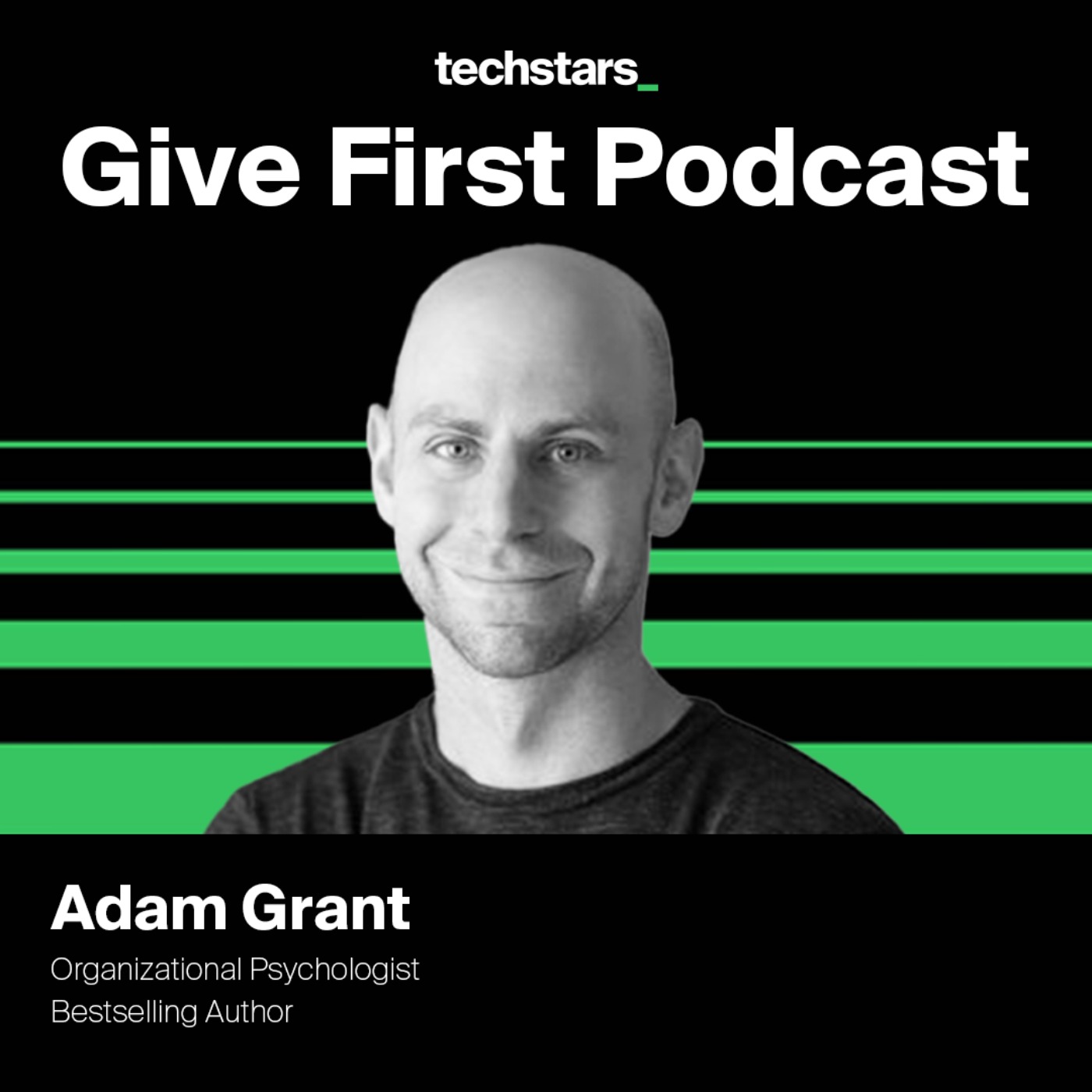
In this episode of the Give First podcast, Brad Feld sits down with organizational psychologist and bestselling author, Adam Grant, for a conversation about the power of generosity in business, leadership, and life.
Brad and Adam trace the roots of give first and give and take, uncovering how their philosophies arrived at the same conclusion: that success isn’t about what you extract, but what you contribute.
They explore why some givers thrive while others burn out, how smart generosity is often a sign of intelligence, and what it really takes to build cultures where people show up for each other. Adam also shares a how to confront takers, and maybe even convert them.
Follow Brad Feld on LinkedIn (https://www.linkedin.com/in/bfeld/) and Twitter (https://x.com/bfeld?lang=en)
Follow Adam Grant on LinkedIn (https://www.linkedin.com/in/AdamMGrant/) and X (https://x.com/adammgrant)
Hosted on Acast. See acast.com/privacy for more information.