Ask ChatGPT
 Give First
11 Nov 2025 · 23m · 9 chapters
How Pledge 1% (startup equity pledge for social impact) grew from a local idea into a global movement, including legal/board mechanics and the “distributed pledge” used by late-stage startups before IPO.
Brad Feld (co-host; venture investor/Techstars co-founder) and Samir Dalokia (venture leader; previously co-founded/led SunGrid; involved with Foundry and Pledge 1%).
Pledge 1% has been taken by “north of 10,000” companies; over 60 unicorns have formally set aside equity; late-stage “distributed pledge” helped generate “over $3B” in equity value for philanthropy; IPO-near adoption by companies like Reddit, Chime, and ServiceTitan produced “hundreds of millions” in giving.
Salesforce Foundation (1% pre-IPO model), Rally Software (Boulder origin via Ryan Martins), Foundry (1% of carry), Atlassian (Scott Farkar/Mike Cannon-Brooks scaling globally), Twilio.org (distributed pledge outcome), SendGrid (used distributed pledge).
Written by AI. May contain mistakes.
Discover how Pledge 1% began and its foundational story.
“This is David Cohen and I'm here with my amazing co-host, Brad Feld.”
Explore the importance of instilling philanthropy in early-stage companies.
“The startup story started around 2006, and the origin of it was a conversation I was having with a guy named Ryan Martins.”
Hear specific examples of how Pledge 1% has made a difference in communities.
“And, you know, each time the companies get visibility for that, but it also gives us tools to support things locally.”
Learn how Pledge 1% expanded beyond Colorado to a global movement.
“Along the way, you know, it got a board.”
Learn about the innovative structure of the distributed pledge that allows startups to commit to philanthropy while preparing for IPOs.
“because you could imagine what happens when you come to your board when you're just about to go public.”
Understand the importance of taking a long-term view in building startup communities and philanthropic efforts.
“the humble origins of a conversation level, Benny off starting it and Orion being inspired and a Scott saying, I want to make it bigger.”
Explore the various benefits of taking the pledge for companies, including employee engagement and corporate responsibility.
“And, you know, this started around 2006 with that conversation with Ryan.”
Learn how recent IPOs have embraced the pledge and the impact of this movement on future companies.
“Last year, we had Reddit, we had Chime, we had Service Titan.”
Hear about the podcast leaderboard and the significance of the guest's contributions to the show.

Get the gist, explore an idea or ask about something said.
 Claude
On Give First, what are the key points of this episode?
Searching your listeningAutomatic transcript. May contain errors.
0:00What do companies like Dropbox, Twilio, PagerDuty, Guild, DigitalOcean, SendGrid, Twilio, Chime, Salesforce, Atlassian, Canva, Toast, and so many more understand about philanthropy? If you build it in, it improves your culture. You can build it in for day one with an equity pledge using Pledge 1%, an awesome organization I've been involved with for a long time personally. many of us have in the venture industry. They've helped over 60 unicorn companies already formally set aside equity to fund social impact, igniting literally billions of dollars in new philanthropy. You can become part of the movement too.
0:39And this podcast episode is all about how coming up right now on Give First.
0:48Hi everyone. This is David Cohen and I'm here with my amazing co-host, Brad Feld. Hey Brad, and this is the Give First podcast. In the startup world, Give First means simply trying to help anyone, especially entrepreneurs, without any expectation of getting anything back. So we'll be talking to mentors and founders about what Give First looks like in action and how it makes great entrepreneurship possible. We polled everyone and they said consistently that their favorite part of the show was the legal mumbo jumbo. So here it is. The following discussion is an expression of personal opinion and does not represent the opinion of Techstars or any company we discuss.
1:22Our conversations for informational purposes only, including any mention of securities or funds. This is not legal business investment or tax advice, and it's not intended for use by any investor. Certain of Techstars funds own or may own in the future securities and some of the companies discussed in this podcast. Got it?
1:43We have a special, super short edition of the Give First podcast. with me, Brad Feld, and Samir Dalokia, who you've heard from recently with the story of SunGrid, with a special episode around Pledge 1%. I'll start with the startup part of Pledge 1%, and I'll let Samir talk about the scale of part. If you read Give First, the book versus the podcast, There's a very short section on Pledge 1%. We'll go a little deeper into some of the things that happened with it, what it means, and why it's something that both Samira and I are incredibly supportive of, fans of, supporters of, and actively engaged in.
2:32The startup story started around 2006, and the origin of it was a conversation I was having with a guy named Ryan Martins. Ryan was a co-founder of Rally Software, a company that some of you may know, essentially was one of the very first companies to do agile software development. They built a nice business in Boulder, Colorado, went public, got acquired by Computer Associates. They were probably the market leader for a while, and then they got their asses absolutely kicked by Jira and Atlassian. but nonetheless still created a substantial and interesting business. Ryan, in the midst of the business, well before it's gone public, probably a decade before it's gone public, maybe not quite that much, but in that general area, sits down with me and we're probably two or three years into the company at this point.
3:28And he says to me, you know, hey, Brian, what's on your mind? And he says, Brad, I want to do what Benioff has done. And I said, that's cool. That's awesome. You want to build a really big company like Salesforce. That's great. I think that's awesome. He says, no, no. I want to do what he's done with the Salesforce Foundation, where he gave 1 % of Salesforce before the IPO to a foundation that endowed the Salesforce Foundation and also built into the company a culture of philanthropy by having people give 1 % of their time and the company give discounts on software, free software to nonprofits.
4:12It kind of went down that area. And I kind of loosely heard of that, but I never really like walked into it. And I, again, said to him, Brian, that sounds fantastic. As your largest investor and board member, I completely support that. I think that's a great idea. It's totally aligned with my values. I'm sure we can figure out how to do that and have Rally do that. He's like, no, Brad, Brad, come on, keep up. That's not what I mean. And I say, well, what do you mean? He says, I want every company in Colorado. He actually said Boulder. I want every company startup in Boulder to give 1%. That's amazing.
4:54I said, huh, that's pretty awesome. We talked about it for a little while. I said, let's do that. It started off Boulder and eventually became Colorado. And what we ended up doing was creating a thing called the Entrepreneurs Foundation of Colorado, which was modeled after something that was the Entrepreneurs Foundation of maybe there were seven or eight cities at the time. And all of them were getting philanthropic intent into the startups, but none of them were really getting the 1%. What they were doing instead was when companies were successful, they were community foundation vehicles for some of the founders to give back a bunch of money.
5:37And in a couple of places that was working and others it was a thing. But we said, okay, well, let's figure out this 1 % thing because it was hard. It wasn't so easy to figure out how to do it. an early stage private company. But our viewpoint was at the very beginning of the journey, if you can basically, as part of the vision of the company, say, look, we're going to benefit from our community, Boulder in this case. And so if we're successful, if and when we're successful, we want to contribute value back to our community, and we want to wire that in from the beginning. So the community we're in, and I was very into the, we were just starting Techstars, I was into the startup community language.
6:18We weren't using that yet, but I was kind of thinking about those sorts of things. That became sort of the shtick. We figured out the legals. The legals actually weren't that hard. The hardest thing was convincing really two categories of people, one that was pretty easy, one that was much harder. The category that was very easy were the founders of companies. hey if your company's successful you know right now your company's worth nothing when your company's successful you know you're able to really visibly uh give back to the community to help you get there and the community will celebrate you and they'll be meaningful that's easy yeah um uh right not hard the one it was hard for was the investors well why would we do that well you know there's no tax benefit to that.
7:04And, you know, well, you know, why can we wait till the end when the company is public? And then the founders can give their money back to the community because they're really the ones that made the money from the community. Like thinking from a, I'm the investor and I'm trying to maximize my dollars versus thinking about it from the perspective of the whole company. And so there were a lot of those conversations. Now there were some investors who immediately got it, like immediately, like, yeah, I totally get that. And that conversation. So we did that, we launched it. And I think in the first year or two, we had about a hundred companies contribute in Boulder.
7:37Foundry contributed 1 % of our carry to Boulder. For people that know how it works, one of the 100%, not one of the 20%, but we gave 1%. Techstars gave 1 % of its profits to that organization. It continued and became a really powerful thing where there was a different conversation happening in Colorado around the importance of startups in their local community. Of course, over time, significant dollars have flowed back from that. And, you know, each time the companies get visibility for that, but it also gives us tools to support things locally. And I'll just give one Boulder example and then hand it off to you for scale up where there are challenges with something that's happening at some point in time.
8:29So I remember, I can't remember what the trigger was. I feel like it might have been COVID or it might have been something else. The United Way in Boulder, which was a fairly significant giver in Boulder, lost its funding from something. And it ended up being something like a$300 ,000 or$400 ,000 hole in their budget, which, because it was the United Way, flowed to other organizations. So it was a pretty significant hit that happened somehow. And when that happened, it might have been a fire. I just can't remember what it was. When that happened, we foundry had money from some recent realizations that was in our DAF at the Community Foundation Serving Boulder County.
9:24That was part of our Pledge 1 % thing. And we allocate how we want whenever we had money. We just hadn't allocated whatever the last distribution had been. And so we said, done. And we contributed whatever the whole was, three or four hundred thousand dollars the next day after we saw the news about it. And it wasn't like, oh, and good luck, how wonderful foundry. It wasn't about that. It was that problem. Local community. Local effect of problem is going to be non-trivial. Solve problem without drama, without having to take from something else, without whatever. And so there have been plenty of examples like that.
10:01Rally, with their money, did that several times in a couple of places, other companies have too. So that's how it got started. Along the way, you know, it got a board. My partner, Seth Levine, got on the board, got very engaged. You know, I was still very supportive, but I would say now in the background, more cheerleader, less active. And so now I hand the baton to you to talk about Pledge 1 % evolving from that. Well, and it's such an awesome story, Brad, because it also shows how you get these things that kind of build on themselves, like as when somebody steps up and leads, and it shows the power of a get first mindset, like Benioff did with Salesforce, that that inspires the next and then Ryan does it.
10:46And that inspires the next and you have about, you know, hundreds of hundred companies in Boulder doing it. And somewhere along that journey, and I wasn't around for, I don't know exactly when, somewhere along that journey, it inspired another guy down in Australia, you know, very, very long, 10 ,000 miles away, named Scott Farkar, who was one of the co-founders, co-CEOs of Atlassian. And he was inspired by all of this activity. And he and his co-founder, Mike Cannon-Brooks, had a deep sense of philanthropy and giving back already at the company. They had already been doing a ton as a just Atlassian, giving back some of their equity and profits of the company and software and time, certainly.
11:37and they said we want to do we have they basically had the same theory that brian did and he's like i want every company in the world to do this and so so scott um i think spent a lot of time getting together i know you know mark uh benioff at the time was hosting a lot of dinners in the bay area trying to spread this message to other um high growth c ceos and um and they really said, hey, let's try to make this a, you know, build some support infrastructure for anybody taking this pledge around the world. We'll build, they started to build playbooks of here's what you would need to put into the S1 filing.
12:21Here are the board consents you'll need to get at the votes. Here's how you build consensus among your board. They started to build a database of all the companies who had ever taken the pledge, all venture capitalists who had supported one of their portfolio companies taking the pledge at some point um to make it easier for founders to go to their boards and say hey i'd like to do what ryan said and uh and since that time um i can't remember the exact number now it is well north of 10 000 companies have taken the pledge um it is embedded in in the tech stars uh of my understanding uh it It is.
13:02It is. Application process like that. It's optional for the companies. The companies can choose. They choose. But it's sort of a checkbox. Like, you want to do this? Here's what it is. It's very easy to do. Easy to do. And that's so key, making it so easy to do and building that culture, you know, in that headset from the beginning. And so now you have, you know, five digits of companies around the world doing this. more recently I say recently now this is probably eight nine years ago many of the last wave of cloud SaaS businesses who didn't take the pledge when they were young because it wasn't a checkbox when they were getting started started to take the pledge right before they went went public and and I give my friend Jeff Lawson a lot of credit for this he came up with this very innovative structure because you could imagine what happens when you come to your board when you're just about to go public.
14:09You're already going to be worth many billions of dollars. All of a sudden, 1 % of billions of dollars is a little bit harder to convince investors of than 1 % of we don't know what it's going to be worth. Maybe it's worth zero, maybe it's worth a lot. And Jeff came up with this really innovative structure that we now call the distributed pledge, which for the benefit of time, I'll just shorten to, he simply said, I'm going to take the 1 % divided in 10 because I'm going to do 0.1 % a year for 10 years. And at the end of that, I'm going to have the self-sustaining Twilio.org foundation and structure.
14:51And that mechanism of the distributed pledge was a huge unlock for lots of SaaS CEOs to get the pledge done before the IPO if they had missed it early. SendGrid was actually one of those companies. We didn't do it early for whatever reason. And I really credit Jeff because he said we were having lunch maybe, I don't know, a year before the IPO. And he said, hey, have you guys considered taking the pledge? And I said, well, I don't know, we're pretty late stage now. How would we do that? He described how he had done it. And it was like, the clouds parted. And I saw the answer. I'm like, oh, this is simple.
15:33That's clear. Went and talked to our board members. And my now partner, Byron Dieter, was my first and second calls. My old mentor and coach and dear friend, Ajay Agarwal at Bain Capital Ventures. You guys at Foundry. I mean, I had the easiest setup. I was pushing on an open door. I had tons of support from my board. Everybody immediately said yes. But since that time, since that window of time, I'll call it 2008, sorry, maybe 2013, 2012, 2013, in that past decade, those pledges from the late stage private companies in particular have generated over$3 billion worth of equity value from those 1 % pledges.
16:20the$300 billion of market cap has led to a billion dollars of, uh, uh, $3 billion of equity value, um, that are then now are in permanent, like the apps that have nations that are going to go out, um, to be donated to the communities in which these companies, um, live and work. And I just think that's awesome because of the, the humble origins of a conversation level, Benny off starting it and Orion being inspired and a Scott saying, I want to make it bigger. and then it just keeps going. Everybody just pays it forward and says, let's go spread some more goodness and keep giving first. I think there's a nice bow to put around this, which is something I say endlessly to the point where people who have to listen to me probably get tired of it.
17:07But one has to always take a long-term view in what they're doing. And it can be cliche in some scenarios. It was a big deal in sort of all my language around startup communities, because one of the challenges with building startup communities was this idea that, like, you know, let me measure how much progress we made last year versus taking a 20-year view. And even, you know, I like to say, Techstars is 19 years into its journey. Well, it can't be talking about its last year. It's 19 years into looking forward 20 years. You have no idea whether, you know, it's 20 more years or 40 more years or 100 more years, but you have to take a 20 year view forward.
17:50And, you know, this started around 2006 with that conversation with Ryan. So we're about 20 years into this. Yeah. And, you know, if you had said to Ryan, hey, Ryan, you know, that's such a great idea. I think it's going to generate three billion dollars worth of philanthropic actual giving into foundation. Now, Ryan has a big enough vision where he might have said, yeah, no problem. It should be 30 billion like that. That might have been his response. But my response would have been, you know, that's a long way. That's a long way from here. At least I got from, you know, at least I got from doing it just for rally.
18:35Thank you. Thank you for sharing that, Samir. I mean, it's it's incredible what the Pledge 1 % team has done. Amy, as the leader of it from the beginning, has been incredible in terms of her leadership and her ability to scale. and her ability to navigate a bunch of people, not just founders, but investors who have very strong opinions, who have very strong perspectives, including many who that perspective is, oh, well, why would that work? That won't work. And being open to those moments that when Jeff comes up with something, Jeff Lawson comes up with something like the distributed pledge, which I can attest in the pre-public company situations I've been in, that have subsequently taken the pledge.
19:25You don't lead with, we're going to give 1%. You lead with, we're going to give one-tenth of a percent every year for the next 10 years. And somebody says, oh, geez, why would we do that? And it says, well, you know, we're going to have an evergreen option program. It's going to be this much. It's going to be much, much greater than that 0.1 % every year that we're giving. And it'll just feel, it's like a super motivator for our employees and a give back to our community in a way, and all of a sudden, person like yeah okay that's cool you know dan springer uh used to be the ceo of docusign he would always say it's not just the right thing to do it's the smart thing to do yet all these great examples from when they did it at docusign and you know it would always show up in the employee engagement surveys as like one of the top things that made people proud to be part of the company and and so there are all these great reasons to take the pledge um and uh whether you're doing it because it feels like the right thing to do, or it's just because as a cold-hearted capitalist, I can tell you, it's also just a smart business thing to do.
20:30I'm happy to talk with anybody who's curious about why that's the case. We could spend another hour on that topic, but I hope that we continue to get the next generation of companies going public, doing the same. Last year, we had Reddit, we had Chime, we had Service Titan. All three of those recent IPOs took the pledge in the month's brief running up to their IPO, and it's generated hundreds of millions of dollars of philanthropy. And just look about the power of that, that you as a founder or CEO listening, with one decision, with one conversation with your board, can have, you know, certainly eight figure and in some cases nine figure philanthropic impact and have your company be a force for good it's super powerful super high leverage and then hopefully you'll be like the Ryans and and uh and Scotts and other and Jeffs and and others who then pay it forward and say let me go evangelize and convince the next five to ten or twenty CEOs to take it themselves and that's how the movement keeps growing but it's uh it is it's really fun to watch Samir in my world you are a massive overachiever and another thing that I just thought of that you're overachieving on is I think you're now on the give first podcast the leaderboard you're in third position uh for number of episodes behind David Cohen and Brad Feld well that is I will take being in that company any day can't wait I love being in that company Thanks again for spending the time.
22:08Thanks, Brad. Thanks a lot for listening to the show today. We'd love to hear your feedback, ideas, or who you'd like to hear next on Give First. And please leave a rating and review, ideally a good one. And reach out anytime to podcasts at techstars.com or on Twitter. I'm at David Cohen. See you next time. Don't forget, Give First.
22:35Thank you.
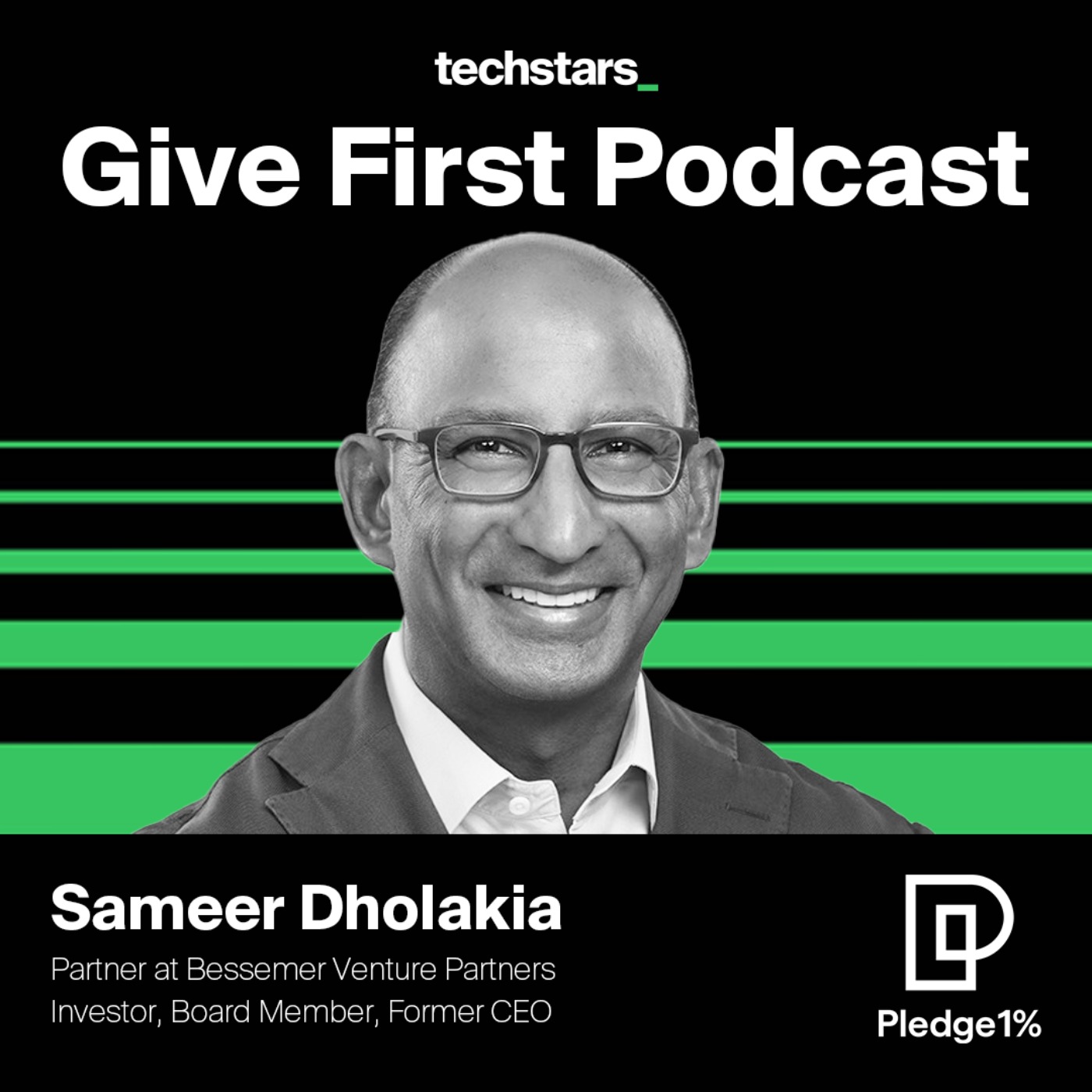
In this special episode of the Give First podcast, Brad Feld and Sameer Dholakia revisit the origins of Pledge 1%, the global movement helping startups build philanthropy into their business from the start.
What began as a simple conversation in Boulder between Brad and Rally Software co-founder Ryan Martens grew into a worldwide initiative championed by Salesforce, Atlassian, Techstars, and thousands of founders who have pledged 1% of equity, time, or product to social impact.
Brad and Sameer trace how a local idea became a global force for good, fueling billions in new philanthropy and inspiring the next generation of founders to make giving part of their growth story.
Sameer Dholakia ➡️ https://www.linkedin.com/in/sameerdholakia/
Pledge 1% ➡️ https://www.pledge1percent.org/
Hosted on Acast. See acast.com/privacy for more information.