Ask ChatGPT
 Give First
30 Jun 2025 · 34m · 17 chapters
Mentorship and “give first” in startup ecosystems; using complex adaptive systems and feedback loops to explain how founders learn through experiments, nonlinear growth, and policy change.
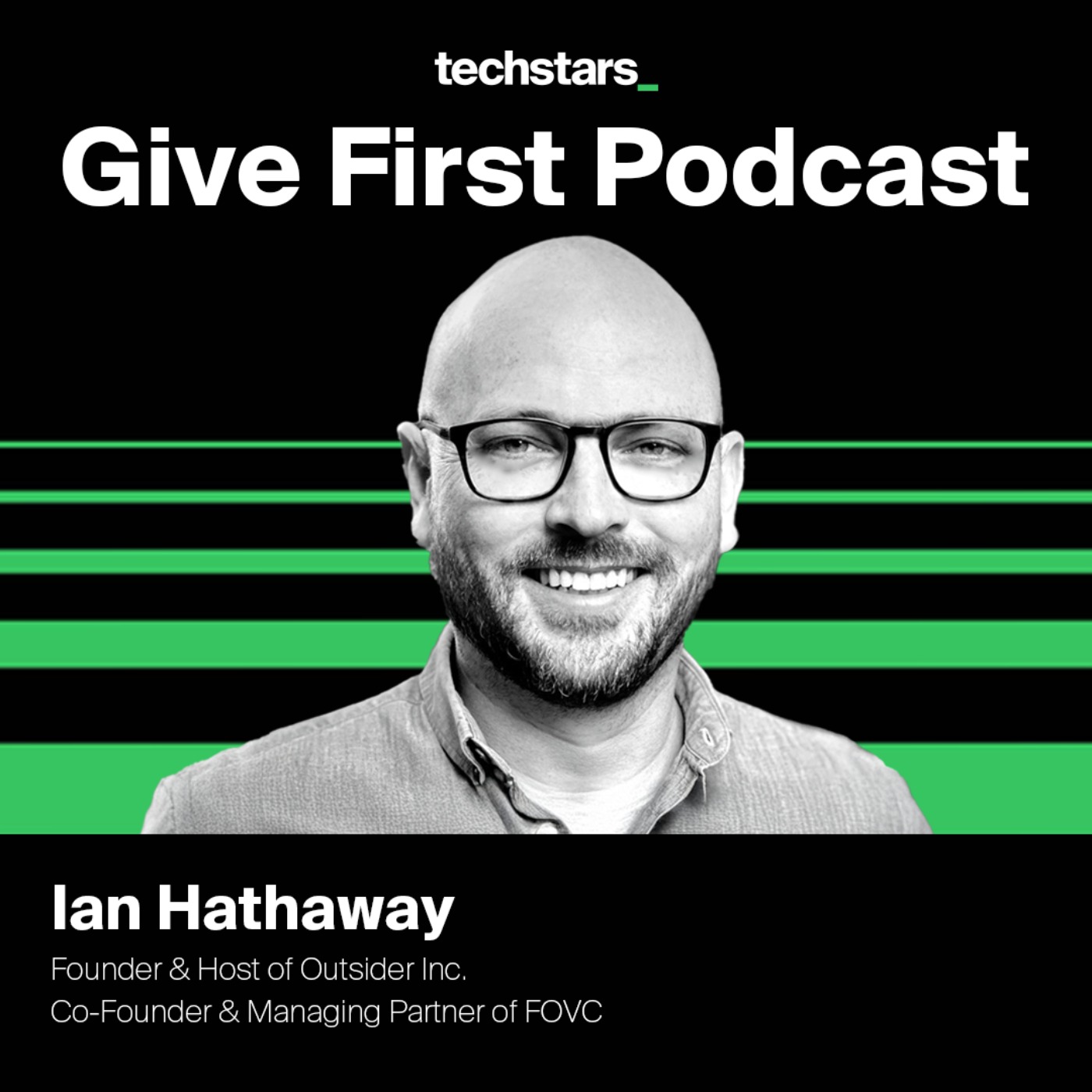
Ian Hathaway, early-stage venture fund operator (FOVC/Fair Out VC) investing first institutional checks in B2B software; co-founded with Jonathan (met at Techstars); runs the podcast Outsider Inc. about entrepreneurs who break the mold. Background includes Techstars strategy work, prior analytics/consulting, and writing on ecosystems; co-author of The Startup Community Way with Brad Feld.
Startup communities are complex adaptive systems; success comes from initiating feedback loops and iterating on outputs as inputs; funding rounds create nonlinear organizational change. “Leaders” should be “founders,” and early community “instigators” (ecosystem builders) are crucial beyond entrepreneurs.
COVID-era rate-of-change/entropy; “The Bear” episode “Seven Fishes” as feedback loop gone out of control; CAE policy work (Center for American Entrepreneurship) via relationship-building in Washington.
Written by AI. May contain mistakes.
Discussion of legal disclaimers and the context of the podcast.
“Certain of Techstars funds own or may own in the future securities and some of the companies discussed in this podcast.”
Description of the podcasting environment at the Global Entrepreneurship Congress.
“My partner, Jonathan, and I met at Techstars.”
Ian Hathaway's introduction and discussion about his business and podcast.
“So certainly when you look at the tech and venture-backed domain, places like Silicon Valley and New York obviously stand out.”
Ian explains the mission of his podcast focused on outsider entrepreneurs.
“financial services clients, Fortune 100 firms.”
Discussion on the co-authored book 'The Startup Community Way' and its context.
“I don't know if it was spring or so 2017.”
Narrative about how Brad and Ian met and decided to write the book together.
“could be as well um so i don't know for me it was just like my goal was to like work on this and go super deep.”
Conversation about Boulder and personal memories connected to their relationship.
“Tell me what that, talk about what that day was.”
Explore the concept of complex adaptive systems and their impact on startups.
“But I felt like it was an opportunity for us to merge those two minds.”
Discuss the effects of COVID-19 on business strategies and mentalities.
“and read a bunch of stuff when I was younger about how complex systems worked.”
Understand the role of feedback loops in the startup ecosystem.
“And it snapped into place immediately for me, just quick sidebar on COVID, because we had this COVID is unfolding as we're about to publish the book.”
Learn about the role of instigators in startup communities and ecosystems.
“You're constantly having to deal with whatever the outputs are become the inputs.”
Discover the mission and activities of the Center for American Entrepreneurship.
“Maybe they don't yet see the need for collaboration.”
Learn about John Deary's journey as a policy entrepreneur and the importance of building relationships in entrepreneurship.
“is what a policy agenda would look like.”
Find out how successful entrepreneurs can contribute to the organization and its initiatives.
“If somebody listening is a successful entrepreneur and that resonates and they want to get involved in some way with the organization, is there an easy way for them to get involved?”
Discover the importance of relationships in the entrepreneurial journey through personal anecdotes.
“We're currently, you know, we have an entrepreneurs council that's made of successful entrepreneurs, exclusive sort of events.”
Learn about Looking Glass Factory and its innovative hologram technology.
“because he used to have receptionists and stuff yeah and uh sean and i hit off and ended up he invested early on in my the very first company i invested in is an angel investor company called NetGenesis.”
Enjoy a light-hearted discussion filled with gratitude and appreciation among hosts.
“Am I the fifth thing you know, or is it just?”

Get the gist, explore an idea or ask about something said.
 Claude
On Give First, what are the key points of this episode?
Searching your listeningAutomatic transcript. May contain errors.
0:04Hi, everyone. This is David Cohen, and I'm here with my amazing co-host, Brad Feld. Hey, Brad. And this is the Give First podcast. In the startup world, Give First means simply trying to help anyone, especially entrepreneurs, without any expectation of getting anything back. So we'll be talking to mentors and founders about what Give First looks like in action and how it makes great entrepreneurship possible. We polled everyone and they said consistently that their favorite part of the show was the legal mumbo jumbo. So here it is. The following discussion is an expression of personal opinion and does not represent the opinion of Techstars or any company we discuss.
0:38Our conversations for informational purposes only, including any mention of securities or funds. This is not legal business investment or tax advice and is not intended for use by any investor. Certain of Techstars funds own or may own in the future securities and some of the companies discussed in this podcast. Got it?
1:01I'm sitting here at the Global Entrepreneurship Congress where they made a nice podcast booth. It's kind of like a glass enclosure thing, like I'm in a James Bond movie, like I can't get out of the glass booth because I'm the bad guy. And there's all this stuff going on around us, and I'm just sitting here recording podcasts today. Yeah, it's good to be in the fishbowl with you, Brad. It's nice to see you. Everybody's ignoring us, though. That's kind of fun. Yeah. uh, Ian, Ian, I know tons about you because you know, you and I spent all the time doing stuff, but tell the world about you. Well, where do I begin?
1:36What are you doing today? What are you doing now? Yeah. So what am I doing now? Um, well, besides sitting here with you, this is at GC. That was pedantic. Um, yeah. Main, main business is, uh, I run an early stage venture fund. Um, what's the name of it? It's called FOVC or fair out. And you have good, good LPs. We have the best LPs. Okay. I'm an LP. Yes, that's right. Okay. Let's check them. We invest, you know, kind of first institutional check in B2B software companies. My partner, Jonathan, and I met at Techstars. So that's kind of our origin story. And, you know, on our website, we have a terrible website.
2:11It says one thing, mentorship-driven venture capital, and that's basically our guiding light. Sweet. Yeah. Is it trademarked? No, it's not. Don't take it. I'm not going to take it. And, you know, rumors are, since I have it on my schedule, that you have a podcast. Yes. Tell us about the podcast real quickly. Recently launched. It's called Outsider Inc. So spending a lot of time on that. The whole idea, you know, I know we're going to, I assume we're going to get into Startup Community Way and other things. But the mission of the podcast is to tell the story of outsiders. So whether it's by geography or pedigree or background or identity or any other factors, people who have had success as entrepreneurs by breaking the mold.
2:58And it came out of a lot of the, you know, talking about startup communities around the country, around the world, people wanting more stories. Also, as I was doing, you know, some of the work at Techstars when we were working on strategy, where should accelerators be, working on the thesis for my fund, the reality is that there's a lot of great companies out there that just aren't in the popular press. So certainly when you look at the tech and venture-backed domain, places like Silicon Valley and New York obviously stand out. But there is a much longer tale out there, and I just want to tell those stories.
3:36Cool. Yeah. I think it's kind of fun to have a recursive podcast where we talk about podcasts. And maybe we can talk about which – no, never mind. So for anyone listening, you may or may not be aware that Ian and I co-authored a book called The Startup Community Way. It was the second book about startup communities. I had written the first one in 2020 – sorry, 2012. It came out with a second edition in 2020. and Startup Community Way came out in 2020 as well, right at the beginning of COVID, or maybe COVID was going on for a couple months when it came out. The title, for those of you that don't recognize the homage, is to Eric Ries.
4:21Eric wrote two books. He wrote Lean Startup, and then he wrote The Lean Startup Way. And Eric was - Startup Way. Sorry, not The Lean Startup Way, The Startup Way. Eric was nice enough to write a forward for us. And there was a lot of, you know, in addition to being friends for a while, there's a lot of sort of karmic overlap between the constructs. Yeah. Let's spend a little time talking about the origin story of the book. Like, how did you get to know me? Why did we bother, like, even talking? Did I respond to your first email? Where did it go? Yeah, well, obviously your spam guard was broken that day.
4:56But, no, it actually is a great story. you know, about giving first. So I was living in London at the time. My wife and I, Susie, we were living in San Francisco. I had an analytics business, essentially a consulting business that I had exited to a consulting firm in London. So I wasn't really happy with my day-to-day job. I was spending the day, you know, pitching and doing projects for big tech, media, and financial services clients, Fortune 100 firms. But kind of on the nights and weekends, I was mentoring founders, advising, doing a little bit of angel investing and doing a ton of writing on startups, on ecosystems.
5:41And that's how I met you. I met you through Richard Florida. He kind of connected us about writing around, you know, the geography of entrepreneurship. And, you know, my two-year commitment was coming up at the consulting firm and I was miserable. And I said to my wife, Susie, who is much smarter than me, I need to bring, whether it's starting a business or working with founders, which I love doing, I need to bring it front and center. And she said, well, who's the person you know that you respect most? And I said, well, there's this guy, Brad. He's in Colorado. We've emailed. We're internet friends.
6:17I don't really know him. But she said, you should reach out to him. And I did. And you called me and we talked. We had some back and forth phone calls, emails, and we landed on doing this book together and eventually coming in and, you know, operationalizing some of that at Techstars. So it was me reaching out to you asking for help. You obviously had some opinion of me that was worth it. I actually had no memory of knowing anything about you. You were just another, yet another random inbound from my inbox. Yes. That showed up one day. Although I probably, I kind of remember the Richard Florida thing.
6:53And I also kind of remember a video interview that we did for some. Oh, yes, you did. About accelerators. Yeah. So I kind of like there was a couple of touch points. That was a course I was teaching at NYU, teaching kind of policy people about like the X's and O's of startups. So you did a, there was nothing out there on accelerators. And so I video recorded you for that. That's right. I forgot about that. The YouTubes probably have that somewhere. So if the book came out in mid-2020, then that was probably 2019, right? It just happened really fast? No, I think we met in 2016, and it took a little while to find our stride.
7:32So wind the clock forward. So we've met each other. You've been thinking about this stuff for a while. You've been writing. Somehow I respond to you. Now all of a sudden we're talking about doing a book. Yeah. Yeah. And so the year is 2016. My son, Teddy, my first child, my oldest, he was born in October 2016. And we had agreed to get kind of started on the book. I don't know if it was spring or so 2017. But my wife was on maternity leave. At the time, she was working for Salesforce. She works in talent acquisition. And she has a year off. You know, in the UK, you get a year off, unlike the United States of America.
8:14And so it was your wise idea. You said, why don't you come to Boulder? You know, you put us up. You have this condo that, you know, for guests, it's usually for your parents. But you let us stay there for a little while. We had an awesome time. My son, Teddy, took his first attempts at steps in your apartment. So I will, you know, never forget that. We have them outlined on the floor, actually. But they mostly look like knees. Yeah, yeah. So he tried successfully, I guess-ish. But yeah, so, you know, some like really foundational memories were there and it really connected me to Boulder. Thought it was a great way for us to build a relationship.
8:52We ultimately went back to London when she went back to work, but it was time well spent. What was your favorite part of Boulder? My favorite part of Boulder. Oh, if you had to wake up in the morning and go to breakfast somewhere, where would it be? I, oh, there was this little diner on the east side. I don't remember the name of it. the greasy spoon kind of place kind of, uh, up 29th, I think. But my favorite neighborhood in Boulder, well, maybe there's two. I like old North Boulder a lot. I don't know why. Uh, but it just like vibes with me, but we spent the most time. There's a Northern, the Northern most neighborhood is called like Dakota something.
9:29Dakota Ridge, Dakota Ridge. There's the best playground there. And so that's probably where I spent the most time taking my son and my dog to go and say, yeah, sweet. All right. So we start talking about this idea for a follow-on to startup communities, which is very popular. And, you know, by 2020, I think there are a lot of people that understood the basic concepts in it and were implementing in lots of different ways. What do you remember about the initial goals that we had for Startup Community Way? Well, I think it was to do a couple things. It was to evolve the thinking beyond Boulder, right?
10:11That was probably one of the big criticisms that people had was, hey, this startup community is this is a book about Boulder. the deeper I went to in Boulder and spent the more time there the less I'm accepting of that criticism because I actually think it's a pretty idyllic community it's I think the startup community in Boulder reflects the broader community itself people are generally helpful they have love of place which are essential ingredients to any good startup community there were some things that you wanted to correct like the role of government and things like that um i i thought my my starting point for the role of government in the first book was uh was not very uh robust it was basically uh say the fuck out of the way and do no harm yeah but point well taken i mean that's still that's still correct but and right yeah there was definitely and things could be as well um so i don't know for me it was just like my goal was to like work on this and go super deep.
11:13You know, I sort of took that founder's mentality to it where I just blocked everything out for three months and read a bunch and talked to lots of people. I traveled to conferences and kind of came back with a different attitude about what we needed to do versus what I kind of thought was going to happen in the beginning. So I remember a moment. I didn't have the acronym for it at the time. Today, I would have referred to you as my LLM. When I wrote startup communities, I didn't do any formal academic research. I had read plenty of stuff about entrepreneurial ecosystems and talked to people. And I knew the history of incubators, of course.
11:50And, you know, I was part of the whole dynamic around creating this concept that's now, you know, commonly understood as an accelerator. But I hadn't really, I almost consciously decided with startup communities that I was not going to spend a lot of time with any formalisms, mostly because I wasn't very happy with anything that I encountered. A few things were interesting and a few stories like Startup Israel were interesting stories, but none of it really landed for me in terms of a framework. And I recall pretty vividly, I don't know the number of them, but I recall that 50, 100 sort of academic papers, you know articles that were substantive articles in different places and being synthesized and you'd sort of send them to me and at some point I said I don't want these anymore send me the summaries which of course is what I would have asked the LLM to do and I remember a day where we sat down and went through a bunch of stuff and we were like in my conference room at Foundry one of those rooms that had whiteboards on all sides and we were just kind of both scribbling on the whiteboards for a couple hours.
13:02Do you remember that day? Of course. Tell me what that, talk about what that day was. Yeah, well, I think maybe also what, as you were talking, it reminded me of another rationale. There was a paper, there were actually several that were, you know, for startup communities, the book not being an academic or researcher. I don't know where you're going with this, yeah. It was like foundational in academic literature. It was discussed, but it was often dismissed. And so obviously, you know, before I became involved in business, I was a research economist. I still did writings for Brookings and Kauffman Foundation.
13:41And so I know about research. And so one of the things that I thought was, well, let's just stick it to them because I know what the research will say if you put it together in the right framework. And so it was kind of a response to that. I wanted and that makes this book not for everyone. And I understand that. Right. But I felt like it was an opportunity for us to merge those two minds. Right. You know, sort of grassroots, you know, practitioner meets kind of theoretical framework. And it actually happens to line up nicely for those who take the time to digest it. So I remember you had you you became more enraged than I did a couple of times.
14:23I remember one moment, for those of you out there that are fans of the TV show Succession, which I loved, and as an aside, Mountainhead, which just came out on HBO, which is by the same guy, Jesse, I just lost his last name. The first half of Mountainhead is outstanding. The second half loses the plot and wanders around too much. There's a scene from Succession in the last season where Logan Roy is trying one last time to get his kids on side with his plans, and they're in, like, a karaoke bar or something in a private room, super high-end, fancy things, and he's, like, trying and trying and trying, and the kids just won't sign up for whatever latest thing of manipulation he wants to do.
15:11He finally looks at him and says, You are not serious people. are just not serious people and one of those papers i'm not going to mention who wrote it uh because i don't need to call him out but essentially what he wrote about startup communities and his very serious paper was this is this is some interesting uh anecdotes but it's not that you know bradfeld is not a serious person and this is not a serious book and i remember you being enraged by that when when we sort of stumbled upon it was a footnote it was like It was kind of like one of those things like, that seems kind of gratuitous. Like, why?
15:50And of course, it's the nature of some of the academic publishing and, you know, look, this has to be really formalized, etc. But I do remember kind of coming out of that, one of the efforts that you had was not to turn the book into this ponderous thing. But instead, we worked hard to get a framework that would allow some of the more rigorous underlying analysis in it. while at the same time making that framework a very easy framework to work with if you wanted just a framework. And when complex adaptive systems came out of that thinking, where the two of us sort of snapped in pretty much at the same time, startup community is just a complex adaptive system.
16:41Yeah. And, you know, I don't know. At the time, I knew what a complex adaptive system was because I was interested in Santa Fe Institute and read a bunch of stuff when I was younger about how complex systems worked. But that was not a very common phrase in the context of anything startup related. Today, when we think about what has played out in so many ways in society, it's middle of 2025, you know, 2020 was COVID. Yeah. You know, lots of things happened after, including once again the inflation and then the deflation of a bubble around tech companies. It probably was 2022, 2023 was the, you know, real turn downward.
17:30The incredible energy around everything AI, some of it being emergent, some of it being positive feedback loops, some of it being utter bullshit. and all of it being sort of this question of, are these things that are being invented and done, are they going to lead to salvation of humanity or extinction of humanity? Yeah. And then, of course, in the United States, the presidential election and this rapid reshaping or efforts to reshape, whether legally or illegally, huge aspects of government that are now having all of the ripple effects, not just of the reshaping, but also the question as to whether the things that are being done are actually going to stand up to scrutiny or get run over or change.
18:21All of those things are examples of how complex adaptive systems work, where the x-axis is time and the y-axis isn't a predictable curve. Um, when you think about that in the context of today and startups and how you advise startups as an investor and how you work with other founders, how have you incorporated the idea of a complex adaptive system into that kind of activity? and maybe even make it self-referential because, you know, your venture fund hasn't followed a predictable path. Your time at Techstars didn't follow a predictive path. Maybe, you know, from an entrepreneur's perspective, how do you embrace that kind of change?
19:06Yeah. So once you see the world through the lens of complex adaptive systems, it's really hard to unsee the world through that lens. it's everything from a dysfunctional family gathering, right? To traffic to on and on and on, right? And it snapped into place immediately for me, just quick sidebar on COVID, because we had this COVID is unfolding as we're about to publish the book. And I have this framework locked in my mind. And I was the biggest alarmist about the world is shutting down, the world is shutting down. And at one point, Susie said to me, my wife said, listen, you got to calm down.
19:47You're scaring people. And I wasn't dramatic enough. The rate of change, right? The entropy just blows, the human mind can't calculate that. It's hard to remember back those days, but that was like, that just sticks with you. I think one of the most important things that how I think about it and work with it today is something that you talked about on my podcast, podcast, podcast, was just about initiating feedback loops, right? And sometimes those feedback loops are painful. Sometimes they, you know, feel good. But the whole point is, is that we're just running lots of experiments and we're looking for feedbacks.
20:30And so that's really what startups are all about. It's just a series of structured experiments. Another thing I would say, too, is that it's interesting to watch the nonlinear transformation of a company, like when a funding round comes and suddenly the CEO goes from, I'm the smartest person, I'm the best coder, you know, I'm the hub and spoke to now you've raised a series A round, you've got 50 employees and all of a sudden you're losing control, right? The rate of change and the shape of the change is not proportional to what the mind is able to calculate. And so quite literally, that framework is something that has guided me, whether it's conscious or not, through interactions like that.
21:19As we're watching whether the system is a startup, whether the system is a family, but watching systems go through nonlinear progression, nonlinear change. I love the family analogy. Do you watch The Bear? No. I don't watch TV. So disappointing. I know. I'm sorry. The chef guy. Yeah, the chef guy. For those of you that watch The Bear, you'll remember this episode. I can't remember. I think it was season two called The Seven Fishes. and is a great example of of of a feedback loop gone out of control where the you know finale is a car crashes through the house right like it's just a family dinner it's i think it's christmas dinner i i didn't have that i didn't have christmas i have christmas dinner but i think it was christmas dinner and it's the the worst version of the dysfunctional family yeah and Amy and I finished watching that, and it was 45 minutes or 60 minutes long, and we had held our breath the whole time.
22:23Like, it was that intense of a build of just anxiety. You have to kind of go take a nap afterwards. But in the context of a business, like when you talk about the feedback loops, one of the things that I really remember us landing on in the book was this notion that the experiments generate output. and those outputs become inputs to the next thing. And it's true with success and failure. You're constantly having to deal with whatever the outputs are become the inputs. And I think what a lot of people miss is this idea of these short, rapid iterative loops where a lot of times you get an output and you're like, this output's a useless input.
23:09I can't do anything with this. I need to figure out why this didn't generate anything useful. in contrast to so many companies, especially large companies, where the whole goal is to generate the output of process A and then blindly put the output of process A into new process as the input, even without really recognizing what you're doing. Yeah. Let's go back to a couple things in startup communities and startup community way. I made a big mistake in the first book, and I separated the world of a startup community into two categories, leaders and feeders. And in that language, I said that the leaders have to be entrepreneurs.
23:55Today, I like to say the leaders have to be founders because the word entrepreneur is overused to apply to lots of people who aren't founders. And the feeders are everyone else. And the mistake I made was that I really classified the feeders as organizations rather than people. And there ended up being people that worked for feeder organizations like university or academia, big companies, service providers, who play a leadership role in the startup community. I remember batting around this word for a while, and you came up with the phrase. Usually I get to claim ownership over a phrase, but in this case, it was yours.
24:36So do you want to spend a few moments talking about instigators? Well, I actually have to correct you. It came from our friend Chris Hively. Even better. He doesn't remember this. He's actually credited as a footnote in the book for this, but he doesn't. Which I didn't remember. And he doesn't remember that he, but this is his and it's great. And so the idea was, and by the way, you know, that profile that you talked about, which we might call ecosystem builders, community builders, types. And when we put this book out, this framework around complex adaptive systems, like the reaction we would get from those people was, I would say that emotional, like you're giving me the language or frame, like, I know this to be true inherently.
25:21This is, you're describing my experience and giving me language so that I can explain it to other people. And that is a very good feeling because I feel like that's, is a core constituency of what we're trying to reach. And yeah, and so, you know, the term came up to say, like, we have to recognize that, yes, a startup community without entrepreneurs who are leading is not a lasting one. But there are more people around the table, especially in the beginning. You've got to, you know, entrepreneurs are busy building their businesses. Maybe they don't yet see the need for collaboration. Many are introverted.
25:58They just want to be heads down. So especially in the beginning, it's critical to have these individuals, these community-minded people who, yes, probably have another day job, but also have this credibility, relationship, and a kind of a mindset to want to do public good in this way, helping entrepreneurs succeed. Let's end with an organization that you're now chair of. Yeah. that I was the initial source of, I wouldn't even call it seed funding anymore. I'd call it pre-seed funding. Yeah. Given the growth of the organization. And it's an organization that a good friend of both of ours now, John Deary, founded and runs called Center for American Entrepreneurship.
26:46How did you get involved with that? What motivated you to get involved in it? What does it do? Yeah. Why should we care? Yeah. Yeah. Everyone should care about the mission of CAE, which is to advocate for entrepreneur-friendly policies in Washington and to a lesser degree in state houses. A very complex adaptive system. Actually, I think Washington, D.C. is now a chaotic system, which basically has no predictive outcome. Yeah, it is spiraling into the chaotic domain, absolutely, now that you mention it. But yeah, so I met John Deary, I don't know, it was 2017 or so. He's got a pretty interesting story.
27:25He's a career DC policy guy, right? Lobbying in the Hill, dealing with agencies, administrations, but he was in financial policy. Financial crisis happens, 2008, 2009. Where are the jobs going to come from? So he does some research. Kauffman Foundation Research realizes actually jobs come from startups, from entrepreneurs. And so John goes around the country, interviews a lot of entrepreneurs, does these roundtables, writes this excellent book and creates a policy agenda that if you wanted more startups, if you wanted to help entrepreneurs, which are foundational to growth and job creation, this is what a policy agenda would look like.
28:04And he said, well, I should hand this to whatever organization does this. And he realized no organization does this. So there begins the John Deary's entrepreneurial journey, which is a policy entrepreneur. So Founds the Organization, you know, walked away from a lucrative job to like a lot of entrepreneurs do to start this organization. And I met John along the way, I think, through his book, was very excited about it immediately, offered to help. You know, over the years, I've been a board member. I've been an advisor. I've done some research for the some writing for the organization. And now I'm board chair.
28:43And so there's a lot of exciting people involved. we're highly effective I think we're one of those organizations that I might describe as all cattle and no hat we do excellent work and I think this will make sense to entrepreneurs immediately which is that I learned this from John you don't affect policy in a permanent way by flying in for photo ops what you do is you build a network over time within the staffs of Congress and in the agencies. You build relationships with them. You demonstrate value. You build trust. Over time, you become the phone call. Hey, we want to do this bill. We're thinking about this.
29:25How should we be doing it? CAE is responsible for forming entrepreneurship caucuses in the House and Senate, which provides a permanent platform for entrepreneurship policy making. And yeah, just in general, we've just been massively successful. We've written bills. Some didn't make it through. Some did. And really, the credit goes to John and an amazing board we have and early backers like you who believed in it. If somebody listening is a successful entrepreneur and that resonates and they want to get involved in some way with the organization, is there an easy way for them to get involved? Yeah, I would say email john at john at startupsusa.org.
30:11We're currently, you know, we have an entrepreneurs council that's made of successful entrepreneurs, exclusive sort of events. Any well-known ones on there? I might. It depends. Are you well-known? I don't know. I'm on it. But not well-known. Yeah, there's some amazing people that, you know, you and I are both known, are friends with Craig Hall, Sean O'Sullivan, others, and Gail Goodman, like amazing people. We just had a— These are my relationship with Sean? It goes way back. Yeah, so Sean, if Sean O'Sullivan is out there, anybody out there knows Sean O'Sullivan. And I met Sean in 1995. No, 1994, when he walked into my office in Boston at Felt Technologies.
31:02And I came out to meet him, and he was engaged in a conversation with the woman who was sitting at the reception desk against about some kind of philosophical thing. The woman sitting at the reception desk that day happened to be Amy. my wife and i think she was there not because she was working anymore for us uh amy had worked for that company for a couple years but i think the receptionist was on vacation or something and we'd asked amy to come in and you know while she was doing whatever her work was she just sat there because he used to have receptionists and stuff yeah and uh sean and i hit off and ended up he invested early on in my the very first company i invested in is an angel investor company called NetGenesis.
31:48He was the next round investor in it. Oh, wow. And we've known each other ever since, but it's awesome that he's gotten involved in CE as well. Yeah. I saw him last week in New York. He showed me, there's another company you're both on the board of. Looking Glass? Yeah. Looking Glass. So he gave me a little product demo of that. It's pretty cool. Yeah. Well, if you need a hologram. Yeah. Anybody out there need holograms. Looking Glass Factory is the way to do it. I do. So any new projects that you're working on? In your podcast? What's the name of the podcast again? The podcast is Outsider Inc.
32:21Outsider Inc. There's a Substack page. You can find it on any podcast platform. Actually, let me give a shout out to anyone who's looking to hire execs, especially in go-to-market for enterprise software or other tech. Vela Talent. Look her up. She's the best in the biz. so yeah that's my other shout out I guess well welcome to the Give First podcast where we do unpaid advertisements for our friends and family you can't see this but I'm slipping a 20 across the table and they can see that because we have shit Ian you're awesome I love spending every time I get a chance to spend a minute with you I enjoy at least a minute or two yeah oh that's pretty good I'll tip that But I thought, yeah, there's only four things.
33:09Am I the fifth thing you know, or is it just? Well, you know, maybe I don't. I like very, very, very, very, very much spending time with you. How's that? Great success. Thanks for everything you do for founders. Yeah, man. My pleasure. Thanks. Thanks a lot for listening to the show today. We'd love to hear your feedback, ideas, or who you'd like to hear next on Give First. And please leave a rating and review, ideally a good one. and reach out anytime to podcasts at techstars.com or on Twitter, I'm at David Cohen. See you next time. Don't forget, give first.
In this episode of the Give First podcast, Brad Feld sits down with Ian Hathaway, co-author of The Startup Community Way, host of Outsider Inc., and Co-Founder and Managing Partner at Far Out VC, to unpack what makes entrepreneurial ecosystems actually work.
They revisit the early days of their collaboration, from Ian’s initial cold email and time in Boulder, to writing the book that reframed how founders, cities, and networks build momentum. They dive into the theory of complex adaptive systems, the power of feedback loops, and why startup success is anything but linear. Along the way, they reflect on Boulder’s influence, COVID’s inflection point, and how Techstars shaped Ian’s investing philosophy.
Plus, Ian shares why he launched Outsider Inc., a podcast dedicated to founders breaking the mold, and how he’s helping push founder-friendly policies through the Center for American Entrepreneurship in Washington, D.C.
If you’ve ever wondered how movements grow, how policy intersects with startups, or how to support founders outside the usual hotspots, this conversation delivers.
Follow Ian Hathaway on LinkedIn
Follow Brad Feld on LinkedIn and X
Hosted on Acast. See acast.com/privacy for more information.