Ask ChatGPT
 Give First
23 Jun 2025 · 26m · 11 chapters
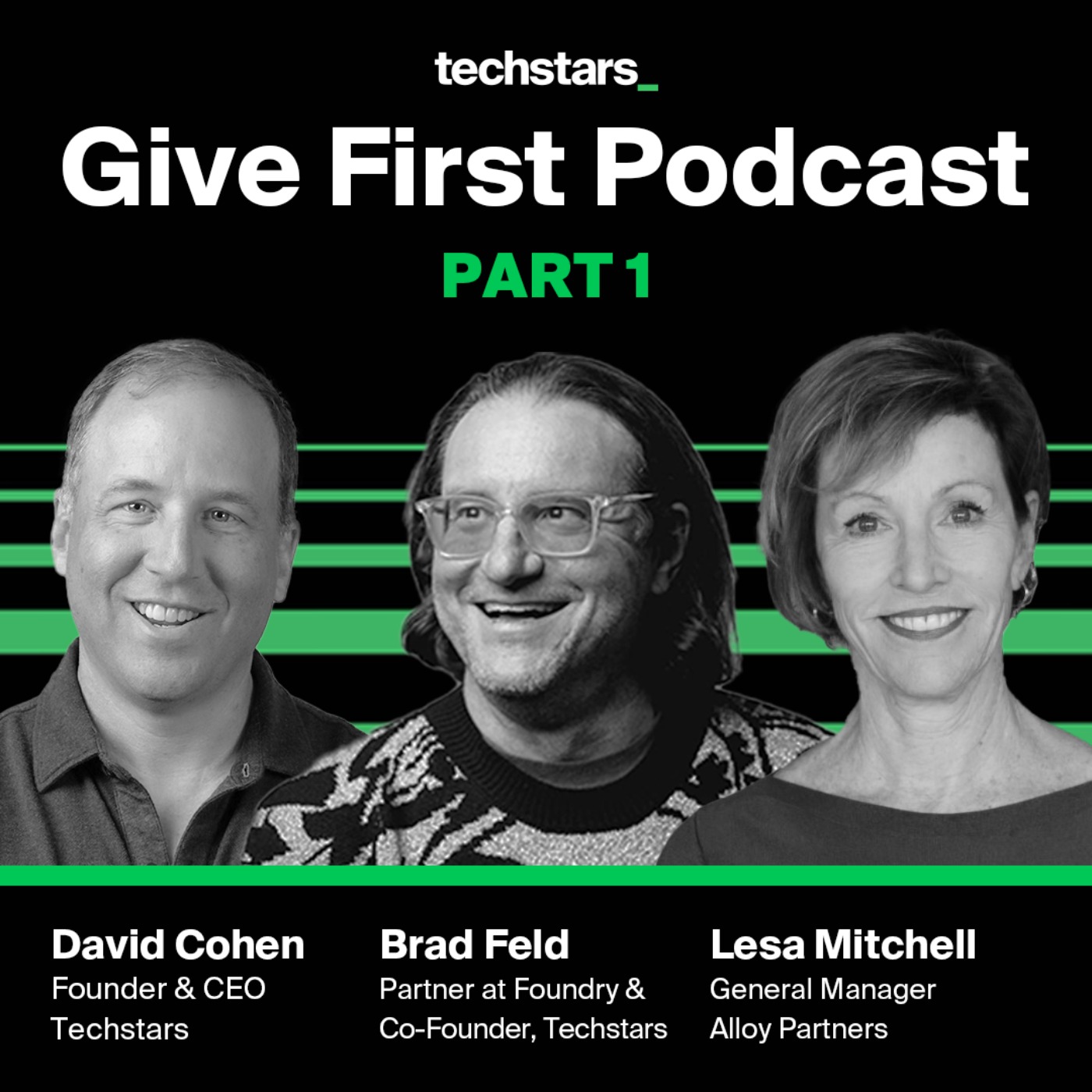
The “startup community movement” over ~35 years, focusing on how founder-centered networks (not gatekeepers) and philanthropic/foundation programs helped create high-growth entrepreneurship support systems.
Lesa Mitchell (Lisa Mitchell) worked with the Kauffman Foundation in Kansas City in the 1990s, collaborating with Jenna Matthews and others on entrepreneurship programs and gatherings; she later connects this foundation work to founder-networking models used by Techstars leadership. (Co-hosts David Cohen and Brad Feld discuss their own experiences.)
Community value compounds when founders meet regularly in confidential “forum”-style groups; foundations like Kauffman funded research and programs that shifted attention toward high-growth entrepreneurs; gatekeeping by VCs/angel groups blocks access and mentorship; networks should be porous (“no walls”).
Birthing of Giants at MIT Endicott House (Vern Harnish); EO/YEO founder criteria; Coffin Fellows and Kauffman Entrepreneur Gatherings (“Kegs”); SBIR vs venture-backed rules; EO Student Entrepreneurship Program funding a Techstars founder; Boulder’s early lack of connective tissue and VC/angel exclusion.
Written by AI. May contain mistakes.
Discussion on the history and evolution of the startup community over 35 years.
“Certain of Techstars funds own or may own in the future securities and some of the companies discussed in this podcast.”
Brad shares his early experiences with entrepreneurship and influential events.
“So I thought we'd start with a little opening history.”
Exploring how community and networking transformed the startup landscape.
“I can't remember in that first year, like the guy who was the CEO of Sam Adams Beer was one of the— Free Beer?”
Discussion on initiatives and contributions of the Kauffman Foundation in entrepreneurship.
“YEO, like YPO and other organizations have had this notion of a forum where you had this confidential group that met once a month that was sort of like a board of directors.”
Reflecting on the needs of high growth entrepreneurs and the evolution of support networks.
“And like we would get together with Jenna and often a couple of other people from the foundation.”
Learn about the unique needs and challenges faced by high growth entrepreneurs in the 90s.
“that I got exposed to, which was putting the founder at the center.”
Discover how the Kauffman Foundation changed its focus towards high growth entrepreneurship.
“But also people don't know about high growth entrepreneurship.”
Hear about the speaker's transition to Boulder and efforts to connect with the startup community.
“I mean, for me, I had moved from Boulder or moved from Boston to Boulder in 1995.”
Examine the gatekeeping role of VCs and the struggles of entrepreneurs accessing capital.
“And I didn't really know, again, I didn't know anybody.”
Explore the issues with angel investment groups and their effectiveness in supporting startups.
“And if you remember, there was a lot of focus back then on create.”
Learn about the shift from closed networks to more open community structures in entrepreneurship.
“That was my experience with the angel group, the C-Tech.”

Get the gist, explore an idea or ask about something said.
 Claude
On Give First, what are the key points of this episode?
Searching your listeningAutomatic transcript. May contain errors.
0:04David Cohen: Hi, everyone. This is David Cohen, and I'm here with my amazing co-host, Brad Feld. Hey, Brad. And this is the Give First podcast. In the startup world, Give First means simply trying to help anyone, especially entrepreneurs, without any expectation of getting anything back. So we'll be talking to mentors and founders about what Give First looks like in action and how it makes great entrepreneurship possible. We polled everyone and they said consistently that their favorite part of the show was the legal mumbo jumbo. So here it is. The following discussion is an expression of personal opinion and does not represent the opinion of Techstars or any company we discuss.
0:38David Cohen: Our conversations for informational purposes only, including any mention of securities or funds. This is not legal business investment or tax advice and is not intended for use by any investor. Certain of Techstars funds own or may own in the future securities and some of the companies discussed in this podcast. Got it?
1:00David Cohen: All right. Live from the Global Entrepreneurship Congress here in Indianapolis. I'm David Cohen, co-host Brad Feld, our special guest, Lisa Mitchell. We thought we'd spend a little time talking today, a double episode, right? We've got plenty of time. Yeah, there's no way we're going to get this in 20 minutes. No chance. We're going to try. We're going to do some kind of double episode and talk about the 35 years of the startup community movement. It's a movement. This thing's been going on for 35 years, and it's got plenty in front of it. So I thought we'd start with a little opening history.
1:36David Cohen: What was going on 35 years ago, Brad? Maybe you'll start. Well, 35 years ago, unlike today where I'm often the oldest person in the room, I was often the youngest person in the room. And the thing that I remember as sort of the starting point for me thinking about any of this stuff was in 1990. I lived in Boston. I had a little company called Feld Technologies. We were probably a dozen people at the time, about a million in revenue. and I remember seeing this thing in Inc. magazine, which I read every time it came out, every month, cover to cover. It was kind of the only thing at the time that was any source material about startups.
2:23I saw this advertisement for this thing called Birthing of Giants. And my reaction to it was a little trepidation because it actually cost some money and I hated spending money on anything because we didn't have any funding. We had to make money every month. So we were really careful with everything that I would put in the category of optional. And this was most definitely seemed like an optional thing. I applied. The requirements were you had to be a founder of a company with under 40 years old with more than a million dollars a year in revenue. Those were the requirements. We didn't quite have a million dollars in the prior year.
2:59We had like$980 ,000. Close enough. Almost. But he was under 40. But I was definitely under 40. And I applied and I ended up doing this thing at MIT Endicott House. I met a longtime friend who's been incredibly influential on so many things around startups and startup community and scale-ups, Vern Harnish. Vern was running this. And it was the very first time I was with essentially my people, where my people were other founders. I had a co-founder, Dave Jilk, but we really didn't know anybody in Boston. And all of our clients were bigger companies and things like that. And I ended up having this amazing four-day experience.
3:43And the experience was all of a sudden being in a room with 60 other people or 59 other people like me. We had a lot of content. So we had a lot of speakers come in. I can't remember in that first year, like the guy who was the CEO of Sam Adams Beer was one of the— Free Beer? Was that part of the event? I think we probably got Sam Adams Beer. You know, but a bunch of people like that. And in my class included some really legendary founders. The one that I think people will know his name is Ted Leonsis. Ted was running a company called Redgate Communications that ended up being bought by AOL, and he ended up being Steve Case's partner in the real rise of AOL.
4:29So that was my first moment. And like the experience that I had there, I remember coming back from it and just being like, wow, this is unbelievable. My roommate, ironically, was a guy named Alan Treffler. Alan was an MIT grad like I was. my company had moved into an office. Our first office was the office he had recently vacated, but I'd never met him, even though we're both in Boston. Right. So it was kind of one of those things where like spending time with this group, I was one of the smallest companies was transformative.
5:02David Cohen: So this is like your first inkling of like there's power in community. There's something about this. That led to a ton of stuff. So, and I'll just list off a few of them and sort of leads to Alisa and Kaufman, I ended up being probably about the 100th member of an organization called Young Entrepreneurs' Organization. YEO, a bunch of the people at that event, at the Birthing of Giants, were YEO members. It was a very nascent organization. Today, I don't know the number of members of EEO, Entrepreneurs' Organization, but maybe it's 25 ,000, something like that, around the world. It was kind of a small version or younger version of young president's organization, YPO.
5:47The difference was that YEO, now EO, was you had to be a founder, a million dollars a year in revenue, and under 40. YPO, they're bigger companies, 5 million in revenue, but you didn't have to be a founder. It could be a founder. So that's probably a third of them. A third of them were hired guns. So people hired as CEOs. And then a third, I won't use a derogative term that YEOers refer to as. But they were people who inherited business. And so the vibe was totally different. I ended up starting the Boston YEO chapter right after that. Like, I got to find more of these. And I ended up in Boston in the early 90s with a pretty big network of other founders.
6:33Because once you started looking around, like everybody was... You saw them everywhere. Everywhere. But Boston, obviously, was that kind of place. But nobody was connected. Like there was no, I mean, you had a few friends eventually, but like just this energy where we'd start getting together every month and then, oh, I know a person and they would come into this thing. YEO, like YPO and other organizations have had this notion of a forum where you had this confidential group that met once a month that was sort of like a board of directors. Still does. Still does. And forum was was unbelievably powerful.
7:08Along the way, I was still living in Boston. I got involved in helping start the MIT Entrepreneurship Center.
7:18My professor that I'd worked closely with at MIT, Eric von Hippel, had gotten a grant from the Coffin Foundation to do a study of how to think about setting up an entrepreneurship center at MIT. Small amount of funding, I don't know, 100 grand or something like that. And Eric kind of didn't really want to do it, so he sort of enlisted me to do it. Uh, and that's how I met Jenna Matthews. Um, Jenna was working at Coffin Foundation. She was also running a thing called Coffin Fellows, which today is a very large organization of VCs who have gone through this sort of program as their younger VCs. I started coming to Kansas City we actually had a big event at an island I think it's called Thompson Island I'd have to dig deeper but it was an island off Boston Boston Harbor that was an old prison and I remember Jana coming to this thing and she was just appalled at the facilities it was like a dormitory and we slept on like cots and it should be and Mike Kerman I think was the president Mike Kerman was the president of Coffin my mentor in life And it was definitely not a Coffin Foundation vibe experience.
8:26It was a little rougher. But we had an awesome time, like just awesome. And this sort of, for me, the energy of those formative experiences really helped me understand, not just understand, but get benefit from sort of the network and the compounding value of the network and the relationship of the network. even when things went wrong there were plenty of stuff in the early days ideas we had that didn't go anywhere things we tried that kind of fell flat lots of you know people would sort of come into the network and come into the different things and then kind of disappear there were occasionally fights between people and disagreements um but but it was this this thing that sort of grew and grew and grew and i you know to this day 35 years later some of the people from that very, very early time are still extremely close friends.
9:17I mean, one person who both of you know well, Jenny Lawton, was really part of that initial group in Boston that started to come together. Another one, Warren Katz, you know, who's been one of my best friends since the late 80s. Same kind of thing. Like, he had just started his company around that time. And they all bring their own network. They bring your own network, but they also bring their frames of references and what their aspirations are and their vision for their own companies. And all of a sudden it starts to share together.
9:45David Cohen: So it was really like kind of a single player thing back at that time. And there weren't really organized communities that you could learn from and that would help each other, invest in each other and make introductions. I think single player is a good phrase. I think it was worse than a single player game. Because when I was trying to learn about entrepreneurship, like the only stuff available was Inc. Magazine, which felt very remote to me. Like I didn't relate to the stuff, although I learned some things from it. And then like Lee Iacocca's biography, because Lee Iacocca was the legendary entrepreneur of America at the time.
10:20Like it just, you know, or Thomas Watson, like these things as a 21 year old, like, you know, what? That's what you get. That's the manual for building a startup. And so it didn't get anywhere. Lisa, talk about your entree early with Kauffman and a few of the things that link there, because that my experience with Kauffman Foundation in the 90s, I would say from about 94 to 99 or 2000. I was in Kansas City about once a month, six to nine times a year for a day or two, working with Jenna and working with a small group of people, Dan Grace, who you know well, Bill Payne, who passed a few years ago, who really became an incredible angel investor.
11:03Post-angels. Yeah. And like we would get together with Jenna and often a couple of other people from the foundation. uh trish costello costello would come occasionally wendy would come sometimes and we would just sort of sit around with other other entrepreneurs yeah um and we created things like do you remember the kaufman entrepreneur gatherings oh sure that we call them kegs yep right so kaufman kaufman was kind of formal at the time like you know you you you had to sort of be proper and like put things together and so all these people would show up in jeans and t-shirts say let's go do a keg and You know, Mike would look at us.
11:41Freak everyone out. Ray Smiler would look at us like. Oh, yeah. Well, the great historical context there is Mike Herman, who was recruited from Goldman Sachs to come and work for Mr. Kaufman, who was the consummate entrepreneur. Yep. I mean, started the oyster shells in the basement story that became pharma. And his interest was, how do I create some kind of a network of entrepreneurship in all sorts of different spaces? So you started MIT for obvious reasons, but then you move out from there. And the interest in creating the Venture Capital Fellows Program was Mike's view was, and he's a physicist by training, everybody in venture capital back then were a bunch of former investment bankers.
12:30And so therefore, how do I get technologists and others into investment banking? Jenna was behind lots of the early women's entrepreneurship, Project Diana with Babson, a number of those other things that turned out. But it was EO, YPO, you know, a number of those things that were all early funded by Kauffman. And I think it's funny that you're talking about Eric von Hippel because I think we ended up funding a bunch of his network research, which was like 10 years later or 15 years later that came out of that. So the ripple effect from Kauffman to startup communities was extreme. Well, the overlapping pieces are really fun to reflect on from a history perspective, but it also, I think, is very much the way that David and I and some of the other leadership at Techstars has thought about networks over a long period of time.
13:32I remember our first conversations in, you know, 2006, 2007, as Techstars was getting started, before we really had any sense of what it could be. And this aspirational notion of getting people just to work together around the process of creating companies. this notion that I really, I would attribute this value of mine to that early time at Kauffman that I got exposed to, which was putting the founder at the center. Yeah. I remember many meetings that we were in. We created the program that Jana created that this group that I was part of really spent most of their time on was poorly acronymed.
14:22um like keg it was poorly well no i thought keg was very well acronym what are you talking about three letters is memorable ours was uh we started calling it leapfrog at some point it was lphge that's a terrible acronym right learning programs for high growth entrepreneurs it was just awful and like i couldn't i couldn't keep a straight face every time we said it But what happened with it was fascinating in some ways, which is no one at that time in the 90s had really thought about what a high growth entrepreneur needed. Correct. It was all small business. Yeah. It was all local business, all which is valuable.
15:09And then this sort of large company innovation and even the word intrapreneurship was sort of dominant. There wasn't this like, I got a company going from a million to five million or I got a company going from, you know, 10 million to 50 million. What the fuck do I do? Like nobody had any idea who to talk to. But even in the early 2000s, from a foundation perspective, the thought process was that group was so small. High growth entrepreneurs was such a small little group that there was no reason to focus on it.
15:39David Cohen: It shows up everywhere. It still does in a lot of ways in the language, even at the government level, right? Small business administration. And the high growth entrepreneurs say, but that's not me. Like, that doesn't speak to me. Yeah. It's kind of the opposite. High growth entrepreneurs don't know what SMB is. That's right. That's right. Well, and, you know, if you think about the software industry, the technology industry at the time, you know, there was a market segmentation that Microsoft did very, very effectively. And that market segmentation today lives on as SMB. Yeah. But to David's point, that didn't really encapsulate fast-growing companies.
16:22And so even in the U.S. government, there was this program, SBIR, that was a research program that was a very, very valuable thing that venture-backed companies couldn't get. They couldn't apply to it. Because of the rules. The rules didn't allow them to do it. And they were probably the most logical ones to do it. So Kauffman was in the middle of all of those things. Talk about your own experience with the transition from sort of this first decade, 90, to the internet bubble. Internet bubble collapses. Your sort of entrepreneurship, you know, oh, yeah, we were right. We told you so, you know, all that internet stuff, hooey, whatever.
17:02We were in constant internal conversations about we need to focus on SMBs because the rest of the world focuses on SMBs. But also people don't know about high growth entrepreneurship. So the goal was, how in the world do we create more of a spotlight on high growth entrepreneur? That's why more focus on, I believe we are the long, Coffin Foundation was the longest funding sponsor of ENY Entrepreneur of the Year. Because Entrepreneur of the Year is all high-growth entrepreneurs. And bringing those 2 ,000 people together every single year for 25 years is what was going on at the time. So we were finding a lot of the research to help it all get going, but also starting to fund really smaller kind of initiatives.
17:54EO then created the EO Student Entrepreneurship Program, of which I ended up funding a Techstars founder that was a winner and exited his company in 18 months. So just shows you how great that program was. But so lots of small initiative funding because there was kind of a worry at the board level that an overfocus on high growth entrepreneurship was misplaced. And that was completely transitioning in early 2000s when leadership changed at the foundation and things changed. All right. So we're early 2000. I mean, for me, I had moved from Boulder or moved from Boston to Boulder in 1995. I knew one person in Boulder when I moved there.
18:46It was Vern Harnish. He was living there. he moved away like six months later he moved to DC and I knew nobody and Amy and I moved out there I think many people have heard this story before but she told me she was moving to Boulder and I could come with her and we've been married a couple of years so you know it was just kind of a life move it was not a go for a job or because of a reason or I won't anything in particular one of the very first things I did in Boulder when I moved there was start YO Colorado. And we're going to have YO Colorado is having its 30th anniversary this year. There's this whole effort to get a whole bunch of people together for that.
19:28And you look at the history of that arc, one of the original members, the first 10 or 15 members that came together in that first group included entrepreneurs like Jared Polis, who is now governor of Colorado, but was co-founder of Techstars. Paul Babarian, who's a longtime mentor in Boulder program, multiple companies, including many that I've funded. Jim Lajil, who was Paul's partner, one of Paul's partners at the time, who has gone on to be CFO at many other companies. Just sort of fascinating to, you know, reflect on that sort of formidable thing. And Boulder in that time period, again, 95 to 96, 97, 98, there were startups in Boulder.
20:20But there was no real connective tissue. And one of the things I observed, which I think the startup community movement has really turned upside down, was this notion of gatekeepers. Yeah. And I want to spend a little time on that because when I moved to Boulder, what I did was I had some money. I'd sold that first company. I was making angel investments. I started to think about how best to get involved in that local community. And I didn't really know, again, I didn't know anybody. So what I did was I made some angel investments, but I also invested in each of the local funds. And Boulder had a handful of local venture funds at that point.
21:00And one of the things I remember was I would, you know, get to know the VCs at each firm and they knew each other. And each one had the same pitch. we see all the best come we see all the companies here and we choose the best and that's who we fund and then i'd meet with the next one we see all the companies here and we select the best and that's who we fund and our network is the best third firm same thing and by the time i got to the third firm best access and and i had no uh i had no uh uh emotional reactions to those things because i just said great i'd love to put some money in your fund and and they all wanted me to put money in their phone.
21:36It was good. But by the time I got to the fourth one, I kind of thought to myself, what the fuck? Like, why aren't your portfolios all exactly the same? Yeah. If you're seeing everything, you're choosing the best. And yeah, so of course there was some overlap, but they were, these VC firms who are many friends of mine still, were acting as gatekeepers. And that, for me, that was really unhealthy that the VCs were a resource, but they were not the gatekeepers.
22:05David Cohen: And I was living that during that time, just as an entrepreneur, you know, building my company with David Brown, Pinpoint Technologies. We would end up selling in 99. But like the idea that you could go into the community and meet anyone else was very foreign. We were on our own. We had no mentors, no advisors, no one helping us. And really didn't even occur to us that you could raise venture capital. We didn't know how to do it. There was no information about it. So we were just bootstrapping and building the thing. But that was my experience in Boulder. I think we figured out one time, Brad, you and I moved to Boulder, I think the same month.
22:39David Cohen: Yeah. 1995-ish. Oh, well, let's decide now. We moved on November 7th as our first day. I don't have a photographic memory like you, so I have to check my, you know, my Outlook calendar or whatever it was. But, you know, I just had been living this experience of doing it alone, right? And that That was one of the formative things that went into eventually creating Techstars as well, is having had those experiences of like, there's nowhere to get help. There's nowhere to get capital. It feels very distant, the venture capital community. I don't even know how to access it. I'm not even going to try.
23:13David Cohen: That's how it felt to me as an entrepreneur. And if you remember, there was a lot of focus back then on create. I mean, we thought Coffin Foundation created the National Venture Capital or the National Angel Association. And in a way, people who were gatekeepers then were part of organizations that became gatekeepers. If you were part of a network, it probably was harder to get in. Well, it was also sort of even antithetical to the notion of network. I remember there was an angel thing in Boston when I came to Colorado. Eventually, by the late 90s, I ran into a couple of different organized groups.
23:58And there was value to them, but they were actually kind of exclusionary groups. Right. They didn't welcome anyone. You kind of had to be a certain something to get into them. And then as a founder of a company, it was always an opposite. You had to go to a society and get somebody to put you in. Yeah, they didn't. It wasn't the other way around where it's like, OK, we, you know, back to this notion of existing to help founders succeed. They didn't exist to help founders succeed. They had some other goal. And in some cases, and I know, you know, I know the spectrum of everything is that one end is really bad.
24:39The other end is really great. I mean, at the spectrum end of really bad, there would be angel groups that would meet once a month. And you say to them at the end of the year, how many deals did you do? And the answer was none. Yeah. And so really all they were, we had a lot of boys.
24:53David Cohen: That was my experience with the angel group, the C-Tech. That was the group in Colorado. And, you know, after I had sold that company in 99, started getting interested in angel investing and went to this group. And it was, yeah, it was tiny sandwiches and little champagnes and laughing at the startups. It wasn't really investing in them. So when we started making investments, it was like unusual that people would do that. Yeah. It's kind of like we move from the era of high walls to the next era, which is porous boundaries. Yeah, or no walls. Yeah, or no walls. No walls. Why don't we break here for episode two?
25:29We're going to cut the double episode right here.
25:30David Cohen: Right here. This is a good— Brad has to pee, everyone. So we're going to cut the upstate right here. I need to uncross my legs and cross the other ones because they're getting tired. No, let's stop here because I think that's a good stopping point, which is kind of—we got to about 2006, 2007. You know, tech is starting to come back. There's still no seed funds anywhere except maybe a couple. You know, people are talking about things. So the question is, what happens next? Stay tuned. Thanks a lot for listening to the show today. We'd love to hear your feedback, ideas, or who you'd like to hear next on Give First.
26:07David Cohen: And please leave a rating and review, ideally a good one. and reach out anytime to podcasts at techstars.com or on Twitter, I'm at David Cohen. See you next time. Don't forget, give first.
In this special episode of the Give First podcast, David Cohen and Brad Feld go deep with Lesa Mitchell on the 35-year evolution of the startup community movement. Recorded live at the Global Entrepreneurship Congress, they reflect on the early days of entrepreneurship support—from the founding of EO and early angel networks to the ripple effects of the Kauffman Foundation.
Together, they explore the rise of startup ecosystems, the shift from gatekeepers to networks, and how placing founders at the center reshaped everything. Brad shares pivotal moments from Boston to Boulder, Lisa brings insider context from Kauffman’s legacy, and David reflects on how it all led to Techstars. It's a look back,—and a look forward,—at the movement that transformed how startups start.
Follow David Cohen on LinkedIn and Twitter
Follow Brad Feld on LinkedIn and Twitter
Listen & subscribe to the Give First podcast on Apple Podcasts, Spotify, and more.
Hosted on Acast. See acast.com/privacy for more information.