Ask ChatGPT
 Harvard Business Review
2 Jul 2026 · 7m · 1 chapter
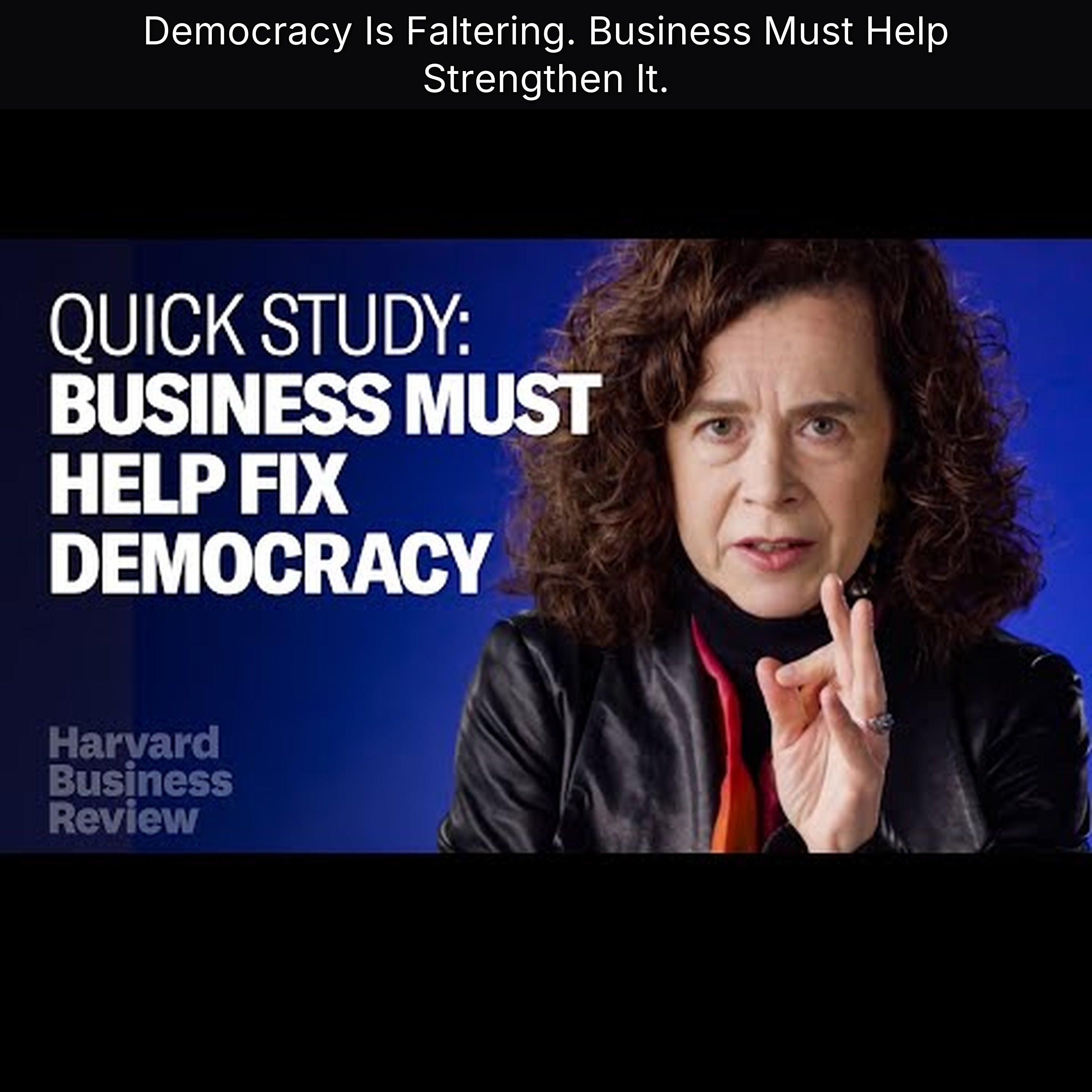
Democracy is faltering as government is downgraded, civil society fragmented, and business becomes the dominant voice; this imbalance risks populism turning into autocracy and attacks on rule of law. The host argues business must help strengthen democracy.
No guests are mentioned; the episode is presented as a monologue by Rebecca (explicitly addressed as “Rebecca” to a student).
Healthy societies balance business, government, and civil society with checks from free media and courts. Uncontrolled markets and uncontrolled populism are dangerous. Autocracies harm business by making growth risky and licensing/starting businesses harder, often requiring payoffs.
“Mussolini made the trains run on time” is used as an argument about perceived efficiency. A friend (“Peter,” real name withheld) in an East European country says he can’t expand because authorities may seize the business.
Written by AI. May contain mistakes.
Explores the current challenges to democracy and the role of business in addressing them.
“I hear more and more people saying, well, maybe what China is doing isn't so bad.”

Get the gist, explore an idea or ask about something said.
 Claude
On Harvard Business Review, what are the key points of this episode?
Searching your listeningAutomatic transcript. May contain errors.
0:00When you need to build up your team to handle the growing chaos at work, use Indeed Sponsor jobs. It gives your job post the boost it needs to be seen and helps reach people with the right skills, certifications and more. Spend less time searching and more time actually interviewing candidates who check all your boxes. Listeners of this show will get a$75 sponsored job credit at Indeed.com slash podcast. That's Indeed.com slash podcast. Terms and conditions apply. Need a hiring hero? This is a job for Indeed sponsored jobs. This episode is brought to you by Google Chrome. You think you know a browser, but Gemini and Chrome?
0:36That's new. It can help you with practically anything on the web, like restoring a vintage motorcycle from a 50-page restoration block, or finally break down that long article you've had open for weeks. Gemini and Chrome is here for it. Ready to make anything online make sense? There's no place like Chrome. Check responses set up required, compatibility and availability varies 18+. Things are pretty bad. Democracy's in trouble. I hear more and more people saying, well, maybe what China is doing isn't so bad. What's so great about democracy? There's an increasing perception that elites run the show.
1:11A lot of people think that their vote doesn't matter. And all this talk about democracy is just talk. And that's really scary. So why do we need democracy? So in healthy societies you typically have a balance between business and the free market, a strong well-run government and a strong civil society, often supported by unions or organised labour, but some way of giving ordinary people a voice. And those three hold themselves in check, supported by free media and free courts. And one way to think about it is everyone is busy watching everyone else, so nobody gets too powerful, and you're kind of working it out.
1:54You're always in this balance between how much public goods, how much government, how much business. You're always having that conversation. And one way to understand our current moment is that government has been systematically downgraded and despised. Civil society has been systematically fragmented. There is hardly any voice for labour or voice for ordinary people now, so business is by far the strongest voice in the room.
2:25I think some people have a fantasy that you could just do away with government, that market could completely self-regulate and we'd be good. It really is not going to happen. Completely uncontrolled markets are very, very dangerous. Let's take inequality. Capitalism generates inequality. If you're a capitalist, inequality is a feature, not a bug. You work hard, you get rich. That's excellent. But past a certain point when you get so much richer than everyone else and everyone at the beginning at the bottom can no longer play, that threatens the foundations of our society. If we don't have a government that can deal with those issues in a way that is fair and transparent, what we will get, what we are getting is a push for populism.
3:11When it begins, a push for populism is a sort of listen to me, respond to me, make it work. There's nothing wrong in a sense with a populist impulse, but uncontrolled populism leads to autocracy. I don't care if they're Mother Teresa or the Dalai Lama. You give anyone that much power without checks and balances, and what you get is tyranny. What you get is a move away from democracy and an attack on the rule of law. We've seen this movie before and it doesn't end well.
3:48So sometimes people say to me, well, yeah, you know, I don't really care about free speech and autocratic regimes, they're much more efficient. Mussolini made the trains run on time. You know, I know the tyrant, he's not going to bug me. OK, why should you care about this as a business person? First, if you're friends with a tyrant now, you might not be in five or ten or twenty years. Under an extractive regime, it's all about making money for the people at the top and their friends and relatives. And if you're not a friend and relative, you can't play. Suppose you're a small entrepreneur. Try getting a license to start a new business.
4:25It gets harder and harder to start a business without paying people off. When you have autocracies running things, your skill as a business person puts a target on your back. I have a friend in one of the East European countries who's built a small business. And he's incredibly proud of it. And I asked him recently, I said, you know, Peter, not his real name, I said, Peter, how's it going? He said, we're going really well. But I can't make my business bigger. If I do, they will take it from me. That's what happens when the democracy goes.
5:00I think business has both an economic interest and a civic duty to fix the system. How might this happen, you're probably thinking. Give your employees time off to vote. Or another concrete thing you can do as a business person right now is stop talking about government as always and everywhere the problem. Start acknowledging that we need strong government. Absolutely, government has to be transparent and responsive, but the idea that we could just live without government is just a fantasy. Business uncontrolled is just as dangerous as government uncontrolled. and it's just as dangerous to business.
5:40If you as a capitalist care about prosperity and freedom, you should care about a democracy. Once I was trying to explain to a group of students why democracy was so important, and a student came down to me and he said, but Rebecca, isn't government tyranny? I said, well, if you don't vote for it, it is.
6:27We'll be right back. Details. Milo's money expires 30 days after issuance. Subject to change. Credit offer subject to credit approval. Close your eyes, exhale, feel your body relax, and let go of whatever you're carrying today. Well, I'm letting go of the worry that I wouldn't get my new contacts in time for this class. I got them delivered free from 1-800-CONTACTS. Oh my gosh, they're so fast. And breathe. Oh, sorry. I almost couldn't breathe when I saw the discount they gave me on my first order. Oh, sorry. Namaste. Visit 1-800-CONTACTS.com today to save on your first order. 1-800-CONTACTS. Mr.
7:05Monopoly here. Miss me? Monopoly is back at McDonald's with millions of prizes. A 2027 cheap charity. A Carnival Cruise vacation. Gift cards from DoorDash and Best Buy. He'll then play in the McDonald's app. Get your bag. No purchase necessary. 50 U.S. and D.C. age 18+. See play at mcd.com for rules and play at mcd.com slash amoe for info and playing without purchase by mail by November 2nd. Chance card game ends November 8th. Game ends November 22nd, 2026. See rules for prize details. Monopoly is a registered trademark of Hasbro.
Democracy Is in Trouble. Business Must Help Fix It.
27 Jul 2020
---
Strengthening democracy is the only way to ensure the survival of free-market capitalism.
Recent survey data paints a sobering picture: Fifty-five percent of Americans say that their democracy is “weak,” and 68% fear it is getting weaker. Roughly half agree that America is in “real danger of becoming a nondemocratic, authoritarian country.”
If government is the counterweight to the free market, democracy is the force that ensures that governments do not devolve into tyranny, seizing control of the markets in the process.
The business community has played an important role in strengthening democracy and in rebuilding society in countries as diverse as Chile, South Africa, and Germany. It can happen again, but only if business leaders understand the extent to which free markets depend on democratic governments — and only if they are willing to stop actively destroying them.
---------------------------------------------------------------------
At Harvard Business Review, we believe in management. If the world’s organizations and institutions were run more effectively, if our leaders made better decisions, if people worked more productively, we believe that all of us — employees, bosses, customers, our families, and the people our businesses affect — would be better off. So we try to arm our readers with ideas that help them become smarter, more creative, and more courageous in their work. We enlist the foremost experts in a wide range of topics, including career planning, strategy, leadership, work-life balance, negotiations, innovation, and managing teams. Harvard Business Review empowers professionals around the world to lead themselves and their organizations more effectively and to make a positive impact.
Sign up for Newsletters: https://hbr.org/email-newsletters
Follow us:
https://hbr.org/
https://www.linkedin.com/company/harvard-business-review/
https://www.facebook.com/HBR/
https://twitter.com/HarvardBiz
https://www.instagram.com/harvard_business_review
Learn more about your ad choices. Visit megaphone.fm/adchoices