 Harvard Business Review
4 Oct 2026 · 9m

 Add vo to ChatGPT or Claude to ask about everything you hear
vo listened to this episode to put together the overview and transcript, so there may be the odd mistake.
The episode argues that U.S. two-party politics functions like a “win-lose” industry dominated by a duopoly (Republicans and Democrats) that benefits rivals even when voters (“customers”) lose. Using Harvard Business School professor Michael Porter and former CEO Catherine Gale’s Five Forces lens, it claims polarization keeps voters loyal, reduces accountability, and co-opts media/advertising and candidate/lobbyist “suppliers.” It also argues barriers to entry are intentionally reinforced, citing no new major party since 1854 and that plurality voting discourages new entrants. The proposed fix is “Final Five” voting: a nonpartisan top-five primary plus ranked-choice voting in November to require majority support.
the 1854 party-entry claim; ranked-choice vote transfers until someone exceeds 50%.
0:00When you need to build up your team to handle the growing chaos at work, use Indeed Sponsored jobs. It gives your job post the boost it needs to be seen and helps reach people with the right skills, certifications, and more. Spend less time searching and more time actually interviewing candidates who check all your boxes. Listeners of this show will get a$75 sponsored job credit at Indeed.com slash podcast. That's Indeed.com slash podcast. Terms and conditions apply. Need a hiring hero? This is a job for Indeed sponsored jobs. Fall has never looked or tasted this good. Sweet Green's fall harvest menu is back with seasonal favorites dressed to impress and made to be devoured.
0:41Warm roasted sweet potatoes, crisp apples, maple glazed Brussels and crave worthy flavors in the autumn harvest bowl, maple glazed salmon plate and roasted bacon Brussels side. The season's most desirable menu has returned to Sweet Green featuring fall's best dressed. Make your move. Order on the Sweet Green app. Healthy competition. It's typically what propels businesses to make better products and services. Better products and services equal happier customers, and happy customers equal happy businesses. Win-win. But what if I told you there was a booming$16 billion US industry that thrives off a win-lose scenario?
1:18An industry where customers are perpetually dissatisfied and new competitors don't stand a chance. This industry has not only been dominated by a duopoly, that is just two players, for the last 150 years, but the industry itself threatens overall American competitiveness and social progress. You think that industry would never survive? Welcome to U.S. two-party politics. When former CEO Catherine Gale and Harvard Business School professor Michael Porter took a fresh look at U.S. politics as if it were an industry, they applied Porter's famous Five Forces Framework to assess its competitive health.
1:54The dynamics between rivals, buyers, suppliers, new entrants, and substitutes are what keep any healthy private sector industry on its toes. However, in the U.S. politics industry, Gail and Porter found unhealthy competition in which the rivals, Republicans and Democrats, do well even if the customers, citizens and voters, lose out. They were also surprised to discover that US politics, while dysfunctional, really isn't broken. In fact, it's doing exactly what it was designed to do. You see, the rules of the system have been intentionally created by and for the entrenched duopoly of Republicans and Democrats to keep themselves in power.
2:33They divide their customers, the public, up according to partisan interests. This polarization ensures customer loyalty and reduces accountability. Each party competes to reinforce the division instead of delivering real solutions that would require compromise. Moreover, channels for reaching customers like media coverage and advertising and suppliers like candidates and lobbyists have been co-opted to serve the duopoly's agenda. And most customers have very limited influence, primarily because the threat of competition is almost non-existent. The barriers to entry facing new competitors like a new political party or substitutes, such as independence, are colossal.
3:13And the two rivals actually cooperate to strengthen those barriers. Case in point, no new major political party has emerged since 1854, despite widespread dissatisfaction with the two parties. And yet, the problem is bigger still. The polarization not only affects who gets elected, it also affects what elected officials do once in office, since every decision is driven by the next increasingly partisan election. Lawmakers vote accordingly, resulting in less bipartisanship, less compromise, and even less getting done in the public interest. Because there's no new competition, there's no accountability for this failure.
3:51If politics was run like a free market industry, more competitors, especially innovative ones, could have threatened the Republicans and Democrats duopoly long ago. This made Gail and Porter wonder, could free market principles help redesign this failing system that seems so set in stone? The answer was a resounding yes. In fact, they found an achievable nonpartisan solution that targets the root of unhealthy competition. Revamp our elections with a Final Five voting model, an experiment already underway in a handful of US cities and states. The first order of business is to broaden the field of candidates.
4:27To do so, we would replace our current party-controlled primaries with a single nonpartisan top five primary, open to anyone regardless of party registration. All candidates from any party, including independents, would appear on the same ballot. Up to five top finishers, regardless of partisan affiliation, would advance to the general election. Then in November, these five candidates would face off with the winner selected by ranked choice voting. To back up, we currently have plurality voting, where the winner is whoever gets the most votes, but not necessarily a majority. Not only can someone be elected with minimal actual support, but plurality voting creates disincentives for new entrants to compete for fear of spoiling the election by pulling away votes from ideologically similar candidates.
5:14By contrast, with ranked choice voting, candidates must receive majority support to win an election. Here's how it would work. Your general election ballot has the names of the five primary winners. You pick your favorite, but, so no votes are wasted, you also make a second, third, fourth, and fifth choice. After the polls close, the first place votes are counted. If one candidate receives more than 50 % of the first place votes, a true majority, the election is over. But what if one candidate gets only 33 % and the next closest candidate gets 32 %? In today's plurality voting system, the candidate with 33 % of the vote would win.
5:53But with ranked choice, the election isn't over yet. In this scenario, the candidate in last place is eliminated and those votes are automatically transferred to each voters second choice. Votes are continually redistributed until enough votes push a candidate over the 50 % threshold to win with the broadest possible support. By opening the field to new and dynamic competition, Final Five voting bakes accountability, results, and innovation into the system. With a steady supply of potential new entrants or substitutes, legislators will have renewed incentive to innovate and deliver results. Their customers, the citizens and voters, are now empowered to hold them accountable at the ballot box.
6:35Healthy competition would flip our win-lose system into a win-win that benefits not only all the players involved across the political spectrum, but American economic competitiveness overall. Business leaders would stand for nothing less in their own organizations. Why should Americans accept such failure where it matters most?
7:21We'll see you next time. Close your eyes, exhale, feel your body relax, and let go of whatever you're carrying today. Well, I'm letting go of the worry that I wouldn't get my new contacts in time for this class. I got them delivered free from 1-800-CONTACTS. Oh my gosh, they're so fast. And breathe. Oh, sorry. I almost couldn't breathe when I saw the discount they gave me on my first order. Oh, sorry. Namaste. Visit 1-800-CONTACTS.com today to save on your first order. 1-800-CONTACTS. Afternoon glare totally ruined my watch party for the big game. That's when my buddy recommended Blinds.com. With custom window treatments made to fit your style, space, and budget, customers who shop at Blinds.com experienced overwhelming satisfaction.
8:12Side effects may include a fuller, deeper night's sleep and the sudden urge to host the watch party again. Blinds.com isn't a medication, but it can improve how you feel about your home. Visit Blinds.com to order your free samples today.
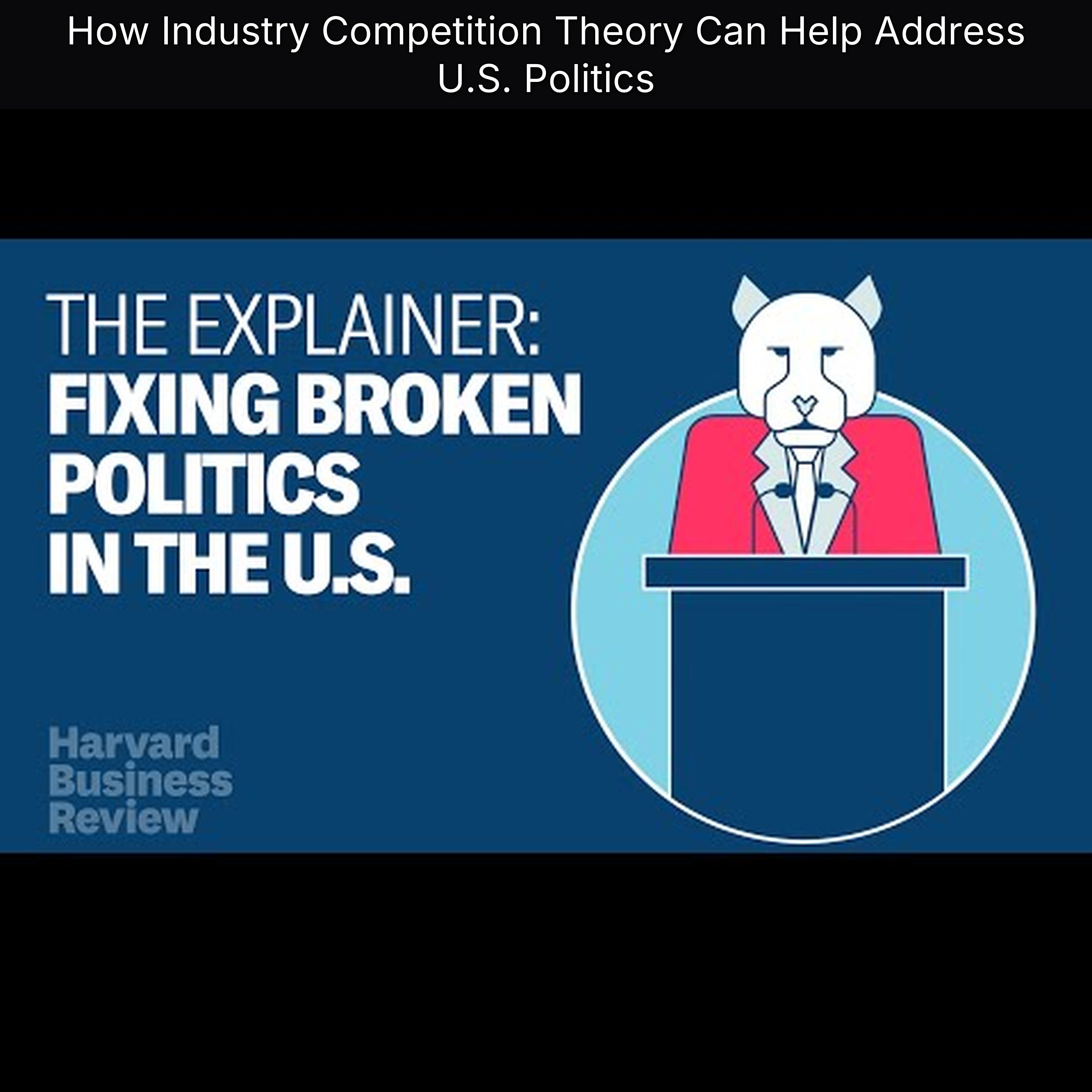
How Industry Competition Theory Can Help Fix U.S. Politics
26 Oct 2020
---
Unhealthy competition is at the root of political dysfunction. Applying a famous business framework can help identify the best ways to fix it.
Although people tend to think of the American political system as a public institution based on high-minded principles, it’s not. Politics behaves according to the same kinds of incentives and forces that shape competition in any private industry.
Our elections and our legislative systems are drowning in unhealthy competition: The political-industrial complex wins, and the public interest loses. Business, in pursuing its short-term interests, has become a major participant in the politics industry, exacerbating its dysfunction.
We can have healthy competition in politics—results, innovation, and accountability—by redesigning how we vote to connect acting in the public interest with getting reelected. Katherine Gehl's application of Michael Porter’s Five Forces framework illuminates the root causes of political dysfunction and points to the most powerful levers for transformation.
For more, see Katherine Gehl and Michael Porter's book, "The Politics Industry: How Political Innovation Can Break Partisan Gridlock and Save Our Democracy", at https://amzn.to/2HB12Cu
---------------------------------------------------------------------
At Harvard Business Review, we believe in management. If the world’s organizations and institutions were run more effectively, if our leaders made better decisions, if people worked more productively, we believe that all of us — employees, bosses, customers, our families, and the people our businesses affect — would be better off. So we try to arm our readers with ideas that help them become smarter, more creative, and more courageous in their work. We enlist the foremost experts in a wide range of topics, including career planning, strategy, leadership, work-life balance, negotiations, innovation, and managing teams. Harvard Business Review empowers professionals around the world to lead themselves and their organizations more effectively and to make a positive impact.
Sign up for Newsletters: https://hbr.org/email-newsletters
Follow us:
https://hbr.org/
https://www.linkedin.com/company/harvard-business-review/
https://www.facebook.com/HBR/
https://twitter.com/HarvardBiz
https://www.instagram.com/harvard_business_review
Learn more about your ad choices. Visit megaphone.fm/adchoices
Scan the code with your iPhone camera
Listen in the app.