 Ask ChatGPT



How to resolve remote workplace conflict by reducing misinterpretation from text-based communication and improving conversation quality.
No guests are mentioned in the transcript.
Remote conflict is harder because we lack in-person nonverbal cues, so we misattribute intent (e.g., “rude email,” “left out of a meeting”) using reflexive judgments, then build confirming stories. To counter this, pause, seek a logical, generous interpretation, admit you don’t know the other person’s situation, and focus on the underlying business/task/process disagreement and shared goals rather than personal dynamics.
The speaker contrasts email/Slack/text (low “fidelity”) with higher-synchronicity options like video or even phone calls; they also describe a child example where resolving disagreements with a friend strengthened their bond.
Written by AI. May contain mistakes.
Exploring how remote work affects communication and misinterpretation.
“The number one thing that we don't have now that we do when we're in person is the sort of casual walk by someone's desk, check out how they're responding in a meeting.”
Strategies for thinking through conflict before engaging with others.
“I feel a little uneasy, like, oh, is that threatening to me?”
Evaluating the effectiveness of different communication mediums for conflict.
“You know where a horrible place to have a difficult conversation is?”
How navigating disagreements can strengthen relationships over time.
“There's some people who would even say having a phone conversation is better than video.”

Get the gist, explore an idea or ask about something said.
 Claude
On Harvard Business Review, what are the key points of this episode?
Searching your listeningAutomatic transcript. May contain errors.
0:00You know, it's funny, I was always the kid, like, when a fight broke out on the playground that was like, fine! I just always found people clashing, sort of trying to sort things out, get their needs met, try to communicate well. Like, I always just found that really interesting.
0:16Amy Gallo: I mean, conflict is a normal, inevitable part of interacting with human beings. The number one thing that we don't have now that we do when we're in person is the sort of casual walk by someone's desk, check out how they're responding in a meeting. We don't get all those informal, nonverbal cues that we used to get when we were in an office together. When we're remote, we are often communicating with text-based communication mediums. So that might be Slack or email or even text message. Those types of communication are ripe for miscommunication, for misunderstanding. We tend to misattribute other people's words and actions.
1:05Our brains, when we're making judgments, was that email rude?
1:09Amy Gallo: Did that person leave me out of that meeting? We're making those with our reflexive, non-conscious brain. That's the part of our brain that we use to assess whether our environment is safe, whether there are any threats. When we are able to then access our conscious part of our brain, we then use that to actually build the story that confirms the judgment we make. So the email comes in. I feel a little uneasy, like, oh, is that threatening to me? I then look for details that prove that this person has some negative intention. And then I'm going to sort of tell myself a story about why that person did that that reinforces my instinctive interpretation of it.
1:55If you think you're getting into a conflict with someone, the very first thing you want to do is take time to think it through. And this is one of the great benefits of being in a remote setting. You don't necessarily have to see that person right away.
2:09Amy Gallo: Because your instinct is likely going to be telling yourself a negative story about the other person, you really have to counter that by asking yourself, what would a logical, generous interpretation of their behavior be? We're working in a pandemic here. People are under pressures that we don't always understand. Admit to yourself that you don't truly know what's going on for that person. when you're actually starting to have the conversation it's really not helpful to focus on the interpersonal dynamic usually there's an underlying business issue a task conflict a disagreement over the goal or a process conflict what is it that you actually need to get done and what is it you have in common what is your shared goal that's a much better place to start a discussion from, then I think you're a mean person or you've been a passive aggressive jerk.
3:06You know where a horrible place to have a difficult conversation is? Over email, Slack, or text. You can use all the emojis in the world, but you're not going to convey the same emotion and detail that you would convey with even just the tone of your voice.
3:22Amy Gallo: it's best to increase the fidelity of that conversation. Raise the synchronicity, so we're having the conversation at the same time. Raise the amount of interaction it requires. Now, video helps that, but it doesn't quite reach that same level. There's a lot we miss with video. Sometimes the sound isn't right. Sometimes you see yourself. There's just so much going on. There's some people who would even say having a phone conversation is better than video. Sometimes a phone call actually lets you really focus in on that person and really hear what they're saying and be able to articulate what you want to say without distraction.
4:04When you have a disagreement with someone and you get to the other side, you tend to have a stronger relationship. In the process of resolving a disagreement, we've had to share assumptions. We've had to explain our thinking. We've had to maybe be vulnerable. I've seen this with my daughter when she was younger. She would go to her best friend Sophie's house. They would have a sleepover. They would come home. She'd come home and she'd say, it was a great time. Sophie and I fought the whole time. We disagreed about what movie to watch, where to sleep, whether her brother should be involved in our game.
4:42and I would ask, you know, why was that fun? And she said, well, because now Sophie and I are BFFs. Going through a difficult time together
4:53Amy Gallo: does tend to form a stronger bond.
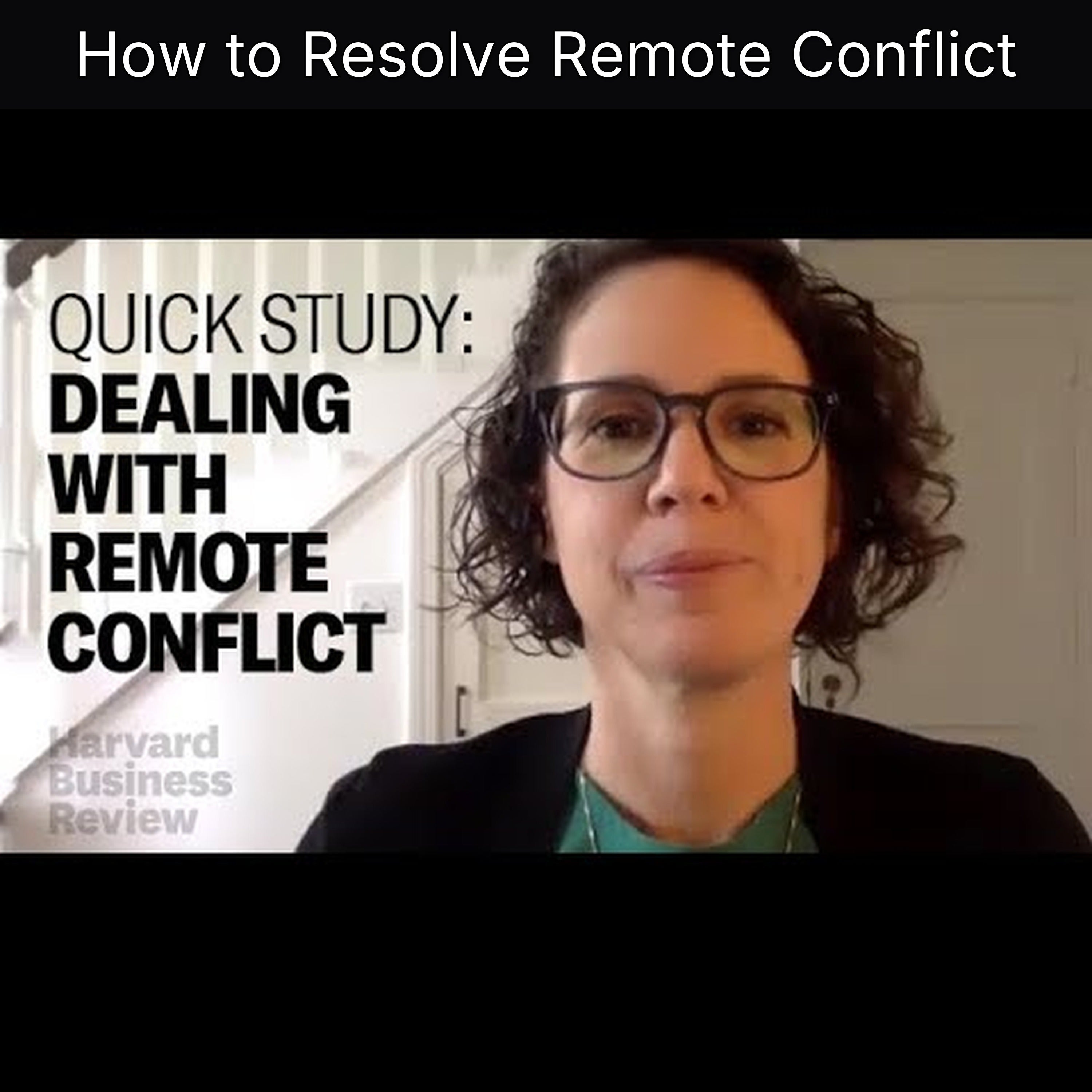
How to Deal with Remote Conflict
20 Oct 2020
---
Disagreements between work colleagues can get even more uncomfortable and tricky to navigate when you can’t work them out in person.
Amy Gallo, author of the “HBR Guide to Dealing with Conflict”, explains why conflicts are more likely to escalate through text-based communication, and says that even in the Zoom-era a phone call may be the best solution. She also points out that there can be upsides to having to resolve differences remotely.
---------------------------------------------------------------------
At Harvard Business Review, we believe in management. If the world’s organizations and institutions were run more effectively, if our leaders made better decisions, if people worked more productively, we believe that all of us — employees, bosses, customers, our families, and the people our businesses affect — would be better off. So we try to arm our readers with ideas that help them become smarter, more creative, and more courageous in their work. We enlist the foremost experts in a wide range of topics, including career planning, strategy, leadership, work-life balance, negotiations, innovation, and managing teams. Harvard Business Review empowers professionals around the world to lead themselves and their organizations more effectively and to make a positive impact.
Sign up for Newsletters: https://hbr.org/email-newsletters
Follow us:
https://hbr.org/
https://www.linkedin.com/company/harvard-business-review/
https://www.facebook.com/HBR/
https://twitter.com/HarvardBiz
https://www.instagram.com/harvard_business_review
Learn more about your ad choices. Visit megaphone.fm/adchoices