
 Harvard Business Review
30 Jun 2026 · 8m

 Add vo to ChatGPT or Claude to ask about everything you hear
vo listened to this episode to put together the overview and transcript, so there may be the odd mistake.
The episode argues against giving employees full freedom to choose which days they work from home in hybrid workplaces, claiming it causes “mixed mode,” diversity/promotion inequities, legal risk, and office planning failures.
No guests are mentioned; the speaker is presenting the argument directly.
Full choice leads to mixed-mode meetings and “in groups/out groups.” Choice is not random—college-educated women with young kids, disabled people, people far from the office, and low-income workers disproportionately choose WFH, while others may come in more. This can reduce promotion rates (cited: WFH workers had half the promotion rate of in-office workers) and create diversity and legal risks. Team-by-team choice risks “great unraveling” (teams backslide unless enforced). Example: Apple sets fixed in-office days (Mon, Tue, Thu) and WFH (Wed, Fri).
0:00When you need to build up your team to handle the growing chaos at work, use Indeed Sponsored Jobs. It gives your job post the boost it needs to be seen and helps reach people with the right skills, certifications and more. Spend less time searching and more time actually interviewing candidates who check all your boxes. Listeners of this show will get a$75 sponsored job credit at Indeed.com slash podcast. That's Indeed.com slash podcast. Terms and conditions apply. Need a hiring hero? This is a job for Indeed Sponsored Jobs. This episode is brought to you by Google Chrome. You think you know a browser, but Gemini and Chrome?
0:36That's new. It can help you with practically anything on the web, like restoring a vintage motorcycle from a 50-page restoration block, or finally break down that long article you've had open for weeks. Gemini and Chrome is here for it. Ready to make anything online make sense? There's no place like Chrome. Check responses set up required, compatibility and availability varies 18+. one thing we know by this point is the future of working from home is hybrid which means sometimes spent in the office and sometimes spent at home the most controversial question about hybrid is how much choice you should give individual employees about how many days they work from home and the big change for me has been if i look back i thought what would be great is to let every employee choose what they want to do so like a menu if you run things forward to july august 2021, I've spoken to hundreds of organizations and come to the conclusion that full choice isn't a good thing.
1:30The first reason for being concerned about people choosing which days is mixed mode. Mixed mode is this horror whereby there's six of you in a meeting, three are at home in individual Zoom boxes and the other three in the office in one similar size Zoom box with their tiny heads. You can see they're talking. Something happens in some controversial statement and there's whispering, there's people smiling. It's just, I've heard over and over again from companies mixed mode is horrible. However you set it up, even if you make everyone in the office connecting on their own laptops, go to cubicles, cert fields, even, you know, after the end of any controversial meeting, you at home close your laptop.
2:06The three folks that are working and close their laptops stand out of their cubicles and carry on the discussion, go grab a coffee, talk about it over lunch. So mixed mode almost always seems to lead to in groups and out groups. The second reason for being concerned about people choosing their days were the issues around diversity. If you look at who wants to come in on which days, it's not random. We've surveyed 50 ,000 working-age Americans. In the data, we see that college-educated women with young kids, disabled people who want to work from home, more people living far from the office, low-income people that can't afford transport.
2:42Put simply, this various subset of people that are going to end up choosing if you give the choice to work from home let's say four or five days a week so in many ways that makes total sense and we want that flexibility the tricky thing is if they're doing that and other groups let's say single young men living next door going to come in five days a week you can see this is going to lead to a huge diversity crisis because when you have teams whereby some folks are working from home four or five days a week other folks are coming in full time there's a big disparity in promotion in one study folks working from home had half the rate of promotion of those being in the office so So if you let people choose in the short run, they're potentially really happy.
3:19They work from home four or five days a week. In the long run, a lot of people may not realize that that's going to lead them to get left behind and the promotion may get frustrated. It's a huge issue for managers, for diversity. And of course, it's a legal risk for firms in the long run. So the two choices, really, the team-based approach, whereby each team decides, but within the team, everyone has the same days. and then there's the company decides. Apple, for example, recently announced everyone's going to come in Monday, Tuesday, Thursday, work from home Wednesday, Friday. Team by team has the upside of choice.
3:52You can tell each team manager. You get to choose which days you come in for your team. It gives employees a sense of input and control. But there are a couple of problems with this. The most immediate problem, I think, is use of space. We surveyed 50 ,000 people and asked them which days they'd like to work from home. you'll not be surprised to know that it's basically Monday, Friday. So everyone says they want to work from home Monday, Friday. Well, it's a problem if you're a firm and you're trying to either save an office space or you're trying to reduce density because people don't want to be crushed in elevators and lobbies.
4:25So either way, if you have the office empty on Monday, Friday, that doesn't make sense. So that's one problem with letting people choose team by team. Second problem with letting teams decide versus letting the center decide is what's called the great unraveling. So that's pretty easy to see. Some teams could say, look, we're all going to work in the office three days a week, except the CEO decides to come in for that extra fourth day. Then the folks reporting to the CEO comes in and then the folks reporting to the folks reporting to the CEO come in and the whole thing unravels. So it's actually critically important, not just to say you're allowed to work from home three days a week, is actually you have to work from home three days a week.
5:02Otherwise you have some risk of backsliding. The interesting thing is when I put the piece out and I got a ton of angry emails, on the one hand, yes, for some people, they're quite upset about it. They want to choose which days. On the other hand, it feels a bit like trying to take the longer run view on things. And it's important to note for employees that, look, hybrid is great, but we do need to make a success of it. So if instead we say, let's have this free for everyone chooses which days. The thing is, frankly, a disaster. People are coming in. There's mixed mode problems and in groups and out groups.
5:34and you know diversity crisis and the office is crushed on Wednesday most employers are going to say look you just can't run a business like this you guys are going to come in five days a week and we're just going to abolish hybrid it doesn't work I feel right now is to do the exact reverse of that old Silicon Valley saying of go fast and break things we are in a completely revolutionary world with this hybrid working is completely new so as a result I'll do something boring vanilla I think hybrid when we come in three days a week where it works well and people are generally happy that's kind of low risk.
6:05And importantly, you make sure folks that are working from home on Wednesday and Friday really do that. And there was no backsliding. So it feels painful to do it, but some ways I'm like bank the gains that we have, make that work, maybe build off that rather than try and go, you know, something that seems the first best, but in all reality, isn't gonna work. But keep your ears open and your mind free and collect data, continue to talk to customers and employees and see what works.
6:52Fall never arrives all at once. First the air, then the light, and slowly the things you love begin to find each other. A jacket meets a dress. A hoodie slips beneath a blazer. An old cap finds a new scarf. Because you don't simply step into the season. You create it layer by layer until it finally feels like fall. Find fall your way at Ross.
7:21Afternoon glare totally ruined my watch party for the big game. That's when my buddy recommended Blinds.com. With custom window treatments made to fit your style, space, and budget, customers who shop at blinds.com experienced overwhelming satisfaction side effects may include a fuller deeper night's sleep and the sudden urge to host the watch party again blinds.com isn't a medication but it can improve how you feel about your home visit blinds.com now to save up to 50 off site-wide during our annual fall blowout sale ryan reynolds here from mint mobile i don't know if you knew this but anyone can get the same premium wireless for 15 a month plan that I've been enjoying.
7:59It's not just for celebrities. So do like I did and have one of your assistant's assistants switch you to Mint Mobile today. I'm told it's super easy to do at mintmobile.com slash switch. Upfront payment of$45 for three-month plan equivalent to$15 per month required. Intro rate first three months only then full price plan options available. Taxes and fees extra. Default terms at mintmobile.com.
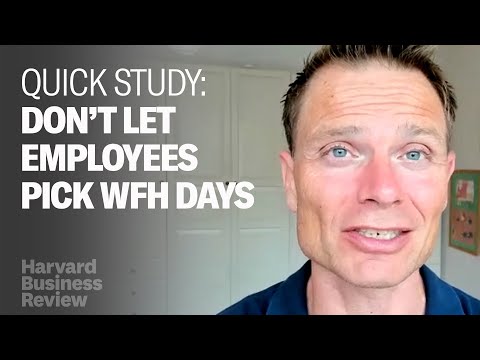
The Case Against Letting Employees Pick WFH Days
13 Sep 2021
---
While some managers may be inclined to let employees choose their own schedule, Stanford economist Nicholas Bloom strongly recommends against this for two very important reasons.
00:00 I used to say, "Let employees pick their WFH days." Not any more.
00:33 The first problem: “Mixed mode” leads to anxiety and exclusion
01:21 Problem two: Disparities create long-term diversity problems
02:35 That leaves us with two options: team-based or centralized choice
02:52 Pros and cons of team-based choice
03:48 Employees must WFH on WFH days to avoid “the great unraveling”
04:09 Yes, my original article on this topic made lots of people upset!
04:50 Let’s do the reverse of “move fast and break things”
First is the challenge in managing a hybrid team, which can generate an office in-group and a home out-group. The second concern is the risk to diversity. Current surveys show that younger women with children at home are most likely to want to work from home permanently. Previous research found that WFH employees had a 50% lower rate of promotion after 21 months compared to their office colleagues. The best solution is for managers to decide which days their team should WFH and which days everyone should be in the office.
Read more: https://hbr.org/2021/05/dont-let-employees-pick-their-wfh-days
Bloom and his research partners spoke to hundreds of managers across different industries, from tiny companies to massive multinationals like Google, Citi, and HSBC.
You can see more of their research here:
https://wfhresearch.com/
https://nbloom.people.stanford.edu/sites/g/files/sbiybj4746/f/why_wfh_will_stick_21_april_2021.pdf
Follow us:
https://hbr.org/
https://www.linkedin.com/company/harvard-business-review/
https://www.facebook.com/HBR/
https://twitter.com/HarvardBiz
https://www.instagram.com/harvard_business_review
Sign up for Newsletters: https://hbr.org/email-newsletters
#HarvardBusinessReview #WFH #HybridWork
Learn more about your ad choices. Visit megaphone.fm/adchoices
Scan the code with your iPhone camera
Listen in the app.