
 Ask ChatGPT


 High Performance Business
12 Mar 2026 · 11m · 7 chapters
Written by AI. May contain mistakes.
Exploration of the animation industry's landscape before Toy Story's release.
“I mean, I remember thinking my toys had a secret life that as soon as I left, they would all get together and discuss stuff.”
Discussion on how technology shaped storytelling and animation at Pixar.
“Not to say it's cheap or easy, but really it's more of like, how is this artist going to bring this idea to life in a way that hooks into people?”
Insights into Steve Jobs' impact and leadership style at Pixar.
“We didn't have our own cafe when Pixar was in Point Richmond.”
How Pixar ensures creative talent thrives within the studio environment.
“and John Lasseter, who was a brilliant creative mind.”
Encouragement for aspiring artists to embrace failure and learn through doing.
“Can I ask what advice you'd give to young creatives that might be listening to this?”
Discussion on the potential of AI in the film industry and its creative implications.
“movies we've made, by the time you see it, there's dozens of versions of attempts and things that It didn't play.”
An overview of Pete Docter's new projects, including Hoppers and Toy Story 5.
“You know, that's always going to be important.”

Get the gist, explore an idea or ask about something said.
 Claude
On High Performance Business, what are the key points of this episode?
Searching your listeningAutomatic transcript. May contain errors.
0:00Pete Docter: Hey everybody, I'm Pete Docter. I directed Monsters, Inc. up, Inside Out, and Seoul, and I'm now Chief Creative Officer at Pixar Animation Studios. So, can you take us back to those early days of Pixar? You know, what was the animation industry like leading up to 1995 and the release of Toy Story? Yeah, it was at a time when animation, at least in my sphere, had been very, maybe marginalized is the wrong word, but there were traditions that, you know, everyone was a musical. They were always kind of generally about princesses and, you know, fairy tales. And so we thought, man, animation could do anything.
0:34Pete Docter: Let's do something different with it. Let's explore stories that are set in our world, but maybe, you know, from a different perspective, we'll lower the camera. A few of those choices just made the whole thing come to life. I mean, I remember thinking my toys had a secret life that as soon as I left, they would all get together and discuss stuff. And so it kind of was second nature to bring that to life because it was so much a part of all of our imagination, I think. None of us knew what we were doing. And so looking back, there was this freedom, a sense that there was no rule book because we, I mean, we desperately wanted rule books.
1:15Pete Docter: We were looking back at the way Walt Disney made films and the way the folks at Disney at the time were making movies. That was kind of our only measurement as to whether we were doing this at all right. But a lot of it was just make it up as we went. And it was a fun group of people. I would routinely stay till midnight, one in the morning animating because it was just such a thrill. And how did the advances in tech change what studios were able to accomplish? Yeah, it's come a long way. I mean, there were a lot of restrictions. I mean, John Lasseter, the director of Toy Story, his approach was, I remember him specifically saying, don't worry about what's possible, what's hard.
1:54Pete Docter: Just let's create what we want conceptually, so through writing or drawing. And then when we get to make it, we deal with that challenge. We had a, oh, I remember on the first film, Woody has been burned with a magnifying glass with Sid. And as soon as Sid leaves, the original thought was he would go douse his head in this bowl of what ended up being water from the dog. So it would have goo flowing in there. And, ah, you know, that was very difficult. Water was near impossible. So if you remember in the film, what we did was we staged it low. And it was like a bowl of old cereal that he dunked his head in.
2:30Pete Docter: So we came up with clever ways of dealing with the restrictions of the technology. Now, I don't think there is really anything that we couldn't do. Not to say it's cheap or easy, but really it's more of like, how is this artist going to bring this idea to life in a way that hooks into people? It's more about that than the limitations of the technology. So you have much more freedom. Yeah, which can be dangerous. And what impact did Steve Jobs have on Pixar? Steve was pretty brilliant, obviously. Remember when we had a meeting about some toy problem? And he came late and he just listened and very quickly cut through.
3:14Pete Docter: Like, we were all talking about this. And he's like, the real problem is this. He was able to analyze and understand the root issue. Pretty brilliant. Also, in our experience at Pixar, very humble. I know that's not the way he always came off at Apple and other places. But he would say, look, you guys are the experts. I just watched this movie. I'm not going to tell you what to do. However, and then he would have two brilliant notes that were very insightful. And my wife said, do you think anybody ever asked Steve to go to lunch? I'm like, I don't know, man. I'll try. So I asked him to lunch, and he said yes.
3:47Pete Docter: So I got to have lunch with him several times one-on-one. I do think he was a guy who just felt like the priority is what I'm doing here. if I hurt your feelings or whatever, that's too bad. I care most deeply about this thing being great. And that is rare. You know, most of us are so caught up in the social dynamics of things. I don't want to upset somebody, you know. So there's a lot at play. But he somehow was able to reduce down to like, this is the single most important thing we need to, which is amazing as a leader. So is the legendary lunch meeting true? The one with Steve Jobs where, as the story goes, several huge ideas like Monsters, Inc.
4:27and Bugs Life were born. Like, did that actually happen?
4:30Pete Docter: Well, asterisk, yes. It was actually a number of lunches. We didn't have our own cafe when Pixar was in Point Richmond. We'd go to this little restaurant called Hidden City, and we'd sit, and they had, you know, a lot of times restaurants will roll paper out on the top, and we'd just sit and draw as we're talking because you keep your hand busy. and yeah I remember a lot of those ideas being floated around there of course ideas you know it's been described like whistling on the stairs of Carnegie Hall like to get an idea to make it a real thing that's where the real work lies and that's what happened after that meal I believe that like finding great talent is one of the toughest things in any business so how did you make sure you are surrounding yourself with the best people yeah it shifts as we go but you Generally, at least so far, we've bet on people rather than ideas.
5:26Pete Docter: Whereas in Hollywood, you might say, the studio buys the script and says, you, you're going to direct this. We generally say, you, go develop some ideas. And so an artist will sit, hopefully, with a few friends and fill a room with ideas, just things that they're interested in, concepts. I remember Dan Scanlon would just think about different aspects of his own life, pin all these things up, and out of that comes generally three or four ideas that then they will pitch to other people, myself included. And then we just look around and go, like, are any of these really compelling and inspiring? And I want to hear more.
6:04Pete Docter: And that's really the only criteria. It's not like it has a checklist of things it has to meet. It's just like, this one is interesting. Let's explore that some more. And is there something you can point to and say, like, this is the secret to the success of Pixar? I think, you know, like with anything, the actual secret is not one thing. It's multiple things. For one, we had amazing origins of, you know, between Ed Catmull, who is a brilliant scientist, Steve Jobs, a brilliant pioneer and entrepreneur who was able to protect us and get certain things, fight against, you know, systems and whatnot.
6:40Pete Docter: and John Lasseter, who was a brilliant creative mind. You know, everyone kind of came together at the right time. And then, you know, we had success, which doesn't happen often. And then we were able to repeat it, which doesn't happen often. I remember Steve Jobs saying he was most worried about our second film because, yeah, you can make one, but how do you prove that you're not just like a one-done? So we've now had 30. Only one or two have not really delivered at the box office. So, wow, I don't really know exactly how to explain all that other than we have amazing people we get to work with and we're very fortunate.
7:23And outside of Steve Jobs, who is perhaps the most famous early backer of Pixar, is there anyone else in your mind who was really key?
7:30Pete Docter: Well, I mean, Andrew Stanton is brilliant. He is a tough guy. He's not somebody who will just say, that's wonderful and pat you on the head. He's going to fight you on stuff, which is really helpful. He's made every film we've worked on better. He's a brilliant writer, and he's just not satisfied. He's always kind of pushing to make things better. I would say he's been probably the most impactful. Can I ask what advice you'd give to young creatives that might be listening to this? Do it. I think most people think, oh, if I read all these books and I study, then I'll have all the information, then I'll be able to do this brilliant thing.
8:11Pete Docter: You don't know anything until you try to do it yourself. And then it will be wrong. So expect that. Do it. Be wrong. Forgive yourself. Move forward. Do it again. You know, every one of the movies we've made, by the time you see it, there's dozens of versions of attempts and things that It didn't play. And I think having some way to, what's the word, mock up what you're doing to show it to other people to kind of experience it objectively, there's no substitute for that. And we can't not talk about AI. How much of a threat does it pose to the film industry? It's funny, thinking back to when Toy Story came out, I would get this question from every journalist, how long until computers replace all actors?
8:56Pete Docter: And that was the fear even back then, that somehow this new burgeoning technology of CG would replace something. Of course, that hasn't happened because I think we as humans want to watch and relate to other humans. And AI, I think, will be a great tool for that, for the creative process. It'll aid people who are creative. I think, you know, it'll make it—I mean, if my mom can sit and generate some beautiful image based on texts, I think what's going to make them really more valuable are people who are creative, who understand how to tell a story. You know, that's always going to be important.
9:31Pete Docter: That's always going to be the real value of this. And of course, all this brings us to your latest film, Hoppers, which my son Sebastian is very excited about. Can you tell us more about it? Yeah, well, Hoppers, we're very excited about. It's directed by Daniel Chong, who is a storyboard artist on Inside Out. He put together this brilliant movie of this girl who discovers she can hop into the body of a robot beaver and maybe hopefully save this glade, this area and environment that she's very fond of, only to discover that the animals are secretly plotting to overthrow humans. So it's a bit of a thriller.
10:09Pete Docter: It's bonkers. It's crazy. And there's just so much fun stuff in it. Toy Story 5 is about all of the gang from Toy Story Films. course, but now it's toys meet tech, right? Just like real life, kids aren't sitting on the ground playing with dolls all the time, they're on screens. And what does that mean now when you're a toy? So it's very timely and real life.
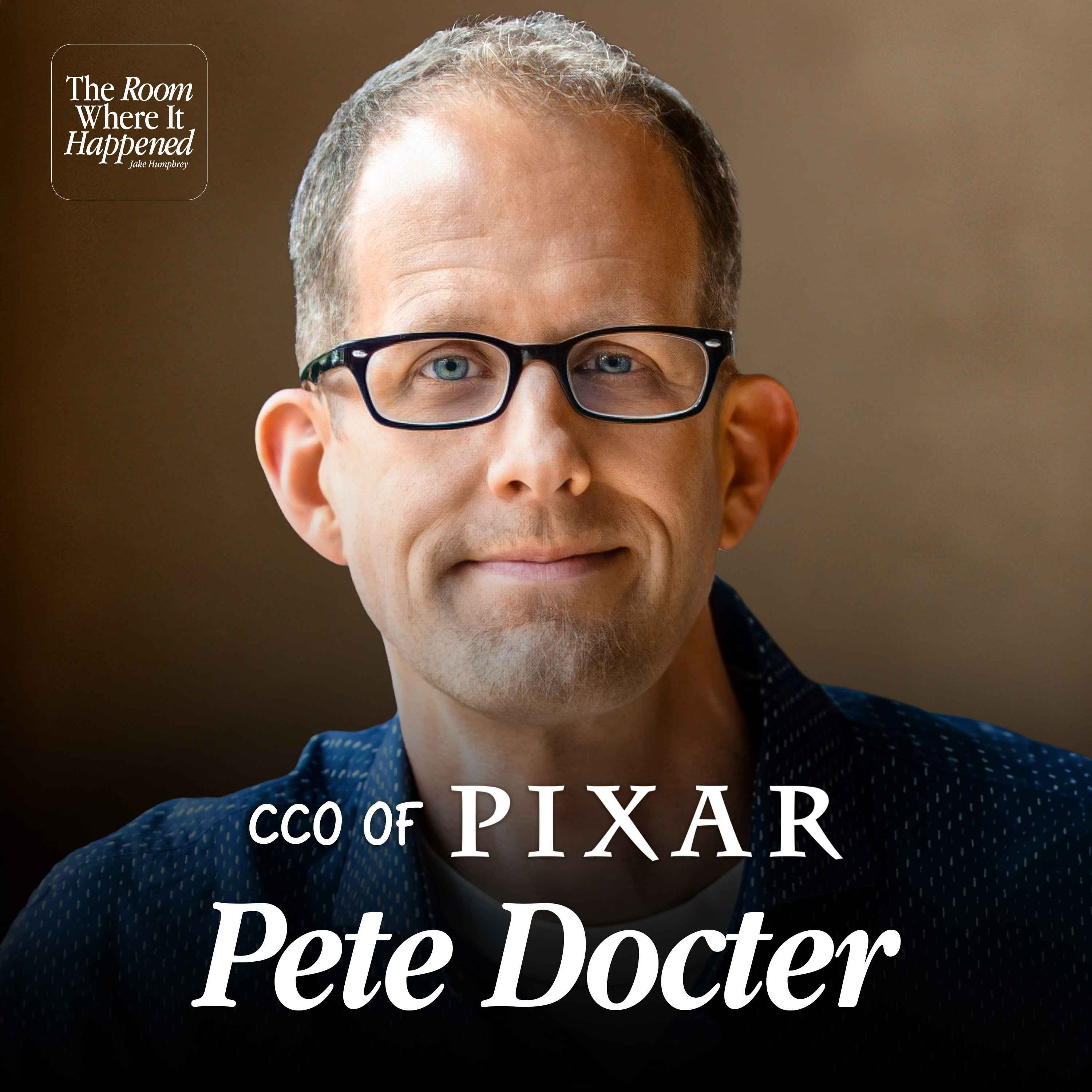
With Toy Story 5 & Hoppers releasing this year, The Chief Creative Officer of PIXAR, Pete Docter, joins The Room Where It Happened to break down 40 years of Pixar's history.
Pete directed Monsters Inc., Up, Inside Out, & Soul, and has worked with some of animation and technology's biggest icons, including, John Lasseter, Steve Jobs, and Andrew Stanton, just to name a few.
In this episode we dive into all of Pixar's behind-the-scenes stories, discuss the incredibly detailed creative process, and break down some of the studio's biggest hits such as Toy Story, Cars, and Monsters Inc.
IFS - award-winning Asset & Service Management software
👉 Reimagine your operations at: https://highpfrmc.com/ifs-au
NordVPN Deal 👉 https://nordvpn.com/rwih Try it risk-free now with a 30-day money-back guarantee
Hosted on Acast. See acast.com/privacy for more information.


