
 Ask ChatGPT


 High Performance Business
14 Jul 2026 · 41m · 15 chapters
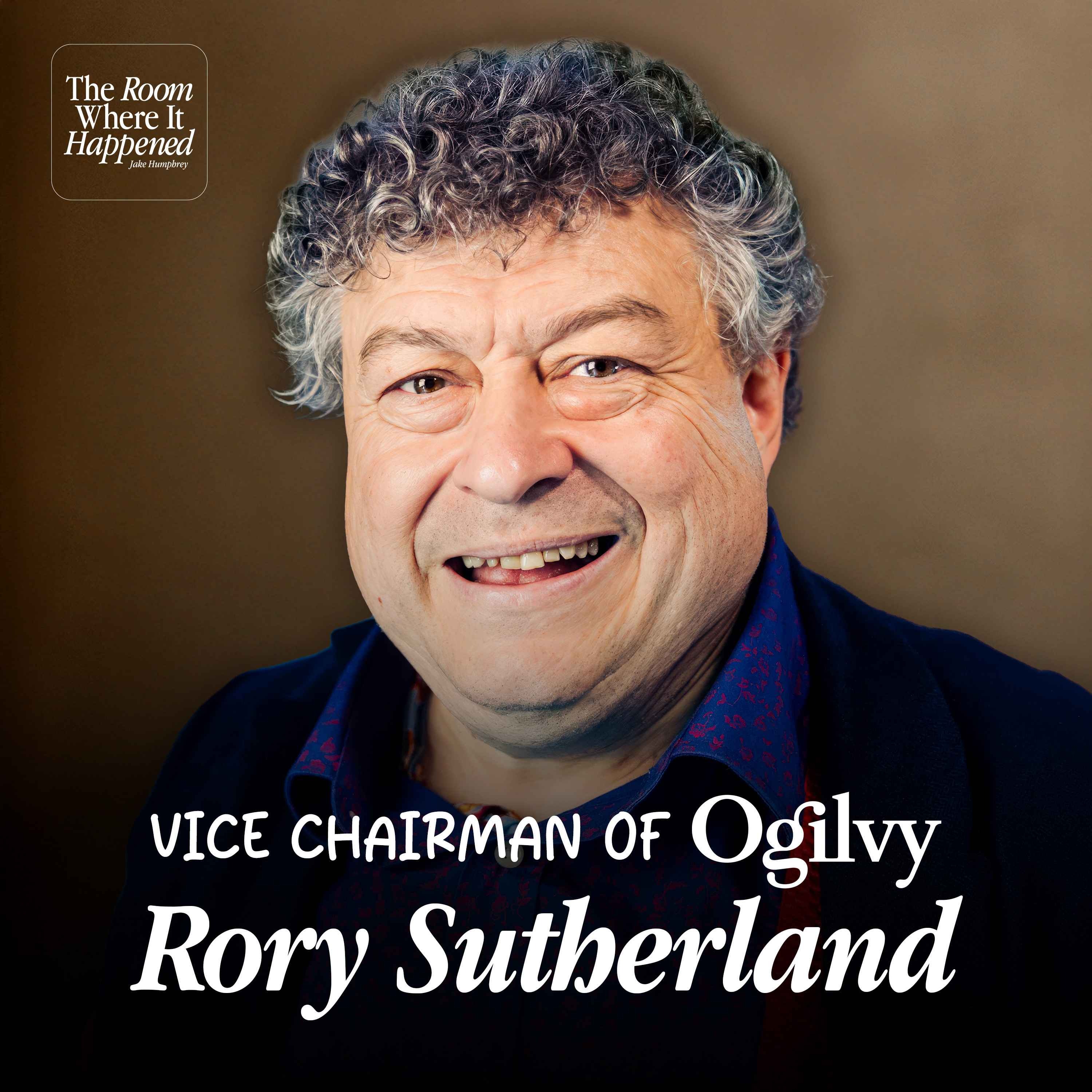
Rory Sutherland’s “marketing masterclass” framed as his 2007 bedroom epiphany while ill, leading to behavioral economics-based marketing. He argues marketing is about seeing hidden motivations and “being interestingly less wrong,” not winning rational arguments. He explains how to design choices using relative framing, stealth/packaging cues, and behavioral interpretation of data (including “dark patterns” ethics boundaries). Notable examples include: lower-fat biscuits in Belgium losing sales until “low fat” was added to packaging; redesigning airline websites for leisure travelers (economy vs premium relative pricing) generating £10M incremental premium revenue; changing “Find flights” to “Find my flights” increasing sales; coffee shop “mop out” behavior near closing; and a Taco Bell UK failure caused by an alley entrance, not lack of demand.
Rory Sutherland, celebrated advertising executive (British Airways work; Ogilvy behavioral science practice; President of the UK IPA). No other named guests.
Written by AI. May contain mistakes.
Rory discusses his pivotal moment of realization while bedridden.
“Well, Rory, I want to start by going into The Room Where It Happened, where you had this realization, this awakening, if you like.”
Rory shares insights from his background in direct marketing and behavioral insights.
“This is podcast advertising without barriers.”
Rory explains the significance of behavioral economics in understanding consumer behavior.
“And so how did you feel walking back into the office after this illness with this kind of, this epiphany still rattling around in your brain?”
Rory describes a case study involving a Belgian biscuit and its marketing challenges.
“by 1902, president of the IPA, which is the advertising trade body in the UK.”
Rory discusses the complexities of human emotion in marketing decisions.
“We spent a lot of money perfecting this lower fat formulation.”
Discover how emotions and experiences shape consumer behavior and marketing strategies.
“And then maybe two or three years later, you let people know that actually they're now less fatty than they used to be.”
Learn why perceived pricing affects consumer choices and how to design better airline websites.
“and crucially, maybe unlearn everything you thought you knew about selling, about status, and about the stories that we tell ourselves.”
Explore the ethical implications of using emotional appeals in marketing and how to avoid manipulation.
“simply because you were allowing people to make the relative decision rather than forcing them to make one decision at a time.”
Understand how keen observation can lead to better business decisions and marketing strategies.
“And the argument Richard Thaler would make in part, and which I would broadly say is true, is that however you design a choice, there's a degree of nudging involved.”
Examine how brand dynamics influence market success and the phenomenon of double jeopardy.
“which is patently very popular with British punters.”
Discover how human behavior influences business decisions and creativity.
“Well, I think that Rory reminds us of something really simple, but actually quite radical.”
Understand the pitfalls of overly rational decision making in business.
“Okay, the first thing is I don't claim to be right about anything.”
Learn why anecdotal data can sometimes outweigh extensive research.
“In fact, I would argue that anecdotal data is often very, very revealing.”
Explore the importance of differentiation and reverse benchmarking.
“Everybody should read that book, by the way.”
Explore the importance of understanding behavioral change in business success.
“I'm now happy to adopt this new technology because big ideas require big behavioral change and big behavioral change is difficult.”

Get the gist, explore an idea or ask about something said.
 Claude
On High Performance Business, what are the key points of this episode?
Searching your listeningAutomatic transcript. May contain errors.
0:02One of the most celebrated and best known advertising execs in the world. His videos regularly go viral, getting millions of views online. Yet our story starts when things weren't so glamorous or exciting for Rory. It's 2007 and he's bedridden. He's sweaty, he's ill, he's feeling sorry for himself. Yet in between tissues and cups of tea, something rather strange happens. With a stack of dusty economics books by his bed, Rory just began reading and questioning. He was learning about theories that made sense on paper, but not in the messy, irrational advertising world that he'd spent years navigating.
0:40And as he lay there, something just clicked. And in that moment, so did his sense of purpose. Suddenly Rory felt as if he'd unlocked an idea that could change everything. So what was the book? And crucially, what was the idea? You're listening to the show that takes you into rooms you never knew existed to understand similar moments like never before. In partnership with IFS, this is The Room Where It Happened with today's guest, Rory Sutherland.
1:14Well, Rory, I want to start by going into The Room Where It Happened, where you had this realization, this awakening, if you like. So talk to me about The Room. Oh, The Room was actually my bedroom and I was ill. But it's that perfect form of illness where you're basically too ill to go to work, but not so ill that you can't kind of read a book, watch television, or generally do something that you otherwise wouldn't be doing. I've got a vague idea I wasn't, I mean, I've got a vague idea I had the window open. But I can remember it precisely because I suddenly got into this thing. This would have been something like 2007.
1:54As a consequence of that, I got into economics blogs, and through the economics blogosphere, I effectively discovered that a book was coming out called Nudge, written by Richard Thaler, who subsequently won a Nobel Prize for economics. Why that was an epiphany was not because the thoughts in that book had never occurred to me before. It's simply that feeling of, I feel seen. I've had these thoughts before myself, but I've basically suppressed them because they make you look mad or feel mad if you're the only person in the room who is open enough to look at the world in this way. And then I realized there was this whole discipline called behavioral economics.
2:34I mean, it's really psychology, but by branding it behavioral economics, they get it taken more seriously. I then decided that, you know, I had 15 years of experience by then, possibly a little bit more, of effectively recognizing that there were these really peculiar, unconscious human behaviors,
2:58which had two characteristics, both of which are important. One, they defied conventional economic logic. And two, they were in many ways unconscious in that you wouldn't necessarily uncover them through market research. You're sitting there in this room. And the one thing I really want to be clear on is, how did you see the world before this moment in the room that you thought the rest of the world didn't see?
3:42Choose the shows that match your perfect audience, set your budget, and launch. And if you want a hand, our podcast specialists are there to help you launch with confidence. This is podcast advertising without barriers. Get started at acast.com slash advertise.
4:03Well, I've been very lucky because I got a job in direct marketing, which is a niche area of advertising, which at the time I joined was mostly direct mail, a bit of outbound telemarketing, and press ads with coupons and 0800 phone numbers. Famously, Amos Tversky, who is the partner of Daniel Kahneman, he said that what Daniel and I do is we effectively discover things and classify things which are already known to advertising people and car salesmen. And we take those things which are instinctively known by those people and we give them a kind of classification. We attempt to codify them. And what did it do for you when you realized the way that you saw the world and the way that you thought had a classification?
4:50Well, the first thing was that it elevated the conversation. So the fact that you had, at this stage, a few people who picked up a Nobel Prize for economics who were deeply interested in, after all, we call it behavioral economics, but I mean, famously, I think Charlie Munger said, look, if economics isn't behavioral, I don't know what the hell is. Economics should be an empirical science, but unfortunately, it isn't. It's one where the elegance of the theory is allowed to override the messiness of the real world experience. And so I had this feeling, which is finally these fairly major discrepancies between economic theory, on the one hand, and market research, stated preference, what people claim they want and what people actually do.
5:39So economics isn't totally blind to the fact that a large part of our brain is trying to accomplish something which the conscious part of our brain may not be aware of or may be unwilling to reveal. Okay? So working with British Airways, once okay i said look people with the british airways gold card right love to display the fact they're never going to tell you that okay why don't you reserve part of the car park at heath row for gold card members the bit that's closest to the first class check-in then you've got an excuse for them to have a little gold sticker in their car windscreen which they'll fucking love okay now nobody will ever tell you that in research in economic terms you know you know doesn't actually offer utility if like me you find conversations like this intriguing and want more hidden insights from the likes of Rory, Sir Richard Branson, or unicorn founders like Will Hsu from Deliveroo, please don't forget to follow and subscribe to the show wherever you get your podcasts.
6:38Right, back to Rory. And so how did you feel walking back into the office after this illness with this kind of, this epiphany still rattling around in your brain? It sat there for a while and I talked to a lot of people about it. What happened decisively, the two subsequent decisive events were, as I said, I ordered a copy of Nudge from the US because it hadn't launched in the UK. And I got it FedExed over at insane expense. And it arrived probably that actually might have arrived the next day, if not two days later. At that time, there were probably only 10 copies of the book in the UK. Obviously, you know, the publishers would have had a few.
7:12One of them was in the hands of a guy called Rowan Silver, who then gave it to either George Osborne, but I think he then gave it to David Cameron for his reading list. Now, interestingly, surprisingly nudge theory tended to get adopted by the democrats in washington but it got adopted by the conservatives in london to an extent and so through this somehow through reasons i can't fully remember uh i was very very early in understanding this long before the book launched in the uk and there was obviously a flurry of publicity there are a few of us rowan obviously much more influential than me uh who are actually going around evangelizing for this and saying this is actually important because all decisions in government are currently being taken by economists or lawyers, basically.
7:57And what you might call persuasion or marketing, or even just consumer understanding and psychology, isn't getting a look in. About a year later, I became, by 1902, president of the IPA, which is the advertising trade body in the UK. and typically the president has an agenda for the two years and I made my agenda. This was another epiphany moment. I was sitting in a coffee shop in Faversham wondering what the hell my agenda was and then going, the answer's staring me in the face. My agenda for two years in this trade role, in this category role, is to get the advertising industry up to speed on behavioural economics because we need to be ahead of the game here because if our clients learn about this before we do, we'll end up being stupid and useless.
8:49So Rory had a dream. He thought he had an answer. Now what he really needed was a chance to test his new theory. Thankfully for him, he was about to get a call. We'd just opened a behavioural science practice in about 2011 within Ogilvy. And it was a little like effectively, you know, being a private detective. We were just three of us, I think, in this office, basically waiting for the phone to ring. You know, a bit like sort of Philip Marlowe or someone. And a call comes in from the office in Belgium, and it says, we've got a problem. We don't understand it. We've got a very, very heavy selling biscuit, very popular in the Belgian market.
9:34Probably not the one you think it is, actually. and we've just introduced a lower fat variant of the product and the sales have fallen off a cliff. And it's weird because we researched the product and people liked the taste. They couldn't tell the difference in blind taste testing. Obviously, everybody in research tells us they want a lower fat biscuit, okay? And yet, having launched this thing and expected an increase in sales, we've got the absolute opposite. And that was one of those interesting cases which you occasionally get in detective work, where you can kind of solve the crime over the telephone.
10:10You said you were waiting for the phone to ring, and how you kind of immediately thought, hold on, all of those things I learned reading for that week, we can adopt that here and see what happens. What it was, was the classic thing, which is, I call, you know, effectively marketing, I think is the science of knowing what economists are wrong about. Fundamentally. and the classic thing would be to a logically minded person research tells people they want a lower fat snacking alternative logic tells people that since they can't tell the difference between these two biscuits in blind tastes they will be completely unaffected in their enjoyment of the biscuit when the words low fat and in that case we just said very simple question did you put now with lower fat on the packaging And they said, well, of course we did.
11:00We spent a lot of money perfecting this lower fat formulation. Why on earth would we not boast about it on the packaging? Well, he said, ah, that's your problem. I mean, there's a very interesting implication there, by the way, which is sometimes if you want the population to eat healthier, maybe the way to do it is by stealth. So you reduce the fat content of things and just don't tell them. What you suddenly realized is that we have this simplistic narrative of what humans are trying to do. And we often, and what economics was allowed to do, it was allowed to denigrate as irrational any time in which the human behavior differed from what an economist would regard as optimal according to their model.
11:43Now, physicists aren't allowed that luxury, okay? They can't say the experiment failed, but it was entirely down to irrational atoms, okay? Or the electrons were in a bad mood this morning. Actually, probably, I don't know, maybe quantum physicists will say that. I have no idea. Okay. But, you know, Newton wasn't allowed to say, you know, I'm afraid my experiment failed, but it's simply because the planets were having a bit of a hissy fit, okay, or were being silly, okay? You're not allowed to do that. But weirdly, in economics, you're allowed to basically decry any behavior which deviates from your theoretical model as being a mistake on the part of the human being.
12:21And I'm very uncomfortable with that. And there are a lot of behavioral economists who would describe things as a bias. In other words, where we should do X, some part of our psychology causes us to do Y, and we're silly to do so. A lot of behavioral economists are very unhappy with the word bias because they'd say, unless you know what the person is ultimately trying to do, it's very dangerous to criticize someone's behavior as illogical. because what may seem illogical to you is perfectly logical once you understand their deeper and often actually unconscious motivation. So was there a moment where you can kind of look at this story almost in completion and say, I was ill, I read this book, it changed how I thought, the phone rang, I advised this Belgian biscuit company to do things differently and then you got the message that actually, Rory, your disruptive way of now approaching marketing worked?
13:18What I realized was, okay, the very fact that that phone call came in more or less on day one, which, by the way, was a product partly of fame because people knew who I was, and therefore people in Belgium, who I know quite well anyway, knew that there was a behavioral science practice opening at Ogilvy. But I thought, okay, we can be of real value to clients here. And actually, we can be of real value to clients sometimes in a way that ad agencies have never historically been of value by telling them not to do things. Okay? So if you've got this new lower fat biscuit, maybe what you need to do is launch it with no change in packaging whatsoever.
13:55Okay? Obviously, you have to upgrade the ingredients legally. I'm not suggesting we deceive people completely. Okay? And then maybe two or three years later, you let people know that actually they're now less fatty than they used to be. What's your emotion as you start to go through this? Well, this is the peculiar mixed emotion, which is part epiphany, part doubt. Right. The mixed feeling was, this is probably true and has immense explanatory power, but at the same time, it's kind of depressing. I discovered a very happy analogy for describing all this, which was the whole joke about the Eurostar.
14:30Okay? Now, what you notice is that trains are run by the real-world equivalent of economists who are engineers. And they optimize things which are SI units, time, distance, capacity, speed. What they want to do is create an optimization model for numerical factors like speed, duration of journey, capacity of train. And my argument was, yeah, okay, but beyond a certain point, humans don't actually care about those things. So I'm not saying it's great for trains to be late, okay? I'm not a total idiot. It's best to keep the train network running to time. However, from a passenger point of view, there are things we care about which are completely unquantified.
15:12High speed two, the brief is probably get this many people at this speed, at this cost between London and Manchester. Okay? That's an engineering brief. The question you need to be asking is a psychological one, which is how can we make the train journey from London to Manchester so enjoyable people feel stupid taking the car? It's a much better question. Now, enjoyable. Now, why does nobody ask that question? and why does everybody ask the engineering question? It's the same answer as to why they all spend their time trying to increase the range of electric cars but don't spend any time reducing anxiety, which is, weirdly, how do you make a train journey enjoyable is an open-ended question, which means it's amenable to all kinds of creative solutions.
15:55People who want to come up with a single right answer to win an argument don't want multiple solutions for multiple people. They don't want imagination to be involved in any point of this process because they want to come up with a single optimal right answer. I love Rory's approach to marketing. I think it's great because I would never have thought of it. But when Rory kind of says it out loud, suddenly it seems so obvious, right? Because people act on feelings so much more often than facts. And actually flipping a problem on its head often reveals a simple low-cost tweak that works so much better than some big logical fix.
16:30And in this next chapter, Rory sits down to unpack why marketing isn't about shouting louder, but about seeing deeper. From airline buttons to popcorn psychology, he'll share how questioning the obvious reshapes the market and why being interestingly wrong, as he puts it, might just be the most powerful business strategy that you can employ. It's time to listen, learn, and crucially, maybe unlearn everything you thought you knew about selling, about status, and about the stories that we tell ourselves. Back to Rory. Did you then use this new way of thinking with other businesses? I'd love to find some more examples.
17:12An example would be fairly early on, which is we realized that the way in which all airline websites worked were fundamentally silly because they were designed for business travelers, not for leisure travelers. And so the first question you got on page one was, where do you want to go? When do you want to go? What class of travel do you want? Find flights. And we said, well, that's very good for a business traveler because they know where they need to go. They have a pretty good approximation of the dates, give or take a day or two. And they also know which class of travel they want because their company travel policy tells them where on the plane they're going to sit.
17:45We said that's absolutely terrible for leisure travelers because everybody will search for the economy price first to know whether the trip is affordable. And they won't go back and search for the premium economy price. If you put these prices... In other words, the consumer preference for going premium economy is probably down to something... Now, an economist would probably argue that the utility of premium economy over economy should be captured by a flat rate. on a nine-hour flight, it's worth£200 to go premium economy. If it's more than£200, I won't go. If it's less, I will. My suspicion is, and I think we can probably bear this out experimentally, is it's a question of proportion as well.
18:31If it's£700 to go economy and, you know,£1 ,000 to go premium economy, we're probably more likely to do it than if it's£200 to go economy and£500 to go premium. In other words, price is very often perceived relatively, not absolutely. Mainstream economics suggest we have an absolute dollar value attached to any particular good. Actually, in many cases, it's kind of like, we're looking at the world through the lens of comparison, really. And so in that case, we changed the design of an airline website and it made them£10 million a year in incremental high margin premium revenue simply because you were allowing people to make the relative decision rather than forcing them to make one decision at a time.
19:17Give us some more. A recent one, I'm just wondering, I've got to be a little bit careful because I don't want to give away our client secrets. I'll give you two insights I had into why things fail. Okay, so I don't want to breach client confidentiality. With one other airline, we actually got something like a highly measurable increase in sales by changing the button from find flights to find my flights. Now, this is the kind of thing Amazon is doing all the time. But fundamentally, we're in the grip of emotional forces. By the way, I'm going to caveat this straight away because some of your listeners are going to be going, yuck, it's wrong to effectively appeal to the unconscious because it's a form of manipulation.
20:03And I'm going to make a confession straight away, which is you can use this for evil. In fact, I would be very happy to give some of my time, particularly in retirement, to consumer protection groups because I think there are dark patterns in behavior. One of the worst things, I think, is getting people into subscriptions and then making it impossible to cancel. I think there should be legislation where you can cancel recurring credit card payments, okay, on your credit card, not having to go back to the initial person who's making the charge. You know, my kids were like at university and I discovered I was still paying for Club Penguin, for God's sake.
20:42Okay, those things I regard as fundamentally unethical. Okay, and they're basically preying on people. I think there are fundamental dark patterns. Now, if you use these techniques to get someone to try something they otherwise wouldn't have tried, and it's fairly easily reversible. In other words, you just get people to vary their behavior a little bit. I regard behavioral variation as just a healthy thing in an economy because existing incumbents have a natural advantage through habit and social proof. And actually, entrepreneurial new businesses are always at a disadvantage, okay, to the incumbents.
21:20And therefore, creating consumer variety in behavior so they try more things than they would left to their own devices, I regard as generally economically beneficial and beneficial to the consumer. by the way, okay? However, getting people into a path of action which then proves irreversible, which they subsequently regret, that's a complete misuse of the same skills, okay? So there are a lot of pretty nasty things online which are manipulative. In this case, I think we were just presenting information in a different way and getting a different emotional response. And the argument Richard Thaler would make in part, and which I would broadly say is true, is that however you design a choice, there's a degree of nudging involved.
22:03Now, I'm not claiming for a second that this is always harmless, but other examples would be of simply noticing things would be, I think most coffee shops close too early. And I think the reason is that coffee sales tail off as you get close to six o 'clock. And they've looked at this data and they've inferred from it that there's declining demand for coffee as you near closing time. That may be true, okay? But there's another possible explanation, which is the staff want to go home early. They therefore engage in behaviors in the 20 minutes or 30 minutes before they close, which are either unconsciously or deliberately off-putting to new customers.
22:45Now, it is known in the coffee trade as getting the mop out, okay? And what people have discovered is what you want to do is clean the bogs, mop down the floor, decalcify the espresso machine, okay? So you can knock off at six o 'clock rather than having to do all that stuff after hours. And in order to do that, it helps if you can discourage new customers from coming in. All you have to do is put one chair upside down on top of a table or put one chair upside down on top of another chair or lean a mop against the wall and basically nobody will come in. So the interesting question is, it's very easy to look at data and to say, okay, what this data reflects is that there is no consumer demand for this, when a behavioral interpretation of the data would say, no, no, no, no, no, it may be a confounding variable that actually between 5.40 and 6 o 'clock, our staff are engaging in behaviors which are massively off-putting to new consumers and that the consumer appetite for coffee isn't diminishing at all.
23:49There's an even more famous story, which is, you've probably seen the wonderful growth, very welcome to be, of Taco Bell in the UK, which is patently very popular with British punters. If I've got this right, there was an earlier attempt to open a Taco Bell in London as an experiment, probably 15 or 16 years ago now. It might have been longer, actually. It might have been 20 years ago. And it failed. And they inferred from that that the UK was not ready for Tex-Mex food. Okay? Now, I looked at that and I thought, hold on a second. It was in London, right? There are enough American expats in London to keep a single branch of Taco Bell afloat, right?
24:32Even if it was just American expats and tourists with a few more adventurous Brits, you'd have a business. And it turned out that they'd bought quite a good location to place this restaurant, but the door was in an alley round the back. So literally, there's a great book I recommend every business person read called Obvious Adams by a guy called Robert Updegraff. It was published in 1916. It was one of David Ogilvie's favorite books. It's a brilliant book about someone. It's a little like the 1916 equivalent of that moment in The Big Short where the guys all fly down to Miami and go and interview strippers, okay?
25:09It's effectively the greatest thing in creativity or I would argue in business is noticing things. It's observation. And actually most creativity is spurred, I think, by a chance observation, combined with a mind that has the right mindset to actually spot the implications. Okay? And so, what's so interesting is it's very dangerous. If you don't look at behavior, and you look at the world through an economic lens, and you ignore the fact that the entrance to the Taco Bell was in a weird alley around the back, right? It's very, very easy for you to look at data, which is location London, you know, average daily sales low and conclude that there's no market for a Taco Bell in London.
25:55Okay. There's a brilliant business which I really admire. A guy who runs a business called The Arcade which is two... Food courts is not doing them justice. They're two places where you have multiple food providers sharing some elements of the kitchen with multiple menus. There's one at Battersea Power Station. There's another one, I think, under Centrepoint. Okay. What's interesting about that is you can test out different restaurant formulae, but they're side-by-side comparisons. It's like a randomized control trial. And therefore, you can arguably say, if this restaurant concept fails, it's probably because it doesn't appeal to the public rather than saying it's because it's in the wrong location.
26:38There are so many variables that can cause something like a restaurant to fail which have nothing to do with the basic idea of the restaurant. That partly is the winner-takes-all effect. You know, which, by the way, that's just a thing, okay? The most successful brand in any category enjoys this disproportionate advantage, and the reason is that more people buy it, and within their repertoire, they buy it more frequently. So it's called, it's technically the Ehrenberg curve, but it's the idea of double jeopardy. That as your brand falls from grace, you actually enjoy a double hit, which is fewer people buy it, and those people who do, it forms a smaller part of their repertoire.
27:22So you get hit twice. And so that partly explains why I think fame has a kind of multiple, fame has a compounding effect. You know, the more famous you are, the more famous you get.
27:38This episode is brought to you by Progressive Insurance. Do you ever think about switching insurance companies to see if you could save some cash? Progressive makes it easy. Just drop in some details about yourself and see if you're eligible to save money when you bundle your home and auto policies. The process only takes minutes, and it could mean hundreds more in your pocket. Visit Progressive.com after this episode to see if you could save. Progressive Casualty Insurance Company and Affiliates. Potential savings will vary. Not available in all states. Here's a tip for you. There's a podcast out there with fans waiting to be your next customer.
28:14They tune in every week, they trust the host, and that host wants to talk about brands like yours in their own words to their audience. The problem is, you just haven't been introduced yet. We're Acast, where that introduction happens. As the world's largest podcast marketplace, we let you browse shows, see who's listening, and book host-read sponsorships or run your own ads all from one platform. Transparent pricing, real-time data, complete control. Start advertising on podcasts by visiting acast.com slash advertise.
28:54So what do we take from a man who found a new way of seeing the world while stuck in bed with a cold? Well, I think that Rory reminds us of something really simple, but actually quite radical. The biggest shifts in business don't always come from data, strategy, or even having a killer product. sometimes it simply comes from noticing what other people miss from trusting your gut when logic runs out from asking not what's the answer but actually asking what am i missing i think if there's one thing that i will take away from this it's that that hidden variable in every decision every brand every market is just human behavior and also that next time i'm ill i might just have a revolutionary moment.
29:37For people who haven't read the books and weren't in the room with you that day when you were feeling ill, read Nudge and it changed the way that you saw the world, what questions would you like the entrepreneurs, the business owners, the employees who listen to this show to ask themselves? Okay, the first thing is I don't claim to be right about anything. Yeah. Okay. And I don't want to be right. Now that sounds like a really weird thing. Okay. When I say I don't want to be absolutely right. I want to provide people with an alternative and interesting way of being less wrong. Now, just to be clear about this, I think a lot of business decision making is totally skewed by the need to win an argument.
30:19Now, when you win a rational argument, the first way you do that is you strip out some important variables, because otherwise you can't reduce it to the number of variables which provide you with that sort of GCSE math style single right answer. You know, the optimal point between two extremes, for example. There's a huge opportunity cost to trying to win an argument because two reasons. Good ideas, and this is true of good strategies, is that where the opposite is not on the face of stupid. Having great customer service is not a strategy because no one would say our strategy as having shit customer service, okay?
31:02Whereas, for example, saying we're going to sell to a few people at a high margin versus we're going to sell to a lot of people at a low margin, those are both alternatives, okay? And therefore, a strategy choice generally involves sacrificing one logical course of action for another logical course of action. Consequently, when you try and win an argument and prove that you're right, what you generally come up with is a single right answer rather than two interesting alternatives, okay? The second problem, I think, with rationality is that fundamentally, when you win an argument rationally, implicit in your argument is not only that this is a good idea, but implicit in that rationalization is that not only is this a good idea, but everything else is therefore wrong.
31:52Yeah. In other words, you pretend you've solved a physics problem where the opposite of right is wrong. Now, a lot of things I think rationality will get you to, we should try this, come under the category of, yeah, that's quite an interesting idea. It's not the only idea. It's a good idea. It kind of makes sense. Maybe we should try it. But when you actually win an argument, you go one stage too far, which is rather than making the implication, this is worth looking at, which I think is a fair conclusion. What you're doing by trying to win the argument is you're not coming up with an interesting possible pathway or source of differentiation for your business.
32:32You're saying, we have to do this, and anybody who basically disagrees with me is therefore an idiot, and we must discount all alternative ideas. And so the creative opportunity cost of needing to be rational is absolutely massive. So what should we do if we're not trying to win an argument? I think we should be... Well, I had a conversation with Rick Rubin about this, and I said the job in many real-world situations is not to be right, it's to be interestingly less wrong. And Rick Rubin said, I'd take it even further, he said, I think there are sometimes cases where you can succeed by being interestingly wrong.
33:07And he gave examples of, you know, bands like the Ramones, where he said the Ramones were actually trying to be the next Bay City Rollers. What they thought they were, and what they actually became, you know, they effectively created punk, But they created an entirely new form of music by, in a sense, not knowing what they were doing. I mean, Rick sometimes calls that, there's a Buddhist phrase, I think, beginner's mind. But interestingly, I'm going to be, you know, I think there are cases where interestingly, I mean, Dyson, okay. A lot of successful businesses, I mention Red Bull quite frequently, Dyson, okay.
33:44There is absolutely no evidence for that, no rational evidence to pursue that line of business in advance of you actually doing it. There was no evidence that there was a market for vacuum cleaners that cost 700 euros or dollars or pounds. Okay. There was zero evidence that people would pay sort of at the time £1.50 for a drink in a tiny can that tasted weird. Okay. A lot of business is Darwinian. It's really trial and error. It's experimentation. It's variation. So what did those two businesses do then to get people to do what we didn't think people would want to do? They had to take a leap of faith.
34:20In other words, they had to accept the use of subjective judgment. Now, I'll tell you a funny story about this, which is where we are completely wrong to think that the person with more data should be given more attention. Okay? In decision making. In fact, I would argue that anecdotal data is often very, very revealing. and it may only be one data point, okay? But if you think about it, I always joke about this, the Titanic had lots and lots of pre-existing data from the past which said there wouldn't be icebergs that far south in the Atlantic in April, okay? But the single anecdotal data point of iceberg dead ahead, okay, effectively overwrites all of that other pre-existing data, okay?
35:05Now, in the case of, I think, Nokia, They had advice from a very large management consulting firm that they could wait three or four years before releasing a smartphone, because until smartphone prices fell to a certain point, there was no mass market for them, particularly in the developing world. They said, we've got literally reams of data that say that people in country X, country Y, countries and highly populous countries, typically, you know, in the developing world, will not pay more than X for a phone. A friend of mine who is an anthropologist reported back working for Nokia said, this isn't right.
35:45He said, when a smartphone becomes available, bear in mind for these people, a smartphone isn't just a better phone. It's also a computer, their first access to the internet, their first access to, you know, everything that you can do online, video, you know, all sorts of video connectivity become possible, etc. No, no, they'll actually pay twice as much for a smartphone as they will for a feature phone. You know, you've only got a thousand data points. The management consulting firm has millions of data points. That was a case where, effectively, relying only on data with strong evidential value kind of killed a company or killed part of a company.
36:25But it's so hard to not do that, though, isn't it? Because when you have a thousand bits of data, everyone listening to this would be like, well, that's where I would go. That's the route I would follow. But often, of course, I mean, there was no evidence for the demand for smartphones before they existed. in many cases, I think, I find it really interesting because at some level, if you're not taking a bet on one particular future, as a business, you're being too cautious. And actually, capitalism partly works because lots of different people place lots of different bets on how they think the future is going to pan out.
37:06Sometimes, perhaps, you get one winner and lots of losers. generally you get several winners and quite a lot of losers you then end up with a much more valuable market and better served consumers because you know consumers have more choice because there are these fundamentally different approaches to you know the future of the electric car okay you know you can you can do a sort of french thing and take a bet on the citroen amy which i think is a totally valid bet or you can do a jaguar and you can place a bet on a super luxury unbelievably futuristic, you know, two-door coupe. Actually, they may both be valid bets, but for different people at different times.
37:50In fact, there will probably be people in five years' time who own the Jaguar XOO and the Citroen Ami for entirely different purposes. So one of the worst things you can do in business is benchmarking, because what you're doing by benchmarking is you're making yourself more similar to your competitors. And that's what I hate about when business... And management consulting firms do this all the time. They benchmark people against their closest competitors. I would argue you should do something which I call reverse benchmarking. And the first example of this was in a wonderful book called Unreasonable Hospitality by Will Godara.
38:24Everybody should read that book, by the way. And Will, when he's running the number 50 restaurant in the world, takes his team to the number one restaurant in the world. And their instinct is to benchmark against it, right? which is, cool, they've done this really well. Look at this. You know, they've made the, I don't know what it was. They made the napkin look like a swarm. I don't go to those kind of restaurants very often. Ooh, look, we should copy this. And Will at the end goes, no, no, no, no. There's no point in copying the things they're already good at. That just brings us more invisibility.
38:57You know, that just makes us more generic within the category. No. I'm going to do what I call reverse benchmarking, which is what were the two things that were a bit disappointing? We go to this restaurant. Unsurprisingly, it's fantastic. But were there two or three things that disappointed you? And it turned out there were two. There was nothing special about the coffee, okay? And the three or four people, because bear in mind he's taking a load of chefs and other people, the three or four people who wanted to drink beer rather than wine got shortchanged, okay? It was kind of like, yeah, we got this on draft, okay?
39:30Now, the wine, they come out and you get a sommelier and the guy would talk bullshit about the fucking terroir and all that crap. Okay, if it was beer, yeah, we got that on draft or we got this in bottles. And so Will goes back to his restaurant and goes, right, forget about all the other stuff which they did well. You know, we can't be shit at any of those things, but let's not try and just match them on what they're doing real. He takes one guy in the restaurant who's a coffee nut and makes him the coffee sommelier. And he takes another guy who I think might have been in the kitchens who was a craft beer, an artisan beer nut, and makes him the beer sommelier.
40:07So if you say, what have you got in the way of beers? You're expecting them to go, we've got Carlsberg or Heineken. And instead, the guy comes with a beer menu and actually starts doing food pairings for you. Now, I'm a very regular beer drinker in posh restaurants because it's a better drink, in my opinion. Okay, and one of the things that is noticeable is that as a beer drinker in restaurants, they're always eager to bring you a second bottle of wine and top up your bloody glasses. And the beer guy's going, excuse me, excuse me. Now, as a beer drinker in a restaurant, you're going to go, this is fucking rock and roll.
40:38The great thing about differentiation is it has three benefits. It's good for consumers because it gives them more choice, okay? It's good for businesses because it effectively differentiates them and prevents them from getting into a kind of price war with a load of other generic providers in the market. It's also, by the way, good for overall resilience. Competition, by the way, is totally inefficient. I mean, this is so weird about economics. They fetishize competition because they think it keeps prices down. But equally, if you take an absolutely classical economic model, competition means duplication, which means inefficiency.
41:14But there's a huge upside to competition and to diversification, which is resilience. So as people's tastes change, you know, effectively, you could move, you know, a perfect example would be, I might currently go to Sainsbury's, but, you know, when I hit the age of 80, I might start ordering the stuff online. It effectively enables you to absorb shifting tastes, shifting trends. And in many cases, it's highly beneficial. And I'm very annoyed, by the way, at supermarkets, driving people towards self-checkout. The correct way to offer self-checkout is an option, not an obligation. The technological door, which is, we can do this amazing new thing we couldn't do before.
41:58And the psychological door, which is, I'm now happy to adopt this new technology because big ideas require big behavioral change and big behavioral change is difficult. And that is where you have helped to change the world. Rory, thank you so much for your time. It's a pleasure. Anytime. What a joy. Thank you very much indeed. Thank you. Brilliant. What a conversation. The truth is we are surrounded by businesses, both the successful and the struggling, those that have good fortune, those that simply seem unlucky. But to truly understand what's behind them, you have to lean in. You have to learn from them.
42:28You have to ask the right questions and crucially, you have to be there. You have to be in a place that previously none of us had access to, the room where it happened. If you enjoyed today's episode in partnership with IFS, don't forget to subscribe to the show, follow us on Instagram, and you'll be the first to get the latest episodes. See you next time.
What if the biggest breakthroughs in business don’t come from logic, but from noticing what others overlook?
In this episode, Rory Sutherland unpacks the moment a late-night scroll through economics blogs led him to Nudge, sparking a fascination with behavioral science that would quietly transform global brands. From saving a snack brand with a single word to helping an airline generate millions through a subtle design change, Rory shares the twists, experiments, and happy accidents that redefined how companies speak to their customers.
It’s a masterclass in innovation, risk, and the power of seeing things differently, straight from the man who helped transform marketing with his unconventional insights.
XTB 👉 To find out more and make your money work, use code RWIH at: https://highpfrmc.com/xtb-rwih-au
IFS - award-winning Asset & Service Management software 👉 Reimagine your operations at: https://highpfrmc.com/ifs-au
Hosted on Acast. See acast.com/privacy for more information.


