Ask ChatGPT
 High Performance Business
23 Sep 2026 · 43m · 21 chapters
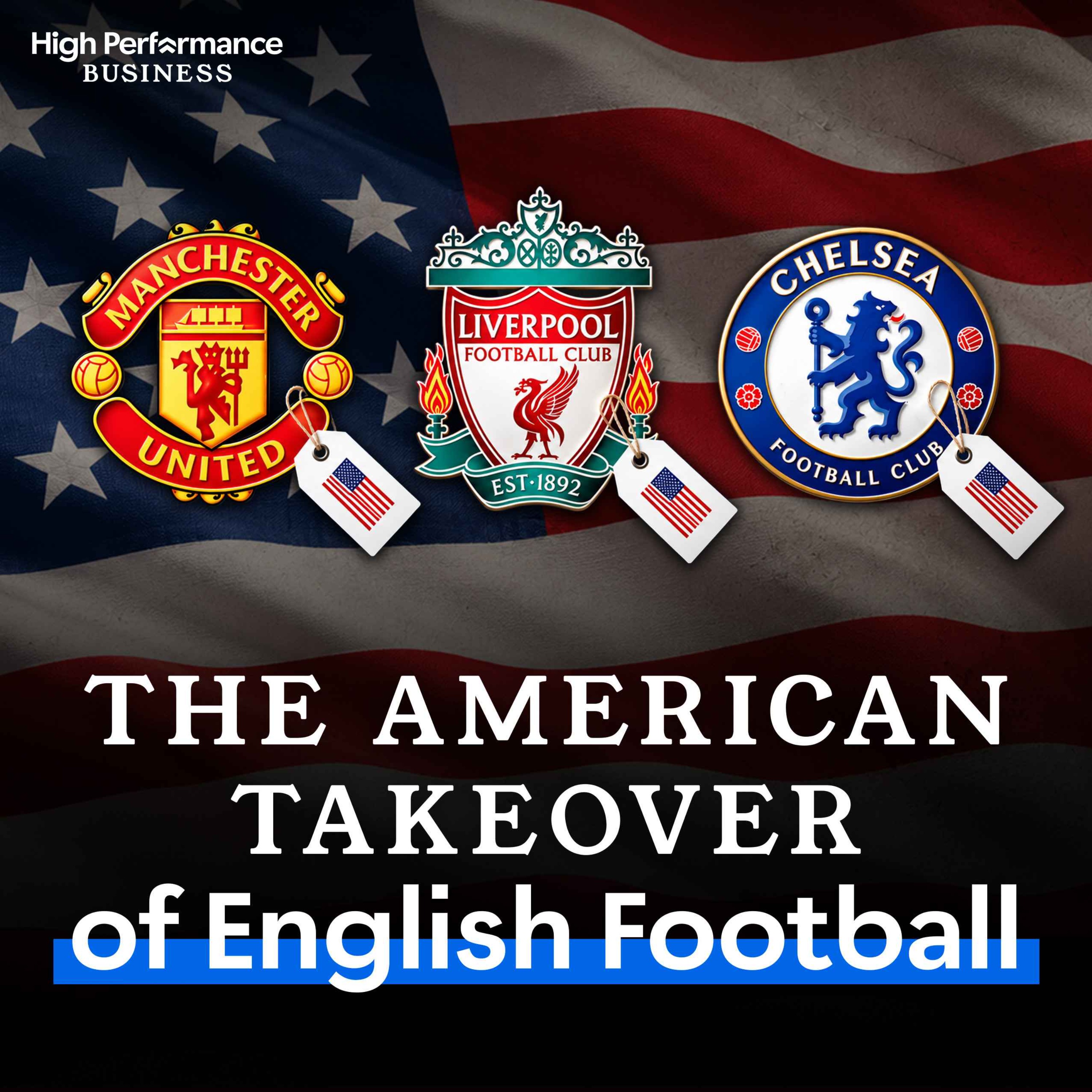
How American investment in the Premier League (11 of 20 clubs majority US-owned) is reshaping football through commercialization—ticketing, sponsorship, matchday “experience,” and potential rule changes—while fans fear clubs becoming leveraged financial assets rather than community institutions.
Two hosts on High Performance Business. One is a North American sports season-ticket holder (compares pricing/season-ticket treatment). The other is a long-time Liverpool fan (focuses on club safety, debt risk, and community continuity).
“Americanisation” is often a proxy for creeping commercialization; the biggest worry is private equity/anonymous ownership treating clubs like portfolios. American owners may also bring operational improvements and growth, but fans’ red line is debt/leverage and threats to club identity. Wrexham’s Ryan Reynolds/Rob McElhenney is cited as a counterexample where fans backed the ownership.
Liverpool/FSG (minority Bezos); Chelsea/Clear Lake buying out Todd Boehly; Glazers at Man United; Wrexham; World Cup hydration breaks; dynamic pricing; Dallas Cowboys valuation vs Man United; Salt Lake Bees “Utah Dirty Sodas” alternate identity.
Written by AI. May contain mistakes.
Discussion about what fans perceive as Americanization in UK football.
“Right, before we actually get into this, when we see Americanization, what do fans actually mean by that?”
Exploration of differences between American sports systems and UK football practices.
“I think then the other side of it, and maybe you can lead me through this, is the window dressing.”
Debate on halftime shows, entertainment, and dynamic pricing in football.
“I think that's really, really interesting to look at us, how we're treated as season ticket holders, what we pay, and our ability to pass those tickets on.”
Discussion on commercialization in football and how it relates to American ownership.
“What are you genuinely concerned about right now?”
Exploration of fans' concerns regarding ownership changes and tradition in football.
“Let's throw FSG in there as Liverpool owners.”
Exploration of how fans view American ownership in football and the emotional connection.
“That's what I think fans are sniffy about.”
Discussion on Wrexham's ownership by celebrities and its impact on the club.
“as they look at the hotel group that they own exactly the same way as the steel company that they own that operates out of 56 different countries.”
The distinction between commercial interests and the Americanization of football culture.
“And I think if you look at Wrexham, you can be sniffy about the documentary and all the razzmatazz that goes with it, but there's no denying what they've done to bring that club up.”
Reasons why Americans are investing in English football and the market dynamics involved.
“But I think those lower league clubs represent something entirely different because you had a crumbling ground that they've started to bring up and make it championship level and all of these things.”
Discussion on how ownership changes affect Premier League governance and club rules.
“I mean, they took over a club that was in financial jeopardy.”
Examining different American ownership models and their implications for clubs.
“Availability and coverage vary by state and insurance plan.”
Explore the valuation comparison between Manchester United and American sports teams.
“or not you're going to call that in two years later.”
Discuss the misconceptions surrounding the culture and fan experience in American sports.
“If you, a Green Bay Packers fan bleeds as green as a Manchester United fan bleeds red.”
Highlight the passion and dedication among fans in both American and English sports.
Examine the potential commercialization and disruption of football's traditional structure.
“I tell you what, there's less police and less violence.”
Debate various practices from American sports that could impact English football.
“but Americans are so used to that kind of I could see that getting voted through yeah why?”
Discuss the role of cheerleaders and entertainment in American sports versus English football.
“If at halftime it stays 15 minutes and it's a big tournament and it's a big final and it's applicable, I kind of feel like we maybe talk too much about that.”
Uncover the historical origins of baseball in North America and its British connections.
“One thing we like to do at the end is called off the bench.”
Explore the historical connections between baseball and British sports.
“Trump and Carney, you do what you have to do with tariffs.”
Learn about the creative rebranding efforts in minor league baseball.
“So this is a AAA team called the Salt Lake Bees, right?”
Discuss how American sports culture impacts fan experiences and promotions.
“Louisville Bats changed their name to Louisville Humidity.”

Get the gist, explore an idea or ask about something said.
 Claude
On High Performance Business, what are the key points of this episode?
Searching your listeningAutomatic transcript. May contain errors.
0:00This summer, football looked a little different. The World Cup final had its first ever halftime show and every match had hydration breaks, creating handy space for advertisers. Yeah, it's not just happening on the pitch, though. This season, 11 of 20 Premier League clubs are majority American owned. Rewind a decade, it was just five. So maybe it's not about when is the Americanisation of football in the UK going to happen? Maybe it already has. But why now? Why is so much American money pouring into English football? Yeah, because it's not just the owners. We're talking ticketing. We're talking match to experience.
0:38The way the game is packed is even it infringes in some of the rules. The question is, how far does this go? You know the score, but what happens on the pitch is only half the story. Yeah, so welcome to High Performance Business and Proud Partnership with IFS. Right, before we actually get into this, when we see Americanization, what do fans actually mean by that? The boardroom stuff, I find a little bit flimsy. So the things we associate with American sport, let's do them really quickly, all right? The draft system through college, we could not build that system in 100 years. And by the way, we should envy that system.
1:18They fill stadiums all across high schools and colleges. It's watched by tens of millions of people. When you talk about the Rose Bowl and everything else that goes with it, we wish we had that system here in the UK. It's not transferable. We do not have the same college system and our teams are signing up kids at four years old. Let's be honest about it. Officially or unofficially, that's happening. Let's talk about spending restrictions. We already have that. We have that. We did a whole episode on it. Let's talk about revenue sharing. We have a form of that. whether we like it or not or we think it's fair we do have that in terms of parachute payments we have a version of it at least not anywhere near the extent of American sports by the way and it's one of the things that makes the majority of American sports clubs profitable by the way let's just say that drafts you're talking out of your backside can't happen here you're not you didn't suggest it I don't know why I'm attacking you I'm just passionate about this I am less worried about that I don't think all of those real foundational blocks that makes American sport American sport transfers to here in terms of that operational side of it.
2:30I think then the other side of it, and maybe you can lead me through this, is the window dressing. Yeah, I think that's when people think of Americanisation. They're really rallying against the cheerleaders. That we already have, okay. The tailgating that you get. Drinking before a game. God forbid that would happen and British sport. And the halftime shows. Okay, let's role play a halftime show. Yeah, I've been at one. So if I'm going to a football match and they're dropping in some new fad band, right? Yeah. You start the singing again, they'll be bleeping. This is what will happen. This is the reality of the halftime show.
3:08Just start singing a song. Any song? Any song. I now have nothing in my head. Just sing anything. One kiss is all it takes. Your new song is f***ing. Your new song. So you're not going to change the culture of what the fans are going to do if you parachute in somebody. Yeah, yeah. So that, I just don't think that's going to happen. We've all been there when the wrong entertainment has been there at half time. The wrong entertainment. Oh my God. But I've also seen Chesney Hawks do well. Really? Yeah. What, one and only? Where was that at? Yeah. That was an England game. Yeah. Yeah, and Declan Rice met him after the game.
3:40Loved it. Right, that's Chesney's maybe an outlier. If Shakira played at the Merseyside Derby, would they boo? No. Right. because you boo the moment. So you might object to something overall, but we boo the moment. So if a player's in a slump, a crowd might boo that moment and it doesn't mean they're not willing him. They'll also cheer louder than they've cheered all season when he finally scores his first goal in 48 games. Liverpool fans adored Dua Lipa at that Champions League final. 100%. Adored her. But I think if it became a weekly thing, like every game had halftime entertainment, rightfully there would probably be protests people would leave at half time and not come back in it'd be nothing personal about Shakira but it is interesting again we carry a little bit of hypocrisy with that but I come back to what you said I think it's a great point I don't think American owners are coming over going let's have a half time show I just don't think that's what they're trying to do I don't think they are either but what about things like dynamic pricing because I think the pricing is what's upsetting a lot of fans this is a whole new episode on its own I think we should do this should we do this as a separate episode and explainer As someone who's a season ticket holder at a North American sports franchise, I think that's really, really interesting to look at us, how we're treated as season ticket holders, what we pay, and our ability to pass those tickets on.
5:02It's very different. Oh, yeah. This is a really complicated issue, the Americanization. I mean, we rubbished it straight away by saying it's commercialization. So let's pivot to that of the other window dressing. the idea that anything that moves is going to have a logo on it, right? I've heard that from so many of my friends I mean, God forbid if we had sponsors on the front and the arms of shirts God forbid if every TV show was sponsored and every ad break was sponsored God forbid if we had double layers of billboards like I would be against all American owners if they brought that into the Premier League, but it's there I feel I don't know what the I don't know what the analogy is and I share the concerns about private equity in football I share the concerns about leverage of debt against these historic beautiful beautiful clubs and I include Manchester United on that list I do however feel like at times we're complaining about there being a slight leak in a pipe when over here there's a flood Do you get what I mean?
6:12Yeah. Like that ship sailed long ago. And also, if suddenly we do start having Corner Kick sponsored by, it won't be the American owner's fault. That will be down to the TV companies or down to the Premier League. Or, you know, that will be not an American, a fault of an American. So in that case, because it sounds like we're almost, and maybe it is the case with you, but that we've been paid under the table. Do you know what I mean? Maybe FSG got to me before this episode because we seem to be making quite a case for don't panic apart from private equity. So what is a red line? What are you genuinely concerned about right now?
6:52Every student, regardless of race, zip code or socioeconomic status, deserves an education that prepares them for lifelong success. But how do we deliver on that promise at scale? On the latest episode of the Good Things podcast, Dr. Liz Chu and Dr. Whitney Oakley, two educators spearheading this research, show how one district bright spot has transformed its system to better support teachers and students alike. Listen to the full story in the latest episode of Good Things from Lemonada Media. Therapy's biggest impact doesn't show up in some dramatic breakthrough. It shows up in the smallest moments.
7:28You bite your tongue instead of escalating. You put your phone down instead of firing off that text. You say what you actually mean instead of what would hurt someone else the most. Nobody applauds those moments, but they quietly change your life. That's what growing feels like, and that's exactly what Grow Therapy is here for. Grow is therapy that works, covered by insurance. Sessions average$21 with insurance, and some pay as little as$0 depending on their plan. There are no subscriptions, no long-term commitments. You just pay per session. Grow connects you with thousands of high-quality, licensed therapists across the U.S., offering both virtual and in-person sessions, nights and weekends.
8:10You can search by what matters, like insurance, specialty, identity, or availability. And you can book a therapy session in minutes and begin in as little as two days, not the national 48-day average. See if you could pay as little as$0 for therapy in seconds at growtherapy.com slash ACAST. That's growtherapy.com slash ACAST. growtherapy.com slash ACAST. Availability and coverage vary by state and insurance plan.
8:43I think as a fan, you are concerned when it feels like the tradition of your club is getting away from you. And any one voting bloc, whether that be 14 owners from the Middle East, 14 owners from Russia, 14 owners from America is scary. Yeah. And I think also when private equity or big money comes into a club, you will see it handled in very different ways. So, for example, when Newcastle United got taken over, they were dancing in the street. That wasn't them being sniffy about what might come. They were just super happy that some money was coming into their club. Great example of wherever it comes from, if it's coming to us, we're on board.
9:24So I guess what I'm saying is I am not against fans who have a problem with the creeping commercialisation of their club, the fact that their season tickets are going up, the fact that their just match day tickets and memberships are going up, the way their club treats them. All of these are absolutely valid points. but maybe we are just a bit extra sniffy about Americans and we treat them slightly differently to the way we might Saudi investment or... And that's a whole different podcast. But Business 101, if you create a global product that's appealing in all four corners of the world, people from all four corners of the world are going to try and profit off it.
10:07So when we chaired that signing, when we managed to go out and get that World Cup winner, when we broke the bank for them and we welcomed them with open arms with every scarf in the air singing the anthems. That is part of this rolling ball. And it started in the early 90s. Great phrase that you used, creeping commercialization. I'll give you my genuine concern about too many American owners. And I think I have been very nuanced about this. If maybe I'm going to a bit too far. It's quite unlike you. What can I say? You make me a better person. Okay, so that's Americanization. And let's just say it again, that's commercialisation.
10:44So much of it, that is the word we should be using. But that's what I love about this subject because I think it's nuanced and I think we're not here to create black and white stories and tabloid headlines. There's a lot in this. But what's the state of play right now? Just how American is for Toxic, the Premier League? Well, I don't think we're talking anymore about one or two billionaires snapping up a couple of clubs. They're the majority now. 11 out of the 20 Premier League clubs are majority owned by US investment. And in the Premier League, a lot of that is down to mainly private equity and consortium clubs.
11:20Across Europe's five big leagues, American investors had stakes in around 32 % of clubs, so a lot. And when you come down to the championship, nine championship clubs are majority owned by US individuals or firms. It's slightly different when you move down through the leagues. But all four of the historical big four, United, Liverpool, Arsenal and Chelsea, are American owned. And even in the last week, we've had Clear Lake Capital, the private equity firm that's run by Badad Agbali and Jose Feliciano, the Chelsea owners. They've increased their stake by buying out Todd Bowley, etc. So that's now hugely owned by Clear Lake.
11:59You do not get enough credit for being the person in this podcast that remembers all of the names. Thank you so much for doing that. Goodness for notes. And I find that really interesting because immediately you've given me something to think about that I didn't think about because three teams get promoted every year from the championship. And I want you to keep that magic number, pardon the pun, in your head, three being the magic number. Let's throw FSG in there as Liverpool owners. They now have, of course, Jeff Bezos and his bunch as minority owners. And it's American for American. Chelsea, American for American.
12:3211 clubs, 3 come up from the championship that are American owned that gets to 14, keep that number in your head we will come back to it but I want to say right now the fear of the Americanisation of the Premier League I'll go to that of British football I'm not sure it is that I think it's the fear of commercialisation and I feel whether it's just the cowboy hat and the Vegas strip and the New York way and La La Land and Hollywood and everything that comes with a razzmatazz of American sport, that it looks different on the heads of American owners than it does on the heads of Russian owners or owners from the Middle East.
13:15And I think that's a really broad and accurate brushstroke to place in American owners. Do you think that we as Europeans are sniffy about Americanisation because what we're actually worried about is the creeping commercialisation of football. The two are distinct, aren't they? Because Americanisation can mean a lot of things. And actually, it might be like a Monty Python sketch, what have the Americans ever done for us? Actually quite a lot when it comes to certain things around sport and our vernacular and the way we approach sport. But it's the creeping commercialisation, I think, is what fans are worried about.
13:50And particularly, I think fans think of the Glazers at United and that leveraged buyout of United and the fact the club had no debt when they took it over. and the way they extract money from that club. That's what I think fans are sniffy about. And I think there's no right answer to this, but I think if you see, for example, an American owner, say Shahid Khan, right? You see the person and that's it. I think when you can see the face of the person it owns, and it doesn't mean it works out right, if you can see a Glazer face, if you can see a Todd Bowley face, if you can see a Shahid Khan face, but I think it's easier to embrace an owner when it's one person or the head of a sports group like FSG, who've already got a good track record with what they managed to do at the Boston Red Sox, that when you see private equity, and the worry is that they will look at you exactly like they look at the fast food chain that's in 48 countries around the world, exactly how they'll look at you in the same way as they look at the hotel group that they own exactly the same way as the steel company that they own that operates out of 56 different countries.
14:55and the worry is when it's not a face, regardless of the nationality, are you going to treat us in the same way as you treat all of your other financial investments? That's a huge worry because football is so much more than that. I think that is probably a justifiable concern right now. I think when we talk about this, we have to remember that not every fan group is opposed to the Americanisation of football. When Rob McElhenney and Ryan Reynolds took over Wrexham, the ownership group were the fans. Fans owned Wrexham and more than 98 % of them voted for that to be done. And I think if you look at Wrexham, you can be sniffy about the documentary and all the razzmatazz that goes with it, but there's no denying what they've done to bring that club up.
15:42So it seems to me what you're saying is that you're all for people who've played action heroes, comic book heroes. So you're saying like Ben Affleck, okay, right? Like Deadpool, okay. Right? I was going to say Spider-Man, but he's English. So that doesn't really count. But it's true. Like the romance of that story and that journey that's documented is absolutely fantastic. You know, Wrexham and the Premier League will be an amazing story. So it's not about Americanization, is it? Let's rubbish our own podcast. Because this was my very first thought. The very first thing I messaged you was like, this isn't about Americanization.
16:20This is about commercialization. And when a lot of new American owners is not a face, it's private equity. That's the worry. And this is what I'm saying about the distinction between Premier League clubs and the lower leagues. Because you can buy a championship club for 20 million. Okay. You know, and that does. I can't, but yeah. Obviously. Thank you for offering. Together, we maybe could, you know. If I could, a buy still. I'm just going to put it out there. A wet Tuesday night. Sleeping giant. Sleeping giant. But I think those lower league clubs represent something entirely different because you had a crumbling ground that they've started to bring up and make it championship level and all of these things.
17:02And there is, as you said, a face to those two men. Ryan Reynolds was very, very clear from the start. He didn't know anything about football. He's fallen in love with it. And that's one of the conversations I had yesterday about why Americans would invest in English football. And there's so many reasons and we'll go over them. But one of them was they've fallen in love with it. Americans are increasingly falling in love with soccer. That's not a new thing. That started happening over the last sort of decade. I think the World Cup being in America certainly helped. But you are now seeing signs, particularly with younger people, that men's football, because of course women's football has been a thing in America for a lot longer than it has even here properly.
17:43but men's football is starting to be very commercially viable for them, very recognisable. So the fact that they're seeing more of it over there coupled with the love of football, that they can fall in love with football, makes it very attractive. Okay, so just to recap then, worried that historic football institutions are being treated as financial assets rather than a competitive sports team and then the idea is that that American style that we see, which we'll get on to later, which I will have a robust defense of, of how American sports operate, the entertainment, the halftime shows, the family friendly atmosphere, the no segregation, lack of singing, if we're being honest, is something that we don't want to see here.
18:30But it seems to me like you're making the case for the opposition here. You're saying that in the same reason that I spend all my holidays going to see that Americana, that they're not buying into football they make in America and they're buying into football because it's quintessentially British. Yes, along with the fact that they've got real estate here. You know, let's not beat around the bush. If you're buying a Premier League club, you're not just buying the fact that you've got 40 ,000 fans or up to 90 ,000 fans who would go every, you know, home match. You're buying into the fact that there is real estate.
19:04And they know that English football is a relatively untapped market when it compares to American sport. There's scarcity here. You can buy a club, whereas in the States, and you know this very well, it's really hard to buy an NFL team, for example. They stay in families for decades. So it offers huge growth potential, commercial growth potential to buy into the English market. But football has jeopardy. It has relegation, which they don't have. It has joy. And a lot of them who buy into English football buy it for all these commercial reasons and then find themselves falling in love with the sport.
19:43One person yesterday said to me that the reason their American owner bought that club was because it's AI-proof. And that's interesting because we are moving. At the moment, it's AI-proof. At the moment. Let's just say that at the moment. And there also is a world where VR headsets are coming and they're coming soon. And so it won't necessarily be AI-proof. But we go to football matches. They can't simulate that. This is something that cannot be replicated. And I think yet again, I come back to embrace the nuance. It's actually horrible to go, every American owner is like this or every private equity company is like this.
20:18But everything that you explained, I struggle to see how a private equity company could reach that emotional connection with their club. And that would be a genuine worry. There's also a middle ground. You're not a billionaire's play thing who's going to put all their own money in and give you success that's way beyond your means and try and work within that new financial rules. They're not a private equity company. They are Fenway Sports Group. And they seem to straddle both of those things. If you talk to Liverpool fans, and I am not getting into this, but there will be quite a lot who will say, well, by and large, positive in what they managed to do at Liverpool.
20:51There'll be some that don't like it. But mixed, let's say, we're probably leaning more towards favourable. I mean, they took over a club that was in financial jeopardy. Liverpool were in financial jeopardy. And they've come out the other side making them a multi-billion pound proposition to new owners like Jeff Bezos. And they've won trophies along the way. You know, you can't denounce one and then celebrate the other. They're connected. So we've got to be very careful about making that horrible grouping of this is what American owners are like, any more than we shouldn't say this is what Middle Eastern owners are like.
21:28however where they do group together is in changing the rules and the foundations and the way forward for the Premier League do you remember 3 is the magic number 11 majority own clubs at the moment 14 is what you need to change Premier League rules without any opposition one club, one vote, two thirds majority you need 14 one more change of ownership and two clubs come up, Wrexham come up plus one other, they have that. But again, not to pour scorn on our podcast. It's ludicrous to think that they're all going to get in the room with a howdy doody and a yee-haw and all voting the same thing. I'd love to be in that room.
22:11I don't swear on this podcast, so we'll bleep it. But that's f***ing madness. It's paranoia to think that Shahi Khan and Clear Lake and FSG and Deadpool are all going to be like, yeah, we've got 14 now. bring on the halftime show. And I actually don't think they're looking to bring that. I think it's commercialization rather than Americanization.
22:38Every student, regardless of race, zip code or socioeconomic status, deserves an education that prepares them for lifelong success. But how do we deliver on that promise at scale? On the latest episode of the Good Things podcast, Dr. Liz Chu and Dr. Whitney Oakley, two educators spearheading this research, Show how one district bright spot has transformed its system to better support teachers and students alike. Listen to the full story in the latest episode of Good Things from Lemonada Media. Therapy's biggest impact doesn't show up in some dramatic breakthrough. It shows up in the smallest moments.
23:14You bite your tongue instead of escalating. You put your phone down instead of firing off that text. You say what you actually mean instead of what would hurt someone else the most. Nobody applauds those moments, but they quietly change your life. That's what growing feels like, and that's exactly what Grow Therapy is here for. Grow is therapy that works, covered by insurance. Sessions average$21 with insurance, and some pay as little as$0, depending on their plan. There are no subscriptions, no long-term commitments. You just pay per session. Grow connects you with thousands of high-quality, licensed therapists across the U.S., offering both virtual and in-person sessions, nights and weekends.
23:56You can search by what matters, like insurance, specialty, identity, or availability. And you can book a therapy session in minutes and begin in as little as two days, not the national 48-day average. See if you could pay as little as$0 for therapy in seconds at growtherapy.com slash ACAST. That's growtherapy.com slash ACAST. growtherapy.com slash ACAST. Availability and coverage vary by state and insurance plan.
24:29Yeah, don't get me wrong. I'm not saying that every American owner that's bought into the Premier League. That's exactly what you're saying. No, I'm not saying that suddenly they've all fallen in love with football and it's a wonderful fairy tale. Because clearly if you asked Liverpool fans, they might be happy. They might think it's okay. They're American owner and broadly they'll be You're right. If you ask Man United fans, they're going to have a very different view on their American owners and how much dividends they've taken out of the club and how much debt they've leveraged against that club.
24:57No two American owners are going to run their clubs the same. But that's kind of back to our point about the sniffiness we as Europeans feel about the term Americanisation. I can't wait to get on to talking about North American sport, Americanisms and the connections with British sport because that's always a nonsense. I can't wait to talk about it. This is a hint. about what we're going to talk about. But do you know what's really clear? You have to get back to the fan, which is when it comes to the business of football. And it's this. It's changed. What my aspiration was in 1988 as an 11-year-old Liverpool fan is so much different than what it is as a 49-year-old.
25:36When a new owner comes in, when the Bezos group buy a minority share in Liverpool, my first thought is, I want this club to be safe. Not, we have more money. It's, do you have the best interests at heart for this club? You're not going to leverage debt against it. You're not going to put us in a situation where my children or my God children can't go and enjoy this thing. That this community remains. That this fantastic community remains. A heartbeat of a society. And everyone feeds that about their football club. We measure success so much differently and so much of football is in so much debt.
26:14And that is the problem. It's a system that doesn't work for the entire pyramid. So as a football fan, and they're not going to say, I don't want an American. They're going to say, I don't want an owner who puts my club at risk. Even if that means we finish 10th in the same division for the next 10 years, at least I can bring my kids. And I think that's really, really important. It's really important. But also, if your club has leveraged debt against it, for example, but it's winning titles and it's winning Champions Leagues, do you care as much? I wonder, I mean, I would care, you would care but maybe some fans wouldn't care as much if the board members were taking dividends every single year and the club had debt if they were winning.
27:00It sounds to me like you're heading like there might be a little bit of hypocrisy. I would come at it from a different point of view is that we're not accountants and the people that take the club, it's their responsibility to do the job, not ours to read the accounts, not ours to hold them to account. Get it right. keep the club's history and the club's security at the centre of everything you do and if there is a way to win trophies if there's a way to compete at the very high level great but not at the expense of the club and I hate when people level at fans well you cheered that but you spent that money I'm not an accountant I'm an average presenter like I can't even manage my own accounts let alone worry about what my football team does that's your job no more than I will pull over at the roadworks in the M1 and go, are you sure you're taking that all right?
27:47I don't know. I genuinely don't know how to run a football club. I genuinely don't know what you can leverage and what you can't. I genuinely don't know how much money you're taking as a guaranteed loan or not you're going to call that in two years later. It's an absolute minefield. Fans are genuinely worried about where football is at the moment and they're worried the bubble will burst at some stage financially. But if you talk to most of the American owners by an end, they'll be like, there's a lot more bubble to blow first. And this is the thing, because if you take a case study, for example, like the Dallas Cowboys, Forbes valued Manchester United this year at 7.2 billion, right?
28:26And that does sound huge until you compare it to the top end of US sport. Because where we stand right now in September 2026, the Dallas Cowboys valuation is 17 billion, which is how much more than Man United? 2.4. 2.4 times. So, you know, United have got 20 English titles and English league titles and then obviously FA Cups, Champions Leagues, whatever. The Cowboys have five Super Bowls. So I think the point there is that American, Americans or American sport has become exceptionally good at turning huge audiences into huge commercial values. And that's why they can see English football as being a bit far behind, an untapped area for them to essentially make more money.
29:14You love American sport. What is it about the sport in America, any sport in America that you adore? First of all, I'd like to say thank you for giving me this platform to just have a robust defense of American sport. I will also state this in a really, really polite way. If our producer Bella cuts this out, I ain't coming back for the next episode. I'm going to say that now. You've heard of Bella. Be warned. You've heard of Bella. but don't cut it out. I don't want quarters and I don't want closed off leagues and I don't want halftime shows. But as someone who follows a North American baseball team religiously, there's such a misrepresentation of North American sport.
29:50If you, a Green Bay Packers fan bleeds as green as a Manchester United fan bleeds red. Let me tell you about my experience of supporting the Toronto Blue Jays. By the way, I used to live there. That was my connection. It's a really happy place. there are phone-ins after every game, like 6.06 on BBC Five Live with fans screaming because the players had a bad week. The season ticket holders, the obsession and the fandom is no different in the NFL, in the NBA and the MLB as it is in the EPL, which they call it over there, which really annoys me. That's there, right? Do you know what I can do? I can go and be passionate about baseball alongside children, alongside women, alongside partners and mothers and sisters and daughters, and they feel safe.
30:43They feel safe. It's about the food and it's about the event. It doesn't make the sport any less important. And we have such a misrepresentation of that here that we don't care so much about the result. Would I like them to sing a few more songs if it would be a bit more lively and it'd be less, let's go Blue Jays and I can make your hands clap. Still do it every time they play that. Yeah, I probably would, but I wouldn't sacrifice that for the safety of children and women when they go and see my baseball team play. I'm so proud of that. So we have, I think, a misrepresentation of what American sport is.
31:22It's not all hot dogs and foam hands. Part of it, the razzmatazz can wear on you a little bit, but sport is at the heart of American sport sport is at the heart of American sport and it's everywhere around us when we walk down the streets here it's in our baseball caps it's in our terminology you've stepped up to the plate today you've thrown me a few curveballs but I think you've knocked it out of the park and there's such a crossover between them and I'm not saying that we want that in football we don't I don't want in football where they're playing music I don't even like goal music by the way get rid of that you want to talk about Americanisation to get rid of music when people score a goal.
32:00Jesus, get rid of that nonsense. There you go, got angry at last. Oh, look at you. Get rid of that. But American sport is about sport. And you go and see any Blue Jays fan or any Cheesehead or any Lakers fan, just because Jack Nicholson is in the front row and they're playing a couple of tunes and people are saying, don't mistake that for not caring about the sport because that is the biggest misrepresentation of all North American sport. I want to make that case today. And just to back your point up, I've been to a few MLS matches in the States and had low expectations and they were vociferous they did not stop singing and I saw the best of football fans You just made the most important point of this entire episode and I never even thought about it never even crossed my mind My friend Greg Brady who's a broadcaster in Canada loves going to see Toronto FC so when I go on the baseball trips he goes there's a game at BMO so we can do the baseball during the day and go to the game there was World Cup games that expanded the stadium Canada played their first game there and there is no part of that that's Americanised the fans they're very Italian actually in the way there's the megaphone and it's orchestrated and they've got a little plinth but if Toronto FC isn't Americanised why would they Americanise the Premier League they take our product and they export it and they love it as it is.
33:27I tell you what, there's less police and less violence. There's less police and less violence. Great point. I think we've done some good unpacking here, but what do you think is actually next? I'm genuinely concerned that we'd be at a commercially motivated break and play during the 45 minutes. Because no matter how much people complained about the hydration break during the World Cup, which was a commercial break, and I got to see it in Canada and it wasn't like here. It wasn't just Ali McCoy moaning about it. It was a proper, you're leaving the game and you can go and do something else and you can check your social media, you can have a drink, you can order a pizza.
34:05It was there for that. It was there to sell you the latest Hyundai and it was appalling and it broke up what football is, that 45 minutes of flowing sport that only stops for restarts. That's the only reason football ever starts. it's because it went out of play or somebody got fouled and it broke it up and it was awful but Americans are so used to that kind of I could see that getting voted through yeah why? because no matter how much people complained about it during the World Cup it happened and I think that's always the thing look at the Super League right it wasn't just people complaining about it it was a step too far it was like we are not coming to this ground if you do that and I think I hope that would happen with any type of break in the 45 minutes and I would be right there outside the ground.
34:54I would be right there outside the ground. A hundred percent. I would bring a packed lunch and to be fair, I'd probably leave after about three, four hours because I've got a bad back, but I would be there. Interesting. I could see that happening. That worries me a lot. There's a line in the sand for you. Yeah, I could see that happening. I don't see halftime shows anytime soon. I don't see how they could over-commercialize in terms of advertising football much more without breaking into that and that's what really worries me. I disagree with you. I think we could see halftime shows a lot sooner than you think.
35:26Maybe not, you know, Liverpool, Bournemouth, but certainly in an FA Cup final, I could see a world. In a one-off like that, again, I think people would suck it up if it's the right artist in that Cup final. Oh, so what would the right artist for you be? But, oh, Nick Cave in the Bad Seeds. I knew you were going to say Nick Cave. Absolutely not. Who does not want to see Nick Cave at half time of a major mainstream sporting event. I'll take you to a Nick Cave gig and you'll change your mind about it straight away. No, I won't because I told you already, the only song that Kylie Minogue ever does that I walk out to is the one she did with Nick Cave.
36:03Do you know who we should get? Go on, Kylie Minogue. The guy who did the theme tune to Peaky Blinders. I love that song. Who's that? Oh, that's Nick Cave. Okay, we would be fine. So to wrap this up then, shall we do a little what we would keep, bring it on and what we would absolutely get rid of okay you reckon am I allowed to be annoying and go that's not American are you allowed to be annoying because do you want to pick at that scam
36:32can I be myself yes yeah okay yes I'm just going to quick fire you're just going to say keep it bring it on keep it out bring it on yeah salary cap salary cap no and in fact we might not have baseball at the start of next season for this exact argument that's happened between Major League Baseball and the Players Union. Okay. Dynamic ticket pricing. No. Keep it out. No a thousand times. More in stadium entertainment. You've just poo-pooed goal music. I would get rid of goal music. If at halftime it stays 15 minutes and it's a big tournament and it's a big final and it's applicable, I kind of feel like we maybe talk too much about that.
37:17I mean, to have Shakira for 12 minutes rather than queue for the toilet and stand with a Carlsberg listening to my mate, I would probably go with Shakira. A draft system. You talked about this earlier. A draft system is N-A. Not applicable. We can't do it here. More breaks in play that can be monetized. Please, God, no. I would actually ban American ownership if they did that. 100%. Closed league, scrapping off promotion and relegation. Closed league's red line, right? We can never close a Premier League off. It wouldn't work here. Why it works in their system is in different ways. All their main sports tie commercialism to competition.
37:53They don't want the same winner all the time. This will blow your mind. Seven of the last 10 World Series, different teams. Seven of the last Super Bowls, different teams. The last eight NBA champions have all been different. They do it their way. We do it our way. red line. Clubs able to relocate to another city? Well, we've been down this road with Wimbledon, but you know, no. It's an interesting one. No, because it's not founded in that way. It doesn't work in that way. It is healthy. It is healthy in a closed league. For a franchise, you're going to say it's a dirty word, but that's what it is.
38:32A franchise that is performing really well and only 8 ,000 people in that state want to go and watch them. What is the logic for keeping that club there? Yeah. What's the logic? But that's an American sport. We don't have that here. We don't have it here. But again, I file it under all the other things we can't do here. Yeah. And finally... And where are they going to move them to? Well, if you're Wimbledon, you're going to move them to Milton Keynes. Right. But the point of me is like, it doesn't, it doesn't even make sense. Yeah. Are Wickham going to go, well, let's just move into West London?
39:07I don't think so. We don't have the space here as well, do we? It's different. And finally, cheerleaders. How do you feel about cheerleaders, Colin? They, I think you have to be very careful about how you talk about cheerleaders because as the Dallas Cowboy cheerleaders will tell you, the amount of work they do within the society, within the culture and within the community, within charity is really important, as do the mascots. so when you just see like Ace at the Blue Jays running up and down the amount of stuff he does it's absolutely brilliant and I have a mascot obsession I probably as a guy I'm quite reticent to go you shouldn't have cheerleaders what is their role?
39:43is it to turn up at half time and dance? or is it to be an integral part of the club? are they a dance troupe? like so I would probably like let's get that splinter out of my backside I'm going to sit on the fence what are you thinking that? I'd love to know I've been watching the Dallas Cheerleaders series on Netflix with my children. Yes. And they adore it. Now... They're definitely role models. 100 % role models. The way they get picked is unbelievable. The process they go through, the work they put in. So I can see the benefit of it. I just don't think it's very us. It's not very applicable to English football because we haven't had that tradition and it is an American tradition.
40:22So I'm not sure it really translates. I also think if you're talking about commercialisation rather than Americanisation, I'm not sure where the financial gain is. It may be, perversely, if a football club said we're going to employ these eight women and four men full time to work in the community at the club and they are going to work through dance troupes, they're going to work through reaching out to schools. I would kind of feel like that's investing in the community. So I think that's probably a different answer depending on the set of circumstances. One thing we like to do at the end is called off the bench.
40:53We want you to DM us your funny stories, the things your mates have done this week. you've gone to football, something's happened, you've been at a tennis match, please send us your stories at dms at highperformance.business on Instagram. He will never look at that, but I might. I wanted to bring you a story this week that is uniquely American and about a sport that's right up your strata. Tell us what you've got on your jumper for those that are listening. So I know there's a trade war at the moment between the USA and Canada, and I don't want to stoke that. But the first recorded game goes back to 1846 in Hoboken.
41:30And there you go. There's your birth of baseball. I won't bore you with it. The problem is that we dig up the metaphorical bones of history and we discover documents and we discover video and we discover accounts. It turned out before that in 1838, there was a game played in Beechville, Ontario. So therefore in North America, as it stands, the first recorded baseball game was in Canada. And it is a really nice bit of one-upmanship. So I don't want to get involved. Trump and Carney, you do what you have to do with tariffs. Well, they do listen to this podcast. And I don't want to inflame tensions, but baseball is Canadian when it comes to North America.
42:11However, and I love this because this is exactly what we talk about, the things we think American aren't American, the things we think are British are American. Actually, the first mention is in a British book that goes all the way back to 1744. Stop it. So as it stands at the moment, there was the Prince of Wales match that looked pretty much like baseball should look in terms of the account. And that goes all the way back to nearly a century before. So when you wear your baseball cap, wear it with British pride. Did they just call it rounders then? Don't do the rounders baseball thing. Don't do the rounders baseball thing.
42:47I was pulling your leg. Let me come back to this. So I want a question for you. which minor league baseball team has spent one day a week for the last season pretending to be a fizzy drink? Savannah Bananas? No. So this is a AAA team called the Salt Lake Bees, right? And the reason I'm telling you this week is because this week they're in the running for the award of the Best New Alternate Identity Award. And now this is something that doesn't happen in English sport. So for one day a week for the last season, they changed their name on a Wednesday to the Utah Dirty Sodas. Do you know what a dirty soda is?
43:25Is it alcohol in? No, it's non-alcoholic. Is it ice cream? It can be anything. It can be soda with something added. So syrup added. I think of a Coke float. That would be a dirty soda, right? So this is a business story too. So the owner of the Salt Lake Bees is the Larry H. Miller company. They also own Swig, which is a soda soft drinks company. Every Wednesday when they change their name, they sell$3 Swig at the match. They've got branded merch, ticket packages. If there's a home run, the whole crowd gets a drink. If they score four or more runs, Swig hands out sodas to the whole community. It took them 18 months to get the proposal through to get this name change.
44:07And the winner is announced on Monday the 28th of September. But I know you're thinking, Nat, tell me the other teams that are in the running for best alternate identity. And I will tell you, the Columbus Clingstones changed their identity to the Columbus Scrambled Dogs. Yes. Named after the Columbus, which is a chopped up hot dog thing. Love it. Las Vegas Aviators changed their name to Las Vegas Headliners for obvious reasons. Louisville Bats changed their name to Louisville Humidity. They literally put sweat stains on their jersey to celebrate their notoriously humid summers. So delightfully obtuse in quaint baseball.
44:41And the final thing, the Palm Beach Cardinals changed their name to the Palm Beach Frozen Iguanas. I love it. Based on the phenomenon of iguanas becoming stiff and falling from trees when it gets cold. That's beautiful. What the hell? This is so American. To tie it all together to finish, right? At the Toronto Blue Jays in the late 90s, whatever it was, early 90s, whatever it was, there's a chain out there. It's called Pizza Pizza, right? What do they sell? Exactly. seven numbers in the local phone number and if we got seven strikes everybody got a free slice of pizza so even when the game was a bit dull you'd get to that you would go on strike them out and when when that strikeout happened win or lose the stadium would be like yes free dinner and they would play every time in the seventh strike when the moon hits your eyes now let me ask you a question how would the Stratford Inn feel about that if if they were getting a free Mackey D's well no that would test that would test our integrity that's amore well listen let's wrap it up there we don't do overtime we're not going to be Americanised at any stage I think it's a really interesting subject and there's loads to talk about hey this isn't a boardroom we didn't just go through all the stats that's what chat GPT is for you can find that out any second but hopefully we started a conversation with you that's where we want this podcast to be so give us a like give us a subscribe if you enjoy it tell your mates if you don't don't tell them anything and I'm looking forward to whatever else we get into next time.
46:08Do you know what I'm loving? Go on. Because I kind of come with being like, this is what I think. And then I leave thinking something slightly different. The point that you made about they don't Americanise their own football was like so important to me. And also we are for the fans. So we want to hear from you, like Colin said, but fans are the lifeblood of football clubs. We all agree that. But what if they're no longer the most valuable supporter of a club? That's what we're going to be talking about next week. We're going to be talking about tourism in football clubs and the sort of flashpoint, I guess, for fans.
46:42So please come and join us next week. And in the meantime, have a lovely break from us. Goodbye.
11 of the 20 Premier League clubs are now majority American owned, up from five a decade ago. This episode asks why the money's coming now, why English clubs look so cheap next to the NFL, and what the new owners actually want to change: ticketing, the matchday experience, and whether promotion and relegation survive.
Also a proper defence of American sport, from why closed leagues have produced seven different World Series winners in ten years to what Wrexham got right.
IFS - award-winning Asset & Service Management software 👉 Reimagine your operations at: https://highpfrmc.com/IFS_HPB_AU
Hosted on Acast. See acast.com/privacy for more information.