
 Ask ChatGPT


 High Performance Business
10 Jun 2025 · 53m
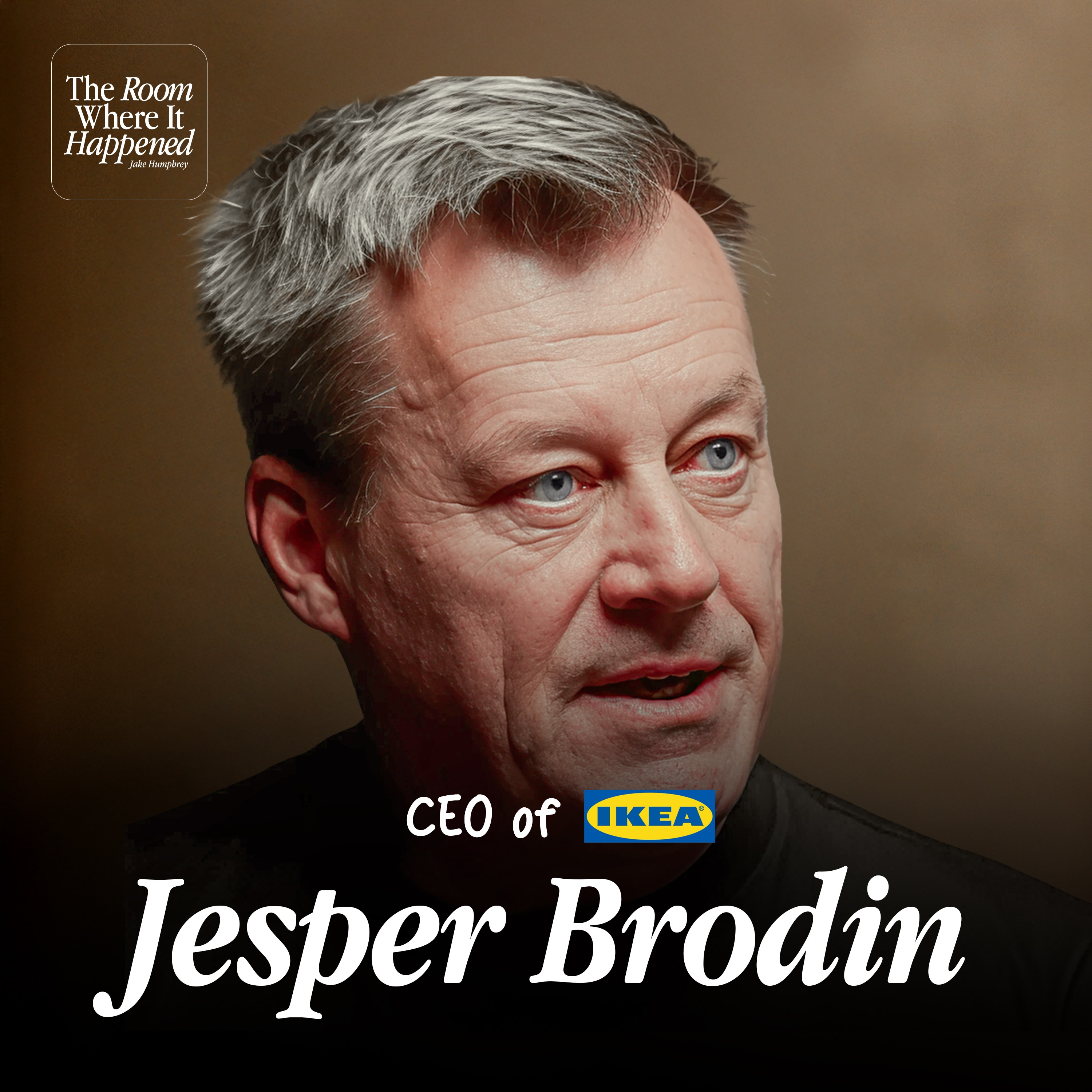
In this episode, Jesper Brodin, the CEO of IKEA, shares his journey in transforming the iconic brand over five years. He delves into pivotal decisions made during a digital revolution, the impact of the global pandemic, and IKEA's bold sustainability mission. Through personal stories and reflections, Brodin emphasizes the importance of humility, listening, and the courage to embrace change.
Written by AI. May contain mistakes.

Get the gist, explore an idea or ask about something said.
 Claude
On High Performance Business, what are the key points of this episode?
Searching your listeningAutomatic transcript. May contain errors.
0:00In a small Tokyo apartment, a single mother is having tea with a stranger. He seems out of place amongst her busy daily life. He's quiet, a slightly quirky man from Sweden. That man was Jesper Brodin, the new CEO of IKEA. Jesper Brodin leads differently, you see. And once you hear how, you will have to ask yourself, what would you do differently if failure didn't scare you? You're listening to The Room Where It Happened, brought to you by IFS. And in this episode, we take you from quiet lessons with IKEA's legendary founder to the bold decisions that reshape the company's future and why Jesper continues to lead the charge on climate change.
0:40But first, to that room in Tokyo.
0:47So Jesper, why did you want to take us into this specific room of all the rooms that you've been to in your career? Well, I take you back some seven, eight years ago. Actually, eight years ago, I signed up to this role to CEO of the group, heading IKEA and I decided to do a world tour actually. So I traveled for five weeks. So I did visit, I think I visited 10 countries over that month. And the interesting thing was that wherever I traveled, I met customers who said, we like IKEA, we love IKEA, we would like to visit you, we will. But at that moment, IKEA was a store-only concept. So people said, you know, when basically on a weekday, and if you don't show up in my telephone or if you're not around the corner, I will deselect you.
1:35But that's just here in Poland or that's just here in Madrid or just here in London and so on. And then I heard the story, I think the sixth or seventh time when I was in Tokyo with a woman in her apartment. I'd love to delve a bit deeper into this room in Japan. Can you remember what this living room looked like that you're standing in talking to this lady? A small apartment as so often in Japan, modern. it was oak veneer furniture there was I think I even recall like in Japan you don't have the same appliances you would have a rice cooker instead of something else a microwave or something huge TV set as always that you wouldn't sacrifice in that part of the world and I also remember this apartment was quite new so it had big windows just from basically floor to ceiling windows with a beautiful view of Tokyo this customer was an affluent person so it was a new apartment and it was fairly well invested and I remember desperately looking for an Ikea piece of furniture but I couldn't find it unfortunately So how had you ended up at her apartment?
2:43If she's a big customer for example I thought she would have had a Yeah, I thought so too A lot of furniture in her house But I don't know how it came to happen but it was very helpful because she was a Nike customers and maybe there was some cattle or some plates or I don't know but she was definitely not shopping everything from Ikea which by the way most people don't do anyhow but she was the thing with her she was very honest what she needed from anyone like Ikea and she was not polite in that way which was important and I it makes me reflect now that maybe one of the successes was that I didn't ask her to please me.
3:24Yeah. You know, but I actually asked her for data and she gave that. And what did you do then? Did you like sit on a sofa or at a table? Where were you? We were in the small kitchen table. Yes. With a cup of tea? Yes, a cup of tea. So the truth is the kid, it was actually early and the kids woke up and I still remember which I found fascinating that one of the kids jumped up and sat in my lap and it's in a total stranger's lap. So that I remember was one of the odd things, the special and lovely. And then I remember, because I thought that was all of us, I remember after almost finishing the conversation, there was a moan and then the husband came up.
4:05He was obviously stepping up a little bit later than the rest of the family, but there you go. The wonderful thing with it was the openness to a stranger, to open your door to a stranger and then not to pretend to be something else or just live life as normal. also. And what was the most important question that you asked her? I asked her, what is it that we are not doing today in IKEA to serve you as a customer? And she had so much to tell me. So I remember it was painful, but it was really valuable. She expressed also specifically that on a Tuesday night, you come home, kids are put to bed and you have a few hours and you need to buy something.
4:46If you don't show up the way I need it, then I will deselect you. So I think this is really interesting. So the business was almost too big to be agile, right? And move quickly. So you know you've got to go digital. You know that she needs to find you on a search engine immediately. You know it needs to be easy for the customer. And if you've got two stores, that's quite simple. You can just set up a Shopify website or something. But when you're the size of IKEA with a global footprint, how do you even begin, which meant you hadn't begun. So how do you then come back and go about convincing all the shareholders and the other senior leaders in IKEA to, as you've said, forget about the cost and realize that if you don't do this, IKEA could be dead?
5:27I think in my case, I normally try to, not balance, but to serve both loving the past and creating the future. We're about 80 years plus now and IKEA was never just there. It was like constant innovations, tests and tries, massive fiascos along the way. Our founder, Inver Kamprad, used to say himself that nobody has made so many mistakes as he did. So I also applied the right to do mistakes along the way. In spring 2020, we found ourselves in a place where most of IKEA was being shut down, country by country. The first indications of a number show that we've been massively in red numbers. We would have had to...
6:12What sort of numbers are you talking about? No, but we talk about that from a growth perspective. We would be maybe... Well, again, we didn't know, right? Because the length of the pandemic and so forth was not known. But we could have easily been down by 20-25 % as a company. And that would have tipped us into layoffs and all sorts of trouble. So thanks to starting the transformation into online, we were not there, but we actually managed in a few weeks, market by market, to click in whatever we had, switch to using our stores, which, by the way, almost carry all of the assortment. So we actually converted our stores into logistics centers during the period.
6:52And we had those two years, the two first years of pandemic, we had 55 ,000 store days of closure. and the first year of financial results, we were minus four in top line, which isn't too bad. So thanks to pandemic, we don't want to thank the pandemic for a lot of things, but thanks to the pandemic, we actually made our transformation in double speed. Because the public were forced to see IKEA as an online brand because they couldn't go to your stores. Exactly. I think it's great though that you're standing in a Tokyo living room having a conversation with someone who says, I need to be able to find you online better.
7:26Three or four years after that, it saves your business. Five years after that, you're opening one of the most expensive and largest stores on probably the most expensive corner in the world, which is just where... I would have to agree. Oxford Street meets region. Which leaves me wondering about your appetite for risk. Yeah, well, you know, I think appetite for risk, if you're an entrepreneurial culture, you, per definition, need to be able to see risk as a friend. I try to, you know, of course, you try to balance to say, I ask myself in most endeavors, you know, that if I say no now, I will never know.
8:03So saying yes, I'm a sort of a yes type of guy. And then the second question is, will anybody get hurt? Will there be a deep financial trouble? What could be the worst things that could happen by pursuing a thought or an idea? And if that's not too dramatic, you know, then the answer will probably be yes. If it has anything to do with us exploring and getting closer to our vision, which is about creating a better life for the many people. I think in the space of city shops, we have made so many mistakes, which meant we had to close a lot of strange hybrids of IKEA, where both ourselves and our customers said, what is this?
8:41It was not clear. We've heard some amazing stories on the show so far. So if you want to learn from the likes of Sir Richard Branson, Rory Sutherland, or the leaders of brands like Five Guys in IKEA, then please follow the show wherever you watch it or listen to it and you'll get the very latest episodes and updates. Take us back to a moment of failure in your business journey. How painful it was, but what you learned from it. Well, I think, well, the recent years, some of the closures of City Stores, the first real brave example of that was La Madeleine in Paris. We opened it 2019, I think. and it was an absolute failure.
9:24And the learning from the failure was basically, so we paid a little bit too high rent, but we did a lot of mistakes by basically having too many parts of IKEA bringing in known facts and not being open for what are the new things that we have to explore. Explain that to me. Well, we had people who were experts in logistic who plugged in what they knew. We had experts in commercial who plugged in what they knew. and in the end of the day, the team, when I met them, they said we knew it wouldn't work because this is new, this is different. So I think the great learning for myself was that we have to be much better to empower frontline people and to engage the local entrepreneurship.
10:04So not every contributor to a big project is a 5 % entrepreneur. You need to have somebody who is passionately running and also mandated to say no to certain things. and I also learned a bit about that actually the internal processes were the things that slowed us down in order to get to it. But as always, the best thing to learn things is to do things. Then you will know and you will uncover your weaknesses. And what does it do for you in terms of either knocking your confidence or the imposter syndrome that all of us carry around here? But if you're the CEO of a huge global brand like IKEA, It's very normal to think to yourself on some quiet flight or when you lay your head down, am I actually good enough to do this job?
10:50Those moments of failure, what are they like for you personally in here? No, but they are, I think it's probably an incredibly important fact that you have that self-critique. Otherwise, you would madly jump into projects and forget about the learnings. But on those occasions, of course, there are moments of doubt, right? Then you say, what's wrong? Was it my insight, my conclusion? Is the strategy wrong? Or is the execution wrong? And which one is it basically? And those moments I've learned over the years, of many years of, together with IKEA, taking steps into develop the future, to have a little bit of patience and not to be too quick in judgment, that the answers will come if you give it a little bit of time.
11:37but as always I think you know what I learned is like very often our intentions are more or less perfect we can have good plans and then when you move to the execution there are so many ways of solving a problem so sometimes you have to celebrate and say okay now we know one way not to solve the problem what I learned is to be brutally honest to myself and to my board and to my management so when we fail it's better to confront it and face it and say, I'm sorry. And sometimes it's good to smile when you say that, I learned over the years. Absolutely. What is the secret to communicating up to your board, particularly in moments of struggle or failure?
12:22How do our audience build the confidence to be able to say to the people above them, I made a mistake? Yeah, well, I think the way I've tried to learn, this is recent for me, the last eight years being CEO. Before that, I had the pleasure to work with our founder, Inva Kampra, as his assistant. So I had the opportunity to observe in boardrooms how things worked or didn't work. So when I took this job, I decided, and I think I was right to the point that times have been much more difficult the last seven, eight years than in any era of IKEA's history. We've had war, pandemic, economic turmoil, and so forth.
13:02So first of all, you know, as you confront and as you lead an organization in a bit of what can be chaotic times, you need to have your back free. You need to have a relationship with the people you report to where you don't have two fronts to monitor. So I think the first conversation we had, and also with my chairman, And Lars-Juan Janhem was to say, we need to be able to establish trust on a level where we are okay. And there is never any hiding or, so to say, putting lipstick on the pig if there is something that is not beautiful. But then also you have to be interested in taking the opportunity of having an organization and a leadership that puts that much of investment in trust.
13:49So I do believe we have a very transparent dialogue. And we do invest a lot in trust. The board members, who are actually representatives in other boards as well, they compliment us. They critique us for a lot of things, but they compliment us for our transparency. And I found it relieving to be able to go to the board and say, this didn't work. And sometimes even say, we're not 100 % sure yet why it doesn't work. But this is our intention. And then, of course, the other way to build trust is to, in people that you respect and that sits on a lot of experience, is also to not only listen, but also to show that you listen.
14:26And that means also sometimes that you agree, but also that you disagree. And I find it's being trust-building to do both. I remember we had a conversation on high performance with a man called Adam Grant, who spoke about, he's a psychologist, who said, be a disagreeable giver. so you can disagree with someone you can ask for more from someone but you do it by giving so if you're not happy with someone's work instead of just telling them that work's not good enough you actually say listen, you're amazing you're so talented I've got such high hopes for you I know how good you are and I know that you can do better it's the same message but it's delivered in a different way I think it's always there a bit of the uncertainty there is no such thing as stability in the world that we are leading right now.
15:15And that means also relations and trust is put on the edge, I think, in every moment. So I found a couple of times when I'm not being 100 % prepared, when I'm not being fully clear in my own head, that can be a bit of a danger because then things can go a bit chaotic in relation to the people you report to, but of course also in the community. So the constant re-evaluation of the situation is fascinating. I think for those of us who have survived the last years in leadership, we're probably a little bit dumb or something, or at least, you know, the capability of being consciously naive, knowing that I need to embark into certain things.
15:59There is no such place as a constant anymore. So you need to take risks that you spoke to, and you need to be able to shift if it doesn't work. Would you give us an example of a time when you haven't been prepared and you've had to learn a hard lesson from that moment? I think in many cases in the beginning of this job, I felt I wasn't prepared enough in the space of sustainability. I had certain insights and beliefs myself, but way back then there was both, you can say, there was both a pull towards something that I felt to a certain degree was driven by only values or only beliefs and not business.
16:43And I also felt there was conservatives in it. So I had to educate myself truly into the area of sustainability, not at least climate mechanism, so to say. So I think today I would probably pass the test from a climate expert perspective because I had to. IKEA is, of course, if you look at the total end-to-end footprint of an IKEA system, it's huge. And the responsibility is huge. What has been interesting on that journey is that I found out not only being a climate leader, it's not only good for the brand, obviously, good because it's the right thing to do, but it's also led IKEA to what I think is actually the biggest transformation from a business smart point of view.
17:26So today, IKEA is well on the way to be a deliverer to the Paris Agreement. And when I look at all the actions we have taken, we have saved costs, made IKEA better. And helped the planet. Yes. And I speak to the economic side because I think we have been driving this agenda on a belief and an hypothesis. And an outspoken, we are not afraid of speaking that we think it's our responsibility from a moral and ethical point of view. It's just that five, seven years ago, we didn't have the proof point. It was economically smart. This we do today. And that is, I think, that journey has been scary and challenging.
18:01Today, it's one of the, if not the greatest pride and joy for me to know that actually I've been part of in a big community to make that shift. And when you meet people who are still a climate change denier, let's say, they still don't believe that actually what they're told is happening is happening. So what is the evidence or what is the line that you use with them that you think is most effective to explain the dire state that our planet is actually in? I think it was a long time since I had that thought, which I've had that thought. And I decided many years ago to spend less time with people who don't believe.
18:35So for people who don't believe, leave us alone. So for those of us who believe, we can go to work. And then there's a risk with that from a leadership perspective that we contribute to polarization, of course. So I've also started to engage more in conversations with people who have a different point of view. And the answer to your question, the unifier is economics. Because I've met groups of people representing oil and gas industry, representing more conservative political sides of society or economy. And when you open up and you share how carbon is basically connected to the economics of a big ecosystem, them.
19:15And then everybody gets excited. And who, you know, first of all, people want to be smart. And I do believe that the risk that we see in society now, because I'm absolutely convinced that the biggest transformation we are seeing in our chaotic time is actually the climate transformation is going to change everything. And it's not an incremental stepwise little change. It is a fundamental change of economics. And the interesting thing is the gap between the people on the bumpy train ride towards ClimateSmart because it is a bumpy road. But the distance between those and those left on the station who's not acting or waiting is increasing.
19:55And I'm increasingly worried for the businesses and business models that are in some sort of wait mode or in a denial to this because they might not even be able to catch up in a few years to the new economy. Can I talk about your founder, Ingvar? Please. I think it's always fascinating when someone gets to work with a founder because a founder and a CEO are kind of different, right? You're running the business, but there's a real emotional connection for a founder. I'd love to know the biggest lessons that you learned from working with Ingvar when you would have only been in your mid to late 20s, wouldn't you?
20:31I was, I think, let me see, I was like just past 30 when I worked as assistant for three years. It was an incredible period. I could say that now, I could have worked for free because it was such a good education. But no, but I learned a lot of things, obviously, from him. The opportunity to be invited to learn about IKEA, about the structures, about everything. But the thing that was, I think probably the biggest learning for me was that he was human, imperfect. But there was something about his dedication to never let go of an issue or a problem. And his almost obsession about believing in that we have actually a role to play in IKEA, where he was incredibly consistent.
21:15And then in all of that, he did make a lot of mistakes. He was really flesh and blood. And for me, somehow, before working in that context, I had some sort of shiny ideas of leaders and founders and CEOs. Just to find out that actually being human was his absolute biggest strength. not pretending to be something he wasn't and then changing his mind apologizing and so forth so in a way learning from him I felt during these years that the best thing I can do is to be myself not to try to fit into a suit of an expectation and that has helped me enormously if not it's made me feel better about myself as well there I think in several cultures and maybe also in junior parts we are led to believe that we need to fit into something that I think is the biggest mistake you can do as a leader.
22:05I think that's really interesting because we're so obsessed with what people do and we're less interested in who people are. So I'm sure very often you go to a party and someone, if they don't know, they say, what do you do? And you're like, I'm the CEO of IKEA. But how often do they say, who are you? Who I am? Who are you? Well, this reminds me of my first leadership training. When you say, so who are you? Yeah, I work at IKEA. No, that's what you work at. But who are you? well I'm 36 years old yeah that's your age so you know obviously you can answer that question in different ways but I think one way is to answer in what do you believe in another could be also to say you know also to open up what are your fears so I think if you want to go deeper in those topics which I think is an important part of successful leadership also you have to be also with yourself of course comfortable to be open and be vulnerable So I think vulnerability is probably one of the most essential questions in describing who you are.
23:07I wouldn't probably go there straight away on a cocktail party, but I've learned, because I haven't always been comfortable being open about those sides of myself, but I learned through the IKEA community that that is not only very effective in leadership because it's a trust builder, but it also helps me get to know myself better. So it's now a good time to ask you, who are you? so you put me on the spot well it is always a good time I think so I am a person with a very genuine motivation so I've never been striving for big roles or big responsibility or money or fame but I've always been I think courageous in beliefs so I am a strong believer in that I can be part of contribute to something better that drives me I am I think a person continues to look for what am I good at and what do I love to do and some days I think I find it in these jobs and some days I think I'm crap of what I do so I think that's part of who I am I think that's lovely and you also said it's important to acknowledge what you're I will ask you this question when there's a camera there you go there you go but I think you know the reason why yes but I think it matters right is because it's very easy for us not to have a vulnerable conversation because you're the CEO of a big business.
24:29And we're all told, if you're the CEO of a big business, don't be vulnerable. Don't open yourself up. Don't talk about failure. Don't let people think that they should be worried about the leadership. I think we're in a different world now. You know, in 2025, I think the very best thing you can do is sit here and explain to us that basically you're not a CEO. You're an explorer, right? You're an inquisitive, ever-changing human being. and you're probably a very different CEO now to a couple of years ago. And in a couple of years' time, you'll be a different CEO again. One thing you mentioned that I'm fascinated by, you said fear is a very important thing to acknowledge.
25:03What is it that, what drives your fear? What are you fearful? Well, you know, worrying and fear is part of who we are, right? And I agree totally with you. If we hide it, then it's not going to help us at all. So I think, you know, the fears, if I relate to my job, Of course, there is a fear of not being successful. Financially, we don't only have responsibility towards our own and the foundation and what they need money for and so on. But of course, the fear of failure with the 170 ,000 people in our community. So there's a lot of jobs and families. That responsibility is there. And the fear is also connected, I think, to not leading change in the right way.
25:47So I think we are absolutely convinced that standing still in this moment and being conservative is very dangerous, regardless of what type of business you are. But to make sure that the decisions are both courageous, but also that in every moment, when I'm part of driving a change and taking responsibility, I have to have the courage to say, I put myself online for that decision, not somebody else, so to say. And when you do that, that makes you reflect once or twice. there is fear sometimes I think in new situations I remember a couple of those as to your podcast those rooms and those moments when when it sort of happened and one of those moments was actually I remember when during the pandemic we realized that we would be financially okay that was a good moment of course and then we looked at and we said what are the things that we need to reverse that we anticipated and one was actually IKEA, like so many companies were applying for furlough during these periods and times in so many countries.
26:53And we had one of those moments where we said, are we okay with taking money if we're still successful financially? We said no. So we took the decision to reverse furlough, which was interesting because in some places that had never happened before. So if I recall correctly, in Spain we had to set up a financial mechanism to give back money to society. So I think, you know, So in those moments, there is a fear of in unknown to put things in the wrong direction. But then again, you can always stop and reflect. And if you're honest to yourself and the community, we took a course and that was wrong.
27:30Now we will change the direction. We will go in a different way. I love this idea of reversing furlough and giving money back rather than taking money because it's the right thing to do. Business isn't always about doing the right thing by society. It's about doing the right thing. I think it's always. Well, sometimes it's about doing the right thing by your shareholders or by your profit or your bottom line. And I'm sure there were people at the top of my kid that were saying, hold on a minute, this is a huge amount of money that is kind of rightfully ours in some way, and you're choosing to give it back, which is the right thing to do, but is it the right thing from a business perspective?
28:02So when you're in a situation like that, what is the secret, do you think, to taking people on that journey with you, to believe in the brave and sometimes total opposite decision to the one that other decisions... I mean, if I reflect on it, I'm sure I've been part of taking tactical decisions at certain times, and I will probably, you know, remember one or two things which I would regret as well. But I think as a business leader, I've learned over the years that when you engage with any part, it might be society, civil servants, companies, you look for some sort of strategic fit and you look for value fit.
28:42And I think strategic fit without value fit doesn't work, that I've learned over the years. So at least for us in IKEA, if we engage, we need to have similar values or views on things. And in our case, our founder, Inver Kampra, I remember, I think it was the second last time I met him. He passed away a few years ago and we were on the porch of his house, me and Anders Stolvik, my former colleague and manager. and we had just one of those wonderful moments waiting for people and there was no agenda, no stress, and we just had a conversation. So at the moment, we asked him, so Ingvar, tell us now, how should we think about the future?
29:20And he said, like he used to do, he said, oh, you should think long-term. This was one of his mantras and values. And then I asked, because I never asked that before, I said, so how long-term do you think we should think? And he said, yeah, 200 years. He said, and that stays with me as you can hear, you know, I will never forget it because it was such a beautiful thing. So I think when you think about how you take actions, what I like to do when I'm in the cluttering to the midst of things, I try to take that sort of 200 years perspective and say, wait a minute, what is most important here? And very often, of course, in a dilemma, you have to mitigate the financial, the board, whatever wishes you have from stakeholders in your company with what are the stakeholders in society demanding from us and so forth.
30:10And of course, you end up in dilemmas that needs a little bit of time to resolve. But in the end of the day, I found so far at least that if you take shortcuts, it's going to hit back. So think 200 years. It's probably better for society now that we lead in an open and transparent way. We might get some friends that remember us for this or not, but it is the right thing to do for the company. At least in the company, it sent a very strong signal. We need to be able to stand our own legs and ride through this storm, and we will. So I thought that was quite cool. I think it's a brilliant way of thinking.
30:42And I would imagine very, very few businesses are thinking 20 years into the future, let alone 200 years into the future. When you reflect on Ingvar, he obviously had a big impact on your life. What is the single best piece of advice that he gave you? I have several good advice that he gave me and we had a lot of good time together. I used to be his assistant, which was much easier than being the CEO for him, I can tell you. And I remember still when I was working out of Hong Kong in China with the regional responsibility. So he called me one day and said, I would like to come and visit you in China.
31:18And I said, when? And he said, March. I said, which week in March? And I said, no, March. The entire month. So he came. And of course, I had to push everything aside. And there were both security things and of course, business agendas. And he was not an easy entrepreneur to live and follow with. But it was one of the best periods of my life from a business perspective. We traveled from North China to South. and I still have people who claim that we have containers left for the bad business we did. I refuse to accept that, but we did a lot of business. And I still, you know, if I would answer the advice part, I think this human side of him in a story.
32:03We were in the car in Shandong province, if I remember it right. And I told him that there is a factory. We started to build a certain kitchen and everything has gone wrong. The company has done wrong. We have done wrong. We tried to fix it. Both of us have done wrong again. So everybody's upset. The relationship is not working and business is bad. So I said to Ingvar, I didn't actually plan that we should go there. But do you think, should we go there and see if we can do something about the situation? And he actually thought about it and he said, yes, let's go there. We went there. It was in the afternoon.
32:41we walked up the stairs of a simple office of the owner and founder of that company, Mr. Ling. And I remember Ingvar stepping up to him. It was like a wonderful light coming in, a bit dusty in the air. And he just hugged Mr. Ling. And he said, Mr. Ling, please forgive us for all our mistakes in the past. And then I thought it was over. But then he kept him and then he said, please forgive us for our mistakes in the future. And then for me, that was like, OK, that's how you do. that's how you build a relationship and you show up. So this is like one of those moments for me. Man, that is a special moment.
33:17That is a special moment, yeah. And a special room, another room where it happened. And Woody had said, from now on, everything's going to be fine. That could have been nice, you know, but he said the right thing. So we will try it out most, but we might go wrong in the future. And I sometimes think, you know, entrepreneurs, people like Ingvar are a million miles an hour, a million ideas an hour. What's the secret to working closely with someone like Ingvar, but also managing to kind of be yourself in that relationship? Well, I think I, unfortunately, I suffer from a little bit of that myself.
33:51I tell you a secret. So in those times we're in right now, which are demanding, to say the least, with the economic turbulence that we're experiencing, not at least, I had to make a commitment to my management group to not have one single new idea until August. So this is, you know, so I am an ideas person and he was too. And I think as such, of course, you need to combine ideas and creativity with structure. So one without the other doesn't work, right? So, and in a way, you know, I think creativity is wonderful in that way because it's the secret juice, right? It's the thing that can make one plus one become three or four and so on.
34:33and I do believe that the soul of IKEA is built on that lustful creativity and some sort of collective agreement that we will be courageous and we will have difficulties to say no, that has led us to a lot of things, I was part of building up IKEA's TV business what a marvelous fiasco that was bad timing, bad product, bad everything but we tried TVs, so now we know and so forth But that type of mistakes, I think, are even sometimes more important than the successes. Because sometimes people might think that success is built on brilliance on the top and so on. But the secret about IKEA is that we are really a culture of wanting to act on ideas, which is not to be taken for granted.
35:24Also in big organizations with a strong legacy, you can suffocate. like in the example of not wanting to step into digital and omni-channel, waiting a bit too long with that. But I actually realized a few years ago that when I met my colleagues out in the organization, we had a bit too little of that sentiment. So in almost some sort of desperation, I created a banana card. So basically, it's a license that I give to my colleagues, people who have an idea and are afraid of what could go wrong. So they get a banana card from me. It's a license to go banana. And I've already pre-signed the mistake, whatever the mistake is.
36:01So it's, of course, a fun, symbolic way. But it's to say, and I actually do follow up on everybody who got the card, say, did you do it? Did it work? Didn't it work? And sometimes people say, no, I didn't actually, after all, I didn't have the courage to act on it. Which is interesting. I don't want to be judgmental, but what I found is that sometimes maybe people are not driven by ideas anyhow. And not everybody is an entrepreneur. So that's all fine. But I think collectively to muster into the future in a strong legacy like IKEA, the space for people to dare to think differently and dare to flag, I want to try something.
36:38Because ideas are fragile. You don't have the proof. So they stand against all sorts of no's or all sorts of knowledge, right? So protect ideas and make sure there is a space and many spaces and places for those to flourish and celebrate when there are some embarrassments coming the way. Where did you get the idea from for the banana card? I have no clue. It just came in a moment of desperation. I think meeting a week, too many people who said I was not allowed to or I couldn't do this and that. And I felt I probably had preached for a while about the concept of making ideas and it still didn't work.
37:16So I thought if I can symbolically show that I'm ready to sign up for your mistake and I'm serious, I will smile. as long as nobody was hurt, we went bankrupt. I'm happy because there was an intent with your idea. And, you know, for me, it sits deep with me because if you have people who are fulfilled of an idea and not allowed to act on it, after a while you stop thinking or stop dreaming even, which would be even worse. So IKEA is built on dreams and even more fiascos on the way. But without those dreams and beliefs that we could be who we are today, we wouldn't be able to not only succeed as a business, but actually make meaning to make sure you can actually make affordable, sustainable products to a lot of people out there.
38:06And still, you're not a charity. So that type of dream, of course, has to be proven. And there's a lot of failures on the way. I think one of the most important things that you said there is when people hear about the banana card, they think, oh, that's a good way of getting good ideas into your business, right? but it's actually way deeper than that. It's about making sure you've got 100 % of your people. Because if you have a staff who never dare push the boundary, never dare make a mistake, never dare fail, they will all operate within this tiny window of safe decisions, of sensible decisions, of unremarkable decisions.
38:43The minute you allow this, you've got double the amount of staff because they're able to make double the brave decisions. That is true. And I think that's why we actually do a lot of structural ways to try to get to it. We do best practice structures, sharing prizes, awards. We have the greatest mistake of the year award, which is a lovely thing, by the way. So we try to stimulate it. But trust me, I think in every company, I can only speak for IKEA, but if you put the weight of the known versus the unknown, the weight of saying no versus saying yes, All of these things mount to what I think a lot of people probably speak to that that's how companies die and how culture dies.
39:30And again, when I reflect on IKEA five years ago, 10 years ago, 20 years ago, 30 years ago, and so forth, nothing never happened. We were never ready and done. So adapting to a situation is one thing, but to creating something from nothing. Where I think, for instance, the way that we are right now, actually last year we it's a proud moment we we say we invested in lower prices some people say is that an investment we say yes because we serve people within wallets we we did a record investment of 2.1 billion euro into lower prices a big part of those uh of that money came from climate smart investments a few years before so like case proven that if you're resource smart climate smart you will also be cost smart.
40:17So these are the type of, I think, concepts that you need to believe. And the world will tell you it's the opposite. Sustainability must come at the premium and be difficult. And today we know it's no longer a hypothesis. And we are in a hurry in IKEA, because we still need to make sure our cost structures get into better shape, get into a resilient state of the future. And climate adaptation, climate smart actions will actually be one of the best ways to get there, which is interesting. I love that you're leading the way in sustainability and being climate aware as a business. What are other people in your position not doing or what are they misunderstanding about the situation we're in that they need to understand quickly?
41:02Well, first of all, I think this is important. I found myself in a growing a number of CEOs and companies, big companies that are onto this agenda. So as an example, I was convinced a few years ago to be the co-chair of something called World Economic Forum's CEO-led Climate Alliance. So this alliance is today 131 companies, I think. Interesting enough, if you take technically what's called scope one, two, and three, which means your total climate footprint end-to-end, if you add that up with these 130 plus companies, would it be a country, it would be the third biggest country in the world. So these leaders, 130 plus leaders, have an opportunity to change the world for real.
41:45And then you start to ask and say, but this is a voluntary association. And we are way beyond debating climate change, if it exists or what to commit to and so on. And the group of leaders are all basically engaged in solutions and troubleshooting. And of course, more and more also engaging with policymakers and others, because it comes, I think, for all industries to a certain extent, where you can't harvest low hanging opportunities anymore. So I would say on one hand, you have that group of leaders. We are, I think probably we should be more vocal about the breakthroughs we're having. No one I know of in that group have any doubts that we're on the right track, both from an ethical point of view and a business model point of view.
42:28And then you have, I think, another group of leaders that are maybe more convinced themselves that have difficulty to find an easy pathway leading the organization. It might be pressure from the stock market or not having support from board, etc. And then you have, of course, people who are basically, I would say, not fully understanding the shift of the economics that is happening. That group, I'm not interested in. But the middle group, if we can provide them with economic incentives and examples for them to engage, I think we will all achieve the same result faster. There's no doubt that the world needs to do this transformation and will be successful.
43:16It's just that we are in a hurry. This is a crisis where we don't set the clock speed. and every five years we lose out on that trap might mean 10, 15 years of catching up and the consequences for not only nature but for people and for economics, I would say. So I guess it's like everything in the world is a matter of believing and the most interesting leadership dimension I find in those different camps and it's very subjective, so it's only my view is that the ones that are on that train ride the bumpy train ride to a climate smart economy they are the curious leaders who are ready to explore while on the station of people who are waiting for others to prove something that can't be proven until it's too late.
43:59So that's why, again, I fear for some of those businesses that are left on the station. When you get it, it's going to be a little bit late. So if you were a horse dealer in 1900 and you hoped that cars would go away, you probably should have looked into another alternative way of investing your money, right? And it's exactly the same phenomenon. everyone has an idea of what IKEA means to them. When you look back at the history of the business, what do you believe is the product that really defined IKEA and maybe transformed the fortunes of the business? I think of a couple of different products.
44:32I think also it's interesting because the product is wonderful, carries off stories, real stories about change. You can talk conceptually, but then you zoom in on the product. One of my favorite products is a product called Lack Table. It's basically a square, very modern sofa table with quite sizable dimensions. And the whole construction is made in an incredibly innovative way. So if you would cut it open, you would find that inside it's not solid wood, but it's actually a honeycomb of paper. So I think it's probably 90 % there. And then it's just a very smart, delicate construction of bearers onto this product.
45:13It makes it actually last longer because it doesn't bend or it stands humidity in a good way. And it's probably in total at least 80 % less material. So what it does for IKEA is, of course, it provides a beautiful opportunity to sell this nice looking piece of furniture at a lower cost. But you can imagine the footprint from the material pressure and so on, sustainability, everything is built in. So I do believe this is one example of many where you think, is it possible, not possible? CEOs of big companies, transformation. Look at the product angle and see if you can transform. And then suddenly you don't have 10%, 20 % improvement, but you have a total radical new reality.
45:55So this is just one of my favorite products. Look, we can't end this conversation without talking about Lord Beaverbrook. Yes, we can. Oh, no, we can't. Okay. The reason why I love this is because I think that we all have a view of a CEO, right? Someone who lives and breathes business, business, business, 24-7. So I guess for our audience, you should A, probably explain who Lord Beaverbrook is. But more importantly than that, what does he do for you? Well, Lord Beaverbrook, to start with, as I found out, was a brilliant, I think he was Canadian and moved to Britain active during World War II and whatnot.
46:37So the story is I've always been into bands and love playing guitar, singing more than sometimes my audience. But I lived in Pakistan, in Hong Kong, in all moments I've been into music. So for me, it's my relaxation. It's like one of those oasis where I'm just like energized. So if I tune up the guitar loud and play really heavy for half an hour, I will have some tinnitus for a while. But I will also be, so to say, recharged. So I started writing songs many years ago. And then during the pandemic, actually, I decided to start to record it and so on. So Lord Beaverbrook is a band. We have released a double album.
47:18It's on Spotify and whatnot. And we actually recorded two new songs that we're going to release just a few weeks ago. So it's just like one of those wonderful... And I should probably explain why Lord Beaverbrook. so we were actually after the first recording i first recorded song in the evening the topic for any band is of course what's what our name gonna be when we get famous and we couldn't agree so i took a book on the shelf and i said people someone in the band had to say stop and it said lord biemenbrook we said there you go so that's fate so we we went with it we thought it was a cool name so i'm interested also in what it does for you in a world of board meetings and big business decisions and billion pound gambles like the store on Oxford Street and everything else that happens among the business.
48:07What does it do for you to have something that is the total opposite of being a senior business leader? First of all, my view is if you don't have something like that, there's a huge risk. You drain yourself. I do get energy in my job. I get so much excitement and energy and things back. But of course, you know, the concept of shutting off and recharge. Some people do yoga. I do a bit. My wife is a yoga teacher. Some people meditate. Some people go running. But I think as a human, you have to find that way when you stop focusing or stop the noise spinning around the problems you have maybe currently, the day you just experienced, the week you just experiment and you just shut down and you do something totally different.
48:56Music has for me the wonderful, I mean meditation is difficult I find, so I do it, but I find it difficult to focus, not to focus, to have anything. Music replaces the noise with something because you need to focus on something totally different. So playing in a band and getting something together it just gives me just a lot of energy and lots of relaxation as well and then sometimes it sounds okay and sometimes it sounds like i don't know what very good um listen i've loved this conversation and what i really love about your story is you've lived in multiple countries right you've done multiple jobs you've always gone out and asked people what is it you want from us rather than you believing that you're the master and that you know you know the answer to everything And I think we live in a world now that is more exciting than ever before.
49:46There's more opportunity for people listening to this show to set up their own business, to be their own boss, to find their own path, to do something that wasn't available a few years ago. Of all your years in business and your experience of running teams and leading people, what's the final thing that you'd like to leave people thinking about for when it comes to their own business journey or their own journey in life? I think my advice would be, first of all, never give up on your ideas. I think you could die from giving up on your ideas because your spirit will die and your dreams will stop coming.
50:24So act on your ideas. And of course, take the consequences of when it doesn't work. I can't offer anybody a banana card, but who knows? I think, secondly, I think it is the aspect of being vulnerable. I think the days are over for, unfortunately, we have in some parts of the world and some parts in companies, those boasted images of leadership, which is built on strength. But it has always failed and will always fail. I think genuine, resilient, agile, continuous leadership is built on respect and much more of a servant attitude than a telling or driving or knowing it was, so to say. so I think if you can combine your determination your competence your passion with the true humbleness you will be a better leader and not to shy away from that don't play roles be yourself brilliant Jesper thank you so much thank you so much thank you for being here really really enjoyed that conversation thank you so there you go the IKEA that you see today began not in a boardroom but at a kitchen table in Tokyo and Jesper listening to one honest woman explain why she was choosing other brands over IKEA.
51:36But he didn't defend himself in that moment. He changed. Because actually, the truth is that growth starts when you stop needing to be right and you start being willing to hear what's missing. I loved so many parts of that conversation. What about the banana cards? This kind of symbolic permission slip to allow people to fail boldly. And I think they show us that Jesper is on a mission to protect ideas, not to punish mistakes. And of course, credit where it's due for leading on sustainability. It might be the right thing to do for the planet. And it's also, if we're honest, not a bad thing to do for the IKEA brand.
52:08You know, we are surrounded by businesses, by the successful, the struggling, those with good fortune, those that are unlucky. But to truly understand them, to really learn from them, you have to be in the room where it happened. And you just have been. If you enjoyed Jesper's story, don't forget to subscribe to the show. You can also follow us on Instagram and LinkedIn, where you can also check out our newsletter. so you're the first to hear about every brand new episode of this show. Thanks for joining us and I'll see you soon.
What happens when a supply chain expert is handed the keys to one of the world’s most iconic brands? For Jesper Brodin, it meant hitting the road, literally, to understand the heartbeat of IKEA from the ground up.
In this episode, Jesper shares the behind-the-scenes decisions that helped steer IKEA through a digital revolution, a global pandemic, and a bold sustainability mission. From the lessons he learned from IKEA’s legendary founder to the surprising power of a “banana card,” it’s a story of humility, reinvention, and leading with purpose.
It’s a playbook for navigating change, by listening, evolving, and never losing sight of what really matters.
IFS - award-winning Asset & Service Management software
👉 Reimagine your operations at https://hppod.co/ifsai
Hosted on Acast. See acast.com/privacy for more information.


