Ask ChatGPT

 High Performance Business
16 Sep 2026 · 38m · 12 chapters
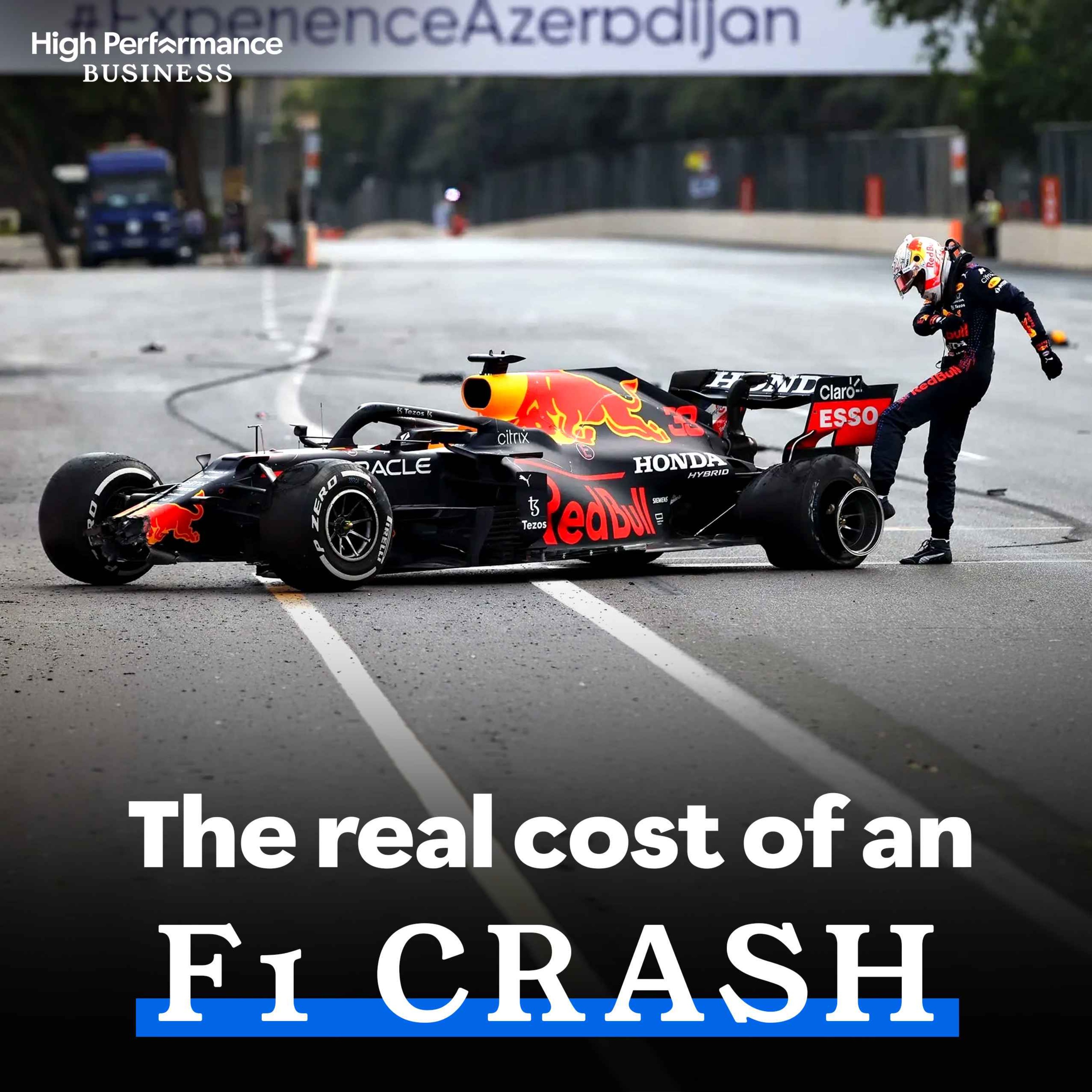
The real cost of an F1 crash and the knock-on effects under the cost cap, including lost development time, parts replacement, and how teams manage contingencies.
Otmar Szafnauer, former team principal of Alpine (and previously Force India/other roles in F1), with experience managing budgets, development planning, and driver/team dynamics.
Crash damage isn’t just the repair invoice; it reduces variable development budget (cost cap leaves development as the main adjustable line). Teams plan crash contingencies; if exceeded, upgrades/learning get delayed. Parts are carried in quantity (rule of thumb: five of many components). Tyres are relatively less costly than chassis/gearbox/suspension damage.
Hamilton vs Verstappen 2021 Silverstone (Horner estimate ~£1.3m damage discussed); Force India 2017 Belgium teammate crash (Perez/Ocon) and Szafnauer’s response; Nico Rosberg and Lewis Hamilton being made to share crash costs (~$360k mentioned).
Written by AI. May contain mistakes.
The hosts delve into the financial implications of Formula One crashes, referencing specific incidents and costs.
“because I always think like, there's no sport like it I've found in covering all of the sports over the years.”
The discussion shifts to guessing the costs of various Formula One car parts, comparing them to regular car parts.
“It was the damage done to that one car in that one crash.”
The discussion shifts to guessing the costs of various Formula One car parts, comparing them to regular car parts.
“ShipStation connects Shopify, Amazon, TikTok Shop, and over 200 more marketplaces with one platform that does it all.”
The hosts discuss how technological breaks and testing can lead to significant financial losses in Formula One.
“Okay, am I allowed to go off on a tangent?”
Exploration of driver accountability in crashes and the financial implications for teams.
“Because I'm really interested in this and I've always wondered about this.”
Learn how financial penalties impact F1 drivers' decisions and team dynamics.
“So, like I said, when Toto sat them both down after that main crash and said, if you do it again, you're both paying for it.”
Understand how the F1 cost cap affects teams' development and strategies.
“what you can get away with is based on how bloody good you are.”
Discover the impact of crashes on teams, driver behavior, and engineering responses.
“So you will have a crash contingency where you plan for those crashes.”
Learn how crashes affect car development and financial planning in F1.
“You'll have three survival cells or three tubs, one for each car and then one in a box.”
Understand the real costs of crashes and their effects on performance upgrades.
“So when a crash like, for example, Verstappen at Silverstone 2021, we were talking about that being in the region of around, estimated, because we really don't know, but around 1.3 million pounds for that crash.”
Discover why even small crashes can have significant financial implications.
“I honestly went into this podcast, Otmar, a little cynical about, because I thought in the millionaire's playground, what does 150 grand there and 600 grand there mean?”
Explore the relationship between driver errors and crash frequency in F1.
“We've only left aside, what, 15 million?”

Get the gist, explore an idea or ask about something said.
 Claude
On High Performance Business, what are the key points of this episode?
Searching your listeningAutomatic transcript. May contain errors.
0:00Natalie Pirks: When a Formula One car hits the wall, can a driver's career do the very same thing at the very same time? In the millionaire's playground of Formula One, make no mistake, the danger is real. The stakes are very, very high. But what's the actual cost of a Formula One crash? And to what extent can that knock on to cause a team's season to crash? Yeah, today we're going to go behind the costs of one of those crashes and its knock-on effects, crucially. and we're going to be joined by our resident expert, Omar Zafnour. And if you were feeling a little bit angry after a recent failed MOT, I think this episode of High Performance Business brought to you in partnership with IFS is going to make you feel a little bit better about yourself.
0:44Natalie Pirks: IFS could quickly become FFS here because I always think like, there's no sport like it I've found in covering all of the sports over the years. You're either a petrolhead or you're not. And I have to say, I've been drawn back in last year with the new batch of drivers and the romanticism of, you know, the end of the careers of the likes of Lewis Hamilton. Yeah. But I've been kept in the dark about loads of this because I'm going to be your guinea pig later and try and guess how much each part of the car costs because I don't know. Yeah. But let's put a bit of context to it because, Natalie, when I think of Formula One and crashing, I think of ones between team rivals.
1:20Natalie Pirks: Yeah. Teammates is one of the best ones. Where do you go when you go like, okay, give me the context of the crashes that we feel, or you feel, that may have cost teams more than we think? Well, let's think about, because you made a good point that, you know, you're a petrolhead and you love F1, you know everything about it. And trust me, I've been around a lot of Grand Prix sort of working and they are so knowledgeable. But there's a new breed of fans who've been drawn into the sport from drive to survive that's done incredibly well, who maybe aren't as nerdy. And I don't mean that in a derogatory sense.
1:53I think they know their sport inside out. but perhaps they've been drawn into the sport in recent times maybe in the last five years so in the last five years if you think about there was a very sort of famous crash between Lewis Hamilton and Max Verstappen 2021 at Silverstone that went on to make the end of that season utterly engaging and pivotal all ended in Abu Dhabi in you know Lewis looking like he was cruising to the to breaking the record and then suddenly everything happens so that crash at the time and of course no team will ever tell you how much a car costs to fix there and then because they don't want other teams knowing all this information not like my local garage does it
2:34Natalie Pirks: where he looks at it and goes can't really tell until i get in there yeah yeah just give me that price yeah so but at the time christian horner was the principal of red bull ended up sort of saying reckoned around 1.3 million. Wow. It was the damage done to that one car in that one crash. So, if you're not a petrol head, you might not know how much parts of a car would cost. So let's say you do a bit of damage to the front wing of a car. This is my guessing. This is your guessing. Right, can I tell you how I'm going to do it? Do it. So I'm going to start with, the other week, I went back out in my car after we tripped the C &O's and somebody had reversed into the back of my car.
3:18Natalie Pirks: Didn't leave a note if you're out there. It just was one little panel, but it dented in, and that cost me about 300 quid. Now, you might think I'm being stupid, right? But I'm going to work on the basis that everything costs about a thousand times more on a Formula One car. Okay. And as the presenter of Countdown, quite good with masks. Okay, good. So I actually think that might work as a way to get me there. Okay. So the front wing, that comes off as one bit. So that's like one panel. And they'll normally take, a big team will take about six of these to a race. Oh, okay. Yeah. 1 ,000 times 300, 300 ,000.
3:58Oh, you've gone high. It's actually around 150K.
4:01Natalie Pirks: Okay. So you could have a couple of those. Well, I'll go to 500 times now and we'll see if it works. I'm going to stick with this. Okay. Right, about 500 times more what it would cost my car. Yeah. Right, you see. Okay, I like this. I am loving this. So, a gearbox. Yeah. Have you ever had a gearbox fix on your car? I've had a car completely written off. Because of the gearbox? Because the gearbox set itself. It was a mini Metro. Oh, okay. How much did that set you back? Car was written off. Written off completely, so that was that. But I remember at the time, it was like, that'll cost you about three grand to fix, so you may as well just get a new car.
4:34Natalie Pirks: So that would be too much. There's no way it's that much. I'm going to bring it down a bit. I'm going to say that was a severe case, so it probably cost$1 ,500 for a gearbox. in a normal car and I'm going to multiply that by a thousand which is 1.5 million I'm going to half it 750 ,000 Nose on the nose Nose It works Yeah There you go Yes Okay So that's expensive Is it actually 750 ,000? It's 750k Yeah This is the greatest moment of my career I'm so pleased for you Can we put this clip out in the internet please Sorry It's hard because behind the camera there's our 68 people production team Yeah And I don't know who does what I know.
5:12Natalie Pirks: But whoever it is, could we put this out on the internet, this clip? Thank you. But it's interesting because if you think of, you know, you look at an F1 car and you look at the big front wing and obviously people play around with the ergonomics and the engineering, but that's a hell of a lot more money.
5:42ShipStation connects Shopify, Amazon, TikTok Shop, and over 200 more marketplaces with one platform that does it all. You can manage orders, sync inventory, track returns, all automatically. Everything your operation needs, all in one place. Upgrade your shipping operations to stress-proof your biggest sales days and capture every bit of potential revenue. Go to ShipStation.com and use code AUDIO and get 30 days free. Quick question. When was the last time a display ad changed your mind? Now think about the last time a friend told you about something they loved. Different feeling, right? That's how podcast advertising works.
6:13A host who's built real trust with their audience talks about your brand in their own words, in their own voice. It doesn't interrupt the experience. It's part of it. With Acast, you can access the world's largest podcast marketplace. Choose the right shows, the right audiences, the right format. Then watch the data tell you it worked. You're not buying impressions. You're buying influence. Learn more by visiting acast.com slash advertise.
6:44Natalie Pirks: Okay, am I allowed to go off on a tangent? Go on, you always do. But here's the thing that interests me, especially with the new rules. There's always these breaks in the season where they're testing the car to make it better. Correct. But if you break a new bit of technology, surely it's not just about, oh, it's 750 grand or 120, 550 grand for the front. It's like, which one did you break? And surely, as you say, they've got six, you know, front noses. But I bet you they're not all the same. I bet you some of them are all, well, they're from the last lot if we need them. So could you be ruining the R &D of it?
7:23Natalie Pirks: Could you be scuppering R &D? So a team will... R &D's talk for research and development, just so you know, just trying to be posh. I see what you've done. A car is always being developed throughout the whole season. So a team will often bring upgrades, won't they? Throughout the season, a team will bring upgrades. Yeah. And they'll be looking for maybe 0.2 seconds more a lap, which we know in F1 is going to be pivotal. So if you bring, I don't know, a simple end plate to a Grand Prix and you've got it on one car because you're testing it and the driver then scuffers it, not only have you lost that new end plate upgrade, not only have you potentially lost all the time, but you've lost all the data they were going to collect on what that end plate does.
8:09And then ultimately, you're talking about 10 million quid between each place that a team finishes in the Constructors' Championship.
8:18Natalie Pirks: That's the actual cost. That's the cost. Yes. It's like if you had a car crash, you fix your car, but let's say you get sued for dangerous driving. Do you know what I mean? Yeah. It's the knock-on of it. It's like finishing one place lower in the Premier League. I didn't realize there's such a big cost. Yes. So if you lose that data, you lose that 0.2 and your driver hasn't protected that, then that could cost you so much more than just what you're paying to replace the part. Sorry about that tangent. No, I enjoyed it. I thought it was worth it. I enjoyed it. Okay. Could you give me a bonus one?
8:46Go on.
8:46Natalie Pirks: Because I'm really interested in this and I've always wondered about this. So every race, you've got your soft tyres, your wet tyres, your hard tyres and whatever, but they're still just tyres. Yeah. Right? But they degrade, some degrade faster. Exactly. Yeah. You would never want a Formula One tyre on, for example, my Volvo. No. Or your 1973 Ford Cortina. Yes. So I don't think they are that expensive because they're expendable. So I think it wouldn't be astronomical. Do you have a tyre figure? I do. Okay. Everyone knows, listening to this, that it varies massively on your car and you've got to be very careful about getting a car that needs a specialist tyre.
9:31Natalie Pirks: and if you've got a specialist tyre you can be looking at 300 pound a tyre in your car yeah am I going to go 500 times 300? no no? you give me a clue? no so I'm going to go I'm going to go way less I think each tyre on a Formula 1 car I'll give you a second to make your mind up as you're listening to this while sitting in silence got an answer? great $11 ,000 a tyre well that would be that would be incredibly expensive really because well they've got to change them a lot haven't they oh my god you're looking at you know one to two pit stops per race yeah yeah no lower how much lower lower lower alright Bruce Forsyth just tell me alright it's three grand no three grand a tyre $3 ,000 roughly well is it pounds or dollars dollars we're dealing in dollars we're dealing in dollars okay so$3 ,000 that's crazy Yeah, that's really interesting, but you're right.
10:29Natalie Pirks: It's a bit like what a wet wipe is to a makeup artist. You use it, you throw it away. So actually, that's really interesting. That's not actually the problem. The tyres wear, it's accounted for, but the problem is if you have, for example, and I go back to, I think it was sort of 2012, 13, 14, 15, when you had Nico Rosberg and Lewis Hamilton in the same team. clearly weren't inviting each other to their birthday parties. There was all sorts going on between them. That power struggle went on between them. And of course, they famously crashed into each other. So if you're the head of that team, you're picking up the bill twice.
11:12Natalie Pirks: Tyres are not a problem. But when you get into the chasse, my goodness, how many times is that damaged? And listen, it's a lifesaver as well, so it's worth every penny. But if you're looking at the front, you're looking at the chasse, So if both drivers are going at it, that is a serious problem. And it was a serious problem for Toto, who sat them both down, made them sign a contract and said, if you do it again, you'll be paying for it. Has any Formula One boss ever explicitly said either them crashing's a problem and done something about it, or we didn't keep a driver because they crashed too much?
11:50Natalie Pirks: Two different big questions there if you want to take your time. Well, so Ottmar will actually have a good point of view on this because he had two drivers that crashed into each other a few times. With Alpine, yes. Alpine. He did, so he'll be good on this. But Mick Schumacher is an example that's often used because he was sort of let go at Haas and a lot of people said that was because he'd caused an estimated$3 million worth of damage to the car with various quite big crashes. I think it's hard to take that in isolation because there was also an issue of speed. His speed wasn't the best. So, you know, whilst Haas were angry with him, maybe it wasn't the only flaw.
12:33Natalie Pirks: What you're saying is, if you're Kimi Antonelli, if you're Lando Norris, if you're George Russell, every month you can crash your car into a wall and walk away from it. And if it's£10 million a place in the Constructors' Championship, they're okay with it. Well, interestingly, if you look at the drivers from last season and how much damage they did cause to their cars, Estimated, again, we don't know. But Lando Norris was third in terms of all the drivers and the damage he caused. How much? An estimated 2.138 million. But you'll take it if you become a world champion afterwards. So where on the list did we find someone where the team would go, where we are in Formula One, we don't want that cost.
13:13The main one, which was Bortoletto at Sauber.
13:17Natalie Pirks: How much? 2.9 million pounds, pounds, not dollars worth of damage. So yes, if you are Mercedes or Ferrari or Red Bull, you can probably absorb the cost of damage a bit better, let's say, than a Haas can. Here's what would never happen, right? Yeah. What should happen. Because this is how we're brought up as children, right? If you break, you've done this with your kids. If you break something, you're going to pay for it, right? That's how you stop any kid from breaking something, right? Correct. Correct. That's what a Formula One boss should do. They should say, if you've broken it, you pay for it.
13:54Natalie Pirks: But there's no way they'd do that. Well, they did do that. Who? I mean, Nico Rosberg literally had to do that. Yeah. So, like I said, when Toto sat them both down after that main crash and said, if you do it again, you're both paying for it. But they did it again. They did it again. Do we know how much they paid out of their own pocket? We do. Nico Rosberg talked about it on high performance, in fact. Wow. 360 grand. No. I'm so glad I downloaded this episode. Hold on, no, I'm on it. I feel like I'm not on it. I feel like I'm listening to it, which is great. The funny thing about what he made them sign was, I don't care if you caused 90 % of that crash and you were just a mere bystander, you're both paying 50%.
14:34Wow. And that certainly made them think, yeah, I probably don't want to crash into my teammate.
14:38Natalie Pirks: So it did, to some extent, solve the problem in that, yes, they usurped a little bit of cost and, by the way, pocket change for them. I wonder, did it improve their relationship then? Like, was there a side of it where they were more harmonious as teammates? You'd have to ask them, I suppose. The main thing in Formula One is your biggest rival is your teammates. And so they were friends as kids coming through the karting scene. But once they were fighting each other for a world championship, the friendship soon took a back seat. Which is, you know, last year, Lando Norris and Oscar Piastri were very keen to tell people they were still very friendly.
15:13even though they were very much fighting for that world championship right to the end.
15:17Natalie Pirks: I'm now starting to see, well, it matters if you're not the top team. It matters if you're not picking up that 10 million, 10 million with every jump. It matters if your driver isn't a superstar. Okay, so I get that. I've now learned that it matters about what you break and is it the old version or the very new version that could put you behind. So I'm on board. Okay, good. That's the first battle. So what about time? So for example, and again, I'm basing everything off my own car, which I don't think is a bad thing to do. Time is the problem. So someone dents my car and I have to leave it in.
15:54Natalie Pirks: How am I getting them a job? Everything gets delayed. So if you're trying to develop your car and you've got these pockets in the season where you get testing and you get that weekend to test it, if the weekend before the break, you have a crash, then you're not only losing that advancement surely your team within the financial constraints are having to work to fix rather than to improve Exactly This is a great episode The question isn't whether a team has the money to repair the car because broadly it's a rich sport they can It's what else the resources could have been used for and the ramifications of that so you're quite right because the factory now has to deal with things and bring in engineers that they wouldn't have had to deal with before.
16:45And then you've got the knock-on effect. So, for example, there's back-to-back races that they have. If you've bought over X amount of parts and your driver totals something that you don't have a backup for, you've got to then spend time and money flying it in because you haven't got the time in between because they're back-to-back races to go back and get the thing that you need.
17:07Natalie Pirks: So you could be a victim of the schedule in a way because if you crash at, say, the Mexican Grand Prix, then the fix is going to be much more difficult if you're a British-based team. And if you're McLaren and you crash at Silverstone, you can get an Uber to your headquarters, right? Yeah. But there have been incidences as well where, say, for example, they've only got one thing in backup. So say they've only got one front wing and your best driver goes and knocks the front wing off. and they don't have that so they're going to take it off of the second driver. Put it on your car and that second driver doesn't have a race anymore.
17:46Thank you very much and that has happened.
17:48Natalie Pirks: Wow, and that second driver is heaved. Imagine that if you said that. We've only got one mic call. Natalie's the only one doing the podcast. Do you know what I mean? Imagine if they lost you. No one's watched what would happen. I'm the number two driver clearly in this episode. I'm not even that. I'm the test driver. Do you know the one? I test the car but they'll let me untrack you that's me with this truthfully you can't crash out of Formula 1 like we said in the intro because it has to be coupled with you not being maybe the best so how good you are is you can really parlay that with the tolerance of your team boss but even then Rosberg and Hamilton they snapped total wolf and he made them pay for it that's phenomenal it holds you back in time it costs you time it costs you development it costs you progress so it's not just about the invoice you get from the garage.
18:36Natalie Pirks: It's about the knock on effect. If you take anything away from this, it's that from a position of no knowledge, I was so good at guessing the prices and we need an expert now. But first of all, let's have a little listen to our sponsors.
19:04with one platform that does it all. You can manage orders, sync inventory, track returns, all automatically. Everything your operation needs, all in one place. Right now, qualified shippers get a real dedicated person to get you set up and switched over for free. So when peak season hits, you're ready to go. Switch today at ShipStation.com, code audio. Quick question. When was the last time a display ad changed your mind? Now think about the last time a friend told you about something they loved. Different feeling, right? That's how podcast advertising works. A host who's built real trust with their audience talks about your brand in their own words, in their own voice.
19:41It doesn't interrupt the experience. It's part of it. With Acast, you can access the world's largest podcast marketplace. Choose the right shows, the right audiences, the right format. Then watch the data tell you it worked. You're not buying impressions. You're buying influence. Learn more by visiting acast.com slash advertise.
20:05Natalie Pirks: Welcome back to High Performance Business in partnership with IFS and this is only our sixth episode and we're learning what we want it to be like. And I think today I really love because we get to be curious and we get to have fun and we get to love sport and we get to understand the business of sport. And then we get to go into fifth gear and say, let's welcome someone who's been there and done the thing that we've been talking about. Been in racing forever. Otmar Safnauer, former team principal of Alpine, stablemate of ours at high-performance racing. Otmar, thank you so much for joining us.
20:40You're in Monza at the moment. I am. I'm in Monza, like in the back scenes of a traveling motorhome or a hospitality unit. And yeah. Could not be better. FP2 just finished and I'm on my way to a team dinner. But I thought I would take some time and visit with you. Thank you so much. We've been talking about just how much it costs to crash an F1 car these days. And, you know, we came to the conclusion a lot. But I wanted to ask you, first of all, would you rather have a fast driver that crashes a lot or a slower driver that nearly always brings the car home? So had you asked me that a few years ago when we didn't have the cost cap, I would have said a fast driver that crashes a lot.
21:28But now with a cost cap, it can have real implications on your development cycle. So if you have a fast driver that crashes a lot, your car ends up being slower and total, total, you might be worse off. So my answer would be how much faster and how many crashes. Until you define that, I can't really answer.
21:50Natalie Pirks: Right, because across sport, of course, what you can get away with is based on how bloody good you are. The superstar footballer can throw his toys out of the prom or misbehave, and you'll forgive it quicker than the journeyman. So I suppose that's part of it. If you've got a great driver who, when you put him together with a really good car, is moving you up the rankings at£10 million a time, you don't mind if he hits a couple of walls. Absolutely right. If he's good enough to score more points to get you 10 million more the next year, and you don't suffer that much from a cost cap, you'd have him.
22:30You know, it's just like having a star cricketer and he gets in a bar fight. Doesn't matter. Good analogy these days. Tell us about the cost cap, because initially, if you're a sort of non-petrol head, you don't know too much about F1. there's this cost cap, which is how much the teams have to stay within in terms of development, racing, etc. How much does that have an influence on, say, you crash a car and it's going to cost a million pounds to fix? How detrimental is that one million pound crash when you've got a cost cap? It's very detrimental. So the cost cap is about 200, it is$215 million.
23:10So whatever that is in pounds, 170 million pounds. However, that cost cap has almost everything under it, apart from driver salaries and marketing expense. So it's got everybody's salaries and it's got all the development costs. It's got travel. It's got all sorts of things in it. I'm not 100 % sure travel's in it. It may not be. But the fact is teams will plan their upgrades and their development budget within the cost cap. And if, for example, you have a million pounds of crash damage, the one thing that is variable to you is development cost. It's hard for you to take away salaries. It's hard for you to take away how much you pay for your engine.
24:02It's hard for you to take away how much you pay for your tires. Those things are fixed. The thing that isn't fixed, it's variable, is development. So for every million you crash, you have a million less on development. And I think big development budgets are in the region of 12 million a year, maybe 15 million a year. So if you spend 1.5 million of that, you have 10 % less development. And that could be crucial at the end of the year. Do teams have a crash contingency though? They do. They will plan for crashes. Absolutely. So you will have a crash contingency where you plan for those crashes.
24:41And if you're below, then and you're towards the end of the year, you can stick it in development. If you're above, then you've got to curtail that development.
24:51Natalie Pirks: That's the insight and that's the expertise. But I want you to take us to the moment when it happens and you're aware of all of this. And if I say Force India 2017, Belgium, you know where I'm going. Oh, yeah, they crashed into each other, the morons.
25:11Natalie Pirks: But you see, you're still hurting. I mean, that's nine years later. Look at that response. I'll tell you, I'm hurting not from a cost cap perspective because I don't think we had a cost cap back in 2017. But our cap in 2017 was not having the money, period. Yeah. So therefore, you know, it was kind of like our own, not artificial, but a real cost cap. We didn't have the money to spend. So if you crash, then you can't develop the car. And that's really what hurt. So what did you do then? So it happens, they've got to make their way back. I got them into the office and I told them, you do this again and I'm getting you in a headlock.
25:49Wow. This is Perez and Ocon, wasn't it, in 2017? No, what I told him was that we were going to separate them on the grid by cutting their gearbox seals and moving them apart. And that kind of helped.
26:01Natalie Pirks: Did you put anything in place that said, going forward, if you cause each other damage, you're going to pay for it? No, but that's not a bad idea. But unfortunately, it wasn't in their contract. So it's hard for them to, or impossible for us to be able to enforce that. But the next contract, for sure, we would have put that in. However, there was not a next one between the two of them. Because Lauren Stroll bought the team, Esteban left, Sergio stayed, and then it was different. Wow. We were talking earlier about, we were just taking guesses, or Colin was, about how much parts on a F1 car cost.
26:43Did very well. These days. They're not cheap, and it all depends on what part it is. They're tens of thousands. You know, a chassis, if you do a chassis, that's 300 grand, for example, in one car part. But you rarely damage a chassis to where you can't repair it. But, you know, wings are$15 ,000,$20 ,000, and you break those all the time. Gearboxes are really expensive. So when you back into something and you need a new gearbox, that is very expensive. So it all depends. Suspension members aren't cheap as well. They're tens of thousands. So when you do a corner, you rip a corner off, you're talking tens of thousands.
27:24So which parts are actually designed to survive then and which parts can kind of sacrifice themselves? And in addition to that, we were talking about, you know, if you lose a front wing, you've got a couple still in the garage. So you carry, you generally carry five of everything. Five. Right. So the rule of thumb is parts that you can damage, except for the survival cell, the tub, you carry five of everything. So one for each car, three spares. So you'll have five front wings, five rear wings, five floors, five engine covers, five side pods, five of all that stuff. Even five gearboxes all built up.
28:05You'll have three survival cells or three tubs, one for each car and then one in a box. So it is a lot of money on car parts. And once you have to start replacing them, if you didn't plan for it, meaning not outside of your contingency, it has a real impact on your development cycle.
28:26Natalie Pirks: If this question is too personal, tell me to buzz off. Buzz off. Yeah, already. Yeah, exactly. You see, I'm wondering, because when it happens, the drivers are on track, okay? and not to go back to 2017, but it's just a really good example. But I wonder, what are the actual mechanics and engineers' response at the time? Because they're the ones now that instead of developing are now going to have to chase their tail to fix something because of maybe an unavoidable crash. I'm guessing, not in front of the drivers, but I'm guessing at that moment, that's their moment just with the team where they can turn the air blue.
29:05Yeah, so the mechanics rarely worry about the cost cap implications. They mainly worry at the track about getting the car back out for the next session so you don't lose time. The engineers have a bit of a worry about cost cap, but because they're on track, their number one worry is, let's get this thing fixed. The crash has happened. Let's get it back out on track. So we lose the least amount due to this crash, the least amount of track time so we can best be prepared for the next session. That's what they worry about. Thereafter, you know, the technical directors, the chief financial officers, the team principals, the operations directors, they start worrying about how much money did we spend on that crash and was it within what we budgeted.
30:02they then start worrying about those things. Wow. So when a crash like, for example, Verstappen at Silverstone 2021, we were talking about that being in the region of around, estimated, because we really don't know, but around 1.3 million pounds for that crash. Yeah, I think that's high. That's brilliant. Oh, okay. That was what Christian Horner, I think, said at the time. He was exaggerating. That's not like him. But say you've got a million pounds worth of damage to a car and you've got this cost cap. What is then going in the bin? What are you sacrificing to then fix that car? I'll tell you what you sacrifice is maybe sometimes you will forego an upgrade or part of an upgrade until you bring the next one out.
30:50So what you don't sacrifice is the learning. The learning has to continue. But what you do sacrifice is when you stop the learning and actually make car parts to upgrade your car. You may delay that. And you delay the expensive ones that are the least meaningful from an on-track performance point of view.
31:11Natalie Pirks: So at the level of elite sport, whether it's Formula One or whether it's road cycling, whatever it is, what you're actually sacrificing is that all-important 1 % that you're always trying to find. You're sacrificing the marginal gains and it's all about marginal gains. Wow. I honestly went into this podcast, Otmar, a little cynical about, because I thought in the millionaire's playground, what does 150 grand there and 600 grand there mean? The answer, quite simply, is a hell of a lot. Especially at the margin. When you didn't plan for it, and you've got to then bring back your development that you know you have in hand, that hurts you.
31:53Colin and I were chatting about how a driver might potentially lose their place in F1 if they are prone to crashing. Have you seen situations where you think that has happened or do you think it's always a combination of things? They're not quick enough or whatever? Yeah, so generally what happens is because they're not quick enough, they drive too close to the margin, 10 tenths as we call it, and it's unsustainable. You got to drive within yourself close enough to the margin, but where you can handle it. And then they start crashing because they're pushing too hard. And therefore, it's not really the crash damage that makes them lose their drive, but it's the fact that they're pushing so close to the margin to be able to get the lap time out of it.
32:37And that's unsustainable.
32:38Natalie Pirks: Listen, you're 10 minutes late for dinner in Milan. Go and give Kimi Antonelli a knock. See, if he'll give you a lift, you'll be 10 minutes early. Very good. I hope that was helpful. Brilliant. Thank you so much. Lovely. Otmar, what a guest. I feel like we're his friend now. We don't have to say his second name. Bezzi's. Yeah. Yeah, honesty. And I said it at the beginning of this. I was underwhelmed by the significance of crashing your car. Because in my head, it's like these guys dropped three million pound in the casino at the Monaco Grand Prix. Do you know what I mean? Yeah. But when it's such a light bulb moment when he said, no, no, no, no, no.
33:13Natalie Pirks: It's not of the overall money because that would be 0.5 % of the cap. He's like, we've already paid for all this stuff. Yeah. He was saying, what was it? We've only left aside, what, 15 million? So if you crash and it costs a million quid, or maybe, maybe, might be more like 500 ,000. Even let's take 500 ,000. You've just burnt such an amount of the money left over. If it's a million of 15 million, one-fifteenth of your money gone. 1.2, 1.3, that's 10 % of your contingency. So what you're saying is you finally, at the end of the podcast, come round to the subject of the podcast. There's parts of the car that after this podcast, I will go and find out how much they cost and hopefully when you now see this and you watch for anyone like me when there's a crash I'll be like are they safe one like I said number two they're safe let's watch it again because it's spectacular and three I'll be like oh that gearbox is real oh that front wing's gone oh I love infotainment right fantastic now at the end of every episode we talk about off the bench we say which is where we want to bring you off the bench we want you to come to us with your stories.
34:23Natalie Pirks: It's going to take a while. How do you get in touch on the old Instagram? You know what I'm like. Highperformance.business. Right. DM us. Can we get an email as well? I think we need an email. For maybe the next episode for old people like me. Yeah. I love an email. You're not ever going to check Can people handwrite a letter? Can we set a target for before the 20th episode that somebody actually handwrites a letter that I can open on set and read, please? Oh, what if it's... Right, we'll get an address. We'll just give out Jay Comfrey's home address. It'll be fine. He'll be fine with that. Right, so next episode, an email address and an actual written letter address would be amazing, right?
34:56Natalie Pirks: Okay, yeah. We just want your stories connected to sport, right? It could be from school sports day. It could be when you bumped into a megastar in Asda. Anything connected to sport, we want it because it'll spark conversation. And when you send in the initial part of the conversation, we can feel genuinely like you're sitting at the table with us, which is what, if we're being honest, we're from the world of radio, where that is the magic of it. and with podcasts, you don't have that live experience and the only way to get it is for you to message us. So I'm going to learn that. Highperformance.business.
35:27Natalie Pirks: I'm there. I'm finally on board with the Instagram if we can have email and written letters. So immediately off the back of what he was saying there, I think about car crashes. That's what we've been talking about, right? And I've only crashed my car once and I consider myself a very safe driver, right? I'm really boring. I talk about chevrons and like I hate the fact that people turn and then indicate. I'm like, that's what should make you lose your license. It's called an indicator. The clue is in the title. Tell me what you're doing, right? So anyway, I was come off a motorway onto the slip road to come off the M6, I think it was.
36:07Natalie Pirks: And there was traffic on the slip road. So I stopped. And then I realized I wasn't turning left. I was turning right. And I was late for an interview with a sports star. And for some reason, I just didn't see the person in the mirror. and I pulled into the right lane of slipper and caught the side of their car. Anyway, he goes careering up the side. This is Hamilton Rosberg. Oh. Don't know which one I am. Anyway, so he goes into the side and the side of his car is dented, right? And I'm thinking he's probably okay, but that's my first worry is that he's probably okay. And his door opens and he gets out and he is a big lad, right?
36:43Natalie Pirks: What's the word the kids use these days? Judi Dench? What is it? Hench. Hench, that's it, right? He's Judi Dench and he's like, he's coming towards me and I'm thinking, forget the damage, right? I'm about to get clubbed by this guy because I'm like, this is my mistake, right? And he's bound and he's getting closer and closer and I'm like, I'm ready to throw because I'm going to have to get the first punch in here because he's bigger than me. And he goes, oh, you're the guy from Fightin' Talk! And the radio show I presented the BBC saved me! He just had a little bump on his knee. I admitted that it was my fault.
37:16Natalie Pirks: We sorted it out in a lovely way. we texted each other we sorted it out and it was all good showbiz privilege I've never in my life said do you know who I am but at that moment I was like you know who I am don't hit me so yeah again my first worry was that he wasn't hurt but you would have wanted to watch that one back and you would have seen if it had been filmed you would have just seen me cacking myself as he was coming towards me Shall I tell you about a time when someone didn't know who I was because to be fair why would they but it was I've been kissed on air before that's a different thing that's on YouTube if you want to check that out I've been kissed on air at Craven Cottage where I thought the man was going to punch me but he was in fact kissing me just on the cheek just on the cheek I've had pies thrown at me on air but my favourite one was I was outside Wembley doing a live broadcast and my dad and my uncle were waiting for me to get off air because it was a Chelsea match a Chelsea final FA Cup final I should imagine and I can't remember.
38:17And I was doing my bit, blah, blah, blah, blah, blah, blah, blah. And I could see out of my periphery, my dad having a quite animated conversation with a random man. And I came off air and took out my earpiece and went up to my dad, gave him a big hug. He was in ever such a mood. And I was like, what's happening? What's wrong? He's like, that man was so rude about you. I went, really? He went, so this man had come up to my dad, stood there with his arms like this and gone, effing women talking about football. What the hell is going on? it's a pandemic of women. And my dad then said, that's my daughter.
38:51Natalie Pirks: And what did he say? Oh, mate, I'm so sorry. Exactly, right? Because the guy was two things, right? He was a moron and he was a flat-track bully. And they all are when they get out from behind their keyboards or their snide comments. And he bottled it, didn't he? He folded like the deck of cards he is. And then shuffled off. But it was quite funny. Oh, wow. My poor dad. My dad did well not to, you know. My dad's quite small though, bless him. And this guy was quite big. I love that. Well, listen, I will dedicate this entire episode to Mr. Perks. And just, you're very good at accuracy. And that's what you do.
39:26Natalie Pirks: And you always correct me if I get something wrong. It was probably one of those League Cup finals that Liverpool beat you. Mr. Perks, it was probably one of those. It was brilliant. Well, listen, we can't wait to get back next week. We'll yet again look at not telling you about the headline, but telling you about why it was a headline. and hopefully bring you along the way as we add the business side of the sport without bogging you down in too much because we wouldn't be able to follow it either. So more expert guests, more curiosity, little bit of fun along the way and quite possibly an email address.
39:59Natalie Pirks: We'll speak to you next week. And a handwritten letter, please. Bye-bye. The dream.
When an F1 car crashes, the repair bill is only the beginning.
Colin Murray and Natalie Pirks explore the hidden cost of crashes in Formula 1, from lost upgrades and valuable data to the millions at stake in the Constructors’ Championship. They look at why a mistake can hit smaller teams like Haas far harder than the likes of Mercedes, Ferrari or Red Bull, and what happens when teammates become each other’s biggest rivals.
With former F1 team principal Otmar Szafnauer bringing a view from inside the paddock, they reveal how crashes can affect far more than the car, costing teams time, development and potentially their position on the grid.
IFS - award-winning Asset & Service Management software 👉 Reimagine your operations at: https://highpfrmc.com/IFS_HPB_AU
Hosted on Acast. See acast.com/privacy for more information.