
 Ask ChatGPT



Host: Jake Humphrey
The podcast explores defining moments in the careers of entrepreneurs and industry leaders, offering insights into pivotal decisions that shaped their respective brands.
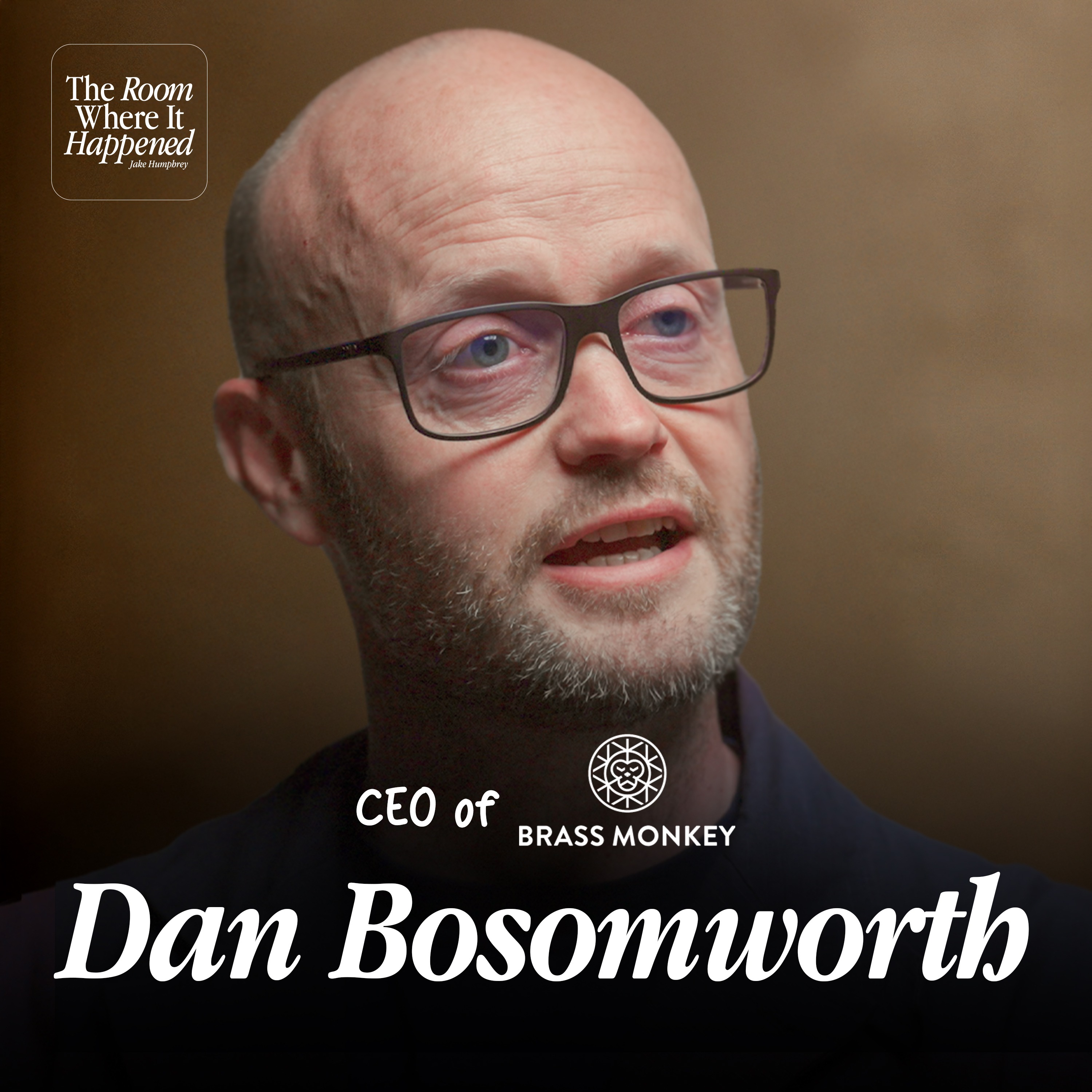
Dan Bosomworth, Founder of Brass Monkey
Dan Bosomworth recounts his journey from a personal crisis in his garage to creating a revolutionary product for recovery, which gained acclaim among athletes and celebrities, including Cristiano Ronaldo.
Written by AI. May contain mistakes.

Get the gist, explore an idea or ask about something said.
 Claude
On High Performance Business, what are the key points of this episode?
Searching your listeningAutomatic transcript. May contain errors.
0:01Imagine being at such a low point in your life that one day you just break down, alone, in your garage, sobbing. a sense there's so much more to life if only you dared to explore it. Now imagine not just sobbing alone, but doing so in a chest freezer filled with cold water. It's a weird image, but that's exactly the situation that Dan Bosomuth found himself in. Now imagine you take that emotion and that home appliance and you turn them into a movement, a brand that everyone from Ronaldo to the royal family wants in on. It doesn't mean the tough times have suddenly disappeared because Dan is about to reveal what creating Brass Monkey has really cost him.
0:41Please don't forget to subscribe wherever you're listening or watching. I love making the room where it happened and I really want to bring even more incredible guests onto the show. So if you haven't yet, hit the follow button. If you already have, thank you so much. Let's do it then. In partnership with IFS, this is the room where it happened with Brass Monkey founder, Dan Bozenworth. Dan, welcome to the show. Thank you for having me. Why have you chosen this specific room to take us to today? It's a trigger event. It created the desire and the motivation to change, which then I didn't know at the time, but led to a formation of not only a company, but a movement, I guess.
1:28Lockdown was difficult for people in different ways, wasn't it? And I know people who think lockdown was absolutely superb. And for me, it created too much space and space to get lost in perhaps and think a bit too much and wonder a bit too much and dwell a bit too much. And I remember feeling incredibly stressed and I'd lived with stress a lot. You know, I've worked in marketing agencies with three kids close together that they're aged eight, nine and ten. So they were significantly younger back then and they create their own pressure. and so on, but I'd never really thought about building my own cold water pod bath.
2:11I mean, there weren't even things then. But it became an imperative in mid to late 2020 because the wheels were far. I was unraveling, really, and I didn't know that. Why? I'd lost purpose. And I'm not sure I'd had the purpose I wanted in the first place, but I felt aimless and I felt a bit stupid. and I'd built this business, I'd sold it and we'd got a bit out of it and, you know, mortgage-free and those kinds of great things. But I've not achieved anything. What am I teaching my kids? And I felt very down on myself and I don't know why, but it can become a downward spiral, can't it? And it's not like it was a depression in the sense of serious, clinical, like I need to speak to someone.
2:57I just felt lethargic, tired, aimless. And for whatever reason, one day I just decided, I need to build an ice bath. I need to make an ice bath. And I said to my wife, Gemma, do you know that? You know the chest freezer? I want to fill it with water and make an ice bath. And she obviously knew things were going on for me. And she just looked at me with a, right. She didn't say anything, which was probably a good thing. So she let me kind of convert this ice bath, and I filled it up, and I was so excited. Were you using the electricity for the freezer to cool the thing down? Yeah, so it makes a big wedge, big rim of ice all the way around.
3:37And I'd looked on YouTube, there's some guys doing it in America, and they were using timers on plug sockets to create the on-off effect so it freezes, and then it, you know, because you need it to go off to release the ice. And I returned the next morning to this ice bath, and it's there, and it's icy, and I'm smashing it up, thinking this is bloody brilliant i cannot wait and um i can remember it now and i and it's and it was dark and it would be like in here actually it was dark he said the door was open no one was there i think jemma had taken the kid down for a walk or something and i got in early you know kind of fairly early in the morning and as i sat in i kind of welled up and just cried it was that this feeling of emotion of, I'm not sure what was going on really, except that some kind of validation of, I know this stuff works.
4:31I didn't ball or anything, but I just really welled up and cried a bit in my ice bath in this dark and gloomy garage, thinking this thing is brilliant. I'm so glad that it's in my life. And within weeks, the idea was born. So the idea for your business, was it born in the ice bath in that moment? Or was something switched on in your brain that kind of... It was absolutely born in that moment. Not in the sense of, I'm going to do this and it'll be called Brass Monkey. But in the, why is this not a product? In that moment, the insight emerged. The founding insight emerged. This works. It was the insight.
5:12The problem was, well, there isn't a product. So why isn't there a product? So the opportunity is, well, should someone make one then? Why hasn't no one made one? And then, you know, Googling around and found a company in the US, Morosco Forge. They were the first ice bath that I came across, kind of in the world, really. About a year ahead of where I was at that time. And I engaged with Morosco. You know, guys, what are you doing? You know, could I import your product? I'm a brand guy. And I was excited about becoming a distributor. distributor and and they were quite guarded and you know fair enough really yeah you know this crazy idiot you know kind of from leeds kind of getting in touch and and then and then i thought actually i should just do this myself but i kept close with them and to this day i keep you know we keep in touch um you know tom and jason out there and and uh we got hold of a morosco and uh dale and i my brother and he dismantled it that wasn't what we agreed but he dismantled it i turned my back and he's you know got it in his garage and it's in bits i know how this works right and that was really the moment where insight met i don't i think we should make one i think we should do it i think it should be a thing and i'd been practicing in that call that chest freeze that you know that cold water immersion experience for a couple of months at the time and it just rapidly then came together but the founding insight was in that moment and and I knew straight away Brass Monkey I don't know where the name came from but it was an instant yeah Brass Monkey yeah yeah that'll be it did you think that in the ice bath that day yeah did you yeah yeah absolutely yeah and I went in and told my wife Gemma and I said you know I'm going to start this thing I'm going to call it Brass Monkey and I was expecting her to be jubilant and excited and she was, yeah, that'd be cool.
7:06Very, I think I wanted a bit more of a reaction, if I'm honest, because this is amazing. You know what I think is important though, is that often we have these moments where we think of something cool. But I think we think that to come up with a new business is so much more than just an idea, so much more than a fleeting thought, so much more than a flash of inspiration. It has to be loads of work and weeks and weeks of meetings and development. But actually the truth is that it's that flash of inspiration where it all begins. Without that, nothing ever happens. Yeah. And I was very lucky, actually, because I've been in the agency world for so long, working with so many brands, a lot of them premium brands, thinking they don't get it.
7:49They're so intent on selling things at people. They don't understand, really, how to inspire people and build community because it makes sense. The shareholders are too hungry for cash and growth, So they shortchange all the time. So for me, it was an opportunity to walk my own talk. As my dad would say, you know, put up or shut up. If you're going to do it, do it. So what was the secret then to not just creating another brand, but creating a brand that people would love, that would create a sense of community, that would give you a sense of fulfillment, that was so much deeper than just what's my turnover, what's my profit?
8:26Brands different to product. So David Ogilvie had this quotation where he said, And every brand has products, but every product is a brand. And what that really meant to me was you've got to create a movement different to the product itself. You've got to create change around the brand. I don't mind that not every person in our following, in our tribe, will ever buy a Brass Monkey. It doesn't matter. What matters is they engage with a category that they understand the cold as a therapeutic tool, that they make change for themselves. Because my founding insight was that when I'm challenged, I'm changed.
9:00When I sit in the cold and it challenges me, I'm changed. You know, it's what doesn't kill you makes you stronger. If I pick up a dumbbell and use it in a set, I'll get stronger. If I do press-ups every morning, I'll get stronger. The cold's no different. It's a hormetic stressor. It's a tool that allows you to become stronger. And that's what matters to me with the brand, is that we're a champion of that idea. And that's way more important than selling products because over time it will come together. it will come to pass if we persist. And I think people can understand how you sell a product, right?
9:35You build it, you make it bloody good, you put a price on it, you put it in a shop or you put it on the internet, right? Yep. Building a brand is sometimes such a far more difficult concept for people to grasp, right? Yeah. So what would you want to share with us about the secret of creating a brand, not just creating a product? Have a vision around why. So I was fortunate to have come from a background in branding. so I understood it and I'd seen it done well and I'd seen it done badly. We can do things to help people and we can popularize a movement away from selling products and making the right product mattered as well.
10:09I don't want to pretend it doesn't. And we chose a very difficult route and we didn't know we were doing it at the time, but we chose to start to build our own product. So the brand idea emerged quickly. I got the logo drawn up for 200 quid by a guy in Israel that I'd found on Dribbble. That was easy. It was like I could go through those motions quite quickly. I drew up the mission. I knew what we were about. What did you draw up when you said I drew up the mission? What did it say? Challenge creates change. And that runs through Brass Monkey. And that's why we've been able to engineer the product as it is, because every time we hit problems, it's okay.
10:47Challenge creates change. Just embrace the discomfort, whether it's an ice bath or whether you're building a business. There's no change without the discomfort. You've got to get uncomfortable. You've got to take so much failure on the chin and see it as progress, see it as feedback. Otherwise, there's no opportunity to grow to where you want to be. Do you believe every business should have a mission? Absolutely. Yeah. It's just too hard otherwise. How do you mean? if you don't have a north star if you don't have an emotional reason to show up and make stuff happen for yourself and for other people it's too difficult it's too difficult but we would have given up like oh the amount of failure honestly in the first year was phenomenal and expensive and we were we self-funded the whole thing for last part two years the three of us my my brother and I and then a third guy, Chris, who joined.
11:44And it was hard. Can we do it? I'm not sure we can do it. And we're taking learning from a chest freezer and Morosco and thinking, but it doesn't work. The price point becomes too high because the way we're building it. And it's really unelegant. So then we arrived at software. It's got to be software led because that'll create the convenience factor of sheets of ice. Great. And we built that out. The obstacle is the way, as the stoic goes. by leaning into the obstacle, this is hard. How are we going to do it created the answer, which was, well, do it in a totally different way and make that a feature.
12:21So now it's a software-led, self-generating ice bath that's connected to the internet that you can control in an app. Well, it would never have been that if mechanically it had worked easily. And that, for me, was important because, well, we've just designed competitive advantage and got our first piece of IP. We can patent that, so we did. we patented effectively a defrost function and when we set out and I remember I got the logo back from the Israeli guy and I just thought that's amazing I'd scribbled this thing it's awful grief you know I want it to feel like this monkey's calm under pressure but it's going to look like a snowflake that's what that is so the monkey's been squashed but it's really calm under stress but it must look like a snowflake you know because we need it to be a bit cold looking and he created this stunning line work and mine was really rubbish what I had sent him.
13:14And I saw it and I thought, that's a wellness brand. And it just felt like this is important. And so all these pieces were coming together, premium brand, clear mission, my brother leading the engineering side, everything just stainless steel and beautiful and software control and cloud-based monitoring and all these things were building up to this point of, yeah, but we're at this end of the market, not that end. And that's not to say we can't go at the lower end. That's a decision that we've chosen to not take. Was there a moment where you just went, just bin this off? No, absolutely not, no.
13:54And, you know, we were told all the time we were stupid. I was told I was stupid. You know, people, they don't say it directly, but they make remarks. They make remarks like, but you've been so successful in marketing. Why? Do you think anyone's going to buy that and do that? Again, it's just too hard. You've got to have a clear idea of your why, your reason to exist, your mission. And I was reading that Ryan Holiday stuff at the time, and Obstacle is the Way, and that really, I believe it. And there's got to be our way around this. And it was Chris, who was the third guy that joined. Chris, he was a co-founder of an agency, the agency we started, First Ten.
14:40He joined and he was like, that's just software. We're messing around with software. Why don't we just make software? So the software to control turning on and off. Yeah, so we made a rudimentary PCB board. We've got a mechanical engineer in. Could you create something with a chip on that tells that to come on and off, that runs a time? And then, And he was like, yep, we can do that. And we'd been to this guy who was one of the most vehement in dismissing us. Because it's very hard to start something when the category doesn't exist. And so we went to a number of refrigeration engineers. And we wanted their advice.
15:19We're not pretending we know it. We know nothing about refrigeration. Can you help us understand? They didn't want to know. One guy laughed us out in the room. But as he laughed us out in the room, he made a comment. because we talked about the stuck ice. Oh, that's just defrost. And I thought, ah, with the software work and the defrost, what if we, what's defrost? So we were Googling in the car park, you know, how does that, and effectively putting the system in reverse, it's a solenoid. So, well, if it's just a solenoid, could we put our system in reverse? And now the PCB, the little computery bit.
15:58will now tell the system to effectively send a small amount of heat back and therefore release the ice in very thin, predictable sheets. But if we'd not faced that much rejection, that much dismissing, we would never have done it. It's mad though, isn't it, that one sort of dismissive offhand comment... And he was insulting, really. He was being a bit derogatory, not very interested. Like, thank you very much for not caring and for basically trying to be a bit cleverer than us by telling us what the problem was because you solved the problem for us. And that's, I think, the magic in these entrepreneurial journeys.
16:37It's easy now to sit here and say it was significant. It's having the ability to know at the time that it's significant. Yeah, and keep going. Yeah. Keep going. And I've always struggled with perfection. And really, it's not about perfection. It's about progress. Keep going. and this idea of lay the next brick, lay the next brick, lay the next brick. I think there's a parallel idea of collecting insight as you go because insight maybe is, are we building this in the right direction though? Because we're building and progressing, but is this the right direction? And other problems we've had along the way have been more strategic in that nature.
17:12Should we keep going? I want people to fully understand that because it's easy to see here because survivorship bias tells you keep going because it worked, right? Keeping going is only effective if you keep going, but constantly change your mind, constantly iterate, constantly learn, constantly speak to people, constantly take feedback, constantly question yourself. So don't just keep going on the same path. Keep going, but allow the path to change around you, right? Yeah. Yeah, listen for feedback. It's listening for those signals, isn't it? And it's not easy that I don't think, because whilst people are dismissing you and reminding you that you're probably not good enough, and people do love to do that.
17:47And they do it in such lovely ways. and they think they're being useful and they're giving you wisdom. But really, they're just not brave enough themselves. So they remind you why you're probably not either. You'll know now in the ice bath market, there's an awful lot of companies that import mass Chinese-made stuff. Some of it inflates, some of it's more lightweight plastic, more hot tub-like, I guess you would call it. And that's cool to each their own. And we thought, well, why don't we give, Why don't we give that a go? And we thought, well, we'll just get one of these Chinese chillers. And everyone's using these Chinese chillers around us now.
18:27Well, that became a six-figure mistake because we shortcutted. It was the first time we used someone else's technology and trusted that it would all just magically work. How much did this mistake cost you? About 150k. What was the mistake? buying and committing to a product that was inferior to what we'd built the brand on. And it cost you 150k how? We've had to replace every single one in market. Because they failed? Yeah. And that's interesting because there's an air of embarrassment. There's an air of letting people down. Yeah. There's the 150 ,000 pound cost of doing that. But there's also the, what do people now think of Brass Monkey?
19:11Yeah. Because we'd sold them a dream. Yeah. And then we'd given them something else. Yeah. What did you learn in that period? Be true to the mission. And the mission, you know, yeah, from that Brand Point Challenge creates change. So the product itself was great and the barrel is stunning. And the detail on the barrel, the way it's resined, the way it's finished, was all brass monkey. But we failed to apply it to the chilling component. We assumed too much. We took the fast and easy route, which turned out to be the wrong and expensive route. And it forced us to, well, actually, let's now make our own chilling product.
19:53And that also created opportunity, which we didn't know at the time. So actually, that being 150K mistake was actually a really big gift. It's great, though, that you can take the lessons from the failure and also allow the failure to send you down routes that you didn't know previously. But it's also a great reminder for anyone listening to this that on something like our show, you can create the greatest show. But if you don't spend money on getting some good social clips or you don't spend the money on the due diligence of making sure a guest is who they tell you they are when they come on, those small things undermine the entire brand and the whole thing.
20:27And we've seen it with other businesses. The whole thing can collapse. So we've been in the room where you have a cry and you decide to do this. We've been in your brother's garage, the other room where you've built this thing and you've created it and then it starts to sell and you suddenly actually have a brand. I'd love to go to the room where you had your greatest moment where you thought, I can't actually quite believe this is happening to us. What room would that be? It was when commercial interest started to peak. So we were doing the stuff with influencers. And we have a lot of famous customers that we're not allowed to talk about and NDAs, so some of them are royalty in this country and overseas.
21:06Some of them are pop star royalty. Yeah, there's all kinds of people. Can we talk a bit about that? Yeah. How do you build a brand when you're kind of having to build a brand by stealth? So you would love to tell people which members of the royal family are using your ice bath, right? It's guaranteed sales. It would be amazing. You would love to share photos of the pop stars. I mean, we read reports. Oh, Ed Sheeran's got a load of your ice bath. You know, whether that's true or not, I don't know. But it's the kind of thing that if you could put it on your website, that would be quite useful, right?
21:38Yeah. Yeah. How do you build a brand when you can't tell people the huge names that are using your product? Because you build it on purpose. You build it with a mission in mind and a clarity of what we're trying to do. And it's built really through building community. And those are little signals because there is a community around those famous people that all they talk to each other. You know, we've recently shipped a unit to Jimmy Carr and he's going to make us a little video and then another comedian's got in touch about, I think I'd like one. I won't name his name because I don't know where that's going to go.
22:13But, you know, they're pockets, aren't they? And then when you're in with pop star royalty, well, there's a way, I trust that that's going to get us somewhere. And then some people are just great. You know, Gary Barlow, he was very much, he just phoned the phone rings and Gary Barlow's on the end of it. And he's like, well, I'd love to buy one. And he was really interested. Well, where are you? Where are you? What's this about? And I'd love one. and are you wanting a deal? No, no, no, no. I'll buy it. It's not a problem. And I'll give you a shout out. Don't worry about it. What's the secret to working with high profile people and getting it right, do you think?
22:46Respect. I think respect. I think they're private. They're regular people, but they're private. They've a lot to lose. They don't want to be talked about. Yeah, respect in their space. And we never leverage them. I guess the most famous publicly known person that uses your ice baths is Cristiano Ronaldo, right? Could you just tell me where you were the moment that you found out he was using one of yours? Well, I knew before he did, because we'd kitted out Al Nasser's spa. Yeah. Yeah. So it was, I didn't know we'd get the picture. I didn't know we'd get the picture, but I knew that, you know, these elite level players go to Saudi and so, yeah, we'd supplied four units.
23:27So Al Nasser contacted you just out of the blue? Yeah. Yeah. Yeah. part of a design project, and there was a guy running the design, and he got in touch on their behalf and said, they want units, it's got to be beautiful, they want yours, they want single player, they don't want communal, it's got to be elite level, think of it more like a luxury spa than players stood in wheelie bins or whatever. So yeah, we did that, and it was like, oh, cool, just think, one of these is going to be Cristiano Ronaldo. And we joked about it, and everyone's like kissing these eyes, having a bit of a laugh. And then, yeah, one day it comes online, and that's probably a year later.
24:06So where were you when you saw the photo? We were in the office, and someone said, you won't believe this. And they held up the phone, and he's there giving all this, isn't he? It was activation for another brand, actually. But they were talking about the effect of cold on his health, and he's referencing some data to do with his nervous system, effectively, in that post. But for me, it was like, yeah, of course he is. You know, of course he is. I mean, some of the guys that we're not allowed to talk about are the ones that I think, wow. So did you ever then get in touch with Cristiano and give him or do a deal with him for ice bars?
24:42We tried. We tried. I know you love our ice bars. Call him again. No, we tried, but we don't. Again, if it's meant to be, it'll come back. So we sent a message and said, if it's ever of interest, we make them. And we left it at that. into that kind of pestering and being annoying. It'll come back round if it's meant to be. And do you think that photo made a difference to your business? Internally. Yeah, internally. Because I think this is the thing that some businesses, they chase, chase, chase. It's a celebrity thing, thinking it's going to transform my business. It doesn't. No. Explain. Progress is what transforms the business, but the culture's fed by those little moments where people think emotionally, can you believe we made a unit in here that went out there and Cristiano's in it.
25:32And we've had that with other famous types, but they don't make a difference in and of themselves. You did say that there are some people that use your product, that if we knew about it, it would be transformational for you. Yeah. Because it's like, we're talking even more impactful than Cristiano right here. Oh, yeah. Yeah. So why wouldn't you then say to those people, is there any chance that we can do a deal here and talk publicly about the fact you use it? Oh, just the sales process educated us that that wouldn't be the case because, you know, the NDAs come through and the big documents to sign.
26:05And, you know, and some of that's very, very obvious. You know, you're not allowed to film while you're on the premises. You're not allowed to disclose this address. Very practical, very practical things. But in there is IP and rights and by paying for this product, we're agreeing that we own the product and it's not about a brand opportunity. And fair enough. Yeah, but the NDAs coming in advance of sale are the telltale signs that it's probably not going to be where we can go. I really like the fact that while some brands are just chasing a name to endorse their product, whether they use the product or not, whether they love the product or not, they just want the endorsement.
26:42Whereas you're basically doing the, you're swimming against the tide here. Yeah, we say no. Yeah, we say no. So we turned down only this week, one of the most popular podcasts on the planet, and said individual said, you know, for free. So we said, oh, yeah, sure. What's the exchange? You know, what's the trade around that we could talk about? Oh, no, it would be a gift. But we'll probably, you know, I might do. So I said, no. No, I've learned over the years that that's a fast way to, you know, lose another 15 grand. that I'll not see it again. Whereas if I, I'll give you an example, if I spend that same money and I build one that goes to the community in Tadcaster Pool, where we are, and the community get to use it, that's far more rewarding.
27:34So all the amateur triathletes are in there, the swimmer, and then people understand the brand that serves them and it's their reserve. This is donated. we run it we give them it and run it for free I'd rather do that I'd rather show up at an event like Joe Wicks where a number of people get to try Cold War Firmation for the first time and talk to them about it but you're a branding expert right you come from a branding background yep and really what we're talking about now is that the well-known faces and names most of whom are not even able to be mentioned right are actually valuable for you for your internal culture rather than for your external brand.
28:15Absolutely, yeah. And they're also lovely for the external. So the Instagram followers would enjoy seeing their Christiana because it's validation, isn't it? Yeah. It's validation. I think they're cool as well, and Christiana thinks they're cool, and that's great. But yeah, in and of itself, it's relatively... Vality metrics. Yeah. So here you are today, a brand and a business you created in a couple of garages used by some of the best-known successful people on the planet, people would go, well, that's a lovely, linear, simple, easy entrepreneurial journey. And you just mentioned a moment ago that the last year has been the hardest.
28:56Yeah. So we've had three times where we could have folded. You know, the business could have ended. Just cash flow because it's... Right. For people that don't understand business, would you just take them into that world of cash flow just to really understand how you can... Because this kills so many businesses. You're successful, you're selling products, you do something great, yet you can still lose your business at any moment. Any moment. It is literally a tight road walk, the whole thing. And a lot of businesses will go under just because of cash flow. They did nothing wrong without insufficient cash to operate, to pay suppliers, to pay staff.
29:33And of course, the whole thing crumbles. So you're building your product before you're selling your product. Yeah. And so it's costing me thousands of pounds. You have to have stock. You've got a lot of fixed costs. And we're buying in stock predicted against the sales. So sometimes you're holding stock. I give the example of the imported chillers. We buy all those in. I don't know. Probably that invoice would have been a good 80K. All of it fails. And we have to replace them all. That's probably an extreme example. But that's a cash flow. So it's always been about putting capital in. It's been about our investor being prepared to walk that line with us, which they have, fortunately, but they don't do it at any cost because they're a business as well.
30:22So they're very sympathetic and understanding, but it's not a case of, oh, we need some more cash quickly. It doesn't work that way. It's like, well, for what? Why? It's difficult. It's difficult. So there's been three points where we could have gone under. The biggest was, I would say, last year. Can we go into that room as the next room? So the room where you realize that there's trouble ahead, where was that room? So we're in Weatherby, where our production facility is, which is a place called Thorpe Hatch. And just seeing data and having that genuine... Oh. So you're sitting around a desk with your two brothers or other people?
31:10Yeah, with Chris and Dale and looking at the data thinking. And what was the data? A lot of people have flooded the ice bath market. And the reason I knew from day one in my own garage that we could be the dominant brand is because it's a niche. You can still build a brand in a niche and you can scale out of a niche. No matter what people tell you, you can always compete. But with that comes another challenge. You know, other people see that niche and they see your success and think, oh, well, we'll have a bit of that. And now we have a number of brands coming at all angles. Some of them are literally copying us.
31:52So it looks like our product. And if you squinted, even the logo looks like it might be our logo. And these are, you know, they're coming en masse from the Far East. so we've been eaten from the bottom end and we've been eaten from the top end what do we do? Because we look at the days and think this is not good. Did you feel you might lose the business? Yeah. Did you? Yeah. How did that feel? Kind of gut-wrenching, a bit nauseous, you know, because we've never really paid ourselves and so that wasn't new. It's a problem because I can only personally do that for so long, and that's the same for the other guys as well.
32:35But that doesn't cash flow the company, not paying ourselves. It's one tiny little thing. So we had to reorganize quickly and change our priorities, which meant changing what projects we're working on. So it's a stop-start change. Quickly, what do we stop-start? Let's do a stop-start change exercise. And what does that look like? So we have different work streams, product development, and innovation like R &D generally, marketing, sales, ops. And they were all gearing towards incremental growth in resi, direct to consumer selling of residential grade ice baths in some form or other. We were very much on that course and it was going beautifully well.
33:19Not like, you know, let's start buying ridiculous cars. I haven't been like that. Still not. Still a loss-making entity, but this is looking really positive. It makes me feel even hearing this. And then it was... And then there's a swiping of the legs. Yeah, yeah, yeah. But the problem is you've got all these areas of your business and they're all lined up for growth. Yeah. And then you have to go, right, we're going to stop doing that and we're going to stop doing that. And it feels like failure, doesn't it? Yeah, it's horrific. You then, you just fear for the... You sort of think those things are there for future-proofing the business.
33:53Yeah. Are we going to cut those off, still struggle, and then they're not there and then we are really going to die it's a it's the yeah entrepreneur's dilemma this and we are still in that transition nearly a year later we're just significantly through it now it's much clearer and and we are converging on completing of some projects and that allow us to move forward i think again it's another great lesson here in your business that through struggle and potential failure comes growth right and if you didn't have cheaper ice baths entering the market underneath, squeezing you from below, you'd still be trying to sell one ice bath per family around the UK and the world, and there's your business.
34:38This is the magic. You've realized that actually that will die, right? So therefore there's something far more exciting. But you were so busy focusing on this, you didn't even see how exciting this was. Without a doubt. Commercial is the game. Commercial is the game, and that market is huge. Basically, every commercial space that has a sauna will warrant a premium ice bath. And there isn't a competitor that can do what we do. So your biggest lesson then for business owners, entrepreneurs, wantrepreneurs listening to this who fear failure? Discomfort is the way. You know, the obstacle is the way.
35:16Challenge creates change. However you want to word that stuff. Lean into it because it's where the insight is. And if you can dig out the insight and define the obstacle, you can then find the way. And some of it is very iterative, if this, then that. And some of it is collecting those difficulties to derive insight, patterns, pattern recognition. We keep seeing this. We keep feeling this. We keep hearing this feedback. What are we going to do? That is absolutely the way. On the way here just now, my brother phoned me and... we've got some problem units in this particular space in Europe. And he's saying to me, you know, they're not performing the maintenance regime appropriate.
36:03And we can see it in data. It's not a discussion. Well, the obstacle is the way, how are we going to stop this? We need to design the problem out. We need to design around apathy, not say, well, you know, you're the operator. We could do that. but there's no space in that for me. The opportunity will be, let's design around Apathy then. What would that look like? So now that sets off a different kind of project. We've bubbled the way on, right, Generation 3 units later this year, Generation 3 units will have some fundamentally new features that allow more apathetic levels of maintenance in gyms because the obstacle is the way.
36:48So that's the biggest lesson you've taken from the Stelics. shall we say what was the biggest lesson that Wim Hof taught you? I'm in control no matter what other people tell me whether it's healthcare professionals or I am what's his expression I'm the captain of my ship What about Joe Wicks who's obviously had a big impression on you what's the biggest thing you've learned from working with him? Joe energy show up with energy he's such a lovely guy you know and I mean I don't mean that as in energetic as in free giving. He's such a lovely person and gives back. He's reminded us to always be community-led.
37:28And as a branding expert and as a marketeer, David Ogilvie would have taught you a lot. What have you learned from studying him? Consistency in brand. And if you deviate, it's probably going to hurt. Amazing. Thank you so much for your time. Thank you. Brilliant. Thank you, Dan. Thank you so much for listening. Listen, if you want to hear more conversations with the likes of Rory Sutherland, Richard Branson, and more from the Brightest Minds in Business, please follow the show and check out our previous episodes. Thanks as well to our partners at IFS, and I look forward to seeing you next time on The Room Where It Happened.
Dan Bosomworth wasn’t chasing fame, he was chasing a feeling. One moment in his garage, fed up with complacency and craving change, sparked the creation of a product that would go on to redefine recovery for athletes, celebrities, and wellness seekers around the world.
In this episode, Dan unpacks the early missteps, how challenge creates change, and the tough calls that pushed Brass Monkey toward the luxury space. From building bespoke tech to navigating near collapse, his journey is a raw look at what it takes to back yourself, build from the ground up, and create something truly original.
It’s a story about discomfort, discipline, and designing a brand that stands the test of time.
IFS - award-winning Asset & Service Management software
👉 Reimagine your operations at https://hppod.co/ifsai
Hosted on Acast. See acast.com/privacy for more information.


