
 Ask ChatGPT


 High Performance Business
15 Jul 2025 · 45m
Host: Jake Humphrey
A podcast that delves into moments that shaped prominent brands and entrepreneurs, revealing pivotal decisions and behind-the-scenes stories that led to their global recognition.
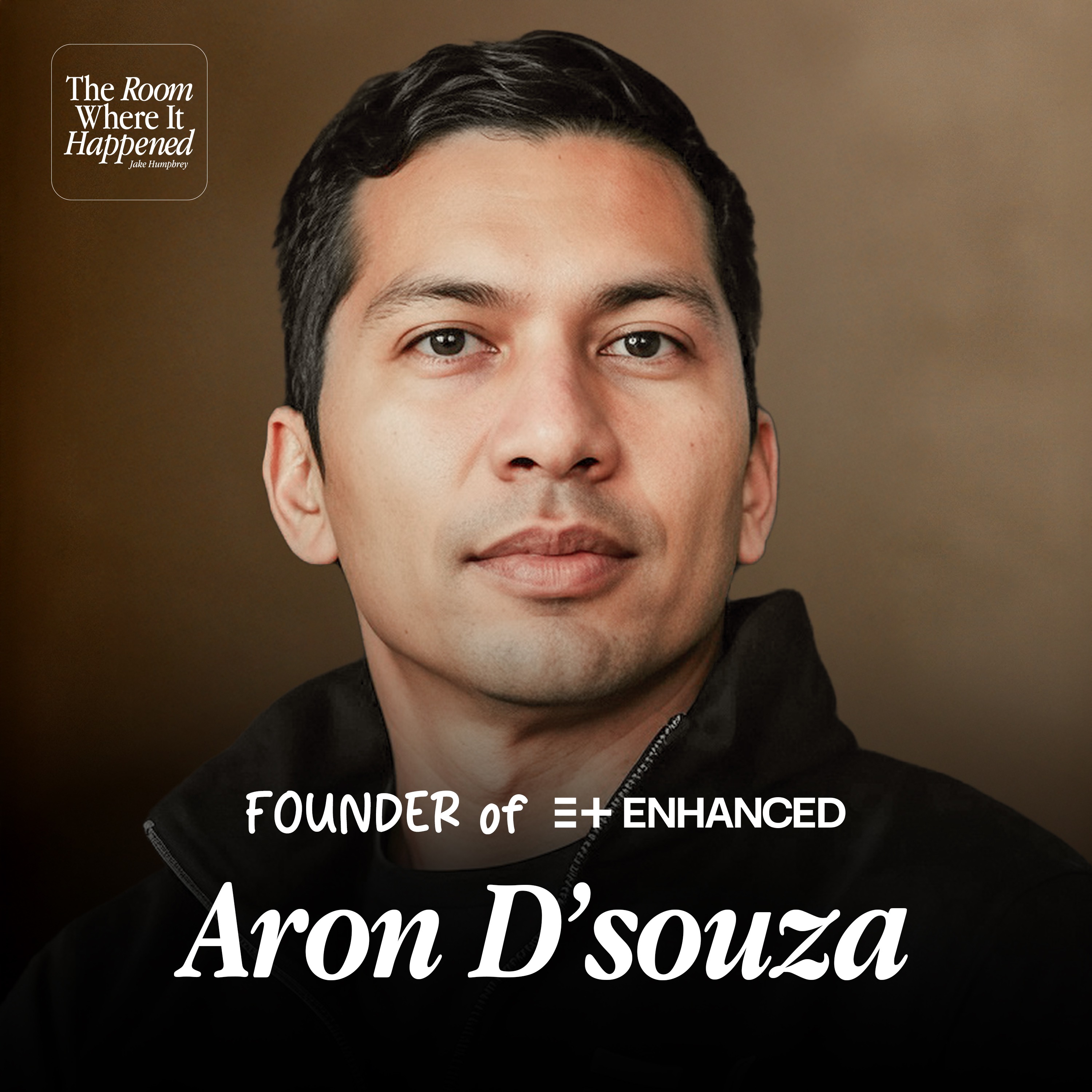
Aron D'Souza
D'Souza discusses his journey of launching the Enhanced Games, a new sports event that embraces performance enhancement, and the controversies surrounding this bold vision for the future of human performance.
Written by AI. May contain mistakes.

Get the gist, explore an idea or ask about something said.
 Claude
On High Performance Business, what are the key points of this episode?
Searching your listeningAutomatic transcript. May contain errors.
0:01Welcome to the room where it happened, exploring the defining decisions of the brightest minds in business and the lessons hidden behind them you won't hear anywhere else. Aaron D'Souza. He isn't just disrupting sports. He's attempting to rewrite the rules of business, ethics, ambition. In fact, rewrite the rules of life. As the CEO of the Enhanced Games, an Olympic-style event where performance enhancement isn't just allowed, it's embraced, he's sparking global debate. Today we ask a simple question. Where does purpose end and profit begin? If you haven't already, please subscribe to the show wherever you're watching or listening, so you'll always be the first to get a brand new episode when they drop.
0:39And we've got some amazing guests lined up over the next few weeks. You do not want to miss them. This has really left me thinking very differently about what I believe the Enhanced Games is all about, as we welcome Aaron D'Souza to The Room Where It Happened. Aaron, welcome to The Room Where It Happened. Thanks for having me on the show. I want to start with how this first came about, Because I'm sure that over the years, various people have thought, I wonder whether we could create our version of the Olympics, but the athletes could be enhanced in some way. When did you first either hear about the idea, generate the idea, and what happened next?
1:19Well, my theory of social change is very simple. I believe that change only happens when someone possessed Sudan goes to work every day trying to solve a problem. And the enhanced games are the perfect version of this thesis because many people, including some very capable people like Professor Julian Self-Rescue at Oxford University or other eminent individuals writing in Wired magazine or in the scientific journal Nature, argued for an enhanced version of the Olympic Games. But none of them operationalized that idea. None of them put a suit on. None of them rented an office. And none of them made it their mission to turn an idea into reality.
2:03So I would say I cannot be credited with the idea. I can be credited with the operations. I hired people. I made it our job. I made it our mission to turn an idea into reality. And when you first hired people for this, how did you send it to them? A high inequality system is not a good recipe for sustainability. The IOC president can't live in a palace and fly in a private jet when the average athlete only earns$30 ,000 a year. And so I thought it was absolutely ripe for disruption because of the amount of inequality that existed in the system. Countries with high rates of inequality are ripe for revolution, just as systems with high inequality are ripe for disruption.
2:47So why not try and change the Olympics rather than generate something completely different? I don't think that ever works, right? So you can say, you know, why did Jeff Bezos not work at Barnes & Noble instead of trying to create Amazon.com? You know, why did Reed Hastings not go and work at Blockbuster instead of building Netflix? Why didn't Mark Zuckerberg go and fix MySpace instead of building Facebook? innovation doesn't happen by fixing old broken legacy institutions innovation happens by building new ones and we see this in in human history there are very few corporations that last for more than 100 years you know i can look out my window here on park avenue and look down to the war's building it was the tallest building in the world the world's largest corporation in 1920.
3:42It doesn't exist anymore. You know, when the Sears Corporation built the Sears Tower in the 1980s, they were at the height of the world. They hardly exist anymore. And Amazon will be disrupted. Facebook was disrupted. Google was disrupted by OpenAI. And the Olympics had a nice long run. But we are the first serious competitor and one that has proven that we can disrupt their core business model, which is the adjudication of world records. But they're not world records in the sense that we know them, right? Which is the ability of an athlete, a clean athlete, to compete at the very top, right? You're changing the rules of engagement here.
4:28Well, so let's go back to the spirit of sport. You know, this important concept that is central to Olympianism, It wasn't invented by the ancient Greeks. It was invented by Baron Pierre de Corbaton, a French aristocrat who invented the modern Olympics in 1896. At the core of the spirit of sport then was amateurism. And from 1896 until 1992, only amateur athletes were allowed to compete at the Olympic Games. And professionals were seen as polluting the integrity of sport. They were cheaters. They were ungentlemanly and they were banned. Banned for life. and now we've completely forgotten about amateurism.
5:06The concept of amateur sport doesn't exist anymore because professional athletes were just better, faster, had longer career longevity and viewers, fans and sponsors actually wanted to back professional athletes over amateurs and I think the same transition is going to happen with the enhanced games. We went from amateur to professional, natural to enhanced because enhanced athletes will just be better. Will people buy into the spirit of the enhanced games in the way that they buy into the spirit of the Olympic Games, despite all the things that you say are kind of broken with that current model?
5:47It still catches people. Yeah, and I think it comes down to a very simple reason, which is that no one watches F2, everyone watches F1. No one watches minor league ball, everyone watches major league ball. because there's something deeply hardwired in us as human beings to want to see the very best of human performance. And so when I started the enhanced games, I thought there would be parallel natural and enhanced world records. However, on the 21st of May, a little over a month ago, when we announced that Christian Kolomev broke the 50 freestyle world record, it's very interesting to note, the media hasn't called it the enhanced world record.
6:25They just simply call it the world record. And so now World Aquatics, whose core reason for being is holding the record book and creating the rule set for international swimming, is in full meltdown mode because they've lost their most important world record. So does that mean the only way then for athletes to remain relevant in your eyes, when and if the Enhanced Games becomes a success, is for them to join the club? To dope? I think that athletes can have a choice, right? I believe in choice maximization, right? The Olympics are beautiful because they're the ultimate avenue of human competition.
7:05But the IOC has engineered a structural monopoly to prevent additional competitors. So if you believe that you want to be the fastest natural human, go and be a natural human. Get rid of the super shoes. Get rid of the shoes at all, right? Don't get paid. Be an amateur. right and go back to the original ethos of the olympic games and the olympics should be the guardians of natural amateur human sport and the enhanced games can be the guardians of fast modern superhuman sport so do you believe that if you've got the enhanced games running alongside the amateur clean olympics that there will be an interest in the amateur clean olympics I don't think there will be because they're structurally broken.
7:58The Olympics can't go around bankrupting country after country, host city after host city with a$100 billion party every four years. And so the Olympics aren't going to run out of athletes anytime soon. They're going to run out of host cities, which they were already running out of prior to the enhanced game. So when the Sydney 2000 Olympics were up for bid, there were 20 cities that competed to host the games. The Brisbane 32 games were awarded without a competitive bidding process, same as L.A. and Paris. So three Olympics in a row now, there have been no cities that really want to host them.
8:37And it's becoming really difficult. When Russia is completely out of the Olympic system, China is being marginalized on a global scale. There's geopolitical conflict in the Middle East. That leaves very few cities that are capable of hosting an Olympic Games. And at the end of the day, the Olympics are fully dependent on taxpayers paying for this huge extravaganza that is not financially sustainable. So what would the enhanced Games be like for a host city? Much, much smaller. So Las Vegas is the first host city of the Games. We have no taxpayer funding whatsoever. We are 100 % privately funded.
9:22And we are designed not for an in-person experience, but for an internet experience. 99.9 % of people participate in the Olympics by watching it on television. And so why do we need to have these giant stadiums that are built at a huge expense and thrown away after two weeks? when actually the principal monetization and viewing experience is via television and on social media. And so when you begin with that premise that you don't need to have a million people there in person for the event, it changes the economics completely. And if your primary output is going to be media, have you got a TV partner lined up for the Enhanced Games?
10:11No, our principal output is not media. So the traditional business of sport, I'm highly critical of. Whether it's FIFA, the Olympics, MLB, NBA, they're wholly dependent on half a dozen customers in the whole world. The Olympics only survives because NBC is willing to pay billions of dollars to broadcast it. There are no other broadcast partners in the world that are meaningful. It is only the American market where NBC is willing to pay billions of dollars for it. On the other hand, our business model is a lot more like Red Bull. Red Bull uses sports marketing to sell a 90 % gross margin energy drink, took$1 million in seed equity investment, and has turned it into a$100 billion company that has defined the entire category of energy drinks and extreme sports.
11:02So actually, the amount of people that are watching and engaging with the Enhanced Games is not the determining factor for success? No, absolutely not. And do you still think... Think about Red Bull. Red Bull doesn't have a media partner. They don't have corporate sponsors. Red Bull won't slap the Mercedes-Benz logo on one of their attempts because they want to use that media space to sell their own products. And this is the best business model in global sports today. Red Bull has grown. It's a family-owned company. It's not publicly traded. It's owned by two individuals. It's worth probably$100 billion, the third largest beverage company in the world.
11:41and they own the energy-engineering category. They own two Formula One teams. They own five football clubs. It's a really impressive organization because they invented a whole new business model in sports. So your partners will be the people who are providing the drugs to enhance the athletes? We are partners. partners, it's hard to say that we have partners. Our suppliers are the ones who are compounding the drugs. But our business model, it looks a lot more like HIMSS, Hone, Roman, or Maximus, telehealth companies that operate here in the United States. Maybe it's unfamiliar to those outside the US, but HIMSS is a$14 billion market cap company.
12:32And it's the easy, simple way to get all the pharmaceutical treatments that one needs without going through the hassle of insurance and going for a doctor's visit. It's all online, very efficient. And they would then be also providing the drugs for the athletes? Yeah, so our medical service, so we're a fully integrated platform here. So we are working with athletes to determine the best compounds to improve their performance, that research and development feeds through a rigorous scientific project into determining compounds that are effective and safe for the wider consumer market and that become accessible through our own platform.
13:23And do you take any enhancements? I take a lot of enhancements, yes. Like? I tend not to talk about my individual protocol because I'm not like Brian Johnson I'm not trying to say copy Aaron D'Souza Well I've seen people talking about your plan and your business model and the way that you're going to go to market they talk often about the safety of the athletes is it safe for athletes to suddenly be taking performance enhancing drugs I think more about my 9 year old son or my 12 year old daughter who loves doing the high jump and the 100 meters and whether she is going to grow up in a world thanks to Enhanced Games where she thinks, well, the only way for me to be a decent athlete is to take performance-enhancing drugs.
14:07And as a parent, that's kind of a heartbreaking consideration. Well, let's talk about who are the largest sponsors of sport in the United Kingdom. Alcohol and gambling companies, right? These are two age-gated industries that are effectively bankrolling sport in Britain? And what example do they set to your 9-year-old son or your 12-year-old daughter? Let me give another example. Let's talk about health. Do you know who the two longest-serving sponsors of Team USA are at the Olympics? No. Coca-Cola and McDonald's. Two organizations that have done more damage to public health than any other entities in the totality of human history.
15:00The death count associated with those two companies are probably in the hundreds of millions, marketed directly at children. Processed food and sugar are more dangerous compounds than anabolic steroids ever will be. Right. The ample scientific evidence has shown the epidemiological damage that these companies have done. and how did McDonald's and Coke build their brands? They built it on the back of Olympic sponsorship, right? And so I find it deeply hypocritical when the IOC and WADA says Enhanced Games are an unhealthy project when they are backed by organizations that are literally killing millions and millions of people every year.
15:40But is there not a way for you to unpick the mess that you believe the Olympic Games and other big sports franchises have got into without having to dope the athletes? I mean, in the UK, for example, we've just had something called the Baller League. It's only in its infancy, it's just beginning, but it's a new way that young people are watching football. Shorter games, more dynamic, more exciting, loads of influencers. It's the kind of football that my son would love to watch over a 90-minute Premier League game. Is there not another answer here? No, because I believe that the implications of the enhanced games are not just about sports.
16:18It's about our wider society. So for example, let's analogize performance enhancement to cosmetic enhancement. So I can walk out of my office in Park Avenue here in New York and walk into any plastic surgery clinic and get Botox, breast augmentation, height extension surgery, lots of things that are very risky, but that we as a society view as perfectly acceptable. However, to ask that same doctor for performance medicine is somehow stigmatized because of what has happened in sports. And so I believe that every person should have the opportunity to overcome their biological limits. I believe that aging is a disease that we can treat, cure, and eventually solve.
17:04And the only way we're going to do that is by innovation in performance medicine in sport. And where do you stand on the argument that the drugs that you need to take to become a performance-enhanced athlete are bad for you? They're bad for your heart. They can cause strokes. They can cause heart attacks. These things are not necessarily safe. We can increase safety measures through clinical supervision. So things like anabolic steroids, testosterone, EPO. These are all substances that are over 100 years old. The toxicology, the drug-adventure interactions are very well known. In fact, the 1939 Nobel Prize was awarded for the synthesis of testosterone.
17:44These are well-documented compounds, and their safety and their efficacy are very well known. Six percent of British men have used anabolic steroids at some point in their life. And the easiest way to prove safety is on an epidemiological or a population health level. Six percent of men have used steroids at some point in their life. Go to your local A &E. There isn't an epidemic of bodybuilders and powerlifters showing up with health complications. So on a population health level, there's high usage but low complications, which is a great indicator of overall long-term safety. So will you put limits on the amount of doping that is allowed?
18:28We don't use the word doping because doping involves a moral assessment. Doping involves cheating within an existing sports framework. So there is no doping at the enhanced games. It is the use of enhancements. It's the use of science. So are there limits? Well, let's remember that the anti-doping system invented by the International Olympic Committee is not about safety. It's about fairness. Lance Armstrong can't use the super steroids when the other athletes don't have access to them. It's about fairness and competition. And so our approach is to create a safety-based system. And so every athlete who competes, whether they're natural or enhanced, has to undergo a full system medical checkup.
19:15They have to have blood work done, echocardiograms, MRIs to make sure that they're healthy and safe to compete, and undergo appropriate clinical monitoring all throughout this, supervised by an independent medical commission, chaired by Professor Guido Piles, who is the top cardiologist for FIFA. Can we talk then about the business side? Because a lot of people are focusing on the actual event itself. But I've heard very few conversations with you about the journey that you're actually on as a business leader, as someone who's leading an organization. Once you decided to go on this journey, and once you knew that it was something that you would, as you've said, risk almost everything for, what's the very first thing you did to start the journey of the Enhanced Games from a business perspective?
19:59my advice to entrepreneurs and it's the advice that i took myself is do not think about your ideas do not talk about your ideas write about your ideas and so i sat down with a good idea of what i wanted to write about but when you are faced with a blank piece of paper and trying to turn that into something cogent and beautiful that you can share with the world it's very it's very confronting. And so that was the first step, was writing the plan of the Enhancing. And when we wrote The First Planet, you know, we encountered lots of really hard questions that we did not have answers to, like questions about safety, questions about fairness, questions about compensation, about economic sustainability.
20:43But as we, as I went through and wrote that plan, then I realized that there was a very comprehensive business model that could sustain all of this and a movement that could inspire people. And once you'd written it down, I'm seeing the criticism that came your way. How did you manage to move forwards through that? Because as much as you can sit there as the public face of a business as a movement, you're still a human being, right? and when there's the amount of criticism coming your way that you've had to suffer, that doesn't come for free, I don't think. No, but the criticism is a sign that we are working, right?
21:32So, you know, I was there at the early days of Uber seeing the criticism levied at Travis Kalanick. But every time a city threw a lawsuit at him, it caused more app downloads, right? It drove more virality. When the taxi cartels mobilized against Uber, it strengthened their resolve. And I think the same is true here. Every time the old legacy governing bodies tried to fight back, that is just validation for our mission. They are showing us that what we're doing is of such immense importance that people who view themselves as equivalent to heads of state like Thomas Bach and Kirstie Coventry, you know, we occupy a disproportionate part of their mindshare.
22:23They know that their system is deeply threatened by us. And despite it driving you on from a business perspective, it still doesn't make it easy from a human perspective. So what are the tools that you've employed to be able to cope with the criticism and the negativity? And who are the people that you've had to lean on to help you? That's a great question. You know, I think that it was great preparation for me to study at Oxford. because Oxford is unlike any other university, Bar-Cambridge, in that the students are taught by the professors directly. So these very small group tutorials where you can be an 18-year-old, first-year undergraduate, and you have to go up mano a mano against the world expert in your field once or twice a week.
23:19And that preparation was very good for the life that I presently lead. On the emotional side, and understand the emotional burden, I think having a comprehensive philosophy of life, right, is very important. I think about, you know, I don't think about, I actually write about what my future is on a very consistent basis. I have a business plan written for the rest of my life personally. Not the company, but for my life personally. That ends all the way in with what will be said, what will be written on my tombstone. And where will that tombstone be? And I think that's a very important exercise to go through because you don't have much space.
24:09Just a few words that encapsulates a whole life and a contribution made to society. Most people on their tombstones write father, son, brother. maybe they write about public service. But on my tombstone, I wanted to say just one thing. Aaron D'Souza, the founder of the Enhanced Age. Not the founder of the Enhanced Games, but the founder of the Enhanced Age. Because it is said today that we live in the Information Age. And this is a very Bill Gates 1980s, a PC on every desk of the information superhighway. It feels outdated. So what is the next age going to be? And I think there are only two options.
24:55There is the artificial intelligence age, where the machines are the superior species, humans are inferior, and then eventually we're wiped out. Or we can live in the enhanced age, where technology enhances the human condition. It makes us physically stronger, mentally more resilient, civilizationally and societally better. And we become superhumans where we can dominate the machines. And I think that is a utopian view of the world and a lens by which public policy can be made. And that cultural movement could be the single greatest contribution that I could ever make to the history of humanity.
25:39Wow. People talk often about post-mortems. Pre-mortems are always more valuable. What can kill you before you get going? Not you personally, but the enhanced age. What can kill it?
25:54My then assistant, now chief of staff, Thomas Dolan, in the early days of this movement, wrote a quote and put it on the wall of our then very little office in London. He said, enhanced age is inevitable. We have set this in motion. Maybe it is not us who will foresee to its full potential. Right. You know, when MySpace was launched, it created a whole new category of social media. Of course, Facebook and then Meta dominates that category now. But we have lit that catalytic spark. And I think the enhanced age is inevitable. There are going to be many manifestations of it. But we have laid the philosophical and cultural foundations.
26:42And hopefully it is us who builds the business that sustains it. but it may be many others and more likely than not it will be a whole ecosystem so interesting aaron have you got children i do not have children and that is one of the sacrifices that i have intentionally made i'm 40 years old i probably should have had children a long time ago i probably should be married a long time ago um but i'm so rigorously focused on creating the enhanced age, that I feel that having children now would distract me from that. And so it may be that by the time I feel that I've set up this organization and this movement in the correct way, I might be too old to have children.
27:29And it saddens me that that might be part of my legacy. I will never have the opportunity to act upon. But what gives me great resilience in that respect is that I look at the young members of my team in particular, and I see them as my children in some way. And they will be the ones who perpetuate my vision of the world, extend my contribution of the world in the way that I'm a disciple of Peter Thiel. and Peter had cultivated an extraordinary group of disciples, including myself, Sam Altman, Christian Engermeyer, Alex Wang, you know, all Unicorn founders, and that his legacy continues on and is amplified through us.
28:24What's the biggest thing that Peter taught you?
28:31Peter taught me to dream large. So when I met Peter at age 24, I was a first-year law student at Oxford University. I met him at my first week on campus. And my dreams were large at that point in time. I thought I'd become a barrister, a QC, and then a judge of the High Court of Australia. And Peter said to me, Aaron, you have so much more capability than that. Why just be a lawyer? Why just be a judge in Australia? You will be, at best, a footnote in history if you did that. You can dream so much larger. And I believe that miracles happen more often than we expect, not because there is magic in the world, but because our dreams are not large enough.
29:25And so as we raise up our expectations, miracles happen more often. And I feel that my life has been miraculous on so many levels because I've always expected so much more of myself and those around me. And so my goal is not to build a unicorn company. We've already done that. My goal is not to build a sporting event. Lots of people have done that. My goal is to build the 10th age of mankind, to take man out of the information age and ensure we don't fall into the artificial intelligence age and that we are stewarded into the 10th age, the enhanced age, where we are dominant to technology and technology enhances the human condition.
30:12What does a day look like for you to try and achieve what you want to achieve? How deep and how hard is the work? My job is actually remarkably simple. My job is only three things. Number one, I need to recruit the best talent in the world. Number two, I need to retain the best talent in the world. And number three, I need to build a culture of excellence to make those people work together. So we achieved number one, attracting the best talent in the world by having a mission. No one is going to go to their grave saying that they were a product manager at Microsoft. Many people will say that building the enhanced age was a meaningful use of their life.
30:59Retention, that's the easy one. It's about creating a sustainable business model where there's the right compensation structures that it makes sense for people to live in. an expensive place like New York or London. Number three, that's the top one. Building a culture of excellence so that all these superstars can work together and create something amazing. And we live in a world, Aaron, where generating headlines, altering people's emotional state, being disruptive, has become a really powerful currency. Is that an element of this that excites you? the fact that you are disrupting not just one of the biggest and most famous sporting institutions of all time, but you're also potentially disrupting how sport itself is viewed in the future.
31:48Because if the Olympics becomes an enhanced Olympics and it becomes enhanced games and no one cares about the original Olympics, well, then no one will care about the Premier League until it's enhanced. And no one will care about the NBA until it's enhanced or the NFL until it's enhanced. This has the potential to completely alter the entire landscape of sport globally for the rest of all time. I think it will change the entire landscape of humanity because we are asking ourselves new questions about what it means to be human. Does being human mean that we age, suffer and die? or does being human mean that we master technology to overcome our limits and become something even more extraordinary than we are today?
32:33I'm lucky. The IOC is not a nation state. They cannot threaten my life. Yes, they can threaten my business interests. They can threaten me in lots of other different ways. But it takes people of conviction and bravery to build a better society. Sam Altman is a great friend of mine. I remember years ago when he was first talking about artificial intelligence, people thought he was a crackpot. And he has built a world that we live in today, creating trillions of dollars of economic value, unlocking productivity and new opportunities for all of human civilization. So why do you care so much that the Olympic Games, in your eyes, is a broken system?
33:13Or is actually, is what you love here, the opportunity to build a business that you think could be worth billions in the future to be disruptive, to be seen as one of the disruptors in an era where we have seen some incredible disruptors like your friend Sam Altman? Well, you know, making money is kind of almost irrelevant. I've had a very, very successful career as a venture capitalist. You know, my mom always says to me, Aaron, you should be enjoying your beautiful house in London and the Ferrari that's parked in your garage and your new husband and, you know, the puppy that's along the way.
33:45She's like, why are you so focused on this? Why give up so much when you already have so much? And my answer for that is that when one is blessed with talent, when one is blessed by God with capability, one has a moral imperative to act. The only reason we do not live in caves, the only reason that we have a civilization to speak of, is because individuals with capability are driven to action to improve our society. And yes, there are many good things about the Olympics, but there are many things that are broken about it. There are many good things about our healthcare system, but I think we would all recognize that it is a sick care system, and it is not optimizing for human potential.
34:38And at the end of the day, the liberal democratic project that I believe so deeply in is failing because of demographics. Right. We spend 30 years from birth getting prepared for the professional workforce. And then we work for about 25 or 30 years. And then we are retired for about 30 years. The reason why the NHS is failing, why public pensions are failing in the United Kingdom and in most of the Western liberal democratic countries is because people are living longer and longer lives, but not more productive ones. And how do we make society more productive? Well, the same drugs that allow athletes to run faster and jump higher will allow older individuals to be more productive throughout their whole life.
35:23and that will change the structural demographics of our entire world that will then lead to a more sustainable public pensions and healthcare system. Have you enjoyed the journey since you created the Enhanced Games? Because I don't know how many interviews you've done over the past few years, but I bet it's in the thousands, not the hundreds, and you've become a face and a name that is spoken about daily around the world.
35:51Do I enjoy it? And some days I do, some days I don't. But I recognize the sacrifice is something that is very important to make. You know, it's a tremendous sacrifice to my family. And they recognize that this is an important mission to go on. And, you know, my team, I look around the office here, 30 full-time professionals working long hours, making immense sacrifices to themselves and to their families. And why do we do this? It's not like working at DocuSign. It's not like working at Microsoft. It's not just about making money. This is about building a world, a future that we actually want to live in.
36:37I don't want to be on my deathbed, having suffered through old age and infirmity and frailty, knowing that I could have solved this problem. Yes, I'm not a scientist, but I can create the economic conditions that feed research and development, that will create the next generation of products, that I myself could live a healthier and happier life, that my friends, my family, my compatriots, my countrymen can do so. And I think that is well worth the sacrifice that I have to make personally to bring this enhanced world into existence. And why do we need to have the Enhanced Games to take those drugs and develop them and get them into us and our friends when we're elderly?
37:26Why can't that happen without the need for disrupting an Olympic movement? Yeah, so that's a great question. So Brian Johnson, the billionaire founder of Braintree, is trying to reverse his aging. And Brian is a great friend of the Enhanced Project. And when I first pitched him on the idea of the Enhanced Games, he said, oh, wow, Aaron, you've got it right. Because for Brian to be proven successful will take 100 years. He will need to be the longest living person in human history. For us to be proven correct fits in a TikTok. It's an intelligible format in this world today. Sport is the ultimate measure, should be the ultimate measure of human performance.
38:10Why do we lionize someone like Usain Bolt? Because he is the fastest man in the world. But is he truly the fastest if he is not using all the potentials, technologies, and science that has been developed by our civilization? It's a very good question. So that is why disrupting sport is a necessary but not sufficient part about bringing the enhanced age into existence. We can't demonstrate the highest elements of human potential without doing so in sport, because that is the point of sport. I mentioned how many interviews you've done over the past couple of years. How many is it, do you think? Over 2 ,000.
38:55What has been the cost then to your life for this mission that you're on? well i gave up living in my beautiful house in london in the safe comfortable environment that i thought i would live in forever i was a quiet venture capitalist earning millions of dollars a year investing in startups i would work three or four hours a day i would get to exercise a lot i could spend a lot of time with my then boyfriend now husband uh and now i work like 14 hours a day. I'm scheduled from the moment I wake up to the moment I go to bed. I live in New York City because we made the assessment that this was a much better place to build the future of humanity than London.
39:44Would I choose to live here? No, I wouldn't. But this is the right place to do it. Am I willing to sacrifice everything for this? Maybe, right? And at times, my board of directors says, Aaron, you should have security because there are people who are going to make threats to your life because you are disrupting a hundred billion dollar monopoly that has sustained some of the most corrupt individuals in the world. And I'm willing to make that sacrifice because I believe in so much in what we're doing, because this is one of the most moral activities, I believe, that is going on in this world. I look at what Sam is doing at OpenAI to make artificial general intelligence, or Elon is doing at Tesla and SpaceX to make humans interplanetary.
40:37These are essential projects for the survival of our civilization, and creating superhumanity is up there. Would I be making these sacrifices if I was just building another AI agent or another enterprise SaaS company making billions of dollars? No, it's not worth it. But to create a world in which superhumanity is possible is definitely worth it to sacrifice almost everything. Do you think someone might try and kill you because of this? Well, you know, I think that I look at the desperation that some of the sports governing federations are in. Are they threatened enough to take such extreme measures right now?
41:21No, but at some point they will be. But, you know, if I die today, the enhanced movement will still succeed. It is inevitable. We've laid out the business plan. We've laid out the strategy. The enhanced world will come into existence. The enhanced age will happen with or without me. You know, I'd like to be at the helm of it. But if I got hit by a bus or I got, you know, assaulted in the streets, you know, the movement will survive well beyond me. It's not reliant upon me. I wouldn't wish my life upon very many people. Being a CEO is a very tough job. And I always say that the first route is clinical supervision.
42:05And that's why we created the Enhanced Performance Products Division, so that individuals can get access to high-quality clinical supervision and a personalized protocol that is suitable for them. Because what's suitable for me is not suitable for you. What's suitable for James Magnuson is not necessarily suitable for an everyday individual, but it's about personalized, customized medicine. And is there an argument that actually the Enhanced Games has kind of swamped your message here? You're not trying to create an Olympic Games for people who've taken performance-enhancing drugs. You're trying to create a change to humanity.
42:40But I haven't heard that narrative being discussed anywhere. All I've seen is people going, oh, it won't be the same if 100-metre sprinters taking some anabolic steroids. Well, I think that core of that debate is essential. The intention of the Enhanced Games has always been to be thought-provoking, to invite a new discourse. And we are not even done with chapter one of this great story. You know, this is a century-long project. When Martin Luther nailed the 9 to 5 Theses to the door of Wittenberg Cathedral, he could not have imagined that he would have created a world that led to liberal democracy and the rise of literacy and technology by writing one essay.
43:27And so I think what we are doing is going to take decades. And I aspire to be like CEOs like Warren Buffett, Charlie Munger, Rupert Murdoch in my 80s and maybe even in my 90s, still on the tools, actively involved and continuing to steward this movement. Well, Aaron, I've spent 50 minutes in your company. And whether someone agrees or disagrees with the morality of the enhanced games or the enhanced age, I have very little doubt left in me that you won't manage it. A fascinating conversation and your conviction to do it shines through. So thank you very much for your time. Thank you very much for having me on the show.
44:11Thanks for joining me. So you've just been in the room where it happened. And we've had some incredible guests so far on the show, the likes of Rory Sutherland, Richard Branson and so many more. So do check out previous episodes because I guarantee you there's something there that you're going to love. Finally, if you can just do me one favour, all I ask is that you hit subscribe, you follow the show. It helps us hugely. Thanks for listening. We'll see you next time.
Aron D’Souza didn’t just question the rules, he set out to rewrite them. Frustrated by the limitations of legacy institutions, he launched the Enhanced Games: a bold, controversial vision aimed at redefining the future of human performance.
In this episode, Aron shares the moment he walked away from venture capital to pursue something far riskier, the power of writing down your vision before speaking it aloud, and how viral headlines paired with deep operational strategy created a movement that couldn’t be ignored.
From fierce public debates to long nights and personal trade-offs, this episode is a story of conviction, controversy, and building something truly unprecedented.
IFS - award-winning Asset & Service Management software
👉 Reimagine your operations at https://hppod.co/ifsai
Learn more about Enhanced Games and follow Aron D’Souza for upcoming announcements.
Hosted on Acast. See acast.com/privacy for more information.


