
 Ask ChatGPT


 High Performance Business
17 Feb 2026 · 45m · 17 chapters
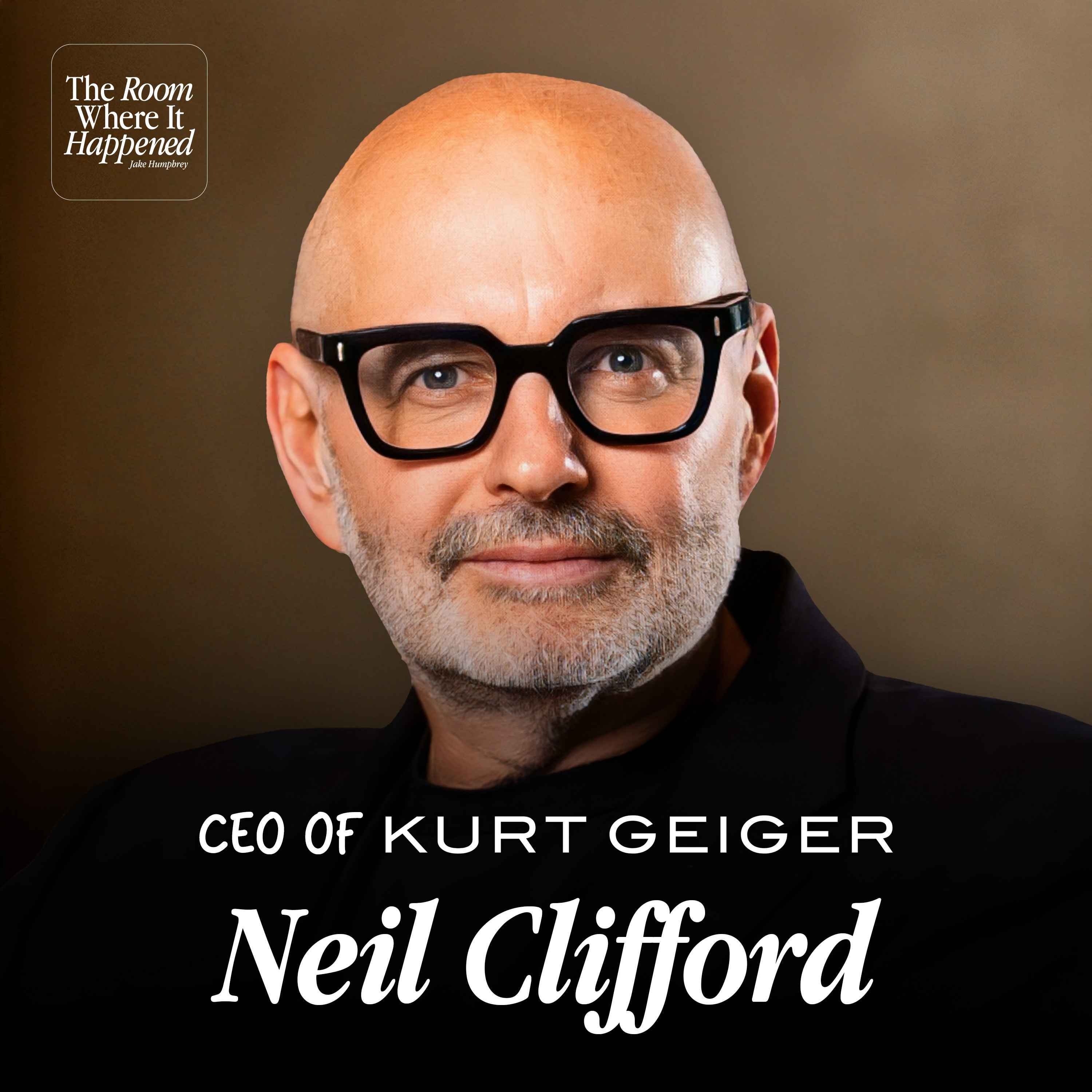
In this episode of The Room Where It Happened, hosted by Jake Humphrey, Neil Clifford, the CEO of Kurt Geiger, shares his personal journey and insights on education, creativity, and leadership. He reflects on his early challenges, the impact of his dyslexia, and the importance of nurturing creativity in young people. The discussion also extends to the value of vocational training and the evolving role of education in preparing students for the workforce.
Written by AI. May contain mistakes.
Exploring the undervaluation of creativity within educational systems.
“We are such a creative nation and I don't think we put the emphasis on that as we should.”
The guest shares personal stories about the education system and its impact.
“Maybe I just wasn't interested in how many wives Henry VIII had or pyramidal peaks in geography or whatever.”
How dyslexia shaped the guest's career and perspective on education.
“unless you've got wealthy parents or parents that are in the industry that can get you that free internship or they've got a mate in marketing that can, you know, get their...”
Discussing the value of university education and its real-world applicability.
“in a way that will get you an amazing job and joy and a feeling of worth.”
Addressing the impact of qualifications on hiring and the importance of skills.
“And I think the option, I mean, Portsmouth 1983, I don't think one person went from Mayfield School to university.”
Introduction to the academy aimed at helping young people enter creative industries.
“I think people skills, you can't really, it's quite hard to teach people skills.”
Learn about the initiative to create an education facility for young people and the challenges faced.
“Therefore, we thought we would start a school fundamentally.”
Explore the disconnect between employer expectations and educational outcomes.
“One thing that confuses me is there are some really bright, brilliant, fantastic people in education.”
Discuss the importance of creativity and new approaches in the current educational framework.
“But where's it going to get you unless it's going to make you Prime Minister?”
Explore the role of parents and educators in guiding youth towards exploration and vocational training rather than traditional academic routes.
“So maybe what we should think about as parents, as employers, as colleagues, is that we have a bigger role to play than we think.”
Discuss the importance of creativity in fostering a competitive edge for the new generation and the UK as a nation.
“Surely, if AI is going to change anything for us, it's that.”
Analyze the negative narratives surrounding the UK and the importance of recognizing its strengths and potential.
“I think that's been really interesting in the fact that for a long time we relied on the fact that we were British as a calling card of quality.”
Highlight the increasing recognition of vocational careers as vital pathways to success in today's economy.
“It's a problem because, you know, we've got to fund a lot of things to do, haven't we?”
Delve into the benefits of private equity in driving growth and innovation within companies, using Kurt Geiger as a case study.
“And I think maybe celebrating that more as a country that success isn't about what university you've been to.”
Discuss personal insights gained from working in private equity and its impact on understanding business dynamics.
“with that internationalization growing growing the categories that you sell and no room for politics no room for so they bring huge ambition yeah a fair amount of pressure to turn the ambition into a realisation.”
Learn about the speaker's early experiences and perceptions of private equity.
“I was always determined to just be as good as I could.”
Explore the speaker’s transition into private equity and the valuable lessons learned.
“No, I had the Land Rover and I had the apartment in Caslano and I had this whole thing.”

Get the gist, explore an idea or ask about something said.
 Claude
On High Performance Business, what are the key points of this episode?
Searching your listeningAutomatic transcript. May contain errors.
0:01I think creativity is everywhere. It's just opportunity isn't it. We are such a creative nation and I don't think we put the emphasis on that as we should. Why do we still have a system set up to tell our young people that the creative stuff is not as important?
0:24Welcome to the show. Thank you. Good to be here. A bit nervous, but I hope it'll be okay. So when did you first realise that the young people that you were seeing in the workplace were not getting what they needed from education and that you had to try and come up with some kind of an answer for them? We all understand, I think, the challenges of what education is. And unless you're very good at remembering things, which frankly, I wasn't at school. Maybe I just wasn't interested in how many wives Henry VIII had or pyramidal peaks in geography or whatever. Actually, I started to be able to remember things much better when it came to getting a job.
1:02I like work. So for me, school was about building friendships and mates. I wanted to do better at school, obviously, but when you open that little envelope and you've failed everything apart from your art O level, you know, it's like, oh, I need a plan B now. I'm not going to be an apprentice at the dockyard in Portsmouth or whatever my mum wanted me to be. So I suppose you've got that scarring inside you and therefore you're always very conscious in how you can contribute to help young people. And I don't think our education system really does that fundamentally very well. Scarring is a pretty strong word to use.
1:41Is that how it feels? Yeah, it was... I always had something to prove, I think. You know, I don't know, not to get deep very quickly on the psychiatrist bench here, but my father died when I was young. It was me and my mum. She had all this drama with three other boys. I needed to be pretty low maintenance. Yeah. And I wanted to prove myself, and school under-delivered for me. So I always felt not a sort of disappointment. You know, I took that piece of paper and threw it away and off I went. You know, I'm always quite a positive person. I knew inside of me that I could be someone or something.
2:22Sounds like a jam song, doesn't it? But I didn't know what it was going to be. But I was good at talking. And I liked repetition and hard work. And I wasn't scared of getting up early. I like getting up early. So I knew that I would get somewhere. I just didn't know where I was going to land myself. Unfortunately, I ended up working in Debenhams in South Sea selling suits in 1985. And I got lucky from then, really. But I suppose for young people, jumping to the academy is, you know, unless you've got wealthy parents or parents that are in the industry that can get you that free internship or they've got a mate in marketing that can, you know, get their...
3:08It's hard to break into. Yeah. And we've got a whole story to tell about that. And I think we've all personally got a story to tell. And, yeah, I'm a bit scarred by it, but I'd use that scarring positively, I hope, to try and help a few people, the company. You know, it's not a me thing. It's a company thing. So is your dyslexia a curse or a superpower? Superpower now. Yeah. And you say now? At school it was dreadful. I only knew I was dyslexic when my son was, you know, we were struggling with Vincent a little bit to be able to write properly. And then Emma, my wife, said, you've got all that.
3:52And I'm like, well, I sort of have really, yeah. Because Kurt Geiger as a company shouldn't, obviously it should because it's wonderful, but it shouldn't necessarily exist. We've been through so much, whether it be, you know, a million financial crises, crisis, Brexit, tariffs. You know, I could list all of the things that have been a big challenge for the company. When I joined in 96, you know, there was 11 people in our head office. It was above the shop in Bond Street. All the brands that were around me, many of them don't exist anymore. So I think through an amazing team, thinking big, thinking international, thinking about new opportunities, thinking differently, starting a handbag business, whatever it may be.
4:44I think we as Brits are very good at thinking solutions differently to others and dyslexia has given me that. and it's interesting isn't it because i've just got a family member who's 18 and just gone through a dyslexia diagnosis right yeah and he's at uh he's now at university but instead of someone in the education industry going i've got great news you're dyslexic therefore this is the amazing creative outlet you're going to have access to what they've done is they've They've actually said there's£3 ,000 for you to buy technology that will make you see the world like everybody else who's dyslexic.
5:25Yeah, yeah, yeah, it's dreadful. So it's now sliding him towards... Not dreadful, obviously. Well, I think it probably is because it's sliding him into a place where he doesn't naturally sit. And he's like, right, now these computers and these programs and this AI is going to do the stuff that my brain can't. Okay, so you've just shut off the magic that's in your brain. And again, why are we doing this? I guess it's because he has to fit into a system that is trying to get tens of thousands of people through the funnel. I think the future is on his side, though. Why? Because I think softer skills, human skills, people skills, creative thought, they're the future jobs.
6:05And I'm not saying, oh, well, because AI is going to, you know. I think AI will replace mechanical process roles or jobs that if you're just really good at remembering, I don't know, legal positions, if you're a lawyer or an accountant or a spreadsheet, things that don't require any thought apart from a yes or no answer. I think the future is brighter for the right-brained people probably than the left-brained people. And I think he should be told that and go and express your creativity in a way that will get you an amazing job and joy and a feeling of worth. Yeah. And I found that just by my journey was sort of just great, but by accident I've ended up where I am, really.
7:03I was just a great suit salesman is where I was good at persuading people that they look wonderful. Because that requires creativity, right? Yeah, it does. And I think the human skills of just being, just people, it sounds a bit cheesy, but sort of liking you, being able to have an emotional intelligence where you're able to build a relationship with a customer or with your boss or in an environment that I ended up in, in an office that making your boss look great or being positive or having energy that people hopefully like is a great thing. And those are great, great assets that young people should be told when they're at school, those things.
7:57What is university and school before university not giving the next generation that it should be giving them? I think what university... And I've got three. Well, they're not young anymore. Unfortunately, they're not young. It's annoying when kids grow up, isn't it? Not for them, but you want them all to stay 12 years old, don't you? I've got a wonderful daughter that went to Exeter University, did economics, super smart. She's got her mum's brain, did brilliantly. She's got a wonderful job now in London. I've got a 17-, 18-year-old son who's probably going to go into graphic design. He's got my right brains, and that's wonderful.
8:39And then I've got a son that didn't go to university, but is an amazing fashion commercial guy and is in the fashion industry. So I don't see university as obviously universally bad at all. I think for many people it's wonderful, but it's as good for your social skills and your building your network and maybe growing up, moving away from home. There's many positive things about university, but does it really prepare you for work? I'm not sure. Or does it cost money? It costs a lot of money now. And I think the option, I mean, Portsmouth 1983, I don't think one person went from Mayfield School to university.
9:25Even the A-level group were all a bit strange, you know. I think as an employer, we were guilty. Maybe I'll take it this angle. We were guilty of always wanting to only employ young people in our head office with degrees. But actually, I don't think we don't see much difference between young people, whether they've been to uni or not. And actually, as an employer in retail, it's the number one industry apart from the NHS. We employ three million people working in shops. And it's a wonderful place to start. You know, it gives you all of the skills of a mix of art and science working. I love working in a shop.
10:12I was doing my visual merchandising. I was, you know, suddenly maths made sense when I was adding up the sales and doing balancing the float in the till and making sure I've done my budgets and I could work out percentages finally. But also serving people, human interaction, those emotional skills, those softer skills, which frankly are more important now for employment than knowing whether you can do long division or whatever other stuff I wasn't very good at at the time. So when someone applies for a job at Kirk Geiger and their CV comes across your desk, do you even look at their qualifications?
10:56I don't actually. A, because I don't read it. But my team, you know, we want you to meet this person. and my first question is always forget your cv forget your you know we'll talk about that tell me about you as a person what do you love tell me about your friendships your love of music your goals your dreams what what's your dream job what do you you know i i used to eight years old sit under my bed covers when my mom thought i was asleep hey looking at top trumps and working out how one day I could afford that car, but also having dreams of how I could get there, trying to figure it out, you know.
11:40So those are always my first questions. And it unsettles people a bit because you think you're going to say, OK, in 1997 you went to work at PwC. Tell me what was the biggest thing you did. I mean, frankly, you can... You don't know it's true anyway, do you? You want to find out the real human being, really. You know, you're talking about people coming into your office or into your industry or to your business. And you're looking for the outliers. You're looking for the creatives. You're looking for those who are exploring, those who are seeing the world in a different way, those who can move Kurt Geiger forward rather than just mold into what you already are.
12:16Yeah. Yet we're also talking about an education system that does the opposite of that and tries to create, you know, automatons, the same people coming out with the same degrees. So when someone comes to you with a first in, let's think of the degree my wife did, business and textile management, and she got a first at Leeds University. Would someone like that be a better leader than someone who, like me, failed all three of their A-levels and went and got a job and learned from people in the industry? I don't think we should look down at people with great qualifications. I think obviously it's a sign that you're good at remembering stuff.
12:59And that is important, I suppose. It's relevant. So I'm not certainly saying there's a negativity to obviously great education. We have some of the best universities in the world, don't we? So I don't want to sort of overcook that one, but I don't think it necessarily means you're going to be a great leader. I think people skills, you can't really, it's quite hard to teach people skills. I think, you know, you probably are born with it a little bit. I want to talk to you about business by design. I think that not only is it a fascinating sense of purpose that you've managed to discover there, but I think it has real value for people.
13:42So first of all, business by design, how would you explain that? Well, it's an academy that we started, and then we moved into how do we take control of the money we're raising, we're providing money into our charity. How do we make direct impact to help young people break into the creative industries? This lucky place that I've managed to wangle my way into. Therefore, we thought we would start a school fundamentally. We had a spare space in our office. No one wanted to come to work in 2021 and 22. We went and found some teachers. We have some amazing people in the company that've got extreme amount of knowledge.
14:22And we thought we're going to try and put that together and build an education facility, which we now educate 60 young people at a time every six months and government approved and a formal qualification and an amazing graduation. And then we try to employ as many of those young people as possible. So, yeah, putting our money where our mouth is a little bit on our kindness, part of our DNA of our brand, really. I think we are trying to help with our academy, young people for whatever reason, financial pressure, geographic pressure, educational pressure, if you haven't got maths and English, good O levels, you can't really easily go to university, which is a travesty really, in my view.
15:12And actually we, before we started the academy, me we held a six month um called the youth council we got all these amazing young people that had made it in creativity whether it be film design architecture fashion and we spoke to them we sat in a room and we spoke to them and one of my clever people that were helping me with this said don't tell us how it felt when you really knew you wanted to work in film but the pressure from your family or whatever it was to be an accountant or to be a doctor go and draw it for me how did it feel and I brought those drawings along and I won't bore you with them completely but these drawings which I carry with me almost everywhere particularly for the days like today it always it was always about the wall where you felt that you were stuck behind this wall that you couldn't get to these amazing jobs.
16:11You were living in Dalston or Hackney, but you couldn't get to the Hoxton beautiful offices where everyone was walking around drinking, you know, lattes with their Apple laptops and had these marketing jobs or these social media jobs. But I couldn't, these jobs are invisible for many young people. Again, the creative world here, the young person with the wall there's an amazing the one that i always show every how old are the people these are these are these are young people that have made it these are 19 20 21 22 this drawing here where the school and the pressures of gcses and a levels and it was miserable and it was cloudy and it was a not an environment that i enjoyed and then there's this wall and over here these beautiful office blocks with all the lights on.
17:02And I had this experience in 87, driving around the city in my little Alfa Romeo, thinking, what jobs do all these people do up here? And look at the squiggles around the A-level, B-tech, and GCSE. Like, the confusion. Confusion. And I'm in the stage where my kids are younger than yours, and they're 10 and 12, so I'm busy saying to my kids, come on, work hard at school, get good grades. What did you get for your French test last week? What did you get for science the week before? or you need to get your grades so you can get to unity and get a job. We all do it because it's all we can do because the school structure manifests itself in that pressure.
17:38There isn't an option of trying to be good. I mean, I don't think I can remember one word in French. I did French for three years. It's a dyslexia thing maybe. Literally in one ear, straight out the other. Didn't stick whatsoever. But here, look, there's sunshine, there's money, there's posh cars, there's all these things over here but how do you break over the wall and what we what we in a very very small way you know we started with a pilot of 20 young people and actually we had no idea what to do we're good at designing handbags and shops and doing our you know doing our brand thing what we didn't no idea is how to set up an educational facility and all the pressures and we went out and found a wonderful uh lady called sophia who's helped us with that and set it all up and now we went from 20.
18:30We employed five of those young people. We then went to 31. We employed seven. And now we're at 61 every six months. We pay for all of the travel. We pay for all the food. We give them a month's work experience paid at the end of the course. And they then move in hopefully into jobs with us or into our apprenticeship program. And I think it's the best thing we've done as a company, to be honest. It's wonderful. I think it's brilliant, and I love what you do and what you stand for with Business by Design. I'd love people to find out more about it after they've listened to this conversation. I'm sure we'll put a link in the description.
19:07And visit our website. It's on there, kirkgargar.com. One thing that confuses me is there are some really bright, brilliant, fantastic people in education. Why have we not managed to bridge the gap between what you believe an employer needs and what school and university can offer? I don't know the answer to that. I wrote to the education secretary, actually, Bridget Phillips, and I don't know, they changed it in five minutes. It still is, yeah. And she was too busy to come to Farringdon. So, you know, I think we're all trying to... How did that make you feel? Not exactly the most motivating thing, is it, really?
19:50Because it's only two miles to Westminster, I'm sure. You know, I don't know. I'm sure there's lots of amazing people doing stuff like us that's bigger and better, whatever. But I think we all have to try and do our bit, really, don't we? If we've made it through that wall, if we've got over the wall, if our company is successful, we've got a bit of money to spend to help young people. Frankly, it helps our company. You know, I've got 50 amazing senior managers that are doing the education, committing their own time. We've written and put together a curriculum that is the journey of a handbag, actually, from design to study cost prices and merchandising through to production and supply chain through to visual merchandising and put it in store and selling skills and designing the store and then finance and the profitability, this whole journey.
20:51And we've put that into a curriculum of six months. And because you're being educated by people that are actually doing work, I think maybe the connection between actual jobs and work and maybe teachers, the gap's a bit big. Do you think it's still because the education system was created in a time where there was an empire and everyone had to be educated in the same way because we could send someone to India or somewhere else and they would know the same things working there. And we also have to try and get tens of thousands of young people through the same funnel at the same time. So there's absolutely no opportunity for an outlier because an outlier takes up a teacher's time.
21:38An outlier challenges school in the way that they don't have the answers for. An outlier requires time and attention that there just isn't the opportunity for. So actually the only way to get everyone through the system is to put them through the system. And therefore you get the same people with the same knowledge and the same understanding. I don't know. I think it's unfortunately worse than that. I think it's often people that are running the country or the government are all of a certain type of human being that are those people, and we need them, of course. We don't need all of them in one place that are really good at those things at school that often kids aren't good at.
22:26They're good at remembering stuff. They're good at, I mean, Latin. Fair enough. I'm sure it's lovely Latin. But where's it going to get you unless it's going to make you Prime Minister? Sometimes it makes you Prime Minister, but I'm not so sure it gets you into a role that understands how to make movies, how to create music videos, how to design handbags, how to design buildings. The things that we are amazing at, that are envious in the world. You know, I've just come back from literally India, Australia, Malaysia, Singapore, China, Saudi Arabia. We are, when I present our brand and present our country and present our creativity, we are so envied the world over of what we're good at.
23:15Latin isn't one of them. But if you're able to show that we are one of the most creative countries on the planet, does that not mean actually that there is something right in our education system because we are producing creative people? Or do you think... I think it's by sheer natural skills and luck. There isn't enough emphasis at all in our education in those areas. We could be better. I don't think we can say that, you know, I look at my kids and you sit, we've all been there, haven't we, with children. You sit around, you know, it's an important meeting this evening and Vincent's got to choose his options.
23:54And we sit there and we say, well, you know, once you've chosen English, once you've chosen math, so obviously you don't choose them, and fair enough, like obviously that's important. You've got to choose a language. Then you've got to choose a science. Maybe you should choose two sciences because you never know. You need physics and chemistry. Do you know what I mean? We've all been in these meetings. I rely on my chemistry GCSE every day. Yeah, exactly. You know, that big table thing, whatever it was. And then you're like, at the end, you're like, well, okay, got one left. You're going to do art.
24:28Oh, where's art going to get you? You any good at drawing? Not really. Drama? Drama's not a job. No, it's not. It's not a job, you're not going to get a job. And then you suddenly see what the country is good at. It's all of those things that get left as the crumbs at the end of the discussion about the options. It's a little bit ridiculous, really, what we're up to, I think. And do you believe that anyone can be creative if they're given the opportunity? 100%. I think creativity is everywhere. It's just opportunity isn't. And I think creativity is not just about design. It's about having different thoughts and being able to provide solutions to things that maybe the Brits are very good at.
25:15The problems are global. It's not a British thing, this. It's a global thing around how do we help young people prepare themselves for work and how do we deal with this issue of this incredible technology of AI. We're all using it, aren't we? And how do we give them the new skills that are going to be the new jobs? It's the same in China. We had an amazing lady, Claire, from Shanghai in my office yesterday because I know our dad because I'm opening stores in Hong Kong in China with her dad. She's a professor in education in Shanghai in partnership with Liverpool University. Spent a day with us yesterday at Kurt Geiger with our academy.
25:58And she's like, this is the same issue in China. If you opened a store in Shanghai and you had the ability to bring your academy and your work experience and your people and give the young people of Shanghai exposure to these creative skills, you'll have a queue of people wanting to join that in Shanghai. And we had that vision, but we're like, actually, this is a real thing. I was in Malaysia with amazing partners called Valoram that can open stores Singapore, Malaysia, Hong Kong, Thailand, Jakarta in the next two years. Same issue. So it's not, it isn't a UK thing. I think it's more pronounced here because maybe all education systems are a little bit sort of historic and backward and designed more for the teachers than they are the students.
26:51I think we definitely need to sort of control, alt, delete the whole thing really. And that's the biggest challenge because how do you control or delete an education system in a world where pretty much every prime minister, certainly every prime minister we've ever had in this country and probably every prime minister around the world is a graduate from university. All of the leaders from the top businesses are graduates from university. Let's not also forget universities are a huge business now. They are. I think if we talk about universities not a business, we're probably not telling the truth, right?
27:25I think there's pressures on them. to fund themselves, isn't there? And therefore, you know, you get three times the money if you get an international student and you do a British student and everyone's working out their spreadsheets there and, you know, how do they fund their pay rises and how do they look after their pensions? You know, it's a complicated little situation going on in those universities, isn't it? One of the last things that is discussed in all of those meetings is about what's best for the students and are we preparing them for work? I don't think that is the first conversation, and it should be.
28:01So maybe what we should think about as parents, as employers, as colleagues, is that we have a bigger role to play than we think. Instead of thinking, come on, university, be more creative, allow kids the opportunity to explore. Instead of looking at my daughter, and my daughter is a terror, by the way, if she can ask chat GPT the answer to stuff, then it will happen. And I find it very hard to tell her off because I'm like, well, that's exactly what I'd reward. I'm here at work saying to the team on high performance and I'm wondering what happened. Hey, guys, use AI. If you're not using AI, you're going to end up falling behind.
28:39And then saying to her, because their teachers have told them, if you use AI, you won't get the marks for this. So instead of expecting university and school to solve these problems, I wonder whether we need to be the ones saying, you know what? if you don't want to do A-levels, no matter how bright you are, you know what this thing, or if you're clever, you do A-levels. If you're not, you do something vocational. Instead of saying that, we're like, do you know what? Fail. Explore. Struggle. Try out jobs. I know you might want to be a doctor, but maybe go and work in a car garage for a couple of months and see what you learn from other people.
29:14I think we have to start having an exploratory approach to what life is like for young people, and not GCSE, A-level, university, job. Work, work, work, work, work, until your body's exhausted and retire. Welcome to life. Surely, if AI is going to change anything for us, it's that. 100 % agree with that. I think we all should be... Arnold Schwarzenegger said, don't moan unless you can affect it. Don't worry about it unless you can affect it. If you can affect it, go in both feet. What can you do to help? And I think all of us can be, whether it be helping in our local schools or helping young people like we are with the academy or whatever, whatever thing you can do, I think be useful and have a voice and try to contribute because governments can't do everything.
30:06I think A, they're a bit skint and B, they're a bit useless. And I think there's plenty of us around that have made it through over those walls so you know how do we throw a few more people over the wall to be part of the gang of because actually an amazing opportunity as a country you know fifth or sixth sometimes france overtakes us right fifth or sixth biggest economy in the world we're tiny it's amazing we are where we are but frankly we're not we're not potentializing of what we of our assets and our skills and our uniqueness as a country. We haven't got a billion people. We haven't got loads of oil and gas.
30:51Our assets are our people, right, really, and the way in which we think is our oil. I think that's been really interesting in the fact that for a long time we relied on the fact that we were British as a calling card of quality. But from what you're saying, it now sounds like we can no longer rely on our legacy as a nation because everyone's doing an amazing job. So actually, the new generation have to be more creative, have to think outside the box even more. They have to challenge themselves. They have to push this country forward. And actually, the only way to do that is with creativity. So creativity is even more important that we talk about it than 5, 10, 15, 100 years ago.
31:34Well, I think as a country, we're really, really good at it. I think we're recognised maybe more outside of the country than maybe we reckon. Maybe it's quite difficult to do your own performance review and how to sort of, you know, we don't really, we're quite humble as a nation in a positive way. It's why people like us, we're not flashy. We're quite understated. We're quite charming. You know, we like to talk about what we're bad at more than what we're good at. We don't like to be show-off, do we? It's sort of an attribute which is a nice part of our character. but maybe we need to push that a little bit more and be a little bit more positive about what we're good at because when you as I say I'm busy zooming around we're seen as that okay we're seen as trusted we're seen as reliable we're seen as amazingly creative we're seen you know we've got this you know we live in you know I know the map can be anywhere but we live in the middle don't we it's quite good we've got this line we've got the time thing we can look left and look right we're well liked as a nation you know all of people love coming to London London's incredible incredible city number one city in the world for me we give it a bad rap you know we talk it down a bit but it's just fabulous we're so lucky to live here I'm not not belittling Manchester Liverpool Birmingham Cardiff Bristol it's an amazing country but it's really little and we need to make sure we absolutely emphasize our best skills and get out there on the front foot a little bit more than we do.
33:13And how do you feel about this current narrative of taxes are too high, Britain's broken, crime is soaring, immigration is damaging, move to Dubai, get out of the country, desert the UK, it's a sinking ship, it'll be the third world in a few years time. The gap between rich and poor has never been wider. I don't read the Daily Mail, so I'll go and see it. I haven't seen any. A lot of people do, don't they? They do. And our kids are growing up in that narrative, in that conversation. Yeah. I get the impression you don't believe that is the story of our country. No, I don't. I try not to read any of that.
33:47Yeah. Clearly. It is, you know, we are quite good at maybe being self-critical. I think it's one of our nice attributes that we're not flashy or, you know, show-offs. but I think we need to turn that around a little bit. We're incredibly lucky. We have an amazing set of skills. We're an amazing nation full of potential. You know, we haven't, you know, since, don't get me on the Brexit thing, but really since then, we haven't grown much in 10 years, right? Yeah. It's a problem. It's a problem because, you know, we've got to fund a lot of things to do, haven't we? You know, we put a lot of debt into the country in COVID, like many countries did.
34:33We've got a lot of infrastructure to invest in. We've got young people to help. We've got old people to help. We've got, you know, NHS, you know, you can do a long list, can't you, really? But the only way you're going to do that is be really good at a load of things to be able to grow your economy and be part of a positive growth story globally. And it's not through oil, it's not through gas, it's not through having an amazing geographic space, it's not through having a billion people because we're quite a little country and we can't fit them all in. So we've got to work out what are, what can we do that's better than other people.
35:14And I honestly think that is in the creative world. Do you still think that we underestimate the importance of sort of frontline jobs or vocational courses or the power of just starting at the bottom and working your way up? I hope that's changing now. I think, you know, the millionaires of the futures are going to be the plumbers and the electricians and the roofers, right? They probably are ready. They're just keeping it quiet, I think, right? You've got all these poor young people trying to do their economics exams and go and work at BDO, Stoy Hayward, and get their sort of posh jobs in the city.
35:52I think all that's dwindling away. The guy that's going to have no mortgage is going to be the plumber. So I'm hoping, not hoping that, but I think that is happening now. Yeah, it's happening now. And I think maybe celebrating that more as a country that success isn't about what university you've been to. I think it's slightly irrelevant. And once people end up in the world of work, I just want to talk to you a little bit about private equity and the world of business, because you have been so heavily involved in so many changes and iterations of Kurt Geiger over the years. And I see that private equity often is framed as the villain.
36:37do you think founders are wrong or right about that? Oh God, I could do a whole podcast on this. Could you? Yeah, I could. I loved private equity. To me, it was my university.
36:52I've been through five different private equity stories, really. And slightly contradicting myself. But for me, I felt that it was an opportunity to learn surrounding yourself with these very clever people that have got all different brains to you. They respect my brain. I remember having a discussion when we were writing the book, you know, these big posh books to sell the company and, you know, our finance director has got us an amazing degree in maths or whatever. And I'm like, well, I want my O level of art in the book. And they thought, you know, I was obviously joking, but they're like, well, not really.
37:35I'm like, are you saying that an O level in art is not as good as... Anyway, I think private equity is a wonderful thing for me, my personal experience. It gets a bad rap in financial journalists. From my experience, five of them, there's no politics. There's always a debate about, constant debate about growth and making the company better. How do you grow? and be bold. We wouldn't have survived if we'd have not done two things, develop our brand and the brand elasticity outside of footwear. We're a 50-year-old shoe company, and we're now a company that sells more handbags than shoes. So we've had a very busy 10 years.
38:19And then internationalize yourself. We're by far a bigger company in America than we are in the UK. If we hadn't have done those two things, we wouldn't have survived. and if we hadn't have done those two things it would have been because we weren't in private equity so i think for for me it was an you know i'm out of it at the moment and we've got a new amazing partner which is going to help us accelerate into the u.s but i think it was it was brilliant and and certainly acknowledging that other people have different brains and being able to be curious and learn from other people and providing a structure around the business that just talked about growth and development and all of those things that come with that internationalization growing growing the categories that you sell and no room for politics no room for so they bring huge ambition yeah a fair amount of pressure to turn the ambition into a realisation.
39:22No politics. But often the thought process is that they don't know the soul of the business because they've come from the outside and all they're looking at is the bottom line. No, they're smart enough, or my experience, smart enough to trust the management team. And in a way it's sort of good that they would be honest enough to not know how and what a great handbag should look like. It actually gave us the oxygen and air around us to be able to do what we felt right.
39:55How do you protect that brand identity in a world where they might be going, well, we know that that boring looking handbag is going to sell 10 times the creative one that you've come up with. And then it's your job to remain the heartbeat of Kurt Geiger. It is, but the numbers always tell the truth, really. I mean, in private equity, numbers are quite important and you have to demonstrate it with facts and show that the more creative, colourful, amazing handbags sell as well or even better than maybe some that aren't quite so visually impressive. I mean, we sell both, actually. But I would definitely advocate private equity as a very positive thing, just because it is focused around growth.
40:41And frankly, even though the current government is talking about that, and it's very good, actually, because that wasn't really a discussion point for many years publicly as a government. Not to get political, but if I would have been the CEO of the government, the country in the last 10 years, I would have been fired. You know, you've got no one's waiting for the United Kingdom to do brilliantly around the world. You know, the US is growing at 4%. India's growing at 7%. China's growing at 5%. I've been in these places constantly at the moment. No one's waiting for us. They're all trying to figure out what their assets are, what they can develop, what they can do, how they can grow their economies in order to be able to provide jobs, help people that need help, you know, fund social services, fund investment, build motorways, whatever it may be.
41:39we've got to be better at that as a country. And private equity was always in me as a store manager that I always just wanted to try to be, I wanted to win the prize, you know. I wanted to be the best store manager of the 1988, you know, winning that prize and getting my little holiday in Portugal, which is what I did, you know. You love it. I was always determined to just be as good as I could. Yeah, yeah. So before you learned what you know now about the power and the beauty of private equity, did you have some kind of predisposed ideas about what that journey was going to be like? I did. I knew nothing about it, but I had no...
42:24I'm not negative about other types of people that are not like me. I see that as a positive thing for me to be able to learn. This was my sponge. How could I be better? One thing I always did, even as a store manager, and I was told it by a boss once, is read the Financial Times. So even from a 20, 21-year-old kid in Woolwich running a little menswear store, chasing people, nicking leather jackets, you know, I would buy the Financial Times at the little newsagent and I would read these. I would try to develop myself, develop my skills that I didn't have. I had all this talking thing. I had all this visual thing.
43:10I wasn't very good at these other things, so how could I make myself a little bit better, be more informed? And therefore, this private equity thing kept coming up. Like, what is this? I had no idea what it is. It was like this mythical venture capital private equity. And then I had a very good friend who was the CEO of Gucci at the time. And he knew me because we run, you know, a lot of posh luxury shoe departments. And he said, do you fancy coming to do some private equity? I'm like, oh, that sounds great. So actually I left Kurt Geiger in 2000 and went to work in Switzerland. I had this dream, I had this sort of thing that I was going to be this like James Bond thing in Switzerland.
43:52And I did have the apartment on the lake. Did you have the Aston Martin? No, I had the Land Rover and I had the apartment in Caslano and I had this whole thing. I had an ironing board, no furniture and a McDonald's bag was the reality. But I went to work for Texas Pacific and saw and got exposure to this Bali Shoes. I was the president, global president. And I had this exposure to all these amazingly clever American, quite aggressive but smart dudes that had the Rolling Stones going to their 50th party in their Palm Beach house. And I'm like, wow, this is just a whole new, you know what I mean?
44:29It was a new door that opened for me. And I'm like, I want some of this. I'm going to learn from these guys. They're really clever. They've got stuff I haven't got in terms of their brain. I'm good at things that they're not, frankly. They couldn't walk into a shop in Los Angeles that was my job and tell them what was wrong with it. I found that quite easy. They were quite good at balance sheets and re-engineering and refinancing and selling the company and blah blah. I just saw it as a positive that I could learn from other people that were different to me. Great. I love that conversation. Thank you so much.
CEO of Kurt Geiger Neil Clifford reflects on the moments and challenges that shaped his journey from a department store floor to leading a global fashion brand.
He shares how early setbacks, including the loss of his father and living with dyslexia, influenced his leadership style, turning perceived limitations into creative strengths. Neil also discusses the lessons learned through private equity and the importance of surrounding himself with people who think differently.
Beyond commercial success, Neil explains how Kurt Geiger’s Business by Design Academy became a way to create wider impact, opening doors for young creatives who might otherwise be overlooked.
This episode explores creativity, leadership, and why human skills, not just technical ones, will matter most in the future.
IFS - award-winning Asset & Service Management software
👉 Reimagine your operations at: https://highpfrmc.com/ifs-au
Hosted on Acast. See acast.com/privacy for more information.


