Ask ChatGPT
 High Performance Business
12 Aug 2026 · 46m · 18 chapters
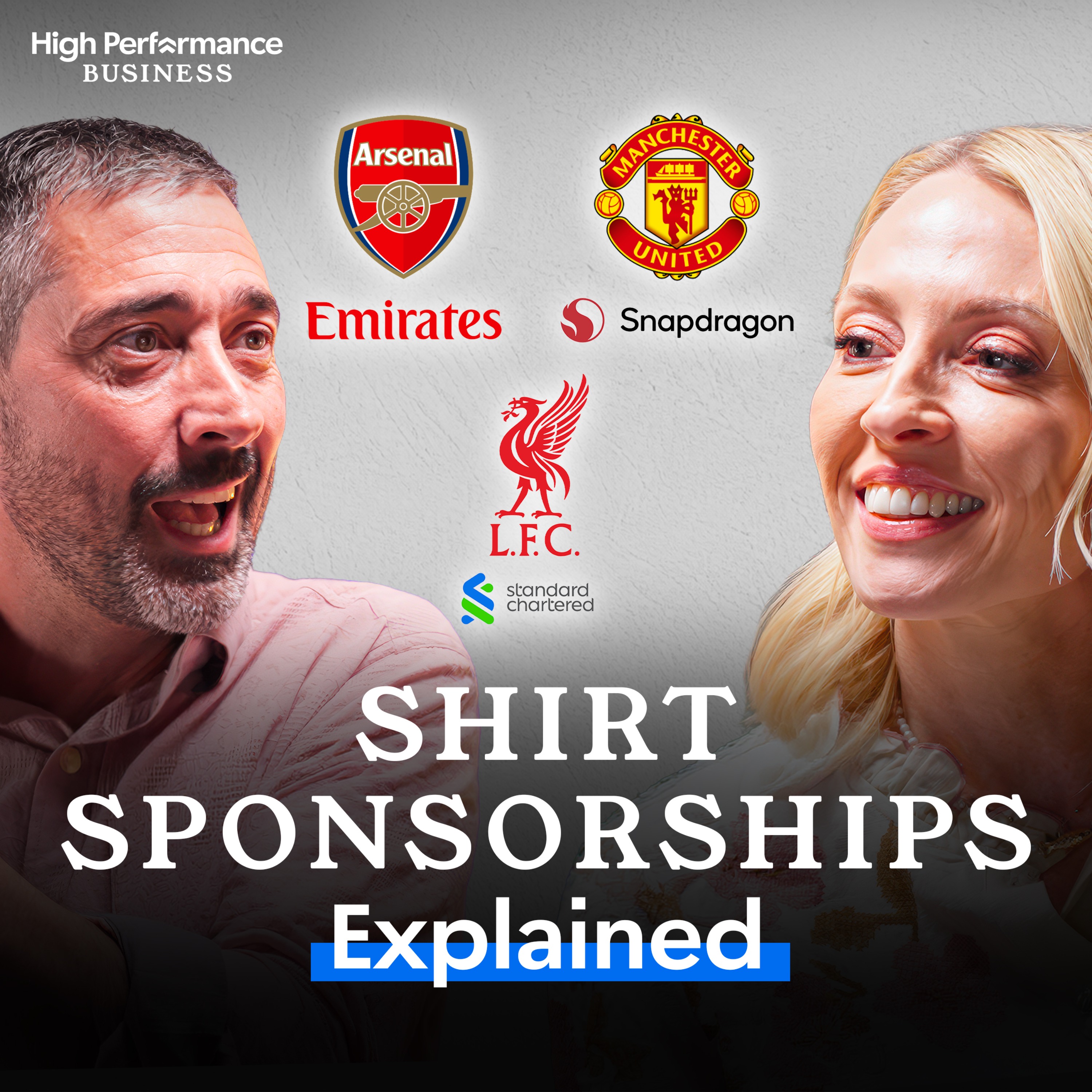
How Premier League front-of-shirt sponsorship works (and why gambling brands moved off the front), plus the NBA’s planned “NBA Europe” expansion into European franchises.
Episode hosts Natalie Pirks and Colin Murray, both journalists and sports fans. Basketball expert guest: Stuart Hodges (covers basketball professionally; works in media/podcasting; described as having NBA-level familiarity).
Liverpool’s Standard Chartered; Spurs’ AIA; Chelsea no front sponsor at start of last season; Manchester United training kit Betway; Kettering Town first English club to wear a sponsor (1976). NBA Europe: 20 franchise bids from 12 cities; UK interest includes London and Manchester, with reported bidders like Daniel Levy’s consortium and Saudi PIF.
Written by AI. May contain mistakes.
Discussion of the two main topics: football shirt sponsorship and the NBA's European expansion.
“We're going to look at how it's changed through the decades, how it's absolutely changing going into this Premier League season and we detail why.”
Examination of how football shirt sponsorship has evolved and the implications for the teams.
“Plus, can NBA Europe succeed where NFL Europe didn't?”
Analysis of the Premier League's ban on gambling sponsors and its effects on clubs.
“What are the big sport or shirt sponsorships that you can recall that you can remember?”
Analysis of the Premier League's ban on gambling sponsors and its effects on clubs.
“Summer's supposed to be the easy season.”
Discussion on the shift from traditional sponsorships to global brands and the implications.
“So moving it off the shirt is designed to hopefully not encourage people to fall into that trap or for people underage to want to bet.”
Discussion on the shift from traditional sponsorships to global brands and the implications.
“a bottle of beer, even a chocolate bar, the high street bank that you could go into.”
Explore how shirt sponsorship in the Premier League serves as a global marketing strategy.
“Well, you're putting a billboard out there and if they get the kit right, that billboard's going to exist for years after your investment.”
Delve into interesting historical and unique examples of shirt sponsorships in football.
The hosts discuss Kettering Town, the first English club to wear a shirt sponsor in 1976, joke about retro kits, and invite listeners to send thoughts via social media.
“Sorry, I knew I was going to mess up the social media.”
Examine the NBA's new strategy to enter the European market, focusing on basketball.
“We're going to talk about the latest attempt by hugely successful American sport to break the European market.”
Learn about the history and growth of American sports in the UK, particularly the NFL.
“So I'm going to focus on the UK and I'm going to give you a potted history that you're absolutely going to love of American sports here.”
Explore the evolving relationship between the NBA and its European audience.
“would probably be okay with there being a team.”
Understand the role of FIBA and the NBA in shaping basketball in Europe.
“to film Madison Square Garden, whether it's for Sky Sports, whether it's for his podcast or whether it's Spurring Time to Talk to Us.”
Delve into the financial and structural aspects of launching NBA Europe.
“That says to me, if you get, and I'm not saying this is going to happen, definitely not out the gate, but let's say Arsenal play Man City at basketball.”
Hear fans share their thoughts on playing American sports in Europe.
“So with that in mind, this is something that I feel we're just going to learn.”
Explore the complexities of football clubs competing in global markets.
“but probably leaning a bit more towards the kind of journalistic side, but still had a great time.”
Reflect on the evolving dynamics of sports sponsorship and market competition.
“We'll play back the clips of you saying it's going to be a huge success if it fails.”
Engage in light-hearted personal anecdotes and discussions about giraffes.
“And after hours, at the end of the podcast, and I absolutely encourage you to tune out now, we are just going to share some of our week, like one thing each that we're going to talk about.”

Get the gist, explore an idea or ask about something said.
 Claude
On High Performance Business, what are the key points of this episode?
Searching your listeningAutomatic transcript. May contain errors.
0:00Colin Murray: Welcome to the second episode of High Performance Business. We made it. Yes, people said it wouldn't last. We are here, of course, because the sport is only half the story. I'm Natalie Pirks. Yes, I'm Colin Murray. We're both journalists, we're both sports fans, and we want to understand more about the business of sport. We'll do all the legwork, but we want to bring you along for the ride. Yeah, and as always, our conversation will be entirely shaped by what you want to talk about, what you want to hear. So please send us a message on Instagram. You can DM us at highperformance.business and we will take it all on board.
0:33You will, I never look at it. But today we're going to be talking about two things. Firstly, football shirt sponsorship. It's right in our face all the time. Every time we've watched football, right back into the mid-1970s. We're going to look at how it's changed through the decades, how it's absolutely changing going into this Premier League season and we detail why. And I think maybe the most interesting part of it is how the sponsors themselves have changed. And ask yourself this question, what does a global financial service get out of spending£60 million a year putting their name on the front of Liverpool's shirt?
1:10Colin Murray: Plus, can NBA Europe succeed where NFL Europe didn't? The biggest basketball league on the planet has received 20 bids for franchises from 12 major cities with all roads leading to its launch in October of next year. You are all over this. Can I just say that was brilliant because I know how nervous you were about just NBA, NFL. Oh, that's not my thing. MLB. I didn't even mention NHL because I didn't want to jeopardise a relationship this early. Don't blow up a blonde's head this early. The thing is, and this is my bag and I promise you it will be interesting. I promise you it's not just going to be an American sports conversation.
1:49The interesting bit is, does Europe need it? And just as importantly, does Europe want it? And as I said that, I realised that was quite Brexity.
1:58Colin Murray: Which is sort of similar to where we're going with shirt sponsorship. So there's really, really big changes this season. But first of all, indulge me. What are the big sport or shirt sponsorships that you can recall that you can remember? Well, first of all, because I'm above corruption in the same way that any FIFA president is. I looked at this before I researched this story because I wanted to give you the honest answer and that answer is not many to my shame it took me ages to remember standard chartered was Liverpool's and we'll get to the reasons why I then got two in a row because there are airlines but they also sponsor the stadiums right Etihad Emirates and I know there's three letters in the front of Spurs shirt which I believe is AIA, which is four, right?
2:53And they, I think, do insurance. And outside of that, a whole load of betting ones I'm not going to mention now and that will connect to this season and the big changes. So, let me throw it back on you because you love this. Like an episode and a half in and you're always like, yeah, you know this. Who sponsored Chelsea? So, go back to the beginning of the last season. Who sponsored Chelsea? Visualize the shirt. Visualize the shirt. I mean,
3:17Colin Murray: All I can see is blue. That's because that's all there was. They didn't have a sponsor going into the season. Can you imagine that? That kind of thought process of a team in the biggest league in the world, for whatever reason, starting a season without a front of shirt sponsorship. But even though they've scrambled going into this season, Chelsea and other clubs to get that sponsor, in mid-July, when we were watching, thankfully, Argentina lose the World Cup final, there was still six Premier League sides didn't have a front of shirt sponsor. Natalie's going to tell you exactly why. Yeah, I mean, commercial directors have been working overtime this year specifically because the Premier League took a voluntary vote a while back and banned gambling sponsors from the front of shirts from this season onwards.
4:02Colin Murray: And it was following discussions with the government. The government were weighing up stricter legislation on gambling advertising, and it meant the league, by saying, look, we'll do it ourselves, it meant they could manage the transition on their own terms. it showed a concerted effort to protect you know greater social responsibility look what we're doing it's a really good thing having betting sponsors is a headache because if you want to use players in your adverts they've got to be over 25 because of UK law betting companies had to take their name off the front of any kids shirts and even this year like Everton and Villa who've moved their betting companies to the shirt sleeve, slightly slamming the stable door after the horse has bolted.
4:46Colin Murray: But they're going to have to remove even the shirt sponsor from the kids' shirts as well. But it was lucrative. And that's the case here, isn't it? Because it's massive across all of sports business. Because this is not just about shirt sponsorship, but it looks like the ball will roll towards a place where you can't have a betting company sponsoring a major darts tournament or snooker tournament, or a boxing event. And if and when it gets to that stage, get ready for a huge decrease in prize money in those tournaments because that's the purse that will get hit first. And whatever your view is on betting in sport in terms of the sponsorship, they supply so much of the purses and so much of the money that goes into the governing bodies.
5:30So we'll probably talk about this many times, but football this season will change with the sponsors on the front of the shirt. So let's just get this clear, Natalie. A lot of people can have a drink and that's it. Thankfully in that place, I know people who aren't and it's an addiction. And it's the same with gambling. 95 % of people can have a bet, but the 5 % that don't, it can be life ruined. And this is a really serious issue.
5:56Summer's supposed to be the easy season. So why are so many people quietly Googling a therapist between summer Fridays? Because more daylight doesn't fix the hard stuff. Sometimes it just turns the volume up. Grow does therapy differently. Grow connects you with thousands of high-quality licensed therapists across the U.S., offering both virtual and in-person sessions, nights and weekends. There are no subscriptions, no long-term commitments. You just pay per session. Grow helps you find therapy on your time. The therapist you want takes your insurance on Grow. Grow accepts over 125 insurance plans.
6:33Sessions average$21 with insurance and some pay as little as$0 depending on their plan. Visit growtherapy.com slash ACAST today to get started. That's growtherapy.com slash ACAST. growtherapy.com slash ACAST. Availability and coverage vary by state and insurance plan. You've got social dialed in. Search is doing its thing. So why do your marketing results look the same as six months ago? That's because you're fishing in the same pond as everyone else. Podcast listeners are a different audience entirely, more engaged, harder to reach through traditional channels, and ready to act when someone they trust makes a recommendation.
7:14We're Acast, and we put them right in front of you. Browse thousands of the world's leading podcasts, book host reads or run your own ads, and track every conversion in real time. Same skills you already have, brand new results. Acast. Acast.com slash advertise.
7:36So moving it off the shirt is designed to hopefully not encourage people to fall into that trap or for people underage to want to bet. So we can't see that. And that's good, right? But you've already said we can see it on the side of the shirt. So apart from the side of shirts, the digital advertising, the sleeve sponsors, the stadium advertising and other commercial partnerships, But apart from that, we will be protecting people from seeing these gambling adverts. And the pitch side advertising boards that are all over your TV when you watch it. But apart from that, this is a blow. This is striking a blow for protecting our children.
8:14Colin Murray: Are you being a little facetious, Colin? No, I'm just... It's not like you. I'm absolutely just heaping non-sarcastic praise onto the entire football governance. There is a little bit of that. It feels a little bit like the initial warning on a packet of cigarettes. But I will say this, in the UK, we have some of the strictest guidelines for protecting people from gambling. There will be those that say that they do not go far enough. I'd imagine there would be a lot of people saying this doesn't go far enough. I think clubs will say, for a bit of balance here, I think clubs will say we've just taken a 20 % in some cases hit on the money we can make in order to do this thing that we didn't have to do.
8:56Colin Murray: So in their defence, I guess you would say, they are trying to do something for the social good. Yeah, I think they'll be all right finding space to advertise, but it's not going to be in the front of the shirt sponsorship. And that's what we're honing in today on our second episode of High Performance Business. Let's go through it bit by bit, because what really intrigues me here, Natalie, is what do you get out of it? Because our sponsors used to be things that we could buy, a washing machine, a bottle of beer, even a chocolate bar, the high street bank that you could go into. Now it's global financial services, big insurance companies, and now gambling's gone out of the way.
9:35Fun fact, since the beginning of the Premier League, there's a huge percentage of products advertised in front of Premier League shirts that we can't even buy, that we can't even access the services in the UK. So there's a big picture at stake here. So let's say Standard Chartered, This bank that you need, international banking needs, or high-worst clients, or business banking requirements. So it's not available at all. They're going to shell out about 60 million to advertise for Liverpool this year. And there's so many like them. So what do they get out of it? Because this is such a far cry from Crown Paints, isn't it?
10:11Colin Murray: Yeah, it's a long way from a local company sponsoring their local team. I guess in the way that you get in the National League or in the League Two or whatever, it tends to be local companies that have an affiliation and a guess similar to how Newcastle Brown Ale did with Newcastle in the 90s you know there was a real local fans loved that all-time grit one of the all-time greats but we don't really have that anymore so what do they get out of it is it brand awareness let's come to it do you want to know first how you go about being the sponsor of a club me yeah would you like to know well I know Billy Hogan at Liverpool so So I would just...
10:50Colin Murray: You're such a name dropper. Look at that. Billy, it's big C here. Big C. I've just come into a lot of money from a really successful podcast. To be honest, I didn't think it was going to work at the start. No, no, she's actually nice. No, she's actually nice. I know, but it goes to show you don't believe things that are written in the internet. Yeah, yeah. Yeah, yeah, put me down. That's how I would do it. How do you actually do it? Would you like to know properly? So I didn't know. So I rang a friend who's been doing a deal with a big Premier League club recently. There are three ways. One is the commercial team at the club do the reach out.
11:24Colin Murray: They'll reach out to all industries that they think might be interested in sponsoring that club. So Premier League, like I said, big, big companies, League Two, National League, maybe more local. The other way is agents. Agents try and get involved to maximize a specific market. So for example, Wrexham, if you're Wrexham, you might want a lot of American companies because you've got that whole tie-in. And then a third less likely way is that you get companies with big budgets who really want to hit their marketing spend with a specific club. Fulham, I discovered, gets a lot of approaches like this because they're basically Switzerland, aren't they?
11:58Colin Murray: They're inoffensive. No one hates them. Global Premier League brand. Oh, everyone. You say that, where should you go and watch football? Once you get beyond going to see Howland score for Man City or visit the Cup at Anfield, when you get beyond that heavyweight journey, the very first thing we all say is, Craven Cottage. You've got to go to Craven Cottage. Got to go to the cottage, yeah. 100%. It's great. do you know he can get a boat there? You know, it's the same. Yeah, absolutely. You used to have a stature of Michael Jackson, what's not to love? Yeah. A lot about that, but let's move on. So once the deal's actually done, the due diligence on that company then gets done.
12:30Colin Murray: So a few of the gambling companies, when it was gambling last season and beyond, they were found to promote things like cockfighting and ban sports on their websites. Of course, they had to do away with all of that before they could get involved with the Premier League. And then, as we've said this year, the commercial teams have had to work that bit harder. Fulham actually now has a global tech and AI sponsor, as does Palace. Then it goes through the lawyers, and then finally you get the negotiations on the bonuses and the fees. So with all of that in mind, given it takes a long time, there's a lot of money involved, what are they getting out of it?
13:02And I know the view of me and my mates in the pub, any time it comes up, is game's gone, game's gone. Like, why are they on the front of the shirt? Why would they bother? And we always talk about it in this terms. We used to refer to the shirt by the sponsor. Have you got the Crown Paints Liverpool kit? Have you got the Carlsberg Liverpool kit? Sharp, the sharp. You know exactly what I mean when I say the sharp. And I say you, I'm looking at the entire crew of high performance business, 63 people all nodding their heads at the same time, right? Now, nobody says that. Nobody's ever said, oh, the Chase kit or the AIG kit or whatever it is.
13:46But that's not the point. When you actually dig into it, absolutely it's worth the money. So think about it in the most base way, which is the old style of advertising. You know, pre-internet, it was flyers and billboards and television ads and radio ads. Well, you're putting a billboard out there and if they get the kit right, that billboard's going to exist for years after your investment. Because just like Crown Paints are still getting advertisement for those Liverpool retro kits, But more importantly, at that moment, that goes into every market around the world. Sponsoring kits here is no longer about the business of the UK.
14:21It's about the business of the world. And let's imagine that you're a global financial service that hasn't been able to crack Asia, right? And you really want to do it. And you look across the teams in the Premier League and you see a guy called Son playing for Spurs. and you know that people travel from Asia in their tens of thousands every week in an effort just to be near him and that he's a hero. You put him in your billboards in Asia, you put your name in his shirt and you've done almost all of your groundwork in that country without having to leave New York. So it's a masterstroke of advertising really.
14:57We don't have to like it. I'm sure a lot of traditional fans don't like it but it is a reality of the growth of the Premier League and its global status that is attracting advertisers that see it as the keys to a kingdom. And based on the players in that team, like you said, and based on that squad, pick a kingdom, any kingdom. That was the first take I got out of it. And we don't talk much before we record. When you looked at the reasons why a global company would spend that 60 million when most people in the stands wouldn't use the product, what did you find?
15:31Colin Murray: I took one specific case study. So who sponsored Palace during their cup run? Their FA Cup, first ever time they've won it. Can you name them? That's brilliant. So we're going back in time. Oh, I can see the kit. Go ahead. Bet 88. No. Yeah. Okay. Yeah. No, I didn't have it. So that whole run, obviously, to the final, and that joy around the final and the fans and the TIFO and the brilliant, you know, what they did, they looked at the media value. So the metric is, it's a metric that determines the monetary value of digital and social content based on audience exposure and engagement. Sorry, that's wordy, but that's what they look at.
16:15How sexy.
16:16Colin Murray: They determined that that run to that final was worth in excess of 31 million pounds to them, four times what they paid. Wow. So. Can we just say there is a bit of an outlier there, Crystal Palace winning the FA Cup. Of course. But they do okay. Yeah. And so that's before you take into account the Premier League. If they'd only reached the quarterfinal, if they'd have finished two places below, you can start to see how the maths add up with a lot less success. Yeah, but still four times getting to the final, they get to the quarterfinals, they probably doubled it. Correct. So that's why you would sponsor a club like Palace or a club like Fulham, because, you know, they might not go on a cup run every single season, but there was definitely a huge value that that company put on that shirt.
17:07What about this angle, which might be, for want of a better word, mollocks? What about that connection to emotion? Because I was thinking, like, have you got to be careful about sponsoring the Titanic? You put your name in the front of a team that have a remarkably bad season, and the last shot of the season is the captain arguing with the goalkeeper and they're being divided. They're being separated by the manager who's in tears.
17:37Colin Murray: Well, it's AIA, isn't it? Is that a good connection to your brand? And I think the answer is yes. Oh, interesting. I think the minute you're on that shirt, what it actually translates to is just brand recognition. The most straightforward thing, we don't need to be a sports business podcast to talk about that. And I think you get an instant credibility or legitimacy at least. And I actually think you're connected to emotion and you're connected to belonging and you're connected to something real that goes beyond the head. The same reason people sponsor podcasts, the same reason these days people look at events rather than the straightforward, you're a customer.
18:14They try and say, no, we're involved in the thing that you love. I don't think it matters. You know, happiness makes you cry. Sadness makes you cry. The same emotion. I actually just think -
18:24Colin Murray: Almost getting relegated must make you cry though. Yeah, exactly. Like, if you were a AIA, isn't it, that sponsors Spurs? See? They're not going to sponsor us now, are they? But if you're them, I'd love to be in a fly on the wall. Like, you know, Spurs didn't just take relegation on a date. They basically almost slept with it. I bet. They almost married it. I think they'd be saying, great. I think they'd be saying, great, could you sack another manager? Because every picture and every back page of every newspaper's got a logo on it. It was certainly busy last year. Because this is what you've never had in a bar, right?
18:56Sorry, who's your football team?
18:58Colin Murray: I can't tell you. You don't reveal your football team? No. No, because I was a BBC journalist for 13 years. I would have been suicide. Get off the fucking thing, tell me. I can't, because you and I are going to fall out on episode two. United. Yeah. Yeah, it is United. All right, fine. I'm a plastic scouser, so I don't get into it. So you're in a bar with your mates. Yep. Right, who sponsors United right now, is anyone? Snapdragon. Snapdragon, thank you. So you're in a bar with your mates, right? The season's gone. Next season, this season we're going into goes really bad. I don't think it will, unfortunately, under Michael Carrick.
19:28I said, jeez. But anyway.
19:30Colin Murray: In Michael, we trust him. You're in the bar, right? You're fighting for relegation. It's mid-March. Your mates will go, why do we keep him? Why did we give him that transfer window? Your other mates will go, give him another transfer window, right? Someone else will say, that player doesn't care about the shirt. He doesn't give 100%. Will anyone in that bar at any stage go to you? I'll tell you what the problem is. Fuck Snapdragon. No. It doesn't affect their brand at all. No. True. So in a way, it's genius. because you're not actually putting yourself onto the success of anything. So it doesn't work like that.
20:02And outside of the UK, this bubble that we are in, you aspire just to walk through the doors of Old Trafford once. True. You aspire to just be able to fly into Heathrow and take the long train to the Emirates and stand in that horrible bowl of a stadium. That's what you do, right?
20:23Colin Murray: I do a great buffet at Arsenal. I was just going to say. Nothing against Arsenal. It sounds alien to me as a council estate boy and it sounds alien to you as kind of a middle to upper class woman. Council estate Luton teenage parents. Thank you very much. I'm the posh one in this podcast. That's brilliant. Let's move my seat slightly over here. I love Luton. We need to talk about that more. Maybe not now. Oh, my God. Anyway. Kenworth Road is incredible. Let me just say it's good that you support your local team. but the all those things that are alien to us are huge for a company and that could be worth 10 million to them just by bringing people into the dressing room just by oh you get to meet the manager oh I'll get you a signed shirt by the team seems so small but it could actually make up a huge amount of your investment yeah but what is the investment what are they actually paying because all I know is Liverpool pay about 60 million and I think most of top clubs are about that yeah top six you're looking probably around that amount Interestingly, most, if not all, have obviously taken quite a dip because of this whole gambling thing that we've already spoken about.
21:30Do betting companies pay more than insurance companies?
21:33Colin Murray: Yes. If you think about the gambling company, Betway, that's now on United's training kits. Out of sight, which is great. Don't take drugs, kids. I mean, not out of sight because they're in the Champions League. So back in the big time, 20 million quid a year. To them, it's worth every penny. Just for the training kit? Just for the training kit. But think about it. Every time that Michael Carrick or Bruno Fernandes is interviewed at the training ground, they're in Betway. Every time they do that, I'm thinking, is there a horse race this afternoon? I put a five or a... It is that straightforward.
22:06It puts it back in people's minds.
22:07Colin Murray: There you go. To them, it makes absolute financial sense to be associated. I think that's everything. I think shirt sponsorship, the changes, you did a much better job than I did of explaining that. But the reasons why that ability to enter a market, that emotional connection, that access that you have, the digital pull that it has, and all of those things together, that's an advertiser's dream. I would go as far as to say they're getting a bargain, being able to be in the front of Man City's kit or Arsenal's kit or whoever. I'm just naming teams here. So instead, maybe two things. First thing, what is your emotional connection to a kit?
22:43Where do you go to in the old days?
22:45Colin Murray: Oh, Sharp, obviously. United. yeah yeah and do you remember the green and black kit with the oh my god yeah oh sexy right it was iconic it was iconic yeah I'm like Kanchelskis yeah see that's the key yeah it's the emotion and the connection to the players that you loved of the 90s for me mine would have been Crown Paints but again the players saying Ross Shinnett Kenny Dalglish and all stuff like that you mean it's funny we can date people by their favourite kit same as email addresses yeah like you probably get a hotmail I've got a hotmail my mate who's you do have a hotmail don't lie I made it myself AOL you know when you start to put the disc in there's no equivalent to that that's one secondly do you want to hear my favourite kit sponsor I found I'd love to please can I just because we went very much in our teams can I just give a shout out for Holston and Spurs who I think outside of our teams you mentioned Newcastle Brown Ale I put that up there as well but Holston on Spurs was just legendary what a kit that was Angry Birds on Everton is brilliant West Brom in the 1980s had no smoking so they were actually sponsored as a public advertising campaign to make people aware of cigarettes but the best one I found again from the 80s was the Southampton sponsor was Durex like I've heard of protecting the back four but that's taken it way too far now imagine being sponsored by that three I promise you we'll move on what was the first sponsorship you know I'll always have a nerdy fact for you of any club of all time of all time oh go on I love your nerdy facts it was Kettering Town football club and they were the first ever English club to wear a sponsor it was back in 1976 people were outraged they had the same conversation that we have when FIFA pulled their latest trick do you know what I mean because it is a drip drip drip isn't it Kettering tyres amazing right and I've never ever wanted to do on a Kettering Town kit until now somebody out there in the world of sports business that does merchandise find out that shirt and get that shirt out there is a niche company in Manchester that sells retro kits and I bet you he can get hold of Kettering tyres I won't do it but I will be really resentful of the person that does excellent know what to get you for your birthday listen if you've got any thoughts on that, even if we don't read them out on air, send them to us on the Facebook, yeah?
25:19Facebook? Sorry, I knew I was going to mess up the social media. Right, send the tours. There's ways you can do it. MySpace, Bebo, and if you've got a Tamagotchi that connects to the Wi-Fi, you'll be able to send that to us on our Instagram.
25:35Colin Murray: Please go to Instagram. Please, I'm being honest. Highperformance.business. What is it? Highperformance.business. That's what it is. This guy. Right. So speaking of front of shirt sponsors, here are some of ours.
25:50Summer's supposed to be the easy season. So why are so many people quietly Googling a therapist between summer Fridays? Because more daylight doesn't fix the hard stuff. Sometimes it just turns the volume up. Grow does therapy differently. Grow connects you with thousands of high-quality licensed therapists across the U.S., offering both virtual and in-person sessions nights and weekends. There are no subscriptions, no long-term commitments. You just pay per session. Grow helps you find therapy on your time. The therapist you want takes your insurance on Grow. Grow accepts over 125 insurance plans.
26:27Sessions average$21 with insurance and some pay as little as$0 depending on their plan. Visit growtherapy.com slash ACAST today to get started. That's growtherapy.com slash ACAST. growtherapy.com slash ACAST. Availability and coverage vary by state and insurance plan. You've got social dialed in. Search is doing its thing. So why do your marketing results look the same as six months ago? That's because you're fishing in the same pond as everyone else. Podcast listeners are a different audience entirely. More engaged, harder to reach through traditional channels, and ready to act when someone they trust makes a recommendation.
27:08We're Acast, and we put them right in front of you. Browse thousands of the world's leading podcasts, book host reads or run your own ads, and track every conversion in real time. Same skills you already have, brand new results. Acast. Acast.com slash advertise.
27:30Colin Murray: Welcome back, and we're going to move on to our next story, which is right up your strasser. We're going to talk about the latest attempt by hugely successful American sport to break the European market. This time it's basketball, NBA Europe, and it's set to launch in the second half of next year. So please, Colin, explain this to us and to me mainly, like I'm 10, because American sport is not my thing. It's very much yours. So give us a, first of all, give us a potted history, and I'm saying short history, please, Colin, of American sport in Europe. Go. So I'm going to focus on the UK and I'm going to give you a potted history that you're absolutely going to love of American sports here.
28:11Colin Murray: I'll be the judge of that. We're going to start with the NFL, which had an explosion here when Channel 4 launched. Channel 4 is where you'll find Countdown, which I host. Oh my God, shameless. It was brilliant. We were playing it in the playgrounds and that was when we had their first game over here way back in the 80s and it exploded on the Channel 4. And that was really the birth of American football here. However, you need to fast forward to 2007 when the NFL decided, hey, we want to regularly have games in the UK. And when they first did it, they cocked it up monumentally. And you remember without remembering, do you remember when the Wembley pitch was torn up?
28:52Colin Murray: Yeah. And we had like the FA Cup final or the Carabao Cup or whatever it was back then, the Little Woods, whatever it was. and everyone was like, get your American football the fuck out of our country. Stop ruining our pitches. We don't want it here. Don't say soccer, even though we invented the word and told you to say it, right? We have that sentiment. And they had a choice right then to say, look, we've been out for a night. It didn't go well. We didn't. It was bad sex and we're just going to leave it. And instead they said, no, we're going to come back and back and we're going to forge a relationship with this country.
29:28We're going to show the UK that we're actually here to have a relationship with them. They took a hotel because the players en masse hated it. They took a hotel where the players couldn't sleep in the beds, where they couldn't fit into the showers, and they refurbished the entire hotel for when they came back in the second year. And we had this run of one game, one game, and gradually it got better and better and better. It became more normal and more normal and more normal. And that's because they invested in the relationship. Natalie, are you still with me? I'm holding on. Right. They would close off Regent Street to have a big street fair, right?
30:11And this is about Europe. It's fans coming from all over Europe. They would make sure they had access to the same merchandise that fans had in Kentucky, that you could get the same thing in Birmingham, Alabama, as you could be in Birmingham and England. And they said, we want to be in a meaningful relationship with you. I can see you're glazing over. Fast forward to today, it's three games, and it is as normal as the netball at the Copper Box. Let's say this straight. Tottenham Hotspur Stadium is an American football stadium. It doesn't host American football. It is an American football stadium.
30:44It was built for both. So the NFL worked at it and have forged a relationship where right now, most people on both sides of the pond, less so in America, but still they have like a grudge and respect for what we're doing here now, would probably be okay with there being a team. I would say it's a case of when, not if, there's an actual franchise in the UK. That's the right way to do it. Major League Baseball, which you know I can talk about all day.
31:10Colin Murray: Please don't. I'm going to do in about 30 seconds, right? We don't have the culture. We have about 45 baseball diamonds. We don't play it at school. And before you say it, rounders ain't baseball. It's a hugely complicated sport, they understand. It took me two years when I fell in love with it. It's not about hitting a home run over the park. It's not what you see in the films. And we just don't have a baseball culture. And they tried to have the one-night stand. They tried it two years in a row, and it didn't work. We don't have the stadiums, we don't have the culture, and we don't have the interest in the sport.
31:39And I'm okay with that. The NBA, and I'm aware our special guest is listening to this, the NBA was never a one-night stand, And nor was it, I think, the right relationship. It was more that ex you have, and I'm talking to you specifically here, Natalie. It's that ex you have that you know you really shouldn't ring, but you do, and once in a while you Netflix and chill. It's been on and off and on and off and on again. And right now it's on. And this is where we're going to get into this subject, and our guest is going to tell us everything we know. And I think that Stuart Hodge, who has enough knowledge of basketball to film Madison Square Garden, whether it's for Sky Sports, whether it's for his podcast or whether it's Spurring Time to Talk to Us.
32:21Colin Murray: Or Taylor Swift's wedding. Or Taylor Swift. He was at Taylor Swift's wedding. Stuart, first of all, looking through the history of American sport here, it's not far off analogy-wise, is it? It is a challenging thing that the NBA are trying to do. But first off, I have to say, I'm delighted to join this particular threesome on this wee podcast today. Ah, brilliant. Got to have a bit of fun, right? Yeah, it's all right. We're launching the podcast on OnlyFans next week, so that's good. See, it's only fans that you need for a sport to be successful, right? Oh, he's done this before. You're not far off, and this is different, and I want you to really get into the weeds in this.
33:00I think we're trying to learn more about the business of sport, but it's through our experts that we really understand it. And what we usually have in sport is a foreign body comes in, and we kind of almost resent that intrusion. But NBA are working with FIBA to start NBA Europe. That to me feels like a game changer and explain who FIBA are, don't leave anything out, get so far down into the weeds, you're digging them up by the roots. That's fine, I'll go and get my gardening clothes on and get right into it. So FIBA is the International Basketball Federation, the FIFA type equivalent, but maybe not courting quite as much controversy as FIFA.
33:41at the moment and they have set up a joint task force alongside the might of the nba to launch a basketball product in europe and in realistic terms what that means is european basketball is absorbing more capital in the 24 months that this is going to happen before it launches than it is raised in its entire history wow so what you've got with basketball is you've got a unique challenge because there are 270 million or so basketball fans in Europe. It's the fastest growing sport. It's the number two sport behind football. And yet basketball takes less than 1 % of Europe's 45 billion sports media and sponsorship market.
34:23So what you've got here is you've got a disruptor coming in trying to level that playing field somewhat. You're probably quite surprised there at the reference of the success of basketball in Europe.
34:34Colin Murray: No, I get that it's a really successful sport. I've seen it when I've gone abroad, funnily enough, to cover football. I've seen Spain standing still because someone's won a basketball match. I understand it. Spain, France, Croatia, the list goes on. We're looking at like five, six, seven countries in Europe that are putting crowds in at five, six, seven thousand for regular season games. Yeah. So I understand it, but how's it going to work then with the leagues that currently exist versus what the NBA are trying to do? That's the rub, right? Right. This is the bit that's very, very interesting.
35:09So it could have gone one or two ways, right? The EuroLeague, which is the existing basketball superpower, if you like, in European basketball, it's where Real Madrid play, where Barcelona play. And this is an important point, right? Because Barcelona, Fenerbahce, Real Madrid, Panathinaikos, they're all playing basketball. And if you've got franchises in London and Manchester, which is two of the 12 target cities and London in particular is the most valuable one in terms of the bids, over a billion. That says to me, if you get, and I'm not saying this is going to happen, definitely not out the gate, but let's say Arsenal play Man City at basketball.
35:49Are you trying to tell me that that's not going to be a differentiator in terms of getting casual fans who maybe have a sort of fledgling interest in basketball to go, oh my goodness, right? Let's stand up and have a look at this, have a look at what's going on. The next step of that is by launching a product in Europe that can break. And Britain is such a fascinating place because this is the place that there is the highest potential. It's the biggest untapped market in basketball globally. So we are, by virtue of being for this country, we are at the centre of the melting pot of this. And I tend to look at the big clubs when I'm judging this.
36:24So if you look at Real Madrid and Barcelona, Barcelona ratified a 10-season EuroLeague extension to 2035-36. Real Madrid was the last of the 13 existing EuroLeague clubs to renew a 10-year license, but it's got a 10 million euro opt-out. And both of those clubs are understood to have bid for NBA Europe anyway. So it's not necessarily saying that Real Madrid committed for 10 years. They bought a 10-year option with a 10 million euro break clause, essentially. And against 500 million euros, which is the kind of floor for franchises, 10 million euros in financial terms is a rounding error. Yeah, it's pocket change to people like Real Madrid, Barcelona, Natalie Perks.
37:09This is the type of money they just drop without even thinking about it, which is unimaginable. That tops from a Paris boutique, just going to say that and then got to move on. From a business point of view, and I think this is the key to wrap it up, is they've already said, we're entering a relationship with you, to go back to that analogy, because they've said, we have set aside a potential£3 billion loss on this across NBA Europe. Over its first, I think it was three seasons they referenced. So a billion a year. They're willing to lose to get to year four of this. So they have that, and that would encourage me.
37:49That would make me be a little bit more confident of it. But what about all the other business pieces that need to be in place? You're the expert in this, Stuart. Will it get the crowds? Will it get the television coverage? And will it get the sponsorship? Well, that's the idea behind having the might of the NBA involved here, right? The NBA is not coming into this without a knowledge of how these things work. They also have partners economically and partners in every sort of facet of running a sports league that give them both knowledge and gravitas as they come towards doing this. So it's not someone coming to the table without a knowledge of how to put this thing together.
38:27It's someone who has, and the NBA, I'll be honest, they don't tend to do things unless they're sure on it. As an organisation, they tend to only do things once they're certain that they can make it work. And that is what I think the interesting part's going to be here. There's obviously a lot of secrecy and a lot of confidentiality around the bidding process, but we do know some things. In terms of the UK, in London, there's been reported interest from Liberty Global and a consortium that involves Daniel Levy, the former executive chairman of Spurs, and Jam Najafi. And the Rubin family are interested as well.
39:07Saudi Arabia's public investment fund, Todd Bowley. Then in Manchester, that's different from London because the London Lions have already been talking to the EuroLeague. That's the existing big London basketball team. But whether they decide to go one way or another or whether it's a new entity in London that springs up, there's so many ways that that could go. In Manchester, though, the NBA have that exclusively because the EuroLeague aren't as interested in Manchester. And an important point as well is you sometimes see a bit of differentiation. Definitely if you look at basketball in the UK, Super League basketball, which is the main domestic entity, it does feel a lot more like a regional product.
39:50We all do respect intended. And that is reflected in how the UK performs internationally at basketball level. So what we're talking about here is something that could potentially be a massive infrastructure play as well. And the NBA has already committed money alongside the government to making that happen. A massive sum. So with that in mind, this is something that I feel we're just going to learn. And the franchise announcements are going to take place as we move from summer into autumn and then probably heading into next year with the idea of that October 2027 launch. So as we talk on this podcast today, we're sitting just on the cusp of this beginning to build into the behemoth of a snowball that's going to be going down that hill.
40:36Colin Murray: Can I ask you both this as a final thought then? Obviously, Colin, you are a huge sports fan of American sports in general. Mainly baseball, these bags are brought to you by the Toronto Blue Jays. Right. So how do you both feel about an American sport coming here and being played here and not your team? Now, you sat there playing possum for all of this second story today and you've just asked a really deep question. And I'm interested to know what Stuart thinks in this first. Who's your team? Who's your NBA team? Orlando Magic. Right. When the Orlando Magic play in London, on a scale of one, I hate it, 10, I love it, what's your answer?
41:21Dude, right. I covered the Orlando... I covered the Orlando Magic coming to Europe last year, right? My first NBA game, I was an accredited journalist. That was the one in Berlin. So it was a double header between the Magic and the Memphis Grizzlies. The first one in Berlin, the Magic have got three German players, so it was like a home game. And it was amazing. So I'm sitting in the room with Adam Silver, the NBA commissioner. And then I wanted to experience it as a fan as well. So me, I had tickets with me and my fiance and we sat and we watched it and I went from Stuart with it or Stuart kind of professional vibe to, oh my God, I'm a fan in dreamland.
41:55And that was an amazing experience. And doing it in London, I mean, nearly as good, but probably leaning a bit more towards the kind of journalistic side, but still had a great time. And I absolutely loved it. 10 out of 10. I don't. So I am much more open to an NBA Europe. I'm much more open to an NFL team. And this is just pure fun. Probably there's no place to talk about this in a sports business podcast, but I just don't want my Toronto Blue Jays outside of Toronto. I don't want my Mets outside of New York. I don't want my Padres outside of San Diego. I always feel like it's Coke Zero, right?
42:41I love Coke Zero. Okay, well, I knew you were going to say that. Let's imagine that you get what I mean, though, right? Yeah, sort of. Like, it is a version of it, but it's not. Like, it's not what was invented. It's not in its purest form, right?
42:58Colin Murray: It's not got seven tablespoons of sugar in it. Yeah. Yeah, I mean, if the product comes from America, you're not going to get the top level of basketball. That's always going to be the NBA, right? I think that's a given. However, it's kind of true in football as well, right? The colour of polo shirt that I'm wearing will give you a clue to who my football team is along with the accent. Hebs. And Hibernian. And Hibernian, no. Celtic play in Europe and Europe feels like a backwater. We feel like a backwater in terms of Europe. And it's really hard for Celtic, which is a club which has more global gravitas and more global intangibles from a brand standpoint.
43:37There's some business jargon for you, right? Celtic have more of that than, I think, a lot of the clubs in the Premier League. Definitely, I mean, we all do respect, Bournemouth are in Europe this year, right? Bournemouth don't have that same global pool and attraction, but they play in the behemoth that is the Premier League. And as a result, can bid like 10 times what Celtic can for the exact same player and are in a different market in terms of they need to find better players to operate in the Premier League. Regardless of the way you look at it, you're always going to have to be compromising in some way because football is still what it always was, but the power of neoliberal capitalism and global globalist economics means that you're in a position where Celtic, despite their history, despite all of the things that they have, are not going to be able to compete successfully very often at Champions League level.
44:26And when they do, bigger fish are going to come and pluck the players away, financially speaking. but not bigger fish in terms of a global recognisability standpoint. Stuart Hodges, you're so ahead of the curve in this story. It feels like we're sort of ahead of even the beginning of it being a mainstream conversation. So we'll continue to monitor this. We'll play back the clips of you saying it's going to be a huge success if it fails. We won't play back any of our clips if we were wrong. No, obviously not. No, we'll just delete them. You're a lovely man. Good luck with everything. And love to the family that is going to grow long into the night.
44:58Well done, mate. Thank you very much. It's great speaking to you guys. Thank you. Lovely to speak to you. And with that, lovely man, right? Lovely man. Business is closed. And after hours, at the end of the podcast, and I absolutely encourage you to tune out now, we are just going to share some of our week, like one thing each that we're going to talk about. Sometimes it's to better our relationship. Think of it like marriage counselling. Stop leaving me voice notes. I knew he was going to do this. The most selfish thing of all the things you can do. Imagine it back in 1986, right?
45:35Colin Murray: Yeah. When phone numbers were four digits. My granny and granda's number, 6694. People used to say their number, right? And I went 6694. Do you still remember your friend's numbers as well? Loads of them, yeah. I got the 10 digits. Can't remember what I did yesterday. Still know my friend's phone number from 1991. 91. You go, hiya, nanny. You all right? Yeah, yeah. Don't talk. Don't say a thing. Let me tell you everything that I think and then I'm just going to hang up. Bye. I get it. I've no signal. There's places for it. Love notes. If we ever get to that stage, who knows the future? You can go just thinking of you.
46:13And if you want to send me a message like that, platonically, I would be up for that. But when you tell me about your day in a voice note, there's no interaction there. it's going to ruin this podcast you do it like every other day
46:26Colin Murray: you literally sent two back to back voice notes yesterday to me and what was the first one you stop telling me no it wasn't but then but then I'm in that situation like what I do like that reply via voice note do you not want me to ring you yeah okay case for the defence then I'm Larry David like and then that puts me in a place where my days ruined you won't get a single voice note from me now yes and you'll understand what it's like to feel left out in the cold and then I'll be like little message which you can still send me, it's fine. No, no. I'm one and done. Once you're done, you're done.
46:57Whatever our Bebo account is, let us know what you think about. Anyway, what's your thing?
47:03Colin Murray: Giraffes. Oh! Okay, so giraffes are my happy place. Yes. This is what you don't know about me. You would know if you listened to my voice note. But if you sent me a voice note about a giraffe, I can't tell you what I think about giraffes. That's what I mean. Okay, right. Don't go back there. Let's go to the happy place. Giraffes are my happy place. Yes, why? I have fed them in Kent and Kenya. I don't know why. I can't explain to you. If I see them, I feel peaceful. Right. I love a giraffe. So this week I discovered the Tanganyika Wildlife Park in Kansas. Yeah. On Instagram. Okay. And they had to perform an emergency C-section on this giraffe.
47:39Is it bad stories about animals?
47:42Colin Murray: She didn't make it, but they gave this calf a 5 % chance of survival. They don't survive C-sections, right? Cue the Rocky music. Yeah, and now Milani. We can't afford the Rocky music. Baby Milani took her two minutes to take her first breath. And they've been doing this round the clock looking after the baby. And she's just taken her first steps. Fans have donated thousands of dollars to keep this. And she's got a little purple scarf which was hiding like her IV. And honestly, I'm now obsessed with baby Milani. And that's what's been making me happy. I have to stay away from those stories. Do you remember the monkeys?
48:19that was thrown out of its troop and had to have the toy. And then, oh, that killed me. I was in floods. And then someone said, there's good news about it. I was like, no, I just don't want any news about it.
48:32Colin Murray: Oh, no, I need the news about it. It hugely upsets me, these individual stories about animals. So basically, I insulted you and you upset me. That's all for highperformance.business. Let me be the first to say about NBA Europe as we say goodbye today. Leave me out! leavey out we'll see you next time bye
Why are brands willing to pay £60 million to put their name on a football shirt?
Colin Murray and Natalie Pirks explore what makes sports sponsorship so valuable. From a financial services company using a Premier League star to reach new markets to Crystal Palace's unexpected FA Cup sponsorship return, they unpack how brands measure the value of being part of the game.
They also look at the Premier League's gambling sponsorship restrictions, why basketball generates less than 1% of Europe's sports revenue, and the billions the NBA is prepared to invest in building its presence across the continent.
High Performance Business are also privileged to be joined by sports journalist & special guest Stuart Hodge.
IFS - award-winning Asset & Service Management software 👉 Reimagine your operations at https://highpfrmc.com/IFS_HPB_YT
We'd love to answer your questions! Send them to @highperformance.business on Instagram.
Hosted on Acast. See acast.com/privacy for more information.