
 Ask ChatGPT



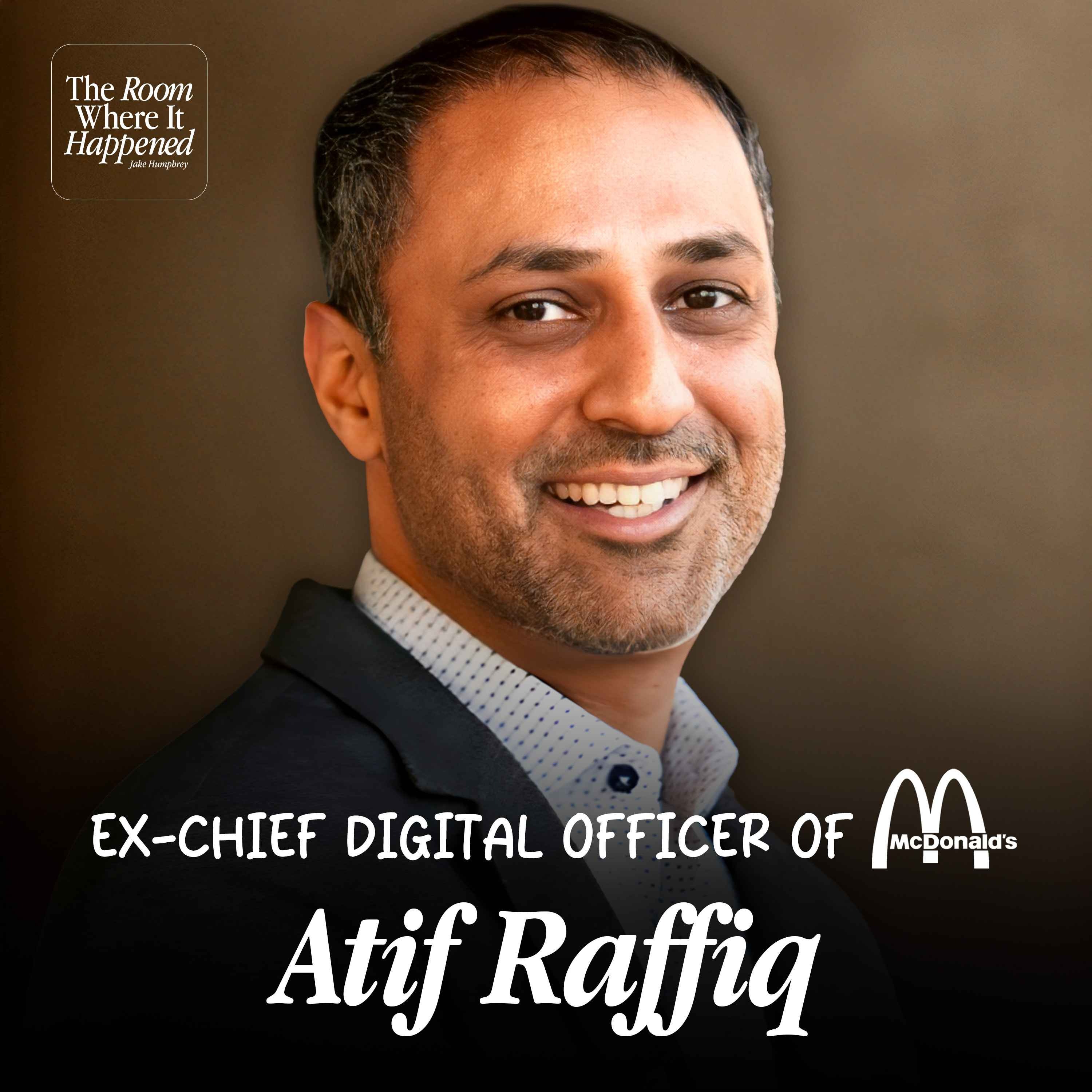
In this episode, digital pioneer Atif Rafiq shares insights from his transformative role at McDonald's, where his leadership as the first Chief Digital Officer led to a billion-dollar digital transformation. He discusses cultural shifts, overcoming resistance, and the importance of focusing on people over technology in organizational change.
Written by AI. May contain mistakes.

Get the gist, explore an idea or ask about something said.
 Claude
On High Performance Business, what are the key points of this episode?
Searching your listeningAutomatic transcript. May contain errors.
0:00The first thing I said to the board of directors was McDonald's is that this company is really about three things. taste, value, and convenience. I can't help you with the first two, but I can help you reinvent the third. Today, we're joined by Atif Rafiq, the man McDonald's trusted to lead their digital revolution as the first chief digital officer in the history of the Fortune 500. Now, you've seen his impact. You probably used the things he came up with, the apps, the kiosks, the curbside pickup, the delivery. What actually happened inside the rooms where those concepts were born? What was it like to walk in on day one into a role that didn't even exist before and convince one of the world's biggest companies to change how it thought, worked and served its customers?
0:40If you've ever wondered what it takes to steer a giant like McDonald's into the digital age, wonder no more, because this is the conversation that you've been waiting for. This is the room where it happened. First-hand accounts from behind closed doors in business to better understand the world today and lessons to improve your work tomorrow. brought to you by IFS. This is The Room Where It Happened with Atif Rafiq. I'd like to start with my first day on the job at McDonald's. The room was actually in Geneva, even though McDonald's is headquartered in Chicago. It was not expected that I would start my first day on a different continent.
1:18I was expecting to get into the corporate office and kind of meet my team. But instead, you know, the timing had coincided to kind of have a leadership, global leadership meeting in Geneva. And what was interesting about that is, you know, you have the top 10 executives of the company meeting with the heads of each of the European markets. So imagine stadium style seating and East Country kind of presenting their business plan and the top five leaders of the company. And I was in a newly created role, which was occupying one of those seats, kind of listening and soaking in like how it was going in each of these markets for McDonald's globally.
1:57It was a very different experience for me than what I was used to at Amazon. What's different about Amazon is really you're expected as a leader to kind of speak up quite a bit. There's a leadership principle at Amazon called diving deep. So you're supposed to listen and give a lot of input and a lot of feedback. And at McDonald's, especially on your first day, you're more of a listener. And you just want to establish, was build relationships. And that really dive into the business strategy at that point. And that was a little bit of an unfamiliar territory. So that was one of the things I experienced amongst other things.
2:34It's a hard thing, though, for you to be a listener, not a speaker in that role, because I had this image of you sitting there, like soaking up information, but actually being desperate to speak, because you were kind of looking at how McDonald's needs to be now and in the future. And I guess a lot of the conversation was about how McDonald's had operated in the past and carrying on in the same way. So the difference is the company at the time had 100 million customers a day. That's pretty ridiculous scale. But at the same time, all of the customers were anonymous, meaning we didn't know if Jake came in three times a month or what his favorites were, which doesn't really make sense for the modern era, especially when e-commerce was already quite established.
3:14What I found was essentially sharing highlights of the latest brand advertisements. So we looked at a lot of ads. And the ads were quite good. I mean, they were emotional. They were touching on things like families and convening and a third place in the world. All good things, but very different than the way in which you would run a business model, you know, 2013 forwards. How many customers do you think McDonald's owns the data of at that point? I asked my team to look into it, and they came back with a number which was under 3 million. Wow. So 100 million a day are using the business. You have the information that you can gather from less than 3 million of them.
3:54But I imagine that they were thinking everything's fine because we're selling loads of burgers and fries. Our adverts look fantastic. Every country in the world virtually buys McDonald's. So I suppose the challenge for you then is to go, well, this can be different, this can be better. I wonder how you kind of went about after the listening period trying to convince them to come on this journey with you. Well, I mean, I did start at the top. So they threw me into a board meeting within 30 days of my arrival, which was interesting. Actually, I remember stepping in front of the room, and I was plugging in my phone to do a demo, and the entire board started to break out in laughter.
4:35And I was curious, well, what's going on here? Did I screw something up? And then I noticed that my screen was kind of mirrored on the screen behind me, and it was showing my email icon. and it sent 90 ,000 unread messages. Hold on. Our chief digital officer doesn't check his email. Well, it's a philosophical thing. I'm not a zero inbox person. I'm a person who's aware of what's most important now, and that's what I focus on. So I don't let my inbox dictate my use of time. I scan the scene to see, like, what is my highest and best use at this moment? And if I need to concentrate, I will. But I think when you come up 30 years in a typical big company, they teach you things like zero inbox, and that wasn't my way of thinking.
5:25So it was actually a little bit of comedic relief, right? The rest of the presentation went quite well. And the good news is after the meeting, we got approval for a billion dollars of capital spending. So it was off to kind of a roaring start in terms of commitment and conviction behind what we were going to do for the next few years. Now we have to go into what happened in this room, right? because there'll be a lot of people watching or listening to this thinking, hold on, Atif walked in a room and walked out with a billion dollars to spend on the things that he wanted to prioritize. So can we go back a couple steps?
5:59In those very early days, you said you were kind of like reading the signals, looking for the signs of whether this is a business that was ready to change to the direction that you thought it should. What, first of all, could you teach us about how we can assess a business when we go in or assess a group of people, assess an organization, to see whether it is ready to be molded? Well, I think I always start with the mantra of what does good look like. And so that's the exercise I went through in my mind and with a small collection of people. And the realization I came to was that, you know, we've got to be able to articulate our vision in very familiar terms.
6:36So the first thing I said to the board of directors with McDonald's is that this company is really about three things, taste, value, and convenience. I can't help you with the first two, but I can help you reinvent the third. And that was a good way to put it in familiar language because we're not trying to introduce something foreign. We're trying to really connect with the heritage of the company, the things that made the company great for 60 years. So leaning into what's already good and seeing it in a different way. Absolutely. I mean, really leaning into the heritage, I think is a way to drive cultural kind of acceptance and open the door to change.
7:13Then I think you need to be super clear about, well, what does that mean specifically? So the next thing I said was that, look, we have$100 billion in system sales, and there's only three ways to use McDonald's. You walk in, walk out with a bag, or you get a train and sit down, or you go drive through. What if we could invent two or three new ways to use McDonald's? They kept nodding their heads. Well, what could those be? And then we introduced ideas like the kiosk and self-service where you could take your time, personalize your order. and then we would bring the food to you on a tray. And other kind of what we call service models, like curbside pickup.
7:49These were ideas at the time. There were some experimentations of these kind of customer experiences somewhere in McDonald's, across all their countries. But we weren't really organized to go after it in a big way. But it's a good question, I think, for everyone to ask themselves, right? Before they look at what's bad in a business, ask themselves, like, what does good look like? What do we already do really well and lean closer to that? If you could connect, you know, something in the cultural heritage, like the three core attributes of the brand, taste, value, and convenience, to a reimagined view of what those look like, you know, in a way that's future-proof, will kind of last for 10 to 15 years.
8:30You know, people want that. They crave that. You know, trust me, there's several years of work after that to realize it. but that's the best way to initiate momentum and get a little bit of a movement going in the company where people want the change. If you can just take a couple of seconds to subscribe, then of course you can get each episode directly to your inbox. And honestly, for you to subscribe, it makes such a difference to our show. It means we can grow and it means we can attract more incredible guests like George Heaton, Rory Sutherland or Richard Branson. From sitting in that room in Geneva, listening to this business, engaging where it was at that time.
9:09How did you come to the decision that the kiosks, which are now adopted, by the way, in pretty much every fast food restaurant, and the curbside pickup, and, you know, how did you work out that those were the answers, that that's what the customers would have wanted, that's what McDonald's would approve, rather than just an idea that everyone goes, well, that's a great idea, but it just isn't relevant for us? The good news in McDonald's is really, at some level, a collection of companies. So people see McDonald's, they see a single entity. But the beauty of a franchise business is that in all these markets, they have the freedom to try things.
9:42So we had a very progressive market in France in particular that was already putting in place kiosks. And they were having a really good experience with it. Specifically, when people can take their time and have control over the experience, they actually buy more. So their ticket size was higher. So it was creating a lot of value to put this capability in people's hands. So I came in, of course, and said, okay, well, mobile is very important. So people can have it at the convenience of their phones and can personalize it and we can reach them and, you know, those kinds of things. So we needed to build a technology that worked across all these different ways of using McDonald's.
10:22That did not exist. In fact, in the early days, they were building different technology, what we call technology stacks, even though in the end you were just ordering food, right? so they were replicating the investment three different times. They didn't have the ability to think about a platform. Explain that to me. So what were they doing? Well, it was like there was a team focus on helping you order and pay through your phone, and it was different software than the software we were building to enable people to do the same thing on the kiosk, which kind of doesn't make sense, right? That's not how Amazon or Google would solve the problem.
11:00They would say, what are the things you want to do as a customer? You want to order, you want to pay, you want to join a loyalty program. And whether your interface is a kiosk in the store or a phone, it's the same thing. That's just the skin on top. But this kind of thinking, we weren't actually set up for that. So I had to put in place the right structure and talent to do this in a more effective, scalable way for the company so that we could get the leverage of what we were. because we were truly a behemoth, but we were really acting as a collection of companies. So the answer then to that is to sort of see it from the end point rather than where you are now.
11:38Instead of thinking we need technology to order on phones and kiosks in another area, ask yourself, well, what is the end goal here? To give our customers multiple ways of ordering and then work backwards from that and keep the technology centralized. Yeah, and what you're talking about, Jake, is what they call product thinking. But if you go to McDonald's in 2013 and you say product thinking, They say, hmm, why are you trying to create a new crispy chicken sandwich? Yeah, that was the product, right? The food. That was the product, the menu. They say, no, digital technology are products as well.
12:05So how do we organize this into a collection of products? I say, okay, hmm, that's interesting. Well, what does that mean? Well, you need new roles like product managers, user experience designers, and engineers. The company did not have a single engineer in the organization when I arrived at the company, which was, in my view, not the right way to approach things in terms of outsourcing things to other people. You've got to own your own destiny. If these are the products that are going to define how you do business with customers, those resources and that talent has to be within the four walls of your organization.
12:43So I think often businesses don't ask these questions because they're already successful. In 2013, what's interesting is that McDonald's was actually flatlining. Is that right? And my first six months there, they actually had what we call negative comp store sales. So do you think that helped you? Well, I think it's an indication that they had a—it's the reason why I joined—my role was created is because they had a major problem, right? And they needed to inject the catalyst to address it. They needed a new source of growth. So they didn't quite get ahead of the problem. They were just kind of in the midst of the problem, and they needed a way out of it.
13:20Did it help? Of course. Then you have a lot of board attention and CEO support. The things that you need can go much faster. So in terms of adding new talent, changing structure, getting behind the ideas, the capital investment, there was a lot of support. What about the pressure that you felt? The pressure was mainly, I would say, around collaboration because I usually don't feel pressure around my vision. I have a pretty good instinct and I trust it and I'm comfortable with ambiguity. that we'd be able to figure out the messy details, which are important. The details do matter. Collaboration, though, is something that is a function of human factors.
14:02The culture in a company can be a very pragmatic culture. It could be a skeptical culture. How are you going to deal with that? That, I think, is more unsettling for a person because I'm coming in from the West Coast. I'm the youngest person in the history. of the executive committee of this company. I haven't come up through the ranks. I haven't run a restaurant. I think my ideas are probably the right ones to help this company grow. But there is a lot of challenges around, well, we haven't done that before or things could go wrong. And how do you meet that risk-averse culture and get people thinking about what we actually can do and start to build momentum?
14:48The collaboration is usually the biggest cultural challenge. Talk to us a bit more about comfort with ambiguity. It's a nice phrase. Well, ambiguity is a double-edged sword. I mean, in a traditional culture, and we could say maybe McDonald's was this way in 2013, they're probably not now. They progressed a lot. You could look at unknowns or like not really knowing the answer in the beginning as a weakness. and that can make you shy to be comfortable with ambiguity because you think, well, I've been in this organization for 20 years. I have this very fancy title. I should know the answer right away.
15:26But when we're working on new problems that are meaningful for the company's future, it's okay not to know the answers. It's actually okay to say I have a ton of questions and I don't have an opinion yet. And this is not a weakness per se. It's just kind of it should actually be the norm and we should bring our attention to really saying, do we have the right questions? And how do we go do detective work to kind of fill them in so we can make a judgment or draw a conclusion? Now, this is a pivot culturally that needs to be made. Organizations like Amazon, it's kind of a default that that's okay.
16:03In the beginning, you don't actually know much, but you can be a whole lot smarter in a month, in two months, and in three months, you can be super confident. And that's really a way to flip this on its head to become a strength as opposed to something that might cause you to be stuck in place. And what is the secret to having someone who has a grand vision like you did at McDonald's, but also making the team below and around them feel like it's not just a case of carrying out your vision, it's also a case of we're able to offer our own thoughts here. We're able to be part of the decision-making process.
16:40Because I think that's also vital. You know, you, as clever and as bright and as brilliant and as talented as you are, you can only have your thoughts if there's another thousand people in the organization. Well, there might be a few other thousand thoughts that could be valuable as well. This is so critical because I have always known that, like, my ideas are really just a seed. And that if I don't gather input from others, you know, it's going to be a fail, right? Because there's going to be too many blind spots. And you're just not close enough to the information. So you have to invite what I call exploration.
17:11and discovery. And that is the thing I did at McDonald's, but not, you know, I didn't have a language for it and I didn't have the tools for it. I did it just one meeting at a time. So for example, I'd come in and the teams would have 60 page PowerPoints, all polished with perfect plans. And I would say, I don't want to see any of that. I want you to back up to the beginning. What's the problem you're trying to solve? And how have you thought about it? And what are the top three questions we need to answer? And I would just get them to sort of get the brain, Like, how is this collective brain thinking about, you know, what could go wrong?
17:45How do we get it right? That kind of thing. And the reason I mention this, Jake, is simply because, you know, that's how I, that's the only way I could operate. I didn't have the tools. I didn't have a methodology. Later, I came up with this stuff. But it's the way I got the right rich input, the brain trust moving and humming, where when they left the room, there was a solid idea. Everyone was confident. but we couldn't say whose idea it was. Those were the best meetings because everyone contributed some input, maybe a blind spot, maybe a risk, maybe a way to categorize that risk as, hey, not so risky after all.
18:22You shaped it together and those were very powerful. I tried to do that one meeting at a time. Obviously, I came up with other ways to approach it later on that I wanted others to embrace as well. I love the idea of not having an owner of these great ideas, because I think we operate in a society, and certainly if you look on social media, everybody wants to tell you that the great idea is their idea. Everyone's a self-made woman or a self-made man these days. But you're actually preaching a very different message there, that there shouldn't be a, what is the phrase, that success has many fathers and failure is an orphan, right?
19:00I can see that, yeah. I mean, I think, trust me, I was very selfish in doing this. I was selfish because I wanted us to be right and I wanted to have momentum because a lot was on the line. And that billion dollars had to pay off because when they give you a billion, they want to see five billion within a few years. That's how, you know, that's how the business model works. And I knew that I had a limited, you know, I wasn't close to everything. I need to activate this brain trust. So how do we do it? And so in a lot of ways it's selfish, but it's also the right way to run, you know, a business where you have complexity and ambiguity and a lot of unknowns, more questions than answers, which is always the case in the problem-solving frontier of a company.
19:47Like if it's a known commodity, been there, done that, you know, which that's a different animal. But for this animal, you need the brain trust to work. These big problems require a lot of thinking, but we don't have to just think in this way for big problems in life and in business, right? Small, little sort of daily things can be looked at in the same way, right? I think decision-making is something we all crave. You know, we could be making decisions on where to live or what job to take. So 100%, what school to go to. Not just like, okay, what's the transformation of this, you know, the largest QSR in the world, right?
20:25All these are part of, you know, and there's brain science behind this. You know, things like Daniel Kahneman won the Nobel Prize, thinking fast, thinking slow, right? Like some things you think fast, right? Like a car's about to hit you. Great. Okay, think fast. But other things, you can think a little slower. You can break it down into some of the bits and really see like, okay, are my emotions get ahead of the rational kind of information that I can acquire? Can I ask people? Can I get some input? Can I slow it down? Can I let it marinate? You know, those type of things. In a business, there's actually methodology for this.
21:04It's called learning, like purposeful learning. Like, here's what we're trying to do. We're Amazon. We're not in the grocery business. We're not in healthcare. You know, we're not, we don't do advertising. Those are all the cases. All those things were true 10 years ago. How do we do purposeful learning so we can be like detectives? What are the things we need to know about these industries so that when we go in, we're likely to have a winning strategy? And what's the secret to encouraging your teams to be bold and brave in this thinking? Because I love it when you say, I'm pretty confident in my ideas.
21:41There'll be a lot of people who are enjoying this conversation today thinking, I wish I could be confident in my ideas. I would say there's a lot of ways to contribute. You don't have to be a creative person or a visionary. That's a small segment of the population. But there's a lot of other important contributions to making an idea viable, right? And those are things like raising concerns or questions or risks, but in a neutral way. It's one thing to, you know, do those in a way which is filled with a little bit of bias or you prejudge something. But if you suspend judgment and saying, hey, this could be an amazing thing, but have we thought about these three things?
22:21I want to hear that. I would always consider that a winning contribution in a meeting. Thank you so much. I hadn't thought of those things. Let's get those on the list. Now take a week to look under those rocks and what did you actually find? And if they found something that we could get ahead of as a blind spot, that's a wonderful contribution. So you take all these amazing learnings and lessons, you convince the board to give you a billion, you know, in the back of your mind, they need five billion back in a few years time. so this thing had better be successful, and off you go. When did you first see some data that told you, hang on a minute, I've backed the right horse here, I've made the right decision?
23:01Well, honestly, it takes time. So it didn't happen in 18 months. It probably didn't happen in two years. It probably happened two and a half years in. But I think the number of people who downloaded the McDonald's app in the United States, that was a big indicator. that just took off like a rocket. What was the number? Do you remember? I think within two years, maybe it was 10 million. It was the number one, one of the top apps in the app store, which was a pretty big deal to be up there with the Amazons of the world. When I arrived at McDonald's and I looked in the app store, I didn't find the app for McDonald's USA when I put in McDonald's.
23:39I found the app for McDonald's Poland. And that's sort of the level of lack of coordination that we inherited when we started, which is it was a free-for-all. And we were operating like a lot of smaller companies as opposed to one big company. There was no organized approach for these things. Even the three million names we had in the database, they were probably sitting with some advertising agency. And who knew if we even had the ability, the legal rights to contact these people or email them, right? But of course, all that changed. And I think they're on their trajectory now for a quarter billion customer records.
24:22And so that's a significant base to kind of continue to be creative around how you drive business and daily traffic. As consumers, we're still in a place where we are a bit nervous and reticent about giving out our personal data, right? It's filled with fear. I guess the conversation that we don't have very often is, of course it's valuable for McDonald's, but actually as individuals, there's an argument that it's also valuable for us because it enables businesses to tailor their offering to us. It enables them to make sure that we're getting the very best service that we can possibly get. So there is actually a case here for it being win-win for everyone.
25:00Especially on the convenience part. I mean, if you think about, like, while I was at McDonald's, you know, a little side note, like I ate the same lunch every day for several years and people would tap me on the shoulder. Don't you like variety? And I was like, not when I'm working, I need efficiency. So I don't mess with my order. I have the same lunch every day. If you're like me, you know, and you can just store your favorites and do one tap and then you don't have to go through the whole process again. You know, that's just very convenient. One less thing to think about. And that's the world we live in.
25:33One less thing to think about is actually very, very valuable for people, especially when it can be a couple hundred million of them. That's a good mantra for businesses. Be one less thing to think about. Kind of don't make yourself central to someone's life, almost being invisible in the background, but of value to them. For sure. But the only way you can do that is to have a mobile app where you make it very easy to, you know, allow people to do that. And the technology actually has to work the same way that Uber works and Amazon works because people are accustomed to a certain level of reliability and ease of use, right?
26:09And those things are not things that non-tech companies were known for, right? But we had to bring in those practices and have the same standard and not be like a second-tier app, for example. I would love to talk to you and for you to share with us some of the challenges that you went through, some of the internal politics, some of the hard conversations, probably some of the self-doubt as well at times, because, you know, as much as you're extremely bright and you do a great job for people, you're also a human being, and that doesn't come for free. Certainly not. I think three months in, CNBC published an article.
26:46It said, the title of which was, CDOs, Here Today, Gone Tomorrow. and I was like, okay, well, you know, is this a temporary thing? Are you just a hired gun? Because also your senior people were seeing that and thinking, oh, hold on, how permanent is this guy's role? Which can be a challenge for you. For sure, because they want to know if it'll stick and if they just have to hold the breath and, you know, time will pass and we can go back to the way we were doing business before, you know. So these are all mega challenges. I mean, I've got to be honest with you, at a couple of points you might have a nervous breakdown.
27:19This is the level of stress, the largest global business transformation of its time. It's not a trivial exercise. It takes a lot of discipline at a personal level in terms of your time. You've got to manage your fitness, your diet. You've got to be on your A-game a lot. So it was very demanding. There were a couple of years of challenges. So the first thing we needed to do was change the structure. and what I mean by that is McDonald's is essentially a very decentralized organization and for all the right reasons because the markets are closer to their customers so you don't want to decide from Chicago corporate what kind of sandwiches to run this month in Spain it just doesn't work so you've got to keep decisions close to the markets at the same time for technology you couldn't do that because you can just localize for one market and then make something that was a global platform, right?
28:21So you needed to change the structure. It was the first time, I think, in McDonald's history where they actually had a global centralized team kind of really being the tip of the spear. Typically, the global teams are more focused on knowledge sharing. Hey, this worked in France around menu. Six months later, let's help the UK kind of roll out something similar. So it's a little bit of knowledge transfer. But this is different. This is leading and building and shipping. And so it was a cultural change. So I had to shift the structure, and the CEO supported me in terms of having a global organization in virtually every market that was working together on this.
29:04So that was one. Talent infusion, I had to hire people from the West Coast. I had to make sure that the internal people who were amazing, that they were part of our organization as well. We brought them along. So as one family, it's not like a new set of people verse. How do you do that? It's how you treat people. You know, like you have to see the value in different contribution. Look, I'll tell you that just because you hire someone from Uber or Google doesn't mean that they don't have their weaknesses. Often they're very naive. They are looking at ideas. They might be talking about drones in 2013.
29:45This is not a good way to get a very pragmatic organization on board, is to talk about something that has a seven-year horizon. We need to talk about the things that have a one - to two-year or three-year horizon. So everyone has their weaknesses. You know, the Silicon Valley crew can be a little bit naive and not pragmatic within the confines of the McDonald's business model. And the folks who have been there a long time, I need to be able to basically take their institutional knowledge and just make sure that they don't suspend judgment a little bit and let us do the work together to figure out, like, you know, what's really a bigger deal or like a blocker versus not a blocker.
30:28So bringing people together, I think, was really, really important. And we are now in such a different time. We're now in the era of AI, and you now have your own business, which is at the forefront of helping people work out how AI can be of value to them and their businesses. If you were walking into that boardroom today at McDonald's, how different would your ideas look, do you think, to the ones that you offered in 2013? I think we would speed things up a lot. I think the ideas would be pretty much similar. I think we would speed up a lot, like, our understanding of, like, diving deeper on these ideas of, like, what are the actual forks in the road?
31:13And, you know, how do we look at those forks in the road strategically? Like, what are decisions that we need to make? Just a whole narrative, strategic narrative of, like, what will it take? What could go wrong? How do we pull that all together into a cohesive brief, if you will, that gets people nodding their head? Twelve years ago in a pre-AI era, that information would take you months and quarters because you need to meet with all the corners of the company, do a lot of meetings, gather the input. But I think what AI allows us to do today is essentially just kind of canvas the problem very quickly.
31:58And that, I think, is a game changer. That's why everything's going to move out 10x. And when you look at the way organizations are incorporating AI into their workflow at the moment, what are the things that you see where you think, no, you've really not understood the way this is. You're still working like it's 2013 with technology that does belong in 2025. what are the questions we should be asking ourselves about how we're interacting as teams? I think working in silos doesn't really help that much. So, number one, I think a lot of AI deployments today are operational and back office because they're safe, right?
32:34So there's a known kind of structure for here's the six steps and now let's just train an agent to do the same things. But what's happening a lot less, and I think it's the next frontier, is using AI to do the strategic work, the strategic stuff that comes to the board, the strategy for your product, the strategy for your marketing direction. How do we bring AI into the center of that? You know, there's still a notion, I think, in a lot of organizations, especially the higher up you go, that, you know, this is more art than science, problem-solving, strategy, figuring out the right things to do, you know.
33:11So I think there's resistance of letting machines kind of enter the room. And that, I think, will change once some organizations show that they can get there faster and better. And for people who are still fearful of AI or who are reticent to change, what would your message be to them? I would say, I mean, pick a project and just see how it works, you know? You might be really, really shocked if you kind of put AI in the center. And I know that's not easy. it's not just about telling your people to use it. You actually have to do some work to figure out where it fits into the flow of the work.
33:50But if you can get that right, I think you'd be pretty surprised at the pace of getting clarity on the things that are maybe holding back momentum. And I love this idea of asking better questions. I think it's one of the big answers to lots of things in life. If you're not getting what you want, ask better questions. And I sometimes look at AI and people say, well, I used it and it didn't really give me what I was looking for. And I would say, well, ask it better questions. I think we forget that the information that we give it is far more important, actually, than the information that comes back to us, right?
34:19Absolutely. These days they call it context engineering. And all the action is in the context that you give. Like you give something very specific, it can be pretty precise. Now, in business, a lot of things we work on are collaborative. So it's not like one person should be interacting with AI. It has to be kind of a team workspace of some kind where everybody's able to contribute their questions. And then everyone's able to see like, okay, wow, we have a pretty good sense of how we canvass this problem. Now let's roll up our sleeves, answer some of these questions, and see what recommendations come out of it.
34:59That gets very, very interesting. So it's really about, Jake, breaking the work down into the atomic steps and then having AI integrated into these workflows at every step. If you do that, the cumulative impact is very huge. It's very different than, as you said, a one-shop prompt. Yeah. And you've got a son who soon began off to university. You've got two other children as well. How different is the world of work going to look, let's say for your boy, in three or four years' time when he finally emerges from university as someone who spends a lot of your time thinking about the future and trying to help businesses be ready for it.
35:38What should our young people be thinking about? My hope for our young people is that we train them on the age-old skill of critical thinking. And critical thinking and original thinking, I think this will always be very, very valued. In any domain, right? You can be in marketing, you can be in finance. It'll still be verticalized from that perspective. But what are the critical thinking aspects of those roles? Example, it's making up you want to be a banker, right? It's not about a spreadsheet and knowing what the columns and rows should be in the spreadsheet because the machine can do that faster.
36:15What are you putting in as the assumptions? Where did you get those assumptions about a business, for example, when you're trying to value it? How did you kind of interrogate your thinking to make better assumptions? What were the questions behind that? But this whole chain is very important. You know, you can value a company at X or, you know, 2X. That's a pretty big difference. But it depends on the assumptions. So when I was, you know, starting my career, the job was make the spreadsheet, you know, be the monkey who's making the spreadsheet. But I think it's going to be much more of like you're actually part of the brain trust.
36:54And so that's where the critical thinking skills come in. So now what contributes to that? I think it is some of the classic liberal arts disciplines, you know. So maybe something integrated, I think, could be quite powerful, depending upon your field of interest. Very good. I would love just to get the biggest lesson you felt that you learned or gleaned or grew from some of the big businesses you worked in. So your period at Amazon, what's the sort of biggest thing that you carried forwards from there? I would say obsessing over details. To be a leader at Amazon, you can't look to someone else to know the answer.
37:37You kind of have to know. You have to be able to do every job that's reporting to you and know their details as well. So it definitely trained me military style in that skill. How do you mean military style? Well, I think, you know, you kind of, the tribal elders will keep you honest as to whether you meet the bar, you know, and you kind of know. So from that perspective, there is a lot of, it's in the air. Does that make for a healthy culture? Not necessarily. I think it makes for a bit of a robotic culture, to be honest with you. You know, people are not perfect, you know, and we've got to be able to, look at the horizon of kind of performance we have with a person.
38:27Like, so one meeting, they weren't on. It's okay. That's how I look at it. But if you expect, you know, like kind of perfection in every instance, you know, I think that has a cost. And in my view, the cost is probably creativity. I don't actually consider Amazon a very creative place. I think they're amazing at taking ideas originated elsewhere in the world and coming up with a winning strategy. And their hit rate is pretty amazing. So who can fault them? McDonald's. McDonald's global scale. You know, I think it taught me that basically leaders have tremendous impact in their words, in every single word.
39:14You know, if you say things in a certain way, you carry yourself in a certain way in a meeting, you'd be surprised how quickly they hear about it in Singapore or Beijing. You know, so how you carry yourself as a leader is just very important. It can cascade, and that could be a huge positive. Volvo? Volvo, I think, collaboration, but not in a bureaucratic way. I think seeing people and, you know, understanding that you've got to win people's hearts and minds. You may be the most senior person in the company. If people four levels below, quote unquote, are not with you, then all of your progress is rate limited.
40:02So another way to think about it is not like, oh, my progress depends on these people being with me. It's think about it in a positive way. what if I could have all these people wanting to be with us, wanting to be with these ideas? That just makes my life so much easier. You know, and there's a power in that. MGM Resorts? I led MGM Resorts through a period of COVID and massive turbulence in the world, shutting down resorts, resorts that run at 98 % occupancy, having to make money on 30 % after being shut down for three months. So running a global operation on 30 % occupancy. So it's not just a matter of crisis.
40:47It's a matter of like ingenuity in a time of like, you know, massive unexpected change. So we were able to survive it, right? Like the company, people collaborated. People were, ingenuity kicked in. People came up with all new ways to handle things like room service and in-room dining. that were more safe, that actually lowered the cost. You know, I think humans are very creative and they can address challenges head-on, even the most turbulent ones. And I think so often we see creativity as those soft skills, you know, the arts, right? But actually working out how to get some food to a customer in a hotel room with COVID everywhere and no one's spreading it from one person to another is entirely a creative exercise, isn't it?
41:36Absolutely. I remember an instance at MGM where I would actually stay in our properties, even though I worked there. And, you know, someone had decided that room cleaning would be default off. So I came back to my room in the evening and it wasn't clean and I wasn't happy about that. I said, well, why is this? Because, you know, to honor the customer, we don't want them to feel uncomfortable that someone came into their room and it's COVID. I said, well, why are we assuming that? Maybe I want my room clean, you know. And so, you know, just thinking through all kinds of issues around like, oh, how do you change something that's a standard across every hotel around the world?
42:16And now the world is a different, is very different. And both could be the right answer. You know, those type of situations and having to make like dozens and dozens of those kinds of decisions. You can navigate your way through turbulence. I mean, humans' capacity for dealing with challenges like this, it just requires patience. I have some quick fire questions to finish with. The first one is one buzzword that you banned from meetings. Definitely alignment. Why? Well, it was used in the wrong way where basically in one of these roles I had, when we had the big ideas, you know, alignment was used as a way to water them down.
43:01Hey, we need to align on these ideas. It's essentially meant like, how do we, we can only deliver 5 % of this ambition. And that's not good enough. Of course, 5 % is a very low number. So that's one reason it's not good to, if that's what you mean by alignment. But I think the other thing is like, you know, if we can only deliver 5 % of that, that might be okay. but a year from now, are we in a position to deliver 10 % or 15 %? That's the conversation we need to have. So what I'm trying to say is that alignment can sometimes be used as a code word for risk aversion as opposed to trying to figure out the hard stuff that allows you to actually realize your ambition.
43:43Now, interestingly, I ate my words, and when I got to Volvo and I banned alignment, then I realized there's a power in alignment, and that's why I brought it back to the table. Very good. What's the most underrated leadership skill and why? I think it could be calibration. You know, I think it's a hard thing. It's much easier to tell people this is what I've decided or this is what someone else has decided. It's kind of also easier to be passive. You know, maybe servant leadership. Hey, what does everyone think? And kind of consensus base. But I think calibration is more intense. You know, it's like trying to get into people's brain in the room and seeing if you can get a mind meld.
44:26And with a calibration model, you're trying to see like what's, where are they correcting their thoughts and where are they off? And then you have to help them see where they're off. And if you can do that quickly, then, you know, and get that across the table with four people around the room, now you're really making progress because everyone's kind of gears are connected and you can really go somewhere far. Very good. And finally, you've got 30 seconds to speak to the disruptors, the leaders, the thinkers of tomorrow. What would you want them to hear from you in those 30 seconds? Well, I think, I mean, in an AI era, I think the model that I use is almost like autonomous cars, where I think we'll have thinking machines and humans will be the sensors.
45:17So let me break that down a little bit. I think human contribution will be very essential to the future of organizations, but it won't be focused on the known commodities. So I would advise, like, if anything has been there, done that, or if you're following someone else in the industry, that is not really solid ground. The value of that will be very limited. Where you really want to focus your energy is what I call the problem-solving frontier. Like, what are the relevant problems, areas of growth, for example, that are relevant for this company going forward? And just live in that ambiguity and making sense of that ambiguity so a company can be clear on its direction and start to see momentum, its initiatives, and its projects.
46:05You know, that, I think, is where all knowledge work will go. So I would focus on this kind of this core definition of knowledge work linked to problem solving, purposeful problem solving in an organization and figure out how AI is going to play a very core role in that. And not just look at AI as something that is maybe for operational use cases or things that you can automate away, but for the highest strategic kind of problem solving in companies. brilliant Antif thank you so much for your time yeah it's a pleasure you're a good man interesting guy and I think that hopefully you will feel like you learn a lot from that conversation I think the things that stand out in my mind is this sense that I got from him that maybe Amazon wasn't the greatest culture and actually when he went into McDonald's he didn't want to be the kind of guy that forced a culture upon people that they that they didn't want and actually when I say to him how did you get these big ideas through and he said well, don't tell people they need to come to you.
47:08You go to them. You ask them the questions about what are you worried about? What are you scared about? And there was a moment, wasn't it, where I sort of asked him about how you get people to come on the journey. And he said, most people will think in their lives, what does this mean for me? How does this impact me? So it doesn't take your thinking away from the big goal. The big goal is still to take that billion pounds and transform the way that McDonald's customers interacted with the company. But the way to get it done was to go to individuals who were thinking, how does this impact me? And make sure that they were comfortable with that.
47:39I think there's a good lesson to be learned as well about the ambition that you can have when you believe the direction that you're taking things. And I'm kind of envious of the fact that he said, I just believe in my gut feeling. I believe in my instincts. I think the things that I'm offering are right for people. I think that's very powerful. But I think that needs to be married up with genuine ambition. And one of the reasons why I like having these conversations is that I meet so many people, have so many conversations where I think you just are not thinking big enough. And he is the master of thinking big, of being bold, of being ambitious.
48:13And I like to think that we can take the lessons from Amazons and McDonald's and Volvos and MGM resorts that he spoke about at the end there as well and take them into our own lives. And the conversation about AI and the importance of AI is not one for you to ignore because it is going to be central to your life. ignore it at your peril. Interesting guy. Thanks so much for joining me. Look, I hope you feel you've got lots to take away from being in the room where it happened today. If you can just take a couple of seconds to subscribe, you can get each episode directly to your inbox. It means we can attract even more incredible guests like George Heaton, Rory Sutherland, or Richard Branson.
48:51You can also check out my newsletter on LinkedIn. And don't forget every week right here where you get your podcasts, I open up my notebook and tell you what I really think about the world. Thanks for joining us.
As a digital pioneer across companies like Amazon, McDonald’s, and Volvo, Atif Raffiq has built a career turning legacy brands into innovation powerhouses.
In this episode, Atif shares how his first month at McDonald’s led to a billion-dollar digital transformation, the culture shock of bringing a Silicon Valley mindset into a 60-year-old global icon, and the behind-the-scenes moments that reshaped how the company connects with 100 million customers a day.
He also reflects on the lessons learned from leading through resistance, building systems that outlast any one leader, and why true transformation starts with people, not technology.
It’s a story of cultural reinvention, courageous leadership, and how curiosity and collaboration can drive change on a global scale.
Partners:
IFS - award-winning Asset & Service Management software
👉 Reimagine your operations at: https://highpfrmc.com/IFS-yt
Heights 👉 Join Jake in maintaining your energy, with Vitals. Get 20% off with code Room20: https://highpfrmc.com/room-yt-vitals
Hosted on Acast. See acast.com/privacy for more information.


