
 Ask ChatGPT



Host: Jake Humphrey
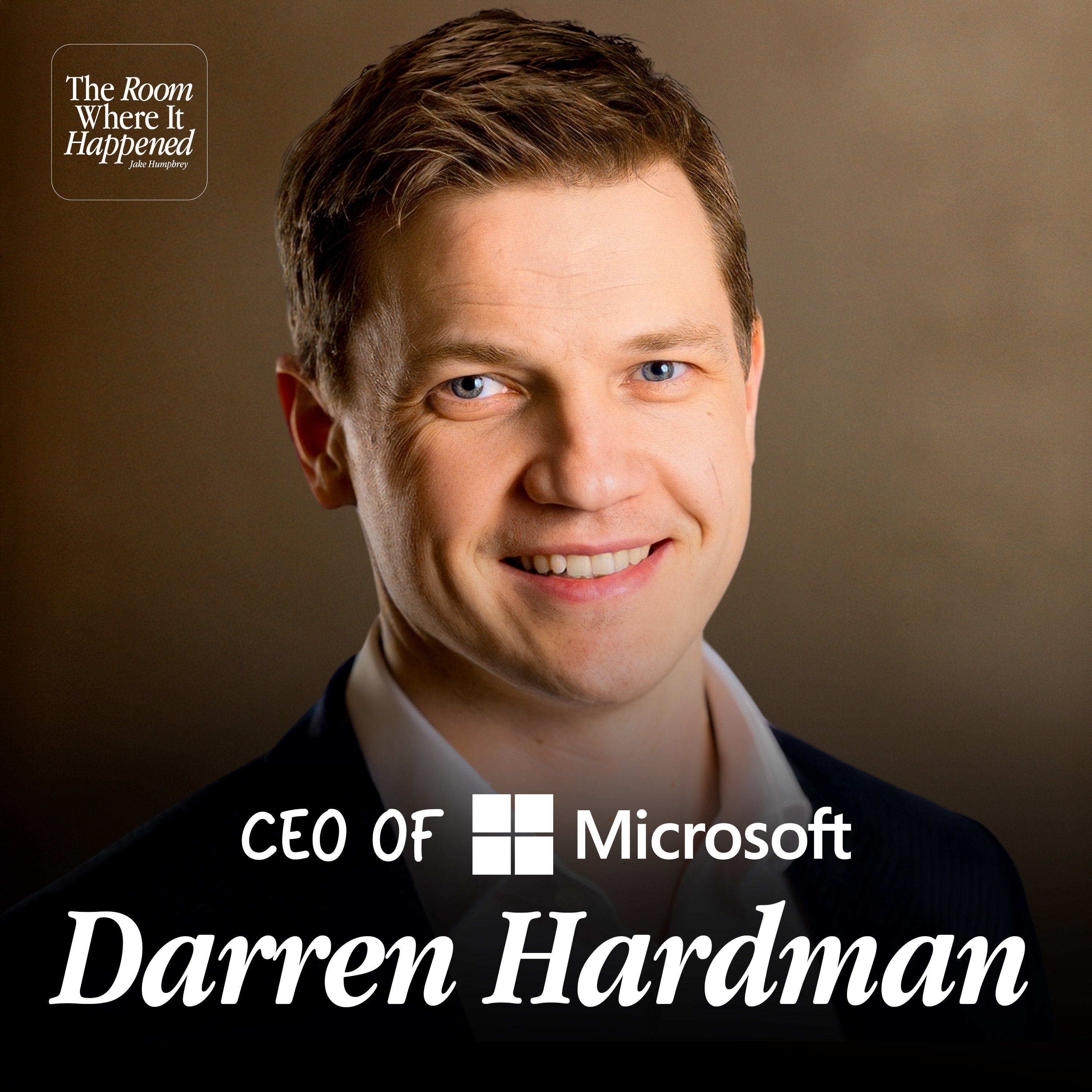
Darren Hardman, CEO of Microsoft UK
Insights into Darren's career journey, leadership principles, the role of AI in the UK, and the future of technology in business.
Written by AI. May contain mistakes.

Get the gist, explore an idea or ask about something said.
 Claude
On High Performance Business, what are the key points of this episode?
Searching your listeningAutomatic transcript. May contain errors.
0:00The reality for me is it's not the AI that's going to take your job. It's the person with the AI skills that can utilize AI to remove the mundane, to remove the administration so that they can focus on the real creative aspects of their job. It's that person that's going to take your job. Today, Darren Hardman, CEO of Microsoft UK, joins us with a very powerful message. He believes the UK can be the AI superpower of the future. He also shares how he was inspired by his dad's work ethic and how those lessons from his dad have remained with him, all the way from his terrace house bedroom in Manchester growing up to the boardrooms of the world's biggest businesses.
0:38So let's dive into how Darren is driving forwards the UK's digital revolution. Supported by IFS, this is The Room Where It Happened with Darren Hardman. So the room is my childhood bedroom, And if you can visualize this bedroom, it's a room which was in a small house in Greater Manchester. It was a room that you could touch all four walls when you were standing in the middle. Bunk bed, shared it with my brother. You didn't have remote controls on your TVs those days. We didn't need it because you could literally reach it from lying down. And that room was important because it was the place where I kind of first experienced what a computer would be.
1:26My brother outsourced his paper round to me. I wasn't old enough to actually work, so he outsourced it to me so I could earn enough money to buy my first PC, a Commodore 64. And it was there, if you remember those machines, that it would take you three days to program the machine to just flash up your name. But the thrill. The thrill of that flash of the name was incredible. And so I got really interested in that. But equally, when I think about that room, you know, you open the curtains, you look outside. This was the legacy of the Industrial Revolution. I'm talking red brick factories, red brick buildings that were the kind of history that fueled this country and the prosperity that came with the Industrial Revolution.
2:17And so that plays on my mind a lot now as we're in this AI revolution. And so how do we make sure that we build the same factories, so the data centers, how do we build the same technology, the spinning wheels that were inside those red-bick factories, and how do we skill and educate the workforce so that we in this country can really take advantage of this AI revolution that's in front of us. So a lasting memory for me, given my dad was an engineer for 35 years, worked really, really hard, never ever saw him of a morning, because at 5 a.m. every morning, I would see his feet flash under the door and the light flicker as he went off to work.
3:01And so that taught me a lot about what hard work means. It taught me a lot about the opportunity around technology, And it also kind of set the scene for me in terms of my passion now, which is social mobility and how education and skilling is going to really support this AI journey that we're on across the United Kingdom. I think it's such a nice place to start. And I also wonder, as well as your dad instilling a work ethic in you through showing you his work ethic, I wonder what it did for you that your brother outsourced his paper around to you. I think there's a few great metaphors for life in your brother doing that and you kind of getting out there and working long before you were meant to.
3:41I think we were quite entrepreneurial. Like, I was the first person to go to university in my family, and that wasn't the path that you typically go on, certainly from my school and from my kind of friends and family. And so it wasn't just a hard work. I think it was from my mother and my father, and you see it in my brother and my sister, that they kind of gave us the foundation that anything was possible and to go and be curious and explore and not go down that path necessarily. My dad went down, which was 14 years old, into an engineering company and staying there for 35 years, but to go and explore the world.
4:17And so, you know, that's been a really big part of who I am. I think it's also really inspiring, actually, that you've gone from that small bedroom, seeing those work ethics, being a bit creative, shall we say, to make sure you could earn some money at a young age and get a bit of cash. But that's taken you all the way to the top of a huge business like Microsoft in the UK as the CEO. But I think when you're young, you're looking at that through rose-tinted spectacles. It just looks exciting. I wonder what the cost is, if you like, of ending up in the position that you've ended up in. Because I don't think that the work that you do or the journey you've been on necessarily comes for free, right?
4:58I actually remember a brilliant colleague of mine, sadly no longer with us, a guy called Colin Fulton. I was sat in the office, I had this team around me. I was relatively junior, maybe 10 years into my career. And he'd been out for a business dinner, and I think it was like midnight, he'd come back into the office. And I sat there, and I had all my team there, and we were just putting the hours in, a little bit like the philosophy of hours equals output. I remember him coming over to me and saying, you know Darren you can work 50 % more than everybody else but what you'll find is over time you'll lose that 50 % your relationships your family even financial you'll lose that because people will be pushed away and so it really made me think about my own work-life harmony and how I create that but also the impact that I have on others because it was my team sat there behind me kind of feeling that they had to do the same.
5:58And so it was a really important lesson in my early career that actually focus and quality is much more important than quantity in terms of the time employed. So what would a working day or a working week look like for you before you had that conversation with your late colleague? You know, lunch breaks don't exist. Breaks don't exist in that type of industry. And this was a long time ago, and things have changed, I know now. But, you know, I wouldn't, I'd certainly be home straight into bed and straight back up into the next day. When I look back on that, that's just ridiculous. But from where I came from, from my working class roots and into a very serious professional service industry, you know, in London, I just felt I had to do something different.
6:44And it only took me a while to realize actually it was more the force of personality and the more the ability to bring others with me and inspire others that was my superpower, not my ability to work every hour under the sun. You never want to be the cleverest person in the room. I never am, which is good. But you want to inspire others to lean in. And you want to give people a voice. And so this concept of every voice is heard, non-hierarchical. Like, I'm not giving orders. I'm giving people the room to express opinion, taking that opinion. And then as long as we walk out the room together, so if we're a leadership team and we've disagreed, as long as we walk out the room together with one voice, where people have disagreed, but they've committed to that action, then you can make powerful things happen.
7:36If you can just take a couple of seconds to subscribe, then of course you can get each episode directly to your inbox. And honestly, for you to subscribe, it makes such a difference to our show. It means we can grow and it means we can attract more incredible guests like George Heaton, Rory Sutherland or Richard Branson. So you're kind of talking about you personally doing less hours, being less single-minded about work, but also you're talking about, I think, changing the way that you speak to others and work with others. So before you had this conversation with your colleague, did you think it was all about you and the more you worked, the more the output was?
8:12and after that conversation you then realise that actually getting other people to come on the same journey with you is more powerful? Totally. I can only scale so far. There's only 24 hours in the day. And I always believed because of my approach through school and through education and through that early life that my success was a function only of what I did. And I think you just learn over time that this ability to scale through others, to hand responsibility, to pull out the strengths of everyone just makes you stronger. And you can just do much more and you can move much quicker with a team that's all focused in the right direction, motivated with the outcome in mind.
8:59And so I was too fixated on trying to do it alone without the trust of others. And were you hierarchical at that point? I think I was hierarchical because of the nature of the organization that I joined. Well, certainly when I started, it was become partner. To get to partner, you push and you push and you push. And I was actually the youngest partner in that business. So I did actually get there. I was 29 years old when I became a partner in that business. I'm sure there have been younger since. But it kind of worked for a while. But I kind of realized on that journey that actually the collective power of everyone was going to get me there.
9:35And what was the first thing that you did personally after that conversation to change? Well, I certainly took a step back and looked at myself. And there was an element of, you know, you think back to my father, you know, you're paid by the hour. It's almost how many hours do you deliver? How much can you actually be at the, you know, in the factory or, you know, out there delivering whatever it is you do every day? And then you have to step back and say, what's actually creating value? What is the 20 % of the things that you're doing that's creating 90 % of the impact? And how do I take that 20 % and make it 25 % versus just doing all the other things that don't?
10:17And so stepping back and really mapping the things that are going to have the most value with the most simple and least input to drive those outcomes. And so when you do that, you can really focus on the things that matter, the heat map of the things that are going to make you successful, your customers successful, your people successful. And so I really started to employ that philosophy of let's not just do things because we feel like we have to. Let's do the things that are going to really make a difference and give people the time to go and reflect, to recharge and to come back with more energy and vigor to focus on those things.
10:58And in all honesty, was there some fear with the fact that you know that there are rival businesses to the one that you're working in or the one that you're now leading? There are KPIs to hit. There are targets to hit. There are other people's jobs on the line if those numbers aren't met. So there surely is a natural fear with taking your foot off the gas a little bit. Even if you're replacing that go, go, go with collaboration, which is what it sounds like you're doing, there must have been a bit of fear about, well, I don't know if this is right because I see other businesses not doing this.
11:28I think when you're in a business and it's all about how you're building a long-term relationship, and all the companies I've ever represented are all about long-term relationships. They're not transactional businesses. I think you have to show up with a culture and an approach and a diversity as well that represents who those customers are. And so I don't think any customer wants you working every hour under the sun at all costs, because ultimately that breaks at some point. And it actually also creates individuals in the chain that become so important that if they do break, there's problems to pick up.
12:12And so I think I never really sat back and worried about that, because I think the customers that I had, the respect that I'd built, they understood that it was more than just solving this problem. It was solving the problem over a long time, over the long period. And so that matters. And this change allowed you to run a less hierarchical approach to your own work in life. So if I was to ask you to define leadership in a sentence, or good leadership in a sentence, how would you describe that? I think inspiring others to do their very best. I think that's the core of my job. I'm a very subservient leader in the way I operate, and so I don't put myself on a pedestal and ask others to lean in.
13:01I want to be out there on the coalface, removing the obstacles. What are the persistent blockers for people to be successful, for the business to move on? And so I'm very hands-on in that regard. And why I don't like hierarchy is because I think with hierarchy, I don't get the information I need. I don't get the real story. What I get is the story that people want me to hear. And I think hierarchy and the fear of what hierarchy means kind of gets in the way. So I can move really quickly if I'm at the coalface. It takes me too long if I'm trying to unpick the real story. And so that's typically what people will say about how I lead.
13:46And I think this is a refreshing thing to hear the CEO of Microsoft UK talk about, to talk about a non-hierarchical culture, to talk about realizing the importance of family first. There must also be behaviors that just are not acceptable in the culture that you've created. And what do they look like? I think it's the reverse of what we've been talking about. It's when people tell me I'm right or want to kind of reinforce my own views, because I don't learn anything from that. If I relate it to where we are today in this industry, you know, this generative AI, the onset of AI, it requires a whole new way of thinking.
14:29This is not like it's an industry that exists and is defined. We're on a journey, and so we're all learning at the same time. And so this is where I need really reactive feedback. I want customer feedback to be clear, clean, and open. I want everyone in my team to be sharing their perspectives and ideas because every day matters in this particular industry. Well, as the show's called Room Where It Happened, would you take us into a modern room where your mind was changed about AI or you realized the potential that AI has for us all? The first time I realized that AI was going to be important, we'd been through an era of AI.
15:14It was a machine learning era of AI. It was pre-gen AI, pre-large language models, pre-the power of GPUs to process huge volumes of information. my son actually you know he he asked for help with his homework and in me helping him with his homework he helped me with this thing called chat gpt so this is 2023 in the public version and it just been released and it was kind of how aware were you of it i was aware of it because I'm in the industry, but the fact that that launched and the impact it had, I knew what it did and I knew what it was. And I'd seen it in action. And it was just one of those moments when I realized that most technologies, the diffusion of those technologies comes from kind of invented in a room, scaled through large enterprises, because that's where the investment capability existed to actually go and put these technologies to work and then slowly would diffuse down into, I don't know, small, medium businesses and into education.
16:27But with this, the diffusion was immediate and it was coming in the other direction. It was coming from a different generation up. It taught me actually, I was clearly well-versed in AI and the industry and the investments that we and many other companies are making and the potential and the reason why we're making those investments because the opportunities are significant. It was actually just the diffusion point with him in that there is a generation below mine, actually two generations below mine, even now, that are being naturally skilled in these tools from everything they do. And then how do we fill that gap to the existing generation, the workforce of today, that need to be enabled with these skills?
17:15Because it's an interesting kind of talk in society about the risk to jobs in AI. But from what I see, and the customers I work with, and the reality for me is, is it's not the AI that's going to take your job. It's the person with the AI skills that can utilize AI to remove the mundane, to remove the administration so that they can focus on the real creative aspects of their job. It's that person that's going to take your job. So how do we take that diffusion from the younger generation and instill it into our workers of today, into our academics of today, into the teachers of today, so that we can utilize that to create economic growth.
18:00We can create businesses that can go and compete stronger in the international market, and we can create new businesses, frankly, that go and take on the world by creating new value. So what are the things that you would like, people who are still reticent regarding AI or still fearful that, oh, I'm just going to be here and I'm going to be irrelevant because AI is going to take my job? What are the things that you would want them to think about? What can we be doing today to make sure that we are skilled to be the people that lead the AI revolution? So I think, first of all, you have to be open-minded.
18:37I think the people that lean into the AI tools are just learning a new set of skills. to create outcomes. There's a whole topic here about how you begin to work with the agentic world, so agents, virtual agents, in terms of your handing tasks to agents to get things done, to free up your time to do other things. But actually, right now, it's even more basic than that. It's how you have a conversation, how you prompt, how you interact with these tools, so that you can free the time to focus on the things that matter. And if I take it as back, I talked about that red brick factory in the 1800s that was built.
19:17Think about that as the data center. It was filled with spinning jennies and machinery. Think about that as all the GPUs and CPUs and storage and compute of a data center. And what happened then in that industrial revolution was a whole workforce was skilled to go and use that machinery that created huge economic wealth for the country and prosperity. And, you know, we didn't hold on to that because it was exported. But we're there now. How do we create? We've got the infrastructure. We've got the underlying technology. How do we reskill the workforce to take advantage of that so that we can drive that prosperity?
19:58And this is very linked to the government and their AI action plan and the story and the position that they want to drive. But the missing link and the thing that we really need to focus on, because we as a business and many others can create the investment for those infrastructure stacks, the data centers. In fact, just last week, we announced 30 billion of investment in this over the next four years. but the skilling piece, if we don't have the people utilising it and turning it to their advantage and inventing new businesses but also making the businesses we have here in the UK more efficient, more customer loyal, more kind of revenue centric because of the AI at its heart, then we don't get to take advantage.
20:43And so that's my passion right now. How do we make sure that what we saw in the industrial revolution in terms of that move forward and that prosperity that it brought to the UK, how do we make sure that happens here? And that's my fear, right, is that we led the industrial revolution, right? We were a powerhouse. It's sort of tentacles spread around the world, right? I fear that in five or 10 years' time, we talk about, oh, India nailed it with AI. America led the way. A country in South America showed us what was happening. Poland were just quick to cotton on. to make sure the UK, right, leads the world in AI.
21:22Is it up to businesses like Microsoft and leaders like you? Or is it actually up to people like me sitting in the interview chair and Simon sitting over there as the producer of the show? Is it up to us as individuals to be the ones that drive this change? Or is it up to big corporations like yourselves? It's up to us all. Like, listen, large enterprises are on this path. You know, I spend a lot of time with some of the biggest companies in the UK. They're on this path. And I think the support and the environment is there. So the skilling will naturally happen. And of course, it could happen faster.
21:55Some industries are different to others. I think in education, I think we're seeing progress there as well. I think we're shifting from the fear of AI, kind of writing your essay for you, to it being the tool that allows you to do the research at a much deeper level that then allows you to put the creativity on the page. I think the area, and I should say public sector, I think public sector we're seeing a huge shift. I think the opportunity to create efficiency, to get better outcomes using AI is profound. You just take the NHS and we're seeing a doctor who can see three more patients a day because the administration of their day is being done by co-pilot.
22:38These are profound impacts that are having transformational impact on people's lives. So public sector, large enterprise, education, I kind of feel we're on a decent path. The area where I think we need attention is the small, medium businesses, the heartblood of the economy. And so how do we ensure that leaders of those businesses are not being kind of lost in the journey? And so doing a lot with our small, medium business team, a lot of the industry players that support the technology stack for those organizations, because if we can get that piece right, I think we'll see a transformational shift.
23:22Give us an insight then into what you think the future of healthcare looks like. So, look, we are really focused on this as an organization. So our Dragon co-pilot, which is a tool which is the application of AI assistance in the health care sector, is phenomenal. And we see a future where you go into that doctor's surgery and the only focus the clinician has is on you because it's automatically listening, transcribing, automatically updating the record, automatically getting to the prescription, using the AI to help actually diagnose so you don't have to return two, three times. This is powerful human impact, but it's also a real efficiency gain for healthcare institutions across the world.
24:08So can I ask you then what are the questions that small, medium businesses should be asking ourselves? And I ask this in a very selfish way because this podcast from where it happened is produced by High Performance, which was the first podcast that we created. We now make five or six other podcasts, all with the same desire to improve and enhance people's lives. We've created a foundation for high performance, which I think you'll like, which is taking those messages from those incredible people on the show and getting them into the school setting through a show called Game Plan. So we're working directly with teachers and tens of thousands of kids across the UK.
24:41And there's about 20 people in the office making all of this happen, producing hundreds of hours of content across multiple different platforms in various different areas, and the content we produce is being absorbed and engaged with right across the planet. So what are the questions that you would ask or want someone like me as the founder of this business to be asking the team? So I'd like you to ask yourself, of that 20 people, do you want to increase your output? Do you want to move faster? Do you want to focus on the top line versus just focusing on the bottom line? Do you want to create a scenario where you can have an even bigger impact than the impact you're talking about?
25:21Because the people in your team, the 20 individuals, they're focused on the things that really matter, the distinction, the differentiation, the creative aspects of everything you do, and not the administration. I'll give you an example. We at Microsoft have released as much code, much new products, I should say, in the last year than we did in the previous three years. And the reason we've done that and how we've done that is we've taken away all the administration and the mundane part of software development, and we've put that into a solution called GitHub Copilot, which is effectively the virtual assistant that does the administration of coding.
26:06And is that an AI agent? It's an AI agent that sits next to the developer. GitHub is a development platform. People across the globe are using GitHub to develop their solutions. And so when you add the co-pilot component in and you've got this assistant that's doing that, it means that the developer is actually focused on the customer impact, the product, the creative aspects that move things forward and not doing the notes management, the logging, the kind of central repository work. And it's had a transformational effect on our ability to get much more product and, you know, much wanted services out to our customers at speed.
26:47And so you take that analogy and you apply it to your own business. You know, there is not an analog process in your business. This isn't a piece of paper, even a digital process that has many touch points. you really need to be thinking about how you create an agentic world where you have humans that are directing the agents the virtual agents to remove the mundane and the administrative and to do that almost as an outsource to the agent so that your 20 people can focus on the thing that you want them to do which is make that impact in that school make that impact on this video and actually move the whole agenda forward and i think one of the reasons why we're reticent with this stuff.
27:30It's because, you know, you and I grew up at pretty much the same time. We saw our parents working hard and grafting. Most of their self-worth came from the fact that, you know, your dad would probably on his deathbed, if someone says to him, what are you most proud of? He'd say five o 'clock in the morning every day to feed my kids. That's how we... The brown paper, the brown envelope on a Thursday. Exactly. I remember it. That's how we judged our impact in the world. And I think we need to retrain our brains to realize that actually if we are in the office two or three days a week if we do have more time to go to every school event or every school play with our kids if we do have the time to travel the world with our partners and our friends because we've got ai agents doing the things that were taking 30 or 40 hours of our week up and at the same time we can lean into the creative side of our business or the human side should we call it then i think that sounds amazing but i think people are also scared of that because i think that we've lost that traveling for three or four days with your other half, rather than being in the office, doesn't feel like you're being productive.
28:31So I think it's changing the way that we see what being a human is all about and become human beings again, rather than human doings. If you think about customer service, I'm not sure, I don't think you have a customer service function, but I'm sure many people do, but just think about the concept of customer service. It's effectively answering a very similar question every day to a customer who has to wait for a response. And the ability to answer that question once with a human who's qualified and deep, and to have an assistant side by side, a virtual assistant side by side to capture that, who can then go and answer the same question when it comes in from that customer, do it faster and more accurately, and actually automate the follow-up and make sure that actions are actually being taken.
29:20The impact on customer service is profound. And that's a massive, massive line item in the P &Ls of many, many organizations. And it's a massive, massive issue for customer loyalty to those customers as well. And so this is the perfect application of a Gentic AI so that people can be doing the things that they really want to do. And actually, we've implemented this across our business. And so we've seen massive increases in NPS. We've seen employee satisfaction go up significantly. And it's actually costing us less and allowing us to reinvest that in the things that matter, which is, you know, the right products at the right time delivering on the right outcomes.
29:59And I'm with you on the AI train. I'm very excited about it. I think it will revolutionize life as well as work. What's the role of government, though, to make sure that AI is controlled, it is good for the environment, it's good for people, it's good for the workforce, it doesn't allow three or four people on the planet to get very rich and everyone else to kind of end up as slaves to these new ways of working? I think there's a big role. And I've been pretty active in the government's AI action plan and its focus on building a future AI economy. And, you know, responsible AI is at the heart of that.
30:33So how we build these tools is really important. What is responsible AI? It's making sure that, well, it's a lot of things, but in the most simplistic sense, it's making sure that as developers build AI, they're building in a way that is human managed, human governed, and has ultimate human control. And so that's a really important factor in things. But also making sure that the industry is investing in the right technologies to make sure that the sustainability aims that underpin AI are real and deliverable. And so making sure that we're building efficiency into the underlying technology, the GPUs, the chips, the way that the code is built around these things are incredibly important.
31:13And I think the other big piece about responsible AI is, again, making sure that people are not left behind, like the digitally disconnected, making sure that the whole social spectrum, certainly in the UK, gets to take advantage of this new AI economy. And so that's a big focus for me. I want the kid in the room that can touch all four walls in Manchester that I was a long time ago to see this opportunity for AI and to not think that's not something for me. I want them to lean in, think about the education and the skilling that's going to allow them to take part in the AI economy as we move forward.
31:57So I've seen quotes and statements about the UK becoming a superpower in the world of AI. Now, I kind of think that maybe every country in the world is saying we're going to become an AI superpower because it's the right thing to say and it puts out the right message. Is the UK actually equipped to become an AI superpower? I think we have huge potential. I think the fact that we have some of the best universities in the world, the best minds, the best education system, which is a real important ingredient because companies like Microsoft, we can build the data centers, we can fill them with the right technology.
32:35What we need to be a superpower is not just hosting physically that infrastructure, but creating the next wave of businesses that go and create value across the world, that create economic value back into the UK. And so I think we really do have that potential if we can harness it right. And again, it's going to come back to how quickly, how effectively can we put the skills into the hands of people so that they can not just build those new businesses, but take our existing businesses to the next level through the advantage of the application of AI and agentic AI. And so I think we can become a superpower.
33:13What will stop it from happening? I think if we become complacent in the skilling agenda, I think if we are graduating people from school and university that don't have the skills to actually see the world of AI and understand its application. I think if we are too slow in the rollout across UK government, and so UK government has the opportunity to inspire citizens through the services they provide. And I think we're on a good path in that direction. And so I don't think it's just about the private sector. I think it's about the educational institutions. And I think it's about the government sector inspiring the nation to move forward.
33:58And so, again, it's not just about the physical. It's about the mentality, the desire to be curious, and the application of that in the things that all of us do, in the business that you run, and in the businesses that people who are watching this run today. So it's one of the things we need to be asking. We know that people are going to be central to what happens here, and we have to be driving the AI agenda. But I think it's hard to drive the AI agenda if we're not educated in what AI can do. I see a potential kind of bottleneck here. I think that actually it's interesting because it kind of brings me to maybe another room, which I think is the title, which is the boardroom, because I spend a ton of time in the boardrooms of my customers.
34:45And the reason I do that is because the top-down nature of diffusion for AI is incredibly important. You have to lead by example. You have to change your own day-to-day interaction with these tools. And it starts with the boardroom. Permission, but also leadership by example. And so where we see the best application and the biggest gains and impacts is where it's top-down, board, ex-co, through the leadership teams of organizations who are proactively transforming the way they do things, the way they interact, the way they engage with their AI assistants to drive the diffusion down. And I think that's really, really critical.
35:27I've got some quickfire questions for you to finish with if you're up for them. What's the best piece of advice you've ever received in your career? The best piece of advice I've ever received was don't worry too much about the direction you're going. Don't try and look for the next job. Just at every single stage, ask for the hardest thing. ask for the hardest thing because it puts you in the conversation it's important to your boss it's important to the organization and so having the hardest thing is probably the biggest learning for me and actually it's what i've applied at every step of the way in my career what are the three ingredients that you think the best leaders have the the ability to inspire the ability to listen and react the confidence to take risks what's the biggest lesson that sport has taught you that you've been able to transfer to business?
36:19The PFA in particular, it's taught me that skills beyond a single act are important. The PFA, the volume of people that actually get to become a professional footballer, or even once they've played one, two, three professional games, it can be an abrupt end. And so re-skilling and the work the PFA are doing to re-skill players so they can move into new careers. And so like everything in this discussion, people believing in skilling and that education to open their mind, to give them the curiosity to move on, is at the core of what I believe in. And the final question, the one thing that you would like people to adopt tomorrow, the habit you would like them to take from this conversation into not just their business life, but their home life as well?
37:17I would encourage people to download an AI tool. Copilot is a good one. Others are available. And just start interacting, not with search, but in a conversation. Start to learn how you engage in the AI world. It's a different process. It's a different conversation. And those skills will sustain you for the future and allow you actually to kick on and to do different things. Brilliant. Darren, thank you so much. Thank you. You can work 50 % more, but you will lose 50 % of everything that matters to you. That was the line from the conversation that stuck with me. And I thought that it was probably a hard thing for Darren to understand because he came from a family where work ethic was important.
38:07You know, he spoke about his dad leaving the house at 5 a.m. every day. And I know that a lot of entrepreneurs and hustlers and self-starters and creators listen to the content that we make. And I really want you to hear what he said. You can't give it everything all the time because what you lose in return for giving so much is a price that is too high to pay. And I think really what he's spoken about with us is we're not asking people not to work so hard. We're asking them to work smarter. So it's actually operating in a different way. and that links so nicely to the conversation around AI. And again, I want you to hear what Darren said.
38:41Your job will not be taken by AI if you learn how to use AI. The people who will struggle are those that just refuse to move with the times. The people that will thrive actually are the ones that go, well, I can bring value because I understand how my industry, how my job can be helped and how it can grow through the use of AI. So I think that's a really important message. And I think finally, I was excited to hear him talk about the NHS Jess, you know, what matters more than being healthy? And the NHS in the UK using AI to treat more people more effectively, more accurately, is surely like the ultimate case study.
39:17And I think of all the things Darren's done, the legacy that he can carry is that he is there at the coalface, as he put it, doing the work at a time when AI can absolutely transform the world for the better. Hope you enjoyed the conversation. you
How does someone go from tinkering with computers in a small Manchester bedroom to leading Microsoft UK’s AI revolution? For Darren Hardman, it began with curiosity, hard work, and a lesson that changed his outlook forever: success isn’t about working more hours, it’s about working with purpose.
In this episode, Darren shares the defining moments that shaped his leadership journey, from early sacrifices and personal turning points to the bold initiatives driving Microsoft’s role in making the UK an AI superpower. He offers a candid look behind the scenes at what it takes to lead through rapid technological change, empower teams, and build a culture of learning and innovation.
It’s a story about balance, belief, and how embracing change can transform both a career and an entire industry.
---
PARTNERS
IFS - award-winning Asset & Service Management software 👉 Reimagine your operations at: https://highpfrmc.com/RWIH-IFS-yt
Heights 👉 Join Jake in maintaining your energy, with Vitals. Get 20% off with code Room20: https://highpfrmc.com/room-yt-vitals
---
JOIN OUR COMMUNITY
👔 LinkedIn 👉 https://www.linkedin.com/showcase/the-room-where-it-happened/?viewAsMember=true
📸 Instagram 👉 https://www.instagram.com/room.where.it.happened/
🗞️ Newsletter 👉 https://www.linkedin.com/newsletters/the-room-where-it-happened-7315326937923485696
Hosted on Acast. See acast.com/privacy for more information.


