
In short
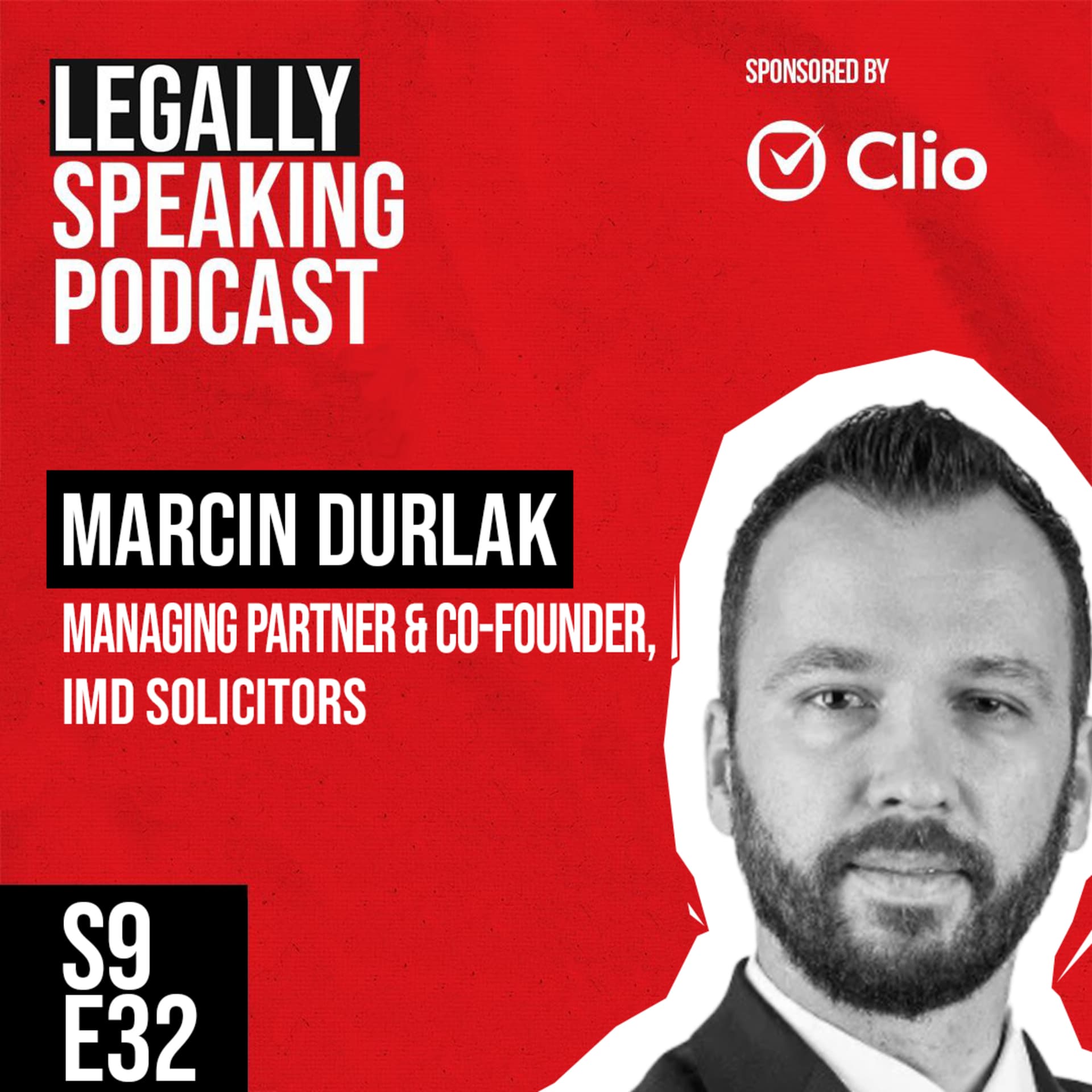
Marcin Durlak (IMD Solicitors) discusses building an award-winning boutique law firm and legal translation business, emphasizing culture-first leadership, adaptability, tech/AI leverage, and implementing a four-day work week with full pay.
Guest background
Marcin is a Poland-born UK-based managing partner and co-founder of IMD Solicitors (nearly 21 years in the UK). He arrived in 2004, failed the Polish bar entry exam, worked as a legal administrator in Manchester, and grew the firm from early language-led work into a ~50-person boutique recognized by awards (e.g., Modern Law Awards, Sunday Times Best Places to Work, Legal 500). He and his wife/business partner were Managing Partners of the Year (2025).
Key claims
“Output, not input” drives success; four-day week improved profitability and satisfaction; AI won’t replace lawyers, but lawyers using AI will replace those who don’t; culture and selective hiring are critical.
Notable examples
IMD evolved from Polish-language services to a team speaking ~18 languages and cross-border expertise; launched legal translation.ai (SRA-compliant secure machine translation); uses a “STREAM” framework (standardization, tech/AI, rest, eliminate inefficiencies, automations, meeting efficiency); digital note-taking for Teams meetings; implemented four-day week first as a family-department pilot, then firm-wide (29% profitability growth by end of 2024).
Written by AI. May contain mistakes. Listen to the episode to check what was said.
Chapters
Tap a time to open that second in VOIntroduction to the Four-Day Work Week
0:00 to 0:34
Learn about the implementation and success of a four-day work week at IMD Solicitors.
“With us, we'll make a decision today, we'll implement it tomorrow.”
Marcin's Journey to the UK
1:19 to 2:11
Discover Marcin's background and the motivation behind moving to the UK.
“It's an absolute pleasure to have you on the show.”
Facing Rejection and Finding Opportunity
2:11 to 4:02
Marcin shares his experiences with rejection and how he maintained motivation.
“So I'm originally from Poland, have been living in the UK for almost 21 years.”
Utilizing Language Skills in Law
4:02 to 5:48
Learn how Marcin used his language skills to build a legal career and serve the community.
“I want to cast your mind back to 20 years ago when you arrived to the UK after completing that Masters in Law in Poland.”
Adaptability in Legal Practice
5:48 to 7:22
Marcin emphasizes the importance of adaptability in the legal industry and personal journey.
“I took my bar entry exam, I failed, and had to redefine my path and my journey.”
Innovating Through Technology
7:22 to 11:03
Explore how Marcin leveraged technology, SEO, and digital marketing in his practice.
“And you've been able to redirect and do some incredible things which we're going to talk more about as we go through your journey.”
The Evolution of IMD Translation
11:03 to 13:49
Understand the inception and growth of IMD Translation and its market positioning.
“But back 20 years ago, my natural approach was how I can improve and how I can deal with digital marketing.”
Leveraging Technology in Law
14:00 to 14:47
Learn how technology, particularly AI, can empower legal professionals.
“really, of the Google Translate or ChatGPT machine translation.”
Founding IMD Solicitors
14:47 to 18:16
Discover the motivation and vision behind founding a law firm.
“We just need to adapt, I suppose, and embrace the technology, what is available.”
Specializations and Growth Strategy
18:16 to 21:26
Explore the core areas of specialization and growth philosophy of IMD Solicitors.
“You were alluding to there, but just sort of so our listeners are more aware, what are some of the core areas you do specialize in as a firm?”
Show all 21 chapters
Implementing a Four-Day Work Week
22:20 to 28:00
Discover the reasons and outcomes of adopting a four-day work week.
“And that leads to what I was going to ask you next actually, but what were some of the challenges you faced with your journey of building the firm and how have you been able to overcome them?”
The Four-Day Work Week Implementation
28:00 to 29:57
Learn how a legal team successfully adopted a four-day work week and its impacts.
“we'll work Monday to Thursday, but we expected to do 10 hours a week, et cetera.”
Enhancing Work-Life Balance and Wellbeing
29:57 to 31:10
Discover the positive effects of a reduced work week on employee wellbeing.
“I'm sure it's not, it helps in terms of better work-life balance, avoiding burnout, but it's like not a solution for everything.”
Innovative Tools and the Stream Framework
31:10 to 34:51
Explore the stream framework and tools used to enhance productivity in a legal firm.
“And I think part of our culture is there's always room for improvement.”
Measuring Success and Cultural Considerations
34:51 to 38:45
Understand the metrics of success and the importance of company culture in implementing changes.
“or maybe the same objective can be achieved by sending a simple email, etc.”
IMD Corporate: Legal Solutions for Businesses
38:45 to 40:41
Learn about the services offered by IMD Corporate and its growth trajectory.
“Around five years ago we thought that we'd love to create a dedicated brand for businesses.”
Hiring for Cultural Fit in Legal Recruitment
40:41 to 42:02
Discover the importance of cultural fit over skills in legal recruitment processes.
“how you hire for cultural fit over sort of stereotypical cv tick-boxing styles and what are some of the factors you take into consideration when making a culturally fit hire for the firm?”
Core Values and Team Player Model
42:02 to 42:45
Learn about the core values that shape a successful legal team and the ideal team player model.
“respect, honesty, commitment to excellence, but caring.”
Future Plans for Growth and Innovation
42:46 to 44:46
Explore the future growth plans of a law firm focusing on innovation and employee well-being.
“And, you know, there is some truth behind that for sure.”
Advice for Aspiring Entrepreneurs
44:47 to 46:05
Get top advice on building a successful practice and embracing risk in business.
“But be open-minded, accept the fact that you're not always going to get it right, accept the fact that, and it's part of our culture, there's always room for improvement.”
Connecting with the Legal Community
46:06 to 46:46
Find out how to connect with Marcin Durlak and learn more about his firm.
“And I think that leads to what you said.”
Transcript
Automatic transcript. May contain errors.0:00Marcin Durlak:With us, we'll make a decision today, we'll implement it tomorrow. IMD translation evolved into a firm providing specialist legal translation interpreting to law firms. There was definitely a gap in the market for us and for many, many years this operated by providing services to IMD solicitors as a law firm. It's about how you can leverage it, how you can make the most of it, how you can adapt. Everyone's been working on a four-day week and we're not even looking back. We've achieved 29 % growth in profitability with everyone being on a four-day week. So it's working for us.
0:34Gregory E. B. Smith:On today's Legally Speaking podcast, I'm delighted to be joined by Marcin Derle. Marcin is the managing partner and co-founder of IMD Solicitors, an award-winning boutique firm recognized for its culture-first leadership and bold innovations. He and his wife and business partner were jointly named Managing Partners of the Year at the 2025 Modern Law Awards after pioneering a four-day working week with 100 % pay whilst achieving record growth and world-class satisfaction. Passionate about culture-first leadership, Marcin is redefining what success looks like in the legal industry. From arriving in the UK with one suitcase to running an award-winning firm, his story is proof that bold ideas can transform both business and lives.
1:18Gregory E. B. Smith:So a very big warm welcome to the show, Marcin.
1:21Marcin Durlak:Hi, Rob. Thank you so much for inviting me. Pleasure to be here.
1:24Gregory E. B. Smith:It's an absolute pleasure to have you on the show. Before we get into today's discussion, of which I'm thoroughly looking forward to, we do have a customary icebreaker question here on the Legally Speaking podcast, which is, on the scale of 1 to 10, with 10 being very real, what would you rate the hit TV series Suits in terms of its reality of the law if you've seen it?
1:44Marcin Durlak:So I must admit, I've not seen it. I, to be perfectly honest, I don't watch much television on Netflix. I just try to allocate my time to family, work and sport and there's not much left, I'm afraid.
2:00Gregory E. B. Smith:No, and we can give it a zero and move swiftly on. And yeah, you've been doing some incredible things on all of those footings. But I want to start at the beginning, if I may. Could you tell our listeners a bit about your background and career journey?
2:10Marcin Durlak:Yeah, sure. So I'm originally from Poland, have been living in the UK for almost 21 years. I decided to move to the UK back in 2004 when my native Poland joined European Union. It meant to be a gap year. A year and a half later, I went back to Poland to take my bar entry exam. Failed. Came back to the UK. Kind of did some planning and started applying to every single law firm around. and eventually got the job as a legal administrator in a boutique law firm in Manchester. And I think I've always had this idea to combine my language skills and legal education. So back in 2007, I went to the managing director of the firm.
3:08Marcin Durlak:I started as legal administrator and suggested, actually, I think I can develop some business. and I'll be forever grateful to him for giving me the independence and support. And yeah, I think since 2007, you know, it has grown from a one-month bond with me doing everything, obviously working on the client cases under supervision, through doing all my DIY marketing, SEO, Google Ads to award-winning boutique law firm with a team approaching 50 with some awards and accreditations like the Sunday Times, Best Places to Work, climbing up the ladder in Legal 500. So it's been quite a journey. It's quite a journey.
3:57Gregory E. B. Smith:And an inspiring one. And that's why I wanted to have you on the show to sort of have that discussion and congratulations on what you've achieved thus far and indeed what you're going to achieve. I want to cast your mind back to 20 years ago when you arrived to the UK after completing that Masters in Law in Poland. What were the factors convincing you UK was where you wanted to build your career?
4:19Marcin Durlak:To be honest with you, it was a little bit random in a sense it was fitting my language skills. The other language, Polish is my native language, I've been living in I've been in Manchester for almost 20 years, still working on my Mancunian accent. But yeah, the English is my second language effectively. So the choice really was between America, England or the United Kingdom, and having been to America a couple of times on our work and travel program during university years. I thought, well, never been to the UK. So with my then girlfriend, we decided, well, let's go to the UK for a year. And so, yeah, that was the reason, really, fitting my language skills.
5:05Gregory E. B. Smith:Yeah. And playing to your strengths and building to your profile, it all makes sense. And, you know, I guess one thing you spoke very openly about before, which we really appreciate on the show is authenticity about failure and rejection. And so you faced countless rejections from law firms in sort of part of your process before moving to Manchester. So what was your mindset during that period? Potentially people who might be facing failure or rejection at the moment. And how did you stay motivated?
5:30Marcin Durlak:Yeah, I think we just need to realize that the failure is just part of the journey, any journey. And I very much encourage our team to try and fail and try again and fail again. And, you know, just pick yourself up and move forward. Right. And just going back to my journey, naturally, my original plan was to qualify as a solicitor in Poland. I took my bar entry exam, I failed, and had to redefine my path and my journey. Then we originally moved, actually spent the first couple years in North Wales. So having failed a bar entry exam in Poland, I started applying to every single law firm in North Wales.
6:13Marcin Durlak:Because in hindsight, I'm probably happy that eventually I wasn't accepted anywhere. But my mindset was, okay, well, what can I do about it? And the decision was, we need to relocate to the bigger city being Manchester. Actually, the choice was between Liverpool and Manchester. And with me being Manchester United fan, the choice was obvious. Okay, we're going to relocate to Manchester. And as we speak, actually, we have office next to Old Trapport. I'm just watching Old Trapporne Stadium from the window now. So there's a little bit of Manchester United in my story as a motivation. But yeah.
6:50Gregory E. B. Smith:This is going to have to be a first on the Legally Speaking podcast because a lot of our fans will know I'm a very passionate Liverpool fan. We're going to have to terminate this interview on the grounds of you being a man. I'm so sorry.
7:00Marcin Durlak:Well, it's 2020 now. But Liverpool is more likely at the moment to get the 21st title, I think.
7:07Gregory E. B. Smith:Well, let's see. Let's see. But yeah, all jokes aside, thank you for sharing that. I always use the acronym lose when it comes to rejection, which is you don't actually lose. It's just life offering some experience. I think if you can have that mentality and keep going through all the adversities, it's just part of your journey. And rejection is typically redirection. And you've been able to redirect and do some incredible things which we're going to talk more about as we go through your journey. So let's go to the utilization of language skills. You kind of focused on that because I believe that Henry Solicitors, you pitched the idea of actually using your language skills to serve the Polish community.
7:39Gregory E. B. Smith:So what impact has this had on your career?
7:41Marcin Durlak:Yeah, I mean, that's where we started. That was actually an original idea to be able to speak the client language and be able to provide the service in the client language. It expanded from just me being able to speak Polish and communicate with the client and provide them with advice and original and obviously supervision of other lawyers. it has grown into the team speaking around 18 languages across different specialism. So it played a key role in kind of building the foundation of the business as it is. But I think in terms of the vision, and it's another thing I believe in, you just need to adapt as you go along.
8:24Marcin Durlak:You need to redefine your maybe the vision or the priorities or the branding. I think in our case originally it was about the language that we were able to speak. But then we quickly realized it's not really only about the language, it's about the cultural understanding, it's about the sensitivity, it's about understanding client that might be coming from abroad and having different issues, whether it's a business client coming into the UK and expanding into the UK or individuals settling here. So I think it's more about this cultural understanding. And in terms of where we evolved, the journey was from speaking the language, me speaking the language, then a team speaking other languages, to developing expertise in cross-border work in English jurisdiction.
9:12Marcin Durlak:And it's interesting how you pivot and evolve. And I think you just need to stay open-minded to be able to redefine the path as you go along. So failures and rejection and dealing with it and drawing the line and moving on is one thing, but then adapting and redefining your path is another important aspect, especially in the age of AI.
9:35Gregory E. B. Smith:Absolutely. And it's a really important word, isn't it? Adaptability. Because if nothing changes, nothing changes. You're going to continue making the same mistakes and you need to be adaptable, as you say, particularly in the age of AI. And I think also taking an element of accountability. I remember a mentor said very early on to me, Rob, if it's meant to be, it's up to me. You need to take self-accountability. You can't keep pointing the finger and expecting, you know, everything to go your way. You need to look at yourself and think things you could be doing differently or be learning from to move forward.
10:02Gregory E. B. Smith:And you've touched on, you know, earlier a few of your other skill sets, because as a sort of law firm founder, you mentioned SEO. And again, kind of sticking with adaptability as a theme. In 2007, you invested in building a website, learning SEO and running Google ads. So how is that different from the norm for the legal sector at the time? You know what?
10:20Marcin Durlak:I think just looking back, I think now I'm more self-aware than I was 20 years ago. But looking at my personality, I've always been, I suppose, my natural personality. I'm more of an introvert than extrovert. So for me, my natural approach was sitting in front of my computer, sitting in front of my laptop, So diving in into the SEO and doing my DIY sort of website optimization rather than going out and network. I do go out, attend events, conferences, and I've learned to do that. And again, I've been pushing myself outside of my comfort zone and I'm happy with it. But back 20 years ago, my natural approach was how I can improve and how I can deal with digital marketing.
11:11Marcin Durlak:It's not typical, I suppose, for lawyers, but yeah, I've always been passionate about the technology and IT. And yeah, back in 2007, I still remember kind of paying equivalent of a couple hundred pounds for a domain, which is sort of Polish equivalent of solicitor.co.uk, paying another couple hundred pounds for the website design and development, you know, back in Poland, doing my own DIY and starting Google ads. It was back 2007 and it worked, right? You know, the inquiry started coming in, business started coming in. And, you know, as soon after it kept me busy. So we started, you know, recruiting another person to help me out.
11:59Marcin Durlak:And the team started growing. And that's how we met with my wife and business partner in Vona. we met essentially you know at work working together and growing this project and i always
12:13Gregory E. B. Smith:say you're only one relationship away from changing your life i'm going to come on to talk you about that story in a in a moment as well and you make a good point about the comfort zone because the comfort zone is great but nothing ever grows there right so if you can find a way to get out of that and kind of go to these things that maybe make you uncomfortable but you pick up new things you pick up new skills networks opportunities whatever it may be so let's go to 2012 now because they then created IMD translation so what gap in the market were you looking to fill with that?
12:42Marcin Durlak:Yeah so when we started 2007 we started growing this market kind of mostly catering for Polish individuals, businesses to start with and many of the cases we dealt with on the legal side there was a need for translation and interpreting. So then we thought, okay, there's an opportunity there. So why not, you know, building a book of our own suppliers, translators, interpreters, and essentially providing the service instead of outsourcing, providing the service ourselves. So there was definitely a gap in the market for us. And for many, many years, this operated as essentially a satellite company providing services to IMD solicitors as a law firm.
13:29Marcin Durlak:But three, four years ago now, we just thought, yeah, I mean, there are just so many other firms offering this one, but quality is not always there. And we really understand the legal market where. So yeah, IMD translation evolved into a firm providing specialist legal translation interpreting to law firms. And quite recently, I have to mention this one. we launched a new product, legal translation.ai, which is a secure, free, confidential equivalent, really, of the Google Translate or ChatGPT machine translation. But it's essential SRA compliance in the sense of providing security. So kind of quite entrepreneurial we are, I think, I suppose, in kind of looking for gaps in the market.
14:18Marcin Durlak:And I very much believe, like we're not gonna mention AI and technology again, it's about how you can leverage it, how you can make the most of it, how you can adapt. And you know what? I mean, I love, just going back to legal, we're actually going to be new customers of Clio, sponsors of this podcast, literally signed the contract very recently and have recently had a kickoff call. And one of the persons mentioned that I think it's a Clio CEO that mentioned his words, I'm going to quote, which I absolutely love, is that AI will not replace lawyers, but lawyers using AI will replace lawyers that are not using AI, which I think is what it is.
15:07Marcin Durlak:We just need to adapt, I suppose, and embrace the technology, what is available. So we have a tough topic, sorry. No, very much on topic.
15:15Gregory E. B. Smith:And we've had Jack Newton feature on the show many a times, And, you know, we're big fans, obviously, of Clio. They've supported us. And, yeah, I think, you know, you've got to be tech curious. You've got to be open-minded. You've got to be looking for opportunities as a business owner because that's what you are in addition to, obviously, the servicing of, you know, the day-to-day role. And I love how you're leaning into where the puck is going when it comes to tech AI and offering new service offerings because there's opportunity, isn't there? It's a tool. These are all tools that are available to you.
15:42Gregory E. B. Smith:The more you can sharpen the axe and get used to them, you can lean into new service offerings, be more client-centered and do some good work. Okay, let's talk about your relationship then, because in 2015, you did found IMD Solicitors with your wife and now business partner. What inspired you to build your own law firm together? And what was the initial vision for the firm? I know you were touching on that, but take us back to that 2015 period.
16:05Marcin Durlak:Yeah, so with Ivana, we met in 2010. So we've been growing this department for a number of years and we qualified at Henry's and then we've been kind of growing the department within the firm to start with. But I think we always wanted this kind of independence and being able to be decision makers and being able to grow the business, apply, implement our vision. So that was the inspiration really we wanted to grow with the business and take it into our direction and build our own legacy. And I touched on the vision earlier, right? And I think that's important part that, yes, of course, your values, your culture, the foundation, the base will remain the same.
16:58Marcin Durlak:But in terms of the vision and direction, I really believe it's something you need to revisit every three, five years, you know, this may change. And in November, it's going to be 10 years since we started trading as IMD. So our original vision was not very different. It pivoted rather than changed completely. But originally, it was about the language being QSP. Now we, you know, we have ambition of vision to become the go to law firm for complex, you know, matters often with cross-jurisdictional element. We have a growing team of, you know, absolutely amazing professionals and partners with both international and local client following.
17:44Marcin Durlak:So it has evolved over the years and we just need to embrace it, you know, embrace the change.
17:52Gregory E. B. Smith:You do, and that's so true, isn't it? Because things do change over time and, you know, that's just the world that we live in. And I think it's great that you have that mindset as a leader. And I think that's one of the, you know, I always say boutique is beautiful because you can move quickly. There's less red teak. There's ways you can react to markets. You don't have so much to kind of deal with where you can hopefully be more client centered as time goes on and technology evolves and market preferences and things happen. You were alluding to there, but just sort of so our listeners are more aware, what are some of the core areas you do specialize in as a firm?
18:23Gregory E. B. Smith:Just so folks who might be thinking about services know.
18:26Marcin Durlak:Yeah, so as IMD solicitors, we deal with both business and individuals. So on the business side, it's mostly commercial litigation, corporate commercial and corporate immigration. On the individual side, family is the largest department. It's my wife's baby. and then we deal with private client probate and high value personal injury so there's quite quite a few areas and our team is approaching 50 at the moment so we still very much boutique in size and and yeah we're essentially building the team and it's always been for us about I think both in terms of the clients, the work we do, and the team, it's about the quality rather than quantity.
19:21Marcin Durlak:And we're very ambitious, we want to grow, but we've always been saying that not at all costs. It's as long as we preserve the direction, the culture, the values. And yeah, a lot of us, the fact that we are boutique, what you mentioned about being more agile and being able to adapt to changes. You know, with us, we'll make a decision today, we implement it tomorrow. I remember speaking to a colleague from Very Large Love, and we're talking about implementing one of the AI tools, I think they were looking at co-pilots. And I was like, yeah, well, it's going through between our compliance team and IT, et cetera, you know, a number of people being involved.
Read the full transcript
20:01Marcin Durlak:And in our case, yeah, we'll make a decision today, implement tomorrow. Yep.
20:05Gregory E. B. Smith:And it is a USP and a competitive advantage. And I think that is the thing where boutique firms can move at speed to implement. I love it. Okay. What's been the biggest lesson you've learned whilst building your firm today?
20:21Marcin Durlak:yeah i think the biggest lesson uh i would probably say is it's normal that not everything will go according to your plan uh and whether you consider it failure or or whether it's you consider it a challenge obstacle it's just uh inevitable and inseparable that in any business or career path, there will be ups and downs. And yeah, so it's, you know, on LinkedIn, I've been posting a lot about success, but I try to keep it balanced. It's not all about success. It's not always upwards trajectory. It's always up and down. So as long as you learn from the downs and learn your lessons, and as long as you think constructively about today tomorrow rather than yesterday what didn't happen yesterday i think you should be able to to maintain the approach trajectory so yeah learning from mistakes and learning from experience it's a big thing yeah it's inevitable that there will be downs
21:26Gregory E. B. Smith:as well as ups today's episode is brought to you by clio duo the first fully integrated legal practice management and accounting solution built for UK law firms. With Clio Duo, you can manage your cases, clients, billing and accounting all in one secure, easy to use platform. No more juggling between different systems or worrying about data syncing. Everything works seamlessly together. Clio Duo was designed to save solicitors time, reduce admin headaches and to give you a complete view of your firm's finances and operations in one place. And as always, you'll have Clio's award-winning support available 24-5 by live chat, phone, and email, so you're never on your own.
22:08Gregory E. B. Smith:Discover why firms across the UK are excited about Clio Duo. Visit clio.com to learn more and see how you can simplify the way you run your practice.
22:18Marcin Durlak:Now back to the show.
22:19Gregory E. B. Smith:Mistakes make you, don't they? Ultimately, you know, the more you can kind of move yourself forward from those, and I think also having mentors and good people around you to potentially pick you up when you go through challenging times, that's important. And that leads to what I was going to ask you next actually, but what were some of the challenges you faced with your journey of building the firm and how have you been able to overcome them?
22:37Marcin Durlak:I think the biggest, I would probably say two, but they probably close linked together. So when we set up IMD in 2015, the first three years or so were upwards trajectory. And by, at the time I didn't realize it's inevitable that there are downs as well as apps. And we kept investing in a team and everything else. And then suddenly we hit massive cashflow problems. And I think it's, you know, of course, you know, we can, you can try to manage, but, you know, financially also for any business, it's not always upwards trajectory. There are some ups and downs and we hit serious down, right? You know, there was some serious cashflow problems and we were lucky that we're able to navigate it, but, but we had to make some serious, you know, changes, make some decisions.
23:28Marcin Durlak:And I need to say at this point that, you know, I never trained as a business owner manager, trained to be a lawyer. I started working with a business coach back in 2018, which was absolutely massive learning curve for me. There's so much stuff we've gone through and the foundations we put in place. It's been absolutely incredible. And yeah, It was actually Sanjeev Dodia from ActionCoach. I have to mention the name because he's such an important person on our journey. And yeah, it was an incredible journey. And we're still building on those foundations and all the challenges were financial. But I think it went back to the team selection, the culture that we had that we're not even aware of.
24:20Marcin Durlak:so yeah in addition to systems processes etc I think the biggest learning from then from the time was yeah how important the culture the values and team selection is and we were guilty so many times of you know maybe allowing people to stay longer than they should have We're always thinking that maybe it's better to have someone than no one. And I think our approach is different now. It's definitely, we're very selective in getting the right people. We don't always get it right. And it's another thing, we have to accept that we don't always get every decision right. And it's okay, as long as you can draw conclusions and move forward.
25:12So big challenges, both financial culture team. We're lucky to navigate it with some considerable effort.
25:25Marcin Durlak:And it's not always been since 2018. It's not always been upwards, but the downs were much lower than the one in 2018. So, yeah, if you run a business, whether it's a law firm or any business, it's inevitable. it's about learning from those experiences and hopefully not making the same mistakes again
25:45Gregory E. B. Smith:yeah and and i love that you touched on coaching it's so important because you you don't know what you don't know and you may have blind spots and actually having someone come in and you know it's so it's so important isn't it and i think i just put it in a simple sports setting you look at any professional tennis player you look at any successful star they've got coaches they've got people around them are bringing out the best of them and i think business coaching is one of of the best investments you can do and it shows to your people and yourself that you you really are passionate you want to be the best you want to be the top of your game and sometimes you don't know what like you say what's going on outside of the four walls and having that strategic thought process and coaching is so important love it okay let's fast forward now to 2023 where you introduced a four-day work week with full pay what prompted you to adopt a four-day work week uh yeah that's We tried January 23, we implemented on the topic of kind of from decision of implementation.
26:39Marcin Durlak:Decision was made mid December, just before Christmas implemented first of January. But the full credit has to go to my wife and business partner, Yvonne. It was her two motivators. The first one was her personal one. she really struggled and you know we need to realize so many lawyers struggling with with the mental health and the challenges that the life not on the work but also life brings trying to combine the work personal life and everything so it brings lots of challenges and she thought yeah i really need to change something but but also thinking about the wider team her team in family department or lawyers in general struggling with mental health and she thought yeah there must be a way to do it differently and she would be kind of talking about the four-day week maybe for some time but never that seriously and then in december 22 we talked about it she made the decision yeah gonna roll it out uh and and in january 23 it started as effectively a pilot in the family department.
27:46Marcin Durlak:It was absolute success. You know, people were obviously a little bit anxious how are we going to fit, you know, all the work in four days because we really wanted to implement the four day in a pure form rather than, okay, we'll work Monday to Thursday, but we expected to do 10 hours a week, et cetera. So we obviously kept the same salary. We kept the same financial expectations and obviously client satisfaction expectations. We just staggered the day off, the fifth day off across the week. But then we just adopted the mindset and always been part of a culture. It's about output, not the input.
28:30Marcin Durlak:It's not about the number of hours you work. But the output and output for us is happy clients and financial results. If this can be achieved in less time, it's a win-win situation. And kind of trying always to kind of promote this within the team and how we can work differently, how we can work smarter to achieve the same. And maybe we can talk about it a little bit more later. But yeah, at nine months on end of financial year, we genuinely managed to achieve 122 % so 22 % increase in fee income productivity with no substantial changes to the team having recorded 80 % of hours on the system so it's not that people record the same amount of hours and but 122 % on 80 % of the time so this came by you know optimizing non-chargeable time but also optimizing you know the work done on the cases where there's agreed fee naturally if it's our rate is slightly more difficult and again so one of the challenges we can talk about but yeah the initial results were absolutely fantastic so then back in 2000 in october 2023 we we decided to roll it out across the firm uh right now since in spring 2024 everyone's been working on a four-day week and we're not even looking back uh we're growing profitably it is growing year-end 24, achieved 29 % growth in profitability with everyone being on a four-day week.
30:04Marcin Durlak:So it's working for us. I'm sure it's not, it helps in terms of better work-life balance, avoiding burnout, but it's like not a solution for everything. You know, we still have a team and we talk about it openly, struggling with some challenges, mental health challenges, and we're looking for the ways to support them, but it definitely helped to get improved work-life balance.
30:29Gregory E. B. Smith:Yeah, which is important, isn't it? I think wellbeing is so, so important. You want people coming that feel refreshed, happy, motivated, full of purpose and can really deliver their best for themselves and also, of course, for your clients. And yeah, sometimes less is more, isn't it? Less days, more output, more productivity, more things that can happen. Okay, in a recent article, Q &A on implementing the four-day week in a law firm, you share, we rely heavily on our stream framework and culture of innovation. We've implemented several time-saving tools. So can you tell us about the tools you're currently utilizing to maintain an open mindset across the firm and encourage everyone to work smarter?
31:09Marcin Durlak:Yeah, so when we, it's been a learning curve from us. And I think part of our culture is there's always room for improvement. We can always do better. So that's part of who we are. But at the back of the four-day week implementation, and with this mindset, it's all about output rather than input, you know, happy clients, financial results. We came up with something I called a stream framework. So S4, standardization. Think what you can standardize. T4, technology AI. Let's think what tools, what AI we can implement to help us deliver the same or more in less time. R for rest and recharge. And, you know, we have people reporting that, yeah, after this extra day off, they come, you know, fully repressed.
31:56Marcin Durlak:They become more productive, which is fantastic. E for eliminating efficiencies. I mean, I guarantee that whether you are working in a law firm or anywhere else, there will be 10 or 20 % of your time or tasks that you're doing that have zero importance or there's no productivity, not bringing any value. So eliminating inefficiencies. A for automations. So what things you can automate in your workflows. And M for meeting efficiency. And I think we quite often see this in large organizations where we have five, six, eight people sitting in a meeting and and not really, there's no need for it. So is the meeting necessary?
32:38Marcin Durlak:Does it have a structured agenda? Instead of one hour, can we do it in half an hour? Instead of half an hour, can we do it in 15 minutes? So the stream framework is something we share, we talk about it and encourage very much everyone to think about it, how they can improve the work of individually within their department. We also brought actually, we respond to your question shortly, but we also implemented innovation bonus, just a small bonus, but just to encourage and incentivize everyone to think about how we can work differently. So it's not only about introducing AI tools and technology, but also maybe thinking about different methods of working, how we can work differently.
33:25Marcin Durlak:And it has been a real success. So, I mean, the tools are different, but even as simple as digital note-taking, right? In all the days, you know, when you have a meeting with a client, whether teams are in person, you would bring in a trainee or junior who would take notes, spend an hour in a meeting, then, you know, put the notes together. It's two hours out of the window, right?
33:48Gregory E. B. Smith:Yeah.
33:48Marcin Durlak:So we use, you know, the digital note taker plugs into the Teams calls or in-person meetings, and you have a beautiful bullet points, transcript, summary, action points in a meeting in zero time. So that's just one of the examples. And we use, for example, text plays for kind of document, sort of for the email, automated email templates, snippet production. A number of kind of little tools that kind of make our life easier. Very much look forward to implementing Clio and look forward to their AI capabilities, which will, I'm hoping, take the productivity to the next level. So sometimes it's not even about the AI tools.
34:40Marcin Durlak:It's about kind of thinking outside of the box and how we can make the work more efficient. and what's really important and how we can achieve the same outcome in less time, right? You know, whether we really need to spend an hour drafting a piece of document or maybe the same objective can be achieved by sending a simple email, etc. So it just really depends on the scenario.
35:02Gregory E. B. Smith:Yeah, and I love that you motivate people as well to innovate, you know, and actually their ideas feel seen, heard and valued. Hence, there's, you know, a small bonus like you say at the end of it as well. And yeah, like you're touching on there, little tools but big impact, right? And you're building momentum. You're adding inputs. What I described as energy inputs with these pieces of technology. And obviously, when Clio arrives with their Clio Duo and their AI tools, I think it's going to really enhance, obviously, workflows and efficiencies. OK, so going back to the four day week, then, what would be your advice to other law firm owners that might be listening to this who might be thinking about the idea or thinking of adopting a four day working week to their firm?
35:39Gregory E. B. Smith:What would you say? Yeah, I think I would probably say that first you really need to consider the culture and
35:52Marcin Durlak:the team because I think for this initiative and for remote working, by the way, we've been operating remotely with still office, head office, Manchester office in London and Birmingham, but everyone has a full flexibility. it needs to be based on trust. There is no room for micromanagement. But the culture and the right culture and the right people is absolute foundation. So first I would look at and have a reflection on what the culture actually is and if there are right people to make this move. So assuming it is, then you can start small, right? We started small with a pilot in family department.
36:40Marcin Durlak:This was announced as a pilot for a period of six months in one department. So this way you allow yourself to test it without long-term commitment. And I would also say it's about identifying what the success look like in terms of the numbers. So what's really, really important. And I think there was a period of time where our KPIs were like really, really complex. We were measuring far too many things. And now we're keeping simple, right? It comes down to happy clients. And we measure client satisfaction both at the end of the case. We also send out a net promoter score survey to every open client every quarter.
37:27Marcin Durlak:On this basis, we measure client satisfaction for individual lawyers, for the department, for the whole firm. So we measure client satisfaction and we measure financial results. So billing and business development depending on the person. And obviously, you know, there are some issues and someone needs support and we can drill down the numbers. But going back to what I think and what I suggest is identify what the success look like and what you expect from a person or team, etc. Keep it simple and then just measure, measure, measure, measured output. And I think it's about the change in mentality as well.
38:08Marcin Durlak:In a sense, it's not about number of hours you sit in front of a desk. it's about what really matters yeah and what matters is happy clients and financial results
38:22Gregory E. B. Smith:for the firm so yeah and so kiss principle keeping it simple is so so so important because if you confuse people you're going to lose people and you're going to cause overwhelm and you know I remember a mentor said to me very early on in my career what gets measured gets done right so if you can simplify what gets measured then you can review it you can look at the data you can make more informed decisions on data rather than emotions sometimes when your emotions go up your intelligence decision making can go down so i love that approach and really good advice thanks for sharing that okay let's talk about imd corporate because it's a trading style of uh your firm focusing on legal solutions for global businesses so tell us more about the corporate
38:57Marcin Durlak:segment and the solutions they deliver yeah so uh imd corporate is essentially a trading startup IMD solicitors. Around five years ago we thought that we'd love to create a dedicated brand for businesses. It has evolved to a brand that involves those international and local businesses with both international and local client base. And we do offer services across the range of areas from from corporate, commercial disputes, construction, corporate immigration, so employment. So yeah, pretty full range of support. Very exciting, growing project. I think as a law firm, we kind of reached a really exciting stage where we built those foundations by way of, you know, obviously great culture, core team, but also kind of building our reputation, winning or being shortlisted for a number of awards, climbing up the legal 500 ladder, getting the Sunday Times best places to work and attracting some really top talent from some top 30, top 50 law firms and really exciting times that we kind of you know start growing on the building on this one and growing the team and some absolutely amazing uh experts and people joining our team so uh but growth yes exciting yes but i always say
40:32Gregory E. B. Smith:not at all costs so grow as you go and i guess um you know this leads nicely onto to my area which is legal recruiting right because there's growing you're going to be hiring so i want to talk about how you hire for cultural fit over sort of stereotypical cv tick-boxing styles and what are some of the factors you take into consideration when making a culturally fit hire for the firm?
40:53Marcin Durlak:So I always believe that the person who is a great cultural fit can learn and grow and build experience. Obviously, naturally, sometimes we're looking for head of department, partner level, so this experience for many positions will be critical. But generally, I do believe that person who is right culture of it can learn the skills, but someone who is the wrong culture of it, even with absolutely amazing skills, they will not fit the team and can do more damage. And I remember speaking to one of the lawyers at one of the conferences and he was boasting about his client following, which was like very, very substantial.
41:39And dealing with
41:42Marcin Durlak:international arbitration potential would be a great fit. But the way this person was speaking to a female colleague was maybe indirectly, but disrespectful. And I wouldn't want to have this sort of person on a team. But responding to your question, so yes, of course, we're looking at our core values and core behaviors, respect, honesty, commitment to excellence, but caring. But I'm also a big fan of the ideal team player model by Patrick Lanchioni. So humble, hungry and smart is the model. I very much recommend this book to any business owner or manager. So this is the model we try to apply as well.
42:30Marcin Durlak:Yeah, absolutely love it. And so it's people, you know, that fit this model that will fit to our team, I think.
42:38Gregory E. B. Smith:Yeah. And I love that you have that focus, you know, because it's important, isn't it? I remember, again, someone said to me earlier on when I was going into business and setting up things, he said, sometimes, Rob, it's better to have a whole than an a-hole. And, you know, there is some truth behind that for sure. Okay. This has been a really fascinating discussion. Let's talk a lot about now going into the future because you've been very keen to adopt technology, lean into AI, find new entrepreneurial service offerings, etc, etc. So the firm is thriving. As you've mentioned, you've had multi-awards, you're a team of 50, you've enlisted in the Sunday Times, best places to work, etc, etc.
43:14Gregory E. B. Smith:But what do some of the future plans of the firm look like?
43:17Marcin Durlak:Yeah, I think we're definitely at the stage of growing and building the team. So yes, we might be approaching a team of 50, but, you know, there are some key appointments we're looking to make and want to get them right. So I think that the future looks building on the reputation that we have and getting more recognition and being seen as, you know, innovative, innovative both in terms of working practices, technology, innovative firm, an attractive employer that also values mental health and well-being for the team and keeping the right balance between delivering absolute excellent client service and also looking after the lawyers.
44:12Marcin Durlak:But how the future looks like? it's about growth. It's about balanced growth. It's about becoming the well-known brand for the work we do. And yeah, having absolutely amazing team that is very much aligned with our culture. Yeah, it's all about people. It's all about the team and culture.
44:39Gregory E. B. Smith:Yeah, people matter, don't they? And I think we is greater than me. The more you can build that team and you can go together and grow you can have such impact and you're doing a great job and you emphasize so much around values and culture and that's obviously why the firms continue to go from strength to strength this has been a really insightful conversation so before i let you go for our list for sort of solicitors who are also aspiring entrepreneurs what is your top piece of advice for building a successful practice from the ground up i'm a risk taker but i would
45:07Marcin Durlak:say just give it a go, dive in. But be open-minded, accept the fact that you're not always going to get it right, accept the fact that, and it's part of our culture, there's always room for improvement. It's about the continuous improvement, it's about self-awareness. And And if things go wrong, just try the best constructive solution and then just absolutely you can do your best. So yeah, I think it's about taking a risk sometimes and learning from the mistakes because ultimately running a business is a massive learning curve, regardless of where we are and what's the size of the business. And as long as we learn from it, the future is bright.
45:58Gregory E. B. Smith:I love that mindset. And it's so true. And I heard recently, you know, it's not the hardest working people that are the most successful. It's people who take the most amount of risk that are. And I think that leads to what you said. You know, sometimes if you don't risk anything, you potentially risk everything. You could be one away business idea if you've got that floating in your head or that partnership or that application for that role or whatever it might be. You might be comfortable in a job, but sort of take that risk to take that next step. Love that advice. This has been a really, really insightful conversation.
46:23Gregory E. B. Smith:I've thoroughly enjoyed it much. And so it's been an absolute pleasure sort of having you on the show. if our listeners want to learn more about your career or indeed imd solicitors where can they go to find out more feel free to share any websites any social media handles we'll also share them in
46:36Marcin Durlak:this episode for you too yeah absolutely if you want to find out more about the firm the website is imd.co.uk i'm always happy to connect with with other lawyers and not on lawyers so please find me on LinkedIn and say hi and connect. So LinkedIn is always an amazing tool to connect. And you never know when at some point in the future, the connection and how it may evolve, I suppose. So please feel free to connect.
47:12Gregory E. B. Smith:And I'll keep banging on about it. You're potentially only one connection away from changing your life. So look, Marcin, thanks so much again. It's been a real pleasure having you on the Legally Speaking podcast sponsored by Clio. But from now, from all of us, wishing you lots of continued success with your career, indeed, the firm and future pursuits over and out. Thank you for listening to this week's episode. If you like the content here, why not check out our world leading content and collaboration hub, The Legally Speaking Club, over on Discord. Go to our website, www.legallyspeakingpodcast.com for the link to join our community there.
47:48Gregory E. B. Smith:Over and out.
From the publisher
On today’s Legally Speaking Podcast, I'm delighted to be joined by Marcin Durlak. Marcin is the Managing Partner and Co-Founder of IMD Solicitors LLP, an award-winning boutique firm recognised for its culture-first leadership and bold innovations. He and his wife and business partner,were jointly named Managing Partners of the Year at the 2025 ModernLaw Awards, after pioneering a 4-day working week with 100% pay whilst achieving record growth and world-class satisfaction. Passionate about culture-first leadership, Marcin is redefining what success looks like in the legal industry. From arriving in the UK with 1 suitcase to running an award-winning firm, his story is proof that bold ideas can transform both business and lives.
So why should you be listening in?
You can hear Rob and Marcin discussing:
- Pioneering a Four-Day Work Week in Legal Practice
- Building IMD Solicitors: From Language Skills to Award-Winning Firm
- Overcoming Challenges and Embracing Continuous Improvement
- Leveraging Technology and Innovation for Growth
- Cultivating Culture, Team, and Balanced Firm Expansion
Connect with Marcin Durlak here - https://www.linkedin.com/in/marcin-durlak