
In short
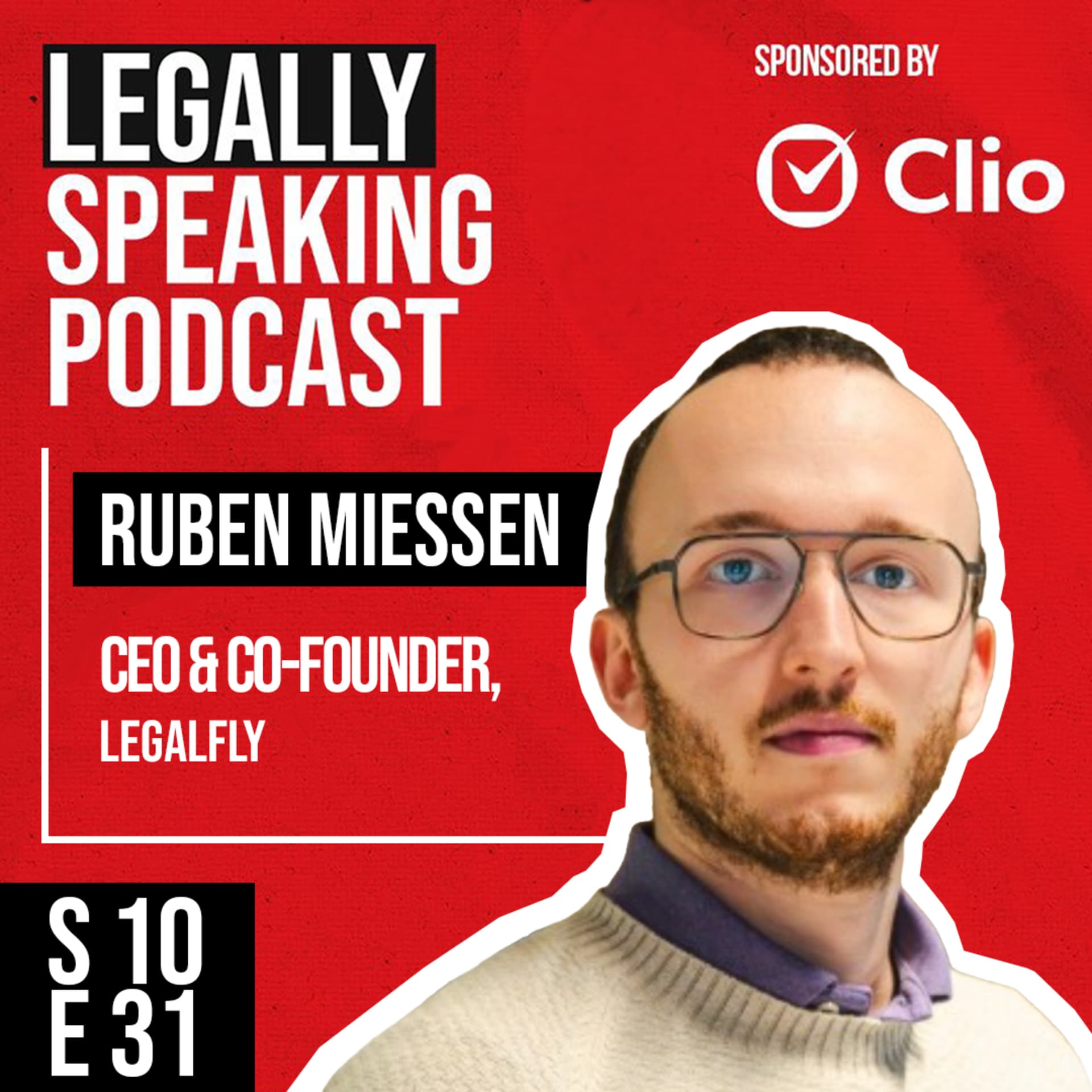
Ruben Miessen, CEO/co-founder of LegalFly, explains how enterprise legal AI can automate in-house legal workflows for regulated industries while protecting sensitive data. He argues that trust is mainly a governance issue (auditability, data control, explainability), and that transformation requires redesigning workflows—not just adding AI to old processes.
Guest background
Ruben Miessen is Belgian; previously a senior product manager at Tinder/Match Group, leading AI roadmap initiatives and building a team that later founded LegalFly. LegalFly has offices in Ghent, London, and Dubai; he’s recognized by Forbes Belgium “30 under 30.”
Key claims
LegalFly uses pre-processing to redact/anonymize documents before LLM access; it’s LLM-agnostic (OpenAI, Anthropic, Gemini, Mistral, plus fine-tuned/on-prem models). It grounds answers in reputable sources (often government/publisher partnerships). It shifts legal work toward transactional automation (contract review/drafting, RFP/tender responses) while humans handle judgment-heavy tasks (negotiation, litigation strategy).
Notable examples
DORA compliance checks; jurisdiction change tracking across 140 jurisdictions; multi-step workflows released 2–3 months prior; contract review thresholds example (business handles <25k; legal leads >25k).
Written by AI. May contain mistakes. Listen to the episode to check what was said.
Chapters
Tap a time to open that second in VOIntroduction to LegalFly and AI in Legal Work
0:00 to 0:45
Learn about the pre-processing of legal documents and the automation capabilities of LegalFly.
“We want to be an academic in that change.”
Ruben's Career Journey
1:56 to 3:47
Explore Ruben's path from engineering to building LegalFly, highlighting key experiences and insights.
“I absolutely cannot read through any contracts before throwing it through LegalFly and get an advice, get my questions answered.”
Identifying Legal Work Challenges
3:47 to 5:05
Understand the legal bottlenecks faced in businesses and how LegalFly aims to address these issues.
“So a technical background, I've been studying mobile app development.”
The Genesis of LegalFly
5:05 to 7:18
Learn about the founding story of LegalFly and the mission behind its name.
“Yeah, and that's exactly where I wanted to go next, actually, is sort of the original issue, because you're alluding to there and you've spoken about seeing legal teams under significant pressure while working at Tinder.”
A Day in the Life of a CEO
7:18 to 10:01
Get insights into Ruben's daily responsibilities and the growth of LegalFly within the legal tech space.
“For folks who may not know, tell us the story behind the name of LegalFly and ultimately what is the core mission?”
LegalFly's AI Agents and Features
10:01 to 11:24
Explore the specific AI agents LegalFly offers and how they enhance legal workflows for clients.
“growth and an exciting market in the legal tech space.”
Integrating LegalFly into Existing Workflows
11:24 to 14:00
Learn how LegalFly integrates seamlessly with various platforms to support client workflows.
“We track any changes in the legal landscape.”
Transforming Legal Workflows with AI
14:00 to 21:16
Explore how LegalFly integrates seamlessly with existing legal workflows.
“So they're using it within words, for example.”
Redesigning Legal Processes for Efficiency
22:09 to 28:00
Learn how AI can fundamentally change legal workflows and team structures.
“Interesting insights we've talked about being client-centered throughout the conversation, I want now to put yourself in your client's seat.”
The Importance of Legal Ops in AI Integration
28:00 to 28:50
Learn how legal ops roles are evolving alongside AI adoption in organizations.
“So what have been some of the challenges you've had to overcome when scaling the company in a very competitive market as well?”
Show all 19 chapters
Challenges in Scaling LegalFly
28:50 to 30:13
Discover the challenges Ruben faced while expanding LegalFly in a competitive market.
“I think, and we're very happy to be able to work with such amazing organizations and with such an amazing team and amazing investors on our side.”
Hiring for Legal AI Success
30:13 to 31:29
Understand the qualities Ruben seeks in candidates for legal AI roles.
“So I think definitely there were some challenges around that.”
Future Trends in Legal Technology
31:29 to 33:57
Explore predictions for how legal tech will evolve and impact businesses.
“And you've built a team with strong backgrounds in AI and indeed product development.”
Advice for Legal Leaders on AI Adoption
33:57 to 36:12
Get actionable tips for general counsel on starting their AI journey.
“And we definitely want to be part of that shift.”
Lessons Learned in Entrepreneurship
36:12 to 38:44
Ruben shares key lessons about entrepreneurship from his journey with LegalFly.
“Someone needs to have very clear KPIs on making the implementation and the discovery process around that legal AI solution a success.”
Key Skills for Legal Tech Founders
38:44 to 40:52
Identify essential skills for founders navigating the legal tech industry.
The Future of the Legal Profession
40:52 to 41:34
Ruben emphasizes the importance of using AI to enhance legal judgment.
“Oh, that's a very powerful way to end that sentence.”
Engagement and Resources
42:01 to 42:51
Learn about the channels and resources available for legal insights.
“We'll also make sure we share them this episode for you too.”
Reflection on Legal Technology
42:51 to 43:18
Explore the transformative future of legal technology and its implications.
“Well, it just leads me to say thanks so much, Ruben.”
Transcript
Automatic transcript. May contain errors.0:00We want to be an academic in that change. We want to leverage the best models available. We want to leverage the best technology available, whether it's developed in Europe, in the US. It doesn't make a difference, but we do care a lot about the pre-processing. And we do care a lot about in what form those documents are shared with those models. So that's why pre-processing sensitive data in those documents and anonymizing them is powerful. There are workflows, mostly within the business teams, that consist of a lot of multiple steps, with different teams being a part of that. And that's when we started building on the concept of the multi-step workflows, which we then released now at LegalFly two to three months ago.
0:39That opens up a completely different level of automation that we can offer to clients. It's amazing to see. On today's Legally Speaking podcast, sponsored by Clio, I'm joined by Ruben Meeson. Ruben is the CEO and co-founder of LegalFly, a European enterprise legal AI company building a secure, governed legal operating system for in-house teams in regulated industries. Before founding LegalFly, Ruben worked as a senior product manager at Tinder, where he led initiatives and built a team that would later become the founding team behind LegalFly. With his co-founders, Ruben identified how legal bottlenecks could slow down businesses, whilst legal teams were strained under pressure and spending time on repetitive tasks.
1:20This led to the creation of LegalFly. LegalFly is now expanding internationally with offices in Ghent, London and Dubai. Ruben has been recognized as one of Forbes Belgium's 30 under 30. Today we're exploring AI, entrepreneurship and the future of legal work. We'll explore Ruben's journey from Tinder to building a legal tech company, the challenges of creating enterprise AI for sensitive legal data, how AI could transform legal workflows and what the legal profession may look like in the years to come so a very big warm welcome to the show Ruben amazing very nice to meet you ah likewise and I'm really looking forward to today's discussion and before we get into it we've got a couple of icebreaker questions firstly what's your favorite beverage and what's your preferred choice of footwear on a typical work day my favorite beverage is a beer as a true Belgian of course I hope to give this answer but the beer is actually called Golden Dragon in Dutch and it's brewed in the city of Ghent where actually Legalfly is headquartered and on the top of the cathedral there is a golden dragon connected to it and that is actually the icon or the emblem of the beer itself Ah, love that little story thanks for sharing and footwear?
2:36I'm wearing right now those are my favourites to be honest sneakers bojee Italian sneakers I like them and then this might be a chance for you to plug something or you may go somewhere else what's one piece of Legaltech or everyday technology you now rely on that you would have thought was unthinkable earlier in your career? I absolutely cannot read through any contracts before throwing it through LegalFly and get an advice, get my questions answered. Not even for a one-page NDA, I'm reading it myself, I'm just pushing it through LegalFly in 30 seconds. If everything is on the green, I sign it off.
3:12Generally speaking, I must admit that I'm using Claude very frequently for the more complex emails as well as it saves quite some time. And I think if you would have told me two years ago that I would be relying on AI to assist me with the more complex matters over email, I would have never believed you. Great answers, great start to what I think is going to be a wonderful conversation and teasing there a bit as well. But Ruben, I want to start at the beginning. Could you give a short version of your career journey from obviously studying engineering to working on AI initiatives at Tinder and ultimately becoming the CEO and co-founder of LegalFly?
3:46Definitely. So a technical background, I've been studying mobile app development. Back then mobile apps was the hype before I even existed or before Gen AI even existed. Then very quickly rolled into my first startup, which was a location-based advertising one. Then COVID-19 hit and I developed a social distancing device. I went into IoT, produced tens of thousands of those devices to guarantee a safe work environment. Then moved to Tinder, actually completely different space again. I wanted to build experience building for an enterprise, been responsible together with my team for several parts of the AI roadmap at Tinder and Match Group.
4:32And then with the release of ChatGPT, we were all amazed by the impact that Gen AI can have on all of our lives. And that is when the idea of LegalFly started brewing. Also, because on a weekly basis, we were working with those legal and compliance teams at Tinder, at Match Group. We experienced the legal friction sometimes of business teams wanting to move ahead, but being slowed down by legal ourselves. So yeah, that's when we really decided there must be a smarter way to handle legal workflows within an enterprise environment. And hey, that's how LegalFly got born. Yeah, and that's exactly where I wanted to go next, actually, is sort of the original issue, because you're alluding to there and you've spoken about seeing legal teams under significant pressure while working at Tinder.
5:19So building on what you just said, what did you observe about the way legal work was being completed, which made you think actually there could be an alternative way to do this? a good question i'll keep it a bit brief on on this one because there's a lot to talk about and we have a whole podcast to uh but this is your moment so go for it so i think to be honest the um the way how a legal team is looking at a specific process in a business team is is quite quite different and the tasks of the legal team is really to de-risk the entire organization so even the slightest risk is a priority and needs to be handled carefully and if it means that the project is slowed down by one week two weeks two weeks then then so be it what i've seen as a result is that a lot of business teams try to bypass legal whenever they could so everyone knew okay if we can risk it not to involve legal the project just move ahead and they never looked at it great so that's exactly what we want to avoid or what we're trying to solve is that if we can build a legal AI platform that empowers the business teams to get top-notch legal advisor, legal expertise without needing to enter a manual legal review process, which slows down everything.
6:38Great, because then only for the high-risk initiatives, legal gets involved. So the legal team can stay focused on the high-risk projects, the business teams gets unblocked, and then only in a minority of the cases legal manager needs to get involved for the business it's great um because every project every process every deal will now have a legal review either by the legal team or an ai native one love it and yeah i love that you found a problem and you leaned all in on it you know that's what entrepreneurship to me is you know you see these problems and then you get fixated about wanting to solve them and go out there and and do it and congratulations on what you've done with LegalFly.
7:19For folks who may not know, tell us the story behind the name of LegalFly and ultimately what is the core mission? The meaning behind the name is basically we want to help you fly through your legal work. It's as simple as that. It's the speed of how you can get through your legal work with LegalFly. And of course, as a founder, you're trying to come up with a unique name, a short name that is descriptive enough. LegalFly, everyone knows it's about legal work, right? And we managed to get a good deal on the.com domain name as well just prior to the year round so yeah i think it worked out quite uh quite well we were debating for a while if we should join some of our competitors and think about movie characters but then you know we we could already see the future where we then had to pay millions to those actors in the future and that's why yeah we wanted to avoid that so we didn't go for that and so today then talking about you know legal fly you are the the ceo what does a role for you you look like?
8:15Maybe give us a day in the life of what you get up to. It's a very good question. I think I've won the most diverse roles, I think, within the organization and it really shifts. In the early days, it sometimes felt like a firefighter role. Like if anything can go wrong, I'm trying to unbroaden and to fix it. Luckily, we have as the company matured, we have around 50 FTEs right now. We have an amazing leadership team that we managed to grow into a record amount of time as well. So my role has become more about very clearly deciding the strategy and the direction of the company and making sure that for everyone, the direction is very clear, that we stay ahead of competition, that we remain very close to the clients and to where the market is evolving in.
9:03And it, of course, means that I'm involved in a lot of processes, in a lot of different teams. with a lot of travels between the different offices as well because our headquarters is in ghent we have quite a significant office in london where majority of the go-to-market team is focused and then we have a dubai office that we opened quite recently as well to be able to more efficiently service the middle eastern market so i'm traveling around quite a lot we're about to open a us office most likely new york we're finalizing that as we speak the good thing as well is that over the last six months I've shifted more and more to go to market sites because I love to be very close to our clients and especially like the more complex clients or organizations like the European Commission, SAP, NHS, those are the ones where I love to be spending my time with.
9:52So you're helping your clients fly but also LegalFly itself is flying you're going around the globe like you say you've got Glenn, London, you know New York coming very very exciting rapid growth and an exciting market in the legal tech space. You know, LegalFly, again, I want to give a chance to tell us a bit more, offers a suite, doesn't it, of AI agents, including discovery, review, legal radar, multi-review and draft. So could you explain maybe a bit about those agents, you know, what they're designed to do and how legal teams can ultimately use these in practice? We often come in as an end-to-end solution, consolidating multiple legal tech solutions across the legal tech stack of the clients.
10:29As long as it's about in-house workflows, I think that's quite important. We're building almost exclusively for the corporate segments, mostly for enterprise. You also see that in our client base, around 96 % of all of our clients are corporates and around 60 % are enterprises. So that's great. We're really trying to build for any workflow that touches upon legal within any team. of the enterprise so legalfly initially started with the contracting heavy related workflows automating contact reviews the process of drafting contracts drafting legal documents then we evolved into compliance running compliance checks at scale on those documents at dora compliance for example was in europe one specific use case we went very very very heavy on and then we kept broadening then we built an arising uh scanner as well that tracks any changes into the jurisdictions jurisdictions all across the globe.
11:26We support now 140 jurisdictions. We track any changes in the legal landscape. We can assist with diligence. And then things got really interesting because we had all those agents available on the platform to all of our clients. And then we introduced a concept, I think now it was about nine months ago, introduced a concept of custom agents where our clients could build their own agents with their own playbooks behind it, run prompts. We learned a lot because we have a legal solutions engineering team, a team of forward deployed engineers as well, that we can involve with some of our enterprise clients with the most complex legal workflows, and they're collaborating with the client to, in a matter of minutes or hours, build a custom agent on LegalFly for a very specific process.
12:12But then we started learning that in a lot of cases, especially for the enterprise clients, And there are workflows, mostly within the business teams, that consist of a lot of multiple steps with different teams being a part of that workflow. And that's when we start building on the concept of the multi-step workflows, which we then released now at League of Fly, I think, two to three months ago to some of our existing clients. And we're now scaling into all. And that opens up a completely different level of automation that we can offer to our clients. So it's amazing to see. Very exciting because where you're going and building on this conversation is these platform-wide basically capabilities.
12:52You've got knowledge, normalization, playbooks, integrations. Tell us a bit more about how these capabilities perhaps support agents across the platform. And where do things like Word, Outlook, Ad fit-ins basically enhance the user experience? There are a couple of decisions we also made on building a LegalFly platform. One of them was, okay, we want to make sure it's more technical and that we're LLM agnostic. So LegalFly is not relying on a specific foundation model. LegalFly is powered by five models. We use the models of OpenAI, Antrofic, Gemini, Mistral, and then a couple of smaller models that we fine-tuned ourselves that we can even deploy on-prem.
13:31Then we also decided, okay, let's make sure we become platform agnostic. Majority of the usage comes from the web platform of LegalFly. but very early on we already released a native word add-in we now recently released an outlook add-in as well i think it was two months ago we have integrations with cloud co-work we have integrations with teams with slack with email so now there are seven different platforms that you can use to engage with legal flies agents because we really want to be completely embedded within the existing workflows of the clients. And it may very well happen that the legal team, for example, is using the web interface because it's the most the most complete, the procurement team is only using legal fly for automating contract reviews based on the playbook of the legal team.
14:16So they're using it within words, for example. And then you have other parties, like the HR team, maybe that is using legal fly per email as soon as a specific complaint comes in, and about an employee or about how an employee has been sanctioned, they forward it to a LegalFly email address and a full legal review kicks off as well. So we're really trying to become as agnostic as possible to the client. And we want to make sure that the client will never have to adapt their existing workflows or way of working for LegalFly, but that we can adopt to fit in exactly to how the client is working today.
14:53And I love how exceptionally client-centered you are. It's what I'm very much gleaming from this conversation. and hence why you've been so successful and had such rapid adoption and deep global expansion. You know, okay, so LegalFly very much focused then on helping these legal teams become more efficient, automating repetitive work, getting that time-consuming task off the desks. So what do you think legal professionals should be spending more time on then if AI is taking the routine tasks away from them? Being a sparring partner for important critical business decisions and managing those relationships within the business.
15:30And I think there, we can often make a split where we can take off all of the boring legal stuff, the commodity legal work out of their hands of the legal professionals and free of their time to focus on less matters, but go way deeper on those for the business. I think that is where we really can make the difference. Another element as well is that by our decision to build for those in-house teams, another benefit of working with legalfly is that the outcome is that we will reduce your dependency on the costly external counsel so actually we'll make the in-house legal team even more important and relevant than it was before we'll make sure the team focuses on the riskier the more complex internal projects and also make sure that this team is now capable of doing a big portion or all of the work that would have been outsourced in those cases anyways so let's look forward then to the future.
16:25You've said basically AI is fundamentally going to transform the way the legal sector operates. I think we can all agree with that. What areas of legal work do you think will be transformed first and what tasks do you think humans will continue to contribute to? I think the areas of legal work to be transformed first will be the more transactional legal works, anything in relation to contract reviews, contract drafting, but also answering on RFPs. for example, tendering processes, summarizing documents, answering legal questions, but based on internal knowledge of the organization. So it are tasks that by itself are not that complex, but there are sometimes tasks that appear in the highest volume as possible, and that are mostly pattern based.
17:15We believe humans and legal professionals will remain essential wherever judgment carries a specific consequence. For example, for negotiation, for litigation strategy, novel risk calls, etc. Well said. Okay, one big conversation around legal AI which comes around is trust. You know, the legal work involves very highly sensitive information, confidential documents, lots of commercial risks. So what are the biggest challenges in building AI that legal teams can trust? The biggest challenges in building legal AI that teams can trust? I think trust isn't a model problem, to be honest. I think it's more a governance problem.
17:57Auditability, data control, and explainability matter much more than raw capability from what we're seeing. Hence why when you're using LegalFly, we're trying to ground every answer that you get by the AI with a reputable source. In most cases, government sources. We have a lot of partnerships with publishers as well. and we're going to announce a couple of more publish partnerships over the next weeks as well. And then I think, yeah, the approach towards data security and processing is key. We're quite skeptical in giving AI and DLMs, powering the AI solutions, direct access to the sensitive data in those documents.
18:41So that is why we make sure that all sensitive data is removed, is redacted, is anonymized in an anonymization framework. It's a fine-tuned model that we can deploy on-prem prior to the LMS accessing it. And we've seen that for a lot of our clients, enterprise clients in highly regulated industries, think about banking, think about insurance. For them, it's very problematic if a legal AI vendor that is powered by an OpenAI model would directly read into all of the sensitive data that's in those documents. So first, this was really a prerequisite that we want to build that anonymization framework completely embedded and make sure that every document every prompt is anonymized prior to that processing and we're lucky as well that one of the founders dennis he has a very strong data security background so it was always at the forefront of all the product decisions that we've made yeah and it's great that you really emphasize that that point as well because it is so important given the nature of the work i guess doubling down on that then for in-house legal teams probably listening to this you know how should those companies those legal teams think about the trade-off between adopting the most powerful ai models and maintaining control over sensitive legal data we think data sovereignty is a subject that is coming up more and more which is great and in 2025 european governments really moved their work away as well from microsoft i think the french government was one of the first who has made that decision because they were very worried about the reliance on having a specific u.s vendor in an uncertain political situation uh that i don't think got that much better in 2026 so let's see how it evolves now the challenge is that those u.s models are more the most developed in the world they're the most powerful as well so of course if you decide that you're not using those u.s models then you're missing out on efficiency.
20:40So then you put yourself at a significant disadvantage if you decide to cut yourself off from them. So that's why we want to leverage the best models available. We want to leverage the best technology available, whether it's developed in Europe, in the US, it doesn't make a difference. But we do care a lot about the pre-processing. We do care a lot about in what format those documents are shared with those models for processing so that's why the pre-processing of the sensitive data in those documents and anonymizing them is powerful because it really allows you to benefit from the best models in the world without that your data is going anywhere today's episode is brought to you by Clio if you're spending more time managing your practice than practicing law it's time for a change Clio is the intelligent legal work platform built for modern solicitors, combining context-aware AI with trusted legal research to help you work smarter, not harder.
21:40Switching is easier than you might think. Clio's dedicated migration teams handle your client and case data every step of the way, so you can focus on what matters most, your clients. Plus, award-winning support 24-5 via live chat phone and email means help is always on hand when you need it visit clio.com forward slash uk to find out why thousands of uk solicitors trust clio now back to the show there are still individuals out there who still think ai as chat bots just answering questions you're obviously building something broad an ai native legal operating system for enterprise teams particularly so what is the difference between adding ai to an existing legal workflow and actually redesigning the way legal work is completed so when you're adding ai to a workflow it makes the old process faster but in a lot of cases redesigning the workflow makes the old process obsolete so that that's why in certain cases we will want to just apply it to an old an existing workflow but in a lot of cases let's have a look at potentially redesigning that workflow itself as well to really get efficiency in the process and most companies are doing purely the implementation of ai into the old process and then calling it a full transformation that that they went through so one of the key things that we do is we really want to help teams already during the first discovery session to fully understand how the existing workflow looks like and then we bring them together with our legal solution engineer to see how we can recreate that workflow with AI potentially most likely change certain elements of the workflow to really get the efficiency and the automation in it because the way how you can execute legal work with AI is a lot of cases completely different than if you're doing it manually or then your tech solution that you've used in the past.
23:41Interesting insights we've talked about being client-centered throughout the conversation, I want now to put yourself in your client's seat. So imagine you're building the in-house legal department from scratch in 2026 and beyond. What would it look like? What roles, skills, technologies would you prioritize? It's a good question. I think one of the first things to decide is the breakdown of which work we want to allocate to AI, which work we want to allocate to our in-house legal team, which work goes to the business teams and is there any work that we're still looking to outsource to either law firms or alternative legal service providers and where are the thresholds for that and to give you a very simple example we're talking about contract reviews that are coming in do we want to introduce a specific gap of the value of the contract let's say any contract below 25k is handled by the business team itself we don't even need to involve legal we just give them a legally trained AI model that they can use for their review.
24:42As soon as we go over the 25K, the legal team is running it and is leading. And as soon as it goes above the 100K, maybe we'll need to have an external platform to review it as well. It's a very basic example, but this could perfectly be a workflow that we create. And the purpose of this is give more autonomy to the business teams, build out a strong potentially leaner in-house legal team and again ideally outsource nothing or a very small portion of the work to those external law firms. I think the legal ops team would become much more central as well and the legal ops team would work much closer with the innovation teams of the business as well.
25:33Newer graduates can make up for fewer years of experience by being AI savvy. So I think the way how you would look into hiring for your in-house legal department will also be quite different. I think experience now becomes a little bit less important. I think you rather bring in some very eager juniors that are very AI savvy and that could build out custom agents, custom workflows very quickly within the legalized version. For juniors listening to this, because we have all ages and ranges of people, when you say AI savvy, give us like maybe a practical example if you're thinking about that, that maybe they should be thinking about to get AI savvy or if they're already kind of conducting it.
26:11Give us an example you think which would make them potentially stand out to be valuable. Definitely something they should prepare for, like for any role, by the way. So not just if you're looking to get a position as a legal professional in a corporate, but for any role that you're being hired for today, I think there is a high chance that you get the question, okay, how are you using AI in your work today already? Because that's something to ask to anyone we're bringing in, whether it's someone of the engineering team, product team, one of the account executives, it doesn't matter. We'll ask the question to the person.
26:42And because it really depends on the role, I think specifically for the in-house legal team, I think what is advised is try to get experience with a verticalized, specialized legal AI solution like LegalFly or like Harvey or Legora. If you don't have access to one of those, make sure that you've worked in CLOT, that you've built your own skills to be able to automate contact reviews to some extent, that you're able to perform legal research to some extent. Because I think on some of those use cases you will definitely want to prove to your future employer that you have some experience and that you have realized efficiency gains by by doing so there we go i think some really sound advice there thanks for sharing you know we're talking a lot about you know agents automation you know efficiencies etc etc freeing up more time but let's really double down on the role of human judgment here which human skills will become more valuable and why the legal function is becoming a an even more important one and because you basically become the the ai engineer for legal within the organization so we're seeing smaller teams that already start to invest much earlier on in this role and the lawyer itself within the business almost becomes a business strategist or the orchestrator of the work so that's i think an interesting change where the legal ops role is even more important because they're really setting up the entire environment for legal to reap the full benefits of adopting and implementing ai within the organization and then the lawyers instead of doing all of the work they'll be more the overseeing orchestrating most of the work and being much more focused from a from a strategic perspective it all sounds great So it's been a great journey.
28:33You've expanded LegalFly since 2023. You've taken the company global. You've got exciting plans. But entrepreneurship ain't that easy. So what have been some of the challenges you've had to overcome when scaling the company in a very competitive market as well? And maybe some tips for other legal tech founders that are trying to get their businesses off the ground. A lot of challenges, of course. And I don't want to make it sound easy. It's been quite a roller coaster. I think, and we're very happy to be able to work with such amazing organizations and with such an amazing team and amazing investors on our side.
29:10I think the key challenges that we've had to overcome in highly competitive AI markets, we have kept our heads down and very much focused on the product, which is key, I think. And it's not always the most straightforward thing to do, because we've seen a lot of others in the space have thrown literally millions or tens of millions or hundreds of millions of dollars into advertising and brand awareness. And on one hand, we don't have the luxury to do so because we didn't raise a billion dollars or a billion euros. So we need to be more capital efficient in how we're scaling the organization. On the other hand, the founders have a different philosophy and approach on how you're building out the best legal AI solution in the market, where we're incredibly customer centric and incredibly product focused.
29:57And we really want to build out the best product in the market. And yeah, we took a lot of time and founder focus in figuring out what exactly that product should be for those in-house teams before we start scaling from a go-to market perspective. So I think definitely there were some challenges around that. And DIR landscape is moving so fast. So our product capabilities and the capabilities of our competitors are developing so quickly. So we're constantly evolving in our messaging and brands positioning as well. It's crazy. It's like every quarter, LegalFly is really, really maturing. I think maybe a third challenge is that, of course, when you're raising capital in the market, in such a highly competitive market, it can also become challenging because there is a lot of money that has been going around in the market.
30:50And we have a lot of inbound interest that is pushing us to do a series of UAs and keep on raising. But also there you want to figure out which investors have not placed their bets yet and decide to partner with those that share exactly the same mindset and the same strategy that we have, which is quite differentiated from yours. It comes down to that probably value alignment as well in terms of the way that you want to go about this and what you want to be known for in the marketplace and some of the other things that you were very nicely saying there. You touched on earlier, I was sort of touching on recruitment talent.
31:28These businesses still do need high quality talent to flourish, to expand. And you've built a team with strong backgrounds in AI and indeed product development. So what qualities do you look for in individuals when hiring them on work problems that are very complex and specialized as sort of legal AI? Curiosity and comfort with ambiguity over the number of years of experience. I think the years of experience is really becoming less relevant now. We're really looking for someone younger with a very young, aggressive mindset to become the best that is very quickly adopting at the changing landscape.
32:07also because the problem space changes every quarter so I think someone who is very quickly to adapt, very eager to learn and very eager to help us become the best in the space, those are the kind of individuals that we're looking for someone who is hungry to learn, smart and who is AI savvy so that's why, to get back to one of the earlier questions you asked for any role that we're looking to hire someone for at LegalFi, we definitely want to make sure that that person, by his or her own interest, has already implemented AI and used AI itself to boost her or his own efficiency. Get out there, get testing, get used to it, play with it, be curious, all of the things that you're referencing there.
32:53Let's look again to the future. I know it's hard to predict because, as you said there, things change by the quarter, month, week, sometimes in the world of LegalAI. But looking forwards, what changes do you think will shape the way companies buy, use and interact with legal technology? Let's have a look maybe at the predictions of Gartner where they said that legal tech budgets are expected to double by 2028. And we believe that that money is moving from external counsel to adopting legal tech, specifically legal AI. that's what we're seeing in the market so we're seeing with all of our clients and that's also why we're betting on solving the legal workflow solving the legal needs for those corporate teams so it's definitely a shift that we're seeing and a transition that we'd love to be to be part of in the market budget will go more and more towards enabling those non-legal team members to use legal tech so business teams will get a lot more autonomy to get their their work done even if it involves the execution of some legal tasks alongside the job.
34:01And we definitely want to be part of that shift. We're also seeing a shift from a collection of legal point solutions to platform decisions. So buyers are becoming more mature. They're kicking off RFP processes where they're looking for a consolidated end-to-end solution and not just a tool to solve one specific task. This also comes back to data security, for example. If you're working with four or five different legal AI vendors, I'll focus on a very specific task or sometimes a subtask. It's quite risky for the business to be leveraging all of those tools or using them. They'd rather decide to go with one provider.
Read the full transcript
34:44It has a much more broader offering for a wider variety of the legal needs that the organization faces. Yeah, and I can hear the sort of passion in your voice throughout the conversation about LegalFly and what you're trying to do. What most excites you about the future? What most excites me about the future, I think the speed at which everything is changing, to be very honest, it's incredible. And the speed at which those organizations are evolving, how legal is being democratized in a way as well, I would say it's, I really think it's incredible. And what we thought was possible to build with LegalFly, what we've built today, two years ago, we would have never believed it.
35:31So the underlying models as well are evolving so quickly, that it allows everyone in the application layer like us to build and to keep pushing the bar for what's for us possible. And maybe one day we'll, we'll reach AGI. And let's see where we end up. But I think it's amazing how fast technology is evolving and how eager because of that, the businesses are to adopt it and to boost their processes. And I just gleam the entrepreneur in you that you get excited by change some legal leaders get a little bit scared or go into inaction with change thinking do we actually have to do this so if you were advising general counsel or legal leaders currently unsure where to start with their ai journey what would be three tips you would give to them and why i think the first one is let's start with one painful ideally high volume workflow let's start with a real problem where you know there is a good ROI if this can be solved with a legal solution and not just develop a company-wide strategy the second one would be involve the team doing the work in the tool selection I think that's that's key make sure it's directly that team reviewing those tools that it's not just innovation team leading it and make sure to appoint a champion while doing so.
36:52Someone needs to have very clear KPIs on making the implementation and the discovery process around that legal AI solution a success. And then the third tip I would give is make sure that incentives are aligned. So measure, reward the team based on their successes using AI. So having clear KPIs in place for those teams, I think is key. and what gets measured gets done as they say and that's some great advice for uh the legal side what about some advice for the for the founders now you've obviously gone from leading ai initiatives to founding and scaling your own company what one lesson about entrepreneurship do you wish you'd learned before starting legal fly it's good one i think and this comes back to the philosophy of the founding team being completely obsessed with having a product first focus, I believe.
37:47So really focus and compromisingly on the product before you even think about scaling your organization, before you even think about sales. And if the product isn't truly compelling, even the best go-to-market strategy will not help you. And if you look about how we did it with LegalFly, we spent the first year to year and a half on really perfecting the product to find the amazing product market fit. Then we spent the next year and a half on building out an amazing sales team I'm finalizing the go-to-market playbook and having a very strong direct sales motion, both inbound and then training that outbound muscle as well.
38:24And then now, let's see if it's not a cycle of one year and a half, but building out a very strong partnerships channel as well. But also here, don't waste any time on building out partnerships or strategy around it if you didn't master your direct sales process first. So I think doing it in a phased approach where you're obsessed and focused on the product first then you look into direct sales and then you look into partnerships is uh is the way to go and then then the best investors in the world will reach out to you themselves the best candidates or people will be at your door to to be able to work for you so everything will come your way if you build out the best product master direct sales and then master a very strong partnerships channel alongside tailored sticking with the school of thought slightly you have a skill toolbox let's say your tools all go missing you know all the skills that you've acquired as a founder as an entrepreneur over the years to running legal fly but you can only get one of those skills back what's the key skill that you would absolutely categorically not want to lose and continue to refine that you think would make you a top-tier legal tech founder now moving forward it's a good one it's a really good one i think the ability to get on a stage and very clearly push the industry in a way to change and and what do i mean with this is that it's a dinosaur industry right like the law firms have not changed their business model ever they have no incentives to become more efficient we do want to be a catalyst in that change and be very vocal about look we need to democratize legal we need to make sure that those corporates and the enterprises have a much more efficient way to get their legal work done we need to solve the legal friction and because it's that vision and delivering that vision in a very appropriate way that is going to help you to find the right team around it to convince the first clients to do the first trials as well and and to get more attention in a very competitive space when your specific business and your specific strategy so i think being able to be very vocal uh on the direction you're going in the direction that you feel the industry should move in and being able to clearly pitch around all of that is is one of the key strengths that a founder in such a highly competitive industry that is changing very rapid should possess and like i said all the time to our listeners specific is terrific and I think that's a really good example about being lasered in there and being that trailblazer and genuinely believing and you know being the change if you don't see the change be the change and you absolutely believe that and you know credit to you and I thoroughly enjoyed this conversation and just a couple of quick questions before I let you go perhaps a final piece of advice if you like if you had to complete this sentence how would you finish it the legal profession of the future will not be defined by organizations using the most AI but by those that By those who used AI to give their people more judgment and definitely not less.
41:33Oh, that's a very powerful way to end that sentence. I like that. Reuben, this has been an absolute masterclass. Thoroughly enjoyed learning about your own individual journey, what you're building with LegalFly, the story behind it, how you're thinking about growth, your ideas, strategies, all very, very exciting. I'm sure you've inspired a lot of our listeners and watchers around the world. So if they would like to learn more about yourself or indeed LegalFly, are there any particular websites or social media handles or indeed resources you would like to share? We'll also make sure we share them this episode for you too.
42:03I think definitely our website, LegalFly.com, is one of the most interesting channels to follow. We're very active on LinkedIn as well. We're also publishing every quarter a report. The report is not commercial at all. what we basically do is we really deep dive into the space. And we often perform research as well, where we're interviewing a couple of hundreds of GCs on certain topics to get their thoughts and also to keep tracking how the industry is evolving, how the maturity of legal AI is evolving as well. So, yeah, I would recommend follow us on LinkedIn. Keep an eye on the website and every quarter, feel free to have a look at that report.
42:43And hopefully there is some interesting information that we can assist you. And if at any point you would like to get a demo, I'm pretty sure anyone of our team would love to show you the platform. Absolutely. Well, it just leads me to say thanks so much, Ruben. It's been an absolute pleasure having you on the show. And I think this conversation proves that an important reminder around the future of legal technology is not about just replacing manual tasks with artificial intelligence. It's about rethinking how legal work is going to be completed and what it looks like in the future. So from all of us here on the Legally Speaking podcast, wishing you and the entire team at Legalfly lots of continued success as you transform the future of Legal Eye.
43:19But for now, from all of us, over and out. Thank you for listening to this week's episode. If you like the content here, why not check out our world-leading content and collaboration of the Legally Speaking Club over on Discord. Go to our website, www.legallyspeakingpodcast.com. There's a link to join our community there. Over and out.
From the publisher
On today’s Legally Speaking Podcast, I am delighted to be joined by Ruben Miessen.
Ruben is the CEO and Co-Founder of LEGALFLY, a European enterprise legal AI company, building a secure, governed legal operating system for in-house teams in regulated industries. Before founding LEGALFLY, Ruben worked as a senior product manager at Tinder, where he led initiatives and built a team that would later become the founding team behind LEGALFLY. With his co-founders, Ruben identified how legal bottlenecks could slow down businesses, whilst legal teams were strained under pressure and spending time onrepetitive tasks. This led to the creation of LEGALFLY. LEGALFLY is expanding internationally, with offices in Ghent and London and Dubai.
Ruben has been recognised as one of Forbes Belgium’s 30 Under 30. Today, we are exploring AI, entrepreneurship and the future of legal work. We will explore Ruben’s journey from Tinder to building a legal tech company; the challenges of creating enterprise AI for sensitive legal data; how AI could transform legal workflows and what the legal profession may look like in the years to come.
So why should you be listening in?
You can hear Rob and Ruben discussing:
- AI-powered legal workflow automation
- Secure anonymisation of sensitive documents
- Unblocking business teams with AI
- Multi-step workflows across enterprise teams
- Expanding globally across regulated industries.
Connect with Ruben Miessen here - https://be.linkedin.com/in/rmiessen