
In short
Legally Speaking Podcast Episode Notes
Episode Title
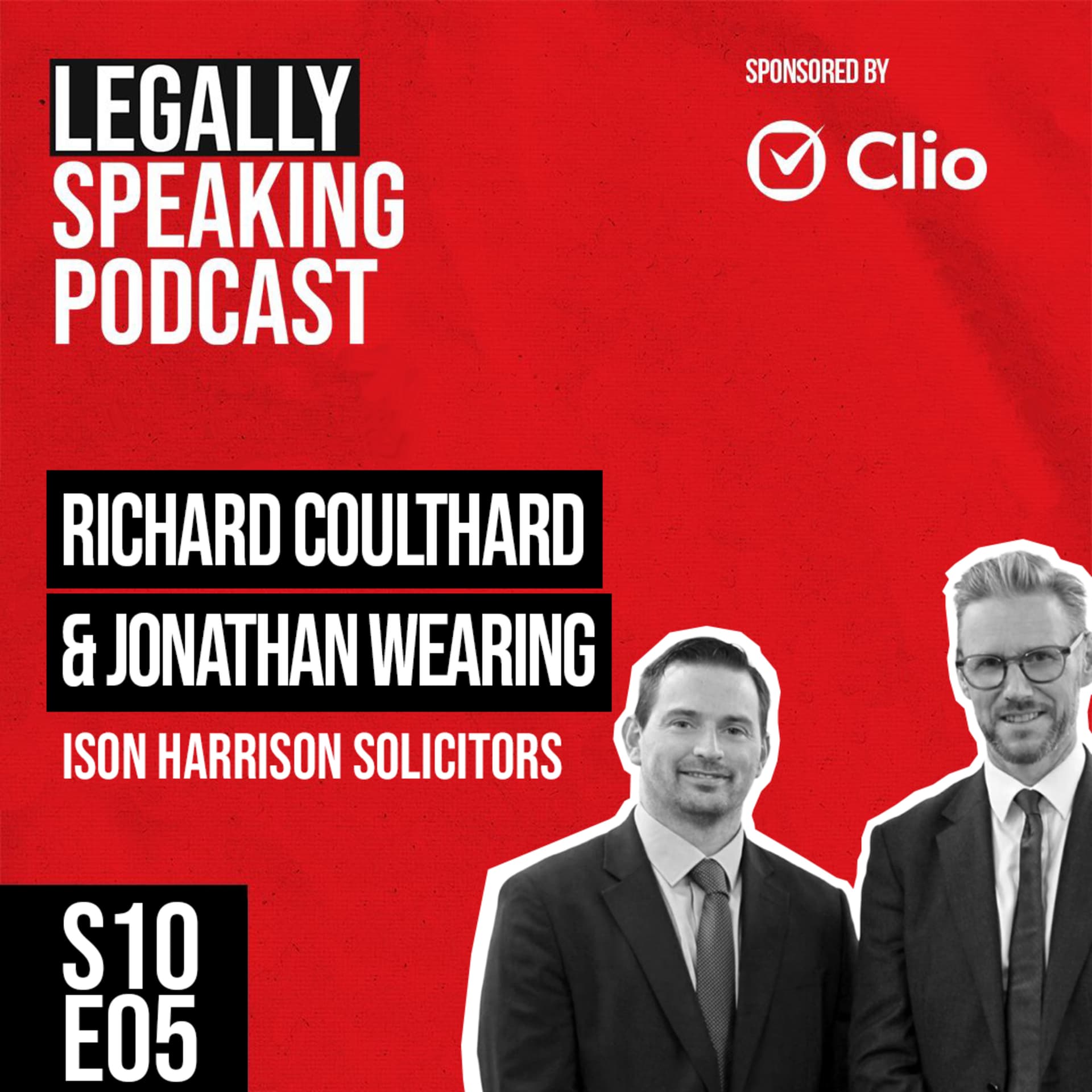
Why Choosing an Employee-Owned Model Saves Law Firms Guests: Jonathan Wearing & Richard Coulthard Host: Rob Hanna Episode Number: S10E05
Episode Overview In this episode of the Legally Speaking Podcast, Rob Hanna interviews Jonathan Wearing, Managing Director of Ison Harrison, and Richard Coulthard, Director and Head of Corporate at Ison Harrison. They discuss the transition of Ison Harrison to an employee-owned business model and the benefits this structure brings to law firms.
---
Key Concepts and Discussions
- Employee Ownership Model
- Definition: Ison Harrison became an exclusively Employee Owned Business (EOT) in 2022.
- Ownership Structure: Unlike traditional law firms, ownership is separated from management, allowing all employees to be beneficiaries of the trust that owns the firm.
- Cultural Impact: Promotes a team environment where success benefits everyone.
- Long-Term Success and Cultural Readiness
- Cultural vs. Financial Viability: Long-term success is more dependent on cultural readiness than just financial health.
- Team Dynamics: A collegiate attitude fosters collaboration and engagement among staff, leading to better overall performance.
- Technology and Efficiency
- Enhancing Human Connection: Technology is seen as a tool to enhance human interaction rather than replace it.
- AI Adoption: Proper integration of AI should focus on creating more time for human interactions with clients.
- Purposeful Storytelling
- Competitive Advantage: Clear and purposeful storytelling can amplify competitive advantage and build stakeholder trust.
- Transitioning to Employee Ownership
- Challenges in Conversion: There can be challenges regarding cultural fit, financial viability, and expectations surrounding equity ownership when transitioning to an EOT.
- Benefits of EOTs: These include tax advantages and a smoother succession planning process.
---
Key Takeaways
- Recruitment and Retention: The EOT model helps in recruiting and retaining talent by offering a purpose-driven work environment.
- Profit Distribution: Employees benefit directly from profit distributions, incentivizing them to contribute to the firm's success.
- Decision-Making Agility: The structure allows for faster decision-making processes as the management team is small and aligned.
- Inclusive Growth: Employees can progress based on their contributions and merit without traditional barriers often found in law firms.
---
Conclusion The episode emphasizes the transformative potential of the employee-owned model in law firms, promoting a collaborative, transparent, and purpose-driven work culture. Jonathan and Richard share their insights on navigating the transition to this model and the measurable success Ison Harrison has experienced since making the change.
---
Guest Links
- Jonathan Wearing: [LinkedIn Profile](https://uk.linkedin.com/in/jonathan-wearing-8ab2821a)
- Richard Coulthard: [LinkedIn Profile](https://uk.linkedin.com/in/richard-coulthard-8b840677)
Further Information For more insights, visit [Ison Harrison's Website](http://www.isonharrison.co.uk) which includes their five-year business plan and more about their operational ethos.
---
Listening Options Tune in to the Legally Speaking Podcast for more episodes that inspire and educate on legal careers, innovation, and the future of law.
Written by AI. May contain mistakes. Listen to the episode to check what was said.
Chapters
Tap a time to open that second in VOIntroduction to Employee Ownership
0:00 to 0:30
Explore the benefits of an employee-owned model for law firms.
“This is going to create more time for us to be human.”
Icebreaker and Personal Insights
1:40 to 4:00
Guests share light-hearted personal preferences and their journeys into law.
“What is your favourite beverage and what is your preferred choice of footwear during a workday?”
Jonathan's Career Path to Managing Director
4:00 to 6:00
Jonathan discusses his background, career progression, and insights on leadership.
“So and now I head up the commercial services across the firm, predominantly corporate work, but you've also got litigation and employment, commercial property, what have you all fall within that commercial umbrella.”
Richard's Career Journey and Law Inspirations
6:00 to 8:50
Richard shares his background and motivations for pursuing a legal career.
“And I love the way that the firm is being run.”
Roles and Responsibilities in Employee-Owned Firms
8:50 to 11:30
Discussion on the daily roles of Jonathan and Richard in their employee-owned law firm.
“And a couple of things I've just picked up on there, you said listening.”
Understanding Employee Ownership Trusts
11:30 to 14:03
Jonathan explains the structure and benefits of Employee Ownership Trusts in law firms.
“If you've been working here for a year or more, then as a beneficiary, you're an eligible employee for a profit distribution at the end of the year.”
The Benefits of Employee Ownership in Law Firms
14:03 to 16:15
Learn about the advantages of an employee-owned model in law firms, including collaboration and succession planning.
“The more successful the business, the more everyone has the capability of earning through profit distributions.”
Measurable Impacts of EOT Transition
16:15 to 17:53
Discover the measurable impacts on performance and growth since transitioning to an employee ownership trust.
“And Jonathan, as sort of MD, do you have any measurable impacts you've seen since transitioning to the sort of EOT, be it from performance strategy or long term planning?”
Inclusivity and Transparency in Employee-Owned Firms
17:53 to 19:56
Understand how transparency and inclusivity are fostered in an employee-owned law firm structure.
“Anything above that is subject to income tax.”
Decision-Making Dynamics in EOT Structures
19:56 to 22:30
Explore how decision-making shifts to employee councils in EOT models and its impact on accountability.
“law firms, it can be pretty hard for decisions to get made.”
Show all 21 chapters
Challenges of Operating as an EOT
22:30 to 24:26
Learn about the challenges faced by employee-owned law firms and how they navigate them.
“They decide who's getting hired, who's getting fired, pay rises, contracts, all of that.”
Humanizing the Legal Profession Through EOT
24:26 to 28:00
Discover how an employee-owned model can humanize interactions in the legal profession.
“It all sounds great, but business is bloody hard and, you know, things are hard.”
Humanizing the Legal Profession
28:00 to 30:14
Explore how employee ownership impacts the legal profession and client relationships.
“Because that was the question I was going to ask you, Richard, in terms of has it impacted anything.”
AI and Legal Efficiency
31:17 to 34:26
Discuss how AI technology can enhance efficiency and client interaction in law firms.
“But actually, if people buy into, you know, why you do it, that story behind it, I think that's super powerful and clients and people can connect with that.”
Succession Planning in Law Firms
34:27 to 39:47
Understand the misconceptions and strategies around succession planning in law firms.
“I think that's going to be the real key for any business, not just law firms.”
Future of Employee Ownership Models
39:48 to 42:05
Predictions on the future of employee-owned models in law firms and their implications.
“I mean, just looking forward, just probably look to close.”
Understanding Employee Ownership in Law Firms
42:05 to 43:33
Explore the implications and identity issues related to being part of an employee-owned law firm.
“It is a struggle often for founders, and again, not just talking specifically for law, but generally people can associate their identity with being an owner of a business.”
Financial Aspects of Employee Ownership
43:33 to 45:00
Learn about the financial dynamics involved in transitioning to an employee-owned model.
“And that has to be funded out of the business over a period of time.”
Advice for Future Lawyers
45:00 to 46:30
Gain insights on networking and relationship-building as essential skills for young lawyers.
“What advice would you give to those interested in pursuing a career in law in 2026, keeping in mind the times have changed over historical times?”
Positivity and Career Success
46:30 to 47:11
Understand the importance of maintaining a positive outlook in your legal career.
“When you look around the successful people, that is what you see.”
Resources and Contact Information
47:11 to 48:35
Find out how to connect with the guests and access their resources for further learning.
“Jonathan, if listeners want to know more about, indeed, Ison Harrison or yourself, where can they go to find out more?”
Transcript
Automatic transcript. May contain errors.0:00Jonathan Wearing:This is going to create more time for us to be human. Being an EOT has a huge amount of benefit to the firm collectively because it's very much a team environment. Everyone's in it together. The more successful the business, the more everyone has the capability of earning. It's part of a wider story about how we're evolving as a nation in terms of being more socially conscious. And so I think that's where this might fit in, that people like to do business with businesses that they know, who care about their employees. I don't actually think that the introduction of AI, which would allow greater efficiencies, is necessarily going to produce something that the client wants, which is cheaper work.
0:41Jonathan Wearing:I think they just want more efficient work and a more human nature to it.
0:46Richard Coulthard:On today's Legally Speaking podcast, I'm delighted to be joined by Jonathan Waring and Richard Coulthard. Jonathan is the Managing Director of Ice and Harrison. A personal injury solicitor, Jonathan has helped the firm grow in size, strength and profile. He has transformed the firm into one of the first law firms in the country to become an exclusively employee owned business in 2022. Richard is the director and head of corporate at Eisen Harrison. He has a wealth of experience in corporate law, commercial law, litigation, dispute resolution, employment law, too. He is also an employee ownership trust specialist with an aims focused approach.
1:21Richard Coulthard:Richard strives to provide first class legal advice and support going above and beyond to help his clients succeed. So a very big warm welcome both to the show.
1:30Jonathan Wearing:Thank you, Rob.
1:31Richard Coulthard:You're right. Yeah, absolute pleasure to have you both here on the Legally Speaking podcast. But before we get into your careers and backgrounds and what are you getting up to with the firm, I have a customary icebreaker question. So perhaps come to you first, Jonathan. What is your favourite beverage and what is your preferred choice of footwear during a workday?
1:52Jonathan Wearing:Favourite beverage, I'm going to have to say, look, it's a tiger beer. I'd rather be a cup of tea but it turns out to be a pint of beer and footwear I'm quite staged, traditional in terms of what I dress so it's a black pair of broads
2:09Richard Coulthard:There we go, Jonathan anything you would say for your favourite beverage and footwear?
2:14Jonathan Wearing:I would say I am a cup of tea man a cup of tea you might pull out an addiction and footwear I wear work shoes because you know you have to look a certain way it probably isn't what I would choose to wear for comfort I would probably go with walking shoes that I had a choice but it doesn't match a suit does it there's walking shoes there we go well both thanks for being
2:42Richard Coulthard:good spirited and sharing that we'll come back to you then Jonathan would you mind by starting off by telling us a bit about your background and career journey then I'll come to you Richard
2:50Jonathan Wearing:so i started out as a trainee solicitor but a relatively small high street firm out in manchester three or four offices and i was doing pretty well everything that came in through the door so i was i was principally a personal injury litigator but i was also doing wills i was doing the conveyancing i was doing and anything else that came in seemed to be coming my way because i could well i was prepared to go and talk to them i started to specialize in personal injury work and get to Gation work and in 2000 found myself moving across the Pennines and four years qualified and I joined Eison Harrison and into the first and injury team here and it really moved quickly then I have to say it was quite a frustrating move because you've got to start your career and you've got to get you're urgently trying to get going aren't they um but within six years I was next partner and a year after I was managing partner.
3:48Jonathan Wearing:That wasn't the plan but that is how it panned out.
3:51Richard Coulthard:And it's panned out very well for you, hugely successful and thanks for giving us that and I'm sure a lot of hard work along the way and some ups and downs in-betweens that we'll probably get into. Richard we'd love to come back to you now, would you tell us a bit about your background and career journey?
4:03Jonathan Wearing:Yeah so I started off at a firm mid-size commercial firm doing sort of litigation work really um moved to another regional firm doing a mixture of different types of litigation i suppose um moved on from there became a director another firm where my role sort of merged into more commercial work more generally um and then moved to uh item harrison coming up seven years ago now actually and and uh as a partner to head up the some commercial services of the firm and then I've become a director at the firm a few years ago when we transitioned to be employee owned back in 2021. So and now I head up the commercial services across the firm, predominantly corporate work, but you've also got litigation and employment, commercial property, what have you all fall within that commercial umbrella.
4:58Richard Coulthard:Yeah, absolutely. Very broad practice. And again, very, very, very successful career. And thank you for sharing that. Sticking with you, Richard, we're always curious to know what inspired you to get into law in the first place was it was it family influence was it something you saw how did you sort of get
5:12Jonathan Wearing:into the law my parents had had some association with you know i've tended meetings with barristers for various reasons associated with family so i had a bit of an awareness of it it came up in certain careers after two tests and things like that i was i was on a debating team so that sort of it's quite that i'm naturally you know having arguments with other people so there's always an interest there from a very young age and it was just felt like a very natural career path for what interests me or what maybe my strengths are so it was it was a it was a driver from a very young age it was with either that or being a pilot but i don't have the eyesight for being a pilot so
5:51Richard Coulthard:there we go we ended up in law yeah there we go and probably weren't trusting laser quite so much back then either today jonathan i'd love to come to you what inspired you to get into law
6:01Jonathan Wearing:look I had a deep sense of justice and purpose and I quite like intellectual rigor and I was just attracted to I was quite good at school I was able to do the academic side but it was a sense of justice and purpose and become honest I wanted to change the world well we've not done that but we've changed a few little worlds on the way and that's probably what I started to understand when I first started work which is you can have a massive impact upon individuals if you do this right with the right heart.
6:31Richard Coulthard:Yeah, absolutely. And you are. And I love the way that the firm is being run. So probably sticking with you, Jonathan, as sort of managing director, what does your role entail? And also, could you tell us a bit about a typical day for you, which I appreciate might be quite varied?
6:46Jonathan Wearing:So what my role entails is as managing director, effectively, I help manage, okay, the college, I suppose, or the group of eight directors who dried and lead the business okay so collectively try and keep them together constantly dipping in and out and making sure that we are completely aligned and thereafter everything else follows because if that if everyone's aligned in that room then it impacts upon managers and branch managers and department heads and what have you i do a lot of listening a lot of conversation with different managers it's not even managers it's everyone across the across the firm, ensuring that the values are straight.
7:29Jonathan Wearing:I'm checking new inquiries coming through. I'm checking that we're taking on the light work. We're quantifying it. We're selling it at a light price. There's the FD side, the finance side, which I'm constantly communicating with the finance director. It's the marketing team. It's the IT team. I'm basically, I described most of us, of what we do actually anyone at work you're either a deep coal miner or you're a surface coal miner okay there have been times in my life and i can still do it where i can go right down okay deep mining but that is really really focused work and you can't be distracted and you basically need to be on your own and this and we've got a good number of lawyers at the firm who are like that and we massively benefit from their their ability to concentrate and focus and get brilliant results for clients i'm not even sure i surface mine i i kind of just watch whilst everyone else is well there's a load of other managers that supervise in a surface mining it's really shallow i do an awful lot at a relatively shallow level there you go i'm not sure i'm not sure i've solved myself there and my average no but i think you've given yourself a really good overview of actually
8:48Richard Coulthard:what the realities are, and that's what authentic conversation is all about. And a couple of things I've just picked up on there, you said listening. And I think the art of any good leader, as you say, is going around listening and really kind of going deep on those conversations to understand. And then as to your point, you're sort of uniting, aren't you? You're trying to unite everyone as that leader from what you've said from those conversations, things that you're doing to try and drive the business forward. And there's lots of different stakeholders, lots of different things, lots of different departments you're engaging with.
9:13Richard Coulthard:So having that ability, that's a good skill set actually to be able to dovetail across all of those different stakeholders and actually make things work. Richard, you sat there very patiently. We'd love to know a bit about your day because obviously you're a director of business as well. You're the head of corporate. You've got a broad background yourself. Could you walk us through what a typical day might look like for you?
9:29Jonathan Wearing:So I think my role would probably be more client facing. A lot of it comes down to relationships. Whereas Jonathan has talked about a lot of internal conversations. A lot of mine is conversations with clients or referrers or contacts, whether that's accountants or finance brokers or business brokers or whatever, and managing those relationships and maybe being a little bit of a face for the firm in terms of the commercial presence. So I do lots of public speaking events and podcasts like this and things like that. So it's managing those relationships. There is some client work. This is then managing the people, the marketing team report to me.
10:06Jonathan Wearing:So there's an element of oversight in terms of marketing around the firm and budget control and what have you. So, as I said, there is some client work. I still work for clients and do transactional work. But a lot of my role is relationships with external stakeholders, clients, contacts, what have you, as well as managing the direct team. and then involvement strategically around the firm and other matters that come with the indirect of a firm of this size.
10:39Richard Coulthard:Yeah, absolutely. And undoubtedly, busy days as well. And thank you both for sharing that. Jonathan, I want to come back to you now, probably for the heart of the discussion today, because what I admire about is actually the firm's structure, because you are at EOT, which is an employee ownership trust. So as that form of business, would you mind explaining for our listeners who may be less familiar what it is and how it works okay so most law firms okay
11:03Jonathan Wearing:and possibly most of your listeners will be working for a law firm or have worked for a law firm and most of them the vast majority are owned and managed by a relatively small collection of people who happen to have found friendship or or an association financially more than any other reason um over time so the ownership and the management are completely connected in most law firms and what we've done is taken ownership away from management and split the two so the ownership of eisen harrison now is owned by a trust which owns it for the benefit of employees Okay, so anyone who works here, you are a beneficiary under the trust.
11:54Jonathan Wearing:If you've been working here for a year or more, then as a beneficiary, you're an eligible employee for a profit distribution at the end of the year. Combining your profit, of course. The management is different. So we have directors of the firm that are appointed by the trustees from the trust. The directors are well incentivized to run the business profitably for the benefits we haven't got here, of course. Now, in another world, those directors are equity partners. The responsibilities are the same, but the profit distribution is different. There are significant incentives for our directors to do very well and indeed better than the vast majority of equity partners at other law firms.
12:41Jonathan Wearing:But of course, you have the groundswell of support of everyone in the firm because they benefit at the end of the year as well, provided that it's a profit. So effectively, governance-wise is different. You have a board of trustees who meet quarterly. They're responsible for making sure that we're run ethically and profitably. But that's it. The directors are running the business. And the directors, such as Richard here, they were brought in as directors from within the firm, by the way, the rate of us. And it wasn't because they could afford to the directors, because they were very good managers and very good leaders in their own right.
13:24Jonathan Wearing:That's a different mindset to what would normally attract an equity partner.
13:28Richard Coulthard:And thank you for being so thorough with that and giving some really helpful context around it. Probably coming back to you then, Richard, because a lot of the conversations we've had over the year have been more of the traditional partnership model, law firm route that most people are used to. So for you, what do you think are some of the key differences to these two models in terms of the Employee Ownership Trust? And what are some of the overarching benefits you think for maybe other law firms thinking about doing this?
13:54Jonathan Wearing:I think being an EOT has a huge amount of benefit for the firm collectively, because it's very much a team environment. Everyone's in it together. The more successful the business, the more everyone has the capability of earning through profit distributions. You know, and our profit distributions have risen over the years as the business has grown. And, you know, even though our headcount's grown, individually people have earned more. So it does bring that sort of collegiate attitude to the workforce collectively, which I'd not convince you necessarily see at every other law firm. because people are looking at it in terms of a desire to be an equity partner or the wealth or the profits being collected by a smaller number of people.
14:41Jonathan Wearing:So it does bring people together in a very different way. It also has the benefit of resolving succession planning for the long term. Many law firms have the difficulty that it's kind of a revolving door of equity partners or shareholders or what have you. There's someone coming in or there's people coming in, but there's also people being paid out, which has an impact on cash flow longer term. And necessarily, you're having to keep an element of cash within the business for that buyout process. We've resolved that issue long term. You know, so there's not a continuous cycle of equity partners that have been bought out, which means you can genuinely invest in the business and in the people for the long term without having to have one eye on, oh, well, actually, in two years' time, three years' time, we've got a significant shareholder that we're going to have to buy out.
15:39Jonathan Wearing:and therefore you create that situation in that type of traditional partnership where you've got aging partners who have potentially got one eye on their exit and actually do I really want to invest in the business because I'm not going to see the benefits in investing in a new IT system as an example, which is going to benefit the firm, but might take a few hundred grand or what have you in cash out of the business, which I really want to have benefit of myself.
16:07Richard Coulthard:No, and again, thank you for giving some practical examples there for us to get our head around this and certainly see the upsides from it all. And Jonathan, as sort of MD, do you have any measurable impacts you've seen since transitioning to the sort of EOT, be it from performance strategy or long term planning? I know Richard was touching on there, but is there any sort of measurable impacts, again, to really hammer home firms and people thinking about this?
16:30Jonathan Wearing:okay so 2021 was our last year of being um what would essentially be an equity partnership there were three of us so for the four years we're now four years after that and what has been achieved over that period of time in 2021 our turnover was just over 16 million pounds okay and we were returning a profit nudging 20 % or something like that. I can't perfectly remember that. And we had 17 offices. Today, or rather, four years on, we're turning over£35 million. And we have over 400 staff and we've got 24 offices. Profitability running at 27, 28%. That's the numbers. I am not putting that all down to the ownership model of employee ownership.
17:22Jonathan Wearing:but I am saying that it has had a significant impact. Our business model also is a good one. We've got this branch and spokes thing with branch network across Yorkshire and the economies of scale that that's driven and the benefits of people being escorted in communities and working in that way has been a really successful one and it was working before we became an employee owned business but we're just in turbocharged by the by the ownership model changing that's what i would say
17:53Richard Coulthard:yeah and powerful numbers and thank you for for sharing that and not just the numbers the impact of this and some of the benefits richard want to talk now obviously you're a director undoubtedly you're probably managing people and there's probably going to be traditional solicitors and associates you know juniors listening to this we have a whole raft of different people just maybe going deeper how do staff at ice and harrison really benefit from this structure that they may not get elsewhere in terms of being sat in more of a traditional firm is there anything you would say to that that you know might surprise people one of the benefits and it might be also
18:23Jonathan Wearing:how we run it is we have a huge amount of transparency in the figures in terms of you know profit mostly well and all the best of it that buys goodwill it buys investment with people people feel part of something obviously getting the profit distribution um in terms of um you know Every year we distribute an element of the profits to the employees and the first£3 ,600 of that is tax-free. Anything above that is subject to income tax. But when you gross that up for many solicitors and the more they earn, it's a significant amount of money. But aside from the financial aspects of it, there are no barriers to success.
19:06Jonathan Wearing:There are no barriers to progression. in some law firms there might be a perceived barrier in terms of maybe background or financial standing you know can you afford to buy in how's that going to be structured there's none of that here you you are promoters and you succeed based on your success and your quality and your commitment without any of that sort of baggage behind you so it's much more inclusive in that way out into the area of its head.
Read the full transcript
19:37Richard Coulthard:Yeah, it definitely feels more inclusive, more collaborative. I say it all the time. Collaboration is domination. We is greater than me if we come together as a team. And you've both been touching on this. But again, I really want to kind of go deep on this topic. So it's the first time we've really talked about this on the show. And I think it's fascinating. I see all the upside with it. And it's decision making. So Jonathan, you know, typically within law firms, it can be pretty hard for decisions to get made. And it can be really, you know, a headache. So having this EOT structure allows the firm to be more agile in making decisions as decisions are made by the employee council for the benefit of the employees and not by the individual partners who may have different priorities than the employees.
20:14Richard Coulthard:We've talked about that. So how is the shifting decision making then to an employee council rather than that small group of partners actually change the culture of accountability and alignment within the firm?
20:25Jonathan Wearing:Imagine that, and this may sound as if I'm overcomplicating it, but it isn't. It just drives more conversations. It doesn't drive greater complication. There are three legs to a three-leadded stool, okay? One of the legs is the board of trustees, okay? They're responsible for the ownership of the shares, effectively. They make decisions, the trustees, of which there will be a couple of employee representatives on there, a couple of founders in there and an external um independent uh trustee will be there as well they make decisions as to what the profit distribution will be the second leg okay of the stool is the board of directors they run the business they make the decisions so when you're saying before oh you know the partners aren't making decisions in a different if you just change the language around that effectively you've got eight partners making the decision but only eight partners within the firm of 400 plus so you haven't got 50 that you're trying to get a decision through with okay so it's tight and we are very aligned and decision making is easy there is a third leg to the stool and that is what we call the eo council and that's where the voice comes in they make very modest decisions but what they do do is feed into trustees and to the board in terms of the feel of the firm.
21:54Jonathan Wearing:And it's kind of like a breathing in and out, what is that? But they're all equally important. And that gets the best engagement as the ADO Council. We as a board make a lot of quick, very agile decisions, or else we wouldn't be opening offices this day, you know, twice a year and refurbishing and all the decisions that we have to make and dragging the business forward. And the trustees trust us because we'd report to them on a quarterly basis and they know about the performance of the business and that it's going in the right direction so they're kind of leaving us be but that's that's how it that's how it works Robert can I just answer that from a from a technical perspective I suppose because we I do quite a lot of advice work for all the law firms in terms of transitioning and it is a question and it's often a concern that I see is well does that mean the employees are making all the decisions and what control it it's really not okay and and if I draw by analogy you let's talk a lot about something like a plc okay plc has a board of directors who run the business okay they're not going to the shareholders all the time for each and every decision but every year they have an agm and there'll be certain updates and what have you and the shareholders can have certain influence on certain decisions and certain resolutions and things like that okay so on a smaller scale that's kind of how an eot works the board of directors are making the day-to-day decisions.
23:17Jonathan Wearing:They decide who's getting hired, who's getting fired, pay rises, contracts, all of that. That doesn't actually change. The board of trustees sits there as representatives of the shareholders to approve certain decisions or certain things that require resolutions. For example, the amount of the profit distribution. So the board of directors would make a recommendation to the trust going like, which is how much we think is sensible for to distributing profit this year. The Board of Trustees have to approve that because it's essentially a resolution. And now they could come back to us and go, well, actually, we don't think that's quite right.
23:56Jonathan Wearing:Or have you thought about this? Or you thought about that? And there'd be a discussion. But there's not a sort of a daily discussion between trustees and directors or any sort of tension there because the trustees are, they're a safeguard to make sure that the business has been run properly by the directors in part, actually. Does that make sense?
24:14Richard Coulthard:It does, particularly on that day-to-day point, because otherwise you would have so much friction and slowing down and you wouldn't be able to be as efficient. So a lot of trust is obviously, you know, in the word put into this as well between those parties. It all sounds great, but business is bloody hard and, you know, things are hard. So, Jonathan, I want to come to you in terms of challenges. Could you share some that you faced as a law firm sort of operating as an EOT and how you've perhaps been able to overcome them over the years?
24:41Jonathan Wearing:operating is an eot being a challenge um there are there have been very few for us we've got the same challenges as every other law firm but they're probably slightly dialed down so recruitment is less of a challenge because we're an eot we've got a story to tell it's about purpose values and actually look how we're treating others that feels right and it is right okay that's how people you know we're not selling something that doesn't exist for example retention is an issue but less so than for other firms i would say that uh marketing might be an issue but less so for the we've got more of a story to get now it may well be but um if they become more and more employer and businesses we become less special in that in that field so therefore we don't stand out but it is a bit of a differentiator it's been hard all of the regulatory which stuff is hard, all of the acquiring work or the marketing, it's all quite challenging.
25:43Jonathan Wearing:But it's very difficult to unpick that from becoming an EOT from our business model because we've got a burgeoning business model. We're competing in certain markets. I don't think it makes any difference to Richard here, who runs our commercial arm, whether we're an EOT or not in terms of being able to pull a client or whether to or or indeed it you know how to how to how to network or anything like that you may have a story that all the hard graft still needs to be done as well it but it's it's it's not a it's not a silver bullet for anything it gives you an edge i think where business and we we did we haven't seen this but i have seen this in advisory work that i've done for other businesses where people can have a challenge on an eot is actually around the process of conversion it's in terms of whether it is a right solution for them as a business as to where they're at in terms of can they afford to do it?
26:46Jonathan Wearing:Have they got cash? How do repayments work? Can they get the people on board? Is there an expectation around equity partnership? That's a problem. Financing, any sort of deal. So there's challenges around the conversion process itself. But I don't think being in EOT causes a challenge beyond that which any other business has. And if anything, it is a benefit. It does give you a differentiator. We have won work off the back of being employee-owned because we are employee-owned. Or that's been the differentiator when we've been up against somebody else. I'll say, well, sorry to drop things off. But I would say that when I looked at other businesses, not just law firms who probably had difficulties after converting, it has either been because culturally they were really never going to be an employee.
27:46Jonathan Wearing:And the founders can't let go of this kind of ownership, the whole concept of that. up secondly they sold for too much or third you know to the trust which has to buy it out that pay the founders back over the other time so therefore they'd overcooked the price and or thirdly they weren't financially viable at the time and they've just they've gone too hard and so we you know we were fortunate in in in many ways with as regards both that culturally and
28:17Richard Coulthard:actually we were set up for this yeah and and look thank you for being so so thorough as well and talking us through it and, you know, some of the benefits, some of the similarities, some of the things. Because that was the question I was going to ask you, Richard, in terms of has it impacted anything. And maybe I'll move to where I was going to ask you next, which is around humanizing. Because, you know, I talk a lot about we're no longer in B2B, B2C. We're in this H2H, human-to-human connection with our clients and our people internally, all of our stakeholders. And you've spoken, Richard, about sort of the EOT model humanizing the legal profession.
28:47Richard Coulthard:So what does this look like in practice for you?
28:49Jonathan Wearing:I think we're moving in terms of society. to a position where, you know, younger generations, they genuinely care about the planet, about people, about stories in maybe a slightly different way. OK. And so you see when the businesses are employee owned, you know, actually, there's a genuine they're genuinely giving back. They're commercial outfits, but actually there's a shared wealth, there's a shared story, there's a shared community about that. And actually, EO businesses, not just talking about our firm, but actually EO as a community around the country is a thing. You know, EO businesses tend to do more work with other EO businesses, a bit of a tried.
29:35Jonathan Wearing:But you see that in other things, you see that in things like B Corp, having environmental policy, the ESG, all of that. I think it's, going back to what John says, it's one leg of a stool. I think it's part of a wider story about how we're evolving as a nation in terms of maybe being more socially conscious. And so I think that that's where this might fit in, that people like to do businesses with businesses that they know who care about their employees and care about the environment. And I think that's where the story fits in in terms of maybe the benefit and how we're perceived as a person.
30:14Richard Coulthard:Today's episode is brought to you by Cleo. Are you frustrated with your current legal management software? You're not alone, and thousands of solicitors across the UK feel your pain. However, the hassle of moving all their existing client and case data holds most back from switching, prolonging the frustration. Clio is here to help as the intelligent legal work platform bringing together context-aware AI and trusted legal research to power the legal practice management. Clio's dedicated migrations team will be with you every step of the way while you transfer your information and if you have any questions you'll get award-winning support available 24-5 by live chat, phone and email.
30:55Richard Coulthard:So help is always there when you need it most. It's no wonder Clio consistently receives 5-star ratings for its ease of use and top-notch service. If you're ready to leave frustration behind, visit clio.com forward slash UK to learn more and see why Clio continues to be the go-to choice for solicitors across the UK. Now back to the show. And stories matter, right? Facts tell, but it's the stories that ultimately sell and land with people and connect with people and give you that point of difference, as you say, because ultimately, you know, yes, you can slice and dice the pie in different ways, you know, different law firms will look at undercutting.
31:30Richard Coulthard:But actually, if people buy into, you know, why you do it, that story behind it, I think that's super powerful and clients and people can connect with that. So, you know, Jonathan, coming back to you, you've talked about sort of, you know, operationally, probably not too dissimilar in many ways to a traditional firm, You know, in recent times, AI technology, legal tech, it's everywhere. I'm just curious, as someone sort of running as an MD currently, you know, if you wanted to influence the adoption of a new piece of legal technology or look at AI tools, how does that work in practice, particularly in your sort of model?
32:02Richard Coulthard:Give us a bit of a flavor and can things be much quicker to get done in the current situation that you're in in terms of that structure?
32:09Jonathan Wearing:Okay. Okay, a couple of things. Firstly, IT can allow you to do things incredibly quickly other than change IT. That's the bizarre bit about it. Anyway, because of our size now and our growth, we're actually bringing in one of our, he's done so well this year, but someone who effectively is working across the whole firm as a lawyer, and he's going to be working within the IT team in terms of innovation and development. And that will align itself to bringing in more of the AI efficiency solutions that we are looking at. My whole mindset around this, and we've got a variety, we've got a little team working on here, and I'm sure all firms are doing it.
32:55Jonathan Wearing:But my whole mindset about this is that this is going to create more time for us to be human. So if I can do the lease, if I can prepare a lease in a fifth of the time that I used to, that has released four fifths of your time to be brilliant with your clients. Whereas previously they were frustrated that you weren't communicating with them. Now you can over communicate. You might bring the price down. You might actually get a different piece of work from them because you spoke to them a little bit more. I was on a conference the other day with a chap who was discussing I think he just released a book actually it was the rise of the humans that is where my whole mindset is around this but the more efficient we can be with the words the more words human words we can actually have whether it be meeting with people in meetings and explaining the documents as opposed to simply sending them the document which has taken you an hour to prepare and you've now got no time to take them through it i do i do think there's something around that um that's probably not answering your question how we integrate i don't think as an eo we are as an employee-owned business we are in any different situation to any other business in terms of introducing ai eventually we'll we'll be charged a lot of money for using that new software that's all i see but
34:25Richard Coulthard:I think you make a really key point on the, you know, the efficiency gains and the opportunity to be more human and, you know, really be client centered. I think that's going to be the real key for any business, not just law firms. But, you know, the world that we operate in now is how do you use that extra time that you basically have been given back to be more client centered, to double down? Maybe it is to get further business, to get greater quality referrals, to just enhance that relationship, whatever it might be, opportunities that come with it. I think it's a very exciting time for those that choose to really be strategic with the time that they have.
34:58Jonathan Wearing:What I would say, and this may be of interest to you, is that our clients are not choosing us because of our price. I don't actually think that the introduction of AI, which would allow greater efficiencies, is necessarily going to produce something that the client wants, which is cheaper work. I think they just want more efficient work and a more human nature to it. So actually, for those firms who think, well, now, instead of doing one of these per hour, I can do five of them and stack them higher and do them cheaper. I'm not sure that's actually what clients want. Certainly not the clients who come to us because they're not coming to us because of our price.
35:37Jonathan Wearing:We just disrupted. We don't have to quote that much.
35:39Richard Coulthard:And ultimately, the price is what you pay, value is what you get. And if they see the value and all of that good stuff, they're going to stay with you. And you're right. I think that perhaps would create a race to the bottom, the latter point that you're making there as well, rather than, you know, actually, this is a real chance for good lawyers to become even better, greater lawyers with their clients and really set the bar nice and high. OK, we'll talk about succession planning now, Richard, coming back to you, because you've said in the firm article, Eison Harrison advises prominent regional law firm on employee ownership.
36:07Richard Coulthard:You shared, we have increasingly been engaged by a range of businesses, including other law firms, to advise on the transition of employee ownership as this continues to become an increasingly popular option for success planning. So what are some of the biggest misconceptions that we may not have already covered that you see organisations having when they explore this route? And how do you help them navigate those uncertainties?
36:28Jonathan Wearing:So I think the starting point, whenever you come to succession planning for any business, whether it's a law firm or anyone else, I see a lot of people leave it too late. I think if you want to get succession planning right, you need to be thinking, properly thinking, probably three to five years out as to actually what does succession planning look like? Because in many ways, there's two stages to succession planning. One is you've sold. I'm not an owner anymore. the second is i'm not in the business anymore i'm laid on the beach or wherever you want to be okay and those two timetables are not ordinarily the same okay so it doesn't matter whether you're doing a trade sale to somebody else or you're doing a management buyer or you're doing an employee ownership first or anything like that the time that you sit and takes you to get to a point where you have souls is probably different to the time when you are actually no longer in the business okay because you're probably going to want to or have to stay in the business for a period of time even after your souls so i think identifying your timetable individually but if you're in business with other people other shareholders i think there needs to be open conversations about that early on because we often see that people's timetables are different and people's priorities are different and that can cause tension so i think getting that plan And then getting a vision as to actually what are you wanting to achieve out of a succession plan?
37:57Jonathan Wearing:Your financial being just one element, actually. You know, people always want to look after people who have supported them quite often. You know, they might not want to sell to somebody who, you know, might rip the heart out of the goodness. You know, financial is clearly the practical side of it. You know, there's all of these things. So in terms of employee ownership, specifically as an option of succession, okay, Yes, there are tax benefits to going down this route. They've changed because of the budgets in November, but it's still more tax advantageous to do employee ownership than any other form of succession conning.
38:35Jonathan Wearing:So you'll get a 50 % reduction in your capital gains tax. Your employees can earn up to 3 ,600 a year tax-free. That's not changing. There's also the least expense corporation tax. So there's huge tax inflators. I would never advocate that someone does it because of the tax incentives. They need to do it because it's right for them in terms of what they want to achieve, in terms of they've got to be right for their business and for their people. Okay, that's not a one-size-fits-all solution. If people are wanting to have a proper impartial advice to go down what the different strands looks like, we can take people down that process in terms of, right, this is what a trade sale might look good and this the advantages and disadvantages this is what a management buyer looks like this is the advantage of this advantage this is what an eot looks like family situation i think you need to get a picture of what life looks like and the money and all the rest of that will take care of itself afterwards
39:33Richard Coulthard:no and again really good advice there because like you say ultimately it's the dna the values and the fabric of the business that you need to understand they're going to match because yes you may want to think about doing these things but ultimately if it is just purely for that then it's probably not going to get the best out of all the benefits you've articulated today that EOTs can actually offer. I mean, just looking forward, just probably look to close. Jonathan, we'd love to get your thoughts in terms of, you've mentioned you're quite early in terms of Eison Harrison as one of the early sort of EOT type businesses.
40:02Richard Coulthard:In the coming years, what developments do you see? Do you see other firms following suits? Yeah, just give us a bit of a flavour of your predictions for the future when it comes to this model.
40:10Jonathan Wearing:I do see other firms following suit. I was expecting more to to have done it uh by now i think if i think if your your business is is i think if you're struggling a little bit it's really not an option i think if you're you're flying you you may keep going um that's you know to say you know comment upon what richard said in terms of um firms do you go long um and then it because and then they turn into a situation where they're not able to to do it anymore i think you do need to be financially secure you need to have a really good culture already of being a really flat hierarchy and people already engaged in knowing about what what's going on um and i think there's a this is i think possibly part of it is the accountants and possibly other law firms and i'm just a mindset of uh entrepreneur or owner can still be a bit cynical about employee-owner shares.
41:10Jonathan Wearing:I'm thinking this because the ownership mentality of owning the shares or being the founder is still significant. In some ways, that's the other side of the coin. That's a massive advantage if you are at an Eisen-Harrison because there are no equity partners for you to feel like you're a failure because I'm not an equity partner because nobody is. So therefore, it's quite liberating for those people who might in their minds have been told that that's what the Holy Grail was. Well, it's not available here. So actually, that's quite that. That's cool. So what do I do now? Well, I can be a manager.
41:47Jonathan Wearing:OK, cool. Let's do because I'm good at management. Actually, no, I just want to focus on being a good lawyer. So it takes away that sense of, I don't know, disappointment or failure or unfulfilled desire, I suppose. and that also probably applies to those firms that we speak to who would sell to us because who owns me now is never a question it's like okay we're joining this employee-owned business just as my secretary would be or the person to the reception or my colleague across the way i'm now going to be in a member of this employee-owned business and that's okay and i think that deals with the the vanity as it were or the status which drives so many um mortals and i i think that possibly passed part of it when when we're talking about the challenges that he sees in succession planning i usually think i'm sure he could agree because we've been in conversations with with clients like this a lot of people need therapy to get through the concept of no longer being younger.
42:50Jonathan Wearing:It is a struggle often for founders, and again, not just talking specifically for law, but generally people can associate their identity with being an owner of a business. And when they cease to be an owner of a business, it becomes something of an identity crisis in some situations, because they struggle to let go, particularly if they're working in the business. But also, just to go to Jonathan's point, as to your business needs to be doing all right. If you're looking at it in terms of doing an employee ownership, because the practical reality of an employee ownership, of course, is that there's still a sale.
43:28Jonathan Wearing:The founders are still selling the shares in the business for a market value. And that has to be funded out of the business over a period of time. So the business has to be generating profits to be able to sustain that. So if the business doesn't have those profits and is struggling, or has lots of debt, it isn't going to be suitable for them unless there are changes made in the run-up tier. I would say, and this is relevant to your listeners, but it's factually correct and interesting, is that when, because I was one of the founders, but the three founders that's been sold to the trust, around about a third of the purchase tribes was available already within the firm because we were doing very well and the cash was available.
44:24Jonathan Wearing:The other two-thirds was to be paid over a period of 10 years. Likely as not, that period of time will be more like five years because it's done so well. And then after that, there'll be no liability at all to the founders, which will actually be a second boost for the firm, where there'll be this kind of financial freedom, where there's even more money to be able to invest in return.
44:50Richard Coulthard:Being able to do that, you're going to continue to be able to innovate, you can continue to be able to be fit for purpose, continue to be competitive, continue to be able to lead, and all of that good stuff. This has been a wonderful conversation. Richard, love to come to you then, Jonathan, with a quick fire question. What advice would you give to those interested in pursuing a career in law in 2026, keeping in mind the times have changed over historical times?
45:09Jonathan Wearing:I think one of the most powerful, but in many ways underrated qualities that a young lawyer, young professional generally can develop is the ability to develop their own network and their own relationships, you know, in terms of professional contacts, you know, whether that's, you know, for us as lawyers, commercial lawyers, you know, you're going to look at people like accountants and IFAs and finance brokers and, you know, people advising businesses. Well, young lawyers have a great opportunity of developing relationships with people of a similar age, similar mindset, but in other sectors. And they can grow their careers together and have those referrals and have those relationships.
45:52Jonathan Wearing:and I fear that in the current society you know the the growth of social media and you know remote work and all the rest of it that there is a generation that is losing that skill set the way of standing out and doing something different you will always have a huge amount of benefit in your career by being able to have that skill of developing relationships and developing networks
46:17Richard Coulthard:I love that I always say contacts are good but it's the relationships pay you if you can sprinkle value over them over time and nsn never stopped networking um we'd love to come to you jonathan one piece of advice for those interested in pursuing a career in law you think would be
46:30Jonathan Wearing:invaluable um positivity just work hard put a smile on your face and whatever whatever is a difficulty today will be an opportunity for you tomorrow you will always well no you won't always we used to have youth on our side okay when you've got youth on your side you may not have experience on your side, but you have youth and your ability to adjust and change with a smile on your face and a positive outlook. Good things happen to optimists. When you look around the successful people, that is what you see.
47:03Richard Coulthard:Love that. I couldn't agree more. I bang on that all the time. I say everything is energy. The more positive energy you can put into things, the more positive outcomes will come. This has been a wonderful conversation. Jonathan, if listeners want to know more about, indeed, Ison Harrison or yourself, where can they go to find out more? Feel free to share any websites or any social media links we'll share them with you with our audience too
47:22Jonathan Wearing:okay well it will come as no surprise to know that ice and harrison have a website uh i i'm gonna have to say www.iceandharrison.com okay then go on there the confineers there i mean it's it's a busy website there's a lot on there it's all the different it's desired to clients obviously but also we put a lot of information on there i'll tell you what will tickle the fancy we put our five-year business plan on there i don't know one other law firm with a business you put a business plan on there and we've done that for each of our last four this idea business plans and it gives the whole story of us it gives our values our purposes where we're heading okay and whenever i hear it back a lot by the way because you know people will come for interview and they will just repeat it back to me because you don't want to read it
48:10Richard Coulthard:it's really it's quite interesting absolutely and richard if people want to get in touch with yourself or or reach out what's the best is there any social media or is there a best way for them
48:18Jonathan Wearing:to get in touch yeah i mean a website my email address is on there linkedin i'm fairly prominent on there so you know reach out to me email via linkedin via the website yeah happy if anyone wants to have a chat half an hour about to fashion planning or about eot's or anything like that um I'm more than happy to give my time. And, you know, if they're looking to something more formal in terms of advice and representation, we're happy to help with that as well.
48:44Richard Coulthard:Awesome. Well, love it. And yeah, I love that point, Jonathan, as well, about transparency on your website as well. And that's been a good conversation throughout this. Transparency definitely is key. Thank you both so, so much for your time today. It's been actually a pleasure having you both on the Legal Speaking Podcast sponsored by Clio. But now from all of us, wishing you lots of continued success with your future careers and indeed pursuits. But for now, over and out. Thank you for listening to this week's episode. If you like the content here, why not check out our world leading content and collaboration of the Legally Speaking Club over on Discord.
49:16Richard Coulthard:Go to our website, www.legallyspeakingpodcast.com. There's a link to join our community there. Over and out.
From the publisher
On today’s Legally Speaking Podcast, I’m delighted to be joined by Jonathan Wearing and Richard Coulthard.Jonathan is the Managing Director of Ison Harrison. A personal injury solicitor, Jonathan, has helped the firm grow in size, strength, and profile. He has transformed the firm into one of the first law firms in the country to become an exclusively Employee Owned Business in 2022.Richard is the Director and Head of Corporate at Ison Harrison. He has a wealth of experience in corporate law, commercial law, litigation, dispute resolution and employment law. He is also an Employee Ownership Trust specialist. With an ‘aims-focused’ approach, Richard strives to provide first-class legal advice and support, going above and beyond to help his clients succeed.
So why should you be listening in?
You can hear Rob, Richard and Jonathan discussing:
- Ownership Structures Shaping Culture More Than Leadership Titles
- Long-Term Success Depending on Cultural Readiness, Not Just Financial Viability
- Efficiency-Enhancing Technology Magnifies Human Connection, Not Replacing It
- Clear, Purposeful Storytelling amplifying Competitive Advantage and Stakeholder Trust
- Transitioning to an Employee Ownership Model
Connect with Jonathan Wearing here - https://uk.linkedin.com/in/jonathan-wearing-8ab2821a
Connect with Richard Coulthard here - https://uk.linkedin.com/in/richard-coulthard-8b840677