Ask ChatGPT
 Make BIG Happen podcast with Mark Moses
12 Nov 2026 · 56m · 24 chapters
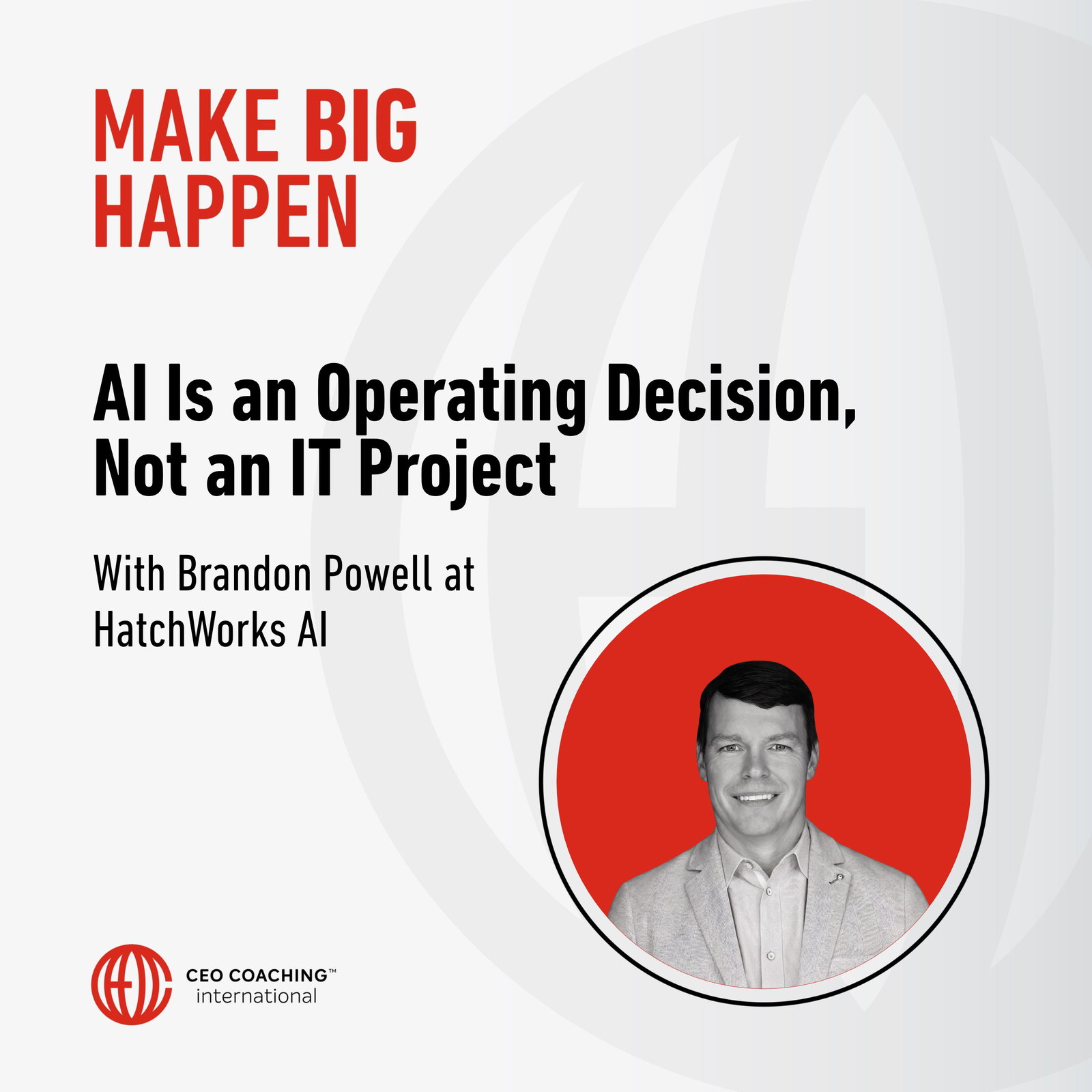
AI as an operating decision and “agentic” operating layer, not an IT project; redesigning how work gets done with AI agents plus humans, tied to P&L ROI, governance, and data/context.
Brandon Powell is CEO of HatchWorks AI. He’s a partner and client of CEO Coaching International and a YPO member. He frames AI as a business/operating model shift, not a technology conversation.
ChatGPT-era use (productivity prompts) is “faster horse”; newer models enable delegation to agents. Agents require a brain (reasoning model), hands (tool integrations), and judgment/orchestration rules. CEOs underestimate organizational change, data “boring stuff,” and AI sprawl without a plan. Governance must be built in from the start; security risk exists with connected personal assistants. ROI requires baselining workflows and reallocating human work.
“Jarvis/Skippy” agent answering questions in a summit audience. A commercial real estate firm used three agents (document parsing, broker field assistance, marketing image/context) to improve broker-to-office-hire ratio from 4:1 to 6:1. Voice agents capture off-hours calls/quotes (revenue) and software development is the most mature area (50–70% efficiency gains).
Written by AI. May contain mistakes.
Exploring the need for leaders to recognize transformational shifts, particularly in AI.
“maybe slightly longer, but that time has passed.”
Discussing how AI must be integrated into the company's operating model.
“We're going to break our chat today, Brandon, into four segments.”
Identifying the gap between AI adoption activities and real transformation outcomes.
“I was in a session about six months ago, and the head of technology was presenting on their AI strategy.”
Brandon explains the evolution from basic AI tools to advanced AI agents capable of reasoning.
“I had 200 software engineers when I went all in on AI two years ago.”
Explaining what AI agents are and how they differ from traditional AI tools.
“And so the agent has a brain and it has hands.”
How to practically implement AI agents to enhance business efficiency.
“And how long would it take you, Brandon, or your firm to build one of these agents for a CEO or a leader?”
Discussing the essential organizational changes required for successful AI integration.
“So do that at you've got 100 software developers.”
Learn why employee involvement is crucial for successful AI integration.
“and the people just revolted, including some of your own customers.”
Explore the challenges of AI sprawl and the importance of a cohesive plan.
“The bigger the business I go into, the more AI sprawl I see.”
Discover how AI agents could transform executive roles in the future.
“These models can't handle more than a million tokens of context.”
Weigh the pros and cons of building custom AI solutions versus purchasing.
“I would say like, I mean,$5 ,000 or less to build your own personal one, depending on what you're doing.”
Understand how to implement an AI operating layer within your organization.
“I believe the future is not humans versus AI.”
Learn how AI can enhance coaching and training for sales teams.
“And he said, Mark, I don't want you to talk to me or ask me any questions for the next 60 days.”
Explore strategies to prevent and address AI tool sprawl in organizations.
“So the 10%, we didn't cut our marketing team.”
Explore the issues companies face when adopting AI tools and the importance of leveraging data.
“And they're going to use the free version.”
Discuss the critical need for governance and security considerations when implementing AI.
“So as companies scale AI across their businesses, let's talk about governance and security because that's something that many worry about or if they don't worry about, they ought to be worrying about.”
Learn about a case study in commercial real estate showcasing AI's impact on efficiency and profitability.
“the importance of security and protecting information that is private.”
Understand how companies can balance efficiency improvements with revenue growth through AI.
“Are you seeing bigger opportunities on driving growth in revenue?”
Identify which functions in companies are rapidly adopting AI and the surprising industries involved.
“What functions in a company would you say are moving the fastest?”
Learn how AI is transforming industries beyond traditional tech sectors.
“Because AI, you know, AI can look at the day or see that Mark had an outage at his house or the rep was late.”
Discover the crucial steps CEOs should take when integrating AI into their business.
“Let's move to segment number four, the CEO playbook.”
Explore the concept of vibe coding and its practicality in business scenarios.
“What is it and why should the CEO care and what are the limitations?”
Learn what CEOs should focus on in the next 12 months to leverage AI effectively.
“So I think every CEO needs to move past the Claude and the chat GPTs and like, yes, that's part of it.”
Understand why AI decisions should be led by CEOs rather than delegated to IT.
“What is the impact organizationally going to be if I do this agent?”

Get the gist, explore an idea or ask about something said.
 Claude
On Make BIG Happen podcast with Mark Moses, what are the key points of this episode?
Searching your listeningAutomatic transcript. May contain errors.
0:00Welcome to the Make Big Happen podcast brought to you by CEO Coaching International. And after coaching more than 3 ,000 CEOs and leaders around the world for the last 18 years, I have learned that transformational shifts don't announce themselves. They start quietly, and the leaders who recognize them early can create an enormous advantage. The ones who wait spend years catching up, and this time is no different. We are living through one of those moments right now. When ChatGPT hit the market, most CEOs asked, how can my team use AI or use ChatGPT? And that was the right question for about 10 minutes, maybe slightly longer, but that time has passed.
0:49And the conversation has completely changed. The companies pulling ahead today are not just handing employees new tools. The redesign and how work actually gets done with people and AI agents executing together at a completely different level. My guest today is Brandon Powell, CEO of Hatchworks AI. Brandon is a partner at CEO Coaching International, and we trust him with our own clients, and including our own firm trusts him as well, to help guide us through this transformation. Brandon is also a client at CEO Coaching International, and also a YPO member. And what I appreciate about Brandon, he does not treat AI as a technology conversation.
1:42He treats it as a business conversation. How should your company operate differently? Brandon, I am super excited to have you here today. Welcome to the Make Big Happen podcast. Mark, thank you so much for having me. I'm excited to be here today. Well, terrific. I'm excited too. We're going to break our chat today, Brandon, into four segments. And the first segment is from ChatGPT. And I know there's more than ChatGPT. I don't even use it. I use Claude. I'm addicted. My wife thinks I have a mistress named Claude. So we're going to talk about from ChatGPT or your favorite LLM to agents. And so our theme for this section is the shift from AI as a productivity tool to AI as part of the company's operating model.
2:35and why agents are the technology behind it. And what I've been seeing across our client base every week, look, almost every CEO can tell me their people are using AI, and you know what? And they are. But very few can tell me their company runs differently because of it, and I'm sure you've seen the same, and how it's making a material difference in supporting their top goal. Now, I'll give you an example. I was in a session about six months ago, and the head of technology was presenting on their AI strategy. It was an excellent deck. It was pretty. Had a bunch of things, and everybody in the room was really impressed.
3:21Until I asked this question, which was, which one of all this stuff is going to help you drive one of your top two goals? there was silence and more silence. And then he said, I don't know. I'm sure you've experienced that. So what I found was there's this gap between activity or what they decided to do and actually the transformation. That's what I want to dig into with you in this first section. So So when ChatGPT exploded, followed by the others, everyone talked about using the right prompt and not leading the witness, right? But today the conversation's much bigger and these models keep getting better and better.
4:19So what changed, Brandon? Yeah, so I think at the beginning, this was really more of a, I'll use the car analogy back in the day. This was more of a faster horse, right? Chats for PT was just a way of whatever work you were already doing. Maybe you used it to write emails or maybe you used it to ask questions. It was just something that you conversed with. And then what happened is these models, they started to get smarter and smarter. And then they started to show you how they think, which is reasoning. And then they started to do work to the point where you could delegate to them to go do it.
4:51Instead of you asking all these questions, you just say, this is the goal I have. This is what I want. And so now it became something that you could actually offload and delegate work to. And that was the dynamic shift. It started with software engineers. I had 200 software engineers when I went all in on AI two years ago. And all it was essentially doing at first was line complete, right? Just like when you're typing a text and it auto finishes the line for you. That's what we were doing in coding. But now you go and literally tell it, this is the app I want. And these agents go off and they literally build the app that you want in plain English, even if you've never coded before.
5:30That's an example, but you're going to start to continue to see that type of adoption when it comes to agents across these different parts of the business functions. So you probably remember at the Make Big Happen Summit, there was a guy in the audience said, hey, and Peter Diamandis was presenting. You probably remember this because several people commented on this. He said, my AI agent Jarvis has a question for you, Peter. And Peter said, oh, that's never happened before. Skippy, who was Peter's agent, said, Skippy, will you answer that question for Jarvis? And then Jarvis responded with an answer to the question.
6:12And we all went, oh, my God, is this where the world is going? So everyone is hearing the term agentic AI, and everybody's talking about AI agents. In plain English, what is an AI agent, and how does one deploy an AI agent, and what's different about that from using ChatGPT, Claw, Gemini, et cetera? Yeah, and we do, you know, I do a lot of work. Agents, I also like to look at agents in terms of like there's enterprise agents and then there's personal and productivity agents. It's simple as terms. It's just software that does work. So if you think about SaaS, right? SaaS has been very disrupted by what's happening with AI because SaaS is nothing more than a database.
7:02You're Salesforce. It's a database with some sort of workflow and a UI and it stores your customer records. Now you can take an agent that acts like a BDR and the SaaS part of it's just included in what the agent is doing. And so think of an agent as software that does work. And an agent, in order to really be an agent, it really has a couple of parts to it. It has a brain, which is the model. When we didn't have reasoning, when first, when ChatGPD came out, it was like this black hole. You couldn't have agents because it wasn't thinking. It was just really answering your question. So once we had reasoning a year and a half, two years ago, now we had a brain that the agent can use.
7:43The next thing we have are hands, right? So hands would be the tools. So if I have an agent and I can connect it to my email or I can connect it to my CRM or I can connect it to my ERP, whatever your stack is, it's what my meeting notes that it takes. Now I've got hands. And so the agent has a brain and it has hands. And the third thing it has is judgment. Okay. And this is the part that goes sideways on a lot of people. Judgment is just what are you allowed to do and not allowed to do. The technical term is orchestration, but judgment is just the rules. What are the rules that the agent can follow?
8:20From a personal standpoint, to make this simple, I built and I led a lot of CEOs, and we can maybe put this in the meeting notes, is a guide to basically build your own personal assistant. And that's what Jarvis was. And that's what Peter had. And I have one. and it basically is an agent that is constantly looking at my world. So from a tools, it's connected to email, it's connected to my calendar, it's connected to my Slack, it's connected to my granola meeting notes and it runs every morning and it checks all these things and it comes and tells me, these are the things you need to do today. These are the things you didn't do.
8:52And so I look at it as like my right hand and it's just an agent with that level of access and the ability to think and it knows me because it has context and that's what they were doing as well. So I have an assistant. We've worked together for 27 years. You know her. Is there a way that I can get my agent that I don't have an agent to do some of that work or even prepare her better or follow up so I don't need to? Is that easy stuff to get done? And how does that practically work? Yeah. So I have a chief of staff, not as long as if you had your assistant, but I was like, at first, you know, this is where we get into this fear, right?
9:35Of like the agents are going to replace all the humans. So what I did is I don't need him reminding me the emails that I didn't follow up on the day before. I don't need him reminding me about what I have on the calendar today. So what I've tried to do is use the agent to do the 70 % of the busy work that wasn't really needed. And what I did with my chief of staff is I took him down to halftime working for me. And the other app, he's doing sales ops. He's doing rev ops. And so to me, the agents can do a lot of the tedious work, but they still, like, I don't want to depend on it to make sure that I'm on this podcast, which is very important.
10:12So he's texting me, making sure I have the link, making sure I have the thing. So I believe that there is a strong place for agents to do the work that's kind of monotonous, that doesn't need to be done by the human. And then there's a role for the human where there's critical thinking involved. If I needed him to create me a PowerPoint presentation, yeah, I can do it with Claude, but that's going to get it 80 % done. It needs to get the rest of the way. That's where he would come in. And he knows me. He knows the business. He knows whatever we're doing. So I see a role in the world for both. But this assistant for me has been like something that I use every day.
10:47It's probably the only thing with AI that every day I'm like, I check it, I look for the email. And by the way, he gets it too. So the same communication that comes from my agent to me also goes to my assistant so he can see everything that I've already seen. And how long would it take you, Brandon, or your firm to build one of these agents for a CEO or a leader? Oh, they can do these now in a couple of hours. And so we created a document and we've, you know, we'll just send it to whoever to try to build these. But that, what I just talked about is a simple thing that you can do within Claude.
11:21And I consider those personal agents. So a lot of times in businesses right now, they're confusing enterprise AI. And then like, let's use Claude as a productivity tool, for example, right? And that example I gave you about agent is a productivity tool that anyone who can follow directions or can ask claw on how to do it can help them build that. You could do that in two hours or less, and it doesn't have to be clawed. It could be Chad. It could be whatever harmonious you want. I know we talked earlier about we use that interchangeably, either one of those terms, but when it comes to an enterprise agent that's actually doing work, it's not a month's type of thing.
11:56If you identified the use case that you want to apply agent to, you can do that in days, you know, and some maybe weeks on the long side, and you can get some really valuable working on it. Hopefully we'll unpack that a little more around in terms of how do you actually use AI to transform your business versus just a faster horse, which is what a lot of people are doing. And we will for sure. What are CEOs still underestimating about where this is headed? I think the number one hands down thing is the organizational change that's needed. I have had to launch a change management practice because too many times the solution was right The data was right, but it didn't get adopted and it fell on its face.
12:39And if it doesn't get adopted, you're not going to get the ROI. So people are really missing kind of the curve and saying, look, okay, let's fish it. We build these agents, okay? And the example we gave about the assistant. So if I just keep the assistant doing the full-time job and then I've taken away 75 % of the work and I don't reallocate that to do something else, how do I actually get the ROI? And do that at scale. So do that at you've got 100 software developers. What we know today is that AI is at least 50 % more efficient in software. And we can measure software because they check code in and you can see how much code was done and how good was that code.
13:18And so if you think about that and you have 100 software engineers and you don't redesign the organization of like, do I need 100 or am I just going to do more capacity? Right. Am I going to get more out of those 100 people? And so org change is becoming really important. I'll throw something out that's controversial, but it's happening. And that is, why do you need middle management? If you've built an AI layer, and we'll dig into it in a second, that essentially middle management pushes down information from a leadership team. So why do I need middle management to push down information that if everyone's working from the same sheet of glass, the same data, it gets passed down?
13:55So I think organizational change, and it's hard. Do you know how many clients we've worked with where we built customer service agents and the people just revolted, including some of your own customers. And they revolted because they weren't part of the process and they were scared about what was happening. And if they revolt, then what are you going to do to actually get it? And if you don't make changes to how that team is formed, you're not going to get the return. That's one. The second thing is the boring stuff around the data. At the end of the day, we can build as much agents and these models are going to be within a hair of each other.
14:30And then it's going to come down to token costs. And we can talk about that as a whole great topic to go into. But that stuff's all going to get commoditized. So it's going to come down to how do you leverage your data with AI to be able to build a moat around your business? That's going to what this is all going to come down to. And I think people get enamored with let's roll out Claude. Here's your license. Here's your tool. Oh, look, we've got a bunch of people that are using Claude. That's great. OK, but what is Claude doing with your data to actually help you differentiate from your competitors?
15:03And so I think that those are really the two things that I think get missed the most. And I would say the third one is they don't have a plan. The bigger the business I go into, the more AI sprawl I see. And that means like Mark's got his thing that he's doing and he's got his little Claude. We call it his Claude Kingdom. Brandon's got his. He's over in marketing. And then the other departments using like chat GPT because they don't really like Claude, but they're doing the free version. You know, we see a lot of that and it's like all over the place. And so if you don't have a plan, like at least a high level plan of this is what we're using.
15:37This is our enterprise play. This is where we're going. You end up in that sprawl situation. And that's the biggest issue I see right now on any business of scale that's been doing AI for the last year. so to to be a little bit provocative you probably remember when peter was talking peter d mondays again and he started saying stuff like well you could have a cfo agent you could have a cmo agent so we're going through the the different roles in the c-suite and then somebody in the audience said hey how about us guys we work the hardest how about having somebody do our job as ceo and he said a year from now all of you will have a ceo agent tell me brandon let's start with let's just take this cmo agent and how does that functionally work and then take me to the point then how does a CEO agent work and how does that support the CEO?
16:45And then what happens? The CMO agent, the CFO agent, the CHRO agent, they're all reporting to the CEO agent. Is that how it works in practice? Sounds like, what's the CEO doing? Just kicking back by the pool. I love Peter. He's always pushing the envelope. So just how I put it, I've had a CEO assistant in a virtual board for probably a year. I actually built that back when I was mainly using Chagipity. You can build that in any of these. And I started running, from a personal standpoint, I started running a lot of issues and questions through that. Not to tell me like what to do, but to help me think through it.
17:22And so I think like right now at minimum, a lot of organizations have already built, like here's the CEO assistant, here's the CMO assistant, here's the CFO assistant. I think where it goes sideways and implementation is the amount of context that you need to be able to make the decisions that these leaders are making is through the roof. Like think about this for a second, right? Think of the Susan CMO, since that's the role they've got CRM and some of these CMOs are managing field operations, content marketing, e-commerce. I mean, these are some pretty heavy jobs and they have a lot of different windows in them.
17:59So if you're not able to pull everything into one place to where the agent can get a full view of everything from a context perspective, you're never going to get there. So I think the first step, and I've seen this already, and we've done this entirely, is building your own virtual organization. So your own, Mark has his agent, Brandon's the CMO, he has an agent, and those agents are all able to communicate with each other. But what I want to be clear on, we can all build agents till the sun comes up, but if we're not working from the same data in the same context, it's not going to be successful.
18:32The other thing we have to remember is context windows. These models can't handle more than a million tokens of context. I mean, it'll get better, but that's the only difference between you and me, Mark. You've been coaching CEOs for so long that even if we tried to replace you with AI, it's just not going to be able to grab the context that you have from the businesses that you've grown, the business. Same with all of your coaches, right? Some people are like, well, why do I need a coach when AI can just do the coaching for me? Like I have a coach. I've had a coach for six years. That's not what I need my coach for, right?
19:04And he's able to help me make these decisions based off 40, 30, 20 years experience that AI just can't get there. I would also say that where Peter is right is if you're starting a new organization, like I just started this in the last 12 months, 18 months, you build this from the start. You can build this organization from the start. And maybe you do get into a situation where like, why do I need a CFO? I do believe that. Anthropic is now coming after the finance jobs, right? They started with developers, get them hooked. Now I'm going to spread into the finance department, right? And it's numbers, just like coding.
19:38It's just numbers, right? So I think there will be a world, and I agree with Peter, that there are roles that you will not fill anymore that are done fully by AI. And I believe that there will be roles that expand because it allows us as leaders to, I don't know about you, but I'm doing way more than I've ever done in my life. You know, I'm doing, I'm able to like go over here. I know a little bit about a lot of things and AI helps, gives me a little more depth about those things. And so I think you're going to see new C-suite roles where it's like, oh, that person does operations and they do X and they do Y, right?
20:12And then they've got agents that are kind of underneath there that are like C-level agents helping them make those decisions. Just approximately, I don't want to put you on the spot, but I'm sure people are curious. What does it cost to build an agent called a chief of staff agent or a CMO agent? Ballpark. I built my own with just reading a guy. I would say like, I mean,$5 ,000 or less to build your own personal one, depending on what you're doing. And then as far as like these bigger agents, you've got to think about the data, right? So it's like the agent's not the complexity. It's actually easy to build the agent.
20:48But like the CMO, we talked about how many responsibilities they might have, right? Content creation is probably just one little one, right? That AI is really good at and you can go ahead and start having AI do a lot of your content creation. But the issue comes down to the data and the agents sit on top of the data. So like if the agents doesn't have access to data, it's just not going to make the decision. And the cost goes up as you have to clean more data, pull more data together, but just rough, maybe 50 ,000, 30 ,000 to do something like that. Cause those are not, those are not the most complex.
21:21Let's talk about customer service agent. There's a lot of out of the box products now, right? That are like, this is your customer service agent in a box. And it's less about building and more about configuring. And that's a big decision. A lot of CEOs are struggling with today is do I build or do I buy? And we, you know, maybe we can get into that later, but there's a lot of agents now that you buy. You don't even build them. And those are more of a SaaS model, right? Or a consumption model where you're going to pay on a monthly or yearly basis for what they're doing. Let's move to segment two, AI as the operating layer.
21:56I believe the future is not humans versus AI. It's really about how they work together and work together with their AI agents. So what does an AI operating layer actually look like inside a business? This is the hottest topic this year that I see. Like I literally have a lot of clients that will be like, I want an intelligence layer. That's the name that a lot of people have started calling it. I want an intelligence layer or they might call it an AI stack or something. And so at the end of the day, most businesses already have a cloud infrastructure, right? AWS, Azure, whatever your flavor is.
22:32You had that, you've had it a long time. And then a lot of companies have a data warehouse or a data lake, right? They got something where they've stored some data. Okay. But most of the time that data is like ERP, maybe it's their CRM, but it's not everything. An intelligence layer is everything. Everything happening in the business gets captured. This call that you and I are having, full transcript loaded in the intelligence layer. Every Slack or Teams or whatever you're on in the intelligence layer. Some companies do every email, even personal, back and forth in the email cloud in there. So the difference between what's been happening before and what's happening now is that you've got to put everything in the intelligence layer because it's only as smart as the data it has.
23:16So giving it like six months of sales data, cool. You probably already have been doing that in your data lake. That's not what moves the needle. What moves the needle is all that data plus everything that your every call your salespeople have. every call. And you go and you say, okay, that was what a good call was because that ended up in a deal. That's what a bad call is. Now I've got the good and I've got the bad. All ends up in there. So now I could build an agent that's literally coaching my salespeople what to say, what not to say based off good and bad. But in the past, we would have just said, oh, okay, we got our CRM data.
23:51Let's see how the sales stuff is going. So an intelligence layer takes everything. And think of it is like where work gets done. So the people that nail this, they're going to be able to have everything that gets captured in this layer, everything happening in the business, every call. And now I've got everything that my humans were doing. And so I can figure out where should I be using agents and where should I be using humans? I love that sales example. Years ago, I hired Jack Daly is my chief operating officer. And he said, Mark, I don't want you to talk to me or ask me any questions for the next 60 days.
24:30Okay. What are you going to be doing? He said, I'm going to be listening to 160 salespeople and learn what best in class looks like. And after two months, he comes back to me and he says, you know what I learned? Your team is selling this like there's 160 different ways to sell your service. What was frustrating to me by that was, oh my God, we're selling, there's 160 different ways of selling this process or the service where AI can come in and say, here's what best in class looks like, and here's what bad looks like, and here's how to fix it. Give me an example on how the coaching would work on that.
25:14AI's looked at what best in class looks like. It looked at the, I'll say the, some of what doesn't look good and does not lead to a deal or creates insecurity in a client. How does that all work in practice? Yeah. So what we've done internally for our own, like call it like, we call it a pre-sales agent or assistant, right? Like business in our space gets done human to human, but we just onboarded a new salesperson on Monday. She got great consulting background, blah, blah, blah. But she doesn't know the solutions we've sold. She doesn't know proposals. She doesn't know how to talk about us. She doesn't know any of those things.
25:52And so what we've done is we've built an agent that uses all that data, every proposal we've ever done. Okay. That's in the intelligence layer. Every proposal we've ever done. Did we win it? Did we lose it? Every call record, right? Obviously we want to take the best salespeople's call records and we want to use that to train her, not the bad ones, but we can use the counter to say, look, this is what you should not be doing. This is how you should not be leading there. And for us, it's not about replacing her. It's about getting her up to speed. If we can improve her, it takes about six months for us to get someone really selling there.
26:26And so her boss is still the coach. Okay. But now she can use this data that we've gathered over the last couple of years of selling AI projects to ramp up faster so that the coaching is more about the gray area, the stuff that's not super clear. And what it actually does, and I do that with my coach, my CEO coach even, is I don't talk to him about some of the same things that I used to talk to him about. I actually go bigger picture because now I'm handling some of that other stuff with my own agent, right? My own virtual agent, my own CEO assistant. And we see the same thing in sales from like in that organization.
27:02Marketing, we're doing the same thing. 90 % of our content a lot of times is created by AI or at least influenced by AI. So the 10%, we didn't cut our marketing team. All we did was like, we can actually market at a scale much bigger than companies that are the same size as us. So I keep hearing CEOs complain about having all these different disconnected AI tools. How do you avoid that trap? And if you're already in that trap, what do you do about it so you don't have this disconnected organization. All right. We could spend a whole hour on this topic, but it's a valid. So, you know, that's where this AI sprawl comes in.
27:45But here's what I think people are missing. So if I give you, let's use Copilot. Copilot's still lagging the market, right? So when a CEO says, here's Copilot, most of the time they have to say, yeah, if I don't give them access to Anthropic, it's a cloud, or I don't give them access to chat, what are they going to do? They're going to use it anyways. And they're going to use the free version. And that's giving security and that's putting data at risk. What I tell people is if you can give the, if whatever tool you're using, if you do the data and you leverage your data, that tool will be smarter than any other tool.
28:19So even Copilot, if Copilot is built using all of your data, humans are lazy, ever how you want it, lazy or efficient, ever how you want to look at it. They're going to do whatever it takes to do the job the fastest and the easiest. And so if you can make Copilot, I'll use it as an example, smarter than Claude or smarter than chat because it's built on your data and we're talking about our work, we're talking about our job at work. That's how you can start to bend the curve on this tool thing. The other thing is a lot of CEOs think that tools are solving the problem of AI in their business. And again, it's a faster horse.
28:58And so they just keep rolling out more tools and they actually think that they're doing something. I don't care how many tokens you use. That's great. You get to a point where first you're driving adoption, then you're talking about, I don't want to spend this much on tokens. And that's a problem with how they're rolling it out. And then they also think that training is going to move the needle. Here, Mark, go take your Claude course. Here's your enterprise license. Let's go. And what happens is there's like a couple of high achievers in each of these groups across the business. They're crushing it.
29:28They love it. They're more productive than they've ever been. But the other 80 % are like, what's happening here? And they're not following along. And so if you want to drive adoption with these tools, one, you've got to pick one and you've got to make it smarter than the others by leveraging your data. Number two is you've got to incentivize them. Okay, I've seen companies incentivize token usage as a game, literally like a game, like Mark used. Again, you do that for a minute to drive adoption and then that becomes not so good on the P &L. But I've seen that where they make it a game. They make it part of the bonus.
30:02We did a lot of hackathons and we put money on the line and all you could use was AI. One tool or whatever we selected. And so CEOs, a lot of times, they just keep adding tools, thinking that they're going to increase the productivity of their business. But a lot of times they end up with this token bill and a couple of people burn all the tokens and the rest of them never really did anything. Very interesting. So as companies scale AI across their businesses, let's talk about governance and security because that's something that many worry about or if they don't worry about, they ought to be worrying about.
30:40What keeps this from becoming a real risk or problem for a lot of companies? Yeah, I want to be clear that there is risk with, like I mentioned, not personal assistant agent. Okay, that is connected from Claude Cowork on my desktop to our enterprise email, calendar, Slack, all that. There's risk there because I don't control how Claude integrates with those tools, right? So those could be had. So I want to be clear that everything we've been talking about has risk. What I think is the best way is when you're looking at rolling out AI, think about governance from the beginning, okay? Because if you wait until there's a problem, what happens?
31:23We're humans. We over-rotate. We over-rotate when there's a problem. And then what you do is you put so much governance in that you lose your ability to go fast, okay? And so you should think about governance from the beginning. I work with some customers that are in healthcare and finance, and it's off limits to go use Cloud and uses. We have to build in the infrastructure, okay? And so what I mean by that is only Microsoft and Google can you build agents right where the data is, right? Because they're both hyperscalers. They both have cloud. So remember we talked about having cloud and having a data lake or a data warehouse.
31:59Those two platforms, and I'm not endorsing either one, I'm saying that you can, with those platforms, you can build agents more securely because you can build it in the same infrastructure where the data lives, right? And so when you're building in a quad or one of these other harnesses, if it's not local, which it's not, that brings more risk. And so my point is that there's ability with how you choose your stack to give yourself more governance than, hey, guys, here's a bunch of tools. Let's go use these tools. And so governance comes down to mean when you build that strategy and then build that plan, say, hey, these are the two use cases that we want to go.
32:38We think these are tied to P &L. We're going to get ROI on these. immediately, you should start thinking about how are we going to govern these? What's going to be our process? What happens if this goes sideways? What happens? And we've already replaced some of these people or what happens if we have a data breach? So you have to think about these things up front. And I believe that if you're hiring someone to do this or you're bringing people internally that you're hiring into your business, it's got to be top of mind for you as a leader. Are they just pure builders or they actually think about the risk that's associated with what we're going to do.
33:13Great description of that. And I can't emphasize enough the importance of security and protecting information that is private. Let me move to segment number three and what's working right now. And I'm going to push you with some examples and And that may be some specifics, some numbers, timelines. So give me an example of a company that fundamentally changed how it gets work done with AI. Walk us through what they did and what it produced. Yeah, I'm going to use, I have a lot of, I think this one's interesting. So we started working with the midsize. They're like CVRE. So they're in like commercial real estate.
34:00They're not, it's not CBRE, but it's a mid, it's a mid cap size where CBRE is a big competitor, right? And so this company about three, 400 million, but trying to scale to a billion. So the first thing we did with them was we spent five weeks and you don't have to spend this long anymore. This was a year and a half ago. We spent five weeks figuring out what are the use cases that are the bottleneck in the business. Okay. And so the highest paid people are these brokers, right? These are brokers out in the field. They got California, got offices all over the place. You would know this brand. They got offices all over the place, but these brokers are the highest paid people.
34:38And for what we found is that for every two brokers, they have to add another person in the home office to do paperwork, to do contract stuff, to like do location stuff. And so what we did, and this was before we even knew what this was going to be called, was we built an intelligence layer and said, all right, what are the, we had five use cases. we decided to start with three. And all three use cases focused on that broker because it was easy to measure the P &L. If we can hire four brokers and only then add one, we just doubled what we were doing before. So that measurement part is very important.
35:14A lot of companies just start building, start throwing AI out there. They have no idea what their baseline is. This was simple to measure. Are we still hiring a person in the office for two brokers or not? Very simple. And those people cost about a hundred thousand dollars each as we do this and there's errors involved okay so we started out with three agents that we know ai is good at okay it's great at document parsing if you've loaded a document in chat gbt or claude it's amazing at figuring out what's what and what's there so we built an agent and for these this company we did everything in google we had to because they needed there's a lot of finance data happening and numbers with these leases and stuff that's happening.
35:53So we built that. We built another agent that helps the broker on location. So if Mark's got a business and he's got one of these brokers out there in the market trying to figure out the best corner to put his restaurant or his office space on, this assistant pulled data from these other systems that they were using so that Mark had kind of an assistant out in the field. And he could quickly, as a broker, talk to that assistant, which was an agent. And it would say, nah, you got to look at this property over here. This would be a great spot. So encouraging them and telling them where to go. And then the third one was a marketing agent.
36:26So what we found is when they listed properties, they spent a lot of hours and spent a lot of money, even though they had offshored it in building content, like making it look pretty, right? They take the pictures and stuff could be done with AI in one click, right? And so we built an agent so that the broker literally could just load the images that they were taking of the things and it would build the context for the marketing. Now that didn't mean get rid of all the marketing people. It just did 80 % of the work. So those three agents for them, I think they're like, last time I checked, they're even more at six to one.
36:59So we started with a goal of four to one, four brokers to one person hired in the office. And we ended at six to one now. And now what they've done is they've taken that in-house, they've built their own team. They've hired a director of AI. They've brought that in-house because I believe every company has to own this. Even as a consulting company, I believe you have to own this. You have to have a path to being able to own AI. Otherwise, what are you doing? Because it's an operating thing. It's not, I guess we started this call. This is an operating thing. This is not an IT project that you just outsource and forget about it.
37:35Are you seeing bigger opportunities on driving growth in revenue? or are you seeing it more on the efficiency side of a business or are you seeing it in the reduction of costs? Yeah, great. I see it on both, but here's the thing. Efficiency on the back office, that's the low-hanging fruit. Okay, but if you want to go big, and this is make big happen, if you want to go big, you look at the revenue side. I suggest you do both at the same time, but if you need a win and you need to quickly get started, you go there. but here's where I'm seeing massive opportunity. I've seen multiple businesses now that were reluctant to launch a voice agent because they're like, we have these people in the office that answer the phone and they sell.
38:21That's cool. What do they do when they're not in the office from five at night till nine the next day? Oh, they leave a voicemail. Sometimes we call them back. Sometimes we don't. And so what I've seen is this use case across multiple businesses. So built a voice agent. At five o 'clock, the voice agent starts answering. Most of these businesses, they need to get a quote. And usually they'll give you a quote if you go on their website and do stuff. But most of these businesses, people call. And so the AI agent takes the information and it's awesome. It has a great conversation with them. It ties into the scheduling system and it schedules a time and gives them a quote for Mark to meet them at the facility or whatever they're doing, if they're okay.
39:01Or if it's, I've seen this in home health as well. And so what they're doing is they're capturing revenue in the off hours that they were leaving on the floor on the weekend, leaving it on the floor. No one ever calls back. And a lot of these businesses, they want it today. If I need a home health nurse, I want it today. I need you to get out here because my mom, I can't take care of her anymore. Right. And so my point there is that's a revenue case, but it's a case that you're not even doing anything with. You didn't disrupt your current piece. You didn't replace your in-house people. you basically built another revenue stream of things that you were dropping on the floor.
39:35The other thing I'll say with efficiency, and we can have a whole call on this whole thing, is like, everyone's like, oh, I want to automate my accounts receivable. Okay, how many people do that? You're tying it back to the P &L. And then what happens if your invoice is wrong? Million dollar invoices, sometimes$5 million invoices, it's a big problem if they're wrong, right? So the juice, is it worth the squeeze if they've got one person, two people doing it, And so like, would I start there? No. One, it's risky because these are multimillion dollar invoices going out. And so you're going to have to have a human check on anyways.
40:08And your upside is like, what is your upside on one or two people? Right. And so that's why you look at things like customer care, where maybe some companies have 400 people doing it. And it's like, how can I go after this? And so, Mark, my biggest thing is P &L. Bottom line is P &L. And of course, there's only top line and people focus down below and looking at OPEX and looking at CAPEX and how I can cut that. But I believe in going in balanced. And if you're conservative, of course, start with the efficiency side. But if you actually want to really move the needle, look at your quoting, look at your things that are going to drive the top line revenue and at least have a use case there that you're considering doing, because that's where I've seen the highest transformation.
40:50What functions in a company would you say are moving the fastest? And what has surprised you the most about who is winning? Yeah, so hands down, software development, that was my background. It's like if you're not getting 50 % to 70 % efficiency in software development, meaning if you can't produce, let's use the 100 developers we talked about earlier. If you still have 100 developers and you're not producing 70 % more with those, then there's something wrong. So that's by far the most mature space is in the software side. In marketing, if you're not creating, marketing content is about 80 % AI generated.
41:31So if you've not quadrupled or improved your content creation, then you have a problem. But those are the two functions that I see a lot of in customer service. And when I say customer service, people misunderstand. They think that if Mark's a customer service agent, let's just say I'm an old school business and humans are a big part of it. They want to, my customers want to talk on the phone to Mark. That doesn't mean that you build a voice agent like I gave earlier and you replace Mark. Why not use AI to predict why they're calling in the first place so that Mark can get off the phone in one minute instead of five minutes?
42:06Because AI, you know, AI can look at the day or see that Mark had an outage at his house or the rep was late. And so like trying to predict, you know, looking at there's different variables in there and they don't, a lot of them don't really involve replacing. If I can move the needle on call time from five minutes to one minute, I just 5x the number of calls that I can take with Mark. Right. And so looking at things through that lens, I think are important. Industries. This is the shocking part. So I've done a lot of work with SaaS businesses because they build software. And they're like in this weird space, right?
42:38Where it's like, all right, do I just drop AI into this thing I already have? I see a lot of customers just rebuilding their SaaS platform with AI. But where I've seen the most surprising thing is I've always more worked in healthcare, fintech, and SaaS. I've never in my life been taken into so many different industries, industrials, distribution, manufacturing. And it's awesome because you go in, they don't have anything. It's like they skip the software stuff altogether, right? And so it actually makes it cleaner for them. And this is a whole world that I never had exposure to, was like this kind of like all these businesses that kind of like make the world work.
43:17And they're betting. I mean, a lot of them are PE back. And these PEs are not messing around when it comes to investment in these. And they look at it as from a portfolio view. But the middle market, non-technical industries has been fascinating. to me. Construction, the real estate example I gave, they're not messing around. What's cool about it is it's allowing them to compete with much bigger customers that can't get out of their own way. The bigger the company is, the harder it is to make this transformation. And so if you're a mid-sized business and you got good coaching and good leadership, and you're really vested in going in on AI and going big, you can compete with companies way bigger than you because their size works against them at scale.
44:02Let's move to segment number four, the CEO playbook. So where should a CEO listening today actually begin? And what is the biggest mistake that leadership teams make when they're getting started? Yeah. So I think everyone will tell you, you can start small and all that. That's fine. I think the biggest thing is making sure that you can baseline the ROI. And so what I like to do is when I'm working with customers is like, let's look at the P &L. Let's figure out where the cost centers are. Let's look at the sales process. That's a top line thing. Let's look at the sales process and figure out where could we use AI to go faster.
44:41Let's look at marketing. Let's look at all of these things. And I suggest you look at the whole business and that you have an open mind versus saying, well, I know I need to do finance. OK, so what you want to do is figure out the use cases. This is a business exercise, not a technology exercise. The first step is to figure out the workflows that are the most impactful to your business. OK, now, if you want to do something small, do it. But I suggest looking at the most impactful workflows in your business. And that's how we found some of these quoting use cases and stuff. It was like they're like blood and AI could do it really quickly.
45:13So identify those cases and then you need to prove it. OK, there's a proof to assess everything. but then you need to prove it. Okay. And start with one or two, but you need to have a baseline of what it looks like. So just like I told you earlier, we knew the ratio two to one. That was the ratio. You need a baseline for whatever you're going to do. Eight out of 10 customers have no baseline of what does good even look like? And that's why they sit in this pilot purgatory is what we call it. We walk in. I've never seen so many pilots in my life. And I'm like, and why is it stuck? We don't know if it's actually giving us ROI.
45:49Of course you don't because you didn't measure it against the baseline of what you were doing before, right? So if you're doing customer service, call quality is probably one of your baselines and understanding your customer scores. And so you've got to prove it. And that's where a lot of companies get stuck. And then you've got to scale it. But the reason they get stuck in the prove it is usually not a technical problem. Okay. It's either changed because they don't know how to scale it with their people. Their people are scared. They revolt. They don't want to do with the pilot or they can't measure the ROI.
46:17And then they stop. Okay. And those three things, if you're looking at your business are the most important. I would also argue that even if you start with use cases that are not maybe so dependent on data, that you get that data process working. Okay. And I don't mean transform all of your data. Look at those use cases that you decided were the biggest needle movers in your business and get that data. What data is needed for those most important use cases? A lot of companies will wait. They'll be like, oh, we got a year data transformation project going on before we can do AI. And that's just not true.
46:52You don't need all of that data for some of these use cases. And so that's what I like to do. Identify the use cases, then work myself down all the way down into the data, figure out if I got clean data. If I got clean data, that's what I want to go take and try to prove. And then I want to go and scale it as soon as I've done a 30, 60, whatever you're trying to run from an ROI perspective. Very interesting. Thank you for that. Let's talk about vibe coding. What is it and why should the CEO care and what are the limitations? Yeah, so vibe coding in simple English is that it allows us as non-developers to quickly build something in English.
47:32Literally, you can just go in there and say what you want and then it gives it to you and then you just keep iterating with it. and it's very valid. It has a place and its place is more around like how do I, I like to use it as an idea. I'm an idea person. I'm not an engineer. I'm not that technical, but it allows me to go and vibe code something. And I say, instead of like some document with a bunch of requirements, I say, this is what I want. I want it to work like this and it works. It's like there. But I would argue that since I do a lot of work in healthcare and stuff, you can't, it's not scalable, meaning I can't just take that vibe coded thing and then start running HIPAA data through it because I'm going to end up getting sued.
48:11And so like to me, vibe coding allows us non-technical people to quickly be able to build out an idea. Some could even use it to get started in a business. So like you're trialing an idea or proof of concept. I think it's great for that. I don't think it's as effective in a large business that has an app with lots of customers and they're trying to scale it. So my point is it has a space and then you would move into more AI-driven development where you're leveraging AI to harden things and build it and scale it. So I'm an accountability guy, as you know. So it's 12 months from now. So call it, it's next July.
48:50And what should every CEO have accomplished 12 months from now? And how should they measure success? Yeah. So I think every CEO needs to move past the Claude and the chat GPTs and like, yes, that's part of it. Every seed needs to have at least automated two of their most critical workflows in the business. Okay. And by, by the way, a workflow is made up of tasks. And so if you just start with tasks, you say a workflow has seven things that it does. If you start with some of the most tedious task of that workflow, you got to, and you redesign, rethink the workflow, you can start to chip away at that, a task at a time.
49:36Task, and before you know it, you've automated a lot of the workflow and the human's only doing the things that weren't needed. I challenge you to reimagine the workflow. So two of those, within the next 12 months, you need to do. The other thing you need to do is you've got to figure out your data. You've got to figure out the data that you need for the most critical use cases in your business and you've got to start to build that intelligence layer. Part of building the intelligence layer, one is legacy data, but the other part of it is what's happening every day in your business. Get the read AI or the granolas or whatever you're using in your business, get the SharePoint data, all those Word documents, PowerPoint documents, get all of that stuff in one place so that now you're starting to build the foundation of what can be the operating system for your business.
50:27So to me, it's you do those things in parallel. You work on the workflows, you identify the data, you start, you know, you can start to make the decision today to start recording calls and getting all those loaded. Those are things that you can do right now. The other thing that you have to think about is your organization. As you make these changes, you will come into major impacts organizationally. And so if you think about that from the beginning about, okay, if I do this in customer service, how do I bring them along for the journey? Am I going to reassign some of them? You look at what Ikea did, thousands of them, turned them into design consultants.
51:02So moved them from a cost center to a revenue center. That's an organizational change, a massive one. But even little changes in our business, you need to think about that upfront. And then as we talked about earlier, the governance piece, think about it upfront. What's my plan? How am I going to make sure that this stays secure? How much risk do I have with this data that I'm using. But those to me would be the channels to think through over the next 12 months. Brandon, we have over 300 ,000 CEOs in our database. And there'll probably be a lot of those that'll listen to this. What is it that they should do in the next 30 days to prepare their organization for this next wave?
51:46What would you advise them to do? So I think the most important thing in 30 days is to go ahead and do the work to build the plan. So figure out, when I say plan, you don't need a two-year roadmap. That stuff's irrelevant, honestly. I mean, I see it, but you don't need a two-year roadmap on AI when it's moving this fast. What are you going to do the next six months? What are you going to do? Max 12. What are you going to do over the next 12 months? The world has been condensed because of the seed that we're dealing with, right? And so you don't, yes, it's important to have a three-year plan, five-year plan.
52:17But when it comes to AI, you need to look at your plan every single month, not quarter, not year, every single month. And so in the next 30 days, have that exercise. By the way, you can go to our website if you want to download a free, I don't see any of the data. It's an agent finder on Hatchworks.com. And we'll put it in the show notes that literally helps you find use cases after you answer questions about your business. And so at the end of the day, identify those use cases, ever how you do that. but I would start with the P &L and I would work backwards. The other thing I would do is as you identify the use cases, how will you measure success?
52:53How will you measure whether that is going to work? Otherwise, you're just going to get stuck in the pilot phase. Third piece is what is the impact on my people? Organizationally. Okay. So those two use cases and do it in that first 30 days. What is the impact organizationally going to be if I do this agent? I have many times worked with clients that the most interesting use case would be the hardest change management on the people. And we chose to do something else first, even though that use case had a higher ROI, it had a much bigger risk from a change management perspective. And so we actually use change management and the impact to the organization to help us select a different use case to start with.
53:33Brandon, I think that's an excellent answer. And I'm going to add to that. I believe it's not a technology decision. And I don't recommend CEOs delegate this to IT. This is vision and operating decisions, which belong to the CEO. And I also believe the winners will not be the ones that have access to the best AI because we all have that now. Everybody's got access to the best AI, the winners will be figure out how to redesign the organization that gets work done. And like you said, you use the word ROI over and over together and go over the most impactful things in the organization rather than trying to be all things to all people.
54:22And that's a leadership job. And it starts with us as leaders of our businesses. is. Brandon, I want to thank you for coming and joining us here at the Make Big Happen podcast. I appreciate your wisdom and insight. And you're a smart guy, clearly. You said you're not really a technology guy or an engineer, but you clearly understand and come off understanding the big picture as to how Hatchworks AI can help businesses achieve what they want and drive more ROI in their business. So on behalf of all of us here at CEO Coaching International, I want to thank you. Keep doing the good work that you're doing.
55:07And once again, thanks for joining us on the Make Big Happen podcast. Thank you, Mark. I appreciate you having me. There are three kinds of people, those who make big happen, those who let things happen, and those who ask what happens. Don't just listen to these stories. Decide who you're going to be. Show notes and resources are available at CEOCoachingInternational.com. Subscribe so you don't miss what's next. At some point, every leader faces a choice. Play it safe or go big. If you're ready to make big happen, visit CEOCoachingInternational.com and learn how our Been There, Done That CEO coaches can help you make big happen.
Almost every CEO I talk to tells me their people are using AI.
My question is: What has fundamentally changed in your business because of it?
Are you growing revenue? Improving margins? Serving customers better? Or are you simply giving your people new tools to do the same work?
My wife jokes that I have a mistress named Claude. I use AI every day. But after 18 years of coaching more than 3,000 CEOs and leaders, I’ve learned that having the latest technology means very little if it doesn’t produce results.
Years ago, I hired Jack Daly as my COO. He spent 60 days listening to 160 salespeople and discovered they were selling our services 160 different ways.
Today, AI can analyze every sales call, identify what the best performers do differently, and help coach the entire team.
That’s not just doing things faster. That’s changing how your business operates.
In this episode of Make BIG Happen, I sit down with Brandon Powell, CEO of HatchWorks AI, to discuss what it really takes to turn AI into a competitive advantage.
Brandon shares how one commercial real estate firm used three AI agents to go from needing one support employee for every two brokers to supporting six brokers per employee. He also explains why so many AI initiatives never deliver a measurable return and what CEOs need to do differently.
Because AI transformation isn’t an IT project.
It’s a leadership decision. And it belongs to the CEO.
WHAT YOU’LL LEARN
KEY TAKEAWAYS
00:00 Why the biggest AI opportunity isn’t better tools. It’s building a better business.
04:22 Moving beyond ChatGPT to AI agents that actually do the work.
06:42 What every CEO needs to understand about AI agents.
09:28 Freeing your best people to focus on higher-value work.
12:23 Why AI transformation fails when your people don’t come along.
22:11 Turning your company’s data into a competitive advantage.
30:47 Building AI governance and security into your strategy from day one.
33:51 How three AI agents helped a real estate firm move from two brokers per support employee to six.
38:09 The revenue opportunities hiding in unanswered customer calls.
44:18 How to identify AI opportunities, measure ROI, and scale what works.
49:01 What every CEO should accomplish in the next 12 months.
51:49 Your next 30 days: identify your biggest opportunities, establish success measures, and prepare your people.
53:33 Why the CEO must lead AI transformation.
Here’s the bottom line.
The companies that win BIG with AI won’t be the ones experimenting with the most tools.
They’ll be the ones willing to rethink how their businesses operate, make the difficult decisions, and hold their teams accountable for measurable results.
The question isn’t whether your company is using AI. It’s whether AI is helping you build a better business.
RESOURCES MENTIONED
HatchWorks AI, Brandon’s AI firm, which builds AI agents and solutions for companies and helps their teams adopt them.
HatchWorks AI Agentic Opportunity Finder, a free tool that helps you find AI agent use cases for your business after answering a few questions about it.
https://hatchworks.com/agentic-opportunity-finder/
Subscribe to Make BIG Happen for more conversations with CEOs and business leaders who are thinking BIGGER, making difficult decisions, and building extraordinary businesses.
#MakeBIGHappen #CEOCoaching #Leadership