Ask ChatGPT
 Make BIG Happen podcast with Mark Moses
2 Sep 2026 · 52m · 21 chapters
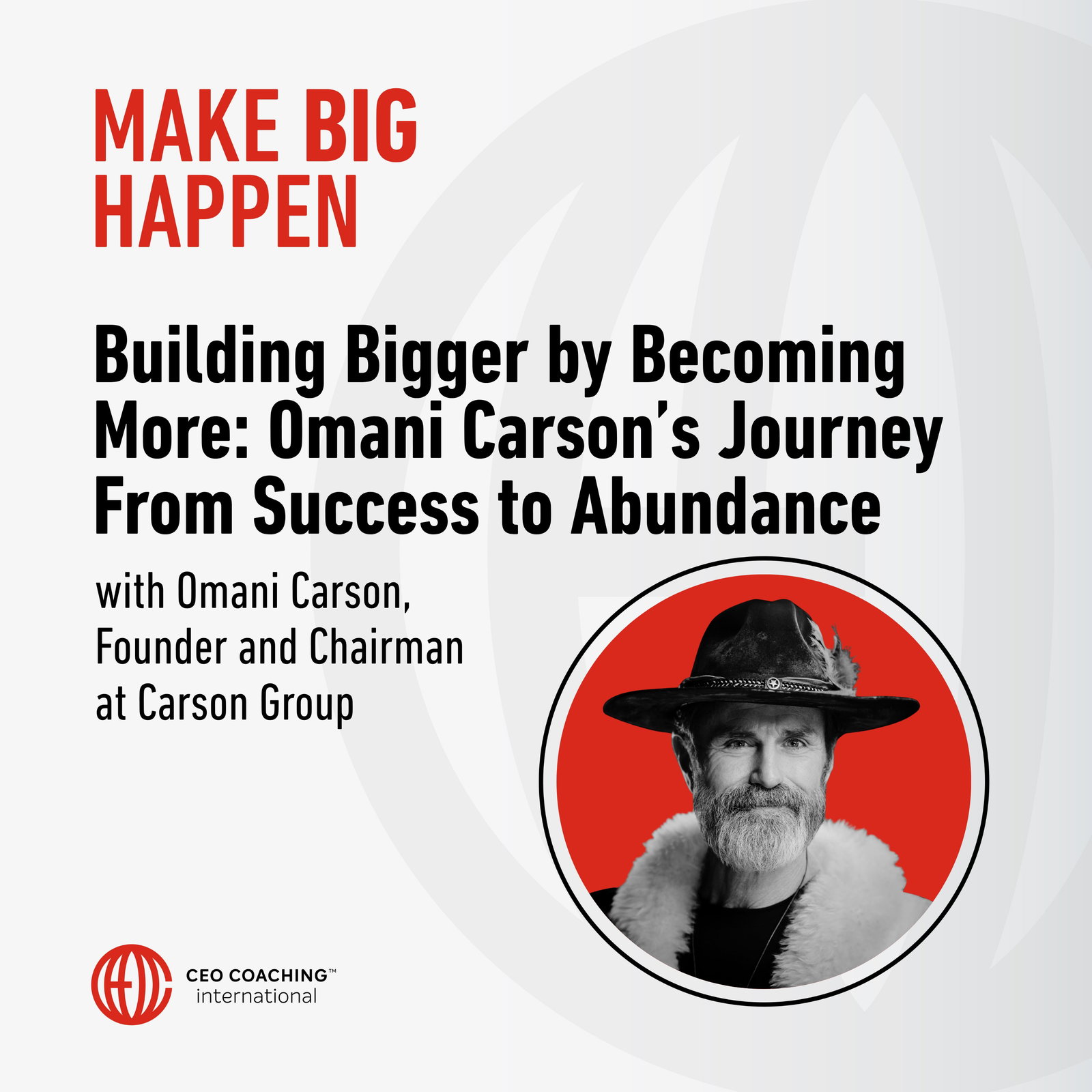
Omani Carson (formerly Ron Carson) discusses his shift from “success” to “abundance,” linking personal transformation to business scaling. He argues that exponential thinking, disciplined goal systems, hiring elite talent, and leveraging clean data/AI enable growth from ~$3B to ~$60B+ AUM, with a vision of becoming a trillion-dollar RIA while funding impact through his family office and conscious capital network.
Omani Carson is a financial-services entrepreneur and coach. He started his business in a college dorm room after trauma and financial collapse in his teens. He later built a coaching firm (CEO Coaching International) and a financial services platform, and has coached for 16 years with Mark. He changed his name to “Omani” after indigenous spiritual work (Lakota name “Tate Omani”) and psychedelic experiences.
“Add a zero” mindset; mistakes are learning; childhood trauma predicts entrepreneurial resilience; “pay up for the best” and share equity; step down from CEO fully; attraction over promotion; AI + clean data drives productivity and profitability; conscious capital and impact alignment accelerates scale.
Rim-to-rim-to-rim Grand Canyon as “just Tuesday”; blueprinting/life-by-design process; Bain valuation north of $1B; CEO transition to Bert White; CO2-to-jet-fuel investment; Nebraska ranch gatherings with ideologically diverse speakers.
Written by AI. May contain mistakes.
Omani reflects on his early days in business while in college.
“Thank you for the beautiful introduction.”
Omani shares how his upbringing and family struggles influenced his drive.
“Mark, I was just trying to survive, you know, that for the, for the people listening to this or watching it, it never met me.”
Omani explains why he sought a coach and the process of finding one.
“And then you said, Hey, sorry, you graduated from college.”
Omani discusses the moment he realized he needed to add more zeros to his goals.
“So that was my official starting point from my college dorm room.”
Exploration of how adding a zero transformed Omani's approach to business.
“Like give me two or three choices and I'll pick one.”
Learn how exponential thinking can transform business growth strategies.
“And Mark, you said, and I know you probably use this in the middle of time.”
Explore the impact of infrastructure investments and AI on business performance.
“It's just every decision you make needs to be thought of through, looked at through the lens of, we're not trying to grow to 5 billion or 50 billion.”
Discover effective goal-setting techniques and the importance of accountability.
“our biggest competitor is cost of doing business because of the architecture of the data and the tech infrastructure that we built.”
Understand the blueprinting process and its role in intentional life design.
“Live a life, an intentional life around exactly what you want to do, who you want to do it with.”
Hear insights on how to learn from leadership mistakes and the value of hiring top talent.
“That's a whole other thing to really truly live it.”
Learn about the challenges and strategies for successfully transitioning leadership roles.
“People that are willing to operate in the results-based economy are going to want to have equity and so be willing to share it.”
Omani discusses the difficulties and realizations of stepping down as CEO.
“I mean, they were, they, they, what they didn't want is me to be unengaged and I'm as, I'm as engaged as ever.”
Omani reflects on rediscovering joy and fun in his work after stepping back.
“I mean, it was, I wasn't in the, you know, like we're in the financial press all the time and it was no longer CEO Amani Carson at CEO Burt White.”
Omani shares his transformative journey toward self-love and understanding.
“This has been a newer thing for me in the last decade is learning how to truly have a lot of fun.”
Omani explains the significance of changing his name and the personal evolution it represents.
“to the fact that, that, you know, it's alcohol is a drug that's just ruining a lot of lives.”
Omani discusses his efforts to unite people with differing views and values.
“And all the work I had done for years, I started going by Omani.”
Omani shares insights on the future of climate solutions and the opportunities ahead.
“And by the way, and it'll be here on your podcast, massive fortunes like Apple, Google, and Amazon over the next 20 years are going to come out of climate solutions.”
Discover how experiences at Omani's ranch can drastically shift perspectives on success.
“This is a sequence of events that's going to transpire and make that trillion-dollar number probably woefully low that I gave you early.”
Explore Omani's strategies for personal growth and community building.
“That's the filter we put everything true.”
Discuss the potential of AI to transform longevity and human consciousness.
“and we're going to have a really cool Burning Man, but an easy Burning Man that goes off in the spring for a week.”
Reflect on the importance of relationships and personal growth throughout life.
“to know that that really isn't the end because of what AI showed us, that would be pretty awesome, wouldn't it?”

Get the gist, explore an idea or ask about something said.
 Claude
On Make BIG Happen podcast with Mark Moses, what are the key points of this episode?
Searching your listeningAutomatic transcript. May contain errors.
0:01Well, before I introduce today's guest, I want to start with a moment that captures who he really is. Years ago, Omani and I went to do the rim to rim to rim across the Grand Canyon together. That's 48 miles with 48 ,000 feet of elevation change. For a lot of people, that's a bucket list item. Something they train for, talk about, frame the photo, put it up on the wall. But for Omani, it was just a Tuesday. It's just who he is. Sure, why not? He's also climbed most of the 14ers in Colorado. That's the thing about Omani Carson. What looks extreme to most people is just his baseline. This is a guy who hangs his goals in the shower so he reviews them every single morning.
0:55While building his business, he used to say, those who work 9 to 5 are keeping up with the competition and evenings and weekends is where you get ahead. That's a level of discipline and intentionality he operates with every day. We've been coaching together for 16 years at CEO Coaching International, and I've had a front row seat to his evolution. Not just the growth of his business, but the growth of the man behind it. Many people first knew him as Ron Carson. What fewer people know is that long before the accolades, the AUM, or the headlines, he actually hired someone whose sole job was to find him a coach.
1:42That decision didn't come from strength. It came from self-awareness, from knowing there was more, and that he couldn't get there alone. Omadi started his business in a college dorm room. He didn't graduate from college. That unconventional path shaped how he thinks, how he learns, and how he leads. When we first met, he was managing about$3 billion in assets and told me he wanted help getting to$5 billion. I told him I wasn't interested in thinking that small. Well, then we added a zero, and everything changed. Not just the business, but the way he saw himself. his responsibility, and his impact.
2:24Along the way, he built systems like blueprinting, sold minority stakes in his company, partnered with Bain at a valuation north of a billion dollars, and eventually made the hard decision to bring in a CEO and loosen his grip on the reins. And more recently, he made another bold move, changing his name from Ron to Omani. And sometimes I get it wrong and just call him Romani. Not as a rebrand, but as a reflection of who he has become. Today's conversation isn't about a resume. It's about discipline, mistakes, reinvention, freedom, and what happens when you decide debt is zero. Not just to your business, but to your life.
3:11I'm grateful to call him a client, a partner, and most of all, a great friend. Please welcome Omani Carson. Thanks, Mark. Thank you for the beautiful introduction. And above all else, I value just the incredible friendship you and I have had for many years now. It really means a lot to me. Thank you. Well, thank you. And I love all the special times that we've got to spend together. either the two of us or with our wives and great friends. And I really appreciate you. You're inspiring, you're fun, and you sure live a really, really cool life. Yeah, thank you. Let's start with, let's go back to the dorm room.
3:57You started this business as a college student. What were you trying to build back then? Mark, I was just trying to survive, you know, that for the, for the people listening to this or watching it, it never met me. I think it's relevant to understand where I came from, you know, by Jeannie and I both grew up and farm families were both farm kids. And she was, you know, lower middle class. My family was, was a little bit of boom and bust. I'd say upper middle class to zero. And, you know, we were farmers, but my dad was also an entrepreneur. He was always piddling with some other way to make some money.
4:35But when I was 17, my parents went broke and lost everything. And I tell people it literally seared my soul. And when I and he I remember him saying, you know what, Ronnie, you need to find something else to do. I can't even support our family. And I saw him cry for the one and only time I've ever seen my dad cry. So when you're a kid, your dad never cries and he cries. It scared the living shit out of me. and a few weeks later, I was in the library at school and there was a Money Magazine article and it said top 10 professions of the year, of the decade. And number one at the list was becoming a certified financial planner.
5:16And I went down to the university, I actually went down to play football at Nebraska and that's what took me there. Otherwise, I don't think I even would have went to college because I was so set on making some money. And I vowed to myself that I would never be poor. And Mark, I was chasing this, which I, by the way, we can get into later. I was chasing this feeling that I thought financial security would give me. And when I finally got to a number that I thought it would, that would give me this, this freedom, this like this, this feeling I can't, I couldn't describe at the time, but I would know it when I felt it.
5:55But when I got to all of these different numbers and I kept exceeding them and adding another one and even, you know, working with you, it was it just it just wasn't what I was looking for. And so that that's that is then the the Ron part of my life and the Omani part of my life was around finding balance and and really calling in another level of abundance I never knew existed. But we can dive into that a little later. so my dad too went bankrupt when i was 17 and that had his exact same age as as your dad how ironic and that really influenced me too in a material way so i i'll share this little story first because it was at one point you were setting up another uh forum group and um you had asked me if I wanted to join and I did want to join.
6:52And then you said, Hey, sorry, you graduated from college. Nobody else in the group graduated from college. So sorry, we can't have you. I'm going to join the Flunko group. And so anyway, so what happened? You didn't graduate from college. And how do you think that ended up shaping who you became? So, you know, I was an unconscious incompetent, Mark. And, you know, and the other thing I left out all throughout my childhood, my sister and I lived in a house of abuse, alcohol, physical abuse. and my mother was in and out of of mental hospital she was she had a she had a bipolar bipolar disorder and so hold that thought I've invested with this guy in DC his name is David Blunden he's part of the moonshots with Peter Diamantis years ago and uh and his track record I think they're fund sports like a 44 % compounded track record over 20 years.
8:06And, you know, they continue to share data with what makes someone you should back. And they've got a handful of criteria that we use, but one of them is childhood trauma is like right at the top of the list. This, I'm answering your question is, you know, once you, the reason childhood trauma is such critical asset to have as an entrepreneur is almost anything that you run into in business will pale in comparison to if you had some real life trauma that you had to overcome. And by the way, I'll share another data point. The other, the other thing they found is when friends, when best friends, and the number is three.
8:50So if you get three friends that have experienced childhood trauma, normally trauma does attract each other. Um, and they're best friends. It almost doesn't make any difference. The idea they're going to figure it out if they're sharp and they've had trauma. And if they're at an Ivy league school and foreign born, that's a formula. We've never had a single loss ever in the portfolio with those, when all of those criteria existed. So back to the college dorm room, it was, it was like, I realized then if it were That old saying, if it's going to be, it's up to me that I'd lost faith in my parents taking care of me.
9:25I had lost faith in education. I remember sitting in a business law school, listening to this lady, this, this person talk about how to run a business. Well, at that time I was, you know, I was a little entrepreneur. I already knew it's like, I'm not, I'm really not learning anything. I'm going to go out. I'm going to start making money. and my net worth was a negative$2 ,600 because I had about$10 ,000 saved up. I invested in some commodity cattle futures. I got delivered the contract. By the time I was all said and done, I was upside down$2 ,600. So that was my official starting point from my college dorm room.
10:05Wow. So at one point, you decided to... get a coach and um and then you hired somebody to find you a coach and uh so what wasn't working or why were you looking for a coach and then you i think you said you had interviewed eight different people why me yeah so i so i have a coaching business to this day we're the largest coaching business that is dedicated just to financial services. We have like 1400 offices as of today. And I started that coaching business in 1993. And Mark, here I am coaching all these people. And I was often asked, well, who's your coach? And I'm like, it really felt weird to say, I'm recommending that you have a coach and I don't have a coach.
11:04And then the more I thought about it. I'm like, my God, why don't I have a coach? What am I missing out on? And, you know, you look at the top performers in the world, they have coaches. It's not a, it's, you know, I think my ego probably got in a way or I would have done it earlier. And I was like, if I'm going to do this, I want to do it right. So I hired a consultant and I said, I want you to find me, give me three recommendations. Uh, and, and I'll pick one of them. And, and I do this a lot. Like give me two or three choices and I'll pick one. I tell my team that all the time. And boy, he really put a lot of time and energy into it.
11:42You know, Peter Montoya is the guy's name. I don't even know where Peter is today, but Peter, thank you for this. This is a gift, annoying Mark that keeps on giving. And, you know, he interviewed 10 coaches and he said, I got it down to three, but I already know who you're going to pick, but I'm not going to say a word. And the first conversation I had with you, Mark, I mean, one, I mean, you've been there, you've done it. You know, there are a lot of coaches out there that are coaching that haven't actually built in monetized businesses like you had. And I just, I love your communication style.
12:17And I, and like, and I love you've been to this day. We asked for permission to hold each other accountable, you know, cutting through the bullshit, being totally honest with each other. That takes a special person to give it and to receive it. And your friendship, your mentorship, and your coaching and being a two-way exchange of truth-giving and truth-receiving has been a real difference maker in my life. Well, thank you. Thank you. I appreciate that. It's for me, too. You're one of my closest friends in the world. And I just love every time we're together. And when we're not together, we get back together.
12:58We just pick up no matter how long it's been. I love a relationship like that without that. I want to go back to this thing about this. Because this really taught me something about you. When we were talking about$3 billion. And then the plan was$5 billion. and I pushed back on it being small. And what I remember, and it was a long time ago, you said something like, okay, hotshot, let's add a zero. I think it was something like that. You can correct me if my facts are a little off. And so now we're talking about this huge number. And so what changed, not in the business, But in you, when you started thinking about$50 billion instead of$5 billion.
13:54Okay. This is so, well, first of all, what you also said, we were talking about something related to the business. And Mark, you said, and I know you probably use this in the middle of time. He goes, give me a break. You're running a lemonade stand right now. It really pisses me off. How many lemonade stands are making millions of dollars a year? You know, and but then I'm like, you know, in the grand scheme of things, it really is a lemonade stand. And and, you know, and I always love the way you would challenge the thinking. It's like, well, what would have to change to add a zero? You know, what would be different if you added a zero and truly nothing?
14:32It's just exponential thinking. I mean, you can either think smaller. You can think big. You can achieve smaller. You can achieve bit. You know, there is there is no limit to what we can. I believe this is holdheartedly that if you believe it, if you believe it, you can achieve it. You know, it just and you were a big piece of saying, hey, I've helped others just to visualize another zero. And and it's not a matter of can you do it? It's just every decision you make needs to be thought of through, looked at through the lens of, we're not trying to grow to 5 billion or 50 billion. And by the way, we're going to hit 60 billion here in the next probably 30 days, 45 days.
15:19And literally, Mark, and I can still hear you on the back of my ear. I believe in my heart of hearts, because getting from three to 60 required such an infrastructure investment that we will be a trillion dollar RIA within the next because we're going now we've hit this inflection point where we're going parabolic because of AI. We made a big, big bet into data about 10 years ago and data warehouse. and it's accelerating, but you really coach me to think in exponential terms versus linear terms. You're nuts. I don't know where to go here for a moment, but let me just throw some things out at you.
16:05So this is going, you just said 60 billion, billion, not million, billion. And you also said a trillion and that's insane. and why do you believe you can do a trillion someday? Yeah, so because of the thinking that was different in my past, when we made some decisions around, I was always like, okay, would this sustain? I remember some of the different decisions I was trying to make even 15 years ago. I said, would this support a business a hundred times bigger than we are today? And that people would say, well, no, but you really think you're going to be a hundred times bigger? I said, yeah, I think there's a real possibility we are.
16:52So we made, I was making decisions then around this infinite scale. So what's happened because of, and I really, I really believe this with my every cell on my body, Mark. If you haven't leveraged clean data and we have to really leverage AI. And I know that's an overused word, but just an everyday task. I mean, things that used to take an advisor six hours are done instantaneously now. Think about that for a moment. Our productivity, we call them internal stakeholders and not staff, is skyrocketing right now. The experience we're delivering to the client is more personalized. We are profitable below our competitors' cost of doing business.
17:34Think about that statement. We are profitable below our our biggest competitor is cost of doing business because of the architecture of the data and the tech infrastructure that we built. And here's the other piece of it is, and this is part of the going from Iran to Omani, is I am focused on, I created this other company called Omia Momentus. Momentus is our family office. Omia is an invitation only network of change makers in the world. And these change makers are looking to Carson. I mean, we're having people transfer over, you know, hundreds of millions of dollars, even though they're happy with their existing advisor because they want to be aligned.
18:24Because Ginny and I have committed, because we still own 56 % of Carson, anything that we make is going towards our impact project. It's going around the work that we're doing in our, you know, we have facilities in Virginia, Panama, Nebraska, Utah, Lake Powell. And we are like, we're really going for it from the size of impact. So now we're starting to attract all this conscious capital into the firm that is what, that I think that is the biggest reason why we'll achieve the trillion dollar AUM in the next 20 years. and you opened up a lot of doors we could go down i'm gonna i'm i want to go back to an earlier door which is when i first met you when you told me about the goals in the shower and uh when you and i first met in person genie was with you and i asked you what's up with the goals in the shower how did they not get wet and you said and laminate them all you got them there you look at them every day.
19:26And when did you start doing that? And are you still doing that today? So I started, there's a lot of things that I did and people are always going to ask this question, Mark. So from, from 17 to 50, I operated one way and from 50 and I'm 61 now from 50 to 61, I completely operated another way. I still look at my goals every week. I don't look at them every day, but back when I was charging, yes, I laminated my goals, put them in my shower. And I also carried a laminate a copy with me. So when I was traveling, I would pull them out of my hotel room. I'd pull them out on the plane because I was a big believer that you had to consciously read through them and say on target off target on every single goal, every time that I did it.
20:17And, and every night before I went to bed tied to these goals is another time management tool that we teach. And that is the six most important items and the vital one for the next day, six most. And I, and I coach and I is, I'd go through and I'd write, what's the most important thing? Is this tied to a goal? Yes or no. Some things aren't right. You guys, I run my kids to school or whatever. And it's so important, But I had this and I and it just came it kept me so zoned and locked in on my activities that everything else I let fall to the side. And I just focus primarily all of my energy on things that were connected to that goal sheet.
20:56And I did 20 year every year. I do 20 years out, 15, 10, 5, 3, 1. And the power it gave me to know this activity the next day, because I'd always do it the night before I went to bed. These are all tied to my one year or tied to my 20 year. And I just got just an enormous amount of things done. And I never really got distracted off my goals. Love it. You built a system. And it sounds part of what you're talking about is your blueprinting system. And I was fascinated by that when I first saw that. And how deep did that go in terms of your company or clients or anybody that knew you? And what problem were you trying to solve with the blueprinting?
21:47Yeah, the blueprinting was the problem we wanted to solve is people, I would say most of societies on this unconscious journey to arrive at death safely. And I say unconscious because they just let life live them versus them living life. If you ask someone, hey, tell me about what you're trying to accomplish. What's most important to you? What's most alive for you right now? People look at you like, I'm not really sure. So the blueprint right on the front of it says, live your life by design, not by default. Live a life, an intentional life around exactly what you want to do, who you want to do it with.
22:30And people will say, yeah, but I'm not you. I can't get there because I don't have the resources. I said, well, when I actually started this, I had very, very few resources. And the truth is, if you envision it, if you desire it, you can achieve it. But if you have no idea where you want to go, then there's no way you're going to get there. And so the blueprinting process is something I use, my kids use, my partner, Jeannie, we've been together 44 years use. I've taken a few clients through it over the years. And, you know, and it's evolved into really this Omia. We've incorporated a lot of blueprinting into it.
23:07And we've added, we want to help change internal operating systems of people, shifting their operating system from this fear and scarcity to this abundance mindset. It's easy to say and easy to agree with. That's a whole other thing to really truly live it. What would you say is one major mistake you made along the way? Something that really cost you and what did it teach you? I made a lot, Mark, a lot of mistakes. And by the way, I was never, one of the things that the ahas I had early on in my career is I never really viewed a mistake as a bad thing. I just viewed it as a more intelligent way to approach a problem or an opportunity.
23:52And so I was willing to try lots of things and fail. But the big one, and this is one, if you were to ask me this 10 years ago, I would have said, I'm doing this at the highest level. And that was, and you and I, my mentor who passed away last year, and I have heard you say this as well, is find the absolute best people you can find and get the hell out of their way. And as a business owner, I could agree to that and I said I was doing it. Man, when I look at who we have today, there's just no comparison. Because I still was operating under that fair and scarcity operating system. I couldn't bring myself to pay somebody that was the best at what they did, what it would take to bring them in.
24:45And I've sensed today we've done that. When I look at Carson today and I look at Omia and Momentus, we have done that. And it is a game changer. So if you're a business owner, you're an entrepreneur, really look at it and say, you know, is there a way I can get creative or I can actually bring in the very, very best? or among the top 1 % in any, whether it's marketing, whether it's HR, whether it's your general counsel on legal, it's your chief strategy officer, it's your CTO, pay up for the best. And you're going to have to share some equity. You know, that says, I know there's a, you know, I often get asked, I tell you what, that pie has grown so much bigger.
25:29When I used to own, and I even coached, I had a coaching call this morning with one of our advisors, coaching clients. And I said, would you really own 100 % of something little or part of something massive? Oh, and by the way, if it's small of something massive, you're going to get your life back because other people are going to be operating like owners. And there's a whole other set of gears that you have as an owner. And guess what? If they're the best at what they do, they're going to have equity somewhere. There's no way to operate in this time and effort economy. People that are willing to operate in the results-based economy are going to want to have equity and so be willing to share it.
26:10So Bain came in at a billion valuation, and I'd already had private equity money prior to that. And that's when I really brought the first group in. We have 60-some owners today. and what Bain's been with us for five years now, we're close to, I think we're a$3.9 billion valuation as of today. Just goes to show, would I rather had something that was worth 100 million, 100 % or 56 % of something worth nearly$4 billion? So did you hire the CEO before or after the Bain deal? After. interesting point because at some point you had to decide when you could give up some of those reins and a lot of you and i've had this conversation privately a number of times it's it's tough to give up the reins at at a certain point it it is for a lot of people it's their biggest asset and to bring somebody in a stranger from the outside no matter how much you vetted them, it's still, there's still risk associated with that.
27:22And so what advice would you give someone that before they do the deal and they're contemplating this, and then you did it after the deal and then you went all in, what are the learnings on both sides of that? So even though, and I had, and I, and I was clear with Bain that I was, I was ready to step down as CEO and that I wanted to bring in another CEO. So I, they could really leverage my time around my, I call it my core competence or my, my genius. And that is going out and telling the story and really working with strategy. and Bain was all for it. I mean, they were, they, they, what they didn't want is me to be unengaged and I'm as, I'm as engaged as ever.
28:12And the important stuff that benefits, benefits Carson. But, but stepping down is a big deal and, and there is risk associated with it. Now it just so happens CEO, I knew I'd known for 14 years, he was with our biggest competitor. So I had a lot of comfort. And I, we brought him in as chief strategy officer for a couple of years before I actually turned the reins over. And okay. This is another mistake I made is when you turn the reins over, you really got to turn them over. So Bert will tell you that I turned them over and I was sitting in the, I said, here, come over here and drive. And then as soon as he put his hands on the steering wheel, I put my hands on too.
28:53I go, well, here, I want to drive with you. yeah and it wasn't fair to him and it was driving me crazy because even though i thought i was ready it was really hard to do and i finally let go and just said i'm gonna trust this process and bird has just been he's been amazing would you learn about yourself when when you did that you finally decided to do it you give him back his own steering wheel and uh you took your hands off You even got out of the car and decided to ride your bike or something. Would you learn about yourself when you did that? And how'd you feel? So two things. One, Jeannie said she was really nervous about this.
29:35She goes, I really think this was a mistake. Jeannie's my wife, for those that don't know. And she goes, what are you going to do? I go, are you kidding? I got so many things I want to do. And then I made the announcement and I stepped down. And I remember the first few weeks, it was like, I just disappeared. I mean, it was, I wasn't in the, you know, like we're in the financial press all the time and it was no longer CEO Amani Carson at CEO Burt White. And it took a little bit of like, is that my ego? And I, and I was like, yeah, it is. It's all it is because the business is actually operating, operating better.
30:15And then I really, I really restructured my time and energy mark to where I am. I am literally living. I said, growing up, I felt like a nine-year-old or my favorite holiday was Christmas and Christmas Eve. I was my favorite moment. And I feel like a nine-year-old on Christmas Eve continuously. I mean, I have so many amazing relationships. I, as now I'm back to bootstrapping these new businesses, which I just love. I just realized how much I love building stuff. And, uh, and I learned that, um, I can have a lot of fun. I found that joy, uh, that I really never had in my life. I put so much pressure on myself, um, to, to be successful, uh, that I didn't really allow myself to have any fun, which I admire you, but I just shout out to you.
31:09I mean, you're doing it and you're traveling the world and you're having a lot of fun. This has been a newer thing for me in the last decade is learning how to truly have a lot of fun. I remember you used to be the most intense guy I knew. You were all in, all the time, game on. And I remember I introduced you at one of our summits. I think it was maybe the last time you spoke at it. And I said, man, you used to be such an asshole. And you are like the nicest guy in the world now. And so what changed that you went from this intense, driven, all-in, all-the-time guy to, man, you are just happy, chill.
31:59You still got very purposeful and very committed. I don't want to underscore that. and very determined, yet you changed into the most likable human being. Help me unpack that. Yeah, okay. So this is a story from Ron to Omani. And you know what, Mark? I have a lot of friends that have known both. Aaron Shaben, dear friend of mine, he's been with me for 15 years. And even my kids. We just did the legacy film with R360. Shout out for them. Um, and you know, it's like, you don't know the kids there, they're going to speak what they feel. And I was really a good dad girl. I really was. I'm going to, and I was not an asshole, but, but people would take it as an asshole.
32:50And this is why if I was focused on my goals, I had no time for small talk. I had no time. Like I didn't, I wasn't going to ask you about the weather. I wasn't going to ask you about your kids, like be direct, be to the point. I got a thousand meetings today and I've got, and I've got a feeling that I'm chasing that is like that proverbial pot of gold under the rainbow. It's not there, but I thought I was going to find it eventually. And then my mom died when I was 50 and she was a one person that, you know, I knew loved me no matter what unconditionally. And I really had a low point. Jenny and I separated.
33:27I really, I was looking for happiness in other places. I wasn't looking for it internally. And you know, and it's, it's weird to say this today, but I don't think I knew what love was until I was 50. I didn't really know, you know, how to, how to even love or like myself. I felt like I was undeserved of the success I had. I felt like a fraud of, you know, all these things that are not rational to say, because there was no one else that created it, but me. Um, and then I met Kudrosh. It was my, I call him my cosmic father who works with me now at Omia. And, and then I did my first psychedelic. And by the way, I did a paper when I was 10 years old, that if you did LSD one time, it would fry your brain.
34:11I mean, I was like conditioned to believe all of this stuff. And my parents were atheists and agnostic. I had no spirituality. And, and once I dove into this world, man, I learned self-love. I learned how to move into creator mode and take every ingredient of my past. I dump it out. I examine it and I build my ego from the most inner sanctum, inside out. And this is what you see today. I did some work with the indigenous people. I got inducted to the Lakota tribe and they gave me the name Tate Omani, which means walking into a sift wind. And I go by Omani. It fits the abundance operating system that I have today.
34:51And here's the other thing, Mark. This work and these ancient and sacred medicines are been around for thousands of years. And now the general world is waking up to the fact that, that, you know, it's alcohol is a drug that's just ruining a lot of lives. I like a glass of wine with Jeannie now and then, but I pretty much quit drinking four years ago because I drank a lot prior to that. And, uh, and I, and I, and I found, I found a world and a way to love myself and externally. So now when I have a conversation with somebody, it's like, I remember their kids. I remember they went on vacation. I sincerely enjoy having conversations with everybody I run into.
35:33I drive Jeannie crazy. If we were on a hike, meet someone on the trail and 15 minutes later, we're still having a conversation. And my kids will even say, hey, go this way, dad. I don't want you stopping talking to everybody on their way out of this event. So what actually caused, what was the moment for the name change? And it wasn't just Omani, it was Omani Rose. Rose, yeah. Yeah. My mom's name. So the question is, why the name change? Yeah, why the name change? I understand because I was with you as all of this was happening. We even did one of these psychedelic experiences together. Okay. I didn't know you talked me into it, but you did.
36:18How fun was that? Right. So what was it? How did it happen? It was just one day you changed your name. It came to you. No. Yeah. OK. So this will get a little bit of backstory here. There's a there's a chief Indian chief who's the chief of chiefs and he's out of British Columbia is where he lives in Canada. And I did, through happenstance, I ended up bringing eight Indian chiefs from all over the world together. It was the Aztecs, Eskimos, Mayans, Lakota. Together, this group represented almost 50 million indigenous people in the world. So it was a really cool group. And one of them brought this map.
37:09This map was 700 years old and they prophesized that a change would start in the center of this spot, which is exactly the ranch that we have in Nebraska. And so I took them through the Heartland protocol, the HeartMind protocol, and it really shifted their thinking. I mean, they had never done anything, even though they had done peyote and ayahuasca. I was, cause this is a protocol that came out of John Hopkins university and it was their gratitude to, to bring me in. I have a little bit of a decision, this blood into, in me and, um, and voila, um, they bestowed this, this name, Tate Omani, which means walking into a stiff wind.
37:54And then I started going by Omani. I love, I never liked my name. I got made fun of as a kid, Ronald McDonald and all that crazy stuff. And all the work I had done for years, I started going by Omani. And so it was so confusing. You would be around. People would be talking about Omani. You'd be talking about Ron. Same person. I was at Burning Man and I introduced myself as Omani. And they said, do you know Ron Carson? been any chance from Omaha? And I said, matter of fact, I do.
38:27And so I went legally and it's a P &E ask to legally change your name. You got to go to court. You got to go in front of a judge and then all the changing, but it, but it's been worth it. I, I have loved the change and it really, it to me, there's the Ron Carson of the world that showed up intently, got a lot of shit done, And made people, you know, really held everybody accountable. I had no patience. I had no patience for incompetence whatsoever. And now, you know, and I still don't tell you the truth, but I approach it a lot different, you know, when I'm communicating with my internal stakeholders and partners about, you know, about what I would like to see from them.
39:07I have a much better delivery than I used to. I'm just laughing because I've known you so, so long. And I've watched this movie. So who is Omani that Ron was not? Yeah. So Omani is very secure in his relationships with his friends. Omani deeply trusts his friends. Omani really trusts his instincts. Oh, and that's another one. You talk about biggest failure. I did trust my instincts like I should have. And I have learned the more I exercise this muscle, the stronger it becomes. And Omani cares deeply about how humanity is going to harmonize with one another. You know, I look at the pain that we really do.
40:02And this is not a political statement. This is a, because as humans, we have so much more in common than we have differences. We truly do. You take, you know, I always said, if you take two people on the earth that hate each other the most, put one on one side of Mars, the other on the other side, let them think they're by themselves for six months and then they find each other. They're going to be best friends like Tom Hanks on the island with the soccer ball. Sure. And I do this. I do this get together, this gathering in Nebraska. I bring 500 conscious leaders to spend five days on the ranch.
40:33And last year we had Governor Rick Perry, who ran for president. it. That's about as far right as you can get. I had 10 ,000 in there who, um, she's Nepalese. She's her dad's a right hand of the Dalai Lama. The Dalai Lama specifically asked her to work on climate. She's a partner of mine. She's one of our founding partners of OMEA. She's about as far left as you can get. And guess what? They have, they had so much uncommon at the gathering. They both spoke at the gathering this year. And that's who Amani is. It's bringing the left and the right together to find common ground that we can make some real system changes.
41:08And then we're investing in it too. I mean, alongside capital, I've just was looking at a company this morning that we invested in over a year ago, that's converting CO2 carbon dioxide into jet fuel. I mean, this is like really cool, Mark. And by the way, and it'll be here on your podcast, massive fortunes like Apple, Google, and Amazon over the next 20 years are going to come out of climate solutions. There's trillions that have to be invested. It's no longer the headwind that it was. It's a massive tailwind. And even this investment we made 12 months ago, we got like a 2.6 multiple of capital already.
41:51And these things are just getting started because guess what? They work. And with AI out there, we're going to be able to move away from carbon-based energy really fast, which is going to usher us into an abundance of energy at virtually zero cost, which is then going to lead to universal high income for everyone. This is a sequence of events that's going to transpire and make that trillion-dollar number probably woefully low that I gave you early. But I needed to give something that people could believe on my team, they believe that number. I think it could be much, much higher than that because of the companies we're investing in and the leaders in the capital we're attracting.
42:38Amazing. If someone listening right now is successful by every external measure, but they're feeling unfulfilled, what do they need to hear? what do they need to do? They need to, they need to connect with me on LinkedIn and come to our ranch. Give me a weekend with them at one of our experiences and it will shift. It just, it just will. I've, I've, I've put hundreds through and we got like a 99 % success rate. I think we have two people ever out of a few hundred that have not had a major life acceleration as a result of go on to the experience that we deliver to people. As you know, I've had many friends and folks from R360, coaches of ours, advisors of mine go to your ranch and they come out with that with exactly what you're describing.
43:39Truly a life-changing experience. Thanks, Mark. And here's one other thing I would say difference between Omani and Ron Ron was selling all the time Omani it's attraction over promotion like I don't sell anymore and it even with Omia like it's like I had someone say I'm gonna join but I don't know how involved I'm gonna be I said and don't join like this is I want fuck yes energy in this Jeannie and I every time we look at something an opportunity with our time. If it's not a fuck yes, it's a fuck no. That's the filter we put everything true. And the same with relationships and the same with anybody that I'm going to spend any time with.
44:20And, you know, if you come to the ranch, come to it with that kind of energy, I promise you, it'll be met with equal and opposite energy. And it'll be a beautiful combining of resources. When is the next one for anybody that wants to attend? I don't, you know, just reach out to me on LinkedIn. I can send them the calendar of event because I constantly change. We're full for the next few, but we're there. I think we're going to be adding more for the second half of this year. Okay. And how are you spending the majority of your time now? And what's next for you? So I leave, you know, literally, I'll give you a good idea of what my days look like.
45:01I had a call this morning from someone who just exited and they got the wire on Monday. Here it is Wednesday. And they said, this doesn't feel the way I thought it was going to feel. And I go, here's what you're feeling. You were expecting this feeling and you're not getting it. So coaching people like that. I'm heading to Acabo tomorrow for a conference called Frequency in which part of our vision is to bring communities of communities together. And these are formally, I'm going to call them mainstream people that really want to invest in solutions. By the way, even at the Gathering Mart, a lot of Goldman Sachs partners, believe it or not, mixed with, you know, so we're, you know, my, my, my day is spent looking at these opportunities that are beyond just right on the horizon.
45:51And as Buffett says, find a trailwind, throw yourself in front of it and you'll do really well. We have some of the biggest trailwinds in AI and climate that I've ever seen in my life. AI is insanely valued. Climate is dirt cheap. And so, you know, as a family office, we're going to benefit from AI, but we're not chasing these valuations. And I'm really helping educate some of our partners on some of these co-investments that we're making and as to the impact that it can have. So it's really those three things, you know, strategy, coaching people that have exodus, like what's next for me, and then really connecting these communities of communities.
46:28Because starting in June 1 of 28, we have this 2 ,000 acre ground that we are building out an intentional community, regenerative, organic ag farming, body workers, art manufacturing, recording studio. and we're going to have a really cool Burning Man, but an easy Burning Man that goes off in the spring for a week. And I expect to have 20 ,000, 25 ,000 people attend this every year from all over the world. So I'm working on that as well to build out the infrastructure to really make that happen. So it's 20 years from now. You're probably going to live to, what, 120? I don't know. You know, it's interesting, Mark, because there's a good, there's a chance.
47:13I'd say it's not high, but I think there's a chance that we, I think we may be able to live to a couple of hundred years of age. I think we're going to be able to figure out what causes aging and how to replace the cells. And I think there's also a good chance that we're going to be able to hold and store our consciousness. This is what, you know, we got, everybody's talking about AGI, artificial general, the artificial super intelligence. I was listening to Ray Kurzweil earlier this week. And by the way, he's been, you know, Singularity University, founder of that with Peter Diamantes. He was saying in the size of a leader by the year 2040, which is not that far away, like 14 years, right?
47:59Size of a leader. And we will be able to store the knowledge of 10 billion humans. That's how powerful AI is going to be. And I just believe that we, I think I'm well, I'm not making any predictions about life expectancy because I don't think any of us know what's in store for the way we're going to be able to live. Now that's a lot of other set of issues and challenges that people say, I don't want to live that long, but how cool would it be to live until you decided you wanted to die? And then if you knew, you just happened to know that that really isn't the end because of what AI showed us, that would be pretty awesome, wouldn't it?
48:36That'd be very cool. So it's 20 years from now. And tell me what your life looks like 20 years from now. 20 years from now, I am as active as I am today. I feel as good as I am today. I have amazing relationships. You and I are still best friends. And we're doing really cool shit together. And the world has entered this period of utopia. And we're all sitting around talking about the barbaric days when you had to really go grind it out at something you didn't love every moment of the day. What else do you want to share with our listeners that are CEOs from all over the world before we wrap up?
49:17I would tell all of them that if you really slow down, you can speed up. If you really take some time to, and I always be selfish to be selfless, you know, working moms are really hard on themselves because they're there for everybody and they deplete themselves, but also CEOs, you know, they don't take that time to really connect with other guys to have, you know, connect, you know, you and I do, but not a lot of people have those kinds of relationships really, really work on you. And then you will increase your capacity and you will dial in abundance that will start showing up in places you never expected.
49:54And life will get 10 times easier and you'll get a hundred times the result. You'll have a lot more fun. That's my message. Don't wait till you're 50 like I did. Start that process earlier. When you were wrong, I loved you. I thought you were fun, inspiring little intense but i loved you as omani that i don't know what happened but it brought you and i even closer together than we already were and i love who you've become and how inspiring you are and how big you think about the things that you truly care about truly amazing you clearly have made big happen. Thank you for being part of that. Like you've been a big part of that.
50:44Thank you. Well, thank you for having me on the journey with you. It's been one of the greatest honors and privileges of my life. And I look forward to our next adventure together that's coming up soon. Yes. And I can't wait. Croatia, here we come, right? That's right. So thank you. All right, brother. I love you. I love you. Yeah, it was fun doing. I'll see you later. There are three kinds of people, those who make big happen, those who let things happen, and those who ask what happens. Don't just listen to these stories. Decide who you're going to be. Show notes and resources are available at ceocoachinginternational.com.
51:33Subscribe so you don't miss what's next. At some point, every leader faces a choice. Play it safe or go big. If you're ready to make big happen, visit CEOCoachingInternational.com and learn how our been there, done that CEO coaches can help you make big happen.
Omani Carson, Founder and Chairman at Carson Group, built one of the most recognized wealth management firms in the country, and then realized the biggest barrier to the next level of growth wasn't strategy. It was him.
Omani walks me through the inner work that unlocked exponential business growth: confronting self-limiting beliefs, moving from a success mindset to an abundance mindset, and learning to live by design rather than by default. He shares how coaching reshaped the way he thinks, leads, and defines what's possible.
KEY TAKEAWAYS
00:00 Why the ceiling on your business is usually a ceiling on you
04:12 The difference between a success mindset and an abundance mindset
09:35 How blueprinting replaces default living with intentional design
14:22 What self-love has to do with scaling a wealth management firm
21:08 The coaching conversation that reframed a billion-dollar business as a lemonade stand
28:45 Why adding a zero requires exponential thinking, not incremental effort
35:17 How Carson Group went from $3B to $60B in AUM — and why $1T is next
Subscribe now and be ready when the conversations begin.
RESOURCES MENTIONED
Carson Group:
#MakeBIGHappen #CEOCoaching #Leadership