Ask ChatGPT
 Make BIG Happen podcast with Mark Moses
14 Oct 2026 · 48m · 17 chapters
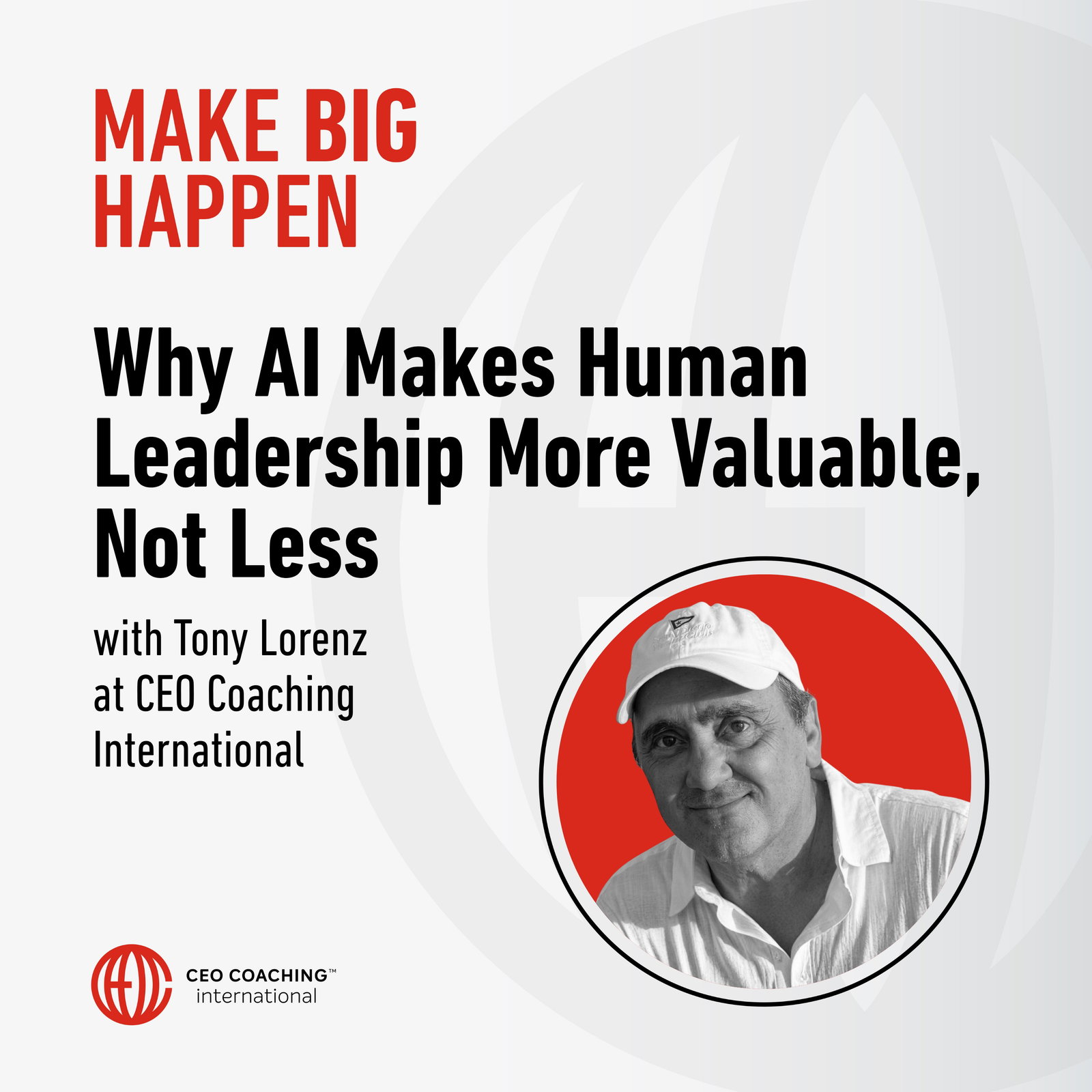
How AI changes leadership (and why it increases the value of human judgment), plus how CEOs should navigate inflection points using trust, servant leadership, and better decision-making.
Tony Lorenz, executive coach at CEO Coaching International. Background: 30 years leading events businesses; founded Freeman Market Leader; later served in private equity environments; led/participated in about 50 acquisitions (buy/sell side). Teaches CEOs through inflection points he experienced firsthand.
AI’s change speed and applicability are massive, but interpersonal “serendipitous” dialogue, taste, and culture can’t be replicated. CEOs often make a mistake by layering AI onto flawed workflows instead of redesigning workflows. Leadership cannot delegate learning; exceptional CEOs inspire. Trust is built by keeping promises; “truth” may cost money but earns long-term loyalty.
1998 $10k Amazon stock turning into ~9.6x (wedding band joke); leaving Freeman due to impatience; 9/11 crisis where he held back ~$250k comp with a promise it would return; using culture/communication/leader happiness/alignment scores to spot problems not visible in P&L.
Written by AI. May contain mistakes.
Tony discusses the importance of face-to-face interactions in leadership.
“and today he coaches CEOs through that exact inflection point that he lived through himself.”
Discussion on what differentiates exceptional CEOs from the good ones.
“and I've monetized it, built businesses around it.”
Tony shares his transition to coaching and the lessons learned over his career.
“I feel the same way about our coaches that we tell our coaches they got to have some game.”
Exploration of how AI is changing business landscapes and the limitations of AI.
“and I met a lot of them and they're great people.”
Tony reflects on a past investment in Amazon and its implications today.
“I think it's bigger than the internet in some ways because the internet did not have fuel.”
Discussion on critical leadership lessons and the importance of patience.
“Your wife know how much that wedding band costs today?”
Tony shares how his experiences shape his coaching philosophy today.
“That's much longer than most survive in, uh, in doing a deal.”
Learn how servant leadership has impacted professional growth and relationships.
“And they told me later that was the moment I said they really wanted to buy the company.”
Understand the significance of keeping promises in building trust within teams.
“Jim Collins, who we had a year ago, did the same thing.”
Explore how to recognize and prepare for inflection points in business.
“Let's talk about, uh, navigating inflection points.”
Learn why trend analysis can transform CEO meetings and team alignment.
“you look at it quarter over quarter over quarter.”
Explore the effects of impatience in leadership and how to manage board dynamics.
“Let me move to, from your experience, do leaders struggle with patience even more today because everything is feeling so much more immediate?”
Understand the importance of asking insightful questions in leadership coaching.
“And if you're in a place where you're not engaging with the board as peers, as partners, it's just not going to work out.”
Discover key strategies for creating impactful events by understanding your audience.
“And that, to me, I find when a CEO's got to think through the pros, the cons, the impact, the risk, which they sometimes forget, the cost to do that, it gives them clarity and confidence in making a decision.”
Learn how coaching can enhance leadership effectiveness and client outcomes.
“Or worse, it's just not received well because they're so not in tune with the reality of their own constituents, be it employees, clients, et cetera.”
Gain insights into how diverse experiences shape effective leadership coaching.
“So, Tony, let's talk about you and your coaching.”
Explore how to leverage diverse experiences to enhance leadership effectiveness.
“You know, I think that's a great question.”

Get the gist, explore an idea or ask about something said.
 Claude
On Make BIG Happen podcast with Mark Moses, what are the key points of this episode?
Searching your listeningAutomatic transcript. May contain errors.
0:00Tony Lorenz: Welcome back to the Make Big Happen podcast. Our theme today is the human advantage and leading through inflection points in an AI world. Every CEO I talk to is asking the same question these days. What does AI mean for my business? And my guest today has spent three decades leading companies through growth, acquisitions, and transformation. And he has a contrarian answer. The more powerful the technology gets, the more valuable the human side of leadership becomes. With judgment and trust and the ability to read a room while leading through uncertainty. Tony Lorenz is now an executive coach at CEO Coaching International.
0:51Tony Lorenz: And we're super happy to have him. and today he coaches CEOs through that exact inflection point that he lived through himself. Tony, welcome to the Make Big Happen podcast.
1:04Mark Moses: Thanks, Mark. So good to see you. Appreciate this time.
1:06Tony Lorenz: Yeah, it's great to see you too. You're looking good for an old guy. Yeah, I do my best. So let's jump right into it, Tony. So looking back at your career and what will you say that common thread is? And I'll put it under the bucket of you learn the same lesson over and over again. So if you look back at your career, what is the common thread for you?
1:36Mark Moses: Well, you alluded to it. For me, the common thread through most all of my career has been the power of face to face. and I've monetized it, built businesses around it. But for me, it is the most powerful media on the planet is face-to-face. And it's also the most expensive, by the way, pulling people together, but it is the most powerful. So, you know, long answer made shorter, face-to-face. It really does make a difference in everything we do.
2:08Tony Lorenz: Man, I love it. I feel the same way. I'm a face guy. I get a lot of energy from people. So especially if they're interesting, if not, I don't notice them. So I want to focus on the people that increase my energy and not get not hang out with those that depleted. So from your perspective, Tony, what separates an exceptional CEO from just a good CEO?
2:36Mark Moses: Well, the exceptional CEOs to me are the one primary trait. They inspire. They inspire people to do what they would otherwise not do on their own. There's a lot of CEOs out there that get the job done, deliver on numbers, and they got great product. They got great teams, et cetera. But they're not getting everything they can get out of a given team, a business, for that matter, the clients. But if they're inspiring them to do something that otherwise probably would not happen without their leadership, those are the great CEOs out there. And I'm talking with one of them. Okay.
3:12Tony Lorenz: Well, thanks. I feel the same way about our coaches that we tell our coaches they got to have some game. And part of having game is being interesting and inspiring. Yeah, yeah. So speaking of coaching, what are coaching now for you, Tony? And why this chapter?
3:32Mark Moses: You know, I've been asked that question a lot lately. And the simple answer is you spend 30 plus years doing something. You don't want it to be only in your rear view mirror. You prefer to take it and still find value in it and leverage it to your next chapter. So this being my next chapter, I'm really enjoying the opportunity to take all the good, the not so good, the lessons learned, you know, all the things across those 30 plus years and make them, you know, give them some value in the forward chapter. It's a lot of fun.
4:07Tony Lorenz: Yeah, this is not part of my normal questions here, Tony, but you just graduated from a pretty cool cohort. So how many started the cohort back when we were in Phoenix together? And how many graduated the training? Yeah, that's a story.
4:30Mark Moses: Yeah, I think there were 10 or 12 in the beginning or we're down to three now. So I think that that speaks to the value in the curation process in your business and how you are really attentive to and caring about who you bring into this community. A lot of good people through those 12, but there's a certain, you know, certain mix of elements you want in coaches. And you guys work really hard to make sure you have that in your collective coaching base. and I met a lot of them and they're great people.
5:06Tony Lorenz: You know, it was amazing to me that we think we're getting better and better at selection, but his cohort in particular, the survivability through training was tough. So I'm glad you're here. You're a good dude. Yeah, I'm glad you're here. Crossed the chasm. You've got clients already. You're making a difference. I've got clients that have fun.
5:29Mark Moses: Yeah, so it's good. It's a good place to be.
5:32Tony Lorenz: So everybody's talking about AI. You can't get enough of it everywhere you go. We probably, if you're anything like me, I'm getting pitched every morning that I wake up and I get all these messages pitching me on AI. So talk to me about what is actually changing as it relates to AI and what is not changing?
5:56Mark Moses: Well, I think that I'll get to know what's not changing second. First, what's changing? Everything. I think this is the biggest technological innovation of our time. I think it's bigger than the internet in some ways because the internet did not have fuel. It took a while for the internet to come up, but now we have the internet to fuel AI. So the half-life of change in AI is tremendous and its applicability across everything is tremendous. That said, as we said earlier, the interpersonal serendipitous dialogue will never go away. You cannot get that done on AI. You cannot. There's taste. There's culture.
6:36Mark Moses: There's those things that we deliver as people that just, I don't know. I just don't see it coming. But there's so much that is coming. And I got ChatGPT in 2022. I was one of those lifetime$79 guys. And so I've been around it a long, relatively long time and had been a believer for a relatively long time. And so I did not see it being as big as it is right now, but I saw it having an impact. And here we are.
7:05Tony Lorenz: So the speed of it's amazing. I remember 1995 when Netscape was the company back then. And I got I got on email in 1995 with AOL and you got mail. and uh and it was just a slow roll and uh and i remember amazon back then and uh that like how could a company lose so much money and there's no way they're ever going to make it and what do they do sell books so i admire uh jeff bezos vision um and to stay the course over a long period of time built an incredible one of the most valuable companies in the world incredible
7:47Mark Moses: Do you want to hear my Amazon story, Mark? In 1998, so I'm getting married. I'm 35 years old. Time to buy the wedding band. What do I cash in to get the wedding band? $10 ,000 of Amazon stock in 1998. So what's that wedding band worth today? Well, every year, one of the guys at my wedding sends me the number, and it's like 9.6 now. I hope you're still married.
8:11Tony Lorenz: I'm still married, yeah.
8:13Mark Moses: Oh, good. Yeah.
8:14Tony Lorenz: Your wife know how much that wedding band costs today?
8:18Mark Moses: Yeah, she knows. And yeah, it's a running joke. I know how to buy it. I don't know how to keep it. That's probably a character flaw of mine, but I didn't. So what part of leadership, Tony, can never be delegated? Well, I'm a big believer that you cannot delegate learning. If we're our best selves, we're always learning. I will never stop learning. And that's something you can't delegate. You've got to be personally a lifelong learner if you're going to be effective in, I think, anything professionally or personally for that matter. So that's an easy one. You cannot delegate learning. That's something you have to do on your own.
9:00Tony Lorenz: What are CEOs getting right today about AI? And what are they getting wrong?
9:07Mark Moses: I think a lot of them see the impact. They see the impact that can be made on their businesses. what they're not getting right and i know i hate generalizations but what i'm seeing a fair amount they're not getting right is they're not looking at the workflows they're taking a they're dropping on top of an existing tool and trying to rationalize ai on top of existing flawed workflows and and that to me is probably a mistake but it is a mistake because if they're flawed especially because if you're just trying to adjunct ai on top of something that's not necessarily the right thing to begin with or is not right with AI, you're just making an already somewhat significant problem more significant probably because AI is just going to put a magnifying glass on the issues that are under that or inside that workflow.
9:56Tony Lorenz: Every CEO learns the hard way. And we all got these lessons that we have learned. Um, what is, uh, a decision, um, that you made that you still think about years later?
10:15Mark Moses: Uh, so many, uh, one that comes to mind immediately is, uh, so as you know, I sold a business. I, I founded and built to a company by the name of Freeman market leader in the space of business events. I stayed four years, uh, but I really wasn't done being an entrepreneur. The issue was patience. I lacked a bit of patience. You're in a billion five at a time business and I'm dropping as an entrepreneur and I was not able to move quite as quickly as I used to move. And that impatience led me to leave. And I still, to some degree, regret that. I mean, it's worked out. I've had plenty of great chapters since then, but I still stay close with Freeman.
11:00Mark Moses: But for the patience I lacked at that point in time, four years after I sold, I would have had a much different career. And so it's a life lesson.
11:09Tony Lorenz: So what did that experience teach you about yourself?
11:14Mark Moses: Take a breath. Pause. Because I have ideas like you do, Mark, running through your mind all the time on how to create value. And I did listen to a few people, but I was listening to the people I wanted to listen to because I wanted to make this move to a content platform I was building. And I didn't listen to the contrarian point of view. Or I didn't allow it to come into my view, if you will. And that was a problem. And I think that's one of the reasons I'm attracted to this career now is because we are given license to bring a contrarian point of view and to hold people accountable to listen to that contrarian point of view, which may or may not be right, but at least you're getting both sides of the equation.
12:00Mark Moses: And my lesson learned in that time beyond the impatience was telling people, giving me what I wanted to hear and not necessarily listening to what I didn't want to hear at that time. Yeah.
12:11Tony Lorenz: So if you could rewind this and do this again, why did you sell? Like, look, you sold, you stay on four years. That's much longer than most survive in, uh, in doing a deal. So that's pretty long time. So if you could do it all over again, what would you do different?
12:29Mark Moses: Well, I would definitely, there's one thing I wouldn't do different. I sold to the right company. And I almost sold to a big holdco. I won't mention them, but one of the big advertising agency holdcos. That would have been a train wreck in a lot of respects. So I sold the right company. I think I could have stayed, I could have built it a little bit longer. But if you think about 07, which was about 16 minutes before the financial crisis, I might not even have made it to the financial crisis because it was tough, you know, for everybody in events. So I think my timing was accidentally right. I sold the right company for sure.
13:06Mark Moses: Culture mattered to them a lot. It mattered to me a lot. I had about 80 employees at the time, and I wanted to make sure they had a pretty strong career path. Yes, it was about the transaction and doing what it's been to my family, but it was a lot about giving my team who built that company a great career trajectory. And some of them are still there years and years later. So it's good.
13:29Tony Lorenz: How did that lesson change the way you coach or advise CEOs today?
13:35Mark Moses: You know what I learned? And I wouldn't say I learned it the hard way, but servant leadership was and is a big deal at Freeman. And when I was in the process of diligence and I met with the Freeman's family, they asked me for a review of the org chart. And I had always put myself on the bottom of the org chart. CEO, founder down here, and then ladders up. And they told me later that was the moment I said they really wanted to buy the company. But I didn't really, I did it just organically. They live it. I mean, they really, really know how to be servant leaders there. And so taking those lessons learned purposefully into other CEO roles later and making that work in spite of the fact that they were private equity backed or in other environments was sometimes harder than it was.
14:27Mark Moses: at Freeman, but I insisted on it. I insist on servant leadership, not only from myself, but from those around me. And I think that lesson was possibly the most valuable lesson I got out of that entire relationship.
14:41Tony Lorenz: If you could coach the younger version of yourself, what would you tell them?
14:47Mark Moses: Listen a little bit more than you did. I was not, I could be a great listening with clients, but when it came time to what I wanted to do, I just wanted to do it. And not having a partner, as you know, I didn't, it was, I had the entire cap table, so I didn't have anybody to really answer to in the business. And so that combined with a lack of mutual accountability, and I had advisors around here or there, but they weren't what these relationships are in your business and CEO coaching, it's not at that level, was not at that level. So if I would have had someone that looks a lot like you in my face, like you have yourself in front of your clients at that time, I would have had a much larger business.
15:36Mark Moses: There's no question about it. And I would have enjoyed a different trajectory. It worked out, but I would have had a much different trajectory if I would have had that mutual accountability, expert advice, come in and actually have an impact on the way around the business. I did not do that.
15:55Tony Lorenz: So one of the companies that you led, PRA, puts on the Make Big Happen Summit and has now for several years. And we didn't know each other, but your firm has Your old firm has done a really great job. We've been very happy with them. And I have heard you say, and I think about this when I'm out in front of 500 people in our audience, I've heard you say, read the room and match the moment. What does that really mean in practice?
16:32Mark Moses: Well, there's a lot of people out there that are on those stages that you're on for the summit, and they are scripted into a 30-minute, 20-minute, 15-minute, 45-minute session, and it really looks that way. They may feel they've done a great job, but it just looks scripted. So when you get out of room, so whoever's been with you has been helping you be authentic and take a breath and a pause. And we all know those individuals out there who are really good communicators because they think in threes, they take pauses, they do the things that we all know are helpful to being strong presenters. But they also somehow get a notion of what's going on on the other side of that stage.
17:18Mark Moses: And what I do when I'm speaking is I get into the audience. I will roam. I will spend 20 minutes with the room and then go straight up on stage when I have the opportunity. And I know you do that intrinsically because it's your event and you're in the middle of everything throughout the event. But I think that when other speakers come in and they come onto a stage and they don't have the feeling of that room, you see it. You feel it. You could see they're either paid or not prepared or wherever the case may be. And so you've got just a different feel coming out of a speaker when they're not connected to that audience.
17:58Mark Moses: And you do a great job of connecting.
18:00Tony Lorenz: You know what? We saw that live this year in April with Peter Diamandis getting right in the, and he was right there, right in the audience with folks. And it changes the energy. Jim Collins, who we had a year ago, did the same thing. He was out there getting people's stuff to do, and he was pressing everybody in the room. It was amazing how he could hold the audience for four hours and it flew by. It was pretty awesome. Talk to me about how a great intentionally builds trust.
18:40Mark Moses: Keep your promises. That's number one. If you make solid promises, you don't keep them, you lose trust. You make a promise, you follow through and keep that promise to the best of your ability, trust shows up. And that is probably 85 % of the equation. of course, truth and all the other things we know about. But promises kept to me are the number one way to build trust in any individual, personal or professional.
19:06Tony Lorenz: Give me a real-life example where a time where you saw this happen that either worked or did not work.
19:15Mark Moses: Well, so many. I'll think of one that cost us a lot of money. And back in the day at Proactive, we had a client, name goes aside, but a Fortune 200 client. We did a lot of measurement around the event and we said to our detriment that the next event in the next quarter should probably be canceled for reasons that don't matter because the data said shouldn't do the event. There's other mechanisms, but don't take the event out of the equation for next quarter or two. And that cost us a lot of money, but it was the truth. It was the way by which we were given the opportunity to get the data, to get the truth.
19:55Mark Moses: And then the truth came to us in a way that we'd rather not have happen to us, but it was right for the business, right for the client. And, uh, and that worked out and that client stayed for years thereafter because they knew it cost us a lot of money and they knew the size of our business and they knew it was a material hit, but they, uh, they stayed.
20:12Tony Lorenz: So, so what was the most challenging time in your life? How did you overcome commit and what did you learn?
20:25Mark Moses: It goes back a couple of times, both during one of the crisis when 9-11 happened. That crisis had a big impact on our business, as you can imagine, the event space. I had to, from a cash flow standpoint, I had to hold back about a quarter million dollars of comp to people on my team just to get through it. And I said, I'm not going to put this on our books. You've got my word. This money's going to come back. And that's all I can give you is my word. And a year and a half later, we turned it. It all came back plus, and that worked out. But it was really hard to ask people to look the other way on 15, I think, percent of their comp for a period of time in order to help us get through it.
21:16Mark Moses: Second one was in the second crisis. Stand by, before you go there, what'd you learn from that? Well, the other side, I learned that you work hard. First, I learned I earned their trust. That was number one, because no one left. I earned their trust. And then we all rolled up our sleeves. And when good people are aligned on a common purpose, which was to get to the other side after 9-11, great things can happen. And great things did happen and that was an inflection point for us at that time from oh three i think on it just got better and better and better every year um because i think that and i'm told that promise made and kept i guess it kind of out in the industry a little bit it became a known thing that uh this guy doesn't um he doesn't fall back on uh what he promises people he does it he does what he's got to do to the best of his ability.
22:14Mark Moses: And he comes through and that paid dividends for a long time.
22:20Tony Lorenz: So I like to say, uh, trust is like virginity. You have one chance to lose it. Yeah.
22:28Mark Moses: And, uh, yeah, we all know reputations get built over years, they're destroyed in minutes. And, uh, that's the case with trust as well.
22:36Tony Lorenz: Let's talk about, uh, navigating inflection points. You use the phrase inflection point often. What does it actually mean when you use it? And how do great CEOs see one before everyone else?
22:55Mark Moses: Yeah, that's that old concept of seeing around the corners, right? It's hard. The only way I know to do it is just be, again, always learning, always taking in the data. And by data, I don't mean financial statements only. I mean, quantitative and qualitative data from all parts of your ecosystem. You've got clients, you've got team members, you've got the macroeconomics scenario out there. There's a lot of different areas in which data can be made evident to you as a leader. And then you take that data and in whatever way you look at it, you try to predict what's going to happen. And if you're lucky, you get on the eve of an inflection point.
23:36Mark Moses: You may fall into an inflection point. and maybe thrust upon you like it was with me with that scenario I just outlined a bit ago. But if you look on the other side, or if you, I'm sorry, if you pull the data together and you can see what just might happen and then you prepare your business and your team and your family for that matter and your clients for that, which you believe to be an eventuality, that's the right side of the inflection point. And then when it happens, you're just that much more ready for it. Probably not completely ready, but you're readier than you would have been if you didn't take in all that data, qualitative, quantitative data.
24:12Mark Moses: Take the time to understand it. And then from there, take the time to understand what that might mean to you and your business.
24:19Tony Lorenz: Well, let's use an example of that. So can a business look healthy, speaking of data, financially, while something more important is breaking underneath. Yeah, of course.
24:37Mark Moses: I mean, you could look at businesses on, you can see the P &L of a business and it could send strong EBITDA and, you know, there's a lot of good metrics in there, no client concentration, all the things we know that represent a good business. You miss the part about the fact that the team is not terribly engaged or that there's a little bit more attrition than you'd like there to be. You won't see that in what already happened, which is the P &L prior, but it will impact the business forward. So it's one example of how financials alone don't tell the story. It's the underlying data. In that case, I just outlined around engagement and retention, and especially when people focus in any business, for what I'm concerned.
25:23Mark Moses: But for people focus business especially, you're in the eve of a bad time if you got tough attrition beyond industry averages. Some industries, as we know, in retail, they're born, they have a high attrition rate, but some are not. And if you're way outside of the norm in your industry, good things are about to not happen.
25:42Tony Lorenz: Yeah, there's a lot of factors that the P &L could look very strong, but let me give you some examples of some trends that aren't in the P &L that are scary. Sales cycle is getting longer. Conversion rate is slipping. Average order size is shrinking. Returns are growing. Customer satisfaction scores are slipping. Culture is slipping. I think about every time I go in and run a quarterly session with a leadership team, I have these four questions that I like to ask. On a scale of one to 10, this is with the leaders of the business, so we'll call it the C-suite and maybe some senior VPs. What is your perception of the culture of the company?
26:40Tony Lorenz: And everybody would write it down on a piece of paper we collected and we'd read out the scores. Next question, on a scale of one to 10, how well do we communicate as a company internally? If culture is bad, communication is going to be worse on a scale of one to 10. How happy are you as a leader in your role? That'll give you a story as well. I remember once I had three, two out of tens, two out of 10, and seven people in the room. and the three guys that gave me twos were the founders. Well, guess what happened? They went out of business a few months later, right? They didn't want to be there.
27:27Tony Lorenz: They didn't like their business. And the last one is how aligned have we been on a scale of 110 as a leadership team? So these are indicators you don't see on the P &L, but if we had this imaginary forecast, they would show up in the imaginary forecast as about what's to happen.
27:53Mark Moses: So Mark, I saw you take that exercise into a client as you remember back in the spring. And not only did you do that, you look at it quarter over quarter over quarter. So you saw the trend analysis on, yes, here we are today, but here's where we were last quarter, the one before that and one before that. So are we turning up or down in these areas you just outlined? And that to me was, I'd never done that in a meeting as a CEO. And I thought that was quite powerful. The trend analysis. Yeah, we've been doing that seven years in a row.
28:27Tony Lorenz: So looking at the trend lines, and then you would be surprised when, like, we did the same client. We just had a tough quarter. And tough quarter in the P &L. But the scores were the second highest ever. And so why? And it was how the CEO communicated the vision as to where we're headed and how he built buy-in and alignment with everybody in the room. That was magical. And that's what great leaders do, right? Yeah.
29:08Mark Moses: And that leader, he'll remain unnamed, but super strong CEO, is one of the better listeners I've ever seen in my life in a meeting like that. As much as you want to say and speak and take the room as a CEO, he did not until his time. And then that was super powerful to watch a team coalesce on a given objective for a meeting and the CEO there to take it in and then make some good calls. It was just magic. Amazing.
29:43Tony Lorenz: And he is a younger leader. I've been working with him for a long time. He's in his late 40s, and he really gives the others an opportunity to speak because he knows when he speaks, he just shut everybody down and arguing. Let me move to, from your experience, do leaders struggle with patience even more today because everything is feeling so much more immediate? Mm-hmm.
30:14Mark Moses: Yeah, I think so. And in my later chapters as a private Equivac CEO, as we know, those environments move along in a pretty good clip. And I didn't mind it because I'm naturally impatient. So I actually, I think, thrived in that environment. But the pace of change and the pace of expectation is so terribly quick right now that patience gets even harder because you've got the demands of your stakeholders on top of you. So if you have an inclination to be impatient, you're given a license to be impatient because of the demands of the stakeholder community, but in that case, private equity. And it makes it tough because with impatience, as we all know, comes many times not so great decisions, as I outlined earlier.
31:03Mark Moses: So you've got a tough dynamic where pace is moving at a accelerating rate, giving license to impatience, which then can many times result in poor decisions. So working against that tide is, I think, one of the bigger business challenges we face right now.
31:22Tony Lorenz: Many of our clients today, Tony, are private equity-backed CEOs. Yeah. Either they reached out to us as a private equity-backed CEO, or like you, we were working with the CEO and they sold into private equity. And now they got, for the first time maybe in their life, a boss. Yeah. So, which for a lot, if you were to give advice to somebody that's selling into private equity, what advice would you give them?
32:02Mark Moses: I think that you have to engage the board as CEO, as the role CEO. In CEO, I was good or not so good, depending on the quarter, on engaging with the board on given challenges versus just answering to them on a quarterly basis and coming up with a report and doing the quarterlies, et cetera. And I don't want to say mailing it in, but being matter of fact about it. But if I really engaged with the board as peers, and I did with not all, but a selection of them, good things came out of those exchanges because they're there for a reason. I'm a board member now for Private Equity Bank Port Co. And the best positions I have now are the ones with the CEO to help them be better, help their organizations be better versus just, you know, we'll take in a quarterly meeting and listen and, you know, like or not like the numbers and the direction, etc.
33:02Mark Moses: that's all very judgmental. But if you're leaning in as good board members do, they look forward to it because the unspoken secret is they kind of miss operating sometimes. And so that they can have a role helping the operator be a stronger operator, the good board members will appreciate that opportunity.
33:21Tony Lorenz: So a CEO struggling today with their, we'll call it their private equity board, what advice would you give that CEO in how to resolve that?
33:39Mark Moses: Well, I think the best thing to do is acknowledge the fact that there is an issue. A lot of CEOs, given where they come from, you're the face. You want to put a good veneer on everything that you're around. As a founder, if you're now a CEO working for a priority-backed board, you've got to acknowledge the challenges that are presented. And I'm working with one now, and they're not acknowledging the challenges. most of those challenges can go away with the proper dialogue and exchange and steps taken with a board as your peer. But if you pretend those things aren't there, it's just only going to get worse.
34:22Mark Moses: And there's no turning it around. Revenue can only cover up so much. And if you're in a place where you're not engaging with the board as peers, as partners, it's just not going to work out. So you've got to, you know, if the elephant's in the room, talk about the elephant and then let's start eating it one bite at a time together as a team.
34:45Tony Lorenz: So when you coach CEOs, Tony, through these kind of moments, are you giving them answers or are you helping them ask better questions?
34:54Mark Moses: Oh, definitely the latter. No question about it. I mean, it's all about help asking questions to elicit their questions and questions build upon each other. And a strong set of thoughtful questions are going to yield the content you need to really run the business the way it needs to be run versus answers. I don't have answers to any business I'm coaching. If they're in my industry or not, I don't have them. I don't have the right to have them. But I do have the right to ask great questions that will elicit the context and the answers that need to come out of the operating team to get to the place where they want to be.
35:33Mark Moses: And that's not all, but that's, I think, a big, you tell me, but I think that's a big part of the job is to be really strong at asking great questions so that the truth comes out. And then from there, of course, mutual accountability and the other parts and pieces to a coaching relationship are there and hopefully evident. But, yeah, great questions are probably 50 percent of you told me that back in January. I didn't quite believe you, to be honest with you, but I'm a believer now.
36:04Tony Lorenz: Our clients ask us a lot of questions, right? And they think we have the answers. Hey, sometimes we do. However, when I get asked a question, this is my playbook. Hey, Tony, what are our options?
36:19Mark Moses: Right, right.
36:20Tony Lorenz: Okay, because you probably thought them through. What are the options? Are there any other options? What are the pros and cons of each of those options? What are the impact on you personally? What's the impact on the business? What's the risk? What's the cost? Now let's rank them in order and you tell me which one of these options you like best. And if you forgot one that seems obvious to me, I might poke at it and say, have you considered this? And either a good idea or a bad idea, but hey, now we might have a fifth or sixth option for us to consider. And that, to me, I find when a CEO's got to think through the pros, the cons, the impact, the risk, which they sometimes forget, the cost to do that, it gives them clarity and confidence in making a decision.
37:13Mark Moses: And then the next part is what's the one thing? As you've said many, many times, you've got options and there's four or five good ones, but you're only going to do one or two. So then getting down to that clarity on what is really, really important.
37:29Tony Lorenz: Well, if you want to take me down a path on this, I believe they get clarity around what's success three years from now? And what is the one thing, if we could make it one, that will drive that outcome?
37:46Mark Moses: How about a year from now? Yeah, a year, a quarter, whichever the time frame. And that focus, that clarity on that one thing is really, really important. Otherwise, you're lost in a morass of optionality on how to spend your day, and that doesn't work either.
38:04Tony Lorenz: How many years did you spend in the events business?
38:07Mark Moses: 30 years. 30 years in the events. Yeah, I was 30 years old and I was running events, businesses of the different types and parts and pieces till I was 60.
38:18Tony Lorenz: So what advice would you give a CEO or anybody that's putting on an event, putting on event that really wants to have a successful event? And what is the biggest mistake you've seen those putting on events make that they ought to correct?
38:41Mark Moses: You know, the biggest mistake I've seen, well, the best advice I can give is on the front end. There's a process of understand your audience, understand the environment, determine objectives, design an experience, deliver it, measure how you did. And inevitably, there's ways to reinforce how to make it better through other communications. That's the general piece. So many, so many go straight to design and they don't design experiences with the viewpoint of the audience, their mindset, what's going on in the business, in the broader community. they just put together an event because they think that's the right way to do it.
39:18And it many times falls on deaf ears.
39:22Mark Moses: Or worse, it's just not received well because they're so not in tune with the reality of their own constituents, be it employees, clients, et cetera.
39:32Tony Lorenz: So how do they get that right? Many of our clients put events on. Many CEOs put events on. And they're doing it with they have a purpose for doing it. and some of the similar purposes, some of them with different purposes. How do they get that right?
39:49Mark Moses: Well, there's the basic pre-event surveys. There's ways to get an understanding of culture, how engaged is it? If it's an internal event, how engaged is your team? If it's an external event, how are you feeling about the brand? There's that quantitative data that comes in, and then there's qualitative data. If it's a big trade event, you can go to a subset of exhibitors. You can go to buyer attendees. You can go to various task force to get that qualitative view of what's going on out there. What's the expectations of the event? So when we deliver, we deliver in accordance with and hopefully beyond that expectation.
40:28Mark Moses: You cannot do that with getting that qualitative and quantitative understanding. And it's surprising how many events go out there without really doing a great job of getting that done. And then we'll see how it goes.
40:42Tony Lorenz: You came out of this year's Make Big Happen Summit with one major takeaway, and it was that everyone needs a coach. So what drove you to feel that way when you were at this summit?
40:59Mark Moses: It was really the exchange with the clients. It's a wonderful mashup of coaches and our client base there. And my dialogue with the clients and seeing, feeling, and appreciating what this organization does for them and their coaches do for them and with them to make them better than they would otherwise be without them, than the coaches. That was my turning point. I said, okay, I'm going to make another chapter of a career out of this because I can see the value. I can see the power of the coaching experience. And so to the extent that I get this right, I can really have pretty big, hopefully pretty big impact on the clients I serve.
41:42Tony Lorenz: So, Tony, let's talk about you and your coaching. Why is it, what special sauce are you bringing to your CEOs, your coaching and their leadership teams? What do you bring into the party that's going to be really useful and unique compared to everybody else?
42:07Mark Moses: You know, I think that's a great question. I think I'm in a little narrower company because I've had all these various roles from founder to paid CEO for private equity to investor, buy side acquisitions, sell side acquisition. I think my acquisition count counts up to about 50 right now. So I've had all these various roles.
42:27Tony Lorenz: 50 acquisitions.
42:29Mark Moses: On buy or sell side, yeah. So I've got that M &A piece, but I've also been in private, you know, my own company, privately held, family owned, private equity backed. I can't speak a lot about public companies, so I'll take that off the table. But a number of different ownership environments, a number of different roles in those ownership environments from startup all the way to$4 billion companies and either CEO or executive on those teams. And I think that collection of experiences is probably, hopefully, a bit unique. And then more importantly, it doesn't mean a thing unless I'm applying it.
43:05Mark Moses: So a call I was on earlier with one of our clients, I brought an investor mindset to that relationship. Another call, I'm going to have the founder mindset and the sentimentality of separating yourself from the company you built over 20 years. So another call, I'm going to have a private equity. what they're looking for as a Tribeca Vets board member, what do they look for in a CEO? So there's different perspectives I can pull from different parts and pieces of my 190-year journey on this planet to bring to bear on a coaching experience.
43:38Tony Lorenz: So if every CEO listening today remembered one thing from our exchange together today, what should it be?
43:47Mark Moses: I think it's all about inflection points. take advantage of them, see them before they, while you can impact them favorably, before they can impact you, and then design accordingly. I am a big believer that those moments, and a moment is both the shortest and longest period of time, as we know, that's the definition of a moment. So those moments, when they are managed and affected with great data and good thinking and servant leadership can yield extraordinary outcome for you, your team, your clients, your families.
44:23Tony Lorenz: And so what's one question every leader should ask themselves before their next big decision?
44:30Mark Moses: How do you have, well, what got, well, the question, the statement is what got you there may, here may not get you there. And so the question is, do I have what it takes to go where I want to go. And so many times, both personally within themselves and within their teams. And because of the success to a given point in time, they may think they have what they need to go from here to that next chapter. Many times they do not. And I think that's when companies start to get a little stale because they just don't have what they need to take another level up. So ask that question honestly of yourself and then make changes accordingly.
45:10Tony Lorenz: And what if you
45:11Mark Moses: don't you're probably stagnate or worse you know because you'll never if you're a 50 million dollar business and you want to go to 100 or you're hard you want to go 300 and you don't make those changes you're going to stay at 100 or probably slip and when you could have with just a few design changes be a team people process approach product mix etc you could have taken that right up to two three hundred four hundred five hundred million and you don't because you're working with yesterday's assets and that doesn't work.
45:42Tony Lorenz: Tony, it was a real pleasure having you on our podcast today. Thank you, sir. You have incredible experience running small companies, large companies. You've bought and sold over 50 companies. You've worked as a private equity um ceo which um not easy to do you survived you lasted four years and you even said it was short and um i i know you will bring tremendous value uh to our clients at ceo coaching international and we're truly honored to have you you're clearly a nice guy you're an easygoing guy I guess most of the time. And you got a lot of fire too. So very grateful that you're here. Thank you for sharing your journey with us here on the Make Big Happen podcast.
46:46Tony Lorenz: And we wish you and your clients much success on their journey to Make Big Happen. Thank you.
46:53Mark Moses: It's a privilege, Mark. It's a privilege. I really do thank you. Enjoy your weekend.
46:58Tony Lorenz: There are three kinds of people, those who make big happen, those who let things happen, and those who ask what happened. Don't just listen to these stories. Decide who you're going to be. Show notes and resources are available at ceocoachinginternational.com. Subscribe so you don't miss what's next. At some point, every leader faces a choice. Play it safe or go big. If you're ready to make big happen, visit CEOCoachingInternational.com and learn how our been there, done that CEO coaches can help you make big happen.
Every CEO in the room is being told AI changes everything. I want to know what it still can't touch.
Tony Lorenz, Partner at CEO Coaching International, spent three decades building, buying, and running companies before becoming an executive coach. In this episode, he makes the case that judgment, trust, and the ability to read a room only become more valuable as technology gets more powerful.
Tony also unpacks why he considers trust one of the most valuable skills in leadership, and how a costly early lesson in patience still shapes the way he coaches CEOs today.
KEY TAKEAWAYS:
00:00 AI's power makes human judgment more valuable, not less.
05:56 What AI cannot and will not ever replace.
08:34 The one thing leaders can never delegate.
18:40 Trust is built by keeping promises, not making them.
22:27 Reputations take years to build, minutes to destroy.
24:35 A strong P&L can still hide a failing team.
30:13 Impatience becomes more dangerous as business speed increases.
34:54 What great coaches do instead of giving answers.
38:41 Great events start with understanding the audience first.
43:46 Inflection points reward leaders who see them coming.
Subscribe now and be ready when the conversations begin.
RESOURCES MENTIONED
CEO Coaching International: The executive coaching practice referenced throughout the episode:
https://ceocoachinginternational.com/
Make Big Happen Summit: The annual CEO Coaching International event referenced in the conversation:
https://ceocoachinginternational.com/events/2026-make-big-happen-summit/
#MakeBIGHappen #CEOCoaching #Leadership