Ask ChatGPT
 Make BIG Happen podcast with Mark Moses
12 Aug 2026 · 1h 15m · 35 chapters
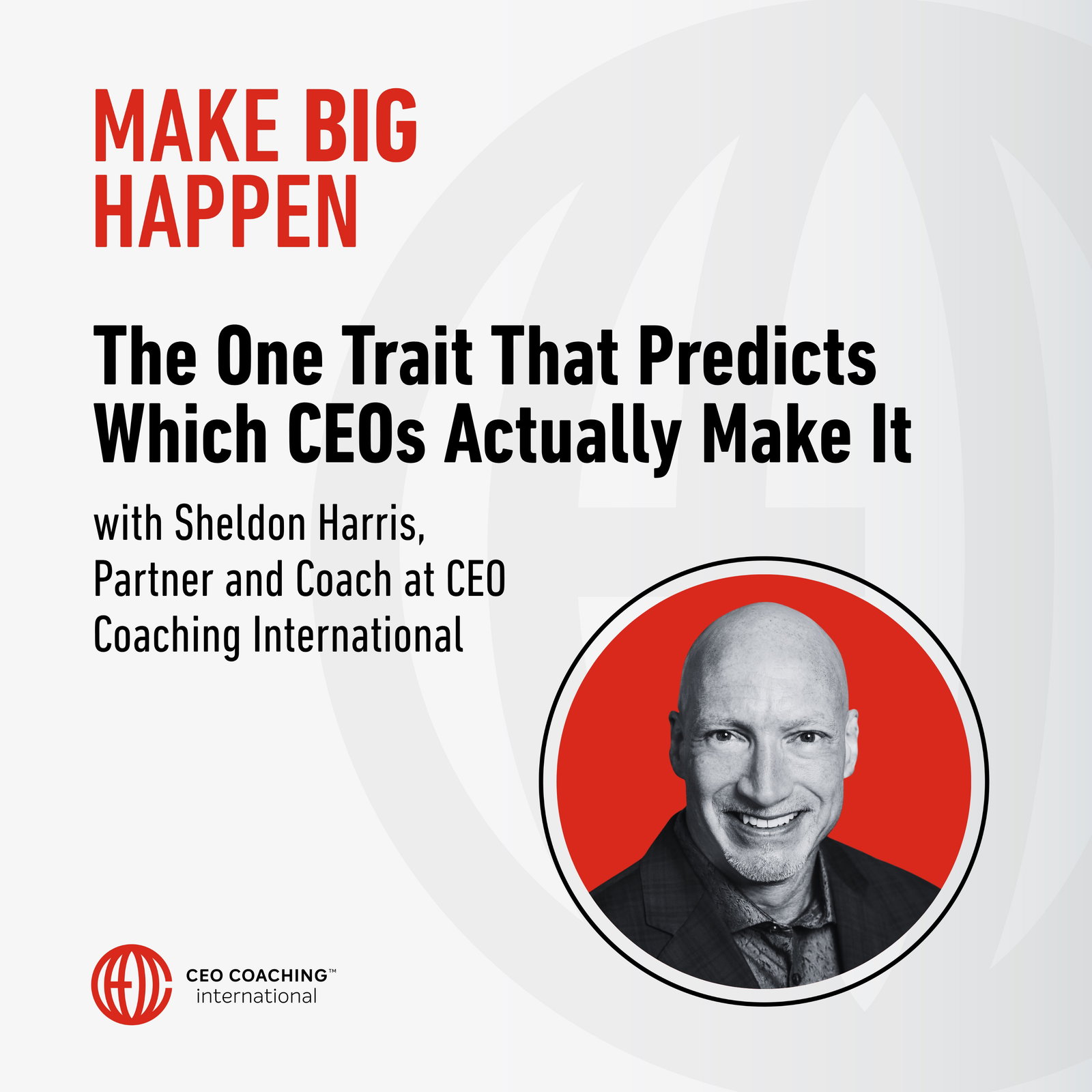
The episode argues that the CEO trait most predictive of “making it big” is being humble and hungry—willing to step out of comfort zones, get vulnerable, and focus on the “one thing” that drives outcomes. It also covers leadership lessons from scaling businesses, crisis response, integrity, and why coaching works as a long-term process.
Sheldon Harris is a longtime CEO coach (12 years) who has coached hundreds of CEOs and trains coaches at CEO Coaching International. He previously led operations at Costco (started as a warehouse manager in Alaska; later led Costco’s entry into Russia) and served as president of Cold Stone Creamery (scaled from 10 to 1,400 locations; 500M+ system revenues; 15,000 employees). He later became CEO of Complete Nutrition.
Never sacrifice integrity; behave according to the future you’re creating; transformation is ongoing (not a six-month fix); crisis success comes from owning mistakes and having a plan; high performers are humble and hungry; busy CEOs diffuse energy, top performers focus.
Costco Russia handshake involving $100 bills; Cold Stone’s foodborne illness crisis traced to unprocessed eggs in a cake-batter flavor; crisis communications and product pull; scaling goal from 75 to 1,000 stores (missed by four months but attributed to the vision).
Written by AI. May contain mistakes.
Sheldon shares his early career experiences and leadership lessons learned at Costco.
“Sheldon Harris, my good friend, welcome to the Make Big Happen podcast.”
Sheldon discusses the challenges and leadership lessons from entering the Russian market.
“And since I lived there, they knew I wasn't going anywhere.”
Sheldon emphasizes the importance of integrity in leadership and business practices.
“I'll never forget, for example, the first time that I went to shake hands with one of my Russian business partners.”
Sheldon talks about his time at Cold Stone and the challenges of rapid growth.
“So let's move to a little later in your career.”
Sheldon recounts a foodborne illness crisis and the lessons learned in leadership during emergencies.
“Maybe we had 600 stores-ish on the way in that journey.”
Sheldon reflects on the value of transparency and accountability in leadership during tough times.
“and how did you guys respond to that negative publicity as all these other firms did?”
Learn the importance of transparency in leadership and the consequences of hiding mistakes.
“It's like people forgave the mistake because they understood the context in which the mistake was made.”
Explore how initial good intentions can lead to negative outcomes when leaders fail to address issues.
“He probably, I guess, didn't go in with bad intent, but he found himself there and then tried to hide it and hide it.”
Discover the pivotal changes necessary for scaling a business effectively, illustrated through Cold Stone's growth.
“It's these little tiny sacrifices that lead us to a place we never intended to go.”
Understand how setting ambitious goals can drive a company towards greater achievements.
“And a lot of times when we were talking with the public or being interviewed in the press, they would point that out.”
Learn about the dynamics and challenges faced when stepping into a leadership role with younger founders.
“it's helping them find the courage to think big.”
Examine the pitfalls of overconfidence and the need for self-awareness in leadership.
“So what's the unspoken truth in this dynamic that nobody talks about?”
Reflect on the importance of courage in leadership decisions and the impact of public firings.
“Well, you really had an impact on that company, and it was very fun to coach you.”
Learn how to maintain composure and integrity during challenging moments in your career.
“But Moses, the funniest part of the story that I'll never forget was you and I walking out of there and you saying, hey, would you mind giving me a ride to the lovely Omaha airport so you could fly back home?”
Discover how adversity can serve as a catalyst for personal and professional growth.
“You know, this is a tough introspection point.”
Learn about the importance of vulnerability and stepping out of comfort zones for success.
“I never wanted to build a business again.”
Explore the dual traits of humility and hunger that define high-performing CEOs.
“Is there a trait you see in those that really perform?”
Understand that transformation is a continuous process, not a one-time event.
“Yeah, I think that's very well said, Sheldon, in the priority and discipline of focusing.”
Reflect on the importance of having a coach and the concept of 'ignorance debt'.
“often have been asked is, what advice would I go back and give my younger self now that I'm mid 60s?”
Learn how testing ideas can create confidence and lead to successful outcomes.
“I think our audience would really enjoy hearing from him.”
Understand the balance between learning new ideas and applying them effectively.
“And we loved having Jim Collins at the Make Big Happen Summit last year.”
Discover the importance of building long-lasting relationships in coaching and the impact on clients' lives.
“well, Jim Collins, he's yesterday's thinker.”
Explore how coaching influences clients' personal lives and relationships beyond business success.
“Some are startups with$3 million in annual revenue.”
Learn how to get the most out of your coaching experience for maximum benefit.
“I'm smiling because I love what you're saying.”
Unpack the impactful one-liners or 'Sheldonisms' that resonate with leaders and their effectiveness.
“One of my favorite topics with you is it's titled Sheldonisms.”
Understand key leadership principles through powerful quotes and their application in real life.
“So that quote helps me in a fun way to poke around and help somebody to see that.”
Learn about the importance of excellence in all endeavors and how small details contribute to success.
“in your heart of hearts, what you have to do, what's holding you back.”
Understand the unique challenges coaches face when working with CEOs and the importance of meeting them where they are.
“Sheldon, thank you for sharing some of those Sheldonisms.”
Discover Sheldon's personal journey of learning and unlearning as he transitioned from CEO to coach.
“So what did you personally, Sheldon, have to unlearn from your CEO days to become a great coach?”
Explore the balance between the science and art of coaching and how to meet clients' needs effectively.
“I'll flip this and I'll take a stab at answering this question as well.”
Reflect on what makes effective leadership and the growth necessary for CEOs to achieve their goals.
“And there's certainly a role for that in terms of specific knowledge or application or tools or techniques.”
Understand the importance of clarity in outcomes and personal motivations for success.
“It's no different than the Cold Stone example I used earlier, where we started behaving as though we were in our roles at a thousand stores, even though we only had 75 stores.”
Discover how leadership can ripple through communities and families.
“You've made an impact in so many people's lives.”
Reflect on the personal connections that shape our journeys and leadership.
“You've coached people from the Philippines to Jakarta to China, Canada.”
Explore the idea of 'best who luck' and its significance in personal growth.
“So I just want to close by saying thank you, Sheldon.”

Get the gist, explore an idea or ask about something said.
 Claude
On Make BIG Happen podcast with Mark Moses, what are the key points of this episode?
Searching your listeningAutomatic transcript. May contain errors.
0:00Today's guest is one of my closest friends and confidants. He's coached hundreds of CEOs over 12 years, and he also coaches me. He's trained every coach at our firm at CEO Coaching International, and his clients don't just grow their business, they become different leaders, and they absolutely love who he is, what he stands for, and how he brings out the best in them. But before any of that, Sheldon and I, we were fired on the same day. And the way he handled that moment told me everything I needed to know about his character and who he was as a person. Sheldon Harris, my good friend, welcome to the Make Big Happen podcast.
0:49Moses, it's so good to be here with you. And just reflecting over the last 12 years that we've been working together, it's just been an amazing journey. Well, it has been awesome for me too. And let's dive right in. I want to take you back to your days at Costco. You started as a warehouse manager at Costco in Alaska. Most CEOs didn't start in the corner office. What did those early years teach you about leadership that you still carry with you today? Well, Moses, I'll say Costco was such a blessing in my life. I didn't know what Costco was when I started. It was a relatively unknown brand. But I had just come out of school and I was trying to pay back student loans.
1:34And they hired me at an entry-level role for$6 an hour in Anchorage where I grew up. So I just did the only thing I know how to do, which is work hard. And fortunately, Costco rewards hard work. Work ethic is one of the number one things that they look for. And some could say, well, Costco is just kind of a pretty straightforward blocking and tackling business. And it is. So fortunately for a guy like me, who's not the sharpest guy out there, it was a match made in heaven. And I realized I fell in love with leadership. I fell in love with business, two things that I'd never really been exposed to before.
2:12So having started there at an entry-level role, I, in short order, set my sights on I wanted to be a warehouse manager and run one of these Costco buildings someday. And, you know, as you know, Mark, I'm super goal-driven. And so nobody had achieved that level prior to the age of 30. And so as a young, probably somewhat arrogant, you know, 20-something-year-old, I said, I'm going to do that before I turn 30 years old. And the next decade was pretty much a blur, just super hard work and learning and a lot of just a crazy ride. But lucky for me, about four months before my 30th birthday, I was promoted to run that very same Costco building that I'd started in so many years before.
2:57I always caution people that might think that's impressive to bear in mind that it's quite possible they couldn't find anybody to move to Alaska to take that role. And since I lived there, they knew I wasn't going anywhere. And you know what? You may be right. I can't imagine what it would take to get me to move to Alaska. I have visited it. Nice place, but I don't think I want to live there, especially in the winter. So you led, this is really interesting. You led Costco's entry into Russia of all places. What does it teach you about leadership when you build something in a place where none of the rules that you know today apply?
3:38Yeah, it's a great question, Mark, because everything about Costco up until that point was pretty straightforward. It's right down the center. We had some neat innovations along the way, putting in fresh food and doing all the ancillary businesses. But Russia was not on the radar screen. And what ended up happening was Costco, I was going to move to another state finally to open a new Costco building. And they replaced me in the Anchorage Costco only to realize the building I was moving to was delayed due to construction and permitting setbacks. So Jim Senegal, my fearless CEO leader at Costco, he said, find something to keep yourself busy.
4:20That was my marching orders. And so I started thinking we were selling a lot of freight out of Anchorage directly over to Russia because there was some direct flights that took freight that way. And I saw that as a big opportunity. So I applied my effort to maximizing that kind of ancillary side thing. And it ended up being amazing, Mark. The volume that we were able to begin to move through that pipe was substantial. And the lesson I take away from that is the importance of being flexible and fluid when you're dealing with new scenarios and different cultures and different people. I'll never forget, for example, the first time that I went to shake hands with one of my Russian business partners.
5:09And as I pulled my hand back, it was full of$100 bills. And I thought, you know, what's Jim Seneville going to think about that? I'm like, hey, I got a little extra VIG here on the side. And yet, how do you say no without offending their culture and their custom and how that works? But I share these things because there's no way that I could have been prepared ahead of time for what I was going to walk into. But it's just how do you maintain that sense of respect, integrity, but also valuing the flexibility to meet them where they live? I know you really, really well, and I know how much you value integrity.
5:49How do you deal with some of these practices you just described that are quite different than what we're used to here? Yeah. The first thing I would say is, like I think anybody would give wise counsel, never sacrifice your integrity. You only get one reputation, make it great. And especially it's amazing how I think when you're younger in your leadership journey, you don't realize the power of that. But by the time you get to be here in my age, people, we know people who have known us for 40 years. And if there was any indiscretion in that, that's now baked into who you are and it It affects who you are and what you achieve.
6:31So the number one thing that I was mindful of in those examples was never violating my integrity. Now, I wanted to try to do that while preserving the relationship that I was trying to build with the other culture, but I would never do anything that could be even perceived as being a violation of integrity. I often use the example that I want everything I do or say to be able to be recorded without my knowing it and broadcast broadly where everybody could see it and still be proud of how that showed up. Well, that is super admirable. And there are presidents of many countries that can learn from that.
7:11We do see it go wrong a lot. I see that. So let's move to a little later in your career. You were the president of Cold Stone Creamery, a place I love ice cream and a place It's one of my few bad habits. And you took Cold Stone from 10 locations to 1 ,400 under your leadership and over 500 million in system revenues, 15 ,000 employees. Take us inside the moment when scaling got really hard and scary in. And what almost broke when you were going through that? Yeah, Coldstone for me was an amazing chapter because I was able to take the incredible foundation that I laid over 13 years with Costco and then start with a fresh canvas.
8:08And, you know, our founder and CEO was Doug Ducey, another gentleman that I'm remain very close with to this day. And he and I were like the dynamic duo, I think, in helping lead the charge for Cold Stone. And the way I looked at it, this was an opportunity to really apply the people first principle to what we were doing. People would often say, well, you're in the ice cream business. And I would say, well, we sell ice cream, but we're in the people business. And we really meant it. The people were the whole purpose of what we did. And when I say people, of course, it was our franchisees who put often their life savings on the line to sign on to this brand, but also all of their employees and our own employees, and even the ice cream lovers that would come into our stores.
8:54Our aspiration was that the world would know us as the ultimate ice cream experience. And that's what we executed on. So in the early days, it was just a making people happy business. It was so refreshing and fun. Hardly anybody leaves an ice cream shop unhappy unless you really mess up the service model. So it was a really enjoyable energy and we were just having fun growing the brand. And I think I had never been involved scaling something like that to that degree. And I was just one day just having fun. Maybe we had 600 stores-ish on the way in that journey. And I'll never forget the morning we got the call that any food service brand in the world hates to get.
9:40It was from a health department in the Midwest. and they had traced some foodborne illness with hospitalizations back to our ice cream. And it was devastating. No sooner did we get off that phone call, then we got a call from a health inspector in a neighboring state and then one in a neighboring state. By the time it was done, we realized we had 16 cases of foodborne illness directly caused by our product. You think like, how does that happen? This is just ice cream. Like we were naive to what could have possibly caused it and prevented that. Subsequently, we found out that we had invented, we invented a lot of new flavors and we would just try crazy stuff and see what sold.
10:22And one of those that we tried was we took some cake batter, some boxed cake batter and poured that in the ice cream hopper with all of our ice cream. And we made this incredible cake batter flavor. It was wonderful. People loved it. It was probably our number one selling ice cream flavor. But unbeknownst to us, part of those ingredients were unprocessed eggs. And the usage directions, if we'd been careful, told us we needed to bake that cake before we ate it. You couldn't just eat the ingredients raw. We had no idea. And we'd done it for years until this situation happened. I think the important lesson, though, is what do you do when things go wrong?
11:06Because things are going to go wrong. And I'll tell you what we did that I look back on and so grateful and proud of what we did, because immediately our attorneys were telling us, don't make any public statements. They want us to read a canned script. Don't make contact with the injured, affected people. And, you know, Doug and I look at each other and we're just like, that's not who we are. That's not the way we operate. We made this issue and we're going to own up to it. So we actually literally got on the phones and called every one of those affected people. They were in the hospital. We spoke with their families.
11:42We spoke with them. And we showed up real. We showed up with genuine care and concern, not worrying about, well, what about the liability of having this conversation? And you know, Mark, I feel like that example, if every leader would keep that in mind when things go wrong to just show up right, show up with integrity and genuine. This example, we got through that. Fortunately, everybody recovered 100%, and we had not a single legal tangle coming out of that entire thing. Sean, that is quite a story, and it reminds me many times in our history, For example, the Tylenol problem, some of the salmonella poisoning or people that were infected by that, the baby chairs where people would or babies would get their fingers stuck in when they would close up the baby chair.
12:43and how did you guys respond to that negative publicity as all these other firms did? That can crush a company and a company can go out of business. How did you end up dealing with the media to get your audience comfortable with what was happening? I think initially it was a hard hit. You have to make some tough decisions. Like in our case, we had to pull, you know, hundreds of thousands of dollars of product off the shelves, out of the supply chain and do it immediately. Fortunately, this goes to the lesson of being prepared. Like we didn't know what crisis we were going to have, but we had a very intentional crisis response plan.
13:27We knew exactly how to fly into action, how to notify the system, how to how to who to coordinate with and who owned what in the execution. So the moment that switch was flipped, we knew exactly how to execute it, including making sure we understood how to talk to the press, how to manage a message in an appropriate way, in a way that reflected our values and who we were as people and as a firm. And although the initial hit might have been significant, I credit to the way we showed up in that time, Mark, that in short order, the entire business bounced back. It's like people forgave the mistake because they understood the context in which the mistake was made.
14:11And we owned up to that context. So it didn't have to become this cloak and dagger trying to figure out why are they being so evasive? So it really just goes to that thing about, you know, good, bad or indifferent. Do the right thing. And that's really the best path you can walk. Thank you. Yeah, I totally agree with you. And I've seen several leaders get themselves upside down and then try to hide the issue rather than get out and own it. And that's the beginning of the end for many. I'm thinking of, and this guy was likely a very bad guy, but Bernie Madoff is an example. He probably, I guess, didn't go in with bad intent, but he found himself there and then tried to hide it and hide it.
15:00And, well, of course, he got taken down along with others that have tried that in the past. Let's move to you personally. You know what I feel like it's that. What is in the darkness always comes into the light. And if we can just keep that in mind, it really helps us say, you know, you're not going to ever get away with anything, especially in this day and age with technology evolving like it is. So don't even try. Don't even make little steps in that direction. Because like you said, it's usually not bad intention that gets us there. It's these little tiny sacrifices that lead us to a place we never intended to go.
15:38So the message then for others is just assume that everybody's going to know everything and operate that way. 100%. It sure makes you sleep better at night too. So not only is it good business, it's good health and good life. Yeah, terrific. Let's talk about you, Sheldon. And you went through incredible growth at Cold Stone in terms of the number of people that you're adding, the number of franchisees that you're adding. The organization got big. Let's talk about what needed to change in you and who you were as a leader. It's a great question, Mark. And it's something that as a coach, I like helping guide CEOs through this journey because if you haven't done it before, it is some uncharted territory.
16:31And for me, the key lessons that I took away from that is you need to begin to behave according to the future you're trying to create. So I'll give you a specific example. We had, I think at the time, we had about 75 Cold Stone Creameries operating. And we set our sights on, we want to do something really big, something meaningful, not just continue to randomly open stores. So we got together and we thought very intentionally about hatching a really bold goal. And our goal was to have 1 ,000 stores operating by a 0.5 years off into the future. to go from 75 to 1 ,000. A lot of firms never make that happen.
17:18And we thought that's going to get us up early and keep us up late and be really exciting to do this. And off we went. Well, right away, we realized we need to start showing up the way we would show up at 1 ,000 stores, not the way we're showing up at 75 stores. And this just impacted everything. It impacted all the decisions we made, the hires we did, the technology investments we do, the relationships we would begin to cultivate, we began to act as though we had a thousand stores already. And I'm confident that's what helped pave the path to effectively achieve that objective that we set. It was beginning to act as though and behave that way right then, even though it was so far over on the horizon, you sometimes have questioned whether it was ever going to happen.
18:06I love that big vision. And I love that you owning it and behaving like it along the journey. And then you all of a sudden found yourself. You got there. How did it feel when you got there? Oh, my gosh. The sense of achievement to pull something off like that, that, you know, like I said, there are many days we doubted, but we just kept pushing, kept believing. And I'll tell you what's interesting, Mark, is truth be told, we missed our target date by four months. We were four months late getting to that thousand unit. And a lot of times when we were talking with the public or being interviewed in the press, they would point that out.
18:45They'd say, well, you missed. It's like, yeah, but you know, if we hadn't had that big vision, we'd probably be sitting at about half that number of stores. It was that big vision that took us there. And I don't have any, any, making any apology for being four months late hitting it. Without it, we wouldn't have even been close. I know this, this is about you, not about me. But it reminds me of a story when I was at my mortgage company and we said when we were tiny that we would do a billion dollars. And I still have this right here when we this thing right here when we achieved one billion twenty seven million five hundred and thirty thousand one hundred twenty five back in two thousand twenty five or two thousand and five.
19:35And it was having this crazy out there vision of what it could be. It's amazing. and the power of just putting it out there, you eventually can achieve it. Mark, as you know, you're the author of this, but the whole idea is you got to think big. And I find a lot of the CEOs that I coach on a regular basis, it's helping them find the courage to think big. And usually they're trapped behind so many pain points that thinking big is out of the question. And if we can help smooth down some of those pain points, all of a sudden big becomes actually achievable. And so that whole notion of when something is, when you have a big vision, as you know, it's inspiring and it helps you power through obstacles that without that big vision would totally shut you down.
20:24All right. I'm going to change direction. So you came into Complete Nutrition. You're a seasoned operator and now you're working for two young founders and you moved from Phoenix to Omaha. And I remember interviewing you, which was a pleasure to do. And I was feeling these two young guys are so lucky to be able to bring you on board as their CEO. So what's the unspoken truth in this dynamic that nobody talks about? Well, Mark, first off, that was amazing. I, you know, as I was considering taking that role, that was how I met you. I didn't realize you were coaching those two young founders. And so, of course, you were involved in the interview process.
21:16And I'm so grateful that it worked this way. So because it started our long journey and friendship together. other. But the thing that I take away from that situation, Mark, is that old adage, it's not the things you don't know that get you into trouble. It's the things you know for certain that ain't so. And I think that's attributed to Mark Twain, if I remember correctly. But it's not the things you don't know that get you in trouble. It's when you think you know, and you just, that's not true. And often happens when I think we're early in our careers as a CEO or as an entrepreneur, I think we're often too quick to kind of believe our own success and think, well, I've made it here.
22:00So of course, I'm going to make it there. But as we know, that isn't the case. And I think in this situation, those two young founders, they were very well intended. But they had some major blind spots that it was going to derail them. And it came close to derailing them. Even with you and myself, they're trying to help guide through it. It was the issues we were dealing with weren't created the day that I got there. They were created there long before and came home to roost once I had arrived as a CEO. So I just think the lesson is, and I often say this as a coach, is anything that I can do to help you avoid getting that far into your trap, the better.
22:45And because I've been there, done that, and seen it a lot, I can help avoid that from, ever getting that far. I wish those young founders had called me five years prior because we could have avoided a lot of that pain and suffering that we all went through. But it is what it is, and I'm grateful for that journey. Well, you really had an impact on that company, and it was very fun to coach you. I learned a lot about your Sheldonisms that we'll talk about here shortly. But despite all of that success and growth and profitability and everything going well, one day you and I were fired the same day and we were fired in public.
23:32What do you remember about that? What was going through your mind when that happened? Moses, that's one of the funniest stories of my entire professional journey. And so, you know, I remember there was, we were making some tough changes and decisions about the brand and about the leadership of our franchise community. And it wasn't a hundred percent popular. I'm a hundred percent certain it was the right way that we needed to go, but it was tough to navigate this important pivot from where we had been, the trajectory had been on to where we needed to go to achieve the success, to achieve our outcomes.
24:08And I'll never forget that a number of the franchisees united together. And I'm going to basically say staged a coup attempt. And what it really speaks to in my mind is the importance of courage for an entrepreneur and a leader. Everybody has their limits to how far their courage goes. We want to believe that it's Herculean strength, but all of us have a limit. And as I recall the situation when we had our franchisees had called the mandatory meeting for us to attend, talk about working it backwards. That's what brought the party together. And it was the two young founders, yourself, myself, and some of the most vocal, challenging franchisees in the system.
24:58And what we witnessed, unfortunately, was the senior founder meeting his limit of his own courage that day. And I really felt for him as a human because as he as he broke down and and got emotional and it was in that that moment of pain, he he promised to fire me and and go the way the franchisee wanted him to go. and it was a shock because that wasn't the outcome I expected from the meeting. I thought we had it scripted a little differently than that, but that nonetheless was the outcome and it was his decision to make as the founder of the firm. So at that point, I felt like how you deal with things really defines who you are and I had to respect that decision even though I didn't agree with it and of course affected me greatly.
25:52But Moses, the funniest part of the story that I'll never forget was you and I walking out of there and you saying, hey, would you mind giving me a ride to the lovely Omaha airport so you could fly back home? And I said, sure, let's take a ride. It was kind of a weird, somber feeling in the whole vibe at that point. And as we're driving down the road on the way to the airport, you said to me, you know what just happened back there? You know you just got fired. I think you were wondering, because like, why was I being so chill about it? I'm like, yeah, I know, Moses. I know. I just got fired. But guess what?
26:33So did you. And so we had to, both of us, one of the air, or both of us fired, trying to think about, well, okay, we're both in the same boat. And where is this going to lead? You know, it's funny about that. When we got in the car, I remember you offered to drive me to the airport. I thought, wow, that's this poor guy, that nice guy. He's bigger than life guy. Just gets fired. Offers to, and you were so kind. You went back to your office. You did a little bit of organizing a few things. And then you offered to drive me to the airport. And because the meeting ended early. And I thought I'd catch an earlier flight.
27:14And you offered to drive me there. And we were a little bit silent at the beginning. And I really felt bad for you. And I wasn't sure what to say. And then when we mentioned that, I didn't realize I had gotten fired too until you pointed that out to me. So to me, that was, it was just like, it was surprising to both of us. It was amazing to me how that happened. It was most interesting to me about you and why I just love you, Sheldon. And you weren't bitter. And you didn't burn any bridges. Not that day. You weren't angry. And you handled it with total class. Most people wouldn't have done that.
28:02Where does that come from? You know, this is a tough introspection point. You know, I always think that I really like that quote. I can't remember who said this, but I really like the quote that adversity doesn't build character. It reveals it. And I really feel like those tough times we go through, the way I choose to behave and show up in those moments is just the sum of who I'd aspired to be for my entire adult life. And by being tested in a lot of littler ways leading up to it, it develops the ability to shoulder pretty big chunks of adversity, but to do it in a way that reflects who you are and reflects your values.
28:46And so for me, as much as that was unsettling and unexpected situation, it wasn't going to change me and how I show up. And the irony of is, I look back at this, I should have been jumping up and down and clapping my hands in celebration of that because it was that was the catalyst for you and I to lock arms and and get CEO coaching international rolling. So it's like, was that good news that I got fired? It was probably some of the best news of my life. So you were the second coach that joined us, said CEO coaching. And absolutely, it was game changing. I never wanted to build a business again.
29:31And it was this adverse moment that you and I began chatting. And look, now you joined us 12 years ago. You've gone on now today. You've coached hundreds of CEOs over the last 12 years. And tell me, after sitting in front of so many different leaders, so many CEOs, within the first few sessions with them or even the first session, can you tell, as an expert at this, who's going to do something absolutely extraordinary and who's going to stay stuck? I think so. I believe, and what I would boil it down to, Mark, is are they willing to step out of their comfort zone? Are they willing to get vulnerable and transparent and step out of their comfort zone?
30:27Because everything I'm going to counsel them on is probably not in their, it's probably in their blind spot, or they would have already been doing something about it, are acting on it. Now, I don't expect them to step out of their comfort zone without first earning their trust. I need to earn their trust that I truly care about them, that I'm credible and can help them, and that together we're going to be just fine moving out of your comfort zone to move forward. But what I always say is for somebody that's interested in coaching or in just becoming a better version of themselves, you've got to be willing to hear the things you don't want to hear and to do the things that you don't want to do, the things that are hard, that are scary or unknown, or maybe even mundane and that you don't like to do.
31:13Well, if that's part of the success formula for what you're trying to achieve, you got to decide what's more important to you, succeeding or living your comfort zone. Those things very rarely go together. Is there a trait you see in those that really perform? Your highest performing clients, that you think would surprise people, something that doesn't look like what we'd expect from a top CEO? Yeah, I do. I feel like it's, you know, I'm such a keep it simple, stupid guy. It goes back to simple principles that have been around for years and years. But to me, it goes back to that blend of being humble and hungry.
31:57That's the, to me, that's the nexus is somebody who's humble. So It's not their ego. They're willing to be vulnerable. They're willing to be wrong. They're willing to make mistakes, but is hungry, hungry to achieve, hungry to help others achieve, hungry enough to get up early and stay up late and do the difficult things necessary to achieve the outcome they want. So to me, it's that nexus of humble and hungry. Many CEOs confuse, I think, Sheldon, activity and productivity. So tell me, from your view, and you've seen many over the decade plus, what's the difference between a CEO who's busy and a CEO who's truly performing?
32:46Because from the outside looking in, it looks identical. Yeah, yeah. You know, to me, and I'm preaching to the choir here, Mark, but the thing I'm always drilling on is when I'm talking to a CEO about overcoming challenges or dealing with situations, I try to use a focusing, narrowing approach to the conversation instead of a broadening and confusing approach. Many CEOs default to thinking about, well, like all the things I need to be thinking about or could be doing. What I try to go to is what's the one thing? What's the one thing that would make the biggest impact on moving us towards the destination we want to go or the outcome we're looking for or the solution we're trying to find?
33:36What's the one thing? Now, we all know there may be shades of gray. You might have a second thing, maybe a third thing, but there's not 10 things. And what I find the difference is those CEOs that are focused on the one thing are the ones that achieve what they're trying to achieve versus those that are diffusing their energy over 10 things, running around with their hair on fire and in a scramble and not ever moving the ball downfield. Yeah, I think that's very well said, Sheldon, in the priority and discipline of focusing. So some CEOs come in and they got this mindset that I got this amazing coach, Sheldon Harris, and he can fix me or cure me in six months.
34:27What happens to those clients and what did they misunderstand about how real transformation works as a leader or CEO? Yeah. In my experience, Moses, transformation is not a point in time. It's an ongoing process. And I think about firms that I've led or coached. The challenges that I'm facing a year from now are different than the challenges I'm facing here today. And two years from now, they're different than that one year horizon. So my advice is when I'm speaking with a client is my expectation, this is going to be a long, mutually beneficial relationship we're going to create. If it's ever not, then let's just part as friends.
35:14There's no obligation. But if we've done this right, if we're doing this right together in partnership, it's not going to be a situation where all of a sudden the day is going to come where you're like, well, I really don't need Sheldon as my coach anymore. That's not going to come because we're going to get, unless you get to the point where you retire or you have a successful exit or something. Although even then, I often continue to work with clients post-sale or post-retirement because there's always something that they're excited about working towards. And bottom line, this is something that's really become clear to me, Mark.
35:46We all need a wingman. We all need somebody because we're stuck in our own viewpoint. You're trapped in that. And one of the things I often have been asked is, what advice would I go back and give my younger self now that I'm mid 60s? What would I tell my younger self? And I answer this 100 % honestly. It has nothing to do with the fact that I am a coach and have found the power of coaching. I wished I'd known the power of coaching when I was 20. I look at all the things that I've done in my life. I kind of did the hard way, whether it was everything from how to work out at the gym, how to set goals, how to pursue professional achievements or personal achievements, I wish that it occurred to me sooner.
36:32One of the younger CEOs that I've coached now for almost a decade, his name's Ryan Iwamoto. He's an amazing young man. Talk about one of those guys who's a learn-it-all versus a know-it-all. He wants to learn. And his application rate for the things that we talk about is off the chart. He doesn't just want to hear it. He wants to go do it no matter how difficult it is. And one of the notions that he introduced to me was this notion that you may have heard of before called ignorance debt. Ignorance debt. And he said, Sheldon, one of the things that I love is you help me accelerate the payment of my ignorance debt.
37:14Meaning I don't have the cost of the things I don't know. and the time delay between now and when I'm likely to have something teach me those things, you shorten that. And it makes it worth every ounce of effort we put in together because my ignorance debt is being shortened. I love the way you describe that. And Ryan Iwamoto's success story is amazing. And I look forward to having him on the show here soon, too. I think our audience would really enjoy hearing from him. there's a lot of skeptics out there, Sheldon. So is there a moment when you can feel a, one of your clients shifting from prove this works to me, Sheldon to Sheldon, I'm all in.
38:02What, what do you believe, uh, triggers that shift? A couple of things, Mark, I would say, first off it's setting. It's me being clear on setting expectations before I even choose to work with somebody. One of the things that I like to say is trust the process. So I'm not going to ask you a blindly and I'm not going to ask you to do it alone. I'm going to be with you, but we know, I know after over a decade of doing this, the process we use works and the impact it makes on the leaders that onboard the process and execute is off the chart. So I have no problem with you being a healthy skeptic in the beginning, but if you're not willing to trust the process and ultimately make that switch to believing in it, we really don't have much to do together.
38:49And I think that one of the things that I do, I often think of, look, there's very few original ideas out there in the world, but I like calling attention to those ideas that are out there that really convey the point. And in this particular situation, I love what Jim Collins wrote about in his book, Great by Choice, when he talked about the power of testing things. You know, and his point is, you should be, as a CEO, you should be constantly testing things, by which he defines as firing a rifle shot versus a cannonball. So you're not going all in on an unproven thing, but you're firing a rifle shot.
39:29But if you're not willing to fire rifle shots and test things, you're going to miss the boat. So one of the things that I'm often challenging my clients on when they're hesitant, and I've decided with good understanding why they're reluctant or hesitant, is let's test this. How could we test it? I'm not asking you to buy fully what I'm selling hook, line, and sinker. What could we do to test it to make you feel safe and confident in this thing? And almost always, there's a way we can find to test this in a way that is palatable for them. And as we build a success story of these successful tests, it makes them less and less hesitant to test the next thing.
40:10Yeah, I appreciate you sharing that. And we loved having Jim Collins at the Make Big Happen Summit last year. Four hours and he didn't lose the crowd at all. The intensity coming out of him was absolutely amazing and some incredible learning for all of us, especially when he had us each firm work on our flying wheels. Boy, hard work. I recommend that to every firm to practice that, either with their leadership team or get some input from a coach. It's a lot harder than one thinks because I remember the hardest part was when Jim Collins said, as you move through that flying wheel, every stage needs to be automatic to the next.
41:00Otherwise, your flywheel is going to get stuck. And I think that is very much what happens to some of our clients or many of our clients that get stuck at some stage that stalls their growth. Jim Collins is an amazing thought leader. And one of the things that I find with my clients, they're too eager to chase the newest bestselling author or book out there with the, and I always say, listen, I love that you're a learner and you should be continuing to learn. But what I want to know is how effectively are you applying the things you learn? So tell me about the last great book you read and, or podcast you listened to and what did you take away and what did you apply?
41:42Because like this example of the CEO summit, all of my clients took that idea of the flywheel away. And then he worked, we worked together for, for weeks or months, helping them refine their flywheels. And it's made their businesses better. It's made them more successful. But that's an example of somebody people might think, well, Jim Collins, he's yesterday's thinker. No, his content is as relevant today as it was any time in the past. And I just think that's an important takeaway for people to don't always chase the new thing. One thing about the great thing you had in your hand that you set aside to chase the new.
42:17Yeah, beautiful. Our chief AI officer, Kurt Gooden, Sheldon, has built an amazing flywheel for our AI vision. That is, and I keep challenging the lawn, is it automatic? How do we make it automatic and truly transformative? But if it's not automatic moving from one stage to the next, it's just not going to happen. So let's talk about your most successful clients have been with you seven years, eight years, 10 plus years. So to a CEO who thinks I should have this thing all figured out by now, what would you say to them? Um, well, if what I would say is my job is to add value to that relationship, to your journey, to such an impact that the cost of that becomes irrelevant and the time required to engage is a non, a non-issue.
43:21And so that doesn't start day one. It's built over time. That feeling that Sheldon's a coach I can trust. He's someone that has meaningful guidance and experience to offer. He's someone that's not afraid to shoot me straight and tell me what I need to hear but don't necessarily want to hear. Often, they'll tell me that they can tell I'm actually listening to things they're not saying. Things they're telling me something, but what I'm hearing is something that they're not even cautiously aware they're zeroing in on that. And those dynamics, Mark, are what make a relationship massively impactful year over year over year.
44:05And to your point, I don't think I've taken a new client on for six years plus, but yet I still have 16 clients, many of whom, like you said, have been with me a decade. And it's important to note, they're all in various stages of their business journey. Some are startups with$3 million in annual revenue. Some are mature, multi-generational firms with over$20 billion in annual revenue. But the journey that a CEO goes through is the dynamics of that are the same. The ways that they're struggling, the help that they need. And if we do it right, the impact they get out of that makes it a relationship that we both want to continue to invest in.
44:50What does it mean to a client's life, not just their business, but when they spend seven, eight more years with you, Sheldon, or with the right coach, what happens? That's probably the most rewarding aspect of the relationships I have with my clients. Of course, I love helping them make big happen and achieve great business success. But what I love more is the impact that it has on them, not just as a CEO or as an entrepreneur, but as a human. As we often say in our practice year, we're one-third coach, we're one-third consultant, and we're one-third counselor. We have to help you in every possible way.
45:41But the most rewarding impact is how it transforms their life around the business, their life with their families, their sense of connectedness to their purpose, to their legacy, to those sorts of things that some might say, well, those are softer skills and outcomes. No, they're not. In fact, done wrong, those can undermine success in every other aspect of your your life, including your business. So they're part and parcel of this piece. But what I often find is much of the coaching that we talk about in our conversations are equally applicable, not just to the business, but to their life in general.
46:24And some of the most heartwarming examples I've had of this over the years is next thing you know, they begin to take those principals home and share them with their families. They share them with their kids. And I can't tell you how many times I've been on a coaching call with a client and I can hear their son or daughter in the background chiming in, offering coaching that I've shared with that client at some point in the past. And the clients will often tell me, it's like, that is now woven into their families. And what happens, Mark, when I say it's so rewarding, watching other people, be able to actually live the life they want, create the life they want is so incredibly heartwarming.
47:06It may have started with a phone call because their business was struggling and we're going to fix that. But what the real part is, how much it helped you live a better life by your own definition. That is the heartwarming part. I agree all in. I'm smiling because I love what you're saying. It makes me feel so good. Sometimes they'll put one of their daughters or sons on with me. Sometimes they put their spouse on with me and it's like right on the spot. And it's like, I love it. It's just, you're just part of the family. And it's so, it is so special. I have become close friends with all of my clients.
47:47And I love that the way it makes me feel being such an impactful part of their lives. You know what, Marco, let me react Let's do that real quick because I know you well, and we share a lot in common about how we do this. To your point, it's valid. I love the genuine depth of the friendships that we create. But that friendship, that's just one part of the equation because they don't need to invest in a coach just to have another friend. They have plenty of friends, plenty of relationships. relationships, that is an incremental add, an incremental plus-up to the value, the actual tangible impact that the coaching is having.
48:32So one of the things I always tell clients that might be newer to the firm or that I'm talking to about coaching, if you see me with my clients and you see, wow, what great friends they are, just understand that that's absolutely true. But the depth of the relationship, the foundation of it is built on a whole bunch more practical, tangible things. The friendship is just the icing on top of the cake. Yeah, very well said, Sheldon. I wholeheartedly agree. So to a CEO listening to this now, and they have a coach, whether it's us or somebody else, what must they do to get the real maximum return on that relationship?
49:19Well, again, I'm going to rely on my keep it simple, stupid approach. So I don't have a lot of academic or theoretical mind-blowing content to answer here. Because what I would suggest to you is you've got to continue to feel like you're being challenged out of your comfort zone. And this is a partnership between the coach and the CEO. Both of them have to be committed to that and willing to do that. For the coach, my challenge is you've got to meet the client where they live. There's going to be days that they're more prone to step out of their comfort zone and days that they want to retreat into it.
49:56And you can't push too hard. At the same time, you got to push or you're not adding any value whatsoever. And to that client, I would say your coach should, it should feel like, I guess the best analogy is you had a personal trainer and you went to the gym with a personal trainer and you've got to be a little sore the next day, but you're going to be grateful because you recognize that you're going to be stronger as a result of that. That relationship, that dynamic has to exist in order to create an effective coach-CEO relationship. So, Sheldon, sometimes somebody decided to give coaching another try again.
50:33Assuming they came back to coaching, what would need to be different about them? About them is the question, not about the coaching this time if they came back. It's a great question, Mark, because I think a lot of times people have a swing and a miss, and then they just stop going to the plate and taking another at-bat. And as I mentioned, you've got to go find the right coach, in my view. And I think the key is I always say to a client, you have to want this more than I want you to want it. And so if I was advising a former client considering going with a coach again, it would be, help me understand why now?
51:15Why is now the time for you to re-engage with a coach? What are you trying to achieve? Are you clear on what you're trying to achieve? on a scale of one to 10, how badly do you want that outcome? Are you willing to step out of your comfort zone and do what you have to do to get it? What held you back before when you had a coach? What got in the way? What did you like and appreciate about the coach? What didn't work and ultimately caused you to leave? Why are those dynamics different now than they were then? So this would be some of the dialogue because it's that, there's that old adage, when the student is ready, the teacher appears.
51:52And I think about this as a client, you have got to make sure that the timing is right for you and you're all in if you're going to get maximum impact from coaching. I love it and agree. Let's move to Sheldon. One of my favorite topics with you is it's titled Sheldonisms. So you are famous for your one-liners, and I truly hope you write a book someday expressing these because there's a lot of wisdom in these. Your clients repeat them constantly, and I'd love to say we could unpack a few. I'll tease out a few, and you have so many, and maybe I'll suggest you unpack a few of them. But I'll give you some examples of some of the ones that I've heard you say over and over again.
52:48People don't care how much you know until they know how much you care. If the jury is out, the verdict is in. Fight the battle with the army you have, not the army you want. If you're sleeping in the same bed, you better be dreaming the same dreams. And the way you do anything is the way you do everything. Now, feel free to unpack any of those or pick some new ones or not new ones, but take them out of your hundreds of these and share a few of those with our listeners that you think would be really valuable to them. Yeah, thanks, Mark. And those of you who mentioned are some of my favorites. And, you know, I found that sometimes as a leader, the way you articulate something, I always say you have to be as compelling as possible in the way you say what it is you say.
53:42There's a lot of different ways to try to convey your point. But I find that these Sheldonisms, you call them perhaps operating principles, are ways that I've found to articulate things over the years that seem to really connect well with the desired impact on the audience. So many of these are somehow things I've made up, but not all of them. Some of them are like that first one you mentioned. People don't care how much you know until they know how much you care. That's a Theodore Roosevelt quote. And it's one of my absolute favorites because to me, it is at the essence of being a successful leader.
54:20It's at that core of being a successful leader. I always say as a leader, you have to inspire followership. Notice I didn't say inspire compliance. That's a very much lower level. Inspiring followership. And you can't do that until people know how much you truly care about them. So the reason that is something I'm often regurgitating over and over and over again is something that is so fundamental to our success as leaders. I think the second one you mentioned was if the jury is out, the verdict is in. And I think I made that one up. I try to give credit where it's due if I've borrowed it from somebody, but I don't think anybody else has said that, perhaps.
55:00But what I mean by that is I'm often talking to a CEO who one of the common pain points they have is they've outgrown a member of their senior management team. And when I ask that CEO, how confident are you that that direct report you have is going to get you to where you're trying to go? the answer I often get is I'm not sure. I don't know. And what I always say is I go to that point, if the jury is out, meaning if you're not sure the verdict is in, in other words, you, the answer is the end, you're just don't want to hear the answer, but the answer is no, that's got to get changed. So that quote helps me in a fun way to poke around and help somebody to see that.
55:47I think you've also said, when in doubt, there is no doubt. That's correct. That's right. When in doubt, there is no doubt. If you're not sure, you know the answer. It's just, do you sometimes have the courage or what's holding you back from, you know, in your heart of hearts, what you have to do, what's holding you back. And as that's the key to help unpack with my clients is let's address what's, if you can buy what I'm selling, that this is you, you do in your heart of hearts, know what you need to do. Let's figure out what do we have to do to make that doable for you. That's what we have to work through.
56:23Yeah, go ahead. The other one, I really like this one that you use often, and it's the one about the way you do anything is the way you do everything. That's one of my favorites, Mark, because I think, you know, excellence, in my view, is not a sometimes thing. Excellence is a habit of the way you do the things you do. So I would often advocate to my clients, if you're not going to do it with excellence, don't do it. Anything worth doing is worth doing well. And so when I think about the way you do anything is the way you do everything, it's those small details that you're thinking, well, that small detail doesn't really matter.
57:03The small things add up to big things. The small things add up to big things. So I'm not saying you have to bat a thousand and get everything perfect, but if you're not committed to trying to show up with a commitment to excellence in everything you do, then in my mind, if I see little examples of that, and I'm your coach, and I see little examples of you not striving for excellence in the small things, I know that I'm going to find the big things that that's adding up to in your business, and we need to fix that. Sheldon, thank you for sharing some of those Sheldonisms. I know you have many, many of them.
57:39I'd like to move now to you train all of our coaches. As a matter of fact, you have trained every coach who has joined our firm. They're all world-class former CEOs, entrepreneurs, operators, and not everyone makes it. What makes a great coach and why is it different from being a great CEO. Wow, Mark, that is something that has definitely become clear to me over the years of doing this, because one of the things that I've come to realize, as hard as it is to be a CEO, it's even harder to coach a CEO. And if I have to get to the essence of why is that? What I would point to is all good CEOs, I think they want to meet people where they lens.
58:35Most of them, the well-intended ones, they want to give each unique employee what that unique employee needs to be their best. But at the end of the day, they're the CEO, which means they get a lot of gratitude. Nobody's calling them out on their stuff if they're not doing that. They show up the way they want to show up. And with rare exception, that's just the way the story goes. When you're coaching a CEO, it's very different because a CEO doesn't need another boss. They didn't sign up for that. And so if you go into that with that same approach that you might have used as a CEO, which is, well, let me explain it to you, but now I'm going to expect you to do it.
59:14What's wrong with you if you didn't do it? I mean, you take that kind of assertive CEO approach as a coach, you're going to get fired. So what I always say that the biggest thing about being a coach is meeting people where they live. It's more important even than when you were a CEO. and that ability to meet them where they live. And as I mentioned earlier in our conversation, Mark, meeting them where they live is just the first step. That's the conduit through which all of the value is gonna go in this relationship, meeting them where they live. Once you've met them there and you've connected, now you've gotta help them achieve success.
59:51You've gotta help them achieve the outcome they want. And if you've done a good job of meeting them where they live, you're gonna know the subtleties of how to approach that CEO to deliver the outcome that you and they have agreed that you want to deliver. So what did you personally, Sheldon, have to unlearn from your CEO days to become a great coach? Well, I laugh because I had a painful learning journey and I share this with all of the new coaches that join our team because I want them to realize this ain't easy. And I don't mind calling my own stuff out for you to see it because let me tell you what happened to me.
1:00:31And as you'll recall, Mark, in the early days, we didn't have, I think there was two or three of us on the team. We didn't have a big coaching team. So I was trying to take on any client who needed a coach. I'm trying to take them on. And I onboarded a lot of clients. But no sooner did I onboard a lot of clients than I started getting fired every time I turned around. every day. I would be going into coaching calls cringing like, what am I doing to not add value that makes this relationship worthy of continuing? What am I doing? Well, what became clear to me with some painful self-reflection is I was not meeting the clients where they lived.
1:01:13My fundamental wiring is I'm very assertive. I'm very driven. I expect excellence. I have very low tolerance for shenanigans and drama. And so what would happen if my client wasn't, if they told me our last coaching call, they were going to do ABC prior to this next coaching call and we show up and it's not done. I don't understand. Now, maybe the first time, what got in the way? Okay. Is it still the right thing to do? Can I count on you to get that done before our next call? But if that next call comes and they still haven't done it, then I'm, then I would flip into my CEO role. And to me, this is not acceptable.
1:01:50Well, that caused me to get fired a whole bunch until I finally realized that I need to push the clients for sure, but I need to do it within the awareness of where they live and what their tolerance is for embracing the change. It also taught me what I always say, Mark, is the importance of sensitivity and self-awareness. Because what it's made me do is realize there's times that that CEO needs me to be right there with them to do the thing that they're trying to do, not just have it assigned to them to go do, but let me help you set you up for success to ensure we achieve the outcome, the successful outcome that we're aiming for.
1:02:34I'll flip this and I'll take a stab at answering this question as well. I have learned that it takes incredible EQ to be a great coach. And some CEOs, despite what they've achieved, they just don't have the EQ necessary to be effective as a coach. The other thing that I think that really matters, and I've interviewed the guys that we end up passing on to you, is that in addition to this style and everything that you've described about courage and integrity and accountability, they also need to have inspiration. and the inspiration to help somebody believe that they can achieve what they didn't think was possible.
1:03:34And I'll make this last point. When a CEO is confronted with whatever problem they're dealing with and I'm coaching them, I think about this. what would I do? And this before I answer, what would I do if I were CEO of that firm? Given their set of facts, given their industry headwinds or tailwinds, whatever they're dealing with, given their confidence in their team or lack of confidence in their team or confidence in themselves, the relationship they might have with their business partner, their board, their private equity firm, given what's going on in their family, their cash flow, their tolerance for risk, which is different from person to person.
1:04:28So often when they ask us, hey, Sheldon, what would you do if you were me? Well, I'm not you. and I got to take in all that into account in order to bring out the best in them. Maybe you could react to what I just said and how that how that squares with you. Spot on, Mark. And I think a lot of times CEOs want to try to rush to the answer and give that direct advice. Well, here's what you should do. And that's what you might do. That doesn't necessarily mean that's what's best for the client to do. The idea here is to unpack with the client what should they do, not what would you do. And so I agree exactly with what you said.
1:05:17And what I like to go in that conversation is what are our choices? What are the options we have to deal with that situation? And I want to help the client think through and unpack the options. they might think of options I hadn't thought of that are more relevant for them. Now, often, I'm going to suggest, hey, well, what about this option? Have you considered that? What about this option? Because maybe there's things that they're not mentioning that I think are worthy of consideration. But then to work through the discussion of, on each of those options, what are the pros and cons of each option?
1:05:51And if we were to force rank these options, which do we think is most aligned with the outcome we want? So what ends up happening, Mark, as you know, is they're able to then make a commitment to what they believe is the right thing for them to do that they they want to do as opposed to being like told this is what you need to do they come to it on their own and they with that perspective there's so much more effective at executing on that thank you for that um it's um it i have learned it's really become it's coaching is an art and uh and people are different and uh like i want to go back to what you've said a few times in this we must meet them where they live and people need different things at different times 100 you know i i think sometimes coaching in general can get a a bad rap perhaps because some coaching approaches are all on the science, the head side of things.
1:06:57And there's certainly a role for that in terms of specific knowledge or application or tools or techniques. But to your point, to me, that only gets you partway there. It's the art piece that is so important. It's the art and the science of the pieces that come together to deliver the right outcome. So I had a couple more questions for you before we wrap up. So after 12 years now, sitting across from some of the most driven leaders, what do you believe now about leadership that you didn't believe when you started coaching? I think what's become clear to me on that, Mark, is not just acknowledging this intellectually, but truly understanding that there are a lot of different ways to take the hill.
1:07:51And just the way that I might choose to take the hill is not necessarily the only way to take the hill. And I've got clients that they're busy making big happen in the way that I would define making big happen. I mean, it's big. I've got some other clients who are making big happen, but it's in their definition of big. It wouldn't satisfy me at all. In fact, I'd be thinking, what's taking me so long? Why am I moving so slowly and incrementally? But what I think about that doesn't matter. It's what do they think about this? Is this helping them achieve what they truly want? And I think I didn't have enough appreciation for that, the truth of that, when I first started coaching a decade ago.
1:08:31And what has coaching taught you about yourself that surprised you? Coaching has, I wish I could go back and be a leader again. Coaching has made me, I think, so much more effective as a communicator, as a persuader, as a thinker. As a coach, I remember something Jim Senegal taught me, the CEO of Costco. He was such an incredible mentor for me. And one of the things that he would do when he'd be touring the Costco building with me is he would ask me a question. Then he would just stare at me with kind of this blank stare. And it was unnerving. As a young 30-something warehouse manager, I was intimidated.
1:09:16And I just started blabbering, trying to think I must not be hitting the nerve. And finally, a couple of years later, I got the courage to ask him one time in the right moment, you know, what's going on in your head when you're just staring at me like that? And he said, Sheldon, you know what? You want to know what I'm doing? I just have one thing going on in my brain. I'm thinking, what question should I be asking? What questions should I be asking? And Mark, I think I took that lesson or I've heard it then, but it's taken me the rest of my lifetime to really understand the power of that. That when I'm thinking, not what am I waiting to say?
1:09:54What answer am I willing to give? And then as soon as I have that, you're turned off from listening. I am continuing to listen because all I'm thinking is what questions should I be asking? And often if I'm fluid in that, the question evolves as the conversation evolves. So I can't afford to get locked on, that's the question, and then stop listening. I have to listen and continually evolve what questions should I be asking. And that is what I think leads to the big ahas that really move the needle. There's a CEO listening right now, Sheldon. They're talented, they're ambitious, they're driven, and they want to build something that truly matters.
1:10:34What must they be willing to do or what must they be willing to give up to make big happen? You're going to have to grow yourself into the leader that you need to be at that end state that you're trying to get to. And you can't just expect the flow of the river to do that. You've got to figure out what is the intentional building blocks that you need to develop in yourself and evolve in yourself as a capable CEO and as a professional to be at that end state you're trying to go. It's no different than the Cold Stone example I used earlier, where we started behaving as though we were in our roles at a thousand stores, even though we only had 75 stores.
1:11:16And that's no easy feat, but that is what's necessary is to get yourself that end state. Part of what that makes you do is get crystal clear on the outcome you want. And I can't tell you how many times that's one of the biggest disconnects. When I meet a CEO who's talking about coaching, they're not crystal clear on exactly what they want. Sometimes more importantly, they're not clear on why they want that. Why is that so important? It can't just be because their forum mates in EO or YPO or Vistage are saying that's what they should want. It's got to be what's in their heart and what's their why.
1:11:50Because if we can connect to that, we can do some amazing things together. Sheldon, you are a great leader. You're an awesome coach. You've made an impact in so many people's lives. And the ripple effect that it has not only on those leaders, but on their families. And you've impacted people all over the world. You've coached people from the Philippines to Jakarta to China, Canada. Of course, all over the U.S. You've made an incredible impact. What I value most of all about you is who you are as a human being and my friend. And you are a great friend. I appreciate you very much. I appreciate you coming on the show here to share with others how they can be their best selves and bring out the best in them.
1:12:47So I just want to close by saying thank you, Sheldon. Moses, thank you so much for that. And thanks for having me here with you today. And I've got to close with one final thought of my own. One of the things I'm going to attribute back to Jim Collins, I believe he prompted this, is asking yourself, who is your best who luck? Meaning who came into your life that you weren't necessarily seeking out that has had the biggest positive impact on making you who you are today? And I have two answers for that, Mark. One is my wife, Jen. The other is you. So I just want to say thank you, right back at you, for being my best Who luck.
1:13:29Oh, that's really nice. And pardon me, Sheldon. That means a lot to me. Thank you. Me too, buddy. Let the journey continue. And we have many more fun adventures ahead. Well, thanks again, Sheldon. Thanks, Mark. Bye for now. There are three kinds of people. Those who make big happen, those who let things happen, and those who ask what happens. Don't just listen to these stories. Decide who you're going to be. Show notes and resources are available at CEOCoachingInternational.com. Subscribe so you don't miss what's next. At some point, every leader faces a choice. play it safe or go big. If you're ready to make big happen, visit CEOCoachingInternational.com and learn how our been there, done that CEO coaches can help you make big happen.
Most CEOs think coaching means getting the right answers. Sheldon Harris built a twelve-year career proving the opposite.
Sheldon Harris, Partner and Coach at CEO Coaching International, talks about the operating principles that have guided hundreds of CEOs through growth, crisis, and reinvention.
From a warehouse manager job at Costco in Alaska to leading Cold Stone Creamery through explosive growth and a public food-safety crisis, Sheldon shares the moments that shaped how he leads and coaches today.
He talks about getting fired the same day as his close friend and CEO Coaching International founder Mark Moses, why he believes the best leaders are humble and hungry, and the coaching principle he calls “meeting people where they live.”
He also unpacks a few of his most repeated operating principles, the ones his clients call the Sheldons, and explains why real transformation with a coach is never a single moment but an ongoing process.
KEY TAKEAWAYS
00:00 Character reveals itself most clearly under real adversity
01:22 Work ethic outweighs credentials when building a career
03:38 Great leadership adapts fast when familiar rules disappear
06:53 Guard your integrity like it defines everything you do
12:47 Owning a crisis builds more trust than hiding it
18:01 Behave today like the leader your future demands
24:32 Getting fired revealed exactly who he chose to be
32:35 The best performers share one trait: humble and hungry
39:01 Trust must be earned before real change happens
60:28 Meeting people where they live unlocks real coaching impact
Subscribe now and be ready when the conversations begin.
RESOURCES MENTIONED
“Great by Choice” by Jim Collins:
https://www.jimcollins.com/books/great-by-choice.html
CEO Coaching International website:
https://ceocoachinginternational.com/
#MakeBIGHappen #CEOCoaching #Leadership