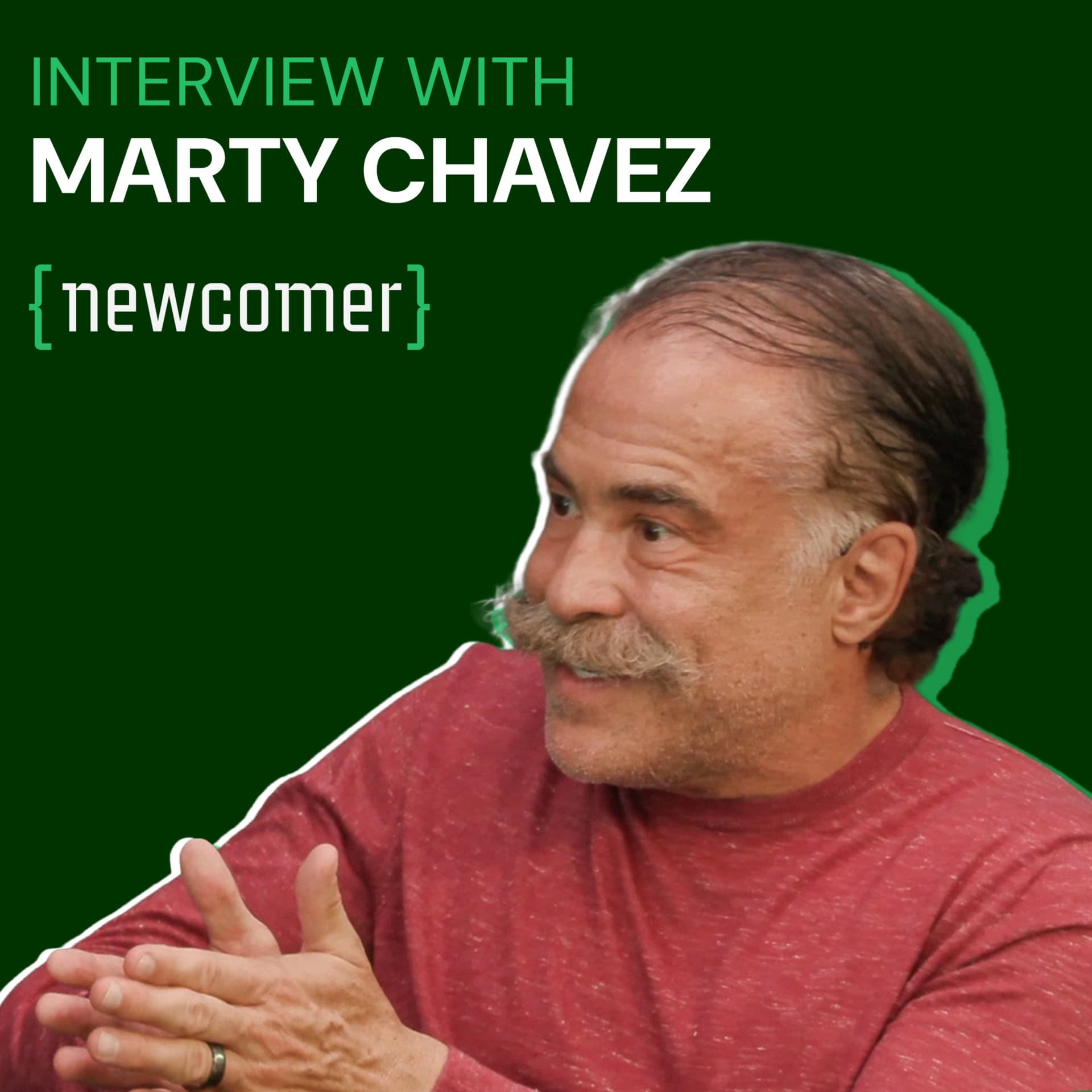

In short
Marty Chavez, an AI PhD and long-time Goldman Sachs executive, discusses how “AI” in finance evolved from earlier algorithmic trading, how big institutions adopt AI, and what AI’s market trajectory and enterprise sales lessons look like. He also highlights AI’s role in protein science via Isomorphic Labs and the longer path to drug discovery.
Guest backgrounds
Marty Chavez earned an AI PhD in 1991 (when he says there were “exactly zero” AI jobs). He spent decades at Goldman Sachs building trading “digital twins” and later algorithmic/agentic systems; he’s now at 6th Street, sits on Alphabet’s board, and helped launch Isomorphic Labs.
Key claims
AI in finance is a renamed iteration of agents/algos; Goldman’s staffing shifted as bots expanded complexity; incumbents prefer building internally but may buy tools; investors may keep funding unprofitable AI until they don’t; Alphabet’s search disruption is being countered by Gemini.
Notable examples
a “legendary” trading failure where simulated routing hit the real exchange and bankrupted a firm in 40 minutes; Goldman’s internal shift from writing proprietary software to using open source/vendors; Abacus.ai for data wrangling and smart order routing; Alphabet’s large capital raise (about $85B).
Written by AI. May contain mistakes. Listen to the episode to check what was said.
Chapters
Tap a time to open that second in VOGoldman Sachs and AI's Evolution
0:29 to 1:25
Discussion on Goldman Sachs' journey in AI and its history.
“When you think about like institutions like Goldman Sachs, they're certainly more cutting edge than many.”
Algorithmic Trading and Its Impact
1:25 to 3:24
Marty discusses the rise of algorithmic trading and its consequences.
“Do you know how many AI jobs there were in 1991?”
Job Dynamics in Trading with AI
3:24 to 6:12
Exploration of how AI has changed jobs and roles in trading.
“So this stuff has been around for a while.”
In-House Software Development vs. Outsourcing
6:12 to 7:28
Discussion on Goldman Sachs' approach to software development.
“one takeaway, if they've already been doing it, is that they don't want some external company doing it for them, right?”
Investment Strategies and AI Adoption
7:28 to 9:28
Marty shares insights on investment processes enhanced by AI.
“So you can sell software to a huge company like Goldman.”
Market Sentiment on AI and Future Perspectives
9:28 to 14:03
Analysis of current market sentiment towards AI and its future.
“And this is such a big question, but on the market sentiment to AI.”
The Evolution of AI in Search
14:03 to 15:45
Explore how AI has evolved in search technology over the years.
“So Google has been working on AI for a long time, as we know, and it's been in search and it just, there just keeps being more and more of it, right?”
The Challenges of AI's Mission
15:45 to 16:40
Discuss the challenges AI faces in organizing information amidst inaccuracies.
“And and if your mission is organizing the world's of world's information and you see this incredible technology and you see that it has this particular human characteristic, which is it makes things up.”
The Genesis of Protein Databank
16:40 to 18:28
Learn about the early initiatives in computational life sciences and their impacts.
“We first met at a bio conference, you know, alphabets exploring, I think interested in data centers in space.”
AlphaFold and Protein Structure Prediction
18:28 to 19:16
Discover how AlphaFold revolutionized protein structure predictions.
“So as a 16-year-old, I'm working on crystallizing the capsid protein of the tomato bushy stunt virus.”
Show all 12 chapters
Future of AI in Healthcare
19:16 to 21:24
Understand the potential and hurdles of AI applications in drug development.
“that have been laboriously crystallized by grad students, and that's all we got.”
Sales Strategies for Startups
21:24 to 24:28
Gain insights on how startups can effectively sell to large enterprises.
“I don't see that happening in the next couple of years.”
Transcript
Automatic transcript. May contain errors.0:00Eric Newcomer:Marty Chavez got his AI PhD back in 1991. How many AI jobs did he have to choose from when he graduated? Exactly zero. So he went to Goldman Sachs and spent decades building the machines that took over Wall Street. Now he's at 6th Street, sits on Alphabet's board, and helped launch isomorphic labs. Few people have watched more AI hype cycles come and go. Fewer still have profited from them. This is my conversation with Marty Chavez from the Cerebral Valley AI Summit in London. I'm Eric Newcomer, author of the Newcomer Substack. Let's get into it.
0:34Eric Newcomer:When you think about like institutions like Goldman Sachs, they're certainly more cutting edge than many. So like any, when you think of like the big old guard, powerful industries, where do you think they are right now on this like AI journey? Are they like fatigued where it's like it's been oversold? They're true believers? Or what is your sense of like these mass enterprises and their relationship to this AI mania? Well, this will be a little bit particular to Goldman Sachs. So I'm old, so I like to think that this is the most exciting time ever to be alive and to be a computer scientist. And also, there's nothing new under the sun.
1:13I was crazy before. All those two thoughts, right, at the same time. And so at Goldman, we've been working on the frontier of AI for a long time. It's just that the names keep changing. So why did I end up at Goldman? Because I got a PhD in AI in 1991. Do you know how many AI jobs there were in 1991? Exactly zero.
1:41Eric Newcomer:Instead, you were like, I'm the smart guy. I guess I go to Goldman Sachs. I just got a random letter from a headhunter. And the letter said, I've been instructed to make a list of entrepreneurs in Silicon Valley with PhDs from Stanford in computer science, and you're on my list. And I had bills and student loans. And so that's how I ended up there. And at that time, I wouldn't even say I got a PhD in AI or machine learning, or I'd just say computer science. Why? Because it was embarrassing because AI couldn't do anything then. And so I ended up at Goldman and they had this crazy idea. Let's build a digital twin of the trading business.
2:23Let's build a piece of software that models everything that happens in the trading business so that we can lose a lot of money and then say, ah, it was only a simulation. Okay. Right. As opposed to losing it in real life. But then around 2011, we started to see something different happen. And it's kind of cute. We called them algos. Does that name?
2:47Eric Newcomer:Algorithmic trading. Algorithmic trading. But it's the same thing exactly as agents. It's humans out of the loop making trading decisions. There were pieces of software that put orders to buy and sell stocks into the exchange. What could possibly go wrong? Right. Everything went wrong. There are many companies that no longer exist because they bankrupted themselves. There's a legendary example of a company that thought it was trading in a simulated test environment, except the trades were being routed to the actual change. And in 40 minutes, they were bankrupt. That was night trading. So this stuff has been around for a while.
3:29We just didn't call it agents. And so at Goldman Sachs and many other places, this is just the next iteration of something that's been around for a long time. And I think we already know how it's going to go, right? So there's a lot of concern about jobs, for instance, job loss. Well, so here's what happened in the trading business of Goldman Sachs over 15 years of bots or algos or AI or whatever you want to call it. There are, would you guess if there are more people in the business?
4:01Eric Newcomer:I assume way more people. Way more. The business is way bigger. Complexity gives people a lot of stuff to do. It makes way more money. It does very much more complicated trades. But if you were to list all the activities of the people 15 years ago and the activities of the people now, they're completely different. And do you think the same people kept their jobs? I guess one of the issues with, and I want to get into sort of the public policy stuff more after we get through this period. But just given you brought that up, do you think the same people kept their jobs or new jobs were created and some people lost?
4:40So there was one day in 2011 where I became co-head of the equities business, right? So it was a little Goldman Sachs drama. If you were a quant like me, you thought this was the best thing ever. If you were a trader who wasn't a quant... You're like, not the champion I want. Not that guy, right?
5:01Eric Newcomer:I want the guy who's like, you need gut. Well, I'm going to get to that. Right. And so I did what you do at Goldman. You have a town hall. You bring everybody together. And so I said, you all have three strategies. One, tell the computers what to do. It's been a great strategy for me. It's not for everybody. Two, collaborate with the computers and the people who tell the computers what to do. I love this strategy. I urge you all to adopt it. Everybody can adopt this one. Strategy three is idiotic. In the name of what you think of as your job security, stand in the way of progress, stonewall the people who tell the computers what to do.
5:43If I catch you executing that strategy, I will accelerate the end of your career to right now. And afterwards, my boss said, Jesus, that was dark. I said that I thought I was being helpful. And people still to this day say, I was listening and I went for strategy too.
6:07Eric Newcomer:From this anecdote and just the experience of Goldman Sachs, one takeaway, if they've already been doing it, is that they don't want some external company doing it for them, right? Not generally. Right, yeah. So what is their opportunity, I guess, for all these startups that say, oh, we're going to do all this AI stuff for you? Or are they just proving to incumbents that realize, wow, if this is our core competency, ultimately we're going to have to do it ourselves. So when I started at Goldman, 93, we had in our group a mantra that we thought was really clever and cute, which was the only thing crazier than writing all your own software is not writing all your own software.
6:47But it was 1993. So we wrote our own object-oriented, transactionally-protected database. We wrote our own programming language. If you squint, it looked a lot like Python, on, right? But this was all happening in 93. And that was a strategy that served us really well. But when I became chief information officer, we changed it. And we said, we're going to do it a different way. First, we're going to see if there's open source. And if there is, we're going to use that. And then only if there isn't, are we going to go out and look at vendors with a preference for open source packaging by vendors.
7:23And then as a last resort, we're going to write our own software. And they're still doing that at Goldman. So you can sell software to a huge company like Goldman. The exciting part of it is it's probably going to be a big contract if it's going to be material for Goldman. But the sales cycle is brutal.
7:41Eric Newcomer:The last thing they want to do, it's like, all right, only if you can convince us it's better than any alternative. And we would say that up front, that you had to do that. But this is very particular to something on the scale of Goldman. And my firm now is a private capital firm, Sixth Street. We spun out of TPG. We have$140 billion under management. We buy a lot of software. We're huge users of AWS. There is an AI company that we actually are using. It's called Abacus.ai. And you can think of it as data wrangling plus smart order routing to a bunch of different LLMs. And it's really on fire.
8:22inside the company. And we would not do that on our own. On the other hand, we were big believers in this moment of the model surrounded by a harness, right? That's very much of the moment. And so we have built our own harness for the investment process. We think it's very specific to us.
8:41Eric Newcomer:To switch between closed source models or to make open source models or models that you control work well? We use a bunch of models underneath it, but it's a harness for the end-to-end process from we first hear about a company, we find its virtual data room, all the way to what are the work products we've got to generate so that we can get to our investment committee, and then what kind of write-up actually gets investment committee to say, yes, let's do this. So that whole process, we're finding that with the right harness over a set of models, and we're using a bunch of different ones, we can greatly increase the aperture of deals that we look at and the quality of them with the same number of investment professionals.
9:28Eric Newcomer:What is your view? And this is such a big question, but on the market sentiment to AI. We had this Asia freak out. SpaceX is trading down a little bit. I didn't get the latest. It's only been a week. I know, it's only been a week. It's priced to perfection. I don't know, but what is, yeah, I mean, do you think, you know, one way to put it directly is like OpenAI Anthropic will be received positively by the markets? Or what can you tell us of your view of how the markets are going to continue to read the AI moment? So there's obviously excitement that I think all of us share and we can see what AI is good at.
10:10And then there's also old school finance professionals who look at these companies and think, hard to see the path to profitability. Even opening eye on Robic? Yeah. I mean, maybe it's there. And they're going to have an opportunity to talk about it. And we'll learn a lot more. Right? It's not completely obvious to me that it's there. And maybe it doesn't need to be there. Maybe there's a long time that investors will continue to fund that gap. And that's the thing that's unknowable. It's one axiom of finance is that investors will keep funding until the moment that they don't. And nobody can predict it.
11:00It would be a fool's errand for me to attempt to predict when that would happen. Well, you know, right ahead of the SpaceX IPO.
11:09Eric Newcomer:I think this was undercovered. We talked about it some in Newcomer, but Alphabet went out and raised a ton of money. You noticed that. Yeah, Berkshire. How much was that? We want the money versus we want to remind the investment community. You could, you know, invest in these very speculative businesses or you could invest in our company, which has one of those very speculative businesses and the old school. And profits. And profits, yeah. And distribution. I don't know. Why raise all that money? It was something like, I don't know, it was like$85 billion. With the green shoe, it ended up around there.
11:44Well, it was because it was possible to do it. And we're always looking at the right way to fund this incredible moment. You can see the CapEx of all the companies and Alphabets is public. And the leadership has been saying a lot to the market about what that trajectory looks like. And so as a finance person, I will just look at that and say, well, there's equity and then there's credit and then there's everything in between. And so what makes sense?
12:20Eric Newcomer:Which is a better deal, equity or debt. I mean, in some ways, is it wrong to think, you know, the market right now is rewarding ambition in AI. So if we take on this money through equity, we are only going to get almost rewarded for leaning in, even though we're raising money. Is that too dumb of a way to think of it? No, that's it. There are many ways to think of it. Old school finance. It's just there's that spectrum of ways that you can finance this ambitious and appropriate and exciting CapEx plan. And this is one way to do it. And why do you think, assuming you do, Alphabet is well positioned right now?
12:59I mean, we surveyed people on products that they thought might get disrupted.
13:04Eric Newcomer:Google search was certainly not their top answer, but it was an answer. I sort of made the case for you guys that, well, to the extent Google search is getting displaced, it is getting substituted with Gemini, your own product. But what, I don't know, but there is clearly a threat of disruption to that profit generator that is so key to the Alphabet story. What gives you confidence in what Alphabet is doing today? So things change really fast, right? So I've been on the board for four years. And there was a moment when people would say, oh, Marty, I'm really, like, you're on the board of Alphabet.
13:42That must be really tough. I know. I remember when you guys were so beat down. And don't you know that search is dead and it's going to be completely, like, it's interesting and cute that you think that, right? That was not going to happen. That was, people said it, that doesn't make it true, right? So Google has been working on AI for a long time, as we know, and it's been in search and it just, there just keeps being more and more of it, right? I'm old enough to be able to say things like AI is just more software or to quote my friend Astro Teller. It's linear algebra on steroids, right? And it's great and it's exciting.
14:25And of course, we're going to use it in search. And it can't be a huge surprise that the search box is morphing to do more stuff. And one thing that I've always said since the beginning is that, you know, chatbots, like fun, but a CLI from the 70s, is that how we're going to all interact with AI, it seemed unlikely to me. And then we moved beyond the chat interface. And then now, actually maybe it's back to the future. I'm using a CLI all the time. It's called anti-gravity.
15:02Eric Newcomer:I think there was this story of like, I mean, obviously the attention is all you need paper. We literally started today with Aiden Gomez, COF Co. Yeah, exactly. COF Co here, who was a co-author on that paper. obviously not at Alphabet anymore. But, I mean, the story was sort of like, oh, they were the geniuses, but then they weren't hardcore enough, and then they sort of like got hardcore. Maybe, you know, Sergey came in or whatever. Like, how much do you think it just took time, or how much do you think there was this sort of like awakening? I will give you my personal perspective is Sundar said 10 years ago, we're going all in on AI, And there's a lot of people I know you don't think this, but for maybe people out there in the general public, AI began with ChatGPT in 2022, but there's been a much longer history of it.
15:59Right. And and if your mission is organizing the world's of world's information and you see this incredible technology and you see that it has this particular human characteristic, which is it makes things up. That seems at odds with organizing the world's information. Right.
16:21Eric Newcomer:There are really things like, oh, that doesn't that's not what we want. It's not. It was it took a while to make it part of the mission. But I totally get if you're a startup, you can have a different plan. And why not release it? That makes sense. That wouldn't have been, in my view, the right move for a company whose mission is to organize the world's information. We're among futurists. I know you're a grounded person. Although I have crazy thoughts. We first met at a bio conference, you know, alphabets exploring, I think interested in data centers in space. I mean, everything from, yeah, disease research, space is in the, so I guess of the many sort of like moonshot ideas out there, which ones are you sort of most energized about or really a believer that our world will be changed in the next, I don't know, five to 10 years?
17:20I have to start with isomorphic. Yeah. So I wake up every day excited about. Doing disease research, Demis Sasabas, co-founder. I think I have a particular angle on it. So I went to college. I hadn't done any due diligence. I thought I'd major in computer science. They didn't have a computer science major. So the science professors are recruiting. And there's a biochemistry professor. And he says to me, in 1981, little 16-year-old me, the future of the life sciences is computational, which was a crazy thing to say in 1981. He said, if you sign there as a biochem major, you can take computer science, you can take physics, you can take chemistry, you can do it all and join my lab.
18:08And we're doing something truly insane and wonderful, which is we're crystallizing proteins, one protein at a time, and we're taking all the atomic coordinates and we're putting it in a database. And I thought that sounded incredibly cool. That was the genesis of the protein databank. So as a 16-year-old, I'm working on crystallizing the capsid protein of the tomato bushy stunt virus. We never forget a name like that. But this is what led to AlphaFold. And I remember saying to ourselves and hearing from the people who really knew what they were talking about, the professors, this is going to be a 50 to 100 year journey.
18:52Eric Newcomer:Right. And these timelines are short. But we got to start somewhere by putting all the coordinates in a database, right? And then Demis and team came along and they used that. And then they did all kinds of other wonderful things for which they got the Nobel Prize, of course, right? Including one of the things that Demis talks about that I find so counterintuitive and exciting is at some moment, and I'm oversimplifying, they decided we've taken all the 50 ,000 proteins that have been laboriously crystallized by grad students, and that's all we got. And now we're going to guess the structures of 75 ,000 other proteins for which we do not know the structure, and then we're going to feed it back in.
19:36Now, that could have sent the model out into the weeds. But instead, something amazing happened. It leapt to this new level of understanding how proteins fold. And then after that, it could predict hundreds of millions, right? So I love that.
19:52Eric Newcomer:We just saw Midjourney is doing these sort of sauna scans. Do you feel like your health today has been improved at all by the AI industry? Or do you think a lot of these I think it's on the come. I think it's on the come. And one of the, this is not going to be surprising to anybody. I think it's well accepted at this point that AI is really good at finding molecules given a target. And that is an incredibly important part of inventing new drugs. But it's just one part. There are many, many other parts and they're complicated. And they're complicated because many of them are legal, social, and political judgments, right?
20:36Like a clinical trial. If a randomized control trial is the only acceptable evidence of a drug's efficacy, then those are expensive and those are slow. And so to my mind, there's many levels of simulation that we still have to figure out. And alpha-fold is a linchpin of that. But maybe to really do it, we're going to need to be able to simulate not just proteins, but cells and tissues and organs and bodies and then whole groups of people and the psychodynamics of whether you take the pill or not. And at the level of a society, is the society going to pay for this treatment? All of that has to go into the simulation.
21:21I think that's going to be a long journey. I don't see that happening in the next couple of years.
21:28Eric Newcomer:We might have this technology to have this amazing idea or development, but then so much needs to play out for it to actually be realized. Yes. We started with the experience in big organizations. And so I just wanted to ask you, there's so many startup founders here who want to figure out how to sell to big institutions or partner with companies like Alphabet. bet. I don't know, what advice would you give like the small startup for going after those like big enterprise sales or striking a big partnership? So I've been on both sides of this. I've been an entrepreneur as well. And so, okay, here it is.
22:11This is something I learned. Well, it's something I learned the hard way. So in one of my startups, it was a dot-com era startup. It was an early software as a service company. Give us your trades. We'll give you the risk analytics. But we didn't even have the term SaaS at that time. This was 2000. And we had this product. I heard someone say earlier, we had this product. And it turns out that there were features in the product that nobody actually cared about. And we worked really hard to build it. And we were getting some deals and it was kind of working, but it was painful. And we started the company two weeks before the dot-com bubble burst.
22:54So the timing was interesting. And eventually, our investors gave us a head of sales. This guy's name in the market was Dr. Payne. So let's start there. Dr. Payne. and he came in and he said two things that froze my blood, basically, as a new head of sales, right? He said, if you, Marty, don't get a call from a very angry customer screaming at you because I, your head of sales, have crossed the line in my sales tactic, then I'm not doing my job. It's all hard. And then the second thing he said to the sales team was, customers buy a product when they have unbearable pain and you have convinced them that only your software product can put an end to their pain.
Read the full transcript
23:55Everything else is just getting lucky. You're in a hype cycle, right? And so it really comes down to that. You have to understand the people in the organization, not just the organization. You have to understand in a large organization, there is always someone who tells you, I am the ultimate signing authority. And that is always false, right? There's always someone higher who has to be convinced. And if you're not talking to that person, you probably don't have a sale. And if they're not experiencing unbearable pain, then you're probably not going to have a sale. And unbearable pain, what I learned in that era, unbearable pain is having to restate your financial statements, going to jail because there were falsehoods in your financial statements, right?
24:46So if my product could mitigate that risk, then people were going to buy. Otherwise, getting lucky.
24:54Eric Newcomer:Marty could talk all day. Hopefully people, never have I felt looking back has made me so optimistic about the future while sort of setting limits on how ambitious to be. Well, human nature is a constant, right? That is true. Thank you so much for joining me. It's a pleasure, Eric. Thank you. Thank you. That's our show. This is the Newcomer Podcast. Thank you so much for listening. Please like, comment, and subscribe. You can follow more on the Substack at newcomer.co. We publish every talk from the Cerebral Valley AI Summit on our Newcomer AI Summits channel. and you can find my conversation with Cerebral Valley co-hosts Max Child and James Wilsterman at our Cerebral Valley show channel.
25:35Eric Newcomer:Lots of stuff going on here at Newcomer. Thanks so much for your support. Please leave a comment, suggest guests. Thanks so much for your time. See you next week.
From the publisher
The Goldman Sachs exec who automated Wall Street on what AI agents actually do to jobs, companies, and the future of enterprise software.
Marty Chavez got his AI PhD in 1991 when there were exactly zero AI jobs. So he went to Goldman Sachs and spent decades building the machines that took over Wall Street. Now at Sixth Street and on Alphabet's board, he joins Eric Newcomer at the Cerebral Valley AI Summit in London to explain what actually happens when AI replaces human labor, why a trading firm went bankrupt in 40 minutes because of a bot, and what it really takes to sell software to a large institution.
Subscribe for weekly conversations with the founders, investors, and executives shaping the tech industry.