
In short
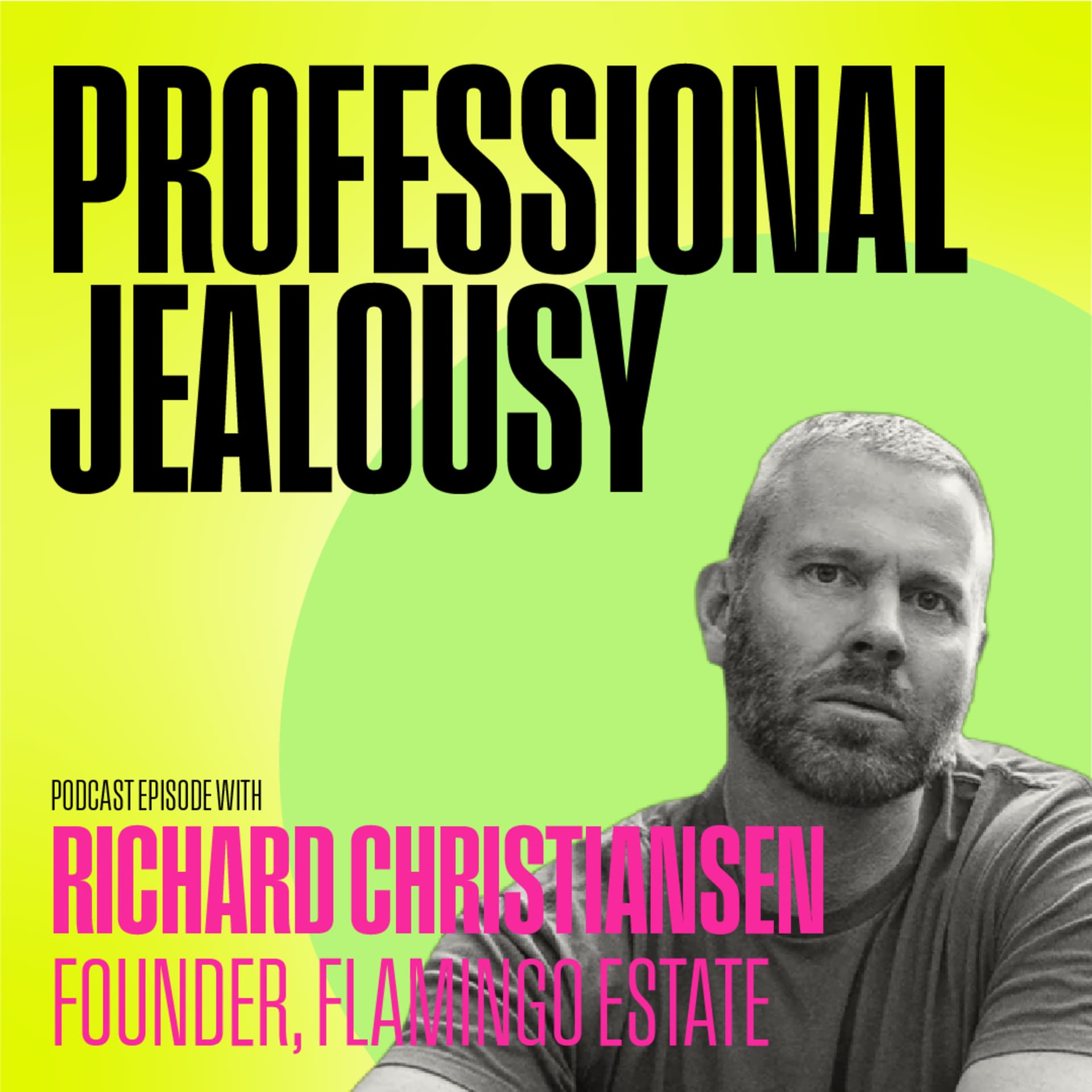
Richard Christiansen explains how Flamingo Estate grew from COVID-era farm support into a luxury brand built around “radical pleasure,” insisting on staying small, making products in-house, and avoiding AI outsourcing (especially for customer service). He connects the brand’s multi-category luxury (food-to-bath-body-fragrance) to intimacy, sensory engagement, and “acting small” as a core business philosophy.
Guest backgrounds
Richard Christiansen is founder of Flamingo Estate; previously led Chandelier, an agency known for fashion and luxury work. Natasha Jakubowski is Chief Innovation Officer at Anomaly and hosts Professional Jealousy.
Key claims
Pleasure is a human right; success means senses “fully on fire.” Sustainability talk can be too earnest; Flamingo sells pleasure instead. Scaling should preserve intimacy; speed and operations can kill it. “Never take money from someone who didn’t earn their own.”
Notable examples
Selling farmers’ vegetables out of a bookshop during COVID; renting Universal Studios for COVID-safe packing; a Mecca (Australia) visit that sparked beauty/nutrition/wellness product expansion; tomato candle and peppermint soap as top sellers; Hawaii/Okinawa/Bhutan farmer collaborations via subscription boxes.
Written by AI. May contain mistakes. Listen to the episode to check what was said.
Chapters
Tap a time to open that second in VOExploring Origins and Brand Philosophy
0:45 to 1:45
Richard Christiansen shares the beginnings of Flamingo Estate and its philosophy.
“business leaders and creatives that I'm impressed by.”
The Accidental Business during COVID
1:45 to 4:00
Richard discusses how the pandemic led to the creation of a vegetable business.
“Well, Flamingo is my home, first and foremost.”
Growth and Expansion of Flamingo Estate
4:00 to 6:10
The evolution of Flamingo Estate from a vegetable seller to a beauty brand.
“this wonderful guy, Oliver, came here who had an olive farm.”
Challenges of Scaling a Luxury Brand
6:10 to 8:34
Richard reflects on the challenges of scaling while maintaining authenticity.
“And that was such a full circle moment for me because I had filmed TV commercials in the backlots here.”
Maintaining Smallness in a Growing Business
8:34 to 11:15
The importance of staying small and personal in a growing brand.
“They just were, their size always started to get in the way.”
Vision for a Billion-Dollar Brand
11:15 to 14:00
Richard shares his vision for transforming Flamingo Estate into a billion-dollar brand.
“Like, so how do you scale while still staying small, not selling out, becoming self-conscious, becoming, you know, letting go of all the things that make it so, you know, so desirable?”
The Pursuit of Pleasure in Branding
14:00 to 17:09
Discover how pleasure and sensuality are integral to creating luxury brands.
“You can scale a brand, a luxury personal goods or beauty brand.”
Navigating the Brand Identity Landscape
17:10 to 19:25
Learn about the challenges of defining and positioning a brand in today's market.
“And a lot of that is about, like, get off your screen and stop looking at your phone and smell things, eat things.”
The Investment Journey of a Brand
19:26 to 21:33
Explore the complexities and challenges of raising funds for a startup brand.
Building a Supportive Board and Team
21:34 to 25:12
Understand the importance of having a strong board and team in a growing business.
“And we were just running out of money because we needed to buy, you know, we needed to buy, you know, ingredients.”
Show all 24 chapters
The Future of a Diverse Luxury Brand
25:13 to 27:36
Consider the possibilities for expansion across various product categories in luxury.
“They're not looking at us as a almond brand, you know, or something like that.”
The Evolution of Luxury and Retail
27:37 to 28:00
Discuss the integration of luxury brands into various retail environments, including airports.
“You go into, you know, hospitality, presumably, like the world is endless that you're building.”
The Evolution of a Luxury Brand
28:00 to 30:08
Explore the strategic growth and brand positioning in luxury markets.
“I think that, well, there's a difference between like where we go category wise and where we go into how to reach us.”
Returning to Nature and Personal Growth
30:08 to 33:58
Discuss the importance of connecting with nature and personal development.
“And so couldn't wait to get away from the dirt under my fingernails.”
The Importance of Connection in Business
33:58 to 36:55
Learn about the significance of personal connections with customers in business.
“And so, but I started to think like, if we had to do that today, what are we seeking victory from?”
Lessons from Heritage Brands
36:55 to 42:00
Understand the key lessons on brand legacy from established luxury brands.
“And I get into these long conversations.”
The Rigor of Heritage Brands
42:00 to 43:59
Explore the importance of craftsmanship and pricing in luxury brands.
Supporting Local Farmers and Sustainable Practices
44:00 to 46:34
Discuss the significance of local farming and sustainable sourcing.
“favorite thing is that we and this really was maybe my solution to an earlier question you asked where you're like, how do you balance this need?”
The Joy of Collaborating with Farmers Worldwide
46:35 to 48:54
Learn about global initiatives to support farmers and their communities.
Reflections on Career and Superpowers
48:55 to 52:41
Insights on personal career growth and the value of softness as a strength.
“I don't think you can own a business unless you're an early riser.”
The Reality of Business Growth and Scaling
52:42 to 55:53
Understanding the challenges and magic of scaling a brand.
“Like we'll get to 75 million in revenue.”
Reflecting on Jane Goodall's Influence
56:00 to 59:00
Learn how a personal encounter with Jane Goodall inspired transformative career choices.
“as business people is to, is much more than just to make some money, you know?”
Creating a Successful Fragrance Line
59:00 to 1:00:56
Discover the unexpected insights about fragrance preferences during economic downturns.
“She was the one that said we should start a business.”
Closing Thoughts and Future Connections
1:00:56 to 1:02:51
Conclude with expressions of gratitude and plans for future collaboration.
“And I do think especially, you know, that my podcast isn't super general interest, but, you know, everyone I've mentioned you to is like, oh, my God.”
Transcript
Automatic transcript. May contain errors.0:00Richard Christiansen:Coming up in this episode of Professional Jealousy. There's a real joy for me in, a real grace in regulating your smallness. Like, why aren't you guys using any AI for your customer service? I was like, we will never, ever use AI for customer service, ever. Sounds a little cheesy sometimes, but honestly, like, I needed to rescue myself. I was a shell. If possible, I would say never take money from someone who didn't earn their own. Just having my senses completely on fire is, to me, the definition of success.
0:35Richard Christiansen:Hi, I'm Natasha Jakubowski, Chief Innovation Officer at Anomaly, a global marketing agency. And this is my podcast, Professional Jealousy, where I'm lucky enough to talk to founders, business leaders and creatives that I'm impressed by. And yes, maybe a little jealous of. Today, I'm talking with Richard Christiansen, the founder of Flamingo Estate, a brand that I have admired and gifted to so many people. We'll be chatting about leaving rural Australia, starting Chandelier, an agency known for its fashion and luxury work, and most recently, of course, the creation of Flamingo Estate. Hi, Richard.
1:22Richard Christiansen:Hello. We're going all the way back to Australia. I mean, I don't know if we'll do much on Australia, But I think it's, you know, as someone that's not from America, I'm always curious. And, you know, anyway, before we go there, for anyone that doesn't know the Flamingo Estate brand, can you give us the elevator pitch? Well, Flamingo is my home, first and foremost. I live here and it accidentally became a brand. And we started selling vegetables. My mom and dad are farmers in Australia. And so I know the grind of farming. And, you know, I spent my whole professional life in advertising. And as you said, it's chandelier.
2:07And then this is not a short, I guess this is not a short answer. Not an hour to switch. Not really. I mean, it's a collision of multiple things happening at once. I had started an office for my agency here in Los Angeles. I also opened a bookshop because there's not a lot of bookstores in Los Angeles. Good bookstores. and uh and then i used to work the bookstore on the weekend and i was there um and a farmer walked in who i knew because i had bought trees from her i have a very flamingo's a very large orchard and garden and um and she said there's this thing called covid it's just happening i'm gonna lose my farm because my vegetables go to all the farmers to the restaurants and the restaurants are about to close and i was like oh nonsense we can we can sell your vegetables your veggies and My mom and dad had lost their farm when I was a kid.
2:55So I was like, you know, it was very personal to me. I was like, let's help her out. And short story is one farm became 10, became 50, became 165 now, keeps growing. And from those farmers just kept pulling everything they were growing and started selling vegetables out of my bookshop the very first Friday of COVID. And the next Friday, we doubled that number. and the next Friday we doubled that number. And so we kind of stumbled across this wild vegetable business. But I'd really cut my teeth on luxury brands and my partner had to and we made everything look beautiful and packaged it perfectly and this thing just exploded.
3:42It just exploded in the most wonderful way. The money was going back to the farms. We were meeting lots of incredible people. At a time for me, we'll probably talk about this later, where I really needed that kind of wholesomeness and honesty. And then sort of maybe a year into it or two years into it, this wonderful guy, Oliver, came here who had an olive farm. And he said, you know, could you help me out? I hear you're helping farmers out. And I said, we have enough olive oil and we don't need any more. And then as he's leaving, I was like, actually, maybe we can make soap from your olive oil.
4:17And so today, and that kind of was a big turning point. Yeah. Today, bath and body products, beauty products, soap and soon fragrance isn't about 90 percent of what we do. Amazing. And the company has just, you know, it's it's exploded in financially in a way I could never have dreamed of. And in a distribution I could never have dreamed of in five years. And so and we'll talk more about that, I'm sure. But so anyway, short answer. Yeah. We started making things in my home from farmers that we met and stumbled into something really interesting, which I'm very proud of, actually.
4:57Richard Christiansen:It's amazing. I mean, yeah, I love the idea of the accidental business that then grew. Like, what was the moment that you realized it went from kind of helping out the farmers and selling through COVID to actually this could be my own business, my own brand? I just think the volume at which we, I've built brands and rescue brands my whole life. I think the volume at which it just, the wind hit the sails so quickly. And people, I think this kind of brand could never exist outside Los Angeles, I think, because our adjacency to Hollywood was very important. People were gifting it. People who had a lot of following were sort of talking about it.
5:40There's a lot of goodwill here for us. You know, we were genuinely helping out hundreds of farmers. And, you know, one point in the vegetable part of the journey, although we still sell vegetables, But when we were just doing that, we had to rent out Universal Studios or somewhere like that because we needed a space large enough for all these trucks to come with their vegetables that was COVID safe, that was covered, that we could pick and pack vegetables on a Thursday to sell and deliver on a Friday. And that was such a full circle moment for me because I had filmed TV commercials in the backlots here.
6:15I'd done, you know, silly, silly, other silly jobs for brands that we were creating fake narratives. And here we were picking out carrots. So it was wonderful. It was that first two years, let's say, under the protective bubble of COVID was just joyful for us. Yeah. And then and I think maybe the other point that I really felt like, oh, something's happened is we got it. We got a visit from this amazing, amazing entrepreneur in Australia, Joe Horgan and her colleague Marita Burke. They really run this business in Australia called Mecca. If you're Australian, everyone knows Mecca. It's like Sephora, but much better.
6:55And the best retailer in Australia, I think. And big, big, big beauty business. Huge in every city in the country. and um they came here and they said i think there's something interesting going on in in the industry we're seeing this collision of beauty nutrition wellness yeah and a sourcing acumen no one can deliver on it because no one's making stuff that way you know they're making stuff in a laboratory they're making they're using contract ingredients they they're not you know most beauty brands as you know don't even touch their products that you know it's all outsourced um i said you know you're doing you're you're one of the only people we can think of who's who can actually deliver on it because you're actually making stuff that way yeah you're pulling food grade ingredients and you're making hand soap from it and that really was sort of how this this sort of skew assortment started we will make i think we made 150 products in our first year which is on it's such a yes but people would come to the house and they say like oh i've got seven acres of sage what can you make from it and oh i've got 18 acres of lavender what can you make with it and i would just think let's make shampoo how hard can that be and we'd figure out a way to make shampoo and so thank god we've we're not mixing markets anymore but um at its core we're still doing the same thing you know which is from the business point of view um really the opposite way most businesses work most people start like i want to make a product how do i how do i do it we were like oh we've got all the stuff what can we make from it so it was the complete upside down way of approaching a brand and it was super counterintuitive of what i had learned and
8:29Richard Christiansen:done for other people well I was gonna ask about that like what what are the things that you know chandelier is so well known for its work in fashion and luxury like what are the things that you did take on like I'm assuming like the the world building is something that obviously I can see from that work and then the other stuff that you had to kind of reject because it it wasn't right I think I say I've said this before to a lot of you know a lot of my colleagues and friends the I was I was at the helm of chandelier for most of my adult life you know I'm not there now um but you know for 20 years I was in New York I was and anyone that works in the industry as you know like it's it's a service industry you're hustling you're always pitching you're always running um and people would come to us very big brands very small brands you know luxury brands tech brands and we know whether you were apple or whether you were hermes whoever you were i in my full heart i can tell you this people came to us with different briefs but they all had the same problem and they all had the same secret question which was how do you help us act small yeah because i think they had all got to in one way or another too big to be um funny too safe to be vulnerable, too afraid to be humorous.
9:58They just were, their size always started to get in the way. I swear to you, we all have seen that. Self-conscious. They got too self-conscious, yeah. And they, not be small, they were big businesses, but they needed to act small and act personal. And so, and I think for me, just seeing that again and again and again and again and getting so frustrated when people wouldn't listen or take their medicine. You must have seen that too. You know, I thought if I ever started my own thing, if that ever happened, I would be just fiercely, fiercely, fiercely obsessed with acting small. And, you know, and then that means like how you function in the office.
10:39It means how you function to, you know, your customers, how you make products. And so, and it's sort of something I'm continuing to be obsessed with. I think it happens to people as well as businesses. I think when you start to get too big for your britches, you start to lose your magic. And so there's a joy, there's a real joy for me and a real grace in regulating your smallness. Yeah. And I'm a huge, huge believer in it.
11:10Richard Christiansen:I thought it was interesting because you have said that you're going to make this a billion-dollar brand. Like, so how do you scale while still staying small, not selling out, becoming self-conscious, becoming, you know, letting go of all the things that make it so, you know, so desirable? It's a really, it's a time relevant question. We are, you know, we learned so much. And I think that, and we've also definitely grown up as a business. And, you know, we're across Australia. We enter Japan next week. We open there next week. We're across America. We've scaled quite quickly. And with that has come those complexities that I used to get annoyed at from other people.
12:01It really is a very true thing. I think the, but at its core for me, the core team is quite small and very intimate. People joke, I still write all the social media copy. I write all the website copy. I write all of it. My partner hardly designs all of it. We will never acquiesce that to, or delegate that to someone else. We make, you know, we only make stuff we use at home. And, and more and more and more, like really trying to make sure that the, the team stays is like very close and personal. And so we, and it's interesting, we had a board meeting yesterday in Ambassadors or like, why are you guys using any AI for your customer service?
12:40I was like, we will never, ever use AI for customer service ever. And so, you know, that's like, we're not outsourcing anything. We make our own stuff. We don't have a 3PL. We have, you know, we have our own warehouse where we ship stuff, you know. We're trying really hard to hang on to all the pieces. I think, I don't think there's one thing. I think it's just a real attention to the small things. And we're so fiercely eagle-eyed on it. It sounds silly and simple, but maybe it is simple. It's also complicated at the same time. I think there's this, with Flamingo, I really feel like there's this collision of something very old and very new breaking through at the same time.
13:22You know, making stuff the way grandma used to make it, whether it's food or whether that's stuff for your home. and trying to think about new ways to package it and sell it. And, you know, my mom and dad are farmers and horticulturalists and environmentalists. And I think one, I'd like to build Flamingo to be a billion dollar brand. I'd say that a lot. Not because I want, not because I'm a tech, not because I'm a finance bro and I don't care about the eggs or any of that stuff. It's because I really do want to turn around to Lauder and L 'Oreal and those big... And show it can be done. And like raise my big middle fingers and say like, You can leave the world better than you found it.
13:57You don't need to use palm oil for everything. You can scale a brand, a luxury personal goods or beauty brand. You can make it at scale and do it the right way because I don't think anyone has unless it's marketing shit. And so I'm really determined that we fly that flag. And when I said new ways, part of it was I feel like that industry, like the farming industry or the the environmental green sort of yeah that stuff gets so earnest and so like farmer joe and we we're not that you know we're we're fussy and we're we're design driven and so i think it just to make people think about the environment a different way i think we have
14:41Richard Christiansen:i love the you know the way that you've kind of included a feeling of hedonism and sensuality leaving it to pleasure instead of the sustainability or farming never talk about sustainability we never talk about it yeah yeah never the tip of the spear if you dug one level down and look at the efforts we go to with sourcing and that's yeah it's very it's very very complicated and it's very very very good but the second we talk about it people zone out yeah that's just selling pleasure well that was also a reaction to me leaving new york and working in a creative agency you know I left Chandelier just like absolutely exhausted and like drinking like a fish and totally over like overweight and out of alignment and I was so I was lonely and I didn't feel sexy and I was in that office until 11 o 'clock every night and seven days a week working for brands some brands I didn't particularly respect and I just was sort of uh you know in the back of my head like praying that one day someone would buy the agency or we would like what's the what's how do I pull the escape hatch I just couldn't figure it out and then but I really subconsciously wanted it so bad and and then to get out you so bad and I didn't know how because you know it's complicated business and it's making money and there's all these there's 100 people on payroll and like oh my god how do I and I was just uh sleepwalking through life and very very productively sleeping through life and um and then covid answered my my prayers you know covid just like destroyed all of our clients advertising and the company just crumbled and and i got my you know your deliverance i did it pushed me out and and so so coming back to los angeles being in my garden um just getting back in my body i wanted to feel sexy i wanted to have sexy and I wanted to eat well I wanted to like I wanted to like just uh I wanted to be in my garden with my dogs and my chickens and just like live and wake myself up and for me that meant like just good food and long baths and hot showers and listening to good music and so it was just really simple fundamental human needs I had and it was about pleasure and I I say those words a lot like pleasure is a human right and um you know I believe in radical pleasure because it's really You had to stand up for your own pleasure.
17:10And a lot of that is about, like, get off your screen and stop looking at your phone and smell things, eat things. And it sounds a little cheesy sometimes, but honestly, like, I needed to rescue myself. I was a shell. And so making these things, I say often to the team, like, the stuff we make is souvenirs of a happy life. I really, really, really, really wanted to create things that brought pleasure just to me, you know. Yeah.
17:36Richard Christiansen:Yeah. I think I mean I find it ironic I'm literally probably sitting uh so close to where the office is um in Soho yeah you know sleep just casually very well without me I'm very enjoyed actually yeah no but it's it's funny I think it's you've kind of tapped into you know whether it's the feeling of disconnection or social media or the world is crazy the lack of transparency and connections to nature i feel like you know so many people are feeling like they're sleepwalking a little through life no i feel like it's more than that now i feel like with trump and what's going on now also i feel like there's this rumbling of um a rumbling of an awakening of goodness in people people want goodness they want they want grace they want happy they want joy and in very complicated times and i think my job is to sort of ring my silent bell very loud like everyone come get it you know come come just enjoy some basic human pleasure and whether it's with my stuff or someone else's I don't care but we have to stand up for that and then you know it'll become a bit of a domino effect for everyone you know we have to um we have to we have to ring our silent bells if that makes sense and is like how do you think about i mean you don't talk do you talk about flamingo say as a lifestyle brand or it's a brand of radical pleasure or how do you what would you categorize kind of that i mean it depends where we are uh yes it's a let's say we're in wholesale speak yes it's a lifestyle brand for sure of course it is obviously and uh but the nice thing about it and really for me the continuing surprising thing about it is that i spent my whole life as many of you your friends have done making up stories for brands yes for creating brand books and creating these narratives and what's the purpose and who's the you know all this stuff and we were we were making things up and the beautiful thing about what my day-to-day thing is like there's just too many stories that are real we don't need to make anything you know there's the farmers there's the there's the there's the property there's the products there's the the the collaborations which have been so interesting the um this stuff this crazy adventure that has just been a real live you know uh bank that's been happening yeah and a real like a real i get so i get so annoyed with um you know brands that are not there's a difference between a brand and selling stuff and as you know and um and and having a real brand it's a very rare thing today to see a real brand and oh some truths with some truth and real like a real connection to a heritage and to an idea as opposed to just like a you know a group of people that sell things and i think most of the you know i could this is a whole other podcast but like this the the access to capital and the ability to copy and the ability to make things with contract manufacturers and to create you know businesses out of nothing it's easier than ever um and that that's sort of like a broken model vc model of uh let's build let's spend into it and what's your exit and all that stuff which doesn't interest me at all is um you know makes the it i think from a consumer's point of view it can get very confusing about what's real and what's not and i just i get very annoyed when uh when i see um you know when i see because I know people are doing things and makes me I know it's almost like you know the acts it just gets so easy that you know I feel like there's just so many kind of disposable brands that are never to last more than more than you know the trend cycle or you know won't last I mean I think what's interesting so you have taken investment we have uh and uh you mentioned your your board meeting i'm curious like how did you think about the investment uh kind of part and building your board like how how did you approach that because i'm assuming you needed a specific terribly actually in the beginning um i had never raised money yeah i'm not a money person and i was really i think quite bad at it i was very lucky in the beginning i had some friends who gave me very good advice they're like you know i always wanted to give that to someone else to worry about and they're like you know like people bet on you they're betting on you as a person you've got to sit there and you've got to be the one to make the ask and i so i was i think we had 162 presentations before anyone even sort of asked us for a second reading wow what was interesting and and also like consistently kept running out of money the business was um growing and the business just kept doubling and doubling and doubling every year.
22:35And we were just running out of money because we needed to buy, you know, we needed to buy, you know, ingredients. We needed to buy so many ingredients and hundreds of thousands of bottles and like hundreds of thousands of candle jars and that sort of stuff. And so we just kept running out of cash. I triple mortgaged my house. I borrowed money from everyone. We just did everything we could. We rented the house out for photo shoots, for parties.
23:03Richard Christiansen:Yeah, amazing. We'd go sleep in the goat shed for a night when people were in our home. We would do everything we could to get money. This is not that long ago. This is a few years back. And anyway, and a couple of things happened that, you know, I think, sorry, before I take it, I had the good stuff. I think the interesting thing about those meetings was, you know, a lot of finance bros were like. Margins. margins margins margins they're not wrong about margins but also the you know you're doing too many things are you a beauty brand are you a food brand are you what brand we don't understand it there's too much going on it's not clear um and i said no when none of those things were an ingredient brand at the end of the day um and then um everyone everyone said kill all the food stuff the margin on food is lower than beauty you know every like we need you to be insert name here glossier we need you to be by radio we need you to be large you know lalabo whatever the brand was like who can we copy and we were just steadfast that we're not copying anyone yeah and what's interesting now that like we've turned that cycle we're profitable we're well capitalized we're like the business is really solid it's interesting now that those people who were actually so aggressively critical in those years um we're like oh you know wow this is interesting you're a dimensional brand with food and beauty and I was like oh I didn't you the person that told me um yeah absolutely and so you know I'm I'm uh I was that uh period of years trying to raise money was uh harrowing and it was and it would keep me up at night and anyone who's done it I know they know how hard it is and how ill-prepared most of us are for it any advice um if possible I would say never take money from someone who didn't earn their own the best investors we've got are people who they themselves built their own businesses yeah and they have such empathy for the grind and they have such um clear and useful feedback for the tough times because they've done it themselves so that's why i get very wary and bored with sort of the dc institutional type um funds and uh all those people um oh we have a lot of good people on our board um the there's a oh my god goodness um people that have different corners there's a colleague of mine a very close friend of mine sid who's been with me from the start sid mather he's got a really sharp finance business mind um the the retailer i told you about in australia mecca um they have they have uh they have a presence on the board and they're just like retail geniuses yeah uh there's a representative from the luxury goods family that we all know that i can't say um in europe who um have a minority stake in the company now and that's actually the very interesting thing is that they sort of um they really they like us a lot i like them a lot they are a luxury brand conglomerate yeah And I like it that they're looking at us as a luxury brand.
26:14They're not looking at us as a almond brand, you know, or something like that. And so, and I think they're very clear that the, you know, let's put our hat on. And in 10 years time, you're running through an airport in wherever, and you need to buy a beautiful gift for someone. And maybe like, oh, it's a bottle of olive oil and a perfume and a soap and a cat. It's not weird that it's got multi-categories. And it's interesting that our number one products are always multi-category sets.
26:37Richard Christiansen:Yeah. Rather than. Yeah. What is your kind of top selling product? It changes season to season because everything's seasonal with us. But the tomato candle, the much copied tomato. Oh, my God. Like such a family multinational luxury company definitely has a tomato candle. Everyone has a tomato candle. but that one's still like still a winner and uh then there's peppermint soap that continues very well olive oil across the whole category um and we launched great sorry my husband always i think i'm ridiculous i actually bought a new square soap you know dish for oh we need to we need to make a soap dish for those you need a soap dish well i mean like what i mean like going into that luxury I think it's interesting because you're creating a different kind of luxury brand that really has the opportunity to go into so many categories.
27:46Richard Christiansen:You go into, you know, hospitality, presumably, like the world is endless that you're building. I mean, like, what are your thoughts on where you go? Is it airports? Is it airport retail or is it? Oh, for sure. I'd love to go into airports. I think that, well, there's a difference between like where we go category wise and where we go into how to reach us. I think we would obviously love to sell wherever, you know, wherever the market feels right. I think gifting is a big part of our business. So, of course, like port retail will be lovely. If you think about those other brands that we're sort of starting to work sort of on eye level with.
28:24Think about Byredo as a great example. Yeah. Or ASAP or Lala. But brands I also respect a lot. the you know think about their you know they're showing up beautifully in airports as well as in their own stores and as well as in different wholesale channels so the the way you find us i think will continue to grow and and already has but the what we do is interesting to me because i don't agree that we could go anywhere i i think um i think you look at some lessons and brands i loved learning about like uh smith and hawken was an iconic garden brand in america um i think the founders will tell you in their books that they you know from financial pressure from their investors actually started selling clothing in their stores because the margins were good but they intuitively knew that people that love plants don't normally love clothes and so that was a place they and that was sort of the start of the end of that brand in many ways and so I don't think we'll ever do apparel we'll never do anything like that we'd never go into those areas but I think if these and we'll never go into like functional health yeah functional beauty like we're not gonna promise you'll have less wrinkles i i'm excited to earn my wrinkles um but i think yeah next year we launch fragrance in a proper way yeah staying and um you know and obviously there's so much still so much room for yeah pleasure through food everything you smell and touch i have said i say and say again like my definition today of a happy life of a success actually is living with all my senses fully engaged of tasting as much as i can as as eating as much as i can smelling as much as i can just having my senses completely on fire is to me the definition of success so as long as we can deliver stuff that does that for me and for anyone i'll stand i think the right thing the definition
30:13Richard Christiansen:of being alive i think this i was wondering you know as i was going back to look at your guide to be coming alive um it was this is where the australia question comes in and it's a very stupid question probably but i was thinking about you know i love the idea of being alive of your ripening as you age oh ripening you got it's my favorite word yeah oh my god so good um i'm surprised i never saw the word fecund in your books um it's like but like you know there's just like yeah I think it's I this is gonna say I don't know what this says about me but I was just wondering if you think like I feel like I should be connecting with nature and like you know always think about that and try blah blah but I don't feel it and I think that's because I just grew up in the middle of London and it just it just isn't part of me and I'm wondering if how much of this kind of dream and this kind of is a return to like your childhood i know that sounds silly but like you grew up in the land you grew up connected to something without tv and phones and yeah no it's interesting my mind you know we grew up on a big farm in the middle of nowhere and um and i ran as fast as i could away from that you know i left home when i was six and i to London when I was 17 or something.
31:42And so couldn't wait to get away from the dirt under my fingernails. And now, of course, like coming really full circle and realizing what a way and a privilege that was. And I crave it now again more than ever. So I think so. I think it's absolutely a return to that. And also I think, as I said earlier, a push against years of working in an industry that I thought was increasingly sort of not real. And I think that the other thing, that book that you mentioned, the Guide to Becoming a Live book, I wrote that book really because I was worried we were a bit of, I had a bit of imposter syndrome.
32:22I was worried. We had just finished sort of financing stuff. I was worried that we were maybe a COVID success story, that maybe this was going to fall apart. That, you know, I just was, we built something so precious to me and I was so nervous that we'd lose it. And so I just wanted to ask my heroes, how do you stay happy? How do you keep it? People who had built worlds in some situations or definitely stood for something, how do you police it? And I think you'll find in that book, all those interviews, whether it's Martha Stewart or whether it was Jane Goodall or whether it was, I don't know, Jane Fonda or any of the people I spoke to there.
33:07I think the answer to that question in different ways for all of them was put your phone down. Just put your phone down, plant a tree, cook a meal, go give someone a hug. It came up in every interview, in every chapter they talk about living life through a small screen. And I think there's something very simple and very powerful with that, those lessons. And so, yeah, I'm very proud of that book. It was fun. I've just finished a new book, actually, which comes out in September. Three books, actually. We've just written three books. but the first one is in September and um it's a wild wild wild book um um about it's sort of that idea but I've taken it even further like how do we shake ourselves from um a mundane life I'm very and it's it's a really it's a great book it's it was uh I started to think about victory gardens do you know what a victory garden is yeah yeah in the war world war one first out of England yeah everyone's like grow your own food so that you can support the troops and we can send all the food there and then in world war ii the americans really ran with it is more of a sort of a uh not very authentic but sort of as a rally cry to get everyone around the war it's like the garden meets war propaganda yeah and um and like grow your own veggies and like save the troops and and uh well victory victory through through gardening and millions and millions and millions and millions of Americans grew vegetable gardens.
34:33And so, but I started to think like, if we had to do that today, what are we seeking victory from? Yeah. It's not Germany. It's not Japan. Is it AI? Is it our phones? Is it our tensions? Is it, is it climate? And yeah.
34:51Richard Christiansen:All I guess, what do we need victory from right now? What do I need victory from? And so really, this is a workbook for that. I'm very proud of it. it's a weird book we'll see how it does i love i mean it's interesting as both it's like you you've obviously you've got great connections you've interviewed these people you've talked about the hollywood thing you've got these books is that your marketing do you do any other marketing or it's mainly no we do a lot i mean obviously i love it's such a pleasure for me to be able to do you know i'm like a kid in a sandbox of all these fun tools at last you know so to be able to write all those books and to um i think that maybe the other way is like it for me like we are obsessed with i know it sounds cheesy but brand first like we're obsessed with it we were we we kind of avoid the finance people and the growth team and we never ask anyone their opinion we're just like we're filming all the time we're photographing all the time yeah yeah we're cooking things all the time we're really like uh that forward and so then you know where can we find a conduit for that storytelling.
35:58And it's interesting that the books do well, the Substack is doing very well, where it's just like long form stuff. But what's the most interesting thing about all the marketing, I will say, is that having done this for a long time, the one thing that's working is the thing that I would never have told anyone to do. I started writing a Friday letter, an email to our customers. Long form, not pretty. not really selling anything. It kind of was like, it kind of was the opposite of every best practice. But I just like, we wanted to talk about the people we're working with or who we're giving money to or whatever the thing was.
36:40And that one email, which still happens every Friday, it has like a 56 % open rate, which anyone that knows email marketing knows that like, you're lucky if you get like 0.1 % open rate. So I'm excited that I think we've built a really I don't know aware enthusiastic group of people who have supported us I'm very very grateful for their support very very grateful and then the other thing I do this is a joke in the office I call the top 50 customers every Sunday from that week and I ask them how they are and what they're doing that's amazing I've been doing it the whole time I do it every weekend drives my boyfriend Harvey absolutely nuts He knows he's going to lose me for the whole day.
37:27And I get into these long conversations. As soon as, first I text them. And then when people realize it's not, it's not like AR, you're like, oh, wow. And then we often all call.
37:37Richard Christiansen:It's the Richard Potts calling you. No, yeah. It's just, here's my son. Call you. And then we've had the craziest conversations. You know, we really like created a new product. That could be a book. It could be. I mean, I've been invited to weddings and funerals and christenings. And we've gone to people's houses for dinner. and so um that's been a really fun a fun thing you got these great stories some people who are like it's so interesting like uh um oh my god i've got so many stories it could be like someone who's who's saved up for six months to buy a peppermint soap at 40 or dollars or someone there was this one woman i called who bought a hundred soap a hundred of the same peppermint door stops i read about this yeah yeah it's my favorite story she bought 100 uses door stops because she lived in texas and everyone in texas has 100 doors um so it was like just like funny funny funny um wonderful like just you know good uh conversations you may have read i've written before um i was checking into a conference a long time ago not that long ago and and um i was at the reception desk of the hotel and there was an older man there next to me who was checking in obviously like the the ceo of a big company that was there i don't know which one and a gaggle of people fussing around him and you could tell like obviously like an important guy and then someone ran up to him and said oh i want you to meet sally sally's going to be doing all of our social media and sally's like 19 and um walks up to him and i i wanted to turn around and shake him really hard and say, like, why would you let the least experienced person in your company be in charge of the biggest doorway into what you're doing?
39:23Like, you're the boss. You should be doing it. You should be at the reins of that, which is why I am. I will always be at the end of that. And just, yeah, it makes no sense to me. Like, we've got to be close to what we do. We've got to be right there at eye level with everything we're doing.
39:38Richard Christiansen:Yeah. I'm curious about, like, you mentioned earlier you know keeping stuff small keeping um yourself small and you are very humble but you are also growing into this visionary founder like how do you think about that do you enjoy that do i enjoy the the attention of that yeah like do you enjoy being that kind of uh because because it is you know i it's interesting thinking you used to be like i'm sure you were always on like selling chandelier and like you you must have been good at that front being a front man do you still like and now you feel like a front man with a purpose and yeah i think i wasn't in the beginning i was very shy in the beginning and i think uh all those years of having to pitch at chandelier just to pay payroll made me good at it yes you know i became the quarterback in those pitches and all those meetings yeah um to a certain extent i don't mind it now i think uh when i was a kid i used to like Richard Branson was one of my heroes when I was a kid.
Read the full transcript
40:40Right. And so I remember reading in his book, like, if you don't have a lot of money and you have to like make an impact, you got to get out there yourself and put your neck on the line yourself. And, uh, you've got to just like put yourself in the firing line. And so I feel like, uh, I just, I just knew that was the case, especially when we started this, you know, I, we didn't have a lot. So I was always, uh, I was always out there trying to like, uh, you know, meet people and be there and talk with So I don't love like getting on camera and that sort of stuff, but I do it. I love going to stores and meeting people and I'm forever meeting, you know, we went to a store that was selling us the other day.
41:14We popped in to get a coffee at the store and they had all of that stuff there. I ended up working on the floor of the store for a few hours and Harvey was so angry. He's like, you know, we can't go anywhere without you wanting to say hi to customers. And so, but I do love that. I love, I love the, I love meeting people. I like just people knowing that there's a real, as I said in the beginning, that this is like a real living thing and i know the names of all our farmers and i know all the plants and i know like i know i have that stuff and it makes me so happy to do things that way and i want i want
41:42Richard Christiansen:to share that with people yeah part of the connection the make keeping it real um yeah it's amazing i was last night i went to an um one of the agency's clients when i was there and still now is hermes and uh one of the few brands i actually like hand on my heart like think does an exceptional job in every capacity and their their client team and their pr team and their everything and uh actually uh for christmas two years ago javi bought me every single hermes catalog that had ever been printed and we opened up a case of wine and read every one between christmas and the year and really got this sense of like there there is a real rigor to creating a heritage brand and doing it like uh it's as what saying no is as important as saying yes to in those situations and like not buckling your standards and i think about um there's this very pretentious hermes catalog from the 80s where essentially the edits the editor-in-chief of the the catalog um said in the front um something like if we're too expensive for you don't buy us it's okay we are expensive because uh we we take craftsmanship very seriously and we use materials and those things cost money there was this real arrogance and a soft arrogance to it which i thought really shook me out of my self-consciousness around the enormous amount of criticism we get around pricing how much our stuff costs but it costs that much for quality it's not and it's not just like the marketing of it you know like if you're paying people who treat their soil well and pay their staff well and and don't you know cut corners those raw ingredients that have to cost more we need them to cost more i think food in this country needs to get more expensive not less expensive yeah which is something that people get really angry when i say but the you know it's hard for a lot of farms to even farmers to like earn a living wage and so yeah we've got to support them at that level which means everything sort of has to start reflecting that and so um yeah the opposite fast fast fashion fast food just getting back to yeah yeah we should also like and this is for another another episode but you know we shouldn't be flying food across or flowers or produce across the world and we should be buying locally and we should be supporting local farms and um you know i think the the one part of the business is my favorite thing is that we and this really was maybe my solution to an earlier question you asked where you're like, how do you balance this need?
44:13Like as you're scaling, how do you not lose the time?
44:16Richard Christiansen:So you're still slowly. Yeah, well, not necessarily. Now farms are everywhere, but we have like, you know, I think speed is the killer of intimacy. And I think like operations is the killer of intimacy. And I think we are a purveyor of intimacy in a way. And so as things have had to scale and, you know, we make a lot more stuff than we did. The like, let's try it. Let's have fun. Let's see what that stuff gets harder to do. And so we created this thing called a subscription box, which is, it used to just be this thing I send my mom every quarter. And it sort of was just a box of things I was excited for.
44:53And then sort of maybe a year ago, actually I interviewed David Leon in that book, who's an incredible regenerative farm leader. He's an amazing man. He started to talk to me about Hawaii, where he lives, and how the Hawaiian islands have the best climate and the best soil, but like no one can survive as a farmer there and a carton of milk costs 15 dollars in hawaii and why does 90 of the food in hawaii get imported um when they have the most beautiful you know infrastructure they to grow their own food so um we really started thinking like how do we maybe do a flamingo state model in hawaii where we get all the farmers together and we say like we're better together let's think about how we you can raise your own margins and yeah anyway yeah we did a we a box a collection of products from Hawaii and that was a small project for us but what was interesting was that group of farmers um did rally together and they had meetings with the local supermarket chains and they started working together and it started this this beautiful ripple effect of conversation around how can we transform farming in Hawaii and then so we really like I got so so happy with the response to that we then went to Japan um to Okinawa and then uh last year went to the kingdom of Bhutan in the Himalayas.
46:10And so we've just been like going to these amazing places to find farmers who, you know, we're in the highest mountains of the Himalayas and, you know, picking flowers for a tea. This tea farm would never, ever have the ability to sell that many tins of tea in America. You know, so that sort of stuff gives me so much joy that we're still able to do that. and uh you know and we and it's sort of i i really hoard that away i don't i hide it from everyone and i don't let the operations team look at it and i don't yeah i don't want to talk about the
46:45Richard Christiansen:margin i want this is my my one amazing yeah um all right more of the last 10 minutes quick fire-ish um uh i'm going to start with something silly which is you interviewed some amazing people obviously in your book um anyone dead that you wish you could have uh interviewed or talked to oh that's such a good question yes um laura ashley uh i think she's amazing uh walt disney um i think they're both like good examples of people who had built worlds guarded them fiercely fiercely and had a very clear vision of a world that they wanted to live in yves saint laurent maybe the same thing his yeah i like uh you know laura ashley owned florals and she had that very clear very and i didn't think about that brand in its heyday that was selling everything from paint to wallpaper to dress i mean i grew up in england there was a lot of like this lifestyle in japan i was there like a few months ago and laura ashley is still a thing yeah no it still is it's owned by a separate company in japan no i know i'm a big laura actually fine i have every catalogue but that that so like that um that world and then in a different way walt disney you know i think that this ability to uh to just manifest a very to be able to manifest a clear vision and then execute it is such a risk and uh i want to learn as much as i can from those people who did it yeah you know um he's i might i might email it something he had this kind of map of what he was thinking of for Walt Disney World before and it's so complete and so amazing it's kind of like the uh flywheel of everything working together it's amazing I'll imagine also like not without his struggles you know ran out of money repeatedly one of my favorite stories of Walt Disney is that and it's still there today is that he ran out of money before he finished Disneyland and in the in Tomorrowland um they couldn't afford any trees so they just let all the weeds grow and the weeds got really high and they put the plant name next to it so people thought they were really proper plants but they were just weeds that were really tall amazing um what do you think is your superpower that's helped you uh get you know where you are today oh wow and maybe there's two one that got you half of the way and now the last stuff is I don't know um can I I think my softness which is the thing I was always the most self-conscious about you know I was a little like a soft kid and tried very hard not to be that as an adult but I think now that I'm back and very comfortable in my skin now yeah this I'm a big fan of soft-skinned people as I am of soft skin fruit you know this idea of like if you bruise easily it's a good thing um because you're really careful about how you treat other people and what you do in the world that's so interesting um all right another stupid one if you had to be pick a fruit or a vegetable what would you be and why wow it's such a good question i don't know about that what would i be a fruit or a vegetable
50:00oh my god a radicchio maybe a radicchio treviso radicchio you know it comes out so rarely but when it does it's so colorful and it's a little bit bitter but it's also delicious and everyone loves it maybe it's that
50:19Richard Christiansen:best career advice worst career advice you've ever had wake up early is probably the best. Wake up early. I don't think you can own a business unless you're an early riser. I'm a firm believer in that. And then do it yourself. Do things in person. I said that before. Like you just, you cannot, I don't delegate things to other people unless I know how to do it myself. Yeah. Yeah, you talked about, I think somewhere you talked about Martha Stewart being a great example of that. She was a great, I remember looking at her early in my career and knowing that she would never ask someone to do something that she hadn't done before.
50:55and whether that was like building a chimney or baking a pie. And she's very clear. And when you ask her about it, like she didn't know how to do so much of that stuff, but she just got herself in the game every day. And I think there's something really good about that. Yeah.
51:10Richard Christiansen:Yeah. Any belief about business that you've changed your mind on?
51:20I've come to love margins.
51:25I think, no, not really. I mean, I think there's a very different thing from having an idea and being able to scale an idea. I think I didn't appreciate the value of those things and how different they were really and requires different. And I think I also now know, which I didn't know before, that the people you need around you from zero to 10 million are different people you need from 10 to 100 million. And the very different skill sets. And the sad part about that is now that we're sort of in that second phase of that journey, that so much of the magic of a brand happens in the scrappy early days.
52:03And then it sort of becomes about scaling that magic. And I remember being in like the hell of hells early on when we had no money and I was asking everyone, but we were having fun making products. And I remember my good friend, Michael, who founded Everlane, he called me and he said, Richard, this is going to be you're going to look back at this. And this is the moment that will be the most fun. And I laughed and I thought he was full of shit. And I was, man, he was so right. Those early scrappy days are always the most fun, you know. And so and so maybe part of my job is to infuse fun in that second part, you know.
52:41Richard Christiansen:Yeah, amazing. um what uh how do you think about success moving forward what does success mean mean to you well like i said earlier i still think it means just like operating with all my senses at full capacity but in terms of business success i've joke at the team that my real definition of success is going to be the day i can delete instagram um for good um but no for the business I think I would, we're on track now to, I don't want to sound like a finance bro because I'm not, but we are on track. You know, we'll cross over next year. Like we'll get to 75 million in revenue. We'll be in Japan.
53:22We'll help out finally, finally, finally, a beautiful flagship store where I'll be able to have a restaurant
53:27Richard Christiansen:and like the whole flamingo world, which I'm so excited for. And so I think the, I only say that not to like, you know, to brag about a number or anything, but just to say like, it was a long hard journey to get the ship right you know and so I think being able to open some stores and really like have a full world of the brand and have the sort of financial ability to do that it will be such a joy for me working at a restaurant every single day I can't wait that's amazing that makes so much sense where I get disappointed sorry do we have time to talk about something and tell me if we have to go.
54:10The part of the industry that was a surprise that really continues to irritate me immensely is hospitality industry in the sense that we've been asked by so many, not so many, but several hotel chains and things like can we do the amenities and the toiletries and that sort of stuff. But then you find out the way that everyone does that is they outsource it to another company who makes a bad product.
54:34Richard Christiansen:A bad coffee, a cheaper coffee. smell like a little bit of the same product but it's made of oil and it's uh it's just shitty shitty formulas and so it's really sad to me because I love I would love to take it to the like the dream of having our body wash or something that like at a scale like that to go yeah but this is it's when someone wants to pay one cent for a bottle of shampoo um it's impossible to make something the right way and I think that's one thing like none if no one hears anything else that I said I think that the thing that keeps me awake that I'm obsessed with is um we've got to like make things the right way we've got to we we have to stop like covering ourselves in chemicals that are that are killing the world you know and so I just uh I get so fanatical about it I get so annoyed um when like I see big brands a competitor of ours sold yesterday for hundreds of millions of dollars and they make such shitty stuff and I and it's all very good marketing and I was just so irritated because i want i think about my garden i think about the animals about the environment i think about jane goodall who's my been my friend in here small and i'm just like we have to do something about this planet and yeah do better we have to and uh you know sometimes people like oh do you you know do you guys want to be patagonia i was like maybe maybe like maybe more hermes than patagonia but maybe two of them if they had a baby um because i think we our job as business people is to, is much more than just to make some money, you know?
56:07Richard Christiansen:Yeah. With that, I'm going to do the last question, which is who are you professionally jealous of? I just mentioned her name, Jane Goodall. I really am. And, you know, Jane, I met Jane years ago. How did you meet her? Like, I know that you've met her and you've interviewed her, but like, how did you meet her through the marketing work? No, I had a bit of a midlife crisis. And I did this crazy thing where you climb Mount Everest and you go you trek to the North Pole and the South Pole. Wow. Why on earth? I signed up for this stupidity. I don't know, but I did them. And actually, no, they were not stupid.
56:51They were remarkable and remarkable like eye opening experiences. But the and I hadn't heard of Jane Goodall. and on my way as I was leaving Everest was the first thing um one of my colleagues put Jane Goodall's book in my backpack and said you should read this book and I got into my sleeping bag every night I was so cold and I was so scared actually on that trip me being thin-skinned
57:15Richard Christiansen:and um thinking I was gonna fall off a mountain every day and um the and I just was like if I get off this damn mountain i'm gonna call her and i'm gonna work for her and so i did i got back down to katmandu and i called her and i said i called her foundation and i said i think what you're doing is amazing and i have an advertising agency that just sells people stuff they don't need um could we could you could we be could you be our first pro bono client and that's sort of how we started and then i realized like jane jane's um you know her her institute her foundation and employed 300 people and they were out saving the world and campaigning for climate work.
57:55And I went to the Congo with her team to look at the chimps and just had the most beautiful experiences. But also understood the reason why I said that about her being the sort of business leader I want is that she very much has a business. You know, it's a huge organization that's dedicated to, you know, real meaningful things. But she, anyone that hadn't met her before she passed will tell you she had this remarkable grace and kindness to her. And she would say very few words. But when she said them, you would hang on every one of them. And just led, was a leader, but led through an unusual degree of just real grace.
58:39And I love that energy and I miss that. And I miss seeing more of that energy, especially as we know what's going on. Sort of in culture right now with everything and politics. It's rare and wonderful when people set that example for others to follow. And that's why I really love her.
58:59Richard Christiansen:Amazing. And actually, she was the one that said she came here for lunch and she said before we started, she said, why don't you take everything you learned, selling people shit they don't need, and do something good for the world. She was the one that said we should start a business. Amazing. Yeah. Anyway. Amazing. Gosh, I've taken up lots of your time. I'm so grateful. This has been wonderful. And, you know, I've been sitting here, literally I can smell the hangry as I'm talking to you. Which one is it? I've got the Jasmine. The Jasmine Rose one. It's a good one. Yeah, it's a good one. There's each one coming out, which is even better.
59:40I love it. Yeah.
59:41Richard Christiansen:Okay. I have an interesting story about the Jasmine Rose. Okay. Yeah. I know way over time. When in the hell of us trying to find financing, we went to LVMH in Paris and had multiple meetings. And we got to the final sort of meeting and they wanted a sample of all of our products to get their noses to smell the scents. And here we are in Paris and I'm like in my gardening gear. and they had known me from my previous life and so i walk into the building and they're like oh my god what happened to you look like you just because i'm wearing you know what i've gone on now and uh like what are you doing and what are you doing here and i was like oh i'm doing this anyway this uh very uh this guy smelt everything and he said i have a bit of advice for you um i think you need a sweet fragrance and i said i i hate sweet fragrances like i like earthy fragrances i know now trust me trust us yeah the economy starts to wobble or if there's an election year in america people get sweet things they know no they get nervous and their body craves sugar and so their noses crave sweet fragrances which is why the billion dollar fragrances all happen like in downturns and during like elections oh my god that's crazy interesting inside so i was like i bet this is not true so we started did just we did a jasmine rose uh fragrance and there's a lot of jasmine growing here and we didn't really put anything behind it i never really talked about it because to be honest i never really liked it and it has become the second most popular thing that we sell yeah that's funny someone gifted me this one um but yeah like i'm i feel like i'm constantly giving it as gift anyway um i'm so grateful i think we're going to stop the recording um but um if there's ever anything i can do to be useful if you're ever in new york i would love to say i'm very trying very hard not to be in new york no i'm sure you're in your home of pleasure gardens um i literally it's funny before um when i was looking for an office space with a nominee like years ago i literally looked at the chandelier space but you just you took it like uh probably like a week after we went to look at it it's funny like our worlds are kind of oh I'm still speaking but you know no no no you're asking all the right questions um does Matt have your address uh yes and he he actually said uh He sent me, I got some candles and I got stuff.
1:02:24Richard Christiansen:Oh, okay. Yeah, it was amazing. Okay. Well, thank you. That was fun. So fun. Yeah. Okay. I'm going to email you. Thank you again. No, my pleasure. Sorry if I rambled. No, it's so, so interesting. And I do think especially, you know, that my podcast isn't super general interest, but, you know, everyone I've mentioned you to is like, oh, my God. Like, I feel like, yeah. That's sweet. That's so sweet. And so not true. But anyhow, it's fine. Amen.
From the publisher
In this episode I chat with Richard Christiansen, the founder of Flamingo Estate. Richard shares his journey from running Chandelier, a high-end fashion and luxury advertising agency in New York City, to building a global lifestyle brand almost by accident. After facing severe burnout, Richard escaped to Los Angeles just as COVID-19 hit. What started as a chaotic effort to help a local farmer sell her vegetables out of his bookstore quickly transformed into a thriving bath, body, and agricultural empire.
Richard discusses the grueling reality of raising capital, the deliberate choice to choose pleasure over his successful marketing business, and what it takes to protect the intimacy and authenticity of a brand as it scales. As we chatted, I was inspired and also increasingly convinced that Richard is savvily building a new type of luxury lifestyle brand that could become of force globally.
Key Themes:
1. Fiercely "Acting Small - Big brands often lose their magic because they get too self-conscious and safe. Richard keeps Flamingo Estate intimate by writing all company copy himself, rejecting AI in customer service, and managing operations internally. Staying intentionally small protects the brand's soul.
2. Selling Pleasure, Not Sustainability - Consumers quickly tune out dry environmental lectures. Flamingo Estate uses strict regenerative sourcing, but hooks customers through design, hedonism, and sensuality. The brand wins by framing pleasure—not sustainability—as a basic human right.
3. Rewriting the Scaling Playbook - Scaling a business that mixes low-margin agriculture with high-margin beauty means ignoring traditional venture capital advice. Richard survived 162 investor rejections, triple-mortgaged his home, and ignored pressure to drop the food items to protect his multi-dimensional vision.
Richard was professionally jealouse of Jane Goodall who met after reading her book and cold-calling her foundation to offer her pro-bono services. Richard admired her work, and how she ran a massive global organization dedicated to changing the world, all while leading with unparalleled grace, kindness, and quiet power. In fact, it was Jane Goodall who delivered the final push for Flamingo Estate, telling Richard to take everything he learned from "selling people shit they don't need" and use it to do something genuinely good for the planet.
Check out https: https://flamingoestate.com/