
In short
Professional Jealousy Podcast - Episode 13: Inside Google’s AI Futures Fund
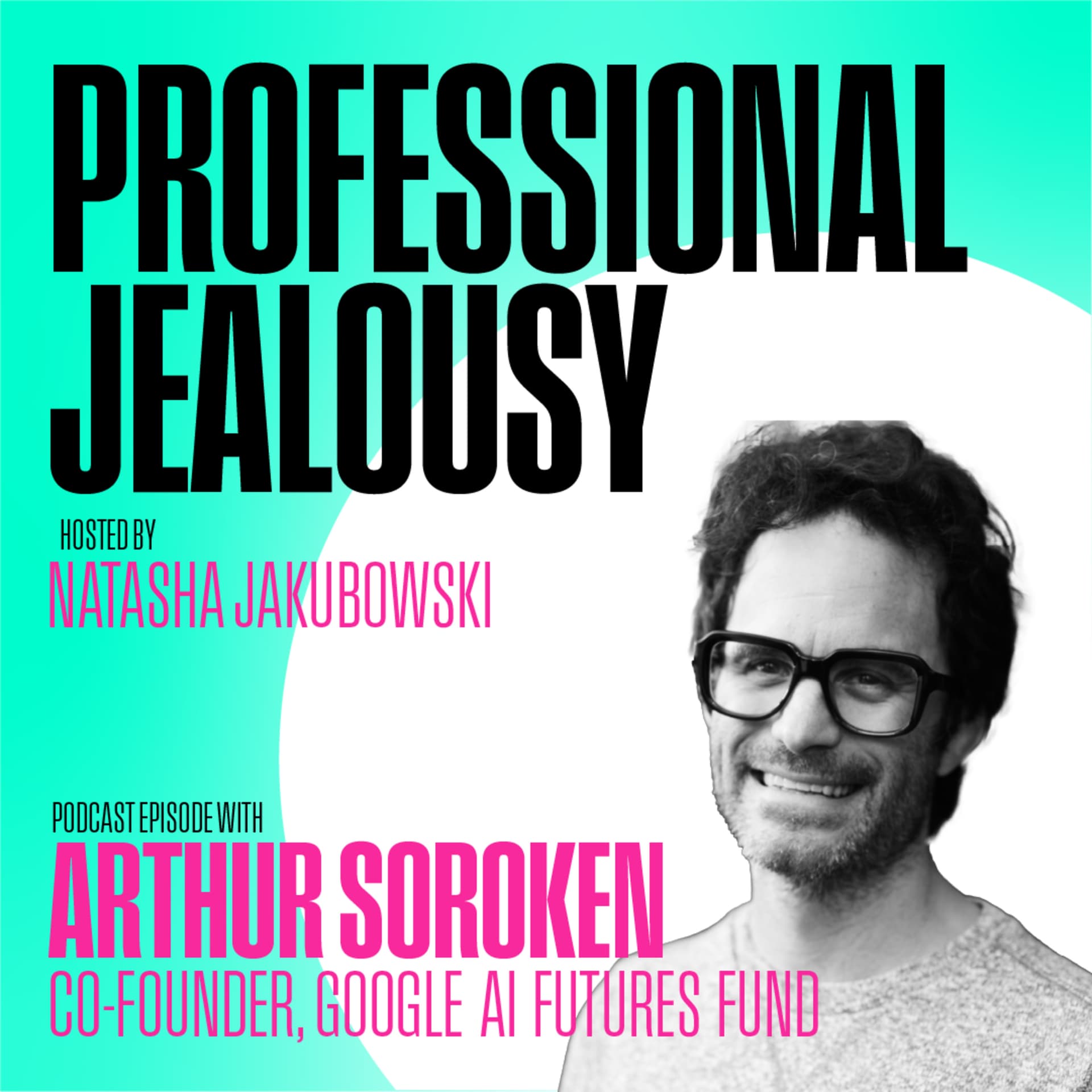
Host and Guest Host: Natasha Jakubowski Guest: Arthur Sorokin, Co-founder of the AI Futures Fund at Google
Episode Overview In this episode, Natasha speaks with Arthur Sorokin about the AI Futures Fund at Google, which aims to invest in and collaborate with startups by providing early access to Google’s AI models, resources, and equity funding. The discussion sheds light on the fund's unique approach, the future of AI, and the ways it can empower creators and democratize technology.
Key Topics Discussed
The AI Futures Fund
- Purpose and Differentiation:
- The AI Futures Fund is distinct from other Google units like Google Ventures and Gradient Ventures, focusing on strategic investments specifically in AI startups.
- Emphasizes a "zero to one" approach for both internal (Labs) and external (Futures Fund) innovations.
- Co-Development with Startups:
- The fund takes a hands-on approach, actively collaborating with entrepreneurs instead of just providing capital.
- Arthur describes the fund as a good feedback loop that helps improve Google's AI models while accelerating the progress of startups.
Vision for AI
- AI as a Co-Pilot:
- Rather than replacing jobs, AI should serve as a co-pilot, enhancing human creativity and productivity.
- Encourages creators, brands, and professionals to leverage AI for more profound insights and innovative outputs.
- Democratization of Creativity:
- AI tools can lower barriers for entry into creative fields, allowing a more diverse range of people to participate and innovate.
Investment Focus Areas
- Futures of AI:
- The fund targets sectors like entertainment, creativity, productivity, and software engineering.
- Discusses the potential for AI disruption within these sectors and how companies can harness AI for unique experiences.
Balancing Risks and Benefits of AI
- Safety Protocols:
- Arthur emphasizes Google’s commitment to safety and regulatory practices regarding AI.
- The fund engages in continuous feedback and communication with the community to address any issues arising from AI deployment.
- Opportunities vs. Threats:
- Reflects on the need for balancing the narrative around AI’s potential for job loss and its capacity to create new opportunities.
Advice for Aspiring AI Professionals
- Hands-on Experimentation:
- Encourages playing with AI tools, becoming proficient in prompt engineering, and launching personal projects.
- Building a Community:
- Highlights the importance of networking and mentorship in the tech space.
Personal Insights
- Professional Jealousy:
- Arthur expresses admiration for his mother, who runs a barbershop, viewing her passion and happiness in her work as enviable.
Key Takeaways
- AI is envisioned as a tool to enhance human capability rather than replace it.
- The AI Futures Fund seeks to co-develop innovative solutions alongside startups, creating a mutually beneficial relationship.
- Emphasizing the importance of hands-on experience and community when entering the AI field.
- Sustaining an open dialogue about the implications of AI is critical for its responsible development.
Conclusion This episode of the Professional Jealousy Podcast offers valuable insights into the intersection of technology, creativity, and entrepreneurship through the lens of AI. Arthur Sorokin’s experiences and perspectives serve as inspiration for both established professionals and newcomers in the AI space.
Additional Resources
- [AI Futures Fund](https://labs.google/aifuturesfund#innovationleader)
- Professional Jealousy Podcast on [Spotify](https://open.spotify.com/) | [Apple Podcasts](https://podcasts.apple.com/) | [YouTube](https://www.youtube.com/)
---
For feedback or inquiries about future episodes, visit [professionallyjealous.com](https://professionallyjealous.com).
Written by AI. May contain mistakes. Listen to the episode to check what was said.
Transcript
Automatic transcript. May contain errors.0:03Today, I'm talking to Arthur Sorokin, co-founder of the AI Futures Fund at Google, which was created to invest in and collaborate with startups by giving them early access to Google. DeepMind's latest AI models, as well as resources, technical expertise, and equity funding. Prior to Google, Arthur spent time as a developer and a systems engineer at Cisco and Sun Microsystem. He did an MBA at Cornell and even started his own business venture with Songza, which sold to Google. Hello, Arthur. Nice to meet you, Natasha. Thank you so much for joining me. I'm going to start with, as someone that has a job title of chief innovation officer, I'm always curious for people with kind of interesting sounding jobs, which yours is, how do you, when someone asks you at a party what you do, what do you say?
1:04I say I'm a growth hacker so that it really, and then I pause and I wait and people go like, oh, what is a growth hacker? I run a team, a growth hacking team, and I say I have three jobs at Google. I have three. Job number one is I run a strategic venture fund, the AI Futures Fund. Job number two, I run a community of an external community where we can take people and place them on products and have the product grow. So as the product grows and goes through the different life cycles, we can have those people grow with them. And then the third job is I do culture hacking, which is how do we across Google improve innovation, speed to market, those types of things across Google.
1:56Sounds fancier than growth hacker, actually. I mean, so you're not just a growth hacker, you're a culture hacker too. Culture hacker, venture hacker. We just keep hacker in the name. Yeah. Interesting. And what are the ways that you encourage culture hacking within Google? Is Google entrepreneurial? Oh, yeah. So, so, yeah. And especially Google has always been entrepreneurial. And Google has, even with the AI revolution, I feel like it's become even more entrepreneurial. So I work on a team called Google Labs. Google Labs produces things like Notebook LM. It has produced things like Flow, the VO3 movie editor tool.
2:42And so the team I'm on specifically, throughout Google, there's innovation happening, but the team I'm on specifically is about taking deep mine model, AI model capabilities and packaging them up in products to showcase those capabilities, like notebook LMs and audio overviews, the Gen AI created podcasts where two people can, they're Gen AI created podcasters and they chat with each other. This one is real, I promise, not a Gen AI podcast. For now. For now, for now, that's right. And so I'm on a team that is specifically doing that. It is entrepreneurial in the sense that we're zero to one, we call it zero to one on the inside is what we're doing.
3:22okay um i'm wondering how how is um how is something like the futures fund different from other internal innovation i mean i feel like google has so many different kind of vehicles but how do you think it's different from other places like alphabet etc um yeah what what kind of makes it different interesting specifically the stuff that you're working on yeah it's it's a it's a good question i i mean yeah you're right google google is quite big um there's a few venture funds in google there's google ventures there's capital g there's gradient ventures um and and you know you look at labs and labs is building zero to one on the inside it's not a venture fund but it's a startup within Google, um, or operates like a startup within Google.
4:18Um, I think first thing I'll say is that we, the venture fund is about if, if labs is, if you take the concept of labs is zero to one on the inside, um, the AI futures fund is zero to one on the outside. So how do we take bets on entrepreneurs, entrepreneurs and startups on the outside, um, and take bets on them who are building and like, you know, using AI to build the next gen of, of like whatever the product is. And so it's all about taking those bets on the outside. So we say zero to one the outside, but how is it different than Google ventures? How is it Google different than gradient, et cetera?
4:58So we are a strategic investment fund. And so the traditional venture capital funds, they have LPs, they go raise rounds. They, they, each fund has a series of LPs and they've raised an amount. Instead, we're on the other side. Oh, and they're not just AI focused, right? AI first focus. Although with the AI, just AI focused. We're just AI focused is number one. And then number two is what we really care about is how do we take deep mind these, these, like I said, at a very interesting point in the company where I'm taking a look at Google deep minds and the model capabilities and the tech that's coming?
5:40And how do I find companies out in the wild that are building towards that to showcase these capabilities? And so, I mean, similar to Labs' mission as well of like the notebook LMs and the flows, et cetera. And so I'm looking for these companies that are innovative and building towards these, you know, can integrate these advanced capabilities, AI capabilities, model capabilities. How do we get them in the product to like help these teams progress faster. And so that would say that's the second thing is we're very AI focused first, we're strategic. So we're trying to build Gemini mindshare. And I'd say that the third for us is we're a really good, one of the things that's core to how we operate the AI Futures Fund is if you take the idea that we're investing in these companies, um ai first companies taking deep mine model capabilities and putting it in it's also a really good feedback loop so we end up being a very good feedback loop of what's working again cutting edge stuff what's working what's not working and how do we make our model better um for their use case but also just for the general population how do we make these models better so we're kind of right in the center of of this bi-directional feedback i say last one i'll say is most venture funds don't do this, traditional venture funds, but we co-develop with these entrepreneurs.
7:05So we're sitting with them day in and day out. We're sitting with them to say, what are you trying to build? Hey, this new model capability is coming. What if we built this together? What could that look like together? And so we're co-developing with them, which is very different than that's very hands-on and very different yeah amazing um yeah so many interesting things because you you know in a weird way there's a little bit of a kind of it's a sales tool then you amplify and you actually help them accelerate their business um as part of the kind of investment um what are areas i'm sure there are you know so many people building uh within an AI first company?
7:52What sort of areas are you particularly interested in looking for, you know, types of companies to invest in? Yeah, it's a good question. So within Google, we kind of look across these different sectors of AI, or we call them futures of AI. So the futures we're most interested in and kind of developed our thesis around is, and by the way, It's just definition of future. For us, it's like, where is the future of AI going? Or how can what we're doing advance the future of this AI capability? So from our perspective, the futures are the future of entertainment, the future of creativity, the future of productivity slash work, and the future of software engineering.
8:43So each of the companies that we've invested in to date align to one of those futures. Now, those features are very broad. They're very 30 ,000 foot, but those spaces are very interesting, moving very fast and have a lot of room for improvement. And, you know, if you just take entertainment specifically, you've seen, you know, just in the past few months, just recently, you've seen, you know, feature films trying to be built. You've seen collabs with film directors and producers to use VO3 in the film production process. And so it's incredible. These spaces give us enough room to play, but also are like really up for AI disruption.
9:27And we love playing in those spaces. Yeah. I mean, it's in, I mean, VO3 is amazing. And yeah, I mean, I'm, I'm within the kind of brand and marketing world. So we're already seeing, you know, technologies like this impact production, the creative process, as well as a whole host of the ways we go about the backend, but, but literally that the creation process. Um, how do you think brands and creators should be thinking about these technologies? Like, what are you excited about? Yeah, I'm really excited about, um, and I think at Google and even in the Futures Fund, what we focus on, um, really excited about how, um, brands, creators, et cetera, are using the technology as a co-pilot, not a replacement, but a co-pilot for what they're doing.
10:30So how do we enhance the thing that we're trying to do? And I say that in the sense of, you know, no one loves, or very few people love futzing with a tool and very few people love that, you know, you have to, when you're designing this thing or you're building an ad campaign that, you're trying to get it to tweak it to make it look right and the color schema is right and the messaging is right and all of those things is the labor behind it. But imagine you can use these AI tools as a co-pilot to focus on the deep thought like how do we land this message with the right user? How are we finding the, you know, taking, letting AI do the market analysis, which is the thing we, some might love it, but how do we do the market analysis to then do the deep, the deep work and the deep thought about how do we create engaging, beautiful products for end users?
11:27How do we tell that beautiful story for an end user? And I feel like that that's where, uh, that's where I think the, the space is going is having this like co-pilot tools to help you. Yeah. I mean, I think that's a more for the marketing industry i think that's probably a more optimistic uh more optimistic kind of viewpoint than a mark zuckerberg we're just gonna do everything um but it is yeah it's interesting i mean we we've had we've definitely been playing with how you use it how do you optimize what you do i'm sure you've seen examples of like you know like the ikea box ad where everything explodes and then suddenly there's that by about four different brands so everything starts looking so how do you actually not just use it to create you know stuff that looks the same but actually amplify creativity i love that exactly exactly and i think that's where the you know the definition of a creator the the job of a creator is to create new exciting different something that speaks something doesn't look the same across the board.
12:41And the head tools are allowing the creator to do that. But on the other end, which I love as well, is we're also, you know, democratizing to some degree. We're democratizing the access to what people have access to. So there's fear, obviously, on one side of, you know, you've democratized, you've given more people access, what happens? um but there's the exciting narrative as well of you get more people the opportunity to come and play and you get diversity and thought diversity and creation diversity it's very very interesting so we're seeing a lot more people pop into the industry um and are bringing unique perspectives you know i always have this joke of like you have now an anthropologist or social uh um an anthropologist or a doctor now coming in and being a creator as well um and and giving a unique perspective of how they use these creative tools to create short films or or ad campaigns or marketing market branding etc so i love that aspect of you know give the people the tools and see what they can do and um it's fantastic yeah yeah the democratization is amazing and i I have kids and every time I see how easy, how easily they create something that actually, you know, 10 years ago, it would have taken me a while to create like a, you know, a keynote or something.
14:07It's just insane. Um, but do you think, do you, have you been seeing ways in which AI can kind of enable a new kind of branding experience, like dynamic branding, um, a shift in how you create relationships and use this technology to, to, to build engagement? Yeah. I mean, I, from a few different angles, I'd say that, you know, what we, what we don't know yet or what we're seeing is the model, what the model is capable of is still open. And so I'll just give like a few examples. We started with natural language, typing, talking, et cetera. I'll even go tech typing. We started with typing. You type, I need you to create this image for me.
15:01I need it in this style. So we started there. And then you've even seen over just recently in the past, past few years, you've seen, um, so we've gone from text to, to image or text out to now we're, um, now we're sending images. So it's like less of a prompt. So we're like sending, uh, these different modalities in to the model to get creative output. Um, and, and what, we have a product called whisk in labs that does that. So it's like removing the complexity of prompt engineering. But then if you think like just recently, just recently, we, you know, somebody had taken a image and had drawn on the image and it said, I want you to, you know, it's a space scene and I want it to the spaceship to land here.
15:54And then I want it to transition here. And they had drawn this on top of the image and they had uploaded that to VO3. and it followed those prompt instructions. And so I think we're still in this era of what are the models creatively capable of and are there interesting ways to prompt these models to get the output you want? I mean, we're watching people just on the AI Futures Fund side, we're very interested in the gaming space right now, we're looking at it heavily. And we're watching people build full games just from doing like JSON file dumps, like taking a big file and saying, this is how I want the game to look and to operate and doing these big dump files.
16:34And now they're having fully functional games that people can engage with. And every gameplay is unique, et cetera. I don't think we've begun to exhaust the ways we're engaging with these models and what they're capable, what they're able to output and capable of. It's incredible. Yeah. I feel like some of the world models using things like Genie 3 are just, you know, you can see the potential for interactive and gaming experiences. Are there any other, beyond like gaming and entertainment, do you see other kinds of practical applications that people aren't using or thinking about as much healthcare?
17:15I don't know. What else? Robots? Yeah. Yeah. So, so yes, I'd say there's a few fields, um, that we are, uh, looking at on the futures fund side of the house where that we're looking at. So robotics is definitely something that's very interesting. You know, how do we, how do we pair this, you know, these models and put them on robotic devices so that we can, um, you know, use natural language or AI processing to, have them engage with real worlds. We're also looking at, you know, different countries and how they digitize health records is like another space that we're very interested in as well.
17:57So we're looking at a lot of companies in India that are doing literally this. And you have to imagine that the gap from where they are today of handwritten paper, digital records to, or handwritten paper records to how do we digitize this and use AI to get the accuracy up. We're also looking at two fields that we actually have invested in to date is software engineering. And so we're starting to see this push through text to app creation. So how do I build a website or an application or a mobile app, et cetera? So we've, you know, I'm very excited about this space. As an agent myself, very excited about this space.
18:42You know, there's Lovable, Replit, Cursor, all these companies that are doing this text to app is incredible. No coding is amazing. Yeah, the low code, no coding. Yeah, exactly. And then I'd say, you know, a space that we also have been looking at very closely is, you know, let's take some, uh, fields that, uh, uh, we've taken fashion as a field. We are looking at a company now, um, that is how do you, uh, use AI to, um, uh, uh, take a look at your wardrobe and do recommendations on your wardrobe. So the spectrum is quite wide of, of what we're interested in, what AI is able to, to augment. Um, but, and, and so we're looking across, again, those futures of AI.
19:35We're very interested across the spectrum. But again, I'd say just we are very interested in or very excited about software engineering, entertainment, creativity. And then the last one, sorry, is productivity. And, you know, what does productivity mean? It means something different for everyone, but the idea is how do we, again, remove the um the mundane the thing that you don't love to do booking meetings uh putting things in spreadsheets take the take that those manual repeatable processes and how are we finding companies or building products with ai to automate that so you can do the deep thought the real human interaction stuff usually day to day yeah okay um i was listening to you talking on on a podcast about, you know, balancing the negatives of AI with the positives.
20:35And I'm just curious how you think about safety or, you know, impact of AI on society, culture. How do you think about that? And is it a formalized kind of, you know, set of criteria or rules? Like, is there a policy or it's more kind of gut? No, there's a lot of different things that go into creating a safe model. And there are benchmarking standards that, you know, we have to abide by. there are so it's like internal things we must do so there's there's safety and eval testing red teaming etc so they make sure the models are appropriate there's um policy around how what what models are appropriate for which age groups and and where do we not go after that so there's policy around that this is internal and then i love this there's this external as well There's an external factor of, you know, you put something out, you do your best to make these things safe.
21:51And then you put something out into the wild and making sure you have those communication mechanisms for people to talk openly and flag these things that are producing content or quality that is not suitable. And you can't stop that, right? There's lots of, you do your best in trying to keep up with the standards, but putting it on the public and having that communication channel is super, super critical and key. And also making sure you have the right people who are listening to that to incorporate back into the, as feedback back into the model. Like AI Futures Fund is like a great example of a place where that is like our job is to sit at the center and take that, be that bi-directional communication channel.
22:36But again, across Google, we're doing this. This is very serious for us. So there's like that narrative of like, you know, safety and how do we look at it? I think, you know, on the other side, I think the thing that gets lost a lot, it's good that there's this open conversation about, you know, let's be careful. These models, they're very powerful and they can do a lot of things. We can talk about a list of things that can harm society, job loss, inappropriate content. There's a huge list. We don't do enough of talking on the other side of how have we opened up opportunities for people who didn't have these opportunities before.
23:25They didn't come from, you know, they didn't have the expertise or the economic means to go to university to study machine learning and AI for a long time or software engineering. But they want, but they have a passion to start a company. It's like, how do we, how many solopreneurs now have we enabled to start companies that were not able to do that before? It's like, we don't have enough of that. Or how do we take things that, again, I always come back to this, this message of like the things we don't love to do, how do we dish that off to an AI or a model to like do the things we do love to do?
24:04And so how do we, how do we allow AI to take in the, again, the things we don't love to do so that we can spend more time with our loved ones and our kids and all those things. And so I, we don't do that list enough. And so I think both, both are important. But at Google, definitely take this very seriously and lots of policies in place to make sure that we're doing the right thing. But it is important that the community, we have that channel open, that the community can talk about this openly. Yeah, I mean, I definitely get the impression that somewhere like Google is actually thinking about these things and has more checks and balances than most companies.
24:42What are the things that you think are most worrying about the future with AI? What keeps you up at night? Yeah. Oh, God. Keeps me up at night. I would say there's a lot we don't know yet of the capabilities and the power and how the model is used. So I think that's number one. It's just there's a lot. Like people are starting to push the models in ways that we haven't seen before. And so I'd say that's number one. So tell us what sort of things? It's again, I, I like the, you know, this is a good, good example, but the taking that image and drawing on it and pushing into the model and like, what, what was, how did the model respond?
25:39Or let's take an image, a list of images as our prompt and let's see what it outputs. Like, is it, is it new? Is it, um, how's the model going to behave for these things? Um, so I think it's like still exploring what's capable of these models is keeps you up at night. And maybe that's more on the positive side of it. I think on the other side is I start to look at as lots of other people come into this market, as the models and processing gets cheaper and other people come into the market, where they don't have the teams or the regulation to regulate these systems. What does that look like? What does that look like?
26:25And there's lots of companies who have entered the ecosystem. There's open source models, although I would say open source typically ends in the good, but open source models. And like, how are people going to use these models? Where's the regulation happen? Where's the policy happening at those levels? So I definitely think about that, especially as things get cheaper. Yeah. Yeah. I think the, you know, the, the workforce, how does that, that change? I think we'd be, you know, it would be silly for me not to, to call that one out. Right. I think it's the thing that's top of everyone's mind. I, we're, we're definitely starting to see where the quality, although still has like a lot of room to grow, the quality is sometimes starting to change how businesses operate.
27:24And, you know, with VO3 is a great example that the how does the film industry get impacted by, you know, you have this flow tool in your hand, and you're able to create video content, it definitely changes the game. I think I, I think I look at that to, I look at that and say, you know, yes, it would probably change, but is the change for good? And I think the answer is yes. And I think we've seen some new participants in the market. We've seen big movie developers saying, hey, am I going to build this scene that costs lots of money over here? Or am I going to use VO to create this scene? I think we're starting to also see, again, I lean more on the optimistic side of the house, But like we're starting to see co-pilots, not replacements ever because the, again, the creative, the artistic creative or the director, they have visions.
28:23They have these like big visions that don't exist anywhere. And so it's like still having that person or that team in the driver's seat to relay that vision is still critical. And models haven't been very good at that. They're very good as a co-pilot. So I, but again, it changes industries. And so I, yeah. Yeah, I agree. I mean, it's, I think you can already see, yeah, huge changes that are going to happen in creativity and, you know, production and making stuff. And whether I'm sure there'll be a lot of those kind of visionaries at the top, I think a whole layer potentially is taken out from advertising agencies to TV production to who knows.
29:10is definitely going to be interesting. You've seen it in other... It's funny, I think of a friend of mine who did sound engineering at college years ago and then left college and then sound engineering doesn't exist. I think there's going to be lots of things like that that are going to be refocused. I think you're right. Look at the industrial revolution. It changed society overnight. This is a big moment. I mean, it's a big moment. And it will definitely change. And does it, like the Industrial Revolution, create new opportunities as well? And I think that's the bet. That's the hope and that's the bet.
29:52And that's, yeah. Yeah. Big changes. Obviously, in the last week or two, there's been a lot of chatter about the huge salary packages being offered to AI superstars. I'm, you know, I'm curious what you think in terms of advice for people trying to work in this space. I'd love to hear, you know, what kind of skills or experiences or things to do if you want to get into AI. What's your advice? Yes. Yeah. I mean, I'd start with it's playing with the tools. So let's start with the simple stuff. It's playing with the tools. It's, you know, I like to, God, my wife will kill me and family will kill me.
30:42But it's like, I write that next birthday card or that anniversary card by using AI so that I can test the tools. Can I get my voice right? So it's break these things, play with them, break them, push the limits of them. I'd say that's number one. It's like, and just throughout my career, I've always been a starter, a builder first, and then figure out the rest later. So I'd say getting into this, know the tools, play with the tools. I'd say second is, you know, this term prompt engineer was created a few years ago. I think it's creator, prompt creator now is, or creator engineer is the new thing.
31:25I'd say, you know, make yourself familiar of how do you get the output you want? How do you coach this thing to get the output you want? I'd say the last thing is we live in a really unique opportunity to start something. So tinkering is fun, but I also come from the world of like, start something, build something, launch something, get your first users, talk to your users. I really lean into that of, you know, build and launch. And I'd say if you wanted to get started, that's the way to do it. There are trainings you can do. There are readings you can do. There's social media. You can go down rabbit hole after rabbit hole on that.
32:04I really believe in just, especially with the access, the easy access to all these things is just play with them. Just play with them, tinker, launch, get some users, figure out the rest later. Yeah. I think that's great advice. Just, just try, just start, hear that across a lot of the people that I've spoken to. Um, what was your trigger for starting Songza? Oh yeah. So I, um, and what was for everyone? And what was Songza? Cool. So I, before Songza, I was in grad school and I was sitting, I was in line. I was at this, I was at this bar and I was, I was sitting in line for the bathroom and a few people come up and they play a great song on the jukebox.
32:58Journeys don't stop believing. Great song. We love it. Everyone loves it. Fantastic. song ended and they put in another quarter and they played that song again uh and i felt like oh it's still a great sign i'm in line for the bathroom like i have to hear this again i like this is fine and that song ends and they play it again and i thought you know what i'm done like how do i democratize the music like i'm just like i love this song i'm starting to hate this song now like this is let's change this how do i democratize music in this room right now so that's how it started the the idea of um i want to give everyone the power in this room to control the music in this room and it was like a silly thing and i was in again i was at cornell i was in grad school jukebox how do i create a small localized jukebox that anyone can control in this room so started and i was at a start uh uh a startup event it was like a three-day startup event.
33:54I, uh, that was, sorry, that was happening this, uh, the following weekend. I go to that event. I pitched this idea. No one wants to work on it. I said like, Oh, it's a bad idea, but I love it. And so I'm going to work on it myself. So I go and I build the first iteration of this. Um, and as we're demoing this thing on stage, I had talked to that bar that I was in Silky Jones in Ithaca. And I had said, Hey, I am going to put this system in and everyone in that room that I'm pitching this idea to at the startup, they're going to be able to control the music in this room. So anyways, that day, literally after that presentation, somebody said, hey, I have somebody that is very interested in investing in you.
Read the full transcript
34:34You're incredible. I'd love for you to meet in Grand Central Station this weekend. Can you get there? Didn't have a car, had to take a train in. And so I get there and this investor, quite reputable, says, I'll write a check now. like it like i don't need to see the pitch i love this let's talk it's crazy crazy so um anyways that company was called sonic panther so i had started this ran it for about a year and a half um and uh at the end of that uh going to raise money and i had met the songs a team and so i'm not one of the original founders of songs i'm an early early and so had met the team We were all in the music space.
35:16I love Elias and Elias Roman, the CEO of Songza, an incredible human. We got along and he said, hey, I would love for you to join our team. Let's do this. So we merge. I joined Songza and I, a year and a half in of being at Songza, Songza is acquired by Google. It's pretty good. It's pretty good. It wasn't a bad ride. Pretty crazy roller coaster. Um, and I was, uh, and I've been at Google for 11 years since. So I've been here quite, quite some time. And, and Elias is still at songs or is still at Google. Most of the team is still at Google, which is the power of Google. And you talked about like earlier, um, you know, it's like entrepreneurial pockets at Google, like startup people end up at Google and stay at Google.
36:10And so it's got to feel startup for us, for us to stay. I've stayed ever since. um sounds like you also have the chance to kind of create the job or multiple jobs that you did i did so i um and then i'll talk about what songs i was but yeah multiple jobs so i was traditional jobs for quite some time so so songs was a concierge for music and the idea was like you could play music playlists we could find you a playlist based off of things we knew about you the time of day, the weather, an event that's happening, and you could find a playlist that met you. So it was like, it's Friday night, you want to party with your girls, find a playlist for that.
36:50And it would, you would go down and choose and it would find the perfect playlist for you. So at Google, after the acquisition, I was attached to Google Play Music naturally. So the acquisition happened and we were on Google Play Music. Google Play Music merges with YouTube music. So I'm on YouTube music for some time. Um, I'm then thinking like, I think I'm ready to go start another company. This was fun. This is great. Google play music, YouTube music, beautiful places. Not for me. I'm going to start something else. And then my first boss on Google play music said, Hey, I'm moving to accessibility.
37:23Will you come with me? And so I move, I said, sure. Love that. Love that manager. Incredible, incredible person. Um, and I went to accessibility, making products for people with disabilities knew nothing about that space uh fell in love with it stayed for quite some time and then i'm asked um then i'm getting itchy again they think i'm ready to go like if my entrepreneurial mind is starting to think about what i could do and then i move i get asked to come to cloud so i'm running like infrastructure it's like couldn't have taken a harder pivot into non-startup land. So I'm in cloud. And then Elias calls me and he says, Hey, uh, area one 20, uh, is a place where, uh, it's an internal incubator at Google.
38:10Will you come be my ops partner in area one 20? And so I come to area one 20 and now I'm investing in Googlers who want to start their ventures, not leave Google. They're like me, don't leave Google, come, stay, we'll invest in you, invest in your future. So I'm there for a while. And then Labs opens up and here I am now. AI Futures Fund, culture hacking, growth hacking. And yeah, I've been in Labs for almost four years now. Yeah, amazing. So you did Sun and Cisco. Why did Why did you decide to do an MBA? Such a good question. So I, why did I do an MBA? I was at Sun my senior year of high school, and I'm from Fremont, California, which is very close to Menlo Park.
39:00And Sun, by the way, just for all of your listeners, Sun Microsystems is, Facebook took over that building in Menlo Park. So now it's Facebook. It wasn't then. uh so i was at sun i was exploring i wanted to be a software developer was like my first first stint at it and then i go to undergrad i then um at the end of undergrad i'm thinking like gotta make money i don't um uh gotta make money want to keep this going um so i go to cisco systems and it was a sales program actually it was a technical sales program where they send you to North Carolina, you stay for a short period of time or stay for a year.
39:45And then they place you after that. So it was like a program, they pay you, but then you get placed. And I was placed on the Verizon wireless account. And although it was just crazy, but also it's, it's technical sales. So my, my, my purview was how do we build, um, sell Cisco equipment, but how do we build networks using Cisco technology, which is great. Um, so I stayed there for almost five years and like no one, I feel like no one in the, that gets an MBA will tell you this, but majority of people who go to get an MBA, it's, it's for a career change. And, um, and so I was looking for a career change at the end.
40:26I was burnt out, you know, great company, but it was not, not, not my cup of tea. I didn't know it at the time. I was a startup person. And I laugh because I remember saying this to friends and family, I'm going to go for a career change. I'm going to go to Cornell and take two years and figure it out. And I remember somebody saying, you're going to take a two, that's the most expensive two-year vacation you have ever taken. Like, what are you doing? That's ridiculous. And it couldn't have been the best thing I've ever done in my life. So I went to get an MBA to figure out what to do next, only to start my first company a week into the program.
41:07So it's like, I spent very little time actually in the MBA program and spent more time running my first business, which was totally separate than everything we just talked about, which was taking intellectual property from Cornell University, a device created by the football coach of Cornell university, not even a tech thing, and licensing that technology to build a business around it called Mad Athletic. And you can't see, but I'm 5 '5", like 140 pounds. Like there's no football in my genes or blood. And it was hilarious. So going and getting these two-year expensive vacation, started my first company and then got the bug.
41:51And then it's been history ever since. Yeah. Would you recommend people do an MBA? I think it's, I think there's a few, if you're going to do, and I would say any masters, I think you want to have, you want to have a reason. And that reason could be career change. It could be headspace to figure it out. Or it could be I actually have a vision and I'm on this path. And I think as long as even all three of those are totally fine, but I think you want to have a reason for what you're doing. I must admit, I did a master's just because I couldn't think what I was going to do after university. Perfect.
42:37Exactly. Even better. Just keep going. But I would say like the beauty of going and getting my master's, and I should be curious how you think about it, but going back to school, it was like the time to do it right. My undergrad happened so fast and going back gave me the time and I had the knowledge and I had the ability to take my time, get close with my professor. So I'd say it's like not about going, should you go back or not? It's about how are you going to use that time as well? So like I'm very close with my professor still from Cornell. I'm still attached to the community. uh my first few two companies that that I had run while I was at Cornell um were completely Cornell yeah uh uh students that I started the company with um so community and network is often one of the beautiful and and I guess had the time to like sit and go deep on things I never had the time for before and I I love that but again it's the most expensive two-year vacation amazing um you're where so again thinking about obviously you are deep in ai expert etc where how do you stay uh up to date are there any podcasts influences sub stacks that you follow that people should look into cool so i spend a lot of time um i spend a lot of time with uh rowan chiong's social plus his uh his daily uh ai newsletter i think it's fantastic um i spend a lot of time with lex friedman um i think whenever he gets the ai um i mean he had demis on he had sundar on They're just like within my camp, but he also brings AI experts across the industry on spend a lot of time with him.
44:37And I spend a lot of time just reading research papers. Probably most of my time. Oh, it can be from anything. So I'm looking at especially from the investment standpoint, I'm looking at research papers on agentic processes. I'm looking at research papers and I almost don't care where it comes from. It's just going deep on recent published research papers from either top universities or. Yeah. So I spend most of my time doing that to learn about the spaces. But I actually spend a lot of time outside the AI space as well. I'm an Eckhart Tolle fan, Power of Now. I spend a lot of time on the outside since my entire day job is AI.
45:25I, I'd say the thing I learned most is speaking with founders, right? I'm in the lucky position that I get to talk with people who are thinking about this every day and trying to build a business and they think are trying to build the next gen of something. So learning from these people is significantly faster than any other thing. Yeah. All right. We're going to go to the last kind of questions. It's going to be quick fire, not only to think about it too deeply. We'll start with an easy one. Favorite use of AI? Oh, easy. Email writing, market segmentation. Yeah. Okay. Tell me one of your guilty pleasures, if you have any.
46:15Sour Patch Kids. Love candy. Love candy more than anything. I could eat it for dinner. Yeah. AI can't take that. Okay. Cannot take that away from me. Thoughts on Terminator and Skynet. What's that? Thoughts on Terminator and Skynet. I love both.
46:37Is it coming for us? Are you on that side of the fence? It's coming to give us a nice warm AI hug. No, not coming for us. Just a nice, nice embraced hug and to be a friend and co-pilot to help us get through our days and our jobs and all those beautiful things totally uh best career advice worst career advice you've ever had all right best career advice i ever had um this is a good one um i once had a manager i was once told something in private at work and told not to leak this thing this was not at google it's pre Google, I was told not to leak this thing. And I went and had a side conversation with, with a few employees say like, or a few coworkers say like, this is the thing, uh, this is happening.
47:28And I immediately get this ping from the VP who says, I don't care how you knew who you heard it from. Don't ever do this again. And I remember thinking like, you know what? That's the best advice ever is to sometimes take information, not all information needs to be leaked, not all information needs to be talked about. Like sometimes take, like the trust you build with certain people is sometimes more important. So I love that one. Worst advice I've ever heard.
47:59Oh God, just so, so many.
48:07Oh, worst advice, career advice I've ever heard. Um, be the first person in at work and be the last person to leave. I think that's the worst advice I've ever heard. It wouldn't work for me. Um, what are your superpowers that have helped you be successful? I'd say I got two. One is, um, I, I love to tinker. I just have the love and passion for technology and tinkering and playing and taking things apart and putting them together. And so I'd say that that's number one. I'd say number two, I love humans. I love the interaction with humans. And so I spend a lot of time listening to people and figuring out their stories and figuring out why they think something is right.
49:04and thinking about, yeah, why do they think this thing is important? Why are they so passionate about this thing? And so it's kind of related to this, but it's like I can also jump on to someone's passion. Like someone can inspire me and I can jump on to someone's passion and be all in on them. So I'd say, yeah, maybe those two superpowers. Okay. I can see you increasing and amplifying people's passions as well. Love it. I'm a megaphone for the human race. um are we going to reach agi anytime soon so yeah i think this this is interesting i think the definition of agi has changed so much throughout time i'd say in some cases and demis has said this but i'd say in some cases we already have yeah right like our models are becoming multi-purpose able to solve lots of things um but i do think there's lots of gaps i think there's lots of gaps that need to happen.
49:59So I think we're, we're, if you think about AGI and multi-purpose and multi-thinking capabilities, I'd say we have reached that, um, able to trick some Turing machines to even, um, produce that. Um, but I think there's a big gap in quality still. So, and cost. So I I'd say we still got time. Uh, what does success personally look like for you? oh man i love this uh success to me is able to um i'd say there's work success i'm able to use my brain every day to make um you know bring happiness bring efficiency bring ai in a safe way to the people, democratize AI so more people can get involved and build the things that they love.
50:55And then I can go home and enjoy my family and enjoy my kid. And I can grow up and be there for both of them. And I love that. That's success for me. It's like I can compartmentalize both of those things or join both of those things so that, you know, life is so short. Spend it with the loved ones. What do you wish you'd learned earlier in your career? Oh, it's totally fine to make mistakes. Make all the mistakes. Make more mistakes. Be okay with making mistakes. Be self-deprecating in your mistakes. Make it a joke. But mistakes is where it's at. Just go make lots of mistakes. All right. Tell me, last question.
51:37So tell me someone or something that you're professionally jealous of? I am professionally jealous of my mom. And my mom, and this sounds cheesy, and I am a mama's boy, it is true, but it sounds cheesy. My mom owns a barbershop and has owned a barbershop my entire life. It is her therapy. It is her life. It is her passion. It is hard work. And she comes home every day and is so happy. And she will die. She will tell you that she will die in that barbershop. And I respect that all day, every day. I think she's an incredible human. That's pretty amazing. Arthur, thank you so much. This was so fun and interesting.
52:31All right. Thank you. Thanks so much for listening. Please do take a look at some of the other episodes we've done. You can find them on Spotify, Apple Podcasts, YouTube or on professionally jealous, professional jealousy.com. Get in touch. If you have any questions, feedback, or importantly, anyone that you think should go on the podcast, a quick thank you to the unreasonable studios and producer Shimmy Boyle. You can follow me on LinkedIn or on professional jealousy.com. And before I forget, please share, subscribe, review all those things because I'm sure it'll help
From the publisher
Arthur Soroken, Co-founder of the AI Futures Fund @ Google - which was created to invest in and collaborate with start-ups by giving early access to Google DeepMind’s latest AI models as well as resources, technical expertise, and equity funding to accelerate their progress. This conversation included:- How the AI Futures Fund is different from other Google units like Google Ventures, Capital G, and Gradient Ventures- Being a "growth and culture hacker" driven to improve innovation, speed to market, etc across Google- Taking a "hands-on" approach that co-develops with entrepreneurs- A vision for AI as a co-pilot, not a replacement and as force for democratization- Advice for getting into AI includes playing with the tools and "Start something, build something, launch something"Arthur is professionally jealous of his mom, who owns a barbershop and has done so his entire life. He describes the barbershop as her therapy, her life, and her passion, despite it being hard work. He notes that she comes home every day very happy and has expressed that she will "die in that barbershop". Check out https://labs.google/aifuturesfund#innovationleader #podcast #careeradvice #inspiredleadership #techleaders #ai #aistartup #aiinnovation #aiinvestments #aistrategy #productmarketing #techcareers #podcastclips #entrepreneurship #entrepreneur #culture #communitybuilding #growthhacking