
In short
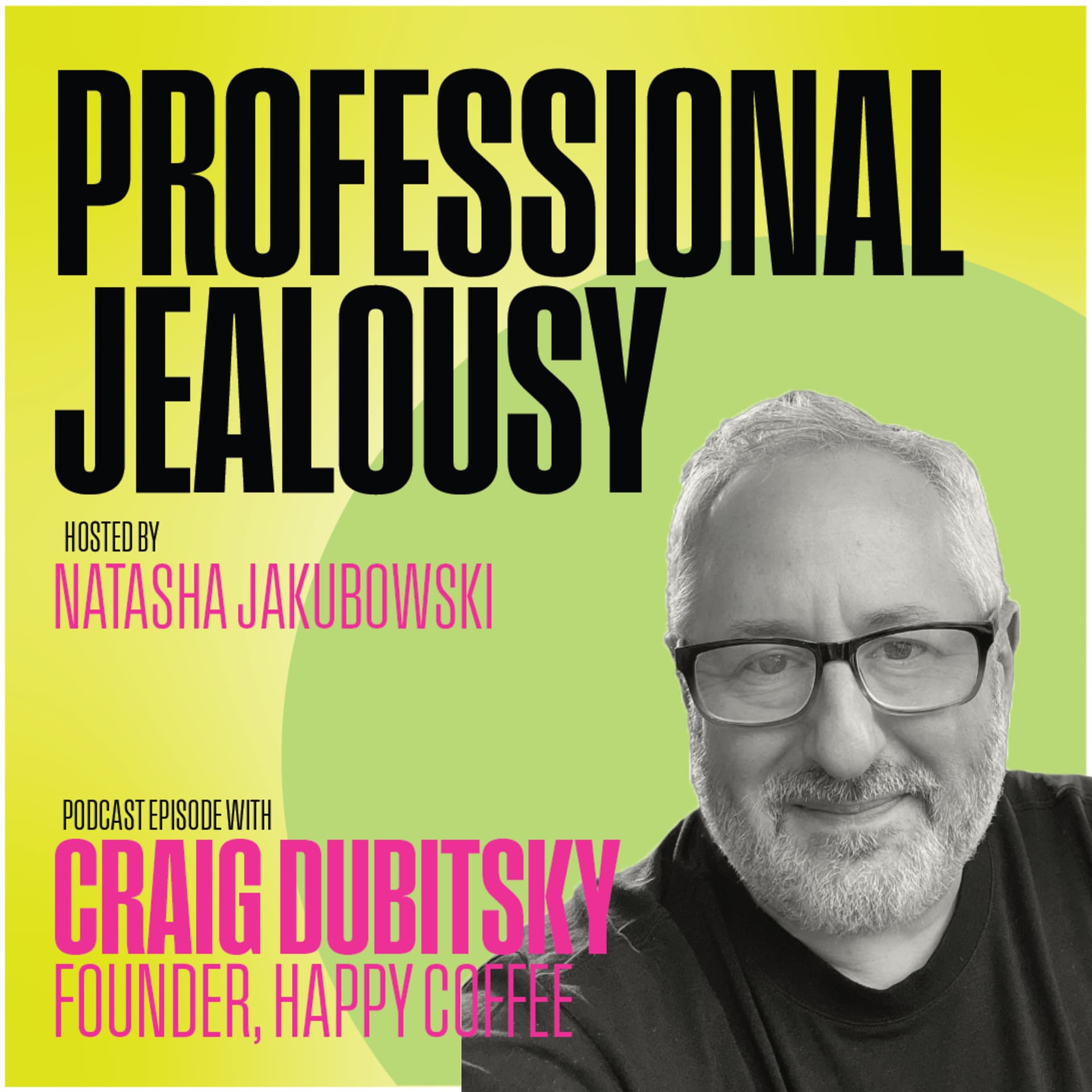
Professional Jealousy Podcast - Episode 15 Summary
Episode Title
Craig Dubitsky has the energy it takes to be a serial entrepreneur
Host
Natasha Jakubowski - Chief Innovation Officer at Anomaly
Guest
Craig Dubitsky - Serial entrepreneur and co-founder of EOS, Hello Oral Care, and Happy Coffee
Episode Overview
In this episode, Natasha converses with Craig Dubitsky about his journey as a serial entrepreneur. They cover a range of topics including brand creation, the significance of design, and the philosophy behind effective branding. Craig’s enthusiasm and innovative spirit shine through as he discusses his experiences with various ventures and shares insights into his current project, Happy Coffee.
---
Key Topics Discussed
- Early Ventures
- Craig's history with Method Home, where he was a founding board member.
- Co-founding EOS, known for the popular spherical lip balm.
- Launching Hello Oral Care, which Craig describes as a successful oral care brand.
- Current Venture: Happy Coffee
- Happy Coffee is described as "coffee with a conscience."
- The product is sourced from small grower farms, with a focus on quality and ethical sourcing.
- The company partners with NAMI (National Alliance on Mental Illness) to support mental health initiatives, including giving them an equity stake in the company.
- Discussed the unique packaging which is 100% recyclable and reusable.
- Philosophy on Branding
- Craig emphasizes that the product must be exceptional beyond its branding and packaging.
- Highlights the importance of relevance in branding and marketing: "Relevance is everything."
- Discusses the concept of story doing vs. story being, emphasizing that brands should live their values authentically.
- Craig believes in the idea that everything communicates, including how employees are referred to and the overall brand ethos.
- Marketing Strategies
- Craig explains the approach to marketing Happy Coffee, which involves traditional retail channels to reach a wider audience.
- The significance of creating advocates and tapping into community engagement for brand awareness.
- Mental Health Awareness
- Craig shares alarming statistics on mental health issues and the importance of addressing these through branding and awareness campaigns.
- Discussed the initiative of placing mental health resource information on coffee packaging and creating educational materials.
---
Key Takeaways
- Optimism and Positivity: Craig attributes his success to a positive mindset and a belief in the power of optimism, emphasizing that these traits help navigate the challenges of entrepreneurship.
- Do the Work: A mantra that Craig shares, encouraging aspiring entrepreneurs to put in the effort and research before seeking assistance or partnerships.
- Build with Purpose: The idea that brands should not only focus on profit but also on social responsibility and community impact.
- Innovative Thinking: Craig encourages questioning norms and thinking differently, which has been a consistent theme throughout his career.
---
Lightning Round Highlights
- Guilty Pleasure: Collecting guitars he can't play well.
- Best Career Advice: "Do the work."
- Worst Career Advice: "Wait for offers."
- Professional Jealousy: Lists artists and designers he admires, including David Byrne and Johnny Ive.
---
Conclusion This episode offers valuable insights into entrepreneurship, branding, and the importance of mental health awareness. Craig Dubitsky's journey serves as an inspiration for those looking to innovate and create meaningful brands that resonate with their values and communities.
Written by AI. May contain mistakes. Listen to the episode to check what was said.
Transcript
Automatic transcript. May contain errors.0:04Today I am so excited to talk to Craig Dubitsky and he is a serial entrepreneur and just all round good person uh who I met a shockingly long time ago um he was a founding board member for method home uh we worked with him at anomaly when he co-founded eos to create uh the disruptive kind of spherical lip balm which did pretty damn well there it is I almost did that I've got one over there and I was like, should I do that? Anyway, then he went on to found and ultimately sell Hello Oral Care, which I don't know if you remember, but my team actually worked on pre-launched very, very early strategy.
0:52And then most recently, he's the founder and CEO of Happy, a brand of coffee on a mission to elevate the everyday, which he co-founded amazingly with Robert Downey Jr. We'll definitely talk about that. This new brand has scaled fast and isn't just seriously delicious coffee. It also cares for the mental health of the people drinking it, having partnered with NAMI, the National Alliance on Mental Illness. And I think what's interesting, it's not just a benefactor, but an equity stakeholder in the company. Craig has endless optimism energy and incredibly generous spirit um he's been named advertising ages creativity 50 of influential thinkers one of the most uh 100 most inspirational marketers in the world by the internationalist and so much more he loves brands packaging design people um and i'm so grateful to have you on my podcast today hello wow i know you have done so much it's such a long intro that's pretty wild well thank you for having me and uh sorry you have to read all that and for those listening sorry you have to hear all that um yes you're psyched to be here amazing uh i thought um you know you you have done so much with hence the ridiculously impressive uh intro um For anyone that hasn't seen your latest venture, Happy, do you want to give us a quick elevator pitch?
2:32Sure. Let's say Happy. It's coffee with a conscience, I would say, in shortest sort of verbal strokes. The coffee itself, which is really important. And I'm going to talk a little bit about how important it is to make sure the product is awesome, not just the brand, not just the packaging, not just your copywriting, not just your go-to-market strategy. The product itself has to be awesome. So the coffee itself is really great. We source from 3 ,000 farms. They're predominantly small grower farms, which means they're two to five acres. and they represent, get ready for this number, 0.000024 % of known commercial coffee farms.
3:27So we're pretty discreet in terms of where and how we source. And I think roughly 40 % or so of these farms are run by women. So right now we're sourcing predominantly from seven countries, most of them in South America, but we also throw some Rwandan coffee into the mix because it tastes great. But the other reason we do it is because there, all the growers that we work with tend to be women because it was genocide and there aren't really any men around to do that work. So we wanted to be able to source from there as well. So long story short, the coffee is epic. It had to taste great. Otherwise, people would say, oh, how clever.
4:07You made it happy and coffee makes me happy. And you're such, you know, clever. Nice to know. Well, maybe not young, but, you know, we wanted to go away from this notion of just cleverness and make sure that the quality was there because the key is to try to make something that is as durable and endearing. Yes, but but really durable. So enduring and endearing, that's sort of the. Yeah. and if we can combine aesthetic and ethic together then you put all that into a mix and you get something really special so that's what we've tried to do with happy so amazing coffee uh really thoughtful sourcing and thoughtful design too because to look at it is to you know it doesn't look like anything else on the shelf and that's not an accident so um the the dirty little secret i think about a lot of coffee is if it comes in a pouch those pouches go directly into a landfill so we wanted to do something a little different so our packaging is 100 recyclable it's reusable it's resealable i keep all my old usb drives in them because no you do those old usb drives bitcoin on there that someone gave you you know like five years ago and it's worth a gazillion dollars you'd miss it if you didn't have those old usb drives so i was amused when i chatted to you gosh uh when you were still pre-launch um that you are not and you have never been a coffee drinker so talk to me about how happy came about so it's really funny um yeah i've never been a coffee drinker now i can say hand on heart i have tried a bunch of coffee but back in the day i didn't even try any coffee i had no coffee and i'm married for a long time we have two kids happy Mother's Day, by the way.
6:01It's the Monday after Mother's Day, if that's important, for the title of this love and conversation. But at one point, our daughter said to me, so dad, let me get this straight. You're going to start a coffee company and you don't drink coffee. And I said, yeah, I think that's, yeah, yeah, that's on the docket. And she said, that makes complete sense. that's well please tell me why that makes complete sense and she said well you you didn't really love going to the dentist and you started this oral care company and that worked out okay you don't know how to shave or like to shave and you don't really care that much for lip balm because people are very addicted to lip balm um and that always disturbed me but anyway i i started this other you know thing eos which you guys know about since we have some history there with anomaly and um uh and she's like and that worked out and you don't really like cleaning so much not that you're not a clean person but you know the actual effort of of doing the cleaning not really your favorite thing uh and this method thing kind of worked out she just went down the list and she's like so of course the base complete sense you're gonna start a coffee company based on all the things that weren't really all that appealing to you before so out of the mouths of babes.
7:17So I started happy. I started really because I was asked to spend some time with a big retailer. And they'd asked me if I would basically be a thought partner for that with something they were working on. And I said, let me think about it. Yes. And I'm not a consultant. And I said, you can't pay me or hire me. I'm just happy you think of me that way. So I'll pay my way and I'll come spend some time with you. And while I was there, they said, hey, we really like how you think, would you mind walking the store with some of our merchants? And I was like, would I mind walking the store? The store to be an art gallery.
7:53Let me think about it. Yes, please. So I started walking the store with a whole bunch of different buyers. And one of them was the coffee buyer. And someone asked me, what do you think about something? Well, you're sparking the start of a conversation. I'm all in, especially if it's going to be about design or brand or retail or adjacencies on the shelf or you name it. So I just started going off on coffee and I made, I wasn't trying to be untoward, but I certainly, I guess, made fun of some brands and some of the language of the category that to me seemed a little silly, you know, like, right.
8:31Yeah. And just bragging about your coffee is mountain grown while all coffee grows on a mountain. There's no hydroponic coffee. There's no intergalactic coffee yet. I'm sure there's some people working on that. Ross, I get pitched a lot of things. I've been pitched a lot of plant-based coffee. And I'm like, last I checked, coffee's a plant. Yeah, AI coffee. It's different. We can make it from whatever. Just because you can't doesn't mean you should necessarily. So anyway, I just sort of went off on what I thought. And that's really interesting. No one's ever said that to us before. Do you think you'd help us sort of visualize what you're talking about.
9:11Could you do that for us so we could get a sense of what you're describing? And I went, like I always do, yeah, sure. I'm in the yes business, right? So I'm like, sure. Could I do that? I had no idea how I was going to do that, but sure, of course I can. So I went about my business and I thought a lot about my bride, as I always do, and she loves coffee, like loves coffee. So I said, you know, coffee makes her really happy. What if happy could make her coffee? And that's sort of where this idea of happy as a brand came from. And I have history with this idea of taking somewhat common sets of words and attaching them to a brand in a more sort of legally appropriate way and beyond that.
10:01um and you know i started going to work on on the trademarking aspect of the thing and then as it turns out the world is magical and i am the luckiest person yes person not happy happy hello yeah that's right i think i created a trademark lucky yeah i think you um didn't ian you worked with my husband on help so maybe absolutely Absolutely. No strength of one good word that starts with an H. Absolutely. So, yeah, it just kind of went from the fact that my bride loves coffee, makes her happy. This incredible retailer meeting. Hey, do you think you can help us visualize it? Just saying yes to things, basically.
10:47And I was talking with a good friend of mine, and he's got a storied background in CPG and CPG investing, and he has a fund, and it turns out I'm part of this fund, and I was telling him this story about this retailer visit. And I said, you know, I have no idea how I could even source this much coffee. And he said, I'll give you the PG version. Dumbass, you know we're investors in the largest vertically integrated coffee roaster in the world, right? forgot about that. Shame. So through the good fortune of having been around the sun a few times and build lots of, you know, real friendships and relationships, I was connected to the largest vertically integrated coffee roaster in the world.
11:36And all of a sudden that started to make things very, very real because, you know, what do I know about coffee? And then it turns out another, friend introduced me to someone who was a Q grader. And not a term I was ever familiar with, but if you like wine and you know what a sommelier is, to be a licensed, registered, official sommelier, you have to be able to sniff whatever it is, swish around, swill, whatever it is that they hand you, and be able to discern about 200 different unique attributes from whatever it is, your provenance and the whole story of where these grapes are from. And it's pretty incredible, right?
12:19And if you're a Q grader, which is sort of the coffee equivalent of a sommelier, you have to be able to discern over 400 unique attributes. So as rare as it might be to meet a fully registered sommelier, it's even more rare to be the Q grader. There's only about depending on which sort of, I don't know what, brute that keeps track of this. But there's about 1 ,500 in the whole world. So got introduced to one of the first three, I think actually he was like number three American cubators on the planet. The first 300 cubators on the planet. So I started to describe what I wanted to do. And all the pieces just started coming together.
13:02and it seemed like this is a this is a really nothing's gonna be easy but i thought there was a really big opportunity here and uh and then it just sort of kept going and then you know downy and i got connected and i can tell you about that if you wanted yeah i mean it's pretty amazing and surprising for you to suddenly get connected with a hollywood superstar tell me a little bit about that well you know since i've been brad pitt stunt double for as long as i'm sure um you know i have these unique ties to hollywood um and for those of you without any video that's called a dad joke that was a bad joke right there so capital d capital d dad joke so um uh over a long period of time i i also just good fortune was introduced to someone who you know was a legendary guy in Hollywood and I didn't know who he was.
13:54Cause why would I know I'm a kid from New Jersey. I don't know about these things, but, um, I don't know how much I should or shouldn't share, but, um, I developed this, this interesting relationship with some Hollywood agent people over years and never was looking to do anything in Hollywood. And again, it was very, I'm going to sound like I'm full of it, uh, but very innocent. I, I'm, you know, I, I, I, I love people and I wasn't looking for anything or looking to do anything in Hollywood or be involved with television or movies or celebrities. That's never been my thing. My thing is brands are celebrities.
14:33And I'm guessing and thinking a little bit out loud, which is always dangerous, but I think my purity in that regard was probably entering into some folks because I didn't have any agenda with older talent or celebrities or any of that kind of stuff. So anyway, this one person, this Hollywood person said, hey, are you still thinking about doing something in coffee? And I said, you're not going to believe it. This thing happened and that thing happened. And he said, well, are you looking for a partner? And I went, no. Like, why would I? No. Are you looking for a co-founder? I'm like, a co-founder?
15:09Like, why would I? No, I'm not looking for any of that. I'm good. He's like, well, are you looking for money? I said, no, I'm not really honest. I'm not looking for anything. And he said, well, one of our special people, everyone's talented and amazing and lovely, but you might have one or two that might be a little more talented and lovely and special than others. And I said, I'd read Animal Farm and I knew all animals are equal. Some are more equal than others. And I said, I think in your world, they called us A-listers. We laughed at me and said, well, one of our special people wants to start a coffee company.
15:43And I told their team, they couldn't do anything until they spoke with you. Will you, at the very least, just do me a favor and speak with their team? And of course, I said yes. And long story made not too much longer. I was on the Zoom however many days later with a bunch of folks. And I sort of expected it to be like a scene from Entourage, you know? It was just going to be a lot of what I imagined to be slick people in Hollywood asking me questions and trying to tell me that they knew famous people and it was my lucky day kind of thing, which is totally wrong on my part and unfounded, but that was where my head was at.
16:24And I got on this Zoom and I was asked these intense questions I was totally not expecting, like, how are we handling potential mold growth issues on cross-border contamination, you know? By his team or by him? By the team. And I had no idea who gender was never even used. I had no idea who this quote-unquote celebrity was. It was a man, a woman, nothing. then. So tell me how you're handling, if you're getting any, probably from Sumatra, how soil density issues in Sumatra, given the increase in humidity, is impacting the outer casing of the cherry fruit. I'm like, what? And the cascara thickness.
17:05I was shocked. And after my jaw dropped and I sort of reattached my mandible. I had this history with this agency from before, so I started showing them some of the things I was thinking about, working on that. I had this idea and it was called Happy, and they just start yelling at each other, I don't give a blank if he's with so-and-so. Get him on that. Right now, I'm like, who? Like, Stephen? Like, who? What? I'm like, who is he with? We don't care if he's a Spielberg. is fucking get him on here right now i'm like who who are we talking about and they said robert so two seconds later down he pops on this zoom and he's lovely and charming and all the things and i don't know him from you know from a from anything and we have this very quick chat there they go show him show the thing show him what it looks like you know i had models and and um you renderings and things and tell me what it's called, explain it's called happy.
18:08And anyway, I had to go, I had another call. So I said, really nice to meet you. Good luck with whatever it is you're thinking about and coffee and, you know, peace out. And they called me back and they were like, he's all in. I'm like, all in on what? They're like, no, he wants to do this with you. I'm like, do what with me? And I said, I really appreciate that, but I have this other call and I got to go. So I wasn't trying to play cute. I just, you know, I was busy doing that I needed to do. And anyway, long story short, I got this under phone call that said, hey, listen, I know you as a person.
18:44I know him as a person. And you two just need to talk. You have to get to know each other. And I know you're not, you know, like a Hollywood celebrity sycophant guy. And I know more about him than you would ever know, because that's not your world. And also, So, you know, I worked with him and I know a lot about him. So anyway, we got on a one-on-one, I think it was a FaceTime, and it was supposed to be 45 minutes. I went for three hours and 40 minutes. And it was this really incredible connection, really. And I told him right up front, no disrespect, I didn't Google you, Wiki you, TMZ you, New York Post page 6U.
19:20I didn't know anything. I didn't want to know anything unless it came directly from him, is what I told him. and um i'm sure that was maybe a little out of the ordinary and i had a weird guitar next to my desk and he saw it and said hey is that a whatever it's called a steinberger he's like is that a steinberger guitar i'm like you know that guitar he goes dude there's a lot of dude dude so it turns out we're very close in age you know maybe we're six seven months apart or something and he had grown up in new york city originally and um we started going down these musical rabbit holes and next thing you know we're seeing these deep cut esoteric ellis costello tracks to one another and amazing you couldn't fake that yeah and i heard a lot about coffee in his life and i heard a lot about his his bride and i told him a lot about my my history my wife and i used to be derivatives trader i was a futures trader and my wife was like what are you doing this is not you You're a creative person.
20:22You went to school for music and other things. What are you doing with this financial nonsense? It's not what you are. So I explained that she basically saved my life and got me out of being what would have been a miserable existence as a derivatives trader. Base metals derivatives. How incredibly toxicating I create is that? And yeah, she saved my life. And I heard a lot about how Susan played this outsized role in Robert's side. so by the end of this conversation and hearing a lot about coffee in his world um i said i want to meet your wife and i want you to meet my wife and he's like yeah that sounds great and i was like no no i'm i'm serious he's like yeah you sound very serious and i said yeah in life you can choose your friends but you can't choose your family but when you start a company it's like being able to choose your family so i want to meet your family and have you meet my family and he's like great so instead of this call my wife was really upset with me because she's like i have to get on a call with some hollywood superhero person and his wife like that's your that's you being you like that's not me and and i said oh please you know they're in you know california they're in hollywood they're in malibu they're you know they don't want to talk with normies like us in the suburbs they'll be quick they have right car boots to walk down trust me, it'll be like 10 minutes.
21:41And the same thing, it went for over two and a half hours. And when we got off, it was funny. We had to go because we're on the East Coast. It was getting laid for us. So we had to go. And my wife was like, that was amazing. They were great. Why wouldn't you do this? And they kept building on your ideas. You were building on their ideas. Everybody's respectful and laughing, having a great time and making the ideas better and better as you went along like why wouldn't you why wouldn't you do this because of ego or economics or like those things aren't like your thing like why wouldn't you do it and she was absolutely right so anyway we did all the secret handshakes yeah and he's been a real co-founder and people ask oh is he a spokesperson i'm like no it's not that he doesn't not a creative director yeah it's not like one of these yeah yeah like roles we would have launched many months earlier but he was shooting he was shooting something a series called The Sympathizer and he was in Vietnam we were overnighting him product you know when we were working on blends with timers thermometers you know Chemex pour over stuff and scales to make sure everything we were tasting in real time was like for like and working on these blends We put a lot of time and energy and effort into the sourcing and really the percentage of which country's products were where and making sure the supply chain could be robust enough that we could do this at scale and keep the quality consistent.
23:16So that was it. And then one day we were talking and he's like, you know, not everybody's happy. What can we do about that? And my bride was sitting behind me and she's a PhD in clinical psych. And I'm like, honey, who's doing anything at scale around mental health? that's really, like, really, really doing it. And she goes, oh, NAMI. I'm like, what's NAMI? Oh, National Alliance on Mental Outless. So I use the Google. I use the LinkedIn. I connect with some folks. And I convince them to give you some time. I go down to Washington, D.C. or Arlington, Virginia, really, and meet with the senior executive team there and explain what we want to do and learn a lot more about NAMI.
23:56And the more I learned, And I'll throw out some stats that are really staggering. The more it became very obvious that we needed to do something that was a little different. And that this was going to be an important bit of what this whole company and ethos and idea that we had and set of ideals were really going to be about. So this super quick version of these data points, one in five adults have some form of mental illness in the U.S., treatable stuff. which is a staggering percentage, right? 20%, one out of five. The suicide rate has gone up 30 % in the past two decades. Yeah. For teenagers, when I was a kid, the number one killer of teens were car accidents followed by leukemia, childhood leukemia of cancer.
24:47Now it's handguns are number one and suicide is number two and often one and two go together. And the numbers are just, to say they're alarming is... Really an understatement. So when I heard about these numbers and asked a little bit more about how NAMI does what they do, and by the way, they started 988, which is the 911 for mental health. It's only two years old. They've already gotten over 10 million calls. This is like, these are real, real numbers. They said the number one thing they hear from people, because NAMI offers free help, and it's more professional help, the number one thing they hear is, well, I had a note about you, Sue.
25:26Yeah. No, we said, well, that's an awareness issue. We could help you with that. And they said, well, what do you mean? We said, well, we're going to make these amazing products and these beautiful packs, and we're going to get them in everywhere. And what if we put information about NAMI on every package? Yeah, amazing. I've seen that. It's such a massive part of the branding and the idea. And I do love that. It's made in from day zero. So it's not, oh, it's Mental Health Awareness Month, which by the way, so let's do a thing. And every time we flip the calendar page, there's a new cause because that's what we've done.
26:07And we didn't want to do something performative and co-opt all the goodwill that NAMI over the past 40 something years has generated. That didn't seem fair. So we just want to help them with awareness. We want to do more than that. And what we ended up doing was we gave them a piece of the company. Yes. So they're an equity stakeholder on the cap table, the business, because personally, I don't like when brands or businesses talk about something they've done from a quote unquote charitable perspective. And then it turns out, oh, we're giving you a piece of the profit. Oh, you know what? Sorry, there was no profit.
26:44We took everybody. Oh, it was Omikase Wednesday at work. And every Wednesday for the past year, we've been taking everybody out for amazing sushi. So sorry, there are no prophets, but glad we got to tell your story and use it to make our story that much more enhanced. We just want to do that. So this is one of the ways we worked around it. And we're very much partnered. We actually just released something the other day. It's on our website now. We made this poster because we have this revelation. We went to a brainstorming session with Nami, and we spent a few days together. and I don't really know where this came from and I don't want to sound like I'm taking any credit.
27:24So I'm just going to use the broader thing. It just kind of happened magically. It really did in this brainstorming session that almost every restaurant you go into or every break room and every business has a choking poster. Like what did you have from this choking? And we did a quick search and it was something like 5 ,000 people maybe have a choking incident in a public place, but the number of people that take their life from suicide is, you know, to say it's an order of magnitude higher than that. It's more than 10 X that number. And yet there's no poster to help you. I like you can identify if someone's choking and there's a poster to tell you what to do, but there's no poster to help you figure out if someone's having a mental illness.
28:07Yeah. Yeah. Yeah. So we made these posters and we went to this conference and it turns out totally out of nowhere, the superintendent of schools for South Florida, Miami-Dade, which I believe is the second largest school district in the country, holds up this poster and goes, like, we're putting these in every school. And I know, like, we've gone from nothing to, I think we've had, like, 2 ,000 different schools approach us. And we just did something with the national, I'm going to get the acronym wrong, but basically they're, like, the National Organization for Parent-Teacher Associations. Yeah.
28:41And we're doing this and we're giving these things away. and you can print it out from our website. And it's just trying to make this notion of mental health into health and to take the stigma away. And if we can get that, that's going to save a lot of lives. It's going to save a lot of hardship. And I can tell you this hand on heart. Since starting this, every single day, today no different, every single day I hear a story from someone who I've either just met or someone who I thought I've known really well for a long time that tells me a mental health story that's just a complete and utter heartbreak.
29:20Yeah. And, you know, someone I'm very close with, or at least thought I was incredibly close with, and now in many ways I'm even closer with them, told me out of nowhere, and I'd known this person for 20 years, oh, well, this matters a lot to me because when I was a teenager, you know, I have a brother who took his life. Yeah. Yeah, so many stories. Yeah. So we have to do something. And yeah, it's imperative. And I think it goes beyond this notion of what's our purpose, our mission. We're not brands talk about our, our, our, which is a substitute for my, my, my, right? What's my purpose? What's my mission?
29:58And what I shared with the team was this is about our collective responsibility because this impacts so many people. And if you're LGBTQ +, it's not Pride Month. It's Pride Picosecond. Every second is Pride. Every time. If you're suffering from mental health, when you care about mental health, it's not Mental Health Awareness Month. It's every second. If you care about the planet, it's not Earth Month or Earth Day or Earth Week. So the idea that we can, you know, create things that are going to hopefully generate meaning beyond the notion of just brand and emotional and social connectivity through tight face and tone of voice, you know, going beyond that, I think is the next level.
30:46Yeah, totally. I mean, one of the things that I think is really apparent in everything that you've done from the beginning is, you know, you're a true believer in the power of a brand. Totally. Multidimensional, everything from design to product to storytelling. Can you talk a little bit about that? What makes a good brand? I think that I think everything communicates everything and when I say everything I mean everything I mean what you name your company sure yeah um do you refer to the people you work with as employees like how you how you refer to one another um the order in which your name appears on the website, the fact that you do appear on the website.
31:43The humanization of almost everything is part of this notion that everything communicates. And, you know, K people wrote on the walls, they drew pictures, like we've always wanted to communicate. And I don't think there are any boring categories, there's just some lackluster executions. And if you think that everything communicates and people care about everything, then you as a brand owner, holder, shepherd, steerer, fellow communicator, it's incumbent upon you to take that mantle and run with it and know that even the shape of your UPC should mean something. I mean, everything. Everything. Good.
32:30So I think. Everything is idea. Absolutely. And I think good brands, I think they don't have to try that hard. I think hopefully they attract a level of thoughtful joiners and practitioners, and that output becomes very clear because the input was the same. That it wasn't sort of this function of, we started here and we're trying to get to, we started point A and we're trying to get to point B. They're almost like it's a constant. it it's and i think people have a bullshit meter and they can tell they can tell if the the thought was there to begin with when they see something and they go whoa what's that you know i've seen people post on linkedin and and some people have been like well that looks out of sorts in the category and that looks like vitamins or that looks like whatever and i'm sort of like it's killing me to not respond they'll respond and i love reading the comments and i'm like well have any of these people ever created a brand for nothing like not to use that as the benchmark but like okay probably not in some cases definitely not and i'm sort of like well you just proved the whole point because you bother to pick the thing up and write about it and the part that kills me is did you find out that we we source the way we source and that you know we're like the actual product is good and we're winning awards for how good the coffee is did you bother to read that those pouches even if you like indonesian civet pooped out high-end coffee that bag goes right into a landfill like did you bother but no they're going to comment on things like it looks different than the rest of the category and i'm holding up this eosphere because i can't tell you how many people told me it's obviously you know that chapstick and i was like chapstick is a brand Lip care is a carioid.
Read the full transcript
34:23Chapstick is a brand. And, you know, everyone told me method wouldn't work and EOS wouldn't work. And Hello, you can't do that. You're not a dentist. You can't make toothpaste. Hello became the fastest selling, fastest growing oral care brand in North America. Right. Yeah. And all these geniuses told me no. So I think a good brand also has an incredible number of passionate, convicted people that touch everything. because they know every little thing is part and process to making something beautiful and better, whether better is more organic or more natural or more transparent in the supply chain.
35:00We define better a lot of different ways. More affordable could be better, right? So however you define it, it's just this notion that someone cared so much about every little bit that it came through, and you could tell with immediacy that there was something behind it. Yeah. I don't and again a lot of these older brands their legacy brands are incredible brands but you know the best who've ever had me to their house you know I'm sure they're you know I'm sure I didn't mean to pick on Maxwell's no no totally but there's no soul there's no driving visions yeah just that was that was great you know years ago and and those are again I I feel bad because I would like to pick on any individual but I I just mean you know sometimes Let me back up.
35:45Not sometimes. It used to be if something had been around for a long time, that was an incredible indicator of quality because it withstood this incredible test, this test of time, right? The test of time. It's really funny because everyone fails the test of time. like time is always going to kick your ass and win so like the test of time like okay that brand is 200 years old i don't know any people that are 200 years old and real so time always wins but like i'd like to be in the now i want to read things that are relevant now and just because it was relevant 100 years ago or 200 years ago doesn't mean it's particularly great i mean you know a lot of things existed 100 years ago that i'm glad we don't have any you know i'm listen i'm glad cholera existed a while ago i'm glad that's not here either so not to compare brands to max on the house to cholera no it's quality quality versus and relevancy versus category management yeah relevance is the key i think you know people use this word innovation a lot and i think that's a little bit of a throwaway word too if it's not culturally emotionally uh relevant you know and economically relevant meaning i can afford it and economically relevant meaning I can run as a business by creating and producing this stuff has to be economically viable for everybody.
37:06And by the way, people who help you sell it need to make margin also. So relevance is everything. And I think if you do it right and you share the way I think people now are absorbing information and seeking out information, then they join and they don't just transact with you because transactions by their definition are very you know discreet and finite and and uh quick and we're trying to build things that are not so quick we're trying to build things that are going to be around um for a while hopefully not for i should say not for hundreds of years i hope i hope you know we create things that morph yeah and change with people not just hearken to the past.
37:47Yeah. And I think, you know, everything is media, building in an idea into the brand that communicates and, you know, starts creating some of that marketing. How do you think about marketing for something like Happy? Obviously, creating advocates, tapping into people that care, Like what is your kind of playbook? That's a great question. I think we're trying to do it a little differently, but the reality of it is most people buy coffee through these very traditional channels. There's a group of people that are very happy to experiment with coffee and don't really stay super loyal. They are just constantly experimenting.
38:38And that's a certain group. And I wouldn't say that's really our group. I hope they all will try us because to try it is to love it. Like our repeat rate is really high because the quality is there. But I think for us, going into retail, traditional retail, was really important because that's still where the bulk of these products are bought and sold. And we're trying to make something super esoteric. And bought it by the way. Yeah. I made up this term. It was the first interview I actually had with Downey at the same time, which was a lot of fun, a media moment. And I just sort of made up this word and I said, you know, we're not for the baristocrats.
39:20We're for, you know, like everyday, like we're making really high quality coffee, but making it up to everyday people. And I made up this term baristocrat, which may have offended some people who were very esoteric in their coffee taste. But I didn't mean it as an obnoxious, you know, jab to anybody. I meant it that we were for everybody. And for us, going into places like Walmart, Target, CVS, Albertsons, Kroger, HEB, Amazon.com, was to make it accessible from a price point standpoint, yes, but also in terms of how you physically could get product. So being in the doors was important. And then trying to remove whatever economic barriers we could, like using price promotion.
40:03Like it's on sale. I could tell you from here to tomorrow, all the attributes of ACAR product, we think, you know, very attractive to people. But there are still a lot of folks that just are very price conscious and conscious. And that's OK. I think to not acknowledge that is is kind of inappropriate. You know, it's just not it's not good business. It's not reality. People have hardship. We might all be listening to podcasts and doing different things in the lion's share of the U.S. populace. We have to be mindful of this out there. This is a mass brand. Totally a mass brand. A mass appeal. Yeah.
40:45We're not trying to win the most esoteric, rifignition, and hope that the coolest factor filters down. We think what's really cool is making a better product and making it available to more people. and you know i've had people also say like oh you're packed for this ground coffee it's plastic and the world doesn't need more plastic and i and i totally agree so i explain whenever the situation avails itself that again those pouches go into a landfill so good luck with that and the other thing i say is um that recycling is a business and a lot of people forget that and a lot of things that say they're recyclable don't get recycled.
41:24So we were very careful about how the dimensions of this work within the context of most MRFs, most local regional recycling centers, and what the materials were. So that we chose the materials that were the most likely to want to be recycled because there's a secondary market. And we made the dimensions such that someone in recycling can actually make money for recycling this. So we thought about all that stuff. And, you know, there are people who don't necessarily have the time or bandwidth or wherewithal to do all that research, and I don't blame them. It's incumbent upon us to educate and to share what we've learned and what we've done, but not browbeat anybody, you know?
42:07So it just takes time. And again, the way I think a lot of the stuff happens in terms of building the brand is patience and perseverance and going out there and telling your story as much as you can. And then hopefully if the story is good enough, other people start taking up the mantle and sharing and go, did you see this? Did you know this? And that's all. And I think you have to create something that's story worthy. Yeah. Like I always loved your hello, you know, eating toothpaste and showing, not just telling that it's actually not, you know, toxic. Yeah, yeah. We actually just came back from a trip to Colombia where we spent about eight days or so with a lot of our growers there, most of whom are women.
42:59And we set up a mental health related program that we put together with NAMI and with local social workers and psychologists in Colombia. And we brought this women's group together to talk about this. And we brought some film crews with us to capture what we're doing and how we're doing and why we're doing it. And we think all these little things will start to come out and people will realize this is a set of ideals, not just, oh, how clever. They have a lowercase single word brand name called Happy. Again, like I'm all in favor of it. I think it's, you know, if I had to choose a word, that's certainly one that kind of little about to me.
43:42But, yeah, it's adding the layers to the story so that when people dig in a little bit, there's some substance there. and again i don't think it's about storytelling it's about story being like we have to live it you know like yeah right yeah i was in this then it's like this perfunctory you know kind of high effort nonsense that we think people can see through so okay living it well i love that i feel like that that's one of the things i think you've always done you've really lived it um i'm conscious that uh we don't have much time left there is so much you would laugh if you looked at my uh discussion guide there's so much we haven't covered we're going to go to the last you got 10 minutes lightning we're going to do a lightning round so you've got to keep it concise and i'm going to keep trying to get highly caffeinated round that's what i know well first lightning round question you don't drink coffee how do you get your energy how do you get an energy boost i honestly i should say honestly i'm always honest i wake up and every day i'm just happy it's another day so i'm naturally internally motivated i that's the only answer i have i've never had taken drugs i'm not anti-caffeine or anything but i'm yeah just i get up and i i'm ready to go yeah okay tell me one of your guilty pleasures um having guitars that i can't play very well i had more guitars than a person should have especially one with no skills so yeah that's a guilty pleasure for me okay favorite robert downey movie uh favorite robert downey movie damn um uh ronnie dangerfield back to school incredible um and also i gotta say like tropic thunder because you couldn't make that movie today no matter what and there's some things in there that i think are just you know really really hysterical and uh yeah i'll put myself out there and say i think it's pretty good uh best career advice worst career advice quickly given or taken uh either your your dealer's choice okay um best career advice um that i can share with someone is do the work i can't tell you how many folks get in touch and they ask for things without having done the work up front and i always tell people because i try to avail myself to anyone and everyone so if you want to get in touch please do if you're listening but uh which i can attest that literally is true i was talking to richard and i was i'm thinking of asking craig i don't know if he'll say yes and richard my husband literally said craig says yes to everyone yeah i love it so yeah if anyone wants to yeah i'm dead serious yeah my cell i'll give it to you it's 917 392 1000 uh people are magical and amazing and i i have had very few bad experiences to be honest um with with people that i don't know who've got in touch so i love people if i It'd never be helpful.
46:57I certainly try. So many people have been so helpful to me. So yeah, I can't. You have to do the work. They have to do the work. They have to do the work. That's the thing. So I've had people call up and, you know, under false pretenses and they'll ask for all sorts of things. And I'm like, you didn't even bother to look like if you're going to ask somebody for their time and you want to ask them ridiculous questions, like, don't do that. Like, at least there's plenty of stuff out there to like do a little research. I'll do just a quick story. At one point at Hello, we were growing and we were bringing in all sorts of people and they would sort of save me for the end just because they're like, well, you're a hyperbolic founder guy.
47:31We have real work to do here. So we're going to save you for the end. And people would come in and I'd say like, so what did you brush your teeth with today? And people would say like, I don't know, like Sensodyne or Crest or whatever. And I'd be like, why are you here? Yeah, crazy. How much$5? It's available every year. What did you miss out? you didn't even bother to buyers even if you weren't smart enough like lie to me just lie tell me you're in our office i just can't tell you to wouldn't do that oh i don't they wouldn't have a single idea of what to do they would tell me all the things they did at a big company and we all know big companies a lot of people touch the work so they would talk about all things they did and all the things they wanted and they would never tell me a single idea that was going to make our thing better.
48:16So do the work and blow somebody's mind. Like someone that I had as a mentor, and I was too young to realize they were even a mentor of me, pointed this out to me later in life because they had known me my whole professional life. And they said, we have this other thing in common besides music. We were big music wonks together and trader people. And he said, you and I have made every job we've ever had, even inside of big companies where I work. You never applied for job. I did the work ahead of time and said, have you ever thought about this? That's great advice. Tell people you got to do the work.
48:48And the thing is, even if whoever you're sharing that with has 90 % of those ideas, they're going to think, wow, we're on the same wavelength. And they actually did do some work. And by the way, maybe the reason we haven't done those things yet is because we didn't have you and you're the person we've been looking for this whole time. So yeah, do the work, blow somebody's mind. Like, don't be scared of like, oh i don't want to share all my stuff it's that share share share worst career advice um uh worst career advice is uh wait so you have an offer what do you wish you'd learned earlier in your career uh how to play the piano um what do you think i'm really curious what do you think your superpowers have been that have helped you succeed?
49:41Positivity and optimism, a thousand percent. Because nothing goes straight to the way you want it to. There's a lot of barriers. And I think you have to either, if a wall goes up, convince enough people to work with you to break through the wall, stand on each other's shoulders and pull you up so they can take you over the top of the wall, dig underneath the wall, find someone who's got endurance that could run until they find the end of the wall, run around and throw a rope over the wall like if you're not positive and optimistic forget it and i think you know my my big thing is i have no fear of failure i fear of not trying because if you haven't tried you've already failed in a way so um which i guess it's part and parcel to optimism and positive yeah yeah very you're very very growth mindset um which i just every day i'm like what can be like look where we live look we have access to like people someone always tell me, well, I don't have any money.
50:37I can't do that. I'm like, you can crowdsource things. There are professional investors that would love to hear of your brilliant idea. Do the work. Or they say, oh, I don't know anybody at this company, or I don't know how to find somebody. There's Google. There's LinkedIn. If you do the work up front and it's really good, you will blow somebody's mind. Be positive and optimistic and do someone's work for them and blow them away. and you'll see doors will open that you never even realized were there for you. What do you try and get better at? Besides guitar and piano, listening. Which clearly, given how much you've said compared to how much I've said, I'm still not very good.
51:18But I try to get better at listening, for sure. Do you...
51:27this one fellow when I was a trader who unfortunately I lost way too early his name's Hunt Taylor was Hunt Taylor my father-in-law was a really interesting mentor and my father my father was a lifelong entrepreneur and always sort of lived by his wits and that was certainly great my mom was a I think a would-be artist who never really had the outlets that she wanted to and always told me just try like you have nothing to lose like why don't you just try so those were all um important players for me and uh yeah i don't know i mean i had a whole question it's exploration around how you know what what inspired your entrepreneurial spirit uh but i think that we only have time for the last question so um tell me someone that you're professionally jealous of oh my this is all right now how much time do we have and how many can i name three minutes three minutes for your you've got your call in three minutes um all right a whole bunch let's see uh in no particular order um david byrne just incredible um yeah on so many levels like an artist and a different kind of thinker on so many levels and being able to have a career just by thinking that way um george lois another like legendary you know design person um um oh god i mean there's just so many uh paul ray a lot of design people uh obviously i i can't not say johnny ive because come on johnny ick and mike usein um incredible um god i mean who else letter cohen um yeah that's a that's a decent list i mean we didn't even talk about design properly another area that i didn't get to anyway design design yeah i know craig i'm so grateful i could have spoken to you for hours um i would love to find a way which i'm going to send you an email about to be useful and maybe see if there's anything i can do to help you with happy but thank you again
From the publisher
In this episode with serial entrepreneur Craig Dubitsky, co-founder of EOS, Hello Oral Care and Happy Coffee we talk about so many topics including what makes a good brand; the importance of design, but also for products to be good above and beyond how they look; the importance of creating relevance; story doing vs story being; and many more insights into creating iconic, unique brands.Craig has endless optimism, energy, and is incredibly generous of spirit. He believes in the power of design and brand storytelling, and isn’t afraid to question norms and think differently. I am so grateful to have known him for years, and partnered with him at EOS to create the disruptive spherical lip balm. He's a legend!
Check out https://www.happyproducts.com