
In short
Professional Jealousy Podcast - Episode 19 Notes
Episode Overview
- Title: Fueling Skateboarding Culture as a Force for Good
- Host: Natasha Jakubowski, Chief Innovation Officer at Anomaly
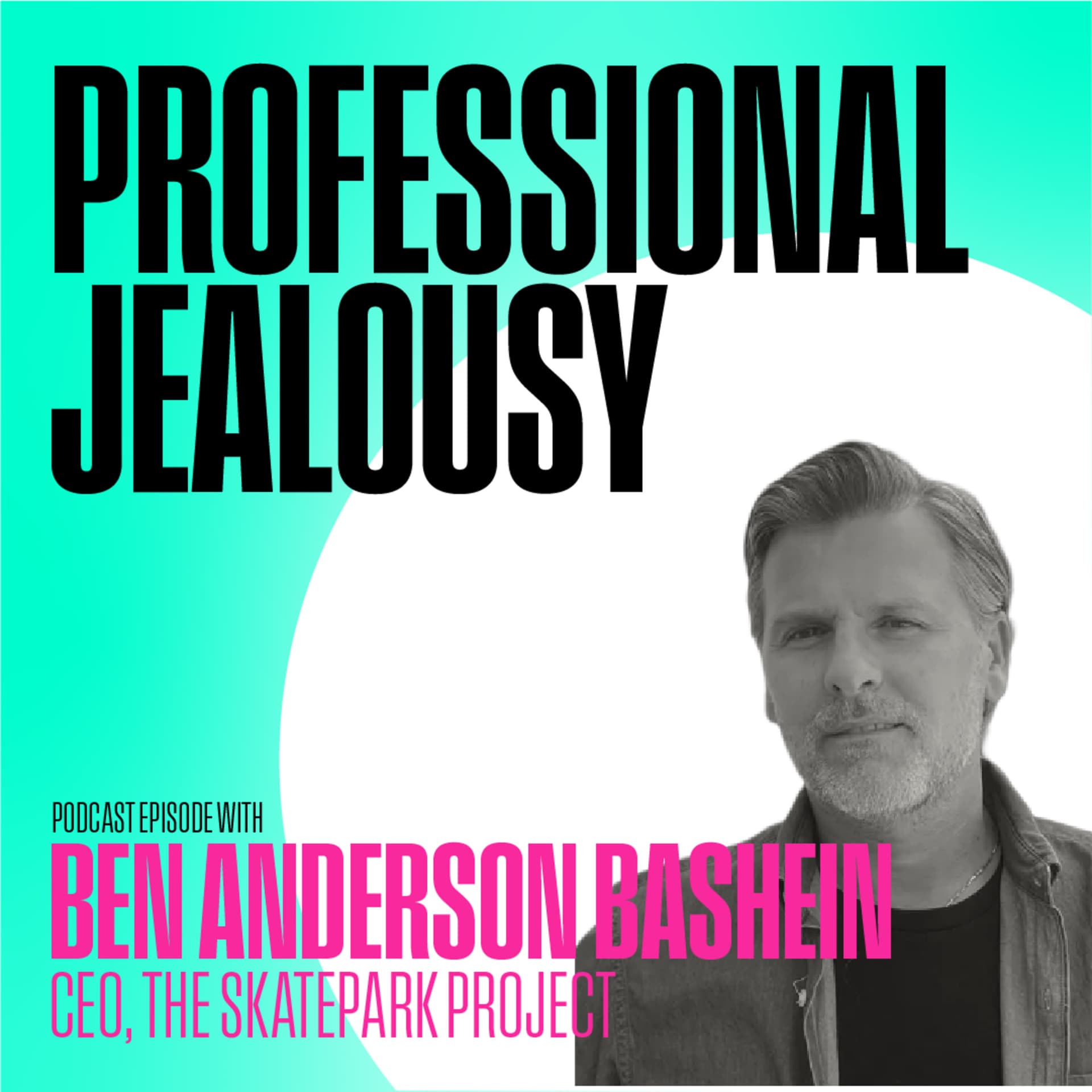
- Guest: Ben Bashein, CEO of The Skatepark Project (formerly Tony Hawk Foundation)
- Focus: Discussing the intersection of skateboarding culture, philanthropy, and community development through the lens of nonprofit work.
Key Themes and Concepts
The Skatepark Project
- Mission: To create safe, accessible, and inclusive public skateparks for youth in underserved communities.
- Impact: Nearly 700 parks built across all 50 states, serving over 9 million young people annually.
- Philosophy: Encourages free play and physical activity among youth, countering trends of limited unstructured playtime.
Ben Bashein's Background
- Transitioned from traditional nonprofit roles to focus on social impact within the skateboarding culture.
- Worked with organizations like Planned Parenthood and CORE (Community Organized Relief Effort).
- Experienced in leveraging celebrity influence for philanthropic endeavors.
Discussion Points
Importance of Skateboarding
- Community Development: Skateboarding fosters community and personal development, helping youth connect and thrive.
- Cultural Relevance: The skateboarding subculture intersects with music, fashion, and art, appealing to various demographics.
Leveraging Culture for Nonprofit Success
- Influencer Collaborations: Worked with celebrities like Tony Hawk and Sean Penn to advance philanthropic goals.
- Authenticity in Partnerships: Importance of aligning with brands that resonate with the skate culture; authenticity ensures successful collaborations.
Marketing and Fundraising Strategies
- Storytelling vs. Traditional Marketing: Emphasized the value of authentic storytelling from beneficiaries rather than conventional marketing tactics.
- Investment in Nonprofit Infrastructure: Advocates for proper funding of staff and organizational resources to strengthen nonprofit effectiveness.
Insights for Nonprofits
- Creative Fundraising: Explore diverse strategies for revenue generation, including merchandise and fee-for-service consulting.
- Building Relationships: The importance of emotional intelligence and relationship-building in nonprofit leadership.
- Mentorship Importance: Value placed on finding mentors and possibly utilizing executive coaching for professional development.
Challenges and Opportunities
- Navigating Funding Challenges: Acknowledgment of the shifting landscape for funding sources, especially within the cultural and athletic sectors.
- Impact of Social Media: The need for nonprofits to engage youth authentically while competing against digital distractions.
Goals and Future Aspirations
- Growth of The Skatepark Project: Continue to expand organizational reach while improving operations.
- Community Engagement: A focus on inclusivity and representation within skateboarding, promoting subcultures and diverse perspectives.
Conclusion Ben Bashein's passion for skateboarding and social impact provides a unique lens on how culture can be harnessed to create positive change in underserved communities. The conversation underscores the importance of authenticity in partnerships and storytelling in nonprofit work, while also highlighting the need for strategic innovation in fundraising and organizational management.
Further Resources
- Follow the Podcast: Available on Spotify, Apple Podcasts, and YouTube.
- Connect with Natasha Jakubowski: LinkedIn and Instagram for more insights and episodes.
---
This structured summary captures key discussions, themes, and insights from the podcast episode, making it easy to understand the core messages and implications for professionals in the nonprofit sector.
Written by AI. May contain mistakes. Listen to the episode to check what was said.
Chapters
Tap a time to open that second in VOMission of the Skate Park Project
0:45 to 2:00
Understanding the funding and advocacy work for skate parks.
“youth development, human rights, disaster relief, placemaking.”
The Importance of Free Play
2:00 to 3:05
Discussing the critical role of unstructured play for youth development.
“We were founded 25 years ago as the Tony Hawk Foundation with the proceeds that Tony won on Celebrity Wants to be a Millionaire.”
Skateboarding Culture and Community
3:05 to 4:19
Exploring how skateboarding fosters community and culture.
“Because they're obviously related, but how have you harnessed that culture?”
Leveraging Cultural Influence
4:19 to 5:34
How the organization uses cultural connections to promote its mission.
“seven to 10 years, skateboarding has really eaten the culture.”
The Role of Celebrity in Nonprofit
5:34 to 6:41
Discussing the advantages of having a recognizable figure like Tony Hawk.
“You know, there's so many people doing incredible work in, you know, all sorts of different fields.”
Transitioning Names: Tony Hawk Foundation to Skate Park Project
6:41 to 7:30
Understanding the reasons behind the name change of the organization.
“And we're fortunate that also drives opportunities to us.”
Engaging with Brands and Municipalities
7:30 to 8:34
Strategies for engaging different stakeholders in the nonprofit space.
“And, you know, the Tony Hawk celebrity, I watched the documentary, not for this, just generally, because, I mean, he's amazing.”
Insights for Other Nonprofits
8:34 to 11:21
Sharing lessons learned and applicable insights for other nonprofits.
“One is very practical because Tony is a sponsored athlete.”
Defining Authentic Partnerships
11:21 to 12:39
How to establish authentic relationships with brands in the skate culture.
“I mean, in this day and age, which is a terrible thing to say in this day and age.”
Navigating Brand Authenticity Issues
12:39 to 14:05
Discussing the complexities of brand authenticity in skateboard culture.
“that kind of gives you a lens of what kind of partners or brands you will work with.”
Show all 32 chapters
Corporate Influence on Skate Culture
14:05 to 14:59
Explore how big brands integrate skate culture into their marketing strategies.
“to think like and it's going to sound facetious but it's like so if sketches does something with skateboarding, then that's okay?”
Working with Celebrity Founders
15:00 to 17:04
Insights on the privileges and challenges of collaborating with celebrity founders.
“Like, what is the, like, there's no authentic connection there.”
Skateboarding's Cultural Explosion
17:05 to 18:15
Discusses skateboarding's rise from subculture to mainstream attraction.
“And then especially after the Olympics, you know, skateboarding for the first time at the Tokyo Olympics, and it just exploded beyond what I would have imagined.”
Inclusivity in Skateboarding
18:16 to 19:22
Focus on the low barriers to entry and efforts to promote inclusivity in skate culture.
“You know, the great thing about skateboarding is that the barrier to entry is really low.”
Journey into Nonprofit Work
19:23 to 21:04
Exploring motivations behind a career in nonprofit social impact.
“I don't I don't think it was an active decision.”
Career Path and Cultural Influence
21:05 to 22:26
A look at the speaker's diverse career in nonprofits and its impact on culture.
“So my background is doing fundraising and communications for nonprofits, and I've worked at a lot of traditional organizations, Amnesty International, Planned Parenthood.”
Challenges for Nonprofits
22:27 to 24:23
Examining the struggles nonprofits face in marketing and fundraising.
“It was definitely at the heart of what we did at Acrea.”
Storytelling in Nonprofit Marketing
24:24 to 26:34
The importance of authentic storytelling in engaging communities and donors.
“see at bigger organizations or in the corporate space.”
Lessons from Diverse Nonprofit Work
26:35 to 28:00
Sharing best practices and insights gained from various nonprofit experiences.
“I mean, I'm fortunate I've had amazing mentors.”
Investing in Nonprofit Effectiveness
28:00 to 29:30
Learn why nonprofits must prioritize finance, HR, and marketing for success.
“strengthening your organization having a robust finance function and hr and operations even when you've reached scale it's still like this kind of um kind of unacceptable to put money into staff development or marketing.”
Navigating Leadership Challenges
29:30 to 31:30
Understand the role of confidence and creativity in nonprofit leadership.
“necessarily think about or any other taboos that, you know, nonprofits often fall into the trap of?”
Nonprofit Revenue Generation Strategies
31:30 to 33:10
Explore innovative ways for nonprofits to generate revenue amidst challenges.
“you know get money to to do what they do have you have you felt that in your space I definitely feel like the world is getting a little a little less nice a little crueler in some ways.”
Community Perception of Skateboarding
33:10 to 35:00
Discuss how skateboarding is being recognized for its positive social impact.
“this is like a nascent moment for skateboarding, where it's blowing up.”
The Role of Mentorship in Nonprofits
35:00 to 36:50
Learn about the importance of mentors and coaches in nonprofit leadership.
“How long have you used executive coaches for?”
Balancing Growth and Mission in Nonprofits
36:50 to 39:20
Discover how to grow an organization while staying focused on its mission.
“leading a startup, it's so rare that you have someone kind of shoulder to shoulder with you whose brain you can pick.”
Volunteer Engagement from Corporations
39:20 to 41:20
Learn how nonprofits can leverage corporate volunteers for community projects.
“in the near and long term either for this gate park project or for yourself sure um I mean I I just want to keep growing this organization.”
Volunteering in Skateboarding Culture
42:00 to 42:36
Learn about how volunteers can contribute to skateboarding initiatives.
“And if so, what kind of volunteers would be useful to you and the organization?”
Quickfire Questions: Superpowers and Skateboarding Tricks
42:37 to 43:58
Discover personal insights on emotional intelligence and favorite skateboarding tricks.
“I'll be sure to put details at the end of the episode.”
Sales as a Key Skill
43:59 to 45:22
Explore the importance of sales skills in personal and professional growth.
“Is there anything that you're trying to get better at?”
Gotham Park and Urban Skate Spaces
45:23 to 46:49
Learn about efforts to revitalize historical skate spaces and create new parks.
“and it's going to be getting this extraordinary skate obstacle thanks to our partners.”
Career Advice: Trust Your Instincts
46:50 to 47:26
Reflect on the best and worst career advice received throughout a professional journey.
“Best career advice, worst career advice you've ever had?”
Professional Jealousy: Exciting Careers
47:27 to 48:38
Discuss the concept of professional jealousy and admire a unique career path.
“success look like for you a happy teen and a successful organization simple all right last Last question.”
Transcript
Automatic transcript. May contain errors.0:04Today I'm talking with Ben Bashain, the Executive Director of the Skate Park Project, formerly known as the Tony Hawk Foundation. The skate park project provides funding, technical assistance and advocacy support to local activists so that they can establish free, safe, accessible skate parks in low income and otherwise under resourced communities. It has also helped build almost 700 parks across all 50 states, which are used by an incredible more than 9 million young people each year. Ben is a seasoned social impact executive with more than 25 years of experience advocating for programs, resources, policies to address the most pressing issues facing society from public health to youth development, human rights, disaster relief, placemaking.
1:02He has a unique expertise in collaborating with talent, creatives, artists, athletes, and other influencers to advance their philanthropic goals. And he also consults on a wide range of development, communications, strategic planning for non-profits, partnerships, and CSR for brands. Hello, Ben. Thank you for coming. Hi. I'm so happy to have you as a guest. it's really exciting to kind of understand a little bit more about the kind of nonprofit world and how you operate and how you thrive, obviously, in this time when I'm sure things are even harder than normal. For those who aren't familiar with the Skate Bar Project, can you give us a quick kind of elevator pitch for the organization?
2:00Sure. We were founded 25 years ago as the Tony Hawk Foundation with the proceeds that Tony won on Celebrity Wants to be a Millionaire. Wow. You know, based on this idea that, you know, everybody needs to go outside and move their bodies more. Free play is essential for the healthy development of young minds. And today, the average American youth gets four to seven minutes of unstructured play a day, which is just wild and not nearly enough. And of course, Tony and so many of us believe that among all the things that you could be doing, skateboarding is the raddest. You know, you're not just joining a team, you're joining a community.
2:46so we've spent the last 25 years helping to get free safe accessible skate parks built supporting programs that use skateboarding to do youth development for girls and young women in post-conflict countries like Afghanistan and South Africa and Cambodia and today we have this very ambitious vision that anybody who wants to skate has the opportunity and a safe place to do it and everybody who does skate is welcome in the skate park and the skate community amazing that's a pretty bold vision do you skate out of interest i did i'm coming up on 50 and i'm a little more fragile than i was and um you know that that's not a great look if the guy who runs the skate park project eats it yeah i i remember i i'm not a skateboard as a as you can probably tell um but I did try it and I think I basically almost fractured my wrist doing it but I loved obviously being English and watching you know it seemed like a just an amazing cool community how do you how do you think about um the kind of culture of skateboarding and the Skateboard Project?
4:08Because they're obviously related, but how have you harnessed that culture? Sure. I mean, it's really remarkable. I would say in the last seven to 10 years, skateboarding has really eaten the culture. It intersects with music and fashion and art. And if you look at younger generations, even from millennials on down, but most especially, you know, Gen Z and younger, like, they very likely skate. If they don't, they've been on a skateboard. And even if they haven't, they're wearing the clothes. And they're listening to the music and they're participating in the culture. It's kind of remarkable. And that's one of the things for me that's so exciting about this, this organization is that you get to move the needle on all these critical issues through culture.
4:59You know, that's exciting. Yeah. No, it's amazing. It gives you a way to connect and storytell in, I guess, in a way that isn't quite as easy for quite a lot of other nonprofits. How do you use, how do you lean into culture and do connect in interesting ways? oh sure um i mean there's more opportunities than we're able to capitalize on and it really it's everything from you know we've done a capsule collaboration with vans to we have this program of skate park stories where um professional skateboarders other sort of creatives who are invested in skateboarding will talk about the impact skate had on them And growing up, we, you know, we work with musicians all the time and actors have been impacted by skateboarding.
6:03You know, there's so many people doing incredible work in, you know, all sorts of different fields. We're just really happy to kind of like carry the banner for skateboarding. Yeah, it's it's so interesting. And also to hear you say you almost have too many. Like, how do you, I feel like you do have like this rich potential kind of stable of influencers, medias, like a bounty of different kind of ways of communicating, which is quite unusual for the nonprofit space or not. no no it definitely is and you know i think of myself as being in the social impact entertainment space which is kind of a unique um a unique sector um that has a lot of advantages that many other non-profits don't have you know association with somebody like tony who has a huge public presence and you know is consistently like among the 10 most recognized athletes in the world and has this sort of mass appeal.
7:09And we're fortunate that also drives opportunities to us. You know, whenever something has to do with skateboarding, we're frequently the first call, you know, whether it's from a municipality or a brand or a celebrity. But, you know, our job, my job is to raise money to make the work possible. So, you know, the discerning bit is figuring out what opportunities have the greatest ROI, you know, whether it's on visibility or revenue generation, you know, and sometimes that's short term and sometimes that's about a longer term investment in a relationship. Yeah, interesting. And, you know, the Tony Hawk celebrity, I watched the documentary, not for this, just generally, because, I mean, he's amazing.
8:01I'm curious, why did the name change from the Tony Hawk Foundation to the Skate Park Project?
8:16sorry for us for a sec no i don't know what's going on with my uh my wi-fi sorry no problem
8:29why did the name change uh so the name changed about five years ago when i joined and it was for two reasons. One is very practical because Tony is a sponsored athlete. So the brands that he has deals with own his name in their category. Because of his profile, he had deals in about every sort of category you can imagine. You know, apparel and footwear and hard goods for skateboarding and like cologne, eyeglasses, everything. So we could only, since we were called the Tony Hawk Foundation, we could only work with those brands that had ownership in his name. You know, he was a longtime writer for Vans.
9:08They're a great supporter of ours. But now we also work with Converse and Nike and Adidas and Supreme. And, you know, it runs the gamut. And then the other reason is that I think after about 20 years of doing this, you know, he had an ambition to see the work of the organization really scale. And in order to do that, it was important to create a space where other people could feel like they were really invested in the organization and not just sort of cheerleading for Tony. Yeah, that's so interesting. So part practical, legal, part just to almost increase the ambition and include more people.
9:49How do you find, obviously, selling into brands is one thing, And then you also have presumably city and municipality kind of stakeholders. How do you how do you kind of sell into both? Is it very different or do you have a different approach to kind of talk to the two different types of stakeholder? Oh, for sure. You know, if you're talking to a municipality about the value of skate parks and the benefits of skateboarding, it's a much more straightforward proposition. You know, we funded and partnered with USC on the largest study ever of the psychosocial benefits of skateboarding. So, you know, it's talking about that.
10:30It reduces stigma, isolation, their physical health benefits. You know, it's an evergreen investment that doesn't take a lot of maintenance. You can design a park that's going to draw tourists, whether they skate or not. You know, that's really the appeal. when you're talking to a brand that's a little bit more nuanced because of course they all you know they want to give back especially if it's to sort of their own audience but they also want to make sure that the way that they're doing it lines up with their brand priorities that it creates the halo effect that they're looking for that it's going to get the sort of public traction and recognition that they need um i think that's the main difference do you think there are any insights or things that other non-profits could be borrowing from how you approach the skate park project because I feel like you are using having done a little bit of non-profit you're using so many more tools and ways of entering culture and building on influences I know not every again not every non-profit is in a cultural kind of category like skating but But I'm sure there are lots of things that you've kind of learned that are applicable.
11:50Oh, for sure. I mean, in this day and age, which is a terrible thing to say in this day and age. But I started my career in 1997. So in this day and age, you know, you have an opportunity. your reach is so much greater than it ever was. You know, if you align yourself with talent and influencers and folks who have an audience of their own and who share your values, there's just a tremendous opportunity there to raise your visibility, to generate awareness, and then to leverage that awareness to get support from the brand space. Yeah. Do you have a kind of, I'm assuming you have a kind of brand framework that kind of gives you a lens of what kind of partners or brands you will work with.
12:45Can you tell me about that? Like, how do you define it so that people can think about how they would think about their nonprofit? Oh, for sure. So for us, the critical element is authenticity. You know, in order for something to resonate with our community, with our supporters, our beneficiaries, it has to feel authentic and not pandering. You know, within action sports, I think there's a long history of people kind of coming from outside the space and selling to the people in the space in a way that didn't feel organic or real. Or like it authentically reflected the culture of action sports, whether it's skateboarding or surfing or snowboarding.
13:29And so for us, you know, we really want to make sure that this is a brand that resonates with our audience and that has an authentic role in the space. And then the other side of that coin is if there's a brand that's out there making money off of people participating in action sports, you know, we feel really strongly that they should be contributing back into the culture. okay okay that's interesting so uh so presumably there are some brands that kind of lean into skating that don't necessarily feel i don't know if they would necessarily feel authentic to all skateboarders but but if they're actually doing something that that that would i mean i'm trying to think like and it's going to sound facetious but it's like so if sketches does something with skateboarding, then that's okay?
14:20Well, I mean, you know, it depends. Honestly, you know, Walmart is selling pink plastic skateboards. They're not particularly well made, but if it's going to be a six-year-old or a seven-year-old's first time on a skateboard and it's going to be the gateway to a life of skating, I don't have an object, you know, but everybody incorporates skate culture into their campaigns now. I just saw, God, who was it? What's the company that does like wellies that you would wear at like a music festival? Oh, like Hunter? Hunter. Hunter did skateboarding ads with people in like festival gear wearing Hunter boots, like ollieing on a skateboard.
14:59And I just thought like, why? Like, what is the, like, there's no authentic connection there. It's just, it's a cool image, but there's no authentic connection. Versus, you know, obviously it's in footwear. It's really a clear red line connecting like New Balance and Nike and Adidas and Converse. Streetwear deeply influenced by skateboarding. And, you know, so whether it's like a Supreme or a Noah or whoever, you know, there it makes more sense. Yeah. Okay. It's interesting. So obviously you've got Tony Hawk, big celebrity that I'm sure is amazing in terms of fame and being able to bring credibility to the space.
15:48And then I know that you worked previously with Sean Penn's foundation. How do you find it working with these founders, like these celebrity, well-known, I'm sure, you know, very opinionated and confident founders?
16:06I mean, you know, it has its challenges, as everything does. Everybody's accountable to somebody, but it's also a privilege. You know, there's so many organizations doing amazing work that would absolutely kill to get a spotlight or a little bit of attention on the work that they do. You know, having a celebrity founder opens a lot of doors, you know, in ways that are apparent. And also, you know, it's not a secret. Tony's a very successful VC. That's sort of been his second life. He's a smart, curious guy and he's done well with it. And so he has a whole universe of friends who are in that world, who are happy to learn about the work that we're doing and potentially support it.
16:55So it really is a privilege to work with, you know, talent like that. Yeah, amazing. What's been the most surprising thing about this role?
17:12um you know as somebody who has skateboarded um i was aware of how it permeates the culture but once you're working on something you see it everywhere you know you see it on the louis vuitton or the runway the dora runway you see it in an energy you see a thousand kids rolling down the street. And then especially after the Olympics, you know, skateboarding for the first time at the Tokyo Olympics, and it just exploded beyond what I would have imagined. Yeah, I feel like it's gone from kind of subculture to mainstream in a way that is super interesting. I can't think of any other sports that have, or, you know, trends actually that have managed to do that in such a dramatic way.
18:14And inclusivity and bringing people into it is part of your work, presumably. Oh, absolutely. You know, the great thing about skateboarding is that the barrier to entry is really low. You don't need like a team and a league fee and a uniform. you don't even, you know, you don't need a field or even a skate park. All you need is a skateboard. I mean, that's out of reach for a lot of kids. So we have a program called Supply the Ride that gives away skateboards, BMX bikes, helmets, and pads, thousands of them a year. But, you know, we're really invested in this idea that there are, within skateboarding, these amazing skate subcultures.
18:54You know, some of it is geographic, like New York versus LA versus San Diego. And some of it is just like there's this incredible rich like women's skate culture and black and brown and lgbt skate culture and you know we see ourselves trying to create space for for all of those perspectives within this larger sport yeah amazing um i'd love to talk about your career journey. So when did you decide or why did you decide to focus in on kind of nonprofit social impact?
19:35For me, that was a foregone conclusion. I don't I don't think it was an active decision. You know, I was raised to feel like, you know, you either leave the world better than you found it or you don't. And so in high school, in college, when I started my career, I just knew that I was going to do something in the nonprofit social impact space. Amazing. Any tips for a parent that would love their children to be more socially orientated to the world? I mean, they go to Quaker school, but yeah, I mean, in all seriousness, like how do you, what in your upbringing do you think sure um i mean volunteerism was very important in our house and philanthropy was also like a family project um you know deciding where and when to give money and then volunteering was critical and that's how my career started out i was volunteering with like small local groups where everybody kind of gravitates to whatever their strength is um and i built that into a consulting business and then full-time work.
20:44But for me, that was it. It was just wanting to make a more just world and realizing I could turn volunteering into an actual job. Yeah, that's amazing. So you turned the volunteering into a kind of consulting business. And then talk to me, give me a kind of high-level journey. Sure. So my background is doing fundraising and communications for nonprofits, and I've worked at a lot of traditional organizations, Amnesty International, Planned Parenthood. I worked in the housing projects on the Lower East Side of Manhattan, and I worked up at the UN with the International Criminal Court. And then in 2007, I went to work for an AIDS organization in New York called ACRIA, which is sort of like the HIV charity of the contemporary art and luxury fashion communities.
21:37It was founded by like Ross Blechner and Bob Colacello and Donna Caron and Calvin Klein. And that was just very much its ethos and most of its revenue and support came from those communities. So I spent 11 years there. I was eventually the executive director for four years, working closely with artists, designers, and brands to raise money and visibility for the work. And then ultimately, we merged into a larger organization and I moved out to LA. Do you think that's where you started really kind of thinking about culture and storytelling and using influence and influences more? Yeah. Yeah. It was definitely at the heart of what we did at Acrea.
22:36And I had some opportunity to do consulting at that time with other nonprofits and brands. But what I realized when I moved to L.A. and started working with sort of talent in the Hollywood sense is just that the megaphone is so much bigger. you know fashion and contemporary art influences sort of um high culture whereas you know i've had the opportunity to work with the organization you know um rihanna's foundation and jose andreas's organization and jason derulo's organization and it's just exponential the impact that you can have with that kind of platform. Yeah, amazing. Yeah, it's interesting.
23:16I was helping out on a reproductive health nonprofit, which, especially compared to a Planned Parenthood, didn't necessarily have as many kind of, well, just didn't have as much awareness. Any advice for, you know, the thousands of amazing organizations out there? Like, what should they, how can they start building up their kind of marketing and awareness and fundraising? I found it, you know, as a marketer and a brand person, you know, it's really hard. It is. I don't think people realize it, nonprofit is an enormous sector, but it's something like 97 % of organizations, I think it's 95 % of organizations have a budget under like a million dollars.
24:15They're in perpetual startup mode. And it's just about kind of making ends meet and getting through the day. And there frequently isn't an opportunity to sort of implement best practices that you see at bigger organizations or in the corporate space. You know, the bandwidth isn't there, the expertise. And I do think it really, even at a small organization, it behooves you to, you know, find the time to learn what those best practices are. Maybe it's a volunteer, someone who comes out of the corporate sector who can sort of help implement those. And then start small. That's, you know, that's always the trick.
24:55Start small. Storytelling works one-on-one with donors. It works if you're pitching your local community newspaper. It works if you're trying to create a, you know, an online marketing campaign. Yeah. Yeah. And what about how, I love how you've you know used storytelling and and kind of really harness that to to engage and touch people any any thoughts on because i i think that's what any any organization could be doing any any advice or insights about how to go about that for people who aren't used to marketing and thinking about
25:41I think the trick is to find a professional who can help you do it and then let your beneficiaries tell their own stories I think that's the crucial part it needs to be authentic and it needs to be real and it needs to come from the minds and the mouths of the people who are experiencing your work first hand you know we work with a lot of different communities we have a Native and Indigenous skateboarding program. There's this amazing culture of skate on the reservation and they just, you know, terrible deprivation in so many of these communities. I could never tell that story. You know, my job is to be an advocate for the work, but I would never presume to be able to tell that story.
26:24So finding local advocates who can talk about that work for you is just absolutely crucial.
26:34almost like testimonials and actually telling the real authentic stories yeah um yeah i guess that's obvious but it's just so true it's it's instead of trying to put together campaigns or marketing stories actually go to the go to the source um show the impact show the emotion show the good that you're doing um yeah um any other thoughts on um kind of i feel like you've had such an interesting uh amount of different types of organizations from the lower east side to the un you know um like it's really broad um any other kind of best practices that you think you've learned along the way, things that, you know, you wish you'd learned at the beginning?
27:34Oh, gosh. I mean, I'm fortunate I've had amazing mentors. I feel like it's also taken me a long time to learn some really elementary lessons. Always. I feel like everyone kind of thinks, oh, my God, that was obvious. Why didn't I know that earlier? like yeah i mean you have to invest in the organization it's crucial i think especially within this non-profit space there's this sort of deep prejudice against spending money on strengthening your organization having a robust finance function and hr and operations even when you've reached scale it's still like this kind of um kind of unacceptable to put money into staff development or marketing.
28:20And I feel like that's misplaced. We need to adopt some of those more corporate values. You need to pay the money to hire the best people. You need to invest in your marketing and your public relations. You need to make sure that you have good governance and operation systems in place. There is a return there for your beneficiaries, and it's a better functioning organization. And I think it takes a long time to, there's like a certain stigma and shame working in nonprofit. Like every penny has to go back to the core programs as if you don't need to pay the person who raised that money or the finance person who dealt with the bank.
29:04Yeah, no, that's super interesting. Investing in being able to do it right, better, yeah any any other things that I feel like that's just a good business kind of approach to realizing that it's not just you know raising money but it's actually putting in practices and and foundations to to do it well over time anything else that you think people just don't necessarily think about or any other taboos that, you know, nonprofits often fall into the trap of?
29:46I think that there's a lot of imposter syndrome. The best piece of advice I ever got from my boss as he was leaving and I was taking on his role as the executive director of an organization was like, a lot of the time, you won't know what the right answer is. You just need to go into your office, close the door, decide, and then come out with confidence and, you know, lead, lead the team. Yeah, it's, you know, so much of leadership is just that, especially in this sector. You know, there's not a lot of folks cheerleading for you, unfortunately. Yeah. So it's important to be able to do that for yourself.
30:26And, you know, especially in these strange times. Folks have to get really creative, you know, earned income, revenue from the sale of products or services is becoming more and more critical for nonprofits. Having, like merch, like consulting, like, you know, there's all sorts of ways to do it. You know, we provide fee-for-service technical assistance now on the design and build process, you know, so that it's done in a way that's cost-effective and fast for municipalities. But nonprofits need to get creative about how they're generating revenue and meeting their mission. I think there's a lot to be said for that.
Read the full transcript
31:12Yeah, no, interesting. Yeah, I hadn't really thought of that because it's so much about, I guess, yeah, I mean, stating the obvious, it is a crazy time where a lot of people are losing funding, a lot of great organizations suddenly without some of the previous ways that they've been able to you know get money to to do what they do have you have you felt that in your space I definitely feel like the world is getting a little a little less nice a little crueler in some ways. Yeah. You know, we're fortunate because we work in the sort of cultural space. Yeah. There's always that conversation. But I will say, you know, a lot of our revenue comes from footwear and athletic apparel brands.
32:14We're the largest action sports social impact partner for Converse and Adidas and vans, and they've been deeply affected, you know, by the tariffs and even just the chaos of the last six months of it's happening, it's not happening. How much is it happening? When is it starting? You know, that's caused these businesses to be much more conservative than they have historically. Yeah. And do you feel like the municipalities and local governments, have they been infected? Or are they still as, you know, still open to these sorts of initiatives? Have you seen any change there? Oh, for sure. I mean, it's, you know, their tax base is going to be affected.
33:06That's for sure. But fortunately, also, this is still, even though it's been around since, you know, the 60s, this is like a nascent moment for skateboarding, where it's blowing up. And actually, fortunately, at the municipal level, I feel like those impacts are being offset by people realizing like, oh, this isn't just those hooligans, you know, making trouble. This is like a crew of skate moms who go to the park with their kids and this is um you know this is universal across you know every race gender ethnicity sexual orientation this is what kids want to be doing and more and more it's what adults want to be doing too so there's traction there amazing do you see a lot of kind of pushback you know as part of the cell obviously it's about moving it's about doing stuff outside uh off social media is that part of the sell when you talk to local governments oh for sure for sure um you know this country has an obesity epidemic and it has a loneliness epidemic and the solution is just go outside be your friends move your body it doesn't you know and that that they're you know the phone is a huge hurdle for that.
34:24You wouldn't think one little device could be so problematic, but you know, it's enticing. And if you can create something that's so fun and that makes kids feel good about themselves while making them physically healthier, it's as good as it gets. Amazing. You mentioned mentors. Tell me, I've always wondered about mentors. I feel like I've never really had any definitely official mentors have you had have you had mentors during your career who what sort of people have you have you gone to not official mentors um i'm very fortunate i've had a handful of bosses who i felt like i could really listen and learn from
35:13you know the woman who was my boss at amnesty international the guy I reported to at Acrea even informally Tony's brother Steve Hawk who's an extraordinary surfer and an amazing writer editor and author who's on our board is just like a great mentor for me I think you know if you can find formal mentors great but even if it doesn't have that framework or that structure you still need to kind of find people where you can And I'm also a big advocate of professional coaches. Interesting. Okay. How long have you used executive coaches for? I'm my first executive coach in probably like 2012. When I got my first executive director role, I was moving up within the organization and the board said, we're enthusiastic in giving you this opportunity.
36:12but we think that you haven't done this, you should find an executive coach. And I found an extraordinary woman, this woman, Joan Gary, who's like the legendary exec past executive director of GLAAD, the gay media organization, and then started a consulting business. And now she, she has this massive, I could never get her now way out of money price range, but she has this huge online community where small nonprofits can pay a very modest monthly fee and they get access to a community and online technical support. But having that person, I think, whether you're an executive director at a nonprofit or a CEO or leading a startup, it's so rare that you have someone kind of shoulder to shoulder with you whose brain you can pick.
37:00Yeah. Yeah. What do you think it gave you over time? Like, is it the sounding board? Is it someone to talk through problems with? Is it about building your confidence as you go into something new? Like what are the main things that you got from it? All of the above. It's another thing I've never done. No executive coaching, damn it. It's amazing. It's well worth the investment. I mean, you know, I'm a very process-oriented person. So, you know, there, there are those conversations, those brainstorms and those ideation that you want to do, but you can't do it with someone who reports to you for whatever reason.
37:41Um, and I think it's also important to have someone who has your, um, you know, who's looking out for you and whose priority is your success. And that's, that's how I think of it. Amazing. You seem very grounded in a great way. You're a non-profit, which I would argue is a very sexy kind of thing to be in. You're doing good. You're surrounded by interesting brands and celebrities and influencers, but still very grounded. How do you work on your, on staying grounded on your own growth and self-discovery beyond the coaching? Oh, sure. I mean, it is, it takes some intention, but I try and stay focused on the benefit of the work on going to parks and seeing kids or, you know, we run clinics and contests for kids who couldn't otherwise afford to participate in them.
38:48And so seeing that firsthand, you know, it's very exciting to have a meeting, you know, with a brand about putting out a sneaker collab, you know, like that's sexy and fun and challenging and exciting in its own way. But for me, it's not fulfilling in the same way as seeing a bunch of kids having the time of their life because of the work that we do yeah I mean yeah that's pretty amazing um so what are your goals in the near and long term either for this gate park project or for yourself sure um I mean I I just want to keep growing this organization. We were six employees when I started in 2020, and we're 17 now.
39:42And that's some really hard-fought growth at that scale. I just want to be able to do more of this work and do it better. You know, really drill down in the cities where we're having the most impact and then keep building our work across the country and internationally and tell the story of what we're doing more and better also. I feel like there's a lot of folks who can learn from what we've been able to do. And so being in those spaces to tell that story is really exciting. Yeah, I'm quite surprised that when you said that you're still only 17 people, that seems quite lean. Me, anyway, I don't know.
40:26I'm trying to think of the organization that I was on the board of within the Repraise space. I feel like 17 is not very many people. Like what are the job functions that you have to do all this work? Sure. We have two people in finance who are extraordinary and do the work of five people. We have one, two, three, four, five, six, seven, eight, nine people. nine people on our program team doing grant making park design and building overseeing the programs that give away hard goods or run clinics and contests and then we have one two three four people in fundraising and communications um who also do yeoman's work um you know it's labor of love.
41:26You have to really be passionate about it. Young people, mental health, sports, skateboarding, to commit yourself. But it's a lot of fun if you do. Yeah. Do you ever look for volunteers from the corporate world? And if so, what kind of volunteers would you be interested in hearing from?
41:51Oh, sorry, lost you for a second. Oh, sorry. I don't know what's going on. I was just saying, are you interested in volunteers from the corporate world? And if so, what kind of volunteers would be useful to you and the organization? oh always um i mean it can you know it can look like whatever the corporation wants it to look like it can be you know cleaning up a skate park it can be giving out it can be building skateboards that's we've done that before it can be giving away helmets and pads to kids in a skate park um you know we're always looking to get folks more involved um absolutely the more hands the better All right.
42:37Super interesting. I'll be sure to put details at the end of the episode. All right. We're going to go to last few questions. Quickfire. Let me see.
42:59tell me what do you think your superpowers are what's helped you be successful
43:10I think for me it's emotional intelligence it's being able to build relationships I have people who work for me now who've worked for me at previous jobs as people who've worked for me at two or three different organizations. I think when you find a good person, you build a relationship and you take them with you. That is great. Yeah, I couldn't agree more.
43:42Favorite skateboard trick to watch?
43:49the best skateboarding to watch is vert skateboarding which is what what tony skates so not to be um you know self-selling about it but it's absolutely extraordinary to watch people drop in on these you know 10 12 14 foot ramps and just absolutely fly through the air and do these extraordinary tricks yeah no amazing i uh again i remember watching the documentary and just seeing him do it over and over again, over and over again, just the level of practice and progression and determination was just incredible. Is there anything that you're trying to get better at? Many, many things.
44:39Many, many, many things. I think I'm one of those people who thinks everything is sales or maybe something I've learned is that absolutely everything is sales so I'm always trying to get better at that I think at the end of the day it's just the most critical skill you can have What was the last thing that you sold? The last thing that I sold was a collaboration with Nike and the Virgil Abloh Foundation to bring this insane skate obstacle to New York. There's an amazing park under the Kosciuszko Bridge in New York, and it's going to be getting this extraordinary skate obstacle thanks to our partners.
45:35Sounds amazing. um any non-profits that you wish had more glory and awareness and culture oh my god um so i'm on the board of a non-profit okay it's called gotham it's called gotham park so there is a space under the manhattan side of the brooklyn bridge called the brooklyn banks it's a historical culturally significant skate space. Punk music, hip-hop, streetwear, all sort of comes from there in the 80s and 90s. And we've been working with this group, Gotham Park, to get it reopened to skaters, which has happened. And now we're pushing to have a nine-acre park created under the Manhattan side of the Brooklyn Bridge, running basically from City Hall to the water, that's going to have climbing walls and biking paths.
46:28And they're already doing such extraordinary programming. They're giving away food and doing Tai Chi and yoga and classes for kids and environmental restoration. There are no parks. There's no public space in that part of the city. And this thing is going to be the high line in five years. People are going to be shocked. Amazing. Amazing. Best career advice, worst career advice you've ever had? that's i mean best career advice was sometimes you just need to trust your own instincts you just need to make the decision and jump with two feet um worst career advice i don't know that i've ever forgotten any actively bad career advice certainly had had bad bosses um one of those people who that was worst boss best boss no um okay well that's good no bad career advice um all right uh what does success look like for you a happy teen and a successful organization simple all right last Last question.
47:47Tell me about someone or something you're professionally jealous of. Sure. I mean, there are so many people that I'm professionally jealous of. There's so many people who have jobs that seem like really exciting.
48:06There is, I mean, it really, yeah, it runs the gamut. But I'll tell you what, there's a guy who I've only met in passing called Laurent Claquan, who runs Social Impact for Caring in the luxury space. And to me, that just seems like the most exciting job to be able to bring those financial resources and that kind of cultural impact to bear to benefit organizations just seems like a dream. All right. That sounds like a pretty good one to aim for next. Anyway, Ben, thank you so much. Thank you to everyone who has listened or watched this. Please do take a look at some of the other episodes that we've done.
48:52You can find them on Spotify, Apple Podcasts, YouTube, or all of them are on professionaljealousy.com. Get in touch if you have any questions, feedback, or importantly, anyone that you think I should feature on the podcast. A quick thank you to the Unreasonable Studios and to my producer, Shimmy Boyle. You can follow me, Natasha Jakubowski on LinkedIn or Instagram, and please subscribe.
From the publisher
In this episode I chat with Ben Bashein is CEO of The Skatepark Project, the nonprofit founded by legendary skater Tony Hawk, where he leads the mission to create safe, accessible, and inclusive public skateparks for youth in underserved communities across the U.S. and internationally.
We talked about Ben’s journey from college to world of non-profits including Planned Parenthood and CORE (Community Organized Relief Effort), Sean Penn's disaster relief organization. His journey is interesting as he has specialized in collaborating with talent and influencers to advance philanthropic goals, and is acutely aware of the role that culture can have in marketing and raising awareness and relevancy.
This conversation included:
- The importance of skateboarding for community and personal development- Leveraging culture to enhance nonprofit visibility and impact
- The way to work with celebrity founders like Tony Hawk and Sean Penn- Using partnerships with brands to drive funding and awareness
- Authenticity as key to successful nonprofit-brand collaborations
- The role of storytelling vs. just marketing and fundraising- Investing in nonprofit infrastructure and the need for creative fund-raising strategies