
In short
Proven Podcast Episode Notes
Episode Overview
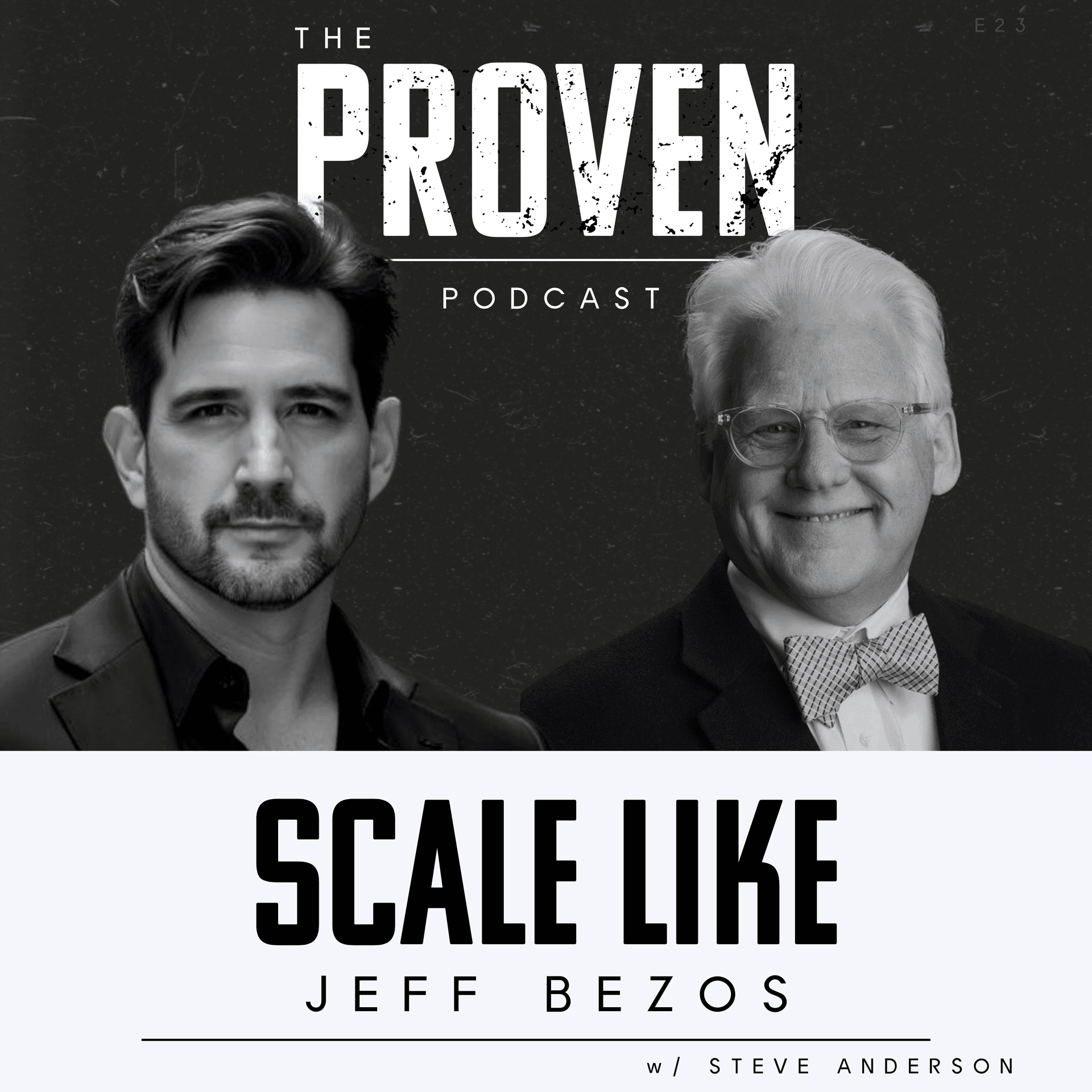
- Title: Scale Like Jeff Bezos - Steve Anderson
- Hosts: Charles & Steve Anderson
- Description: This episode dives into the secrets behind Amazon's extraordinary success, as revealed by Steve Anderson, a bestselling author and expert on Jeff Bezos' business strategies. The discussion centers around key principles that have driven Amazon's growth and innovation.
Key Themes
- Long-Term Thinking: Emphasizes the importance of a long-term focus over short-term profits.
- Customer Obsession: Highlights how a relentless focus on customer needs drives business decisions.
- Innovation vs. Invention: Distinction between improving existing products (innovation) and creating new solutions (invention).
- Agility and Rapid Decision-Making: Importance of maintaining operational agility to keep pace with market changes.
Key Takeaways
- Amazon's Four Pillars of Growth Strategy:
- Test: Conduct experiments and embrace "successful failure."
- Build: Focus on customer needs, long-term thinking, and understanding the business flywheel.
- Accelerate: Simplify complexity, increase decision-making speed, and promote employee ownership.
- Scale: Maintain company culture, hire for high standards, measure what matters, and always approach business with a "Day One" mindset.
Detailed Breakdown
- Steve's Background
- Transition from the insurance industry to business strategy.
- Extensive study of Amazon's shareholder letters, leading to insights into Bezos' thinking.
- Amazon's Shareholder Letters
- Serve as a roadmap for understanding Bezos' business philosophy.
- Key insights are woven throughout the letters, helping to identify core principles.
- Four Business Cycles
- Test: Innovating through testing and embracing failure as a learning tool.
- Build:
- Obsessing over customer experience.
- Fostering long-term thinking, resisting pressure for short-term gains.
- Accelerate:
- Generating high-velocity decisions.
- Simplifying complexity in services and processes.
- Scale:
- Maintaining culture and high standards during growth.
- Focusing on meaningful metrics that drive success.
- Operational Strategies
- Six-Page Memo: Replacing PowerPoint presentations with comprehensive narratives to foster deeper understanding and discussion.
- Two-Pizza Teams: Keeping teams small to maintain agility and enhance productivity.
- Bar Raiser Hiring Philosophy: A rigorous hiring process to ensure high standards.
- Avoiding Day Two
- Bezos' warning about the dangers of stagnation and complacency.
- Strategies for maintaining a "Day One" mentality:
- Customer obsession.
- Skeptical view of outdated processes.
- Eager adoption of external trends.
Practical Insights
- Companies should focus on *inventing* rather than merely *innovating* to maintain a competitive edge.
- Understanding and improving customer experience should be an ongoing process.
- Experimentation is essential; companies must not fear failure but learn from it.
- Hiring should focus on quality, not just filling vacancies to maintain high standards.
Conclusion This episode provides actionable insights into the principles that have made Amazon a leader in its industry. The discussion underscores the importance of a mindset focused on the long-term, customer-centric thinking, and the necessity of being adaptable and innovative in business strategies.
For further engagement and to access additional resources, listeners are encouraged to visit [Proven Podcast](https://provenpodcast.com/) and explore Steve Anderson's insights on his book, "The Bezos Letters."
Written by AI. May contain mistakes. Listen to the episode to check what was said.
Transcript
Automatic transcript. May contain errors.0:00Welcome to the Proven Podcast, where it does not matter what you think, only what you can prove. Everyone thinks Amazon succeeded because of logistics and pricing. Steve Anderson proves they're missing the real secret. After decades in insurance and studying every Amazon shareholder letter, Steve cracked Bezos' hidden scaling code. The show starts now. We're with someone who's also a Wall Street Journal bestseller. I'm crazy excited to have him on the podcast today. Thank you for being part of this, Steve. Charles, thanks for having me. I look forward to our conversation. There's so many things.
0:30And at the end of this, we're going to talk about how I know you've written a book. I know you're a Wall Street Journal bestseller, and we're going to go over that. But there's this one thing at the end that we were talking about off camera before we started recording that just completely changed how I just understand things. So we'll get to that in a second. But before we do that, let's get the audience updated. Who are you? What have you done? Tell me more about it. I'd be happy to. So my career has been in the insurance industry in insurance agencies, so selling insurance to individuals and businesses.
0:59Started that a long time ago, worked in an agency in the Washington, D.C. area. one in the Dallas-Fort Worth area, and kind of during that time got a real interest in technology. So this was, you know, literally late 80s, 90s, 2000s, so lots of things were happening. And I started my own consulting business in 1999, helping agencies with all of that, right? And so certainly database systems and tracking policies and clients, the social platforms just starting to come websites right all of those kinds of things fast forward uh to probably now five six seven eight years ago um i really started asking the question because technology continues to develop so rapidly and even more so today i think is the biggest risk insurance agents face actually not taking enough risk which is again very counterintuitive for the industry, right?
1:58Because we're all about reducing risk, mitigating risk, transferring risk to an insurance policy. What is this taking more risk thing? So that started a research, looking at companies that were once very successful and are gone. Why? What happened? And also looking at companies that have been successful and continue to be successful. And again why what's the difference came across the amazon letters to shareholders that jeff bezos wrote starting in 1997 when they went public and at the time i think there were probably 15 18 letters and i'd read one or two but i got all those letters and literally read them in a row as a book.
2:47And I realized that there were strings going through those letters, thoughts, ideas. And that really intrigued me because it felt like a class on how Bezos thinks and how he grew Amazon. And I realized that these things, these threads could apply to any company. And so that led to Honestly, my first iteration of the book was a PDF lead gen giveaway, one page executive summary of each of the letters. And fortunately, my wife is in the book publishing business. And so I showed it to her. She showed it to the founder of the book publishing company that she was working for. They both immediately came back and said, this is a book.
3:37And I went, oh, shit. Because I'd written my entire career. but there's a big difference between a thousand or 1500 word article and what ended up being a 65 ,000 word book and so that was a 18 month plus process getting the book ready and then the publishing um from there the fact that you wrote a book i'm a little jealous of it because not only do i have the book here because you you gave me a copy but you're also usa today bestseller and I'm just WSJ, just like you. So I'm a little jealous that you got it. The other thing that I'm jealous about in the book is you did such a good job dividing up kind of these, there's these 14 principles you talk about and you divide it up in four sections, which makes my life easier as a guy to understand these things.
4:25So I, you know, the audience, if you haven't read the book, let's go through there. I know there's four specific sections you've done. So if you could walk me through those four sections and then maybe some key things, some key takeaways because again, everyone wants to scale like Bezos. You were talking about at the time Bezos was doing 2 ,300 % growth. That's what the internet was doing at the time, which is wild. You broke it down in a digestible way where reading the letters by themselves, it doesn't give enough insight. Your book, which does such an amazing job. And again, what we're about to talk about at the end just surpasses all of it.
4:59I was like, what? it's such a concept that didn't even make sense. Can you walk us through what the four divides are? Yeah, I'd be happy to. So as we were, you know, 14 is a lot, right? It's a lot to digest. So we're trying to figure out, okay, how can we simplify this and make it easier to understand? And you certainly alluded to that. So we created these four cycles is what we call them. And the four are test, build, accelerate, and scale. And I believe every business, from the startup to the 50-year-old company, are going through these cycles, either as a company, as a division, as a region.
5:44They could all be at different places. So test. When you start, you're testing. you're testing ideas product service platform whatever it is what's what is your great idea that you are inventing on behalf of the customer and so to do that according to bezos and again if you look at amazon in their history you can see this over and over again the first principle there is called encourage successful failure because what amazon says and what bezos in built into to the culture there is that we need to experiment in order to find that next thing that's going to delight our customers. And by its very nature, an experiment means you're going to fail.
6:36Because if you're not going to fail, it's not an experiment, right? There's things you don't know. No matter how much prep work you do, there's things you don't know. And we've all experienced that right great ideas execution whatever the reason and and i'm i quote a friend of mine who said this in the book employees aren't afraid of failure they're afraid of the consequences of failure correct and so that's part of that culture and i also want to make sure i always say at this point, Amazon has an intolerance for incompetence. So this is not an excuse for lazy, shoddy work. This is, this is the, and Amazon built some tools around making sure that every experiment had the best chance of success as possible.
7:31So that's test. So with the tools that you were talking about that amazon's created to build in these these tolerances what are some of the tools because you've spent a lot more time in this than i have i agree wholeheartedly that the only way to succeed is to fail you can you can't you can't succeed your way to success you can only fail your way to success and we talk about this all the time that one massive success will make up for a lot of failures yep and to the quote you gave which was you know they fear the consequences of failing. I fear the consequences of not risking enough that you go, cause I've done that.
8:08I've wasted so much time in my life where we're trying to do things and I'm like, Oh, I don't want to fail. Those consequences are much worse normally than failing. This obviously doesn't count if you're jumping up an airplane without a parachute, completely type of failure, but well, the result really quickly at the end of it, what are some of the tools that Amazon's implemented that, you know, you talk about the tools that they they've gone through to, to make sure that their employees are failing on a high level and that they have these fault tolerances built in. The primary tool, and it started in 2004, when Bezos sent a letter out to his senior leadership team, so the top executives, and said, we will no longer allow slide-oriented presentations in our meetings.
8:54No PowerPoint, no keynote. I don't even think there were Google Slides back then. So, but no, none of that. Instead, the person who has called the meeting and is looking for a decision or pitching an idea must write a physical narrative about what they want and why. It was dubbed the six-page memo. So, it was a maximum of six pages, so constrained. and then a lot of development as they continued working through that process. But that memo started with a future press release. So the person had the press release that would go out when the product platform service was launched to customers. The benefits, why they need it, you know, whatever.
9:50And then an FAQ, frequently asked questions. They would go in and try and anticipate what are all the questions that the other people in the meeting might ask or want to know, and then they answer those questions. That is not sent out before the meeting. It is handed out at the meeting. And literally the first 15 minutes for a smaller decision, maybe 30 minutes for a larger decision, is spent in study hall. every executive is reading the memo because what bezos said was executives say they will read it or have read it and they haven't because they're busy right so we carve out time so everybody literally is on the same page and then you open it up for discussion and the discussion is so much richer because you're not getting interrupted with a question.
10:50Oh, that's in, you know, two slides down or whatever, all of that back and forth. And what Bezos says is when you have to write your ideas down, they're more well-formed. Absolutely. You have to think through at a deeper level. People hide behind PowerPoint bullets. It's one of the powers of journaling and why we make people journal because you have to write things down and process through it. Well, and literally for me, often the comment, I don't know what I think until I write it out. I mean, it's that same idea. And so it's developed over the years. The sixth page came in when people were writing 25 pages, so they constrained it.
11:32Bezos said a good memo probably takes two weeks, maybe more, to write. And it's passed around the team, lots of input. But another interesting thing is the memo itself is from the team, not from an author. So it's a team function. Now, I mean, there's a leader who's leading the charge. But think about that now. We're thought through here, all the things questions come in, they refine it. That becomes the document now for implementation. And if it fails, you now have something to go back to and say, what didn't we understand? What didn't we get right? So now you're learning because people don't remember what happened in the meeting, right?
12:22But now we have the document that we can go back to and adjust into the future. you will more commonly hear it described as the working backward document so that that working backward idea is we work backward from the customer to invent on their behalf so as we go through this and and people start finding these copies and obviously we're going to give them a copy of your book and have it have access to that which is amazing um which i can't believe you offered that and I stole your thunder. But in this, that's just the first section. And what I loved about your book is it's all of these practical implementation things, which is what all of this is about.
13:05What can I use immediately? What are the things that I can implement to start scaling, to start leveling up immediately? And there's so many books that are fluff, but you know, Steve, as much as I've had time with you, there's never been any fluff. We get directly to it. Here's practical things that you can implement immediately. so once we get out of test our next section that we go into if we've tested it we now need to build it right that's the the next phase that's the next part of this system as we go through the process talk to me about building and what are some of the things in there the tools that you know people right now are already going to punch you down to get down this list these examples everything it's already going to happen so expect it what are the things that we have with building which is the next phase yeah building and there are three in build i'll just mention them talk one or two, a little more depth, but obsess over customers, apply long-term thinking, and understand your flywheel.
13:57And I have a hard time on all three because all three are important, but I think the first one I'll mention is obsess over customers. And this is really interesting to me. It really is one of the first things that caught my attention. Bezos wrote about obsessing over customers in his first 1997 letter. And one of the things that's really interesting to me is That first letter set the foundation for Amazon. And every subsequent letter, he attached that very first 1997 letter to remind people. He had a whole section on we will obsess over customers. And what's interesting to me is every business knows they need to take care of customers.
14:40You don't have customers, you don't have a business. But we think of it in terms of customer service, customer journey, you know, customer focus. Obsess has a whole different connotation to it, and in some cases negative. You're too obsessed. But my question is, can you be too obsessed over your customer? And the way that works itself out at Amazon is a fanatical focus on making the customer experience at Amazon as frictionless as humanly possible. And they spent, what, 26 years now working on that. I mean, think about when I ask people when I'm speaking, how many here have bought something on Amazon?
15:26Most hands go out, everybody. Why? It's easy. You know, I know in our household, it's often the question is, is it worth going to the store or should I just go ahead and get it? Because I know Amazon has it, It's a decent price and I can have it in a day or two. So obsess over customers. Long-term thinking, just quick comments. Long-term thinking is another one of those foundational 1997 sections. And what he said was, is we make decisions based on long-term benefit, not short-term quarterly profits. So he went totally against Wall Street quarterly profit expectations and said, no. the internet's growing it's kind of like the wild land rush in the wild west we need to get our presence out there we will reinvest everything into doing that and they did they didn't make profits for a number of years and they bucked that trend now early on in the 2000s they had all kinds of pushback so apply long years he drove a honda civic yeah for years there's a there's a famous interview where he's driving he's a multi-bazillionaire and he's driving his little honda civic to work yeah and you know we talk about what makes people loyal this obsession over customers is why i shop at amazon because the return policy is so frictionless it's just i'm like okay i go click and i'm done i've never had any issues with any returns ever yeah and it's why i shop at amazon and yeah i'll wait a day or two for something i could go over to tarjay or well and the thing about going you don't know if they have it right and so then are you wasting And one of the things Amazon continues to work on is really not just self-service customer service, but automated customer service.
17:19So I had, I ordered a product first time in a long time, missed the delivery date, got a notice, missed the delivery date. And they said, we think your package is lost. Click here to cancel and reorder. and they proactively reached out and said, here's the process. That's different than most businesses. It's not proactive. And that proactivity creates loyalty. For example, my cell phone service, they changed their plan about six months ago and it's a cheaper plan. And I just happened to stumble upon it six months later. And I was like, hey, why didn't you tell me that oh well we don't tell people we don't do that right your amazon on the other hand has by in default this is turning into an amazon commercial amazon by default if your price changes in 30 days you literally can go in and request the difference and they won't even challenge you on it okay okay so they have these proactive ways and when i go again for me it's a return policy because now that there's ads in amazon prime video i'd get mad at it but i'm like no i'm not charging me but in this environment where people come in you have just you click and you're done the return policy is so easy and you can have a pickup at your door you can drop it off it's just it's part of my shopping experience because i shop at um whole paycheck i mean whole foods and uh just it's a whole paycheck at this point it's getting a little better i think but oh god it's still it's oh god it's rough you know jeff if you're listening to this fix it dude come on stop it you're killing us like hey it's orange shoes for four hundred dollars i'm like dude so but going into that environment i just we just it's part of our shopping experience we're going to bring our packages and drop them off and that process is even easy as well like they don't even talk to you anymore you show them the qb and then and you're done so it's amazing really really good so we've gotten to the point of testing we're assessing over clients in the build process as we're getting to the next one which we've got skip which i know it's accelerating we do accelerating next and i always want to go to accelerate yeah yeah i always celebrate and actually i'll i'll talk about one that relates to our just our conversation and accelerate it's make complexity simple and that's exactly what we've just been talking about and that actually that principle came when i was listening in my car to npr interview when amazon had just purchased to pharmacy called PillPack.
19:52And there was a, I don't remember, one of the other big pharmacy chains, CEO was like, well, we're not worried about Amazon getting in the pharmacy business. It's more complicated than they realize. And I literally remember saying out loud, yeah, but that's what Amazon does. They make complexity simple. So, but the one I want to accelerate that I think is where businesses start i don't want to say failing but start slowing down and the principle is generate high velocity decisions so as a business grows there's a natural tendency to add layers supervisors managers division heads whatever it might look like and bezos hated that he wanted bureaucracy as small as humanly possible.
20:52So when he talks about high-velocity decision-making, he breaks decisions into two different types. He called them type one, type two, or one-way doors and two-way doors. One-way doors are decisions that are big, out of bet-the-company-type big decisions. And he said those decisions should be made at the highest level possible with as much data and information as you can gather and probably ends up being a gut decision. He says, what the problem is, is those are very few and far between. But as a business grows, the two-way door decisions, type two, are easily reversible. So we make a decision to go and do a product.
21:40And you see this at Amazon all the time. You hear like, oh, they shut this down or they shut that down or they close these stores or they did. Those are two-way door decisions. We thought we were going to go this way. It didn't work out the way we planned. It's not generating what we need to continue to move forward. So we pivot. You either pivot to something else or you literally turn around and go back, flow stuff down, take what you learned, and then do something else. So, you know, we can talk about grocery, we can talk about healthcare, we can talk about even Alexa and all of that. I mean, there are all kinds of different areas where Amazon tests, this is back to that experimentation, try things out.
22:30Now, some, you know, smaller businesses are going to say, I don't have their money. No, you don't. But you do have whatever budget you have and should be setting aside for these experiments and these tests and figuring it out. And a couple of tools there are, again, and this is an example of where the principles stand on their own and they interact with one another. So the working backward document six-page memo is another key here. He also said two-way doors, decision-making. you make a decision when at most you have 70 % of the data or information you wish you had. And you wish you had, I think is a really important phrase, I think gets skipped over.
23:21So you make those decisions quickly and by a small team, what became dubbed as two pizza teams. So teams at Amazon should be no bigger than what two large pizzas can feed. Really simple topics. Yeah, that makes sense. And the people on that team are there because they are high quality people. You have hired high quality. So that leads, we won't go into it quite yet, but a principle in the scale area, which is focus on high standards. So you don't hire people to fill a position. You hire people that have the skills, knowledge, and ability either you need or you want. And if you hire them and they're the top people, let them make the decision.
24:06And again, if you build a culture that failure isn't punished, all of that starts working together. And that's why the cycles, I like the cycle idea of them. They're all working together to generate what the company needs, which is profitable growth. one of the things that you know when you talk about the principles you divided them up there's in the first two there's three principles and then the second two there's four principles and when we're talking about this you know a lot of people trying to accelerate and we'll get into scaling but the four principles that are that are in accelerate or and i want to make sure that we're telling the audience hey we're only picking one but when it comes to accelerate what are the what are the four principles that as you've broken them down so generate high velocity decisions make complexity simple accelerate time with technology and then promote ownership so i and i will i will focus two sentences maybe on promote ownership bezo said again in that very first 97 letter so we've already talked about long-term thinking We've talked about customer obsession.
25:21Employees was another big section. And he said, employees are going to make Amazon what it is. And we need to focus on hiring the best. And employees need to be owners, need to think like owners. And to think like owners, they actually need to be owners. So Amazon's pay scale package from the very beginning certainly was money, but weighted more to stock options because Bezos said there's a different mindset when you actually own a piece of the company. And even early on, it's changed somewhat because times change, but even early on, fulfillment center workers participated in those stock options.
26:06And so, you know, it was a important piece of building that culture that allowed Amazon to be able to continue to grow. So as we go through this cycle, we've done a great job of testing. We've built, we've accelerated. Now we're in my favorite section, which is scaling, which I know, surprise. I love scaling more than anything else. And I've got my experience scaling, but seeing it through the eyes of Bezos is totally different. Seeing it through the letters, how you digested it there are four sections inside scaling and i know we've had this this other thing we're going to talk about that popped my brain cells but for scaling i want to take some time what are the four parts of scaling and which one stands out with the tools as well okay so the four parts are maintain your culture and and again a quick comment there uh amazon now has about 1.3 million employees worldwide about 550 000 in the u.s how do you keep all of this from the early stage and help keep incorporating that into that large so that so but that's focused on culture um one quick story and it kind of leads to your comment earlier about bezos trying to drive around in the honda he was very focused on frugality to only spend money on what improved the customer not what improved you know like flying coach and those kinds of things
27:53early on in the garage where he started they were packing books to be driven to the post office and they were on the floor and he was had somebody else helping i mean he and bezos looked over and said we need to get knee pads my knees are killing me and the guy said no we need packing tables and he looked at him and said that's brilliant went out box store lumber place realized he could get solid core doors and four by fours some brackets and create packing tables that became known as the door desk bezos had a door desk in his office he may still i don't know that but for years a symbol visible of culture.
28:40And again, there are other examples of that, so building culture. The second, focus on high standard. I mentioned that in terms of hiring. When you're scaling, there is a, you need people. If you're accelerating your growth and you're scaling, you need people. The tendency is to hire a body. But if you're going to scale long term, you need to focus on quality and those high standards you have. And I will tell you, it's hard to get a job at Amazon even today. And it's interesting because I see all kinds of different kind of tips on how to interview and what to expect and all of those kinds of things.
29:26And there's no question, you know, people often ask, I hear Amazon's a hard place to work. It is. They have high standards and they expect you to keep up to those high standards. But when you think of that and you hire A players, A players want to work with A players, not B or C players. And if you bring B or C players in, they bring A players down. So it's, I mean, and I don't know how many open positions Amazon has right now. It's still a lot. always is, but they're very intentional. And one of the ways they do that, again, a quick story, is they have a position called a bar raiser. There is usually that person in interviews, when they're interviewing a potential candidate, that bar raiser has ultimate veto authority over hiring that person above any manager, above any VP.
30:23If they say they don't think this person would be a good fit. They are not hired. They've been getting extra training. They have demonstrated the capacity for understanding culture, et cetera. But that's a tool to help scale, which is a really interesting concept. Third in the scale is measure what matters. And the subtitle is question what's measured and trust your gut. So Amazon's hugely data-driven. They know everything.
30:59and it's not just the reports. So Bezos published his email address in, I don't remember what year letter. And he said, this is my email, write me. You have a problem, I want to know. And people did. He said, I used to look at him, he doesn't anymore, obviously as a team, but people send, I had a problem, I had this, and then he did originally, his team, might do now or his team might bring it to Bezos. Well, he's not there anymore. So I think Andy's, Jassy's doing this still. But he literally just forwarded that email with a question mark to the person responsible for that part of the organization.
31:41Nobody ever wanted to get a question mark email from Bezos because it meant there was a problem. And so my point here is hugely data-driven, but he said anecdotal data often brings more insight than hard numbered data and we're either that's why i say measure what matters and question what's measured we might be measuring the wrong thing getting results we think are telling us it's good when in actuality there's some other nuance there that we haven't understood so that's key i think it goes back to what you were talking about before about hiring people. Don't just fill the void. Don't just put a body there.
32:23That's not an ideal solution for you. Hire someone that you know you're going to get on a higher thing. To hire just the higher is not measuring what matters. You're doing this and it costs, there's so many situations where people hire people and it costs you a fortune because it didn't work out. I'd rather hire four or five people, figure it out, put them through the testing process and purge out on it when I'm dealing with businesses. If they have an open position, I always say, hire three people. You're going to probably fire four. And they're like, wait, what? I'm like, you're probably not only going to not hire these people, but there's someone else on your staff that you're going to realize through this process isn't your person.
32:56Because to the pizza box example you gave, it doesn't take a whole lot of people to scale. It really doesn't. Some of the people I know who are making solid eight figures have four or five people who work for them. You don't need this big bloated staff for most people. You need operations and systems and doing these things in order to scale effectively. So those were two of them we've got two more well those three so maintain your culture and data the last one measure matters and the last one yeah i believe it's always day so i'm smiling because i like this i speak on it a lot so uh and the again very first 97 letter so much goes back to that letter just it still intrigues me he he said in that letter it's day one for the internet now or in 1997, nobody knew what the internet was.
33:45It really was day one. It hadn't been built. Nobody knew what it was going to be. Like today, people said, oh, this is a fad. This is never going to do anything. And he said, it's day one for the internet and for Amazon.com if we execute well. And then every letter subsequent, every other letter he wrote, always ended with some form of, it's still day one, it's always day one. Even in the 2019 letter, which I call the pandemic letter, he said, even with the troubles we faced, it's still day one. So what is day one? It's a mindset. It's a, what were you thinking the first day you walked into your new business or you started or you got online or whatever it was for you?
34:40That excitement, that realization, I have an idea, we're going to see if this works. How do you maintain that excitement in scaling? And so here's what he said. He was in front of an all-hands meeting in Seattle, regular occurrence, update on the company, a couple thousand employees there. And at the end, he did Q &A. and he had people, you know, write down questions and we got cards and he looked at the next card and he kind of chuckled and he said, I think I know the answer to this question and the question was, Jeff, what does day two look like? Well, the crowd started laughing and he said, I think I know the answer to this.
Read the full transcript
35:25Day two is stasis followed by irrelevance followed by excruciating painful decline followed by death. And that's why it's always day one. So I won't name them all, but you know companies. In fact, I have an article in my head. I haven't written it down yet because, you know, I write to know what I think. But HP, I don't know if you've seen their printers, had this subscription service and they would lock out your printer if you didn't renew. That just happened to my wife. And the article title right now is HP Printers. a day two company. Oh, absolutely. Yeah. And your previous day two companies, Kmart, Sears, things of that nature, you can run to those day two boys.
36:16Blackberry. Absolutely. Oh God, Kodak, IBM. Oh yeah. And also in a way, Microsoft right now. I would say Microsoft, and that's really an example. It's really hard to turn a company around when you start that process. Microsoft is one of the exceptions. One of the few, I think, exceptions of a company that was going down really fast and was able, new CEO, able to reverse that trend. But let me give you the, if I may. Yeah, they're trending differently, but I don't know if they're going to get out of it. Say that again. I don't know if they're going to get out of it at this point because the culture, and this is why culture is so important, the culture that Apple has made, that has built is so solid.
37:02It's an identity. And people don't violate identities. Because in our core, that means death. the culture that Microsoft built was based on features, right? That was like, we have these features, this is what we do, this is our tech, look at us, shiny new toy. Apple was, no, this is an entire ecosystem. This is who you are as a person. That's exceptionally hard to defeat. The reason I bring that up is I'm a Microsoft certified trainer. I own IT companies, I trained MCFCs, I'm this guy. I just bought a MacBook, which is unbelievable for me to go because the devices that are in the Apple world can do things that the PC world just regrettably can't.
37:41And I wouldn't have gotten there if I didn't have my iPad that I fell in love with and my iPhone that I fell in love with because it's cohesive. And if you're not focusing on your culture, you're going to lose. You're going to become a day two company. Unbelievably quickly. So he went on to say in the 2016 letter, told that story, and he went on to say, I'm more interested in how you fend off day two. So he said, I don't know all the answers, but I have a few. So here are four. The four he mentioned to fend off a day two mindset are customer obsession, we talked about, a skeptical view of proxies.
38:22Now that was a little harder to delve into, but for Bezos, a proxy is a process or procedure that no longer serves the customer. And so, again, so a skeptical view, you know, and again, back to how many times have you heard a customer service agent say, well, that's not company policy versus, right? I mean, that's the idea behind it. Or even a procedure internally that causes friction for the customer. So skeptical view of proxies. And they change. And they need to change. And you need to have processes and procedures. No question. third is eager adoption of external trends and again 2016 and he says one of those trends now and he and he said they're actually pretty easy to figure out because they're talked a lot about he said one of those trend now is machine learning which is the foundation of where we are with generative ai and all that kind of stuff but eager adoption of those trends not being afraid of them not being willing to experiment right so we go back um and then fourth high velocity decision making again which we've talked about so four defenses for a day two mindset and that's to me that's kind of the ultimate cap off of scaling well i know that's the ultimate cap off what we were talking about beforehand, which is I want to lead you into how to avoid day two, it's completely counterintuitive.
40:02And I know this is what you're speaking about now. And I know that there's a new iteration of the book coming out, but this concept that you just gave to me, I initially had pushback when we were talking. I was like, what are we talking about here? And very quickly I was like, oh crap, he's right. So I'd love to share this with people. We've been leading into this. Let's talk about it. I know you're speaking about it more than anything else. I don't want to give it away. I already saw your thunder with the book. What is this thing that broke my mind? So I've realized over the last few years that it really is understanding more and more of the principles, the cycles, how businesses work.
40:42Everywhere I look in the business press, be it Harvard Business Review, be it Fast Company, be it A, be it Bloomberg, you pick them. I don't care which. It's all about innovation. Companies have to innovate. All this new stuff coming, they have to innovate. I think that's backwards. Okay, let's get into it because I still have resistance to this. So if they're not innovating, what should they be doing? Innovation is improving on what already exists. What companies need to be doing is inventing on behalf of the customer. So again, back to experimentation. So in my framework I'm building, experimentation leads to invention, which allows innovation.
41:33So Amazon's innovative. I mean, the Kindle keeps getting different and better. The Echo keeps getting different and better. Their services keep getting different and better. AWS keeps adding new things. at the core they also invent new ways to do things and so if you're focused on innovation I believe that is actually the doorway to day two and I kind of go back it's an old book to Clay Christensen's The Innovator's Dilemma because they get to a point where they're continuing to innovate and somebody else out there has created something brand new And now all of a sudden they're doing Hail Mary, that kinds of things that mostly don't work to catch up and they can't.
42:25So if you're in a business and you're like, okay, I get it. I'm going to get surpassed. Even though I have the greatest, most amazing typewriter in the world, someone over here has invented a laptop. I'm going to lose no matter what, no matter how great my typewriter is, no matter how well I innovate in that environment where innovation needs to be fed by invention. If you're a business owner and you're trying to scale, and I know you're talking about this all the time. What are the things that you can do as a business owner to kind of scale and level up and the practical tools, because you're great at giving tools.
42:55What are the things that people can do to start really leaning more into invention versus innovation? I'm going to, I'm going to go back to customers because Bezos did all the time and kind of that working backward I talked about earlier is at Amazon, they spend an inordinate amount of time deeply understanding customers' wants, needs, and desires, more so than any company I can think of or can identify. I mean, they go out, they interview, they visit places, they spend the effort to deeply understand. And Bezos said the whole purpose is so we can find out what they will want if they knew it was available.
43:47So that's the invention part. For example, I could do Kindle, I could do Echo. Who needed a device that sits on the table that you can talk to in a response to you? Nobody's asking for it. That's a fallacy of focus groups. If they don't know what's available or what's possible, how can they tell you what they like? Now, you might want, but focus groups, you're better off getting customers and giving them prototypes and maybe doing some things like that. But what are their, and here's where I will, I got too many things in my head going. Too many businesses don't understand their own processes they haven't gone through them and so secret shoppers send somebody that doesn't know the your business ask them to buy ask them to go through the sales funnel the process the whatever and and ask them to tell you honestly and forthrightly where the problems are where the friction is.
45:05And I will tell you just a simple example of that. You know, doctors, doctor visits. Used to be hugely painful, right? Had to fill out the forms all the time, same information all the time, blah, blah, blah. Some of the more advanced ones now, just did this for an appointment I had coming up, online portal, fill all the information out, check double check change all done when i walk in no clipboard and maybe if i have to sign something they have everything and i can communicate with the physician through the portal that's an example of huge friction getting better where in your business do you have that situation and then how can you invent new ways to fix it so yeah i mean when we first started this off camera i was I don't think I agree.
46:02But now that we've talked about it, the idea that innovate, you've got to invent. If not, you're going to have the best typewriter on the planet. You're going to get crushed by laptops. Steve, I adore it. Thank you so much for being on. If people want to track you down, if people want to have more access to you and learn more about this, if they want to learn more about the book and to learn more about the secret center, because remember guys, this is less than an hour. We could do this for days. There's so much value in there. And I love how you deliver it. because it's tactical. It's one of the things that I adore more than anything else.
46:34I don't want to know what the name of your dog was. I want to know how to implement now. I don't care about where you grew up. I want to know this now. How do people track you down? How do people get a hold of you? How can people see you speak? What are the things that they can do? Yeah. So one comment is for everybody listening at the end of every chapter, we've got questions. So I was really focused and thank you for identifying that really focused on how do we make this practical that, you know, somebody reading can start thinking about how it can apply to their business. So that, that is my goal.
47:06Um, and you, you've kind of alluded to, we have a gift for your listeners, um, in the show notes, there'll be a link to a place where you can download a digital copy of the book. So you can get access to the book. My request there, Charles is for everybody to leave an honest review on Amazon. There's nothing better that could help me. If you liked it, if you didn't like it, honest review. I don't want fluff. So that's there. So people can get me. The book website is thebezosletters.com. I'm on LinkedIn, a pretty big presence there. So you could search Steve Anderson Bezos or Steve Anderson insurance.
47:53and you'll likely find me. Let me know if you want to connect. Let me know you heard me on the podcast. I'll be happy to. And that's where I post most of my stuff. And so we can certainly stay in touch that way. So if someone wants to work directly with you and really track you down, is LinkedIn the best option for that to send you a message from there? Actually, Steve at thebezosletters.com. We'll skip the LinkedIn back and forth stuff. But certainly LinkedIn, you can reach out there and I can give you that email address also. Gotcha. But I will say that if you get a response from Steve, that's just a question mark, you might be in trouble.
48:32You might be on day two, so just have to worry about it. Steve, I appreciate it. Thank you so very much for coming on. Charles, it's been fun. Really enjoyed it. Thank you. Here's what separates winners from wishful thinkers. Winners test relentlessly, fail fast, and learn faster. They don't perfect their ideas in conference rooms. They put them in front of real customers and let the market decide.
From the publisher
In this episode, Charles peels back the layers of Amazon's unprecedented success with Steve Anderson, the Wall Street Journal bestselling author who's become the Rosetta Stone of Bezos' business philosophy. Steve unveils the hidden gems he's mined from years of studying Amazon's shareholder letters, offering a masterclass in corporate strategy and innovation.
From the trenches of the insurance industry to the pinnacle of business analysis, Steve's journey is a testament to the power of long-term thinking and relentless customer focus. He dissects Amazon's evolution from an online bookstore to a tech behemoth, revealing the DNA of their "Day One" philosophy that's kept them perpetually ahead of the curve.
Charles and Steve engage in a riveting dialogue, exploring the four pillars of Amazon's growth strategy: test, build, accelerate, and scale. They unpack the counterintuitive approach of "successful failure," the magic of high-velocity decision making, and why invention trumps mere innovation in today's cutthroat market.
Steve's insights crackle with practical wisdom as he breaks down Amazon's unique operational strategies, from the legendary six-page memo to the "bar raiser" hiring philosophy. He challenges conventional business thinking, advocating for a radical shift from short-term gains to long-term value creation.
Whether you're a startup founder looking to disrupt your industry, a corporate executive seeking to inject innovation into your organization, or an entrepreneur navigating the rapids of rapid growth, this episode is a goldmine of actionable strategies. Prepare to rewire your business brain and embrace the principles that have built a trillion-dollar empire.
KEY TAKEAWAYS:
- Uncover the secret sauce of Amazon's customer obsession and how it drives every business decision
- Learn why "Day One" thinking is crucial for maintaining startup agility in a growing company
- Discover how the "two-pizza team" rule can skyrocket your organization's productivity and innovation
- Understand the power of long-term thinking in defying Wall Street expectations and building lasting success
- Explore strategies for fostering a culture of invention that keeps you ahead of the competition
Head over to https://provenpodcast.com/ to download your exclusive companion guide, designed to guide you step-by-step in implementing the strategies revealed in this episode.
KEY POINTS:
2:00 Steve's Background: Anderson shares his journey from insurance industry to business strategy expert.
4:24 Amazon's Letters: Reveals how Bezos' shareholder letters became a goldmine of business insights.
6:31 Growth Cycles: Breaks down Amazon's four cycles of business growth: test, build, accelerate, and scale.
8:07 Embracing Failure: Discusses Amazon's counterintuitive approach to "successful failure" in innovation.
10:40 Six-Page Memo: Explains Amazon's unique meeting protocol that replaced PowerPoint presentations.
12:34 Working Backward: Describes Amazon's strategy of starting with the customer and working backwards.
15:11 Customer Obsession: Highlights how Amazon's fanatical focus on customers drives their success.
16:54 Long-Term Vision: Explores Amazon's commitment to long-term thinking over short-term profits.
19:01 Proactive Service: Illustrates Amazon's approach to anticipating and solving customer issues before they arise.
22:02 Rapid Decisions: Outlines Amazon's high-velocity decision-making process for maintaining agility.
24:07 Small Teams: Introduces the "two-pizza team" rule for maintaining productivity in growing organizations.
26:01 Acceleration Principles: Lists four key principles Amazon uses to accelerate business growth.
30:01 Hiring Standards: Examines Amazon's rigorous hiring process to maintain high standards as they scale.
34:30 Meaningful Metrics: Discusses the importance of measuring what truly matters in business growth.
39:00 Avoiding Stagnation: Explores strategies for avoiding the dreaded "Day Two" in business evolution.
40:54 Day Two Defenses: Presents four defenses Bezos outlined to maintain a "Day One" company mentality.
42:36 Invention Priority: Emphasizes the crucial difference between innovation and invention in business growth.