Ask ChatGPT


 Run the Numbers
10 Sep 2026 · 34m · 16 chapters
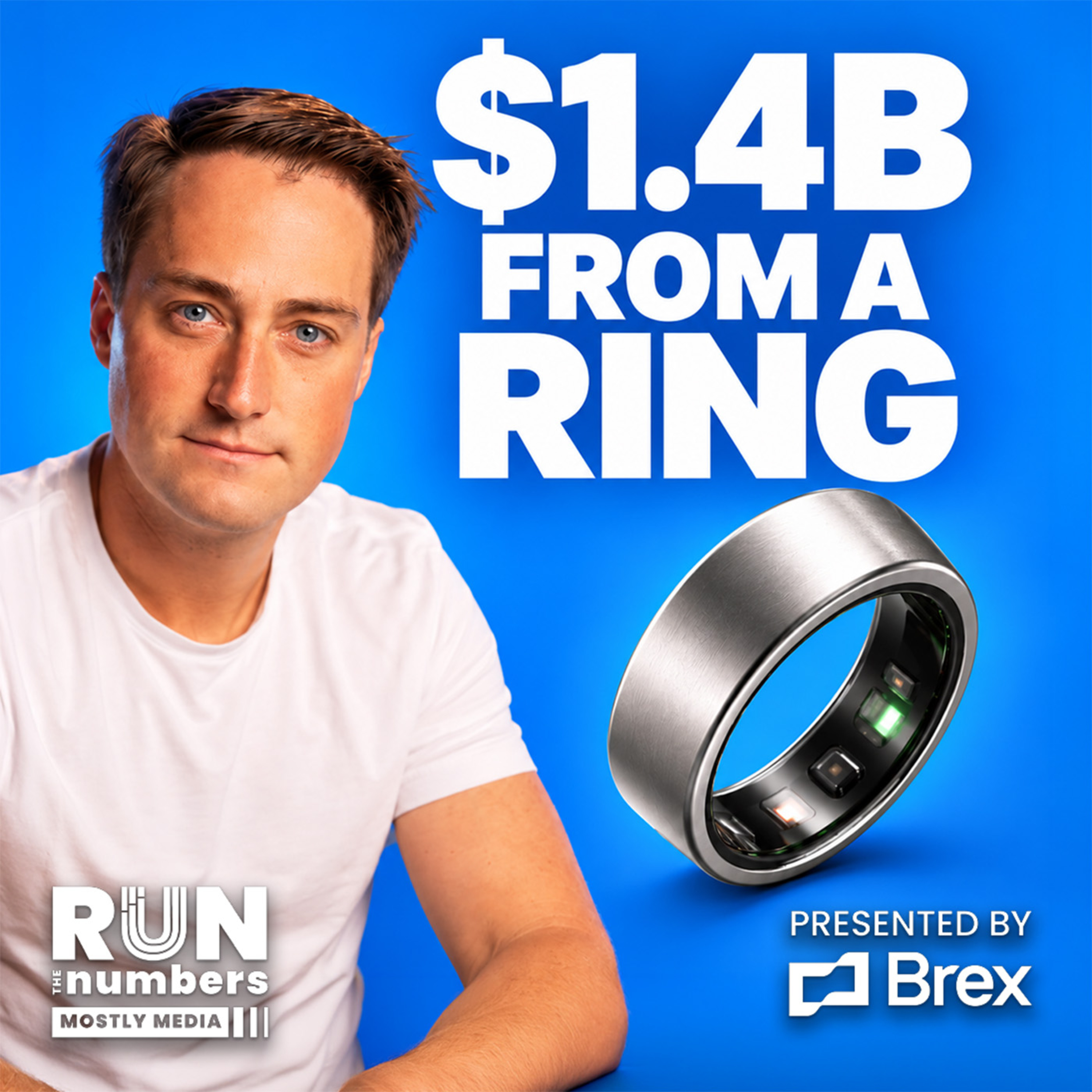
The episode breaks down Aura’s S-1 IPO filing for its Oura Ring (NASDAQ: OURA), explaining how a sensor ring became a $1.4B trailing-12-month business.
Aura’s mission is “empower people to live healthier longer,” and it pairs ring hardware with a subscription membership (about 80% hardware / 20% subscriptions). Notable examples include “sleep debt” tracking and the 30-day trial that converts 94% of activations to paid members. Key metrics: 3.6M rings sold (5M paid members), 74% YoY revenue growth, 55% gross margin (down from 65% due to an $84.4M battery/warranty issue), and 85% 12-month subscription retention. Go-to-market: 8,400 retail doors (Costco, Amazon, Best Buy, Target) plus word-of-mouth (40% of member acquisition). Risks/examples: Samsung ITC patent complaint, sleep-accuracy class action, battery warranty liabilities, customer concentration, single-source suppliers, and tariffs.
none—this is a solo host analysis of the IPO document.
Written by AI. May contain mistakes.
Explore Oura's impressive revenue figures and unique business model.
“And now, despite my obsession with metrics and health, I do not wear one.”
Understand Oura's financial metrics including income, margins, and losses.
“And paid members have grown over 100 % for seven straight quarters, which is a trend you'll have to see.”
Learn about Oura's subscription model and customer retention rates.
“So Aura spent nearly 1.2 billion buying stock back from existing holders during the first nine months of the year.”
Get insights into Oura's employee distribution and operational effectiveness.
“Every decision a company makes is inherently a financial decision.”
Delve into Oura's product development and market penetration strategies.
“At its core, Aura is a sensor wrapped around your finger.”
Learn how Aura began with a direct-to-consumer model for growth.
“Direct-to-consumer is how it all started.”
Discover how Aura's retail partnerships enhance its market reach.
“They say retail has played a critical role in supporting product discovery, in-store size and convenience, and availability during periods of peak demand.”
Explore the diverse demographics of Aura's customer base and their needs.
“chunk of growth is coming from people who were not already wearing a Garmin, Fitbit, or Apple Watch.”
Learn about Pulley, a platform for simplifying equity management.
“We'll be right back after a word from our sponsors.”
Examine Aura's aggressive spending on marketing and customer acquisition.
“The ERP category is finally getting disrupted.”
Understand Aura's cash flow and financial stability amid challenges.
“They're already in 56 countries globally, but less than 20 % of hardware revenue comes from outside the United States.”
Identify the potential legal issues and operational risks facing Aura.
“Aura specifically calls out heavier advertising and marketing around Ring 5 in its growing retail footprint.”
Explore Aura's financial strategies and actions taken by shareholders as they prepare for the IPO.
“They used some of the money from Fidelity to do this, actually.”
Learn how Aura's performance stock units (RSUs) work and the tax implications tied to the IPO.
“It raised more than$1 billion of new preferred capital in fiscal 25 while simultaneously using hundreds of millions of dollars to cash out older shareholders.”
Assess Aura's valuation against competitors and the potential market perceptions leading up to the IPO.
“because under GAP, they couldn't treat an IPO as probable until it actually happened.”
Discuss the unique challenges Aura faces in consumer hardware and their strategies for success.
“So, Whoop is probably the closest business model comp.”

Get the gist, explore an idea or ask about something said.
 Claude
On Run the Numbers, what are the key points of this episode?
Searching your listeningAutomatic transcript. May contain errors.
0:00This is the Aura Ring IPO S1 breakdown. So their mission statement, empower people to live healthier longer. That comma there, as AI would say, that's doing a lot of work. So Aura is filed for an IPO. It's going to be on the NASDAQ. It's going to be under ticker O-U-R-A. I guess it wasn't taken. The Finnish-founded health wearable company is making its debut on the backs of triple-digit revenue growth in its last full fiscal year, 2025. A trailing 12-month revenue tally of$1.4 billion in actual gap profitability. And now, despite my obsession with metrics and health, I do not wear one. So I have three kids that are four and under and scientifically confirming that my sleep score is in the toilet would be a mental excuse to phone in a subpar day.
0:59And plus, I already know that my heels hurt from running too much. My liver does not need two Miller lattes a night. And I probably shouldn't have eaten my child's leftover pirate booty at 11 p.m. Sleep debt. Sleep debt refers to the feature in Aura app that shows users how much sleep they have missed over the past two weeks based on their personal sleep. While I don't own one, I am in awe of their highly retentive consumer business model, which pairs hardware with software subscriptions. And it successfully reaches cohorts of customers across a wide variety of gender, age, and income levels, which I'll show you.
1:33So I read all 362 pages this Saturday in between shuttling my kids to birthday parties. And many times I thought of the legendary JP Pruitt. So he's the hand model played by David Duchovny in Zoolander. But why male models?
1:52You serious? I just, I just told you that a moment ago. It's a shame that JP was 25 years too early to make it into this S1, because this document, folks, is literally just like a compilation of hand models. And I want to know what the casting call was like. Did an analyst from Goldman Sachs, their lead left, sit in a nondescript conference room on Kearney Street, reviewing the knuckles and cuticles and deciding whose fingers photograph best in titanium rings. Did they ask about the skin routine? Was there a callback? It puts the lotion on the skin. Okay. Anywho. So key stats here. Revenue, 1.4 billion on a trailing 12 month basis.
2:28That is 74 % year on year growth compared to the prior period. Fiscal year of 2025, they did 908 million of revenue off of 407 million the prior year. That's up 123%. So now you have to break this into hardware versus software subscription revenue. So 80 % of the revenue is hardware revenue. 20 % is recurring subscription revenue. And now the mix has shifted from 83, 17 in fiscal year 2025 as the subscription base increases, which you would expect. In the hardware portion of the business, that's growing 65 % year on year, and the subscription portion is growing 121%. How many rings did they sell last year?
3:06Well, on a trailing 12-month basis, they've sold 3.6 million. And that represents roughly 2 % of the 212 million wearables shipped worldwide. And that stat came from IDC in the S1. Total paid members, 5 million. That was up 100 % year on year. And paid members have grown over 100 % for seven straight quarters, which is a trend you'll have to see. 94 % of ring sales, so the hardware portion, turn into a subscription activation. So someone who pays for it. Revenue per ring,$311 for the first nine months of fiscal 2026. So a lot of the stats in here were very frustratingly quoted on a last nine month basis.
3:44So right now, average per ring is$311. That's actually down from$326 in fiscal 2025 and down again from$332 in fiscal 2024. But for context, Ring 5 launched June 4th and it started at$399 and Ring 4 started at$349. So despite these price increases, they're making less per ring as their direct-to-consumer mix shifts to these retail partners like Costco and Amazon, who will demand some points. Gross margin. So this is both revenue streams. 55%. This is up from 51 % in the prior nine months, but it's actually down from 65 % in fiscal 2024. So you're like, whoa, what happened there? More on this later, there was this battery debacle that caused a big warranty expense that drove this down.
4:31Now, they don't break out the hardware margin, but you can pretty much back into it. So memberships to$241 million in revenue at 89 % margin, which is about$214 million of the$662 million in total gross profit. So some simple math here that leaves$448 million on$974 million of hardware revenue, or roughly 46 % gross margin. And 46 % gross margin on physical objects is actually strong. Apple runs around 37 % on hardware. Now, at a$311 revenue per unit, that's about$143 of gross profit per ring. And they say they pay back their CAC customer acquisition costs on day one. Income from operations,$71 million, a 6 % margin.
5:17It was$60 million in the prior nine months,$45 million in fiscal 2025, and 13 million in fiscal 2024. So the absolute number is getting bigger. Net income of 61 million. So they are legit profitable. But this is a weird one. So they have a net loss attributable to common shareholders of negative 924 million. What? And a loss per share of$89.53. So Aura spent nearly 1.2 billion buying stock back from existing holders during the first nine months of the year. The vast majority of it was preferred stock, which means it was institutional investors. Because they paid substantially more than the accounting carrying value of the preferred, $985 million gets treated as a deemed dividend when calculating the earnings available to common shareholders.
6:03This is purely accounting treatment and not a reflection of their operations. Why do they do this? More on that later too. So a couple more metrics here for you. Adjusted EBITDA,$107 million, which is a 9 % margin, up from$84 million, which was a 12 % margin. So adjusted EBITDA grew in dollars, but margin fell three points from 12 % to 9%. So that incremental growth isn't dropping to the bottom line yet. Cash,$372 million debt of$380 million. $375 million drawn on a$525 million revolver. So they do have a facility. Subscription retention. This is strong. 85 % at 12 months. Retention climbed by cohort.
6:43So it's 81 % in fiscal 23, 85 % in fiscal 24, and 87 % for the fiscal 2025 cohorts. Daily active users to monthly active users. Your DAOs to your mouths. 65%. This is a cool stat. Repeat purchases. So people who go back and buy another ring accounted for 11 % of rings sold for the nine months ended June 30th, 2026, compared to 9 % in fiscal 2025 and 5 % in fiscal 2024. So it's going up and it's good because it means customers will eventually refresh their wardrobe. I've bought multiple Garmin watches over the years. I imagine it's somewhere where after a couple of years, you want to get the newest one.
7:20How many employees do they have? About 1 ,350 spread across 11 countries. They have over 350 people working in hardware and operations. Their headquarters is now in San Francisco. They recently moved it there this year from Finland. but the engineering muscle is still in Helsinki and Oluhu, which I learned is not a place in Hawaii. Revenue per employee is roughly 1.1 million, which is top, that's how being over a million bucks is awesome. Now, the offering size is not solidified yet. Share count price ranges and ownership percentages will be locked in in the coming weeks, but reports have them raising up to$3 billion at a$16 billion valuation.
7:57Who are their bankers? Goldman's Co and Jeffries across 18 banks. So this is a huge syndicate. Hey, thanks for listening. We'll be right back after a word from our sponsors. Every decision a company makes is inherently a financial decision. Folks, I've been trying to tell you that for 300 episodes. So it's wild that most finance teams have to spend a week on what already happened. While my favorite movie is Back to the Future, we'd be living in the past. Speaking of movies, here's a terrible plot. Tired accountant chases down a receipt from March and then polices a$20 Anthropics subscription, starring the accountant Ben Affleck.
8:35So stop living it. You don't have to play defense on what already happened if you get your system sorted. And Brex's intelligent finance platform clears the backward-looking work. Policy enforced at the point of sale, receipts matched instantly, closed short into days, not weeks. What's left is the forward-looking part. Where to deploy capital, how fast you can move, what next quarter actually needs. because the defense is handled by Brex. It's time for finance to go play offense. Throw the ball deep. Thousands of companies, including Anthropic, Coinbase, and DoorDash, already run on Brex. Head to brex.com slash metrics to join them.
9:13That's brex.com slash metrics. Today's episode is brought to you by Anarok, the intelligent tax infrastructure for global commerce. The world be changing. Companies that took five years to go global are doing it in just one. E-invoicing mandates are landing in every major market, and your team is starting the handwork to agents instead of logging into another app. Anarok's platform runs every tax job, and it's the only tax engine with reconciliation built in. Whether you're selling into your first state or your 40th country, Mr. Worldwide, it's all supported by the same platform. One engine, however you reach it.
9:50Agents included. Every tax dollar owed, collected, because Anarok gets the transactions right underneath. Pax stops being an expense and becomes a pastor. AnRock, built for what's next. Learn more at anrock.com slash rtn. Remember when pricing was simple? One product, one subscription, one invoice every month. Those days are over. The AI economy is changing how everything gets bought and sold. We're seeing usage-based pricing, hybrid contracts, and something called a credit. The finance systems built for vanilla subscriptions weren't designed for this. This isn't just a RevRec problem anymore, because outdated revenue architecture can kill a great pricing idea before it ever reaches the market.
10:32RightRev lets you recognize revenue in whatever shape it comes in. Whether you're launching consumption credits or testing entirely new commercial models, RightRev gives finance the flexibility to support whatever pricing model comes next. So product teams can keep on innovating, and finance teams can keep pace. If you're architecting revenue for the AI economy, learn how RightRev can help. Visit rightrev.com slash CJ. That's me. That's rightrev.com slash CJ. What does Aura do? At its core, Aura is a sensor wrapped around your finger. The finger is highly vascularized, which Aura says gives it a signal up to 100x stronger than the wrist.
11:12And with 5 million paying members, that has turned a piece of jewelry into this massive health data set. They're a business model from the S1. We operate an integrated hardware plus software subscription business model that combines hardware sales with a recurring membership to scale adoption while driving durable long-term engagement. So the TLDR on that is Aura sells you a ring that pays back the cost of acquiring you up front, then charges you a subscription for as long as you keep wearing it. For their first six years, they were solely a hardware company. The first Aura ring shipped in 2015, but the subscription didn't launch until October 2021 with Ring 3.
11:47Historically, more than 94 % of ring activations convert to paid members after their initial 30-day trial that comes with it, and roughly 63 % of the new members start on the annual plan, which runs$69.99 a year, so$70, with the remainder starting monthly at$5.99, around$6. Retention is also improved by cohort from roughly 81 % in fiscal 23 to as high as 87 % in the more recent cohorts that they disclosed. Today, subscriptions make up 20 % of total revenue at an 89 % gross margin. The majority of revenue is still hardware, which backs into roughly 46 % gross margin, which I told you before. They charge between$349 and$499 per ring, so call it$350 to$500, depending on which generation and finish you pick.
12:33But after the promos, the channel discounts, and whatever Costco negotiated, or a Clex,$311 per ring. Membership grew 121 % over the nine months against 65 % for hardware, and the mix moved up from 17 % to 20 % subscriptions. They say hardware economics recover customer acquisition costs on day one, after which members enter a highly retentive subscription model. Where the domain comes from. They got strong WOM. That's word of mouth. Our go-to-market strategy is anchored in product-led growth and efficient diversified distribution. During the nine months ended June 30th, 2026, approximately 40 % of members were acquired organically through word of mouth, driven by our passionate member base.
13:12So someone at work wouldn't stop bragging about their sleep score. We complemented this organic demand with an omni-channel approach that combines direct-to-consumer, D2C, with our wholesale channel, which includes our retail and enterprise partners. We are present in approximately 8 ,400 retail doors globally, increasing product discovery and brand awareness. So that organic engine matters because Aura is very much still spending aggressively on marketing. Roughly 21 cents of every revenue dollar currently goes to sales and marketing, even with that 40 % of new members showing up through word of mouth.
13:44Because those billboards ain't cheap. Go-to-market channels. How do they sell this thing off the back of the truck? Well, the business has very much evolved how it does this over time. As our business model has scaled, our go-to-market strategies evolved from an initial focus on D2C distribution to an intentional omni-channel model that integrates D2C and select retail partners. Direct-to-consumer is how it all started. What's great about this channel, other than the margins, is they get first-party data, allowing them to experiment across onboarding, experimentation, and conversion. They say, we initially emphasized D2C distribution in the United States and select European markets to drive, scale, and build direct-to-customer relationships.
14:23Retail is now about half of hardware revenue across roughly 8 ,400 doors. Amazon, Best Buy, Costco, and Target are their major partners. They added 39 retail partners fiscal 2025 and another 70 in just the first three quarters of fiscal 26. So this is a land grab and they're not being subtle about it. They want more distribution partners. And while the margin on hardware sold through these partners is lower, they get distribution and still sell all the subscription plans through their own platform. So Costco might squeeze them on that one-time ring purchase, but it doesn't get a cut of the$70 a year it gets on subscription for the yearly plan.
15:00They say retail has played a critical role in supporting product discovery, in-store size and convenience, and availability during periods of peak demand. Go-to-market partners is basically a euphemism for ways to spend those HSA and FSA dollars. As a health device, it's a smart move to tap into these budgets since buyers can use pre-tax dollars to pay for their ring. It also includes Amex, which gives platinum cardholders up to 200 bucks a year in statement credits toward a ring. So that$400 ring costs you only 200 bucks and Amex will eat the difference. Enterprise, they have an enterprise motion now.
15:34That means they have some quota carrying reps calling on insurers, employers, and government agencies. Signo is an example. They give it away as part of some employer plans and it's covered as a wellness benefit. So in this scenario, your HR department buys the ring for you. So they say, we also reach members through enterprise channels, including employers, government organizations, and healthcare partners and strategic ecosystem partners. Aura really does not want to be called a fitness tracker. So Aura sold 3.6 million rings over the trailing 12 months against roughly 212 million wearables shipped globally or 2 % of global wearable unit shipments.
16:08But that's not the market they want you to use. The number they'd prefer you to use is 90 billion, which they call their serviceable addressable market. It gets there by adding together fitness trackers, health and wellness coaching, digital care management, digital therapeutics, and connected biosensors. So there's about 10 pounds of shit in a five pound bag. The important part is why they're doing it. So Aura does not want to be valued as a fitness tracker. Garmin and Whoop live much closer to that bucket. Aura wants investors to think of it as a preventative health platform that happens to just start with this ring you buy.
16:41And they drop the word preventative 18 times and the word proactive 24 times. And that positioning makes more sense when you look at who's actually buying it, because this is much broader than your typical fitness audience. About 33 % of new members say Aura is their first wearable, while another 29 % say it replaced an existing one. So a meaningful chunk of growth is coming from people who were not already wearing a Garmin, Fitbit, or Apple Watch. And the customer base does not look like the stereotypical biohacker cohort I had in my head. 72 % of members are women. Female members have compounded at roughly 143 % since fiscal 2024 versus 94 % for men.
17:21Cycle tracking, conception, pregnancy, premenopause, and menopause give aura. The sequence of use cases specific to women that can stretch over decades. And that matters because they're not trying to win one workout at a time. They're trying to stay attached to the customer as their health needs change. They don't want you to just wear it when you go to the gym, right? which I do in my Garmin watch. I take it off when I'm done running. Some of the other demographics that surprised me. 37 % of members report household income below 100 grand. So it's not for the mass affluent. 31 % are 29 years or younger.
17:5442 % are 30 to 45. 27 % are 46 plus. 15 % of US members work in healthcare and more than half report at least one chronic condition because it helps them track it. So I did go in expecting Aura to look like this Bay Area status symbol. Like, look at what I'm wearing. I'm so healthy. The customer base though is much broader than that. Hey, thanks for listening. We'll be right back after a word from our sponsors. Hey, founders and finance folks, you know how early on everything is fast and scrappy, and then suddenly equity gets messy. Spreadsheets break, grant docs pile up, lawyers are sending new forms and collecting fees.
18:29It all shows up right about when you're already swamped. Well, if managing your cap table feels like one more frustrating thing on a very long to-do list, you need to know about Pulley. Pulley makes equity management simple and stress-free. You can issue options, model dilution, complete 409As, and more. All in one place with support from real experts when you need it. So if you're raising, hiring, or scaling, Pulley keeps your cap table clean so you can stay focused on building. Not wrangling spreadsheets. Learn more, request a demo at pulley.com slash mostlymetrics. That is p-u-l-l-e-y dot com slash I got news for you.
19:08The ERP category is finally getting disrupted. And if you haven't heard of Realit yet, please pay attention. It's the AI native ERP built specifically to replace NetSuite. And it's already won over hundreds of finance teams. Their mission is to make the zero-day close a reality. And they're actually doing it. We're talking teams closing the books at 1.35 PM on the first day of the month. Companies like Windsurf, Mercore, and hundreds of others run their entire finance stack on Rillit. Revenue recognition, close management, multi-entity, native Stripe, and Salesforce integrations. Woo! Everything a scaling company needs.
19:40They've got 5.0 stars. 5.0, wow. 5.0 stars on G2. They're backed by A16Z and Sequoia. Heard of them. And CPA-led implementations that get you live in 45 days. That is simply unheard of in the ERP space. If your books aren't running as fast as your business, check out Rillit. Book a demo at Rillet.com slash CJ. That is R-I-L-L-E-T dot com slash CJ. That's me. Maximor, get your Maximor here. Sorry, I just came from selling Cracker Jacks at the ballpark. Everyone in finance is adopting AI right now. The problem, it's a dozen disconnected tools. Yeah, one for revenue, one for AP, one for the clothes.
20:22And each one needs training and documentation. And the expertise to run them lives in your head. not the systems. Maximor takes the opposite approach. One autonomous finance platform for the whole operation. Order to cash, procure to pay, the close, cash management, and reporting. It all runs on a unified finance context that pulls from your ERP, billing, banks, even email and slack. No rip and replace. Maximor runs on self-learning agents that learn how your team already works. No prompts to wire, no workflows to build, nothing to document. Every output is audit ready and when a call needs human judgment it escalates for review because the agents optimize not just execute and your kpis keep on improving one pe-backed customer posted 98 of transactions straight to their erp no error rate the other two percent go to a human before posting you pay only for real outcomes, not seats.
21:19See it at Maximor.ai. That is M-A-X-I-M-O-R dot A-I. They are still barely penetrated in these markets. They're already in 56 countries globally, but less than 20 % of hardware revenue comes from outside the United States. Even domestically aided brand awarenesses, which is just a simple survey of have you heard of them before, is only 38 % up from 15 % in an early fiscal 2024. So despite the growth, six out of 10 people in Aura's target audience in the US still have not heard of them. And that is definitely a bull case. Let's talk about that battery problem. So Aura had an$84 million battery problem.
21:58There's this pretty nasty blemish hiding inside their gross margin. In fiscal 2025, Aura recorded an additional $84.4 million of warranty expense because batteries in certain cohorts of the Aura Ring 4 were not performing the way they were supposed to. So basically, customers were getting replacement rings, sometimes even after the normal warranty period had expired because the batteries didn't work well. And that helps explain why gross margin fell from 65 % in 2024 to 52 % in 2025. So as of June 2026, OR was carrying$132 million of accrued warranty liabilities, up from$98 million nine months earlier.
22:34Its reserve for product returns had also more than doubled to$88 million. So that's my balance sheet. The good news is it appears to be getting better. Gross margin recovered to 55 % during the first nine months of 2026, which Aura attributes in part to lower warranty rates and lower manufacturing costs per ring. This is the part of the S1 that reminds you Aura still makes physical shit. I also want to talk about their spend on growth because it's aggressive. Aura is also stepping on the gas pretty hard in sales and marketing. So sales and marketing expense went from$108 million in 2024 to$202 million in 2025.
23:07That's an 87 % increase. And of that increase,$44 million came from paid media and advertising meant to drive customer acquisition and brand awareness with another$17 million tied to retail and distribution expansion. And that spending has continued into 2026, especially around new product launches and the expansion into retail. Aura specifically calls out heavier advertising and marketing around Ring 5 in its growing retail footprint. And this is one of the more interesting tensions in the business because Aura says, hey, 40 % of new members come organically through word of mouth. That's fantastic.
23:40But it also spends heavily to turn itself into a mainstream consumer brand. This does feel a little bit different than a software company dumping money into Google ads to manufacture pipeline. Aura does seem to be trying to make the ring itself culturally ubiquitous. Cash generation. One thing that does look legitimately strong is cash generation. Aura produced 328 million of operating cash flow through the first nine months of 2026, more than double the year before. Although a big chunk of that came from working capital, particularly higher accrued liabilities, deferred revenue, and payables.
24:14A couple of red flags here. Samsung, a competitor of theirs, is asking the ITC to block Aura Ring imports. And Aura owns no factories. So they say in the S1 on December 12, 2025, Samsung Electronics and Samsung Electronics Americas filed a complaint with the ITC, alleging that certain Aura products infringe on patents and seeking relief that could include restrictions on the importation of certain Aura ring products. So the ITC can't award civil damages, but it can block you from importing stuff. And that would be a big problem because Aura assembles nothing. Contract manufacturers build the rings and every unit must clear customs before it reaches that Best Buy shelf.
24:53So Aura's counter to all this is essentially like, dude, We have over 1 ,140 patents. Cut the shit. Another one here. A class action says they falsely advertised their sleep accuracy. So in August 2026, a class action was filed against us alleging that we falsely advertised the accuracy of our sleep tracking technology. You gotta remember that 87 % of members told Aura that accuracy was a reason for buying. So this, that wouldn't be good. Number three, the former CEO is suing the CFO and the board, plus three other parties who want equity. Harpreet Singh Rai ran Aura until December 22. 21, he left.
25:28The dispute here centers on the September 2024 agreement under which Aura repurchased his equity shortly before the company's private valuation moved materially higher. So he's saying you may have known that it was going to be higher and you let me sell at a lower price. That wasn't fair. Also coming after Aura includes none other than Peter Atiyah, who has been on multiple lists lately. He says he was promised stock that he never got. Another potential red flag, two customers of 22 % of revenue, five or 82 % of receivables. They say in the S1, our two largest customers accounted for 12 % and 10 % respectively of our total revenue.
26:02As of June 30th, 2026, five customers accounted for 26, 17, 15, and 12 % and 12 % respectively of our accounts receivable. Okay, well, it's an interesting development for a company that started as direct-to-consumer because receivables sat at$157 million, up from$80 million nine months earlier. So about$129 million of what Aura is owed is concentrated amongst five customers who presumably have a hell of a lot more negotiating leverage than the people buying rings on Aura's dot com website. Number five, no internal manufacturing, single source suppliers and tariffs across six countries. So semiconductors, sensors, batteries, circuit boards and titanium.
26:40These are all critical to making the rings. And many come from suppliers that Aura names as single source, meaning these come from one of these suppliers. They also have tariff exposure across Estonia, Finland, Mexico, South Korea, China, and the Netherlands, including reciprocal tariffs on metals. For context, as part of the normal course of business, they commit to 12-month rolling forecasts with their manufacturers. If they miss low, they eat inventory. If they miss high, they are out of stock. Some good news, though. They get the green light on the following. There are no material weaknesses.
27:08Remember, Cerebris had a ton of those. There's no dual-class stock. SpaceX had that. There's no sponsor holding a majority of shares. That was Cumberland Farms. So they're just kind of being sued by a bunch of people. Let's take a look at the cap table. Like I mentioned, there's one class of common stock, one vote per share, and nobody holds a super voting block, which does make things clean. The plus 5 % holders they list are FMR, which is Fidelity, plus Forerunner Ventures, Bedford Ridge, and Lifeline Ventures out of Helsinki. At the moment, the percentages left here are blank. We just know that they're 5%, so we know who but not how much.
27:43Aura spent a shitload buying back stock recently. So one of the stranger things in the filing is how much liquidity Ora gave existing shareholders right before the IPO. In fiscal 25, the company spent$308 million buying back common and preferred stock. Then, in the first nine months of 26, the pace accelerated dramatically. They used some of the money from Fidelity to do this, actually. In February alone, Ora ran a$534 million tender offer at$40 per share, followed by another$437 million of repurchase signed at prices as high as$56. I was like, why the hell would the shareholder self and IPO was eminent?
28:20Then I checked out the prices. So the prices match here. So Forerunner led Aura Series B, which was issued at a weighted average price of about 77 cents per share in February. Then in February, Aura bought 65 million of their stock back at$40.18 per share, roughly 52X the Series B price. And Forerunner was still a major shareholder after. Remember, they're listed as plus 5%. So it's a pretty easy way to take some chips off the table without giving up your upside completely. The more interesting part, though, is what Ora was doing on the other side. It raised more than$1 billion of new preferred capital in fiscal 25 while simultaneously using hundreds of millions of dollars to cash out older shareholders.
28:59Ora created a massive private liquidity event right before creating what we think will be this public one. My guess, though, is there were these really early investors and employees taking some chips off the table after getting these enormous gains while still keeping plenty of exposure to the IPO. And while we're saying, hey, this IPO looks to be close, they probably weren't as sure in February as they are now in September. And the filing doesn't say why they sold necessarily. But I mean, like 40x, 50x your entry price taking partial liquidity isn't exactly irrational. An interesting point about RSUs for all the CFOs listening.
29:32So Aura has 18.8 million performance stock units sitting out there, and the IPO is about to flip one of the two switches required for those RSUs to vest. So most private company RSUs have two triggers. You have to work there long enough to earn them, and the company has to actually go public. That second condition is important because it keeps employees from getting whacked with a tax bill on private stock that they can't sell. Aura's awards work the same way. The IPO satisfies the liquidity trigger, but that does not mean all 18.8 million shares suddenly just vest. Employees still need to have satisfied the time-based portion of their awards.
30:07The fun accounting part here is Aura hasn't been recording most of the expense associated with these awards because under GAP, they couldn't treat an IPO as probable until it actually happened. As of last September, there was$169 million of stock comp expense sitting there waiting to be recognized. Once the IPO happens, ORA will immediately recognize the accumulated expense of the portion employees have already earned through time served. The rest gets recognized as they finish vesting, right? Then you got taxes, death and taxes. When those shares actually settle their compensation, so employees owe ordinary income tax based on the value of the stock.
30:42ORA plans to withhold some of the shares and use cash to send the associated taxes to the government. That's what they call the RSU net settlement that they mentioned throughout the filing. So they are literally earmarking part of the IPO proceeds for this. The exact dollar amount and assumed withholding rates are still blank in the draft. That's one. Part of the primary IPO proceeds is already spoken for. It's going toward the tax bill created when those awards settle. Valuation. At a reported$16 billion valuation on$1.42 billion of trailing revenue, Aura would go public at roughly 11.3x current sales.
31:17And their last funding round was done at around 11 billion bucks. That was their Series E and then Series E extension. Okay. Initial reports, and once again, the pricing hasn't settled yet on this, are hinting at 16. That would be a decent step up. Who the hell do you compare them to? That's the harder part. So, Whoop is probably the closest business model comp. It also pairs screenless hardware with a recurring subscription, although it skews much more heavily toward fitness. Its latest private financing valued the company at$10.1 billion. Garmin is where you end up if investors decide Aura is mostly a hardware company.
31:55So Garmin trades around 7 times revenue, but it also has a 26 % operating margin, decades of history to look at, and a much broader product portfolio. And then there's Peloton, which is the cautionary tale that nobody from Aura is going to utter on the roadshow. Their hardware plus subscription model looked fantastic until hardware demand stopped growing. That's really the bet here. If Aura gets valued like premium consumer hardware, 11x revenue looks rich. If investors buy the argument that the ring is really just the acquisition channel for a high margin, highly retentive health platform, you can start to understand how they get there.
32:33Some random stuff. They redomiciled this year from Finland to the US. Their fiscal year end is September 30th. That's weird. I couldn't find any cool athletes in this S1. Wupez LeBron and Rory McIlroy. The CEO is not the founder. He actually joined in 2022 and he came from SurveyMonkey most recently. He was also at Adobe. CFO came from Headspace. That's kind of in the health space. They issued a weird$50 million safe to an unnamed investor in June of 2026, right before the filing, probably some strategic partner and their old debt was expensive as hell it was 9.5 stated interest roughly 12 effective plus an 8 back end fee that sucks they refinanced it away in 2025 good for you final take here this is an unusually good consumer hardware business because the hardware itself has attractive gross profit and pays back acquisition at time of purchase while the subscription sits behind an 89 gross margin the catch here is that aura has had real hardware quality problems with the battery stuff in the last couple of years, and it's becoming increasingly exposed to a concentrated retail channel.
33:34It's currently reinvesting almost all of the operating leverage created by its growth back into sales and marketing. Now, none of this is financial advice, informational purposes only. I wrote this post-kids birthday party in a post-Chinese food coma. Run the Numbers is a mostly media production. Yelling an intro by Fat Joe. Artwork by Meg D 'Alessandro. Show is executive produced by Ben Hillman. Nothing said on this podcast is intended to be business or investment advice. It's the sole opinion of me, a guy who feeds his dog way too much ice cream and has a history of net operating losses, LOL.
34:08If you like this podcast, hit subscribe and give us five stars. It will take like two seconds and our algorithm overlords love it. Drink water, call your mom and have a great day. Peace.
How did Oura turn a tiny piece of wearable hardware into a $1.4 billion business? CJ breaks down the numbers behind Oura’s IPO filing and the surprisingly powerful business model hiding behind the ring.
—
SPONSORS:
Brex is an intelligent finance platform with AI-powered workflows that enforce expense policies at the point of sale, match receipts automatically, and reduce month-end close from weeks to hours. Thousands of companies, including Anthropic, Coinbase, and DoorDash, already run on Brex. Stop asking A-level finance talent to do B-level admin work. Learn more at https://www.brex.com/metrics
Anrok is the sales tax platform that watches your exposure everywhere, automates compliance, and flags risk before it turns into a surprise back-tax letter from a state you've never set foot in. Companies like Anthropic, Notion, and Vanta already trust Anrok to stay ahead of rules that move faster than any spreadsheet can. Talk to a sales tax expert for a personalized exposure estimate at https://www.anrok.com/rtn
RightRev is a revenue recognition platform built for the AI economy, helping finance support usage-based pricing, credits, hybrid contracts, seats plus consumption, and whatever commercial model comes next. It gives product teams the freedom to keep innovating without outdated revenue systems slowing them down. Learn how RightRev can help at https://rightrev.com/cj
Pulley is an equity management platform that lets you issue options, model dilution, and complete 409As without your cap table turning into a spreadsheet disaster. Founders raising, hiring, and scaling use Pulley to keep equity clean and stay focused on building. Learn more or request a demo at https://pulley.com/mostlymetrics
Rillet is an AI-native ERP built for modern finance teams that want to replace NetSuite and close faster. With revenue recognition, close management, multi-entity support, and native Stripe and Salesforce integrations, Rillet helps scaling companies run their finance stack in one place. Hundreds of teams, including Windsurf and Mercor, use Rillet to make the zero-day close real. Book a demo at https://www.rillet.com/cj
Maximor is an autonomous finance platform that runs order-to-cash, procure-to-pay, the close, cash management, and reporting on self-learning agents instead of a dozen disconnected tools. One PE-backed customer posts 98% of transactions directly to its ERP, with the remaining 2% routed to a human for review. You pay for outcomes, not seats. See it at https://www.maximor.ai/
EY has been part of Silicon Valley since it was just a valley, helping the most successful names in tech go from startup to exit to megacap. With teams across strategy, tax, audit, and transactions, EY helps you get your financials right early, long before your investors start asking for it. You build the next big thing, and EY will help you build it right. Learn more at https://www.ey.com/techstartups
—
LINKS:
Mostly Talent: https://mostlymetrics.typeform.com/to/cLTxtAsN
CJ: https://www.linkedin.com/in/cj-gustafson-13140948/
Mostly metrics: https://www.mostlymetrics.com
—
TIMESTAMPS:
0:00 Oura Files S1
2:24 Key Revenue Stats
3:35 Revenue Per Ring
4:14 Gross Margin Breakdown
5:31 The Weird $924M "Net Loss"
6:11 Adjusted EBITDA and Cash Position
7:20 Headcount and Bankers
11:01 What Oura Actually Does
13:46 Go-to-Market Channels
15:57 Why Oura Rejects the "Fitness Tracker" Label
16:49 Who's Actually Buying It
21:26 Global Penetration Is Still Low
21:54 The $84M Battery Problem
22:56 Aggressive Growth Spend
24:16 Samsung's Patent Complaint
25:00 The Sleep Accuracy Class Action
25:17 Former CEO Lawsuit
25:52 Customer Concentration Risk
26:31 Supply Chain and Tariff Exposure
27:07 Clean Governance, No Material Weaknesses
27:20 The Cap Table
27:44 Oura's Massive Stock Buybacks
29:29 The RSU Vesting Mechanics
30:34 Tax Withholding on Settlement
31:07 Valuation: $16B at 11x Revenue
31:34 Who Do You Comp Oura To
32:34 Miscellaneous Filing Details
33:14 Final Take