Ask ChatGPT

 Run the Numbers
14 Sep 2026 · 46m · 18 chapters
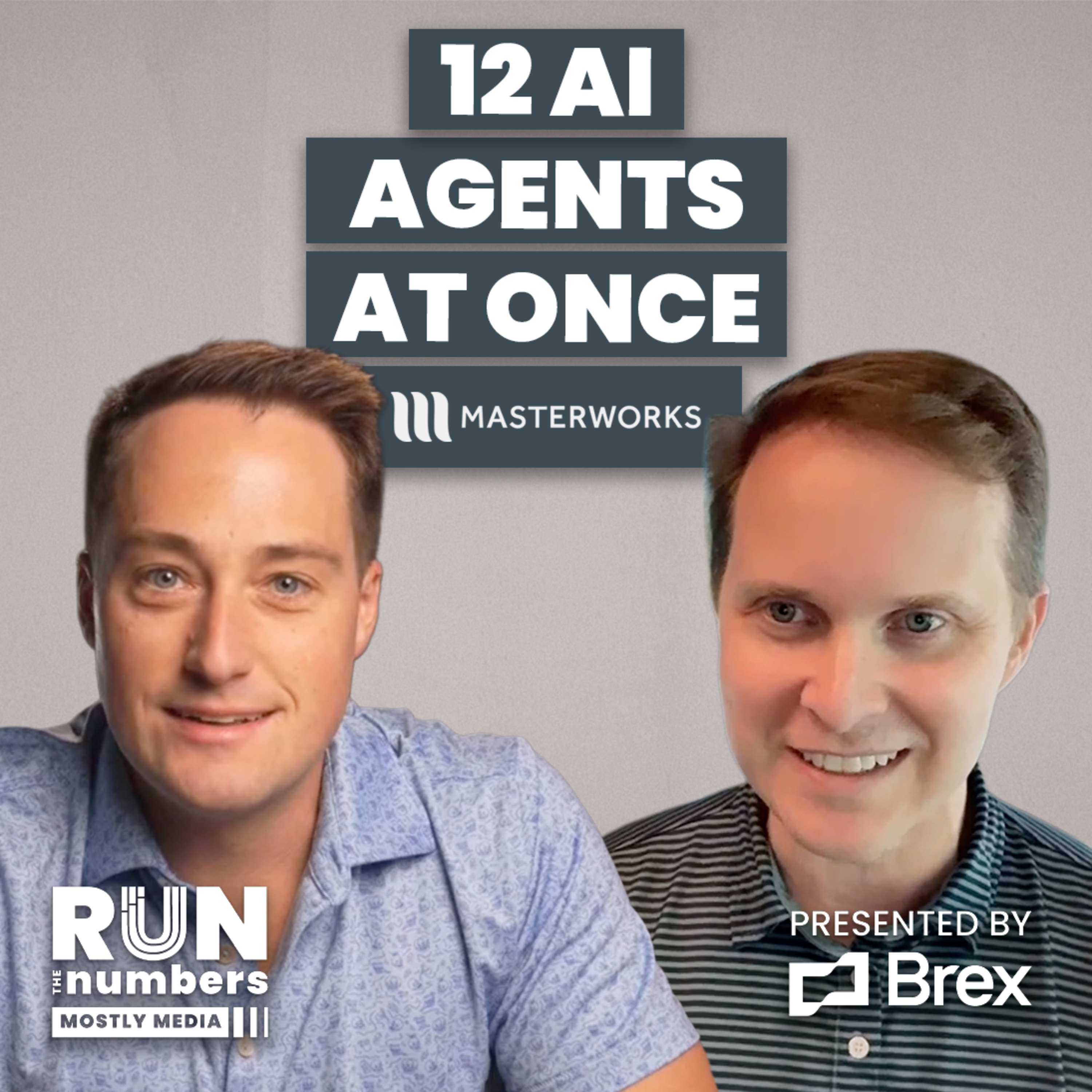
Nigel Glenday (Masterworks CFO/COO) explains how he uses AI agents and “context engineering” to automate finance and operations, arguing AI increases productivity and workload rather than eliminating judgment. He also gives a market update on art investing, emphasizing “death effect” estate sales and that soft prices often reflect fewer high-quality works, not forced selling.
Nigel Glenday is CFO and COO at Masterworks, a platform that securitizes artwork for fractional share investors. CJ (host) is a recovering tech CFO.
AI needs a “map” (engineered business context) to be useful; relevance realization is a core limitation. Best ROI comes from deterministic workflows plus human-in-the-loop. Human taste is required to avoid “AI slop.”
Running 10–12 Claude Code terminal sessions with multiple agents; building a customer service agent by constructing a payments knowledge base; processing ~300,000 K-1s via Alteryx-to-Python pipelines; art examples include Leonard Lauder’s Klimt and Cy Newhouse’s Jackson Pollock selling for about $180M.
Written by AI. May contain mistakes.
Exploring the relationship between AI tools and human memory.
“If we had the same like memory to intelligence ratio as these tools, like we wouldn't be able to remember how to like brush our teeth in the morning.”
Discussion on how Nigel utilizes AI in his daily life and its implications.
“Nigel, my friend, it is so nice to have you back on the Run the Numbers podcast.”
Nigel gives insights on the current state of the art market.
“AI, if anything, it's just, it's operational leverage.”
Analyzing how estates and significant sales impact art market sentiment.
“The recovery in the art market has taken hold.”
Discussion on how AI is changing perceptions of creativity and valuation of art.
“But we have done a ton more, I'd say over the last two years in particular, around events and museum loans around the collection because people want to see and experience these assets, right?”
Discussion on model selection for AI tasks and the importance of context.
“I want to talk about AI use cases because I look at you as someone who's pioneering this AI CFO office.”
Learn how AI models require contextual understanding to interpret and process business data effectively.
“I'll type and speak to these things like a complete Neanderthal.”
Discover the challenges and strategies in creating an effective knowledge base for AI in customer service.
“CFO was building a customer support bot.”
Understanding how to make data accessible efficiently and the role of dashboards in AI applications.
“Nigel, I'm going to ask this in a very non-technical manner, so please bear with me here.”
Explore how AI tools are integrated into financial workflows and their impact on decision-making.
“It just does the thing and it runs on a cron job.”
Nigel shares his setup for using AI agents, highlighting efficiency.
“Nigel, maybe it's a good segue for you to give us a description of what your setup is today.”
Discussion on how to manage multiple AI sessions and tools effectively.
“Yeah, like I've got a zillion tabs open.”
Nigel explains how he enables communication between multiple AI agents.
“across all these sessions, but also has like interagent messaging, right?”
Discussion on processing K-1s and handling financial complexities at Masterworks.
“like by an agent or we need to offshore them or we need to outsource them or maybe some combination combination of all three.”
Insights into leveraging tools like Alteryx and Python for finance tasks.
“is because the muscle memory of actually starting to use code really predated AI.”
Discussion on the essential skills needed for future finance roles in an AI-driven world.
“We had a summer intern that was working with Tofiq, right, who filed all the taxes two months early.”
Explore how tool proficiency and coding knowledge are becoming essential in finance.
“It was like the killer app in the late 1970s that launched the PC revolution, right?”
Discussion on the practical applications of AI in finance and the importance of human oversight.
“I know you've been building a lot, but have you bought any tools for the finance team or anywhere in your remit that use AI that you found especially useful?”

Get the gist, explore an idea or ask about something said.
 Claude
On Run the Numbers, what are the key points of this episode?
Searching your listeningAutomatic transcript. May contain errors.
0:00Nigel Glenday: If we had the same like memory to intelligence ratio as these tools, like we wouldn't be able to remember how to like brush our teeth in the morning. It's so true. They start from a blank slate. These tools need a map. They need a way to understand the world around them. I gave the Masterworks team really an ultimatum. I was like, listen, 80 % of all these like machine tasks we were doing like need to be performed like by an agent or we need to offshore them or we need to outsource them or maybe some combination of all three. values created by addition, by subtraction. You can have AI create as much content as you want.
0:35Nigel Glenday: And it comes back to my point about relevance. It's figuring out what's important. It's surfacing the right context. It's human taste and judgment. Is this thing on?
0:49CJ Gustafson: Yesterday's price is not today's price.
1:00CJ Gustafson: Welcome back to Run the Numbers. My name is CJ. I'm a recovering tech CFO. And today I sit down with one of my best CFO friends, Nigel Glenday, CFO and COO. He's a renaissance man. Over at Masterworks. Nigel has come on the show before. He talked us through the securitization of artwork and how that works. Pretty mind-blowing. You can go back. We'll put that in the show notes. What we go through today is how he is using AI in his daily life. Funny story. I held a dinner in New York City. Nigel got there 10 minutes early. I caught him having a cold beverage at the bar with his computer open and he was running like 10 agents.
1:37CJ Gustafson: Before you know it, me and him are both sitting at the bar and he's walking me through all his workflows. I said, dude, you got to come on the show and talk about how you are building with AI. Masterworks, they really got it unlocked. They have some super technical finance people. He walks us through the evolution of the finance leader role and how accounting and FP &A people are contributing in the world with AI. So you'll enjoy this combo with Nigel. Great guy. Stay tuned. Nigel, my friend, it is so nice to have you back on the Run the Numbers podcast. Hey, CJ. Good to see you. I want people to know how about this AI life you are.
2:11CJ Gustafson: So I come into the dinner that we're having and you beat me there to the restaurant and you're sitting at a high top table. You have your laptop open. You have a cold beverage on the left and you have two Claude terminals running in real time. This was next level stuff.
2:27Nigel Glenday: That started for my like banking days way, way back. I have to lug a laptop. You know, this whole view that AI is going to reduce people's work. I just, I don't see it.
2:36CJ Gustafson: Then me and you get into like a 20 minute demo where you're showing me all the cool stuff that you're doing. We're going to talk about that on the show, but I just wanted to bring it up to people because it's fascinating to your point, how we think that AI is going to take away our jobs. I think like many of us are working harder than we ever have.
2:52Nigel Glenday: AI, if anything, it's just, it's operational leverage. In principle, it should make people more productive, right? You're just able to just produce more output. And I think that your ability to produce more output just creates and raises the expectations of your stakeholders, whether it's like your boss or your customer, for more output. it. So, you know, when I see people lamenting about like, well, what are analysts going to do and what are auditors going to do? I'm like, they're going to do a hundred times more work is what that is. I mean, I had a situation where I built a little model for myself for a project and, you know, cranked out this financial model like an hour or so.
3:27Nigel Glenday: And I said, gosh, you know, if I think back to my like banking analyst days, your MD knew you could crank a model out that quickly. Like, it's not like, hey, go hang out on the beach for the rest of the weekend. It's, I need to see 30 of these on Monday.
3:40CJ Gustafson: Well, we're going to get into the workload and also some of the cool ways that you're leveraging AI. The last time you came on, we nerded out for an hour on the securitization of any sort of asset class. And you're at the forefront of masterworks of securitizing artwork so people can buy fractional shares on it. I just wanted to quickly check in with you. As our resident art expert on the Run the Numbers podcast, what's the state of the art market?
4:04Nigel Glenday: The recovery in the art market has taken hold. So we had an amazing high right around COVID. The market moderated both the AI wave and also just, you know, the fact that the art market just marches to the beat of its own drummer has contributed to, you know, a recovery that started to take hold at the end of last year through the auction sales there and that has continued through this spring. So I think year to date, we've seen the highest auction sales that we have since 2022. One of the things that really drives sentiment within the art market is when big estates come up to sale. And that is, it's not correlated to anything, right?
4:43Nigel Glenday: It's when people pass away and they've got to pay big IRS bills. So we saw that at the end of last year with the Leonard Lauder collection. This is one of the years, the Estee Lauder fortune had a massive Gustav Klimt painting. listeners may kind of recognize it like the Gustav clip has the kiss, which is what everyone recognizes. But when you see things like that, there's just there's a sentiment boost. And I think as the market was much quieter over the last several years, you know, a lot of these biggest states that would pretty much just sit on the sideline. I mean, what's what's interesting about art is that market prices don't really come down in a way because there's no there's no forced sale.
5:19Nigel Glenday: Like if the market is soft, people just don't sell. So sometimes what is perceived to be like a drawdown in prices in the art market is really what you're seeing is just a drawdown in quality. I really think about it just I may connect more with your, you know, the CFO listeners is a lot more like the IPO market where you need management teams that feel good. You've got investment bankers that have a certain read on volatility in the market, you know, and when
5:42CJ Gustafson: and when the stars align, you go for it. Some of the quirks and seasonality remind me of a conversation that I had with Dan Batts. He's the CFO of SoundCloud. So he's fully in the music world. And he was saying when an artist passes away in the music world, they see a spike in their catalog.
5:59Nigel Glenday: In a very like morbid economic sense, right? That's like the supply of art that's created becomes fixed. That supply actually tends to dwindle over time because you get art that gets donated to museums and it pretty much comes off the market. Like a perfect example of this is what we just saw in this past auction sale season after, you know, Cy Newhouse, who was the Condé Nast, passed away, massive art collector, put his Jackson Pollock up for sale. Now, Jackson Pollock, everyone knows the splatter paintings and the Met and all that. Those things just don't come up at auction, right? They're like a dozen of them in private hands.
6:34Nigel Glenday: And they're like all the major ones. But the one that came up was like this eight foot masterpiece sold for a hundred and I think it was close to one hundred and eighty million dollars. There's like interesting economic research about like when the death effect actually happens. Does it happen after someone dies or it happens in anticipation? Oh, wow.
6:53CJ Gustafson: Yeah. It also reminds me in many ways of how people always drop the term. Oh, there's dry powder on the sidelines when it comes to IPOs and how people want to get in on these investments. But if there aren't quality assets that are out there to buy or to invest in, to your point, it doesn't necessarily mean like the market has seen degradation. It just means that there isn't the supply that people want to reach out and write a check for.
7:15Nigel Glenday: If you've got that prized Rothko and you're living with it and the market is slow or whatever, interest rates remove it, you just won't sell it.
7:23CJ Gustafson: So there's no forced sale. There's no margin. Masterworks is in the business of valuing human creativity. At the same time, AI has suddenly made everyone question what creativity is worth. So have those conversations changed how investors think about art?
7:38Nigel Glenday: I mean, this is something that's happening in real time. It certainly has emphasized my continued view on the art market. And I think Mastrox continued view on the art market that, yes, there's a very interesting financial dimension to all of this, right? Art is appreciated over time. It's a large market. It's global. wealth creators across cycles have invariably come to the art market. But at the same time, it's an experiential asset, right? I mean, there's just no argument that standing in front of these paintings is a completely different experience. And Masterworks, you know, historically has done, you know, a lot online and we've got a great app and a lot of ways to different, to learn about the art market.
8:21Nigel Glenday: But we have done a ton more, I'd say over the last two years in particular, around events and museum loans around the collection because people want to see and experience these assets, right? I mean, these are things that all kind of say something about humanity. And I'm totally with you. I think in the age of AI too, where content can just be created just sort of at like zero marginal cost, the value of things that are human curated, human touch to them is only going to create a value.
8:54CJ Gustafson: This may be a weird analog, but I'm thinking about all the millennials and how they're going back to the headphones with the cord, right? They're rejecting the Bluetooth method. I think in many ways we're seeing that with anything that's human-led. People want to kind of rewind the clock to what had more craft to it almost.
9:14Nigel Glenday: It's like I don't want to give my kids an iPhone at the same time, but I don't want to deny them having a camera or access to music.
9:21CJ Gustafson: I started collecting vinyls over the last probably six years, and I hang them in my office, and there's something to be said about that. And part of it is the music that I love, but part of it's also the cover art brings me back to a certain time.
9:33Nigel Glenday: Taylor Swift has made a whole thing of economic research around her business, but her fans all buy the CDs, right? She accounts for most physical CD sales.
9:42CJ Gustafson: Today's episode is brought to you by Anrock, the intelligent tax infrastructure for global commerce. The world be changing. Companies that took five years to go global are doing it in just one. E-invoicing mandates are landing in every major market, and your team is starting to hand work to agents instead of logging into another app. Anarok's platform runs every tax job, and it's the only tax engine with reconciliation built in. Whether you're selling into your first state or your 40th country, Mr. Worldwide, it's all supported by the same platform. One engine, however you reach it. Agents included.
10:16CJ Gustafson: Every tax dollar owed, collected, because Anrock gets the transactions right underneath. Tax stops being an expense and becomes a pass-through. Anrock. Built for what's next. Learn more at anrock.com slash rtn. Remember when pricing was simple? One product, one subscription, one invoice every month. Those days are over. The AI economy is changing how everything gets bought and sold. We're seeing usage-based pricing, hybrid contracts, and something called a credit. The finance systems built for vanilla subscriptions weren't designed for this. This isn't just a RevRec problem anymore, because outdated revenue architecture can kill a great pricing idea before it ever reaches the market.
10:58CJ Gustafson: RightRev lets you recognize revenue in whatever shape it comes in. Whether you're launching consumption credits or testing entirely new commercial models, RightRev gives finance the flexibility to support whatever pricing model comes next. So product teams can keep on innovating and finance teams can keep pace. If you're architecting revenue for the AI economy, learn how RightRev can help. Visit rightrev.com slash CJ. That's me. That's rightrev.com slash CJ. Hey, founders and finance folks, you know how early on everything is fast and scrappy and then suddenly equity gets messy? Spreadsheets break, grant docs pile up, lawyers are sending new forms and collecting fees.
11:38CJ Gustafson: it all shows up right about when you're already swamped. Well, if managing your cap table feels like one more frustrating thing on a very long to-do list, you need to know about Pulley. Pulley makes equity management simple and stress-free. You can issue options, model dilution, complete 409As, and more. All in one place with support from real experts when you need it. So if you're raising, hiring, or scaling, Pulley keeps your cap table clean so you can stay focused on building. Not wrangling spreadsheets. Learn more, request a demo at pulley.com slash mostlymetrics. That is P-U-L-L-E-Y dot com slash mostlymetrics.
12:16CJ Gustafson: I want to talk about AI use cases because I look at you as someone who's pioneering this AI CFO office. Maybe we can just start to talk about, I don't know, maybe model selection here because you've got GPT-5, Claude, Gemini. I've actually heard you argue that the real differentiator is context. Maybe start there. How do you think about when you're choosing the model you'll use versus, hey, I got to load this thing with some context?
12:40Nigel Glenday: I mean, the intelligence capability of all these models is incredible. And I think in large part, they're starting to converge. I wouldn't say they're totally commoditized and we're continuing to see huge leaps in intelligence capability. The difference between these models being kind of useful or not useful is not so much the intelligence, but it's the context you're able to engineer around it. And I saw this just in kind of real life using these tools kind of early in kind of 2022 and 2023. I just found when I would brain dump to them almost in stream of consciousness around whether it's a particular aspect of the business or otherwise, that first of all, that the outputs were just that much more useful.
13:24Nigel Glenday: And you actually realize how fault tolerant they are, too. Right. I mean, I think it's not great for this sort of use of language because I'll go through and barely correct anything. And there's so much context there that these models will basically get the drift of what you're trying to provide it.
13:39CJ Gustafson: I've stopped spellchecking my brain dumps into Claude, which I don't know what that says about me, but I trust for it to make up for it. But at the same time, I have such a high expectation for how grammatically correct and even tonal it'll come back to me. So it's a very different trade.
13:56Nigel Glenday: I'm totally with you as a liberal arts student, someone who cares deeply, deeply about good writing. I'll type and speak to these things like a complete Neanderthal. Forget, you know, correcting spelling. I just won't correct entire sentences and be like, you got my idea.
14:10CJ Gustafson: When you say AI needs context, what context actually matters? You're talking about org charts, process maps, account mappings, historical memos, tribal knowledge. What are you referring to there?
14:22Nigel Glenday: All of it, right? All of what you just described is like the raw material. And so many people are trying to figure this out now, right? Because it's like businesses are just made up on all of these different knowledge artifacts, right? Whether it's, like you said, it's the org chart, it's the spreadsheets, it's the various levels of documentation, it's the things that live in people's heads. And I think what we've seen to date so far is really enterprise search over all of that. All right. Let me hook up Claude. Let me hook up any of these enterprise search tools. I can just map through all of it.
14:54Nigel Glenday: Right. And I can just pull up old documents. Right. It's amazing first step. Right. And the ability to have semantic search and search their emails. It's incredible. Right. But one of the shortcomings of these models, and there was a book called The Blind Spot by Adam Frank, which is which is great. And it touches on LLMs. And one of the shortfalls that LLMs have is called relevance realization. These models, for all their intelligence, right? Remember, they operate purely on language and often that's code, right? So they don't have any other inputs for like lived experience, right? Obviously.
15:27Nigel Glenday: And they have a very hard time teasing out what's important in a business, right? So when I mean context, I'm not just talking about kind of the org charts and the private maps, but how do I shape that into a mental model that I have of the business, right? That then I can share back to any of these LLMs for any task that I'm using, right? So, and I think everyone's had this experience, you know, CJ has this role or CJ does this, or it doesn't understand like this particular aspect of the business. It's because there's some breakdown in the context. It actually may have all of those org charts, right?
16:03Nigel Glenday: It may have all those process maps. It may have the account mappings, but it doesn't understand in an explicit way how all of those things relate to one another, right? In the same way that you and I, when we think about a business, is really ultimately a network, right? It's a network of relationships and concepts, right? And these models, when they try and ingest all of this data, I think they're very good. They're very, very good, right? But they have to sort of figure out all of these relationships on the fly. So when I say like AI needs context, again, it's not about just shoving a bunch of documents at it, which is definitely a first step.
16:39Nigel Glenday: But how do I basically curate and validate and make sure the world that this model understands actually matches how I understand it?
16:50CJ Gustafson: I had this weird moment where I was trying to come up with this workflow for something we were doing within the media company. And then it said, and then you can pass this off to Callie. Callie runs recruiting on our team. I had this moment. I was like, holy shit. It actually remembered somebody in the team from like a prior chat and just brought her out of nowhere. But I was like, Callie doesn't work on what you're telling me to give her. Like, it'd be weird if I asked her to do that task. It was this uncanny thing where like it understood the org to a certain extent, but didn't understand the specificities of what somebody does at day to day.
17:20Nigel Glenday: I always think about it's just like the ratio of like intelligence to memory. If we had the same like memory to intelligence ratio as these tools, like we wouldn't be able to remember how to like brush our teeth in the morning. It's so true. So they have to, you know, they start from a blank slate. These tools need a map. They need a way to understand the world around them.
17:43CJ Gustafson: It is funny, too, because we've been running orgs for how long has Masterworks been around, for example?
17:49Nigel Glenday: Boyd, founded in 2017.
17:51CJ Gustafson: Okay. And you didn't start out in 2017 saying, let's make sure all our data can be easily digestible by AI.
17:58Nigel Glenday: That is the work that so many people are doing now. They're so intelligent, but they're only as useful as the context I can serve up to them. So some people call it like context engineering and you're about context graphs. Another way to think about it is called knowledge modeling. It's just like modeling your financials, right? And why I've always loved spreadsheets is that like I'm an inherently visual thinker. And I think about spreadsheet work is inherently visually about how metrics wire up to each other in creating a business. LLMs need something that's very similar, right? But not just across numbers, but across an entire business.
18:33Nigel Glenday: So how do I get from this number to how CJ actually impacts this number? And what are all the different steps along the way?
18:40CJ Gustafson: A lot of CFOs are asking which AI tool should we buy? Nigel, you seem to be asking how do we encode how the business actually works? Why is that the better question?
18:49Nigel Glenday: The tools are only going to be as useful as the context you're able to engineer around them. And, you know, interestingly, like CFOs are in a really unique position to do this. I think among like any position within the business, they have a 360 view of the enterprise, deeply involved in systems and in systems building. And they're in this position to be able to shape exactly the framing of context for these models. I mean, for example, I've been spending time recently building out a customer service agent for Masterworks. And the exercise there is not in creating a model that can auto-draft emails, right?
19:32Nigel Glenday: That's not the hard part. The hard part is how to actually build a knowledge base that accurately reflects all the things that these models need to know and understand so they can triage through email. They can resolve very basic issues. I mean, that's where the that's where the actual the hard work is now.
19:51CJ Gustafson: We got to pause there. CFO was building a customer support bot. Part of me thinks that AI is making this the best time for someone who's, I don't want to call you a generalist because you're a master of many trades, but you didn't come up in the customer support or customer success world. I think it's giving people the opportunity to be domain experts across a broader array of departments.
20:14Nigel Glenday: I definitely have worn a lot of different hats at Masterworks. I think that the customer service one is interesting because that's an example where the whole challenge is constructing the knowledge base. Masterworks is an investment platform. We are our own fund administrator. We orchestrate all payments coming in and out. So a lot of that context is context that's out of the finance team, right? I just sent in a wire. Where is my wire going to hit? Oh, you just sold a painting, right? When is my payout going to come? Always a huge question that comes up. And Masterworks disperses funds using a number of different rails.
20:49Nigel Glenday: The company's got investors in 130 countries. So we've got these weird edge cases coming up. Like, how do we send 500 bucks to the kid in Moldova who invested in a Kusama? I mean, like, this is real things that come up. And like, how do you teach an agent to resolve all of these? So it actually winds up going back to the team saying like, OK, I know we put this in Notion or I know we put this in confluence at some point and maybe that's stale. So how do we frame all that context? Where does it actually live? That's actually a whole separate issue that I think people are all trying to still figure out in real time now, whether these live in Markdown documents, do these live in something like Notion, do these go in something like a graph database?
21:28Nigel Glenday: I mean, there are a whole bunch of different ways that people are coming at it and there are just different pros and cons, but it's an interesting time for sure.
21:35CJ Gustafson: Nigel, I'm going to ask this in a very non-technical manner, so please bear with me here. I know that it costs a lot of money if you don't cache your data. And let's say you have a chat bot and somebody's asking for the same data or 10 different people are asking for the same different thing. It would be a lot cheaper if it lived somewhere and it was easily accessible. What have you learned about making data available without having to spend a lot of tokens on it?
21:57Nigel Glenday: Dashboards exist for a reason, right? And I think it's not a surprise that one of the first use cases across all businesses have basically just been custom dashboarding. If you just believe that, as I do, the finance function is meant to be a feedback loop to the rest of the business in order for the operation to be able to make good decisions, whether it's like capital allocation decisions, strategic decisions. It's all just about servicing and organizing data, right? Whether that's my operational data, whether it's my P &L, it's sort of like lightweight BI tools or sort of new BI dashboards that are very tuned to like the specific shape of my business.
22:34Nigel Glenday: Those have been like the first initial use case. So in that case, like I don't need the LLM to do something, right? I'm just using the LLM as an enabler to create better analysis, right? Because ultimately the real like initial use case around AI has been as a coding tool, right? It's a really good coding tool. We're sort of still in the early innings figuring out like how good is it at being a financial analyst, right? How good is it being at a customer service agent? What I do know is it's very good as a coding tool so I can use code to basically develop solutions for those workflows or rapidly, the extent to which I actually need the LLM then doing the thing after I build it really depends, right?
23:20Nigel Glenday: And oftentimes the workflows themselves are actually quite deterministic, right? I'm just creating a Python workflow. It just does the thing and it runs on a cron job. But what AI enabled is it just enabled me to build it really quickly. Because I'm the subject matter expert and my team's the subject matter expert. There's like close to the metal on these issues. They just go and they build exactly, exactly what they need. OK, well, then do you actually need an LLM as part of the workflow itself? Well, maybe, but it comes with all those risks that you think, right? They're probabilistic. They make errors, right?
23:53Nigel Glenday: They don't have the right context, et cetera, et cetera. They really need a human in the loop somewhere to be useful.
23:59CJ Gustafson: But that's really the way to think about it. You bring up such a great point because one AI use case that I had is I don't know how to code, but I wanted to find a way for us to figure out when CFOs I know have open positions come up that they're looking to hire for. And so let's say there are 200 websites out there that have these job boards. How would I get an update email every morning that went through and scraped the web and told us, Nigel is hiring for an XYZ. Once again, I don't know how to code that. But if I can use AI to help me create that script, and then I put it in a Google script and Google apps.
24:31CJ Gustafson: I can run that every day, but I don't need to be burning tokens on that cron job, whatever it's running there. That is simply deterministic. So you bring up a really good point that there's no shame in just turning to something that works fine without AI, whether or not you used AI to get to that point.
24:47Nigel Glenday: We in like corporate America is trying to figure out where are the efficiency and the efficiency gains that are going to come from AI? To what extent are agents actually able to replace certain functions, I think it comes down to, again, how well engineered the context around these models could be and how deterministic. You don't want the model to guess who Callie is on your business. When you open one of these sessions, they open from a blank slate. You don't want to just open an org chart document or just give it to Notion and have like, here's a whole brain dump on my business and I want you to fuzzily remember everything.
25:22Nigel Glenday: You want things to be much more deterministic And that's kind of where we're, I mean, that's where I see all this headed.
25:29CJ Gustafson: I got news for you. The ERP category is finally getting disrupted. And if you haven't heard of Realit yet, please pay attention. It's the AI native ERP built specifically to replace NetSuite. And it's already won over hundreds of finance teams. Their mission is to make the zero-day close a reality. And they're actually doing it. We're talking teams closing the books at 1.35 p.m. on the first day of the month. Companies like Windsurf, Mercore, and hundreds of others run their entire finance stack on Realit. Revenue recognition, close management, multi-entity, native Stripe and Salesforce integrations.
26:00CJ Gustafson: Woo! Everything a scaling company needs. They've got 5.0 stars. 5.0. Wow. 5.0 stars on G2. They're backed by A16Z and Sequoia. Heard of them. And CPA-led implementations that get you live in 45 days. That is simply unheard of in the ERP space. If your books aren't running as fast as your business, check out Rillit. Book a demo at Rillit.com slash CJ. That is R-I-L-L-E-T dot com slash CJ. That's me. Maximoor, get your Maximoor here. Sorry, I just came from selling Cracker Jacks at the ballpark. Everyone in finance is adopting AI right now. The problem? It's a dozen disconnected tools. Yeah, one for revenue, one for AP, one for the clothes.
26:44CJ Gustafson: And each one needs training and documentation. And the expertise to run them lives in your head, not the systems. Maximoor takes the opposite approach. one autonomous finance platform for the whole operation. Order to cash, procure to pay, the close, cash management, and reporting. It all runs on a unified finance context that pulls from your ERP, billing, banks, even email and slack. No rip and replace. Maximo runs on self-learning agents that learn how your team already works. No prompts to wire, no workflows to build, nothing to document. Every output is audit ready and when a call needs human judgment, it escalates for review because the agents optimize, not just execute, and your KPIs keep on improving.
27:28CJ Gustafson: One PE-backed customer posted 98 % of transactions straight to their ERP, no error rate. The other 2 % go to a human before posting. You pay only for real outcomes, not seats. See it at Maximor.ai, that is M-A-X-I-M-O-R dot A-I. Every decision a company makes is inherently a financial decision. Folks, I've been trying to tell you that for 300 episodes. So it's wild that most finance teams have to spend a week on what already happened. While my favorite movie is Back to the Future, we'd be living in the past. Speaking of movies, here's a terrible plot. Tired accountant chases down a receipt from March and then polices a$20 Anthropics subscription.
28:11CJ Gustafson: Starring the accountant Ben Affleck. So stop living it. You don't have to play defense on what already happened if you get your system sorted. And Brex's intelligent finance platform clears the backward-looking work. Policy enforced at the point of sale, receipts matched instantly, closed short into days, not weeks. What's left is the forward-looking part. Where to deploy capital, how fast you can move, what next quarter actually needs. Because the defense is handled by Brex. It's time for finance to go play offense. Throw the ball deep! Thousands of companies, including Anthropic, Coinbase, and DoorDash, already run on Brex.
28:48CJ Gustafson: Head to Brax.com slash metrics to join them. That's Brax.com slash metrics. Nigel, maybe it's a good segue for you to give us a description of what your setup is today. So you log into your computer. What do you have open? Because I was looking over your shoulder and I was like, this guy has it down.
29:06Nigel Glenday: I've been entirely in Claude Code. And I know Codex has become very popular as well. But I almost entirely am running off of terminal sessions. And I don't know, you know, other than my like nostalgia for running like MS-DOS in the 1990s, like I actually find the terminal sessions just to be more just faster and more performant than the than the web app. Also, I can run multiple, you know, sessions across different different windows. So where if you're in the web app, a lot of these tools, you're in kind of one window. You might have a it might have a sidebar with all your different chats. If I'm running different sessions, I can have different windows for different sessions that all have like their unique context and like unique functions.
29:49Nigel Glenday: It's really like anywhere from like half a dozen to like a dozen of these separate Cloud Co-Terminal sessions running. And I've had to build a lot of tooling then around that to sort of like orchestrate and just like keep all that organized.
30:02CJ Gustafson: Nigel, that sounds stressful if I had 12 windows open.
30:05Nigel Glenday: Yeah, like I've got a zillion tabs open. I don't know if you've ever heard like command shift A is like the tab search. And I'm just like a hotkey nerd with that kind of thing.
30:13CJ Gustafson: I was today years old when I discovered what that was.
30:16Nigel Glenday: Usually after a while, I just declare tab bankruptcy. It's a little bit of that way with all these cloud code sessions. The trouble I was having is I'd have all these sessions running and they'd be running out of folders, right? So it's kind of like cloud projects, right? But you're running basically out of your local folders. Your local folders might have context that have these different reference files, like everything it needs to like do its task. And you'd launch them out of each folder, but inevitably I'd have to like close my laptop or go do something. And I was like, ah, this is kind of a pain in the neck.
30:45Nigel Glenday: Like I'm going to have to go through these different folders and like launch my like 12 different agents again. I created this simple tool called the A-Team. It was basically just a directory. They hop out of a black van. Yes, they all hop out of a black van. But it's a directory, so I could just pop them open. And ClockCode's been really good for me to discover all these weird little power user tools within Mac OS. My budget agent or something like that, so I'll pop it right open. The new session will open. It'll change the window name so I can navigate around it. So I had to do that so I could just move around all these things.
31:19Nigel Glenday: And as I was using these tools, I had to build just little workflow affordances. because I just realized like I would write something in one agent and I'd be like, well, say I've got an agent that I've set up that's doing like my tasks and my calendar and all that kind of stuff. And I want that agent to basically manage all of that. But I need a way for these things to talk to each other. I call it EA agent, which is kind of like an orchestrator across all these sessions, but also has like interagent messaging, right? Like send a message over to this agent. So like they all have inboxes and it's like very simple.
31:49Nigel Glenday: And I'm sure a bunch of your listeners have maybe used like OpenClaw and Hermes. Someone mentioned me really like, do a lot of these things natively.
31:56CJ Gustafson: Sounds like you created AIM for your agents.
31:58Nigel Glenday: Again, there are like frameworks out there that I think do this more natively, but I don't know, it works pretty well. And the tooling stack has become like more simple in a way because if, for example, I need these to keep track of pipeline, for example, if I'm doing like, you know, I've been working recently on a number of new like product launches for Masterworks, right? And we're doing outreach to a whole bunch of like new customer types, right? If I were to manage that type of pipeline, I could manage that in a regular CRM. But I also, there are ways you can just create very lightweight, almost text-based CRMs that give these LLMs like very efficiently a view on like what the state is of like any project you're on.
32:36CJ Gustafson: Was the command line interface or whatever that was encapsulated and it was called ghostly? Yeah. So that's what's called a terminal emulator. People love this tactical stuff though, because they'll go back and they'll Google it or I guess chat GPT it and it may help them unlock what their next workflow is going to be.
32:50Nigel Glenday: You have your normal terminal app in Mac. Ghosty is one of them and there are a handful of others. I think like Ghosty is, you know, written in a programming language that's like particularly performant and then you can customize it to look like any way you want. It can have tabs, all kinds of little like affordances for that. So I found it to be super useful.
33:11CJ Gustafson: And I saw you had a list of the agents I think on the left-hand side. So you had your EA, you had your budgeting agent. What are some of the other agents you've created?
33:20Nigel Glenday: Outreach campaigns for like certain projects we've been working on. Again, budget agents, any type of like document review agent I need, modeling agents who are actually building a new financial model. All of these have like very specific context on the specific project at hand.
33:38CJ Gustafson: I do a ton of work using Claude Projects. I have like 50 of them. And I always am uploading documents. I'm uploading even style guides to try to build out that context. Why is Claude code and not Claude projects become your preferred workflow?
33:52Nigel Glenday: I think it's like the word you just use there is upload. Like, I don't want to like sit there and upload stuff. Last year when we were like talking about our ERP, I gave the Masterworks team really an ultimatum. I was like, listen, what is a machine task? And we need like 80 % of all these like machine tasks we were doing like need to be performed like by an agent or we need to offshore them or we need to outsource them or maybe some combination combination of all three. You know, a lot of the friction was within like some of these like financial like software tools we were using where there was just like an upload stuff, right?
34:24Nigel Glenday: It's like you could do all this stuff, everything all of it. Then someone's got to like upload the CSV and it just like breaks the chain. Interestingly enough that you bring that up, you're going to have users using software and you're going to have agents using software, right? Sometimes these, and I'll go back to this like customer service agent because it's actually like, it's very instructive. One of the folks on the finance team is in charge of all like payments orchestration, right? And a lot of times he's the one that gets asked like, oh, I've got a customer who's like has an inquiry about certain payments, right?
34:52Nigel Glenday: So he creates like a Slack bot automation. You know, these are all like really good and Slack's become like just really a go-to surface to like interact with agents. For a customer service rep to figure out, okay, like where's CJ's payment, blah, blah, blah. As I start to think about constructing an agent, like I need an agent to use that. You've built this like great Slack automation, right? But how is it agent readable at the end of the day? Like is it exposed by an API? Like how can agents consume all these things? So the world of like, where I have to like upload a document, like I'm trying to minimize that.
35:23CJ Gustafson: I want to go to another use case. You got me going here. So I was scrolling LinkedIn and I'm, I'm connected with your controller. And I saw a post about processing something like 300 ,000 K-1s. So my first question is what? My second question is how did you even approach solving that?
35:42Nigel Glenday: Massworks didn't really have a choice, right? So there's particular complexities have arisen with the Massworks business model, right? I mean, Massworks has 500 different paintings, now 530 paintings,$1.3 billion in total assets, right? That are all individually securitized, right? And they all individually go through SEC process. So they have their own financials and are all partnerships. They all have their own K1s to process. And we have trading on top of it. So you may have actually like multiple partners on top of it. So for so many things at Massverse, there just wasn't a off the shelf solution provider for this, right?
36:19Nigel Glenday: And I think it's one of the reasons the Massverse team has like gotten so AI pilled is because the muscle memory of actually starting to use code really predated AI. Because we had these issues like, how on earth are we going to get 300 ,000 K1s out the door? How on earth are we going to generate all of the financial reports that need to be done? How are we going to do all the basic blocking and tackling? And so a lot of that was PyCon code. I think we were really successful in recruiting a team that had great finance, tax, and accounting skill sets, and then paired it with technical skill sets.
36:53Nigel Glenday: You didn't need to hire, you know, software developer, right? But you needed someone who just like was broadly proficient, understood the capabilities and was a fast learner around it. We have people on the team who are in finance, pivoted into software development for a little while and then pivoted back to finance.
37:09CJ Gustafson: And this is why I'm highlighting because I think it's such a great AI use case because it's not like you even had an option to go home and buy something for 300 ,000 K1s.
37:16Nigel Glenday: I'm going to give all the credit to Tophique Elder, who's our controller, because this is really his baby and his brainchild. So I don't want to take any credit for it. What he's done really started with Alteryx workflows, right? Because there are a lot of people that came out of like PwC and some of the big four that understood Alteryx. There's really kind of like a visual data manipulation tool. We built a lot of the workflows of that. Okay. So we like get partner information out of our backend, transform in a variety of different ways, populate the K1s, populate the returns. And the tool stack there was like Alteryx, Python, Thomson Reuters, OneSource.
37:50Nigel Glenday: AI is done, I think, across all these. It's just leveled up the entire thing. So now it's completely Python. And now we can have an intern do it. We had a summer intern that was working with Tofiq, right, who filed all the taxes two months early.
38:03CJ Gustafson: I'm so glad you said that because I've been thinking deeply about if I was to hire somebody who is 22, 23 years old out of college, what skillset would I be looking for them to have so I can arm them with AI and they can be useful?
38:16Nigel Glenday: I've always indexed to it within the masterworks team and generally around high intellectual curiosity. I mean, you just need to learn. You need to be able to learn quickly. And AI tools are great for nothing else, for learning very rapidly. What I would say though, coming to accounting, they're fundamentally coding tools, right? They're engineering tools that are designed by engineers, right? So I think having some base literacy around Python, around SQL is fundamental. I was sitting across from someone at the prior business I was with who was, you know, one of our data analysts and they did everything in R.
38:51Nigel Glenday: And so I sort of just by osmosis was always hearing about sort of R all day long. I picked up a book on R for Excel users. And it was written by, I think it was written by like a former consultant. And it was really like instructor at the time for translating basically all of this, like my mental model of a spreadsheet into the world of code. Okay, this is what a variable is. This is what tables look like. This is what a time series look like. I started to be able to learn these patterns. Wes McKinney was the developer of a data manipulation package in Python called Pandas, right? Which is very well known as basically a way within Python to manipulate time series data.
39:28Nigel Glenday: He built it because he was at a QR at a hedge fund and he saw people just crunching time series in spreadsheets and was like, this is crazy. There's got to be a more efficient way to do this. If I have a whole bunch of data that's like monthly data and I want to resample it so it's yearly data, right? And I want to interpolate the differences, right? If you do that in a spreadsheet, like real pain in the neck, you're using an average formula and you're dragging things, right? That's not even a line of code. That's like one argument in a function. Transposing data is just like, you know, it's dot T in code.
39:59Nigel Glenday: So there's just a lot of things that in a spreadsheet are quite challenging, but then are quite trivial. They don't need to be software engineers, but I think they do need this sort of like basic proficiency around it. Because ultimately, that's what you're looking at with AI to make these like AI workflows really, really work.
40:17CJ Gustafson: I find it hilarious how we're saying that AI is going to get rid of engineers, but at the same time, we need way more people who are kind of like almost quasi engineers. So like these two things can be true.
40:28Nigel Glenday: It's going to create more, more of everything, like just just like more productivity and more work. And people don't want to be sitting on the beach, right? People people want to be like engaged in doing stuff right. So all these like for market prognostications, I think, are are still a bit premature.
40:42CJ Gustafson: Five years from now, what percentage of a great FP &A analyst value do you think will come from their finance knowledge and acumen versus their technical skills like Python and learning how to work with APIs?
40:53Nigel Glenday: I mean, human judgment is not going away, right? With all these things. Just like I said at the beginning, right? Machine tasks have to be either done by machines or you outsource them or otherwise, right? So I want everyone on the Mastorx team or any team that I'm working with to be working at the bleeding edge of the company, right? So if if we're launching a new product or expanding into new division, right? Or we're just trying to keep up with scale. I want people making human decisions at kind of the threshold of the business. That is always going to be the vast majority of the value of really anyone on the team, especially in something like an FB &A.
41:35Nigel Glenday: But frankly, like accounts, there are judgment calls that have to be made across the board. I think technical skills, again, they're just, what are the tools of the trade, right? And how am I going to do that more effectively? Programming languages and coding tools are becoming more and more accessible. I think there is a convergence between finance tools and engineering tools. That may be just a moment where we are, right? Because the spreadsheet is a great abstraction for data manipulation that was designed for non-technical people. It was like the killer app in the late 1970s that launched the PC revolution, right?
42:09Nigel Glenday: It was called VisiCalc at the time. It's the reason anyone bought a PC. It was like, hey, look at this. Look at this thing. Those are all tools at the end of the day. And I think people's tool proficiency will change. And I think coding knowledge will increasingly be a part of that, just as were the spreadsheet and the slide rule before that.
42:27CJ Gustafson: For our next segment, I want to ask some better questions brought to you by our friends at EY. And let me tell you, they think a lot about great questions across enterprise risk, audit, diligence. They're a smart bunch. So I'm going to ask some smarter questions right now. I know you've been building a lot, but have you bought any tools for the finance team or anywhere in your remit that use AI that you found especially useful?
42:51Nigel Glenday: We migrated to Campfire. And that ERP migration was like not on anyone's bingo card. We'd done an ERP migration two years ago. And again, like coming to the story I mentioned, like the ultimatum I gave to the team was like, okay, how do we get to like 80 % of all machine tasks are automated? And the feedback to me was like, hey, Nigel, like we don't need some like fancy agent doing everything. Right. We just need to like get at all of these frictions that are crossing. And a lot of them were these like manual workflows. We had to upload something. Yeah, we had to upload something. We want it straight through processing, all this stuff.
43:26Nigel Glenday: Right. And it was just there was a there was a friction element in that. Right. I think it was the first time that I've ever heard where I had a team that was legitimately excited to do an ERP transition. When we moved over to Campfire, the real value was not only the product they built, which is fantastic, but is something that when you say like AI native, what you really mean is like, can any AI agent talk to it? Does it have like a legible API surface? Does it have an MCP? Can I integrate it into my other like Python workflows? So if I build a script and I build all this context or semantic layer, everyone loves to say no, where it can grab all of that financial data very, very easily.
44:09Nigel Glenday: And I can do that without having to bring in other resources to do it. Don't have to hire a consultant for another$100 ,000. So that was probably the big unlock last year.
44:19CJ Gustafson: Has there been a use case or a task that you're trying to accomplish where you tried to use AI and you said, we actually don't need AI for this? We should just go back to, I don't know, doing this as humans, maybe? I care a lot about great writing.
44:33Nigel Glenday: Recently, a tweet by Brett Taylor, he like laments that like he has to get rid of M dashes out of all of his writing. Really anything that needs my voice, it's really hard to have that come through. I've given Claude and these guys, you know, these tools a lot of examples. They're very competitive and they're really verbose, really verbose. So, I mean, half the time when I ask it to do something, you know, you'll look at it and it'll come back and you're like, bro, it's like, give me 80 % less words.
44:58CJ Gustafson: This guy, Alex Cohen on Twitter had shared this. It says, a slide from our last all hands. I've also started to call out this behavior publicly in Slack channels. Tired of consuming work slop. We don't ship slop here. As a company, we need to get better at not shipping purely AI generated content without out a level of human taste and filtering. AI content is very cheap to create and incredibly expensive to consume. When you create something with AI and pass it to coworkers, you're putting the burden of reviewing the AI on them, not you.
45:30Nigel Glenday: It is 100 % true. And I was listening to a podcast recently and someone who made the point that value is created by, you know, it's addition by subtraction. You can have AI create as much content as you want. And it comes back to my point about relevance. It's figuring out what's important. It's surfacing the right context. And ultimately, it's human taste and judgment.
45:53CJ Gustafson: That's a great place to end. Nigel, it's always a blast to hang out with you, man. You've got a juggernaut here, CJ. Keep it going. You're too kind. Thanks, man.
46:13CJ Gustafson: way too much ice cream and has a history of net operating losses. LOL. If you like this podcast, hit subscribe and give us five stars. It will take like two seconds and our algorithm overlords love it. Drink water, call your mom and have a great day. Peace.
CJ Gustafson sits down with Nigel Glenday, CFO and COO of Masterworks, to talk about how AI is actually changing day-to-day finance work. They cover why context matters more than model choice, how Nigel runs a dozen Claude Code terminal sessions at once, and how his team solved a 300,000 K-1 problem with Python instead of a $300K tool. Plus: a detour into the 2026 art market and what securitizing fine art teaches you about scarcity and pricing power.
—
SPONSORS:
Anrok is the sales tax platform that watches your exposure everywhere, automates compliance, and flags risk before it turns into a surprise back-tax letter from a state you've never set foot in. Companies like Anthropic, Notion, and Vanta already trust Anrok to stay ahead of rules that move faster than any spreadsheet can. Talk to a sales tax expert for a personalized exposure estimate at https://www.anrok.com/rtn
RightRev is a revenue recognition platform built for the AI economy, helping finance support usage-based pricing, credits, hybrid contracts, seats plus consumption, and whatever commercial model comes next. It gives product teams the freedom to keep innovating without outdated revenue systems slowing them down. Learn how RightRev can help at https://rightrev.com/cj
Pulley is an equity management platform that lets you issue options, model dilution, and complete 409As without your cap table turning into a spreadsheet disaster. Founders raising, hiring, and scaling use Pulley to keep equity clean and stay focused on building. Learn more or request a demo at https://pulley.com/mostlymetrics
Rillet is an AI-native ERP built for modern finance teams that want to replace NetSuite and close faster. With revenue recognition, close management, multi-entity support, and native Stripe and Salesforce integrations, Rillet helps scaling companies run their finance stack in one place. Hundreds of teams, including Windsurf and Mercor, use Rillet to make the zero-day close real. Book a demo at https://www.rillet.com/cj
Maximor is an autonomous finance platform that runs order-to-cash, procure-to-pay, the close, cash management, and reporting on self-learning agents instead of a dozen disconnected tools. One PE-backed customer posts 98% of transactions directly to its ERP, with the remaining 2% routed to a human for review. You pay for outcomes, not seats. See it at https://www.maximor.ai/
Brex is an intelligent finance platform that combines corporate cards, built-in expense management, and AI agents to eliminate manual finance work. By automating expense reviews and reconciliations, Brex gives CFOs more time for the high-impact work that drives growth. Join 35,000+ companies like Anthropic, Coinbase, and DoorDash at https://www.brex.com/metrics
EY works with high-growth tech companies to navigate the messy realities of scaling—from regulatory requirements to IPO readiness. By helping teams get it right early and often, EY lets founders stay focused on building while reducing risk as they grow. Learn more at https://www.ey.com/techstartups
—
LINKS:
Mostly Talent: https://mostlymetrics.typeform.com/to/cLTxtAsN
Guest: linkedin.com/in/nglenday
Company: https://www.masterworks.com/
CJ: https://www.linkedin.com/in/cj-gustafson-13140948/
Mostly metrics: https://www.mostlymetrics.com
—
RELATED EPISODES:
Nigel's Previous Episode: https://www.youtube.com/watch?v=zfmqwIzM0P4&t=9s
—
TIMESTAMPS:
2:04 The Dinner Story: AI as Leverage
7:27 AI and the Value of Human-Curated Creativity
12:16 Why Context Beats Intelligence
14:11 What "Context" Actually Means for AI
16:50 Building a Knowledge Map
18:50 Why CFOs Are Uniquely Positioned to Encode Context
21:36 Making Data Cheap to Access
28:55 Claude Code Over the Web App
30:49 Building "The A-Team"
35:24 Solving 300,000 K-1s with AI and Python
42:26 Asking Better Questions Segment
42:50 Adopting Campfire
44:20 When Human Writing Beats AI
#RunTheNumbersPodcast #AIforCFOs #FinanceLeadership #MasterworksArt #ContextEngineering