 Ask ChatGPT



Whether humans can decode whale vocalizations and potentially “communicate” with whales, and what that could mean for conservation.
Emma Bryce, an environment journalist who wrote about scientists decoding whale sounds.
Whale vocalizations may be mapped to contexts/behaviors using machine learning, but researchers avoid calling it “language” because human definitions of language are too narrow.
1970s humpback whale recordings popularized by National Geographic; baby belugas vocalize within an hour of birth and “babble” to mimic mothers, using an “acoustic name tag” (described as like a rusty chainsaw) with individual differences; Project SETI studies sperm whales off Dominica using drones, acoustic tags, and machine learning, finding codas shift with shipping noise and different click sequences for foraging, mating, and migration; humpback males sing complex evolving songs (phrases/themes) while females don’t sing.
Written by AI. May contain mistakes.
Exploring the historical significance and emotional impact of whale vocalizations.
“From The Guardian, I'm Madeleine Finlay, and this is Science Weekly.”
Understanding the various vocalizations of different whale species.
“So we know that the first official whale recording actually comes from 1949, and it was discovered, if I'm not mistaken, earlier this year.”
Insights into how baby belugas communicate and learn vocalizations.
“They sound like castanets kind of going really quickly.”
An overview of Project SETI's research on sperm whale communication.
“but also potentially between different groups as well.”
Discussion on how humpback whales construct and evolve their songs.
“They've also discovered that sperm whales use different types of clicking sounds or clicking sequences when they are foraging, when they are trying to attract mates, when they are migrating, etc.”
Examining the similarities and differences between whale communication and human language.
Explore the similarities and differences between human and whale communication.
“communication does have some similarities.”
Discuss the challenges of interpreting whale vocalizations and the implications of understanding them.
“The lives of whales couldn't be further from our own.”
Reflect on personal questions one might pose to a whale if communication were possible.
“But I think also, to be honest, just wanting to hear a whale describing its ocean environment to me.”
Reflect on personal questions one might pose to a whale if communication were possible.

Get the gist, explore an idea or ask about something said.
 Claude
On Science Weekly, what are the key points of this episode?
Searching your listeningAutomatic transcript. May contain errors.
0:00This is The Guardian.
0:30The impact is felt by everyone. Be a changemaker. Visit tr.com forward slash changemakers. You're either all in on this model or maybe you're building with another. You're either speed or is it security? Or you're AWS AI. Don't pick a side. Pick them all. AWS AI is how.
1:03Imagine if we could understand what animals are saying. It might make us treat them better. For years, scientists have been trying to unpick the intricate songs and calls of whales, and modern technology is bringing them closer. From chatty belugas to singing humpbacks, whale vocalisations could tell us how to better protect these incredible creatures. So today, decoding the whale song. From The Guardian, I'm Madeleine Finlay, and this is Science Weekly.
1:48Emma Bryce, you're an environment journalist, and you've just written about the scientists trying to unpick whale sounds. And I think we're so drawn to whale song because it's so otherworldly and ethereal. But I'd love to know a little bit about the background of our interest in whale vocalisation. I think a lot of it has to do with those famous humpback whale recordings that were made and shared in the 1970s and popularised through the spread of National Geographic magazines. If you listened for a long time, you would hear that the sounds are organised into definite repeating patterns. I actually read recently that that is the most purchased natural environment recording ever made.
2:38So, yeah, obviously that really struck a chord with people.
2:45I think a lot of it has to do with the sort of mournful beauty of those songs. And I have to admit, even when I was writing the story, I had whale song playing in the background for several hours, which really got me through. So, yeah, I think it sort of gives them personality and makes us feel we can connect with them. I think it creates a sense of kinship between humans and whales. And when did it become something that researchers and scientists were interested in trying to decode? So we know that the first official whale recording actually comes from 1949, and it was discovered, if I'm not mistaken, earlier this year.
3:23And that seems to be the first time that humans even realized that whales produced these sounds. And that led to decades after that of research. And so essentially the researchers now looking at whale sound are understanding that acoustic signals could be a way to understand more about these whales and to conserve them and protect them and shield them better against climate change, noise pollution, warming oceans, reduced fisheries, those threats that they now face. And do all whales make vocalisations? And give me a feel for what's in a whale's repertoire. We of course think of the whale song, but what other kinds of sounds are they making?
4:05Yeah, absolutely. So all whales really interestingly do vocalize. Of the singing whales, two that really stand out are humpback whales and bowhead whales. Humpbacks are the sort of maestros of the sort of whale song world. And then bowhead whales produce similar sounding kind of songs, but to my ear at least, it sounds a little harsher. It's almost like a violin's bow kind of scraping against the string. So it's a much more sort of gritty sound. And then you have toothed whales, animals like belugas. They whistle, they trill, they produce these really amazing kind of mewing sounds. They literally sound like cats sometimes.
4:47They sort of chatter amongst themselves.
4:57and then orcas produce I would say sort of louder, harsher sounds. Sometimes they sort of screech and scream and then you've got sperm whales that produce clicking noises. To our ears it sounds really alien, but if you play these recordings, I mean they are incredible, they often sound when the whales are communicating with one another. They sound like castanets kind of going really quickly. It's a really lovely kind of interesting sound to sort of add to that vocal repertoire of whales.
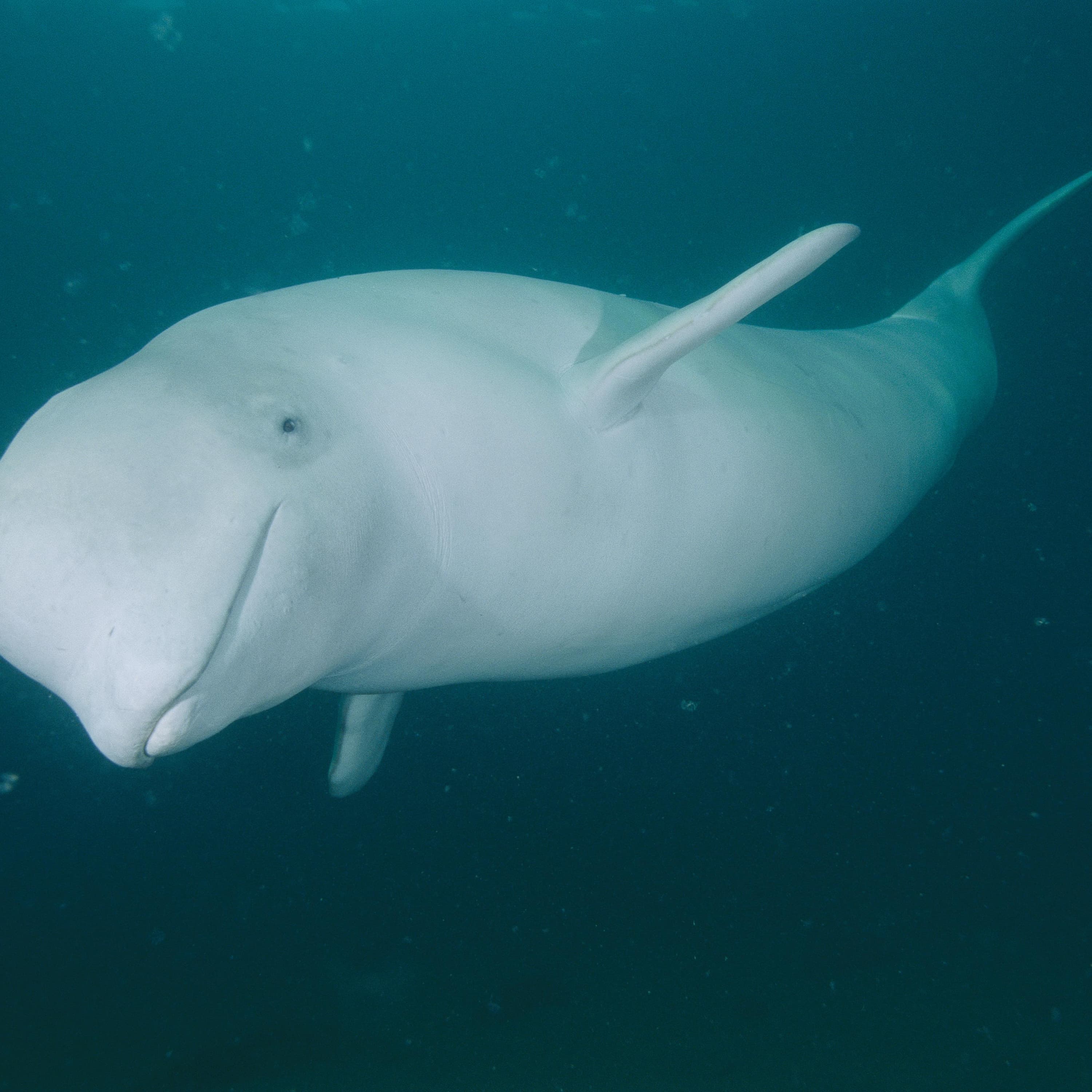
5:53And so, Emma, you've spoken to some of the scientists trying to decode whale sounds. And one of the scientists you spoke to, Valeria Vergara, she made some really charming discoveries about baby belugas during her PhD. Tell me a bit about this work. Oh, this was one of my favourite reporting moments. She discovered during her PhD research that baby belugas, they start vocalizing within the first hour of their birth. So they're really coming out chattering. And she had this really lovely way of describing them. She said they're the real social butterflies of the whale world. They're very loquacious.
6:31They're very chatty animals. And baby belugas learn to speak by babbling, which is kind of very similar to human babies. So they essentially start out trying lots of different sounds and experimenting and messing around. And through that process, they learn to mimic what their parents are saying, their mothers particularly. And that sort of builds up into a very diverse vocal repertoire. They think that some beluga populations have upwards of 50 individual sounds that they use to communicate. And they are described as the canaries of the underwater world because of that sort of constant chattering that they're doing.
7:07I love the idea that these baby belugas are babbling away just like us. But what are some of the things that they first learned to vocalise? Vergara, the researcher I spoke with, she explained to me that some of the first sounds they learned to develop are something that she described as an acoustic name tag. and essentially this is kind of like a self-identification sound that baby belugas learn to make in order to communicate with their mothers but also to tell them where they are and so that their mothers can stay in contact with them. They're really fascinating sounds that are very different to the sounds that belugas make otherwise and the best way I can find to describe it is it sounds like a rusty chainsaw.
8:14And they differ between individuals and that is what a baby will use to say basically, here I am mum, this is me, come and find me. And this concept of an acoustic name tag, it really implies that these vocalisations that all different kinds of species of whale make are really important in their lives, not only among their own pods, but also potentially between different groups as well. and one of the more prominent research groups in the space of whale communication is Project SETI. So who are Project SETI and what are they aiming to do? Yeah, Project SETI is a really interesting group of researchers.
8:57They mainly focus on the sound, vocalisations, communication of a group of sperm whales that live off the coast of Dominica and they have got this kind of long-term goal to sort of decode whale communication, sperm whale communication to understand what they're saying. They're using a raft of different tools to do this. They're using drone technology to attach acoustic monitoring tags to these animals. They are also using machine learning tools to basically listen in on the recordings of sperm whales and to detect patterns and signals in those. and to learn more about what these animals are saying.
9:38And they have made some really interesting discoveries up to this point. So tell me about those. What kinds of things have they found? So one of the things that I find very fascinating that they've discovered is that sperm whales in this particular population off the coast of Dominica, they have a series of clicks that they will make, which is called a coda. that coda will change in its tempo and type when they are in the presence of shipping noise which suggests either that they are using that coda in a different way to communicate more efficiently when they're experiencing sound stress or sound pressure or potentially as the researchers explained to me it might suggest that there's some kind of meaning in that coda and the shift in the pattern and the tempo of the coder implies that they could be trying to communicate something different in the presence of shipping noise.
10:36They've also discovered that sperm whales use different types of clicking sounds or clicking sequences when they are foraging, when they are trying to attract mates, when they are migrating, etc. So tell me a bit more about how different whales construct their communication. You mentioned coders there. How do whales bring these sounds together to potentially communicate with each other? Right. So there are sperm whales, which basically construct these coders out of individual clicks. And then you've got humpback whales. And it's interesting, first of all, to note that male humpbacks are the only ones that sing.
11:18The females don't sing. But the males will construct these hugely complex songs, starting with what's called a phrase, and that is then linked to others to create a theme. And then themes made of many different phrases will be kind of stitched together to compose a song. And not only do all the members of a population learn the same song, but that song evolves all the time. So if they hear a new theme or a new phrase, they will incorporate that into their song. So essentially there's this group of male humpback whales and they're constantly as a group learning a song together and if there's any change introduced by one of them from an neighbouring population for instance they will all learn that song together.
12:08They will all make that change together and learn the new song together.
12:16Coming up, will we ever really understand what Wales is saying? And could we ever talk back?
12:30He looked at me and he said, if something ever happens to me, release the AI. Your husband goes down an AI rabbit hole. How do you pull him out? I just kept asking myself, what is happening? Black Box, The Chatbots, a new series from The Guardian Investigates about the strange things happening between AI and us. All episodes coming soon. Search for Black Box wherever you get your podcasts.
13:02This podcast is brought to you by Thomson Reuters. The best don't just do their work, they change what's possible. Cases won, audits completed, jobs saved. Behind every one of those moments is a professional who needed to get it right and did. Thomson Reuters builds the technology that sharpens insights, speeds up decision-making, and powers the outcomes that matter. So when professionals act, the impact is felt by everyone. Be a changemaker. Visit tr.com forward slash changemakers.
13:37when we're talking about all of this it's really hard not to use human words like speech and language but how much can we compare whale vocalizations to human speech is it fair to say that whales have their own language that's a really interesting question and it kind of gets to an issue that is somewhat controversial in the whale research community, human speech and whale communication does have some similarities. For example, there is research that shows that the structural kind of patterns in human speech, we see some of those appearing in the structure of humpback whale communication. However, the big takeaway I received from several or sort of most of the researchers is that just because there are similarities between two modes of communication does not make them the same thing.
14:33So we can't currently call whale communication language, because our definition of language is drawn up in very human terms, right? So it's quite restricted to what humans can do. However, there is an argument, which is that potentially our goalposts of what languages need to shift in order to accommodate other species. And Project makes the argument that because language is used as such a clear divider between individuals that have legal personhood and have essentially human rights, that we should be able to open up that definition of language in order to incorporate other species so that they too can have something like legal personhood.
15:15Emma, there's a famous philosophical proposition put forward by Ludwig Wittgenstein that says, if a lion could speak, we wouldn't understand him. The lives of whales couldn't be further from our own. So will we ever really be able to decode what whales are saying? I think the question of whether we'll sort of ever really be able to understand precisely what whales are saying is a really tough one to answer. We have machine learning tools now, which are making it really easy to sift through huge data sets and see patterns and also to map particular types of vocalizations onto particular scenarios and contexts and behaviors that whales use, which is giving us an inkling of kind of what they might mean in very broad brushstrokes.
16:06I think there is a question of, should we talk to whales and what would they say to us if we did speak to them? Some researchers would say we don't need to ask whales what they need from us to know what we need to do. So that's not necessarily the purpose of sort of understanding precisely what they're saying. Emma, I've got one more question for you. To put you on the spot, if you could speak to a whale, what would you ask it? I think this is such a tough question because there are loads of things I'd like to ask whales. A little part of me would like to know what they think of us. That might not be so flaccid.
16:45But I think also, to be honest, just wanting to hear a whale describing its ocean environment to me. What is it like to move through the ocean, to experience it? And as someone who loves the ocean, I would love to be able to perceive it from the perspective of a whale.
17:06What a magical thing that would be.
17:13it's been a real pleasure to enter the world of whale song with you emma thank you so much thank you so much for having me i really enjoyed speaking about it thank you my thanks again to emma bryce you can read her article on theguardian.com as part of the seascape series exploring the state of our oceans you can also find a list of the credits for the well audio played in the episode description. And before you go, a reminder that on Thursday the 3rd of September, that's this Thursday at 7pm, Science Weekly is hosting a live event at the London Podcast Festival, which we'd love you to come along to.
17:51To mark the return of The Guardian's chart-topping podcast series, Black Box, I'll be in conversation with science editor Ian Sample and Blackbox host Michael Safi on the topic of season two. How our relationship with chatbots is reshaping our minds. It's going to be a fascinating discussion so to join us you can get your tickets via the link in the episode description.
18:20And that's it for today. This episode was produced by me Madeleine Finlay. The sound design was by Joel Cox, and the executive producer was Ellie Bury. We'll be back on Thursday. See you then.
18:39This is The Guardian.
18:49This podcast is brought to you by Thomson Reuters. The best don't just do their work, They change what's possible. Cases won, audits completed, jobs saved. Behind every one of those moments is a professional who needed to get it right and did. Thomson Reuters builds the technology that sharpens insights, speeds up decision-making, and powers the outcomes that matter. So when professionals act, the impact is felt by everyone. Be a changemaker. Visit tr.com forward slash changemakers. You're either all in on this model or maybe you're building with another. You're either speed or is it security?
19:26Or you're AWS AI. Don't pick a side. Pick them all. AWS AI is how.