Ask ChatGPT


 Science Weekly
13 Aug 2026 · 15m · 8 chapters
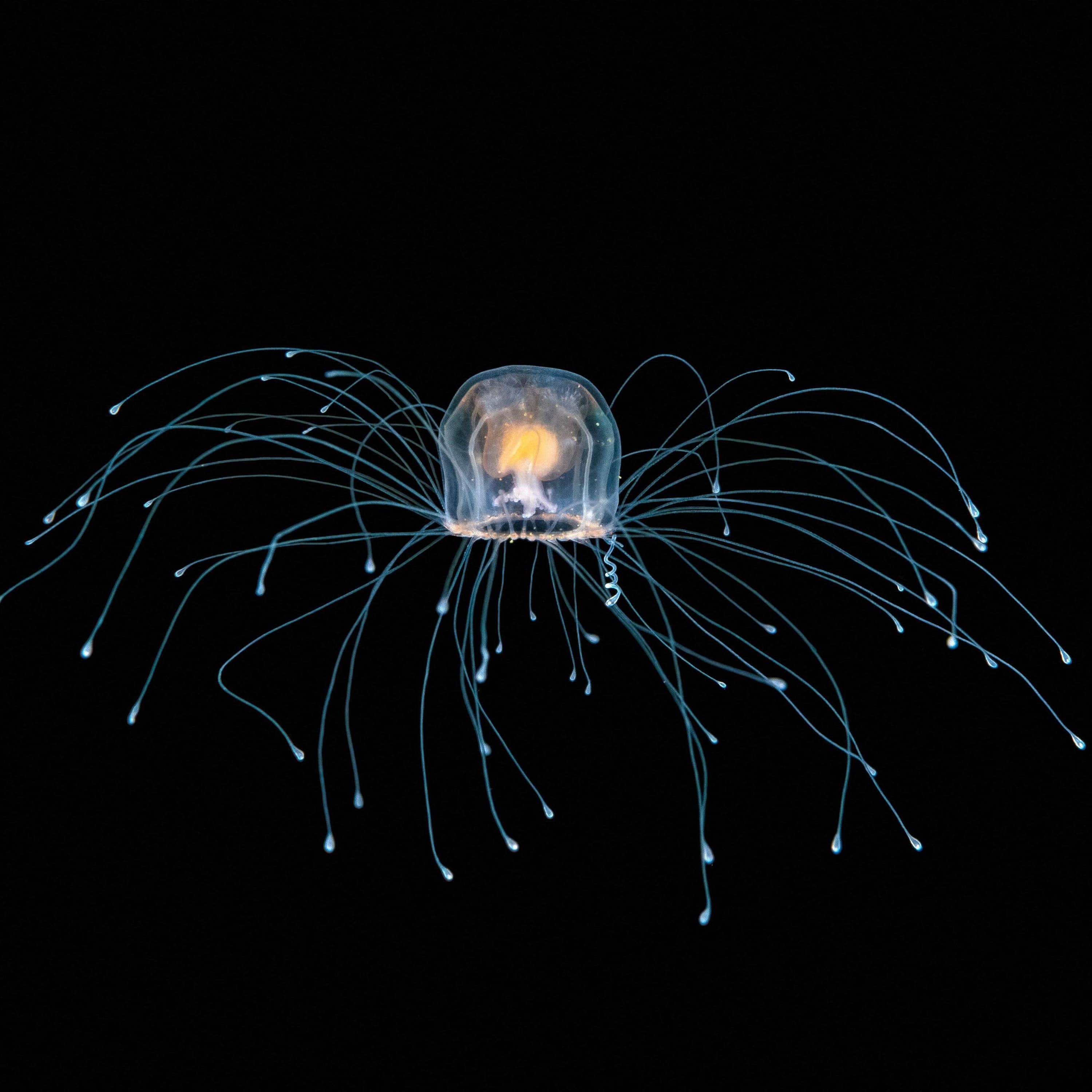
The Guardian Science Weekly discusses its “Invertebrate of the Year” competition and spotlights three nominees: the immortal jellyfish (Turritopsis dorni), the horseshoe crab, and the “leaf sheep” sea slug, arguing invertebrates are vital and underappreciated.
Ian Sample (Guardian Science Editor) hosts. Maddy (producer/host voice) pitches nominees. Petra Stock (Guardian climate and environment reporter) explains the immortal jellyfish. Oliver Millman (Guardian US environment reporter) covers horseshoe crab biology and its human relevance.
Turritopsis dorni can revert from medusa to polyp/juvenile stage after injury or aging, effectively restarting its life cycle. Horseshoe crab blood (LAL) contains clotting immune cells used since the 1970s to test vaccine safety. Leaf sheep (5–10 mm) uses kleptoplasty to steal algae chloroplasts and photosynthesize.
jellyfish “jellygeddon” fears; horseshoe crab “helmet” shape and nine eyes; leaf sheep rhinophores/serata and egg spirals.
Written by AI. May contain mistakes.
Discussion about the unique competition focusing on invertebrates.
“Maddy, Invertebrate of the Year, it is quite an idiosyncratic thing we do, isn't it?”
Exploration of the ecological significance of invertebrates.
“So are you bringing me like a choice selection of the list for this year?”
Introduction to the immortal jellyfish and its unique life cycle.
“But I've got in touch with some Guardian journalists who are going to tell us about their favourites.”
Detailed explanation of how the immortal jellyfish regenerates.
“So these jellyfish can turn themselves back into juveniles and start life all over again?”
Discussion about the horseshoe crab and its evolutionary significance.
“So I'm going to give you a close second to immortality.”
Introduction to the leaf sheep and its unique characteristics.
“coming up could a sea slug that's cute get your vote maddie so it's time for your nomination and something i'd never heard of before has caught your eye.”
Discover why the leaf sheep embodies the spirit of invertebrates.
“I mean, as if, but it's a wonderful idea, isn't it?”
Learn about the nominees for the Invertebrate of the Year competition.
“An immortal jellyfish, the prehistoric horseshoe crab and the very cute leaf sheep.”

Get the gist, explore an idea or ask about something said.
 Claude
On Science Weekly, what are the key points of this episode?
Searching your listeningAutomatic transcript. May contain errors.
0:00Madeleine Finlay: This is The Guardian.
0:13I've become obsessed with this tiny sea slug. It's called a leaf sheep and honestly, if you've never seen one, you have to take a look because you're about to have your mind blown. In fact, I've been thinking about invertebrates a lot lately because The Guardian's running its annual competition, Invertebrate of the Year.
0:41Madeleine Finlay: Find out why Maddy is so enamoured with a sea slug as we chat through the runners and riders. I'm The Guardian Science Editor, Ian Sample, and this is Science Weekly.
0:59Madeleine Finlay: Maddy, Invertebrate of the Year, it is quite an idiosyncratic thing we do, isn't it? Yeah, I would call it unique. It does always raise a lot of eyebrows. I think people find it baffling that The Guardian runs this competition, but there is a good reason why we do it. Now, we're in the third year, so in our inaugural year, it was won by the Common Earthworm. In year two it was won by the tardigrade, this microscopic, seemingly invincible creature that has been described as looking like a piglet wrapped in a blanket. This year hopefully we're going to crown yet another glorious animal. and the reason that I love invertebrate of the year so much is because so often the way that we describe these creatures creepy crawlies bugs beasties so many negative connotations around these creatures and actually they're incredible we should stop being so squeamish about them and in fact us spined creatures make up only five percent of animal life on earth Whereas there are 1.3 million invertebrate species.
2:16So there is enough for us to be astonished by every single day for thousands of years. So I think it's quite right that we admire and honour these creatures that, you know, keep our soils healthy, keep our waters clean, pollinate our plants, keep our ecosystems in balance when we are constantly knocking our environment off course.
2:42Madeleine Finlay: All right. So are you bringing me like a choice selection of the list for this year? I certainly am. So there are 10 excellent nominees, including some wonderful submissions from our readers from across the world. But I'm going to bring you a choice selection and actually I'm going to be very cheeky and pitch one of mine as well. But I've got in touch with some Guardian journalists who are going to tell us about their favourites. First up is climate and environment reporter Petra Stock, who's asking us to consider the immortal jellyfish. As a couple of jellyfishianados have pointed out to me over the years, so much of the media reporting on jellyfish is negative.
3:27They get a lot of bad press, whether it's overhyped fears of a jellygeddon or just beachgoer complaints that they can't swim because a smack has arrived. But jellies are incredible animals. They range in size from teeny tiny ones a few millimetres wide to others that are bigger than us, like the huge lion's mane or Nomura jellyfish. But out of all the nominations we received for jellyfish this year, we really couldn't go past the immortal jellyfish, the Turritopsis dorni, because as one of our readers said, it does exactly what it says on the tin. These are teeny tiny jellies that are a bit smaller than your pinky now, but they've cracked the code to eternal life.
4:23Essentially what happens is when this jellyfish gets old or it gets hurt, instead of just dying like most animals, it actually transforms itself back into a juvenile form and then grows up all over again. You should put in a vote for the immortal jellyfish.
4:45Madeleine Finlay: Hold on Maddy, explain this to me. So these jellyfish can turn themselves back into juveniles and start life all over again? Right. They got there before the longevity bros. You know, humanity has always sought immortality. We've always tried to find ways to escape death. And among us is a creature that has already managed to do it. So the jellyfish, they started out in the Mediterranean, we believe. They're now found all over. And so these tiny, tiny creatures, they're able to, whenever they get old or they get stressed, just say, you know what? Nah, I'm starting again. Now, they can die. They're only immortal in theory.
5:34You know, they can be predated on and things like that. But I'll hand over to Petra to explain the biology of how all this works. This jellyfish was described back in the 1800s. But as I understand it, its immortal abilities were only described by accident by a couple of students who had these jellyfish in a tank in their lab. What happens is most jellyfish and the normal jellyfish will start off life as a larvae and then it turns into a polyp which is like a tiny little stationary body that's sort of a grouped in colonies a bit like coral and then those bud off these sort of mini jellyfish that ultimately become the medusas which is what most of us picture when we think about jellyfish.
6:28Then most jellyfish if they get hurt or they get old they basically eventually crumble a little and die and fall to the bottom of the ocean. What's different with this one is instead of dying, it kind of skips back to that polyp stage and then just starts the whole thing all over again.
6:59Madeleine Finlay: Okay Maddy, you brought me immortality. How are you going to beat that? What comes next? So I'm going to give you a close second to immortality. This is an invertebrate that has barely changed in 450 million years. This thing predates trees. Trees, Ian. So Guardian US environment reporter Oliver Millman is going to tell us about the horseshoe crab. I would say horseshoe crabs easily deserve to be invertebrate of the year because not only are they the ultimate survivors. They are still actively helping humans stay alive today. So you just think about their longevity. These animals have been around for so long that they kind of predate dinosaurs by about 200 million years.
7:53And they look like it. They have a very kind of old-fashioned look about them, which I find quite charming and endearing. They kind of look like a kind of streamlined helmet with a kind of spiky tail. And they form a kind of fearsome defense against predators. If they are flipped onto their back, they do become vulnerable. But that's where their tail comes in. People think that their tail is spiky and is used as a weapon. In fact, it's used to kind of flip them the right way up, which is something like, if I had a robot wars or something, it's kind of quite an ingenious bit of kit that they have there.
8:29They have nine eyes all around their bodies. They have six pairs of legs. Only five of them are used for actually walking. The last pair are used to kind of crush up food like clams and worms and shovel them into their mouths. The other thing is they're not actually crabs. They're actually kind of arthropods that are kind of closer to scorpions and spiders. So this is amazing, right, Ian? but even better these things are actually quite big and Oliver really made me laugh because when I asked about its size he said that you could pick it up and put it on your head like a helmet which I would say is extremely inadvisable you don't want it anywhere near your head I'm sure we should say you should not be touching these animals but there is one thing that is even more mind-blowing about the horseshoe crab their blood incredibly is glue but the important thing about their blood, they have immune cells in this blood that clot around dangerous bacterias that are found in vaccines and other drugs.
9:34So they're really important. Since the 1970s, their blood has been used to test vaccines to ensure they're safe. And so, you know, many thousands of horseshoe crabs have bled out for this task, which is quite a grim thought, but a really important one for us. And we should recognize their sacrifice and the sheer endurance of these creatures by naming them a very worthy invertebrate of the year. Where do I find these things? So they have quite a wide geographical distribution. There are certain hotspots, so the east coast of the US, Mexico, Southeast Asia and India. And what the horseshoe crab does is it goes on to sandy beaches to lay its eggs, so that's where you might find them.
10:20Now, we do degrade a lot of our beaches, so this is a risk that they face in the future. But Oliver did reassure me that these creatures are very good at finding any opportunity for a suitable habitat. And, you know, he made the point that evolution, 450 million years ago, got it right, it's stuck to the plan and it's lasted all this time. And Oliver had no doubt that they will also outlast us.
10:51Madeleine Finlay: coming up could a sea slug that's cute get your vote
11:05Madeleine Finlay: maddie so it's time for your nomination and something i'd never heard of before has caught your eye. I've got to say, Ian, before this competition, I had also never heard of a leaf sheep, nor had I seen one. But now I want everyone to vote for the leaf sheep. The brilliant thing about this sea slug is that it is so, so cute. And sea slugs, you know, the word slug, it's kind of onomatopoeic. You know, these are creatures that are really sort of derided both terrestrial slugs and sea slugs. And I think what the leaf sheep does is that it proves that they do not deserve this reputation. They are helpful and it turns out they can be exceptionally adorable.
11:55Madeleine Finlay: Come on then, what does it look like? Okay, so it's about five to ten millimetres. So it's kind of like a grain of rice in size. And I want you to start out imagining this by picturing a hedgehog. But instead of its head, it has a sort of Disneyfied sheep's head. So I don't know if Sean the sheep means anything to you, Ian, but it kind of looks a bit like Sean the sheep. And it's got these two black beady eyes that are really close together and sort of two blushing cheeks. And it's got what would be the sort of sheep ears. And these are actually called rhinophores. they look like antennae they're chemical sensors for the leaf sheep to kind of make sense of the world the hedgehog part the spikes look more like aloe vera branches and the tips are kind of pink or white or purple and these are called serata and you can find these things in waters around Japan and Indonesia and the Philippines.
12:58They graze like sheep on algae and they even lay their eggs in these like cute little neat spirals. But I haven't even told you the best thing about them.
13:14Madeleine Finlay: And come on then, what is that? So the leaf sheep can perform a trick called kleptoplasty. As the leaf sheep is going around grazing on the algae, they are eating, absorbing, stealing the algae's chloroplasts. Now chloroplasts are the part of an algae that captures sunlight and performs photosynthesis. When the leaf sheep takes these in, it goes into its serrata, the spikes, and the leaf sheep can then perform photosynthesis. This is a solar powered sea slug. That's so impressive. It doesn't get any better than that. I mean, think of it like this. Imagine if you ate lettuce and then you could go outside and re-energise.
14:02Madeleine Finlay: The idea of eating lettuce. I mean, as if, but it's a wonderful idea, isn't it? It's so good. And I think this is why I want people to vote for the leaf sheet, because I think this just totally embodies what the invertebrate of the year competition is all about. It reminds us that all around us there is just such joy and wonder to be found in the natural world. And so vote leaf sheep. Well, there you have it. An immortal jellyfish, the prehistoric horseshoe crab and the very cute leaf sheep. But there are seven others on the list that deserve your consideration. So head over to theguardian.com to see the rest of the nominees for Invertebrate of the Year.
14:50Madeleine Finlay: Voting is open until midnight BST on Sunday the 16th of August. So get over there and pick your winner.
15:01Madeleine Finlay: And that's it for today. This episode was produced by Maddy. It was sound designed by Joel Cox and the executive producer is Ellie Bury. We'll be back on Tuesday. See you then.
15:19This is The Guardian.