Ask ChatGPT


 Science Weekly
18 Aug 2026 · 15m · 7 chapters
The boom in private fossil collecting and celebrity purchases, focusing on how major Jurassic specimens are leaving the UK and harming scientific access.
Nicola Davis, Guardian science correspondent who broke the story about Chris Moore’s Jurassic fossil collection being sold to the Natural History Museum in Abu Dhabi.
Moore’s collection (over 300 specimens, ~190 million years; ichthyosaurs, crustaceans, and others) was offered first to UK museums under non-disclosure agreements, but they lacked funds; it was bought by Abu Dhabi and moved overseas. Even when fossils are loaned, private ownership can block research because journals may reject studies on privately held specimens and access can be withdrawn.
Leonardo DiCaprio, Russell Crowe, Nicolas Cage; Cage’s 2015 dinosaur skull returned after suspicious Mongolian export; Sotheby’s 2024 “Apex” stegosaurus bought by a hedge fund manager and loaned to a US museum; a recent $50.1M T. rex sale.
Written by AI. May contain mistakes.
Discussion on a significant Jurassic fossil collection and its sale to a museum in Abu Dhabi.
“From The Guardian, I'm Madeleine Finlay and this is Science Weekly.”
Exploration of the implications of fossils leaving the UK and concerns from academics.
“So the Dorset Coast is a World Heritage Site, the Jurassic Coast.”
Understanding the codes of conduct in fossil collecting and their implications.
“But in a nutshell, the code of conduct basics is if you follow this code of conduct, what you find, the ownership will be transferred from the landowner to you, the collector.”
Insight into how celebrities are driving the popularity and prices of fossil collecting.
“From my own experience, just of a day down on the beach, you could spend a lot of time not finding anything.”
Discussion on the implications of private fossil collections on scientific research.
“You really need those fossils to be somewhere that scientists can go and look at them and study them.”
Exploration of potential measures to prevent important fossils from leaving the UK.
“And I think it's not straightforward as to how that would necessarily be solved.”
Explore the complexities of fossil ownership and repatriation.

Get the gist, explore an idea or ask about something said.
 Claude
On Science Weekly, what are the key points of this episode?
Searching your listeningAutomatic transcript. May contain errors.
0:00This is The Guardian.
0:14What do Leonardo DiCaprio, Russell Crowe and Nicolas Cage have in common? Apart from being A-list movie stars, they've all spent thousands of dollars on dinosaur fossils. No longer just of interest to museums or special collectors, prehistoric skeletons are going up for auction and selling for record-breaking sums. But what's the appeal of owning the bones of a T-Rex? And what does it mean for the scientists wanting to study them? Today, we explore the boom in fossil collecting. From The Guardian, I'm Madeleine Finlay and this is Science Weekly.
1:08Nicola Davis, your science correspondent, and you recently broke a big story about the sale of one of the UK's most important collections of Jurassic fossils to a museum in Abu Dhabi. So tell me a bit about this collection. This is a collection of fossils. It was made by a private fossil collector called Chris Moore, largely down on the Dorset coast. And from our understanding, it contains over 300 specimens, some of which may be new to science. It includes ichthyosaurs, which are those huge marine reptiles, fish, crustaceans, lots of other kinds of organisms as well. And these date back to about 190 million years.
1:51So this is what was in the waters around what is now the Dorset coast. So it's a quite stunning collection. And indeed, experts have said it's, as you said, one of the finest collections of Jurassic fossils to be found in the UK. And they've been beautifully prepared as well. It sounds absolutely incredible. So tell me what happened. How did it end up leaving the UK? So obviously this fossil collection was made with a lot of work and over a number of years. And as many fossil collectors find, you know, there's a need for a new home for these collections. People want to see their life's work somewhere, probably on display somewhere.
2:28And so what happened was that this collection was offered to two museums. It wasn't offered sort of openly to every museum. It was offered very specifically to two museums and under non-disclosure agreements agreements in the UK Museum World and the Natural History Museum in London but neither of them had the funds to be able to acquire this collection this is what we discovered through some freedom of information requests having offered them to UK museums they were then offered overseas and it was the Natural History Museum in Abu Dhabi that has bought this collection and indeed a large part of it's now on display in Abu Dhabi at present.
3:07And so when your exclusive came out what was the reaction? So it's interesting because I think it's important to note that the collector involved Chris Moore hasn't done anything wrong there's no rules that have been broken here but what happened was that several academics who I spoke to were quite concerned about this really because these are obviously now lost to the UK they're very far away in a museum overseas and that means that you You know, they're out of the context in which they were found. So the Dorset Coast is a World Heritage Site, the Jurassic Coast. It's got wonderful fossils. It's got a fantastic and extensive history.
3:43Mary Anning, the pioneering fossil collectors and dealers, it should be added, was born in Lyme Regis in, I think it was 1799. So just down the road, really. So there's a rich, deep history of fossil collecting, fossil selling. And even now, as I found out, which we can talk about, fossil hunting down on the coast there so these fossils are lost to the UK as a nation they're lost to that locale where they are very much seen in context for some people that's not the end of the world because they are at least in the museum and available to researchers however others have said it's not just one or two fossils it's a whole collection of amazing fossils and there should have been ways to keep it in the UK.
4:27One of the things that I found very surprising about this story was that although these two museums were kind of given first refusal to purchase this collection, the fact that, you know, a private fossil hunter can go out and collect things and that that then can be sold and sold on. And is it always the case that it's kind of finders keepers or maybe find us sellers? That's a really interesting question. Essentially, when it comes to collecting fossils, there are codes of conduct. Now, these are voluntary and different parts of the UK have different codes of conduct and ways of handling this.
5:05But in a nutshell, the code of conduct basics is if you follow this code of conduct, what you find, the ownership will be transferred from the landowner to you, the collector. If you find something loose on the beach, you can just essentially take it home with you. If you find something that's really wow or very exciting then uh you should go and inform the experts and so on and and have it recorded so if you just find a little ammonite whack it in your pocket if you go and find some enormous iciosaur maybe you know you should go and go and inform someone and so there's sort of various things in place there to try to make sure that the big finds are recorded and it very much emphasizes that fossil collectors are really important these fossils are coming out of cliffs which are being eroded by the sea.
5:52And if these fossils are not found and collected, they could just be lost. Then everybody loses out. So there is an acknowledgement that that's really important. And this takes time, it takes effort. From my own experience, just of a day down on the beach, you could spend a lot of time not finding anything. That might just be my lack of expertise. I'm sure people with keener eyes and greater savvy than I would do a much better job. The really big fossils aren't just found loose. They're found in deposits. And so then they need to be prepared, which some of these private collectors, you know, have spent a lot of time developing techniques and the rest of it.
6:25So there's a lot of work involved. And so the codes also recognise that to earn a living, collectors need to be able to sell.
6:42now nicola this story is so much bigger than just this one sale of this collection dinosaur fossils in particular have become really popular with celebrities and millionaires what's going on there? It's not exactly a new thing per se but it certainly is the case that there's big money flying around to the collection we've just been talking about the exact figure has not been disclosed but one source said to me eight figures so that's big money if if that is indeed how much it has actually gone for. Fossils have become a status symbol I suppose in some ways but for private individuals. So who exactly has been snapping them up then so that's interesting so there are some celebrity names that have gone around so there's leonardo dicaprio nicholas cage got into a bidding war over a dinosaur skull which nicholas cage won the the bid but unfortunately um it turned out that this skull had left mongolia under suspicious circumstances and he had to return it that was in 2015 but it's not always celebrities It's not just your film stars.
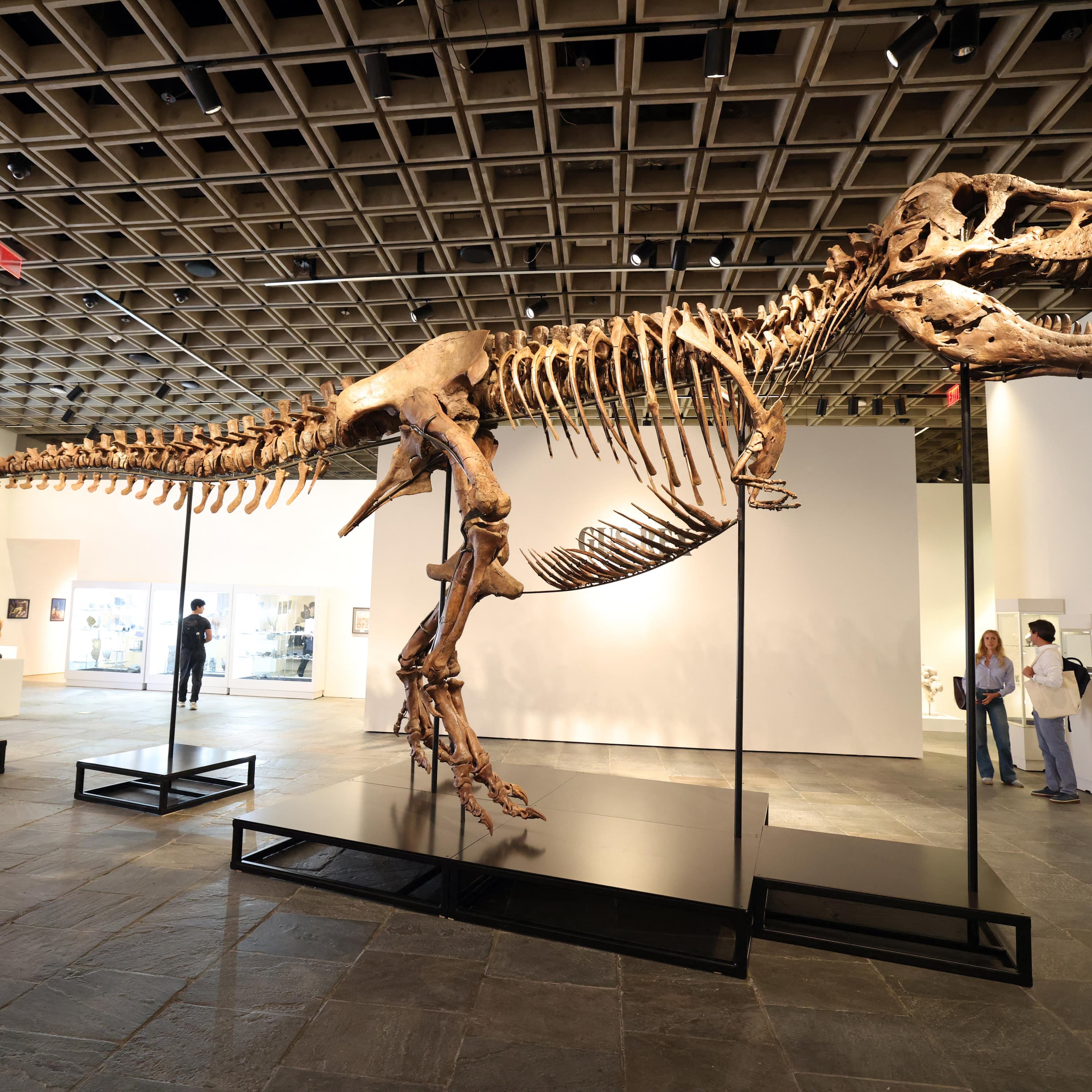
7:55There was a stegosaurus called Apex that was bought at an auction in 2024, I believe, held by Sotheby's. And that was bought by a hedge fund manager who loaned it then to an American museum for four years. And then, of course, very recently we had Gus, an amazing T-Rex that was sold very recently. I think it was 50.1 million dollars, US dollars. a beautiful, incredible object. I mean, objects really, a number of bones involved, but something that definitely is out of the reach for most of us. So when you have this kind of money coming in, what does it mean for the fossil market in general? These are not necessarily sums of money many institutions are going to necessarily have access to.
8:42It means that some museums are just priced out. And that matters because what people might not understand is that if you own a fossil privately, Even if you say, scientists, you're welcome to come, pop over for a cup of tea and look at my fossils. The problem is that a lot of journals won't accept studies based on privately owned fossils. And that's for a good reason, which is that the whole point about science is that other people should be able to come, make their own measurements, test your conclusions. And if it's in a private collection, that invitation to come and study, it could be withdrawn at any point.
9:19It's not just accessible on the same grounds to everybody. And that means that that scientific process could be jeopardised. When fossils end up in private collections, even if they're loaned to a museum, that's still a problem because that loan could be retracted. Especially if you've got spectacular fossils, if you've got fossils of new species, things like that, where there is a scientific interest. You really need those fossils to be somewhere that scientists can go and look at them and study them. And what does it mean for the interest in fossil hunting? I mean, I'd love to know more about your trip to the Jurassic Coast.
9:54Do you see yourself getting into this and going out hunting fossils? Yeah, it's extremely addictive. I had a fantastic guide who really was amazing. He was very good at helping us, myself and the photographer that came with me, I should say, to understand what we were looking for about the colours and shapes and textures. And so when you're looking down, you're keeping those in your head so that you're kind of really scanning for that unusual item. And I was able to find a few ammonites and beautiful iron and pyrite ammonites and some bellomite fossils. These are like kind of squid like creatures and some fossilized wood and some fossilized sponges.
10:31So we found some very exciting different things. You've got quite a good haul there, Nicola. None of them would end up in a museum, but they are very excited to hold in your hand something that, you know, is the relic of something that lived 190 million years ago. And I think that what's existing here is a tension, a tension between the need for there to be fossil hunters and a need for scientists to be able to access those specimens and be able to study them. And I think it's not straightforward as to how that would necessarily be solved.
11:10Coming up, once fossils have been found, how can we stop them disappearing again?
11:25This podcast is brought to you by Thomson Reuters. The best don't just do their work, they change what's possible. Cases won, audits completed, jobs saved. Behind every one of those moments is a professional who needed to get it right, and did. Thomson Reuters builds the technology that sharpens insights, speeds up decision-making, and powers the outcomes that matter. So when professionals act, the impact is felt by everyone. Be a changemaker. Visit tr.com forward slash changemakers.
12:03Nicola, is there anything that we can do to stop important fossils like the ones in Chris Moore's collection from leaving the UK or going into private hands? That's a really interesting question and certainly there are countries around the world who are looking at that. I think it's important to note obviously that the UK has fossils from lots of other countries as well. It's not like we only have our own fossils in our collections. And indeed, the Natural History Museum in Abu Dhabi have said to tell the story of the world's past, you need sort of fossils from all over the place. You can't just sort of have one set.
12:37However, at the moment, what's really interesting is that there is a situation where if you had, for example, some sort of antiquity or beautiful painting or something that was deemed to be really significant to the nation, that can under a set of criteria basically be deemed to be a national treasure and a temporary export bank be placed on it and that means that it has to be offered to UK institutions and they have to be given an opportunity to bid for it and if they don't stump up the funds then it can be sold overseas but that doesn't include fossils so at the moment fossils don't really have any exports, license is required.
13:18And there's now been a move to try to get the government to change the rules. So the Lyme Regis Museum and people associated with it have written to their local MP, who's written on to the Department of Culture, Media and Sport, to ask for a change to export licenses. It's not about stopping the sale or preventing every fossil from being sold. I think that's important to say this is not not that i think there's just uh some people are hoping that there could be more checks and balances so that the biggest and most important things can be kept here and indeed there are efforts underfoot from some countries so for example brazil and mongolia if you find a fossil there now that belongs to the state and it's very difficult to export that and there have been cases of fossils being repatriated back to those countries that have been found to have been essentially smuggled and sold abroad so countries are taking different approaches particularly you know the global south a lot of fossils were found and were then just taken and sold and obviously that again is about sort of that cultural heritage and and who owns those fossils so again i think that there are questions not just in the uk but around the world about how do you handle this?
14:40Well, Nicola, thank you so much. And I look forward to hearing about you finding some kind of special specimen. Who knows? I hope to return one day and have another comb of the beach. Thanks again to Nicola Davis. You can find all her reporting at theguardian.com.
15:04And that's all from us today. This episode was produced by me, Madeleine Finlay. The sound design was by Joel Cox. And the executive producer was Ellie Bury. We'll be back on Thursday. See you then.