Ask ChatGPT

 Search with Candour
19 Oct 2026 · 57m · 19 chapters
State of AI search in 2026 and how “AI SEO/GEO” differs from traditional SEO—especially citations vs rankings, fragmentation across AI platforms, and whether AI-written content performs differently.
Nathan Gotch, co-founder of Rankability; SEO entrepreneur and author of The SEO Entrepreneur and AI SEO for Dummies. Background includes building a seven-figure SEO agency after being fired from a security guard; known for reaching millions of marketers via YouTube, podcasts, social, and speaking.
ChatGPT citations correlate poorly with Google/Bing/Brave rankings (evidence suggests OpenAI uses its own search index). AI search demand grew ~3.6x (2023–2026) while SEO demand dropped ~30% over the last year. AI platforms are fragmented: no pair shares more than 24.1% of cited pages. AI vs human content showed no clear performance difference in his expensive detection study.
“Best AEO books” citations can come from low-authority sites because AI fills inventory gaps; once bigger sites cover the topic, those weak citations can disappear. Exact-match title coverage is rare: only 4.8% of AI citations had the complete query in the title tag. Outreach strategy: extract 500–1,000 citation opportunities across AI platforms, then do one-by-one outreach. Actionable tip: prioritize reviews (Google Business Profile for local; Yelp for ChatGPT).
Written by AI. May contain mistakes.
Nathan shares his backstory from a security guard to an SEO expert.
“I am Jack Chambers-Ward, I am your host as always, and this is episode two of season five.”
Discussion on the methodology behind the SEO data analysis and findings.
“He is the co-founder of Rankability as well as the author of The SEO Entrepreneur and his brand new book, which is available now, AI SEO for Dummies.”
Exploring the correlation between being cited in AI platforms and traditional search rankings.
“So, you know, I'm in a very privileged position because of rankability, so I'm able to get a lot of data.”
Nathan shares strategies for optimizing content for AI search engines.
“And there wasn't really, there was really no, no, no obvious clear differences.”
Explore the differences between AI SEO and traditional SEO strategies.
“And so that's going deeper in the funnel.”
Discuss the shifting landscape of SEO terminologies and their implications.
“It picks it up real fast when it senses something's going down.”
Analyze the current market demand for AI search and how agencies should pivot.
“But then also a 30 % drop in SEO demand over the last year.”
Discover how SEO practices have changed with the advent of AI and what that means for strategies.
“You can't have SEO and have a, there's no way you could do that because otherwise you'd be like not doing the full job of either.”
Learn how a simple SEO strategy achieved long-term success without traditional elements like reviews.
“And all I did was I built one page and I slammed it with links.”
Explore the changing landscape of how authority is measured in AI search versus traditional search.
“And then one in four AI-sited pages came from a domain with DR below 40.”
Understand the peculiar dynamics of AI citations and their implications for SEO.
“So it's a really strong website, quote unquote, by third-party metrics.”
Discuss the potential future interplay between AI search mechanisms and traditional SEO practices.
“I think what I'm finding is the URLs that are getting retrieved that are low authority.”
Examine the quality of citations in AI search and how it affects SEO strategies.
“And like you said, you get the citations, but you're not appearing in traditional search.”
Learn effective outreach strategies for SEO in the evolving landscape of AI search.
“I mean, I guess one thing that I have observed is the AI citations, pure AI citations, not the ones that rank in both, like appear in both, just like they only are cited by AI and they're invisible in search.”
Discussing how AI citations are related to title tags and the importance of semantic relevance.
“One last data point I want to get to, I think that kind of stood out to me was the only 4.8 % of AI citations came from pages with the complete query in the title tag.”
Nathan shares essential tips for enhancing online visibility through reviews and citations.
“But in general, I don't think you need to be so rigid about how you do it.”
Exploring various tools and methodologies for optimizing SEO tasks and analytics.
“at least on the priority list to focus on.”
Nathan discusses his recent enjoyment of a movie and shares thoughts on Christopher Nolan's works.
“attribution, please, for the love of God, do it today.”
Nathan provides information on where to find his book and online content, followed by show closure.
“I mean, I did see the Odyssey twice in theaters.”

Get the gist, explore an idea or ask about something said.
 Claude
On Search with Candour, what are the key points of this episode?
Searching your listeningAutomatic transcript. May contain errors.
0:00Nathan Gotch: How much has the demand for GEO and AI search optimization services grown in the last year? And has that affected the demand for SEO services? And how much crossover is there between the citations and rankings and the things that are being mentioned in the different AI platforms? I'm joined by Nathan Gotch this week, and we're getting into the state of AI search as of 2026.
0:23Candour: One thing I was really looking at is if you're cited in Chack GPT, how does that correlate with your position in a traditional search engine? And I don't know if you guys have done like deep AI detection across pages, but it gets really expensive, super expensive. So we ran a ton and basically we're trying to see, is there any advantage or disadvantage of using AI content versus using human content? And there wasn't really, there was really no obvious clear differences. All I've been trying to tell people is just don't go against the tide. If the market keeps telling you over and over, they want ChatGPT, even though it's a lot of the same stuff, it doesn't matter.
1:05Candour: You should still sell what they want. And so that's why for me, I'm just like, let's just throw the kitchen sink at this. That is my strategy. And what we do, it's stupidly simple. We just run tons of prompts for the category we want to win. We extract all the citations across every AI platform. And what ends up happening is we'll de-dupe them. And then we end up with a list of 500 to 1 ,000 opportunities in that particular category. And this is the crazy part. We just start doing outreach. Just start doing it one by one. I don't even know if what I'm doing anymore is even SEO.
1:47Nathan Gotch: Hello and welcome to this week's episode of Search with Candor. I am Jack Chambers-Ward, I am your host as always, and this is episode two of season five. We're getting into more AI search and geo discussion, and this week I am joined by the one and only Nathan Gotch to really get a broad scope of what is happening in AI search right now. The team at Rankability and Nathan did a really interesting study. We'll get into a lot of data from that about what is happening with various different chat GPT and various different AI mode and all this kind of stuff. How they cross over with each other, what demand and what shifts have been happening in terms of the search landscape.
2:27Nathan Gotch: It's a really nice setting the groundwork for a lot of what is going to happen over the next few months for the rest of the season as well. If you're not already, please do, of course, subscribe on YouTube, follow on Spotify, and leave us comments. Let me know who you would like to see on this season. Like I said, we're focusing on AI search and GEO, so please do let me know if there are any experts, any particular people you'd like to see on the show. I've already got the next four episodes recorded and a few more episodes lined up as well with some fantastic guests. So there's going to be some great conversations and great interviews over the next few weeks.
3:03Nathan Gotch: But yeah, let me know in the comments if you have any feedback. If you wanna see anybody in particular, join me on the podcast. And of course, like I said, like and subscribe and all the usual stuff that helps spread the word and share the podcast around. I really, really appreciate anybody who leaves comments and likes and lets me know if they're enjoying the podcast. So without any further ado, let's get into my conversation with Nathan Gotch all about the state of AI search in 2026.
3:34Nathan Gotch: Today's guest went from getting fired as a security guard to building a seven figure SEO agency and becoming one of the most prominent voices in SEO, reaching millions of marketers around the world through his YouTube channel, podcasts, social media, and speaking at conferences around the world. He is the co-founder of Rankability as well as the author of The SEO Entrepreneur and his brand new book, which is available now, AI SEO for Dummies. Welcome to Search with Candor,
4:00Candour: nathan gotch thank you so much yeah man you brought up some tough times about that security job that you just brought back some bad memories there um but yeah yeah thank you so much for
4:10Nathan Gotch: having me i appreciate that oh it's a pleasure man like i said i i said before we start recording i've been following you for a long time i've enjoyed your podcast and youtube channel linkedin content for many years so it's very nice to finally sit down sorry for the traumatic memories of you know past experience we've all got that awkward transitional phase before we accidentally fell into SEO, right?
4:29Candour: Yeah, exactly. So, um, yeah, but yeah, I'm really excited to be here. Excited to obviously geek out about my favorite topic. So, yep.
4:37Nathan Gotch: Absolutely. Yeah. And you brought a really interesting topic and a study and I'll give you a little shout out for the book right now as well. I know you've got that with you, please, please share that with the folks and highlight it.
4:48Candour: I've got, I've got, I've got some copies. I've got some copies. Yep. Nice. Nice.
4:53Nathan Gotch: You know, you've that's a real you've made it when like it's the four dummies series that you've seen so many times in every shelf and every library in the world it's like that's that's yeah and i want to
5:04Candour: be clear about the book like i think just because the title i think some people think it's going to be like overly simplified you know i think that and that's a natural like thing to think but it i get pretty i get pretty technical so even if you're like even if you're someone who's let's say middle experience even more experience like you can still probably get some pretty good
5:24Nathan Gotch: stuff out of it i would imagine so yeah yeah i feel like the four dummies sort of suffix has been around for so long i would hope people understand that it's you know a bit more of a marketing kind of thing rather than just a this is literally like you know the classic funnily enough the
5:40Candour: classic ai thing of like teach me like i'm a five-year-old yeah it's still i i have read a
5:45Nathan Gotch: few over the years. It was like an old coding for dummy, JavaScript for dummies and stuff like that back in the day. They're always fun. For sure. For sure. So we are going to get into some AI SEO stuff. And I think you brought a really interesting study as well. I know you've done a really great analysis of a lot of different stuff. We're going to cover a lot of different topics. And I kind of want to frame this around the state of AI search, AI SEO at the moment, as we're coming towards the end of 2026 and heading into 2027. For context, Nathan, we're kicking off a new season that's going to be focused on AI search and you are episode number two.
6:25Nathan Gotch: So this is the perfect timing for this sort of thing. We're going to get straight into, I think it's a really great analysis of different keywords, different citations, all that kind of stuff. Before we get into the specifics, Could you tell me a little bit more about the study itself and the methodology behind it?
6:41Candour: Yeah. So, you know, I'm in a very privileged position because of rankability, so I'm able to get a lot of data. And honestly, we have so much data that I still haven't had enough time to really dig into so many different data points. And it is unique because there's a million AI search tracking tools out there right now. But one thing that we have, which is kind of some unique data points is we also pull traditional search as well and we also pull even video search so we're able to really pull a lot of this together into kind of one unit and kind of see just like okay like one thing i was really looking at um and i've been looking at recently is like if you're cited in chat gpt how does that correlate with your position in a traditional search engine and so we'll look across like google being duck duck going brave so we'll look like across all four and it's just amazing to see how different it is across every single platform.
7:38Candour: I mean, there's some obvious ones. Like if you're ranking well in Brave, you do well in Brave's AI tool. So like those things correlate really well. If you rank well in Bing, you do well in Copilot. Those things work really well. But things start to get really weird when you start getting into the other ones. So like ChatGPT in particular, you know, it's been basically kind of thrown out there a lot over the last couple of years, like, oh, chat, GBT just uses Bing. Like that's been like the thing for a long time. And I haven't, we actually haven't found that that's really that true. And there's some stuff starting to come out.
8:13Candour: I think it was actually from the team at Peak. And they came out that they found some pretty strong evidence that OpenAI has its own search index. Right. And there's, we've known this because it has its own crawler. So it's like, what is it crawling? What is it doing? You know, so it must be building something. And so that's where we see a big disconnect where we look at like, we've studied a bunch of citations from ChatGPT and it doesn't really connect with Bing or Google or Brave, like none of them. And I'm like, okay, that's weird, right? And ChatGPT is like the one outlier platform where it does not connect well with a lot of search engines at this point, we've noticed.
8:55Candour: And then obviously this is our sample set.
8:57Nathan Gotch: So maybe different sample sets could prove different things, different verticals, whatever.
9:01Candour: But within our set, that's the one channel where we look and we're like, man, what is going on here? It's not even pulling the top Google results. It's not pulling the top Brave results. It's not pulling the top Brave results. So where is it getting this, right? Now it's starting to become clear that it's probably coming from its own stuff. But anyway, that's one little piece of this. And then as far as the methodology, it's actually pretty simple. we're just extracting real grounded answers and citations from the database that we have. So, and then, so basically the way that we do is we pulled a huge number of citations.
9:39Candour: We kept it controlled because I wanted to run some other analysis. So like, which is very expensive. We ran a whole sample set around AI content as well. And I don't know if you guys have done like deep AI like detection across pages, but it gets really expensive, like super expensive. So we start, we ran a ton and basically we're trying to see like, is there any advantage or disadvantage of using AI content versus using human content? And there wasn't really, there was really no, no, no obvious clear differences. And once again, we can talk about how you can't really like isolate one variable is very, very difficult in a study like this.
10:25Candour: But yeah, we can talk about some of them, you know, the other details, but yeah, that's kind of the basis of what we did.
10:31Nathan Gotch: That's a really interesting thing. Cause I know Ahrefs had a study recently about that, the amount of purely AI generated content ranking pretty highly. And it was only sort of like five, I think it was off the top of my head, apologies to the Ahrefs team. I think it was 5 % of top five rankings had some purely AI generated content in there. And then they could also, like you said, get more granular to like, if it's 80%, or is it most like, again, however you're doing this detection system as well, it's going to change that as well. And I think some of those statistics you just mentioned were the things that stood out to me most.
11:09Nathan Gotch: The amount of crossover and the lack of crossover between both traditional search and between each AI search platform. I think that was the most stark thing. I've got the numbers here. So no pair of AI platforms shared more than 24.1 % of the pages they cited. And to me, that describes a pretty significant sort of fragmentation across AI search, right? So when we're thinking about that as SEOs, again, usually we've kind of just relied on Google as do good stuff for Google and the rest kind of trickles in. And, you know, you don't need to make huge, significant strategic decisions to optimize for Bing, for example.
11:50Nathan Gotch: Do you think we now in this era where we actually need to be thinking about it per platform? Do we need to be fragmenting our strategies a bit more and personalizing and customizing them to specific search platforms?
12:03Candour: I, you know, I don't think so, to be honest. I think it's much better to probably approach it as like, so I'll just tell you the way we've been approaching it. that might be helpful to see kind of like the thought process. So I'm actually running a live experiment right now just to prove this methodology for the book itself. So it's kind of a meta situation where I'm like talking about, I'm using this stuff in the book to promote the book. But basically what I try to advise people to do is like pick one category because it's, what you can do is by picking one. So I define a category as like, I'm going to try to win.
12:37Candour: I'm going to try to get visibility for AI SEO for dummies in the category of best AI SEO books. Right. So that's kind of like the way that I'm thinking about it. Now, I don't, my first thought isn't like, how do I rank in Bing? That's not what I'm thinking about. I'm thinking about like, okay, I need to get evidence, as much evidence as humanly possible about this book out there. And so I'm first going to start with, okay, what do we already have that I can tap into? right? So like right away, I'm going to think about our owned assets. The website is just one piece of the owned asset pie, right?
13:12Candour: So I'm going to, I'm going to, every website that we have that I can control, trust me, I'm going there and I'm going to start creating content specifically about, you know, and I'm going to go, I usually start middle of the funnel. So it might be like, you know, best SEO books, best AI SEO books, what you, so on and so forth. And then go down, go down deeper. And we're starting to create content around like, cause we actually, I'll just to give you some insight into this. When we started to track the prompts, we started to see that the AI was describing, it was having a hard time deciphering between AI SEO for dummies and SEO for dummies.
13:47Candour: So, and it makes sense. It's very, very close, but there's a book that's really old, SEO for dummies, great book. But it's having a hard time. Like, are these different? I don't really know. It's having issues with that. So what we're doing is we're creating content specifically about that one topic, which is like AI SEO for dummies versus SEO for dummies, the book, and making it clear like, okay, these are the differences between these two entities, right? And so that's going deeper in the funnel. And then finally getting to the bottom of the funnel, which is like, you know, what you would describe as like most aware, which would be like an AI ISEO for dummies review or summary type of thing.
14:27Candour: So we're attacking every stage of the funnel with all of our owned assets. That's going to be the website. You can see this happening on my YouTube channel. There's stuff happening, right? And then also LinkedIn as well. So that's the way that we like to attack it is like thinking much, you know, we were talking before the call, like, what do we actually call what we're doing now? And I always laugh about this because it's like, I don't even know if what I'm doing anymore is even SEO. Like, I don't even know. I would just describe what we do now as just digital marketing. I mean, at this point, you're touching so many different skills and different channels and different...
15:10Candour: It's like, man, and so many teams have to be involved too to be able to execute this at a high level, right? So as I work through this, it's kind of just like, okay, we've got our owned assets. We've got our earned media opportunities. And then within the earned bucket, there's a lot of little categories in there. So like we're looking at obviously reviews. Now for this particular situation, the book isn't live, so I don't have reviews to tap into yet. So I don't have the UGC for that. That's after the fact that I'll be able to bring that element in. But the other piece of this is UGC related to the topic itself.
15:50Candour: So like going to Quora or Reddit and finding people that are talking about best SEO books or what's the best way to learn AI SEO, so on and so forth. And then having a presence there as well. So like I have Codex, I have a task set up in Codex where I'm logged into my own account. And every day, three times a day, Codex goes and responds on my behalf on any topics that are directly related to AI SEO books or learning AI SEO. And it's funny when I watch the way the agent works, I'm like, man, you're smart. It doesn't always include the book in every response, which is really smart. So some of the responses, it's just pure value.
16:35Candour: And then it's a subtle drop on some of them. So it'd be like, it'll put AI SEO for dummies number five on the list or something like that. And it's like, I didn't even tell it to do that, by the way. It just decided that was the cleanest way. Because I made sure I'm like, listen, we got to be careful. We're too aggressive. We could trigger some filters. So go slow, be smart. And it's doing its thing. But that's just a small example of like, I'm thinking, how do we attack the owned assets? Look at our existing inventory. Leverage everything we have, right? And then thinking about, okay, where are the other places where people are talking about these topics?
17:12Candour: Let's be there as well. like that that's what we do and i don't even honestly i don't even really think a lot about like i'm trying to rank and being or brave or like i know if i do all this stuff that just will come i'm not worried about that so yeah yeah i think that's the i've heard that from a lot of smart
17:32Nathan Gotch: people who have been around for a long time in the industry is that foundational marketing stuff and so many conversations i've had on the show over the last year or two end up i feel like we're both just screaming like this is just marketing ah this is nothing new this is marketing what i want it's like people need to learn about your brand and understand what products and how your products work like yeah that's marketing what are you talking about like oh you need to get other websites to talk about you it's like yeah i know we've been doing this for 20 years like what are you talking about this isn't new this isn't suddenly some transformative thing and i think you're totally right as well there the discussion of kind of digital marketing and or what we label this thing as you even had some data in that in the study right of whether it's geo or aeo or aiseo i think it was the shift in demand from aeo to geo was two and 2.2 times higher for geo and i know a lot of people don't like that phrase also because it's kind of an existing thing like that's a prefix for geological stuff and geographical stuff and you know it's kind of interesting i'm leaning more towards the ai seo or ai search optimization kind of thing um i know you and i spoke about this before we started recording and i know like people like ashley liddell have been going around talking a lot about this search everywhere optimization kind of topic right but that doesn't roll off the tongue in the same way that's still seo you need to kill still get stuck with seo versus seo right yeah i can see you making those distinctions there and it's a tricky one i think again coming around to what you're saying about the codex agent there that was smart for it to not go too hard because reddit can be pretty hostile for that sort of stuff for sure yeah if you if you storm in you know being super brand heavy people are going to notice and be like leave our community alone stop trying to sell to us too hard right yeah well you
19:28Candour: even well and just reddit's filters alone it's automated filters are really really good like really good. It picks it up real fast when it senses something's going down. So I can't say the same about Quora. Their filters are easier, let's just say that much. So hopefully they're not watching this. Yeah. So, but yeah, going back to what you said about the acronym debate, which is just, it's getting exhausting to be honest. Like I just, I don't even, I don't even engage in that type of stuff. It is very challenging with GEO because it has many other meanings, which is a problem. Same thing with AEO though, like it also has other meanings.
20:07Candour: I mean, there's literally a publicly traded company in the U S under AEO. So, you know, American Eagle outfitters. So you're not going to, how are we going to overcome that? That's going to be tough. And I actually, to be honest, I actually like answer engine optimization. I think it makes a lot of sense. I like, it really does. Cause we're, we're trying to optimize for the answer, trying to get the brand mentioned the answer. Like that makes sense to me. Generative engine optimization is like a lot to try to, cause I think about, I think about trying to explain that concept to a small business owner.
20:38Right.
20:39Candour: Yeah. And it's like, is this going to, are there, are their eyes going to gloss over when I start talking about this? Like, and that's my criteria. And like, it has to be simple for them to understand. Um, they're not experts. They were not experts in what they do there. And, and we're, you know, they're not experts in what we do. So we got to really, really dumb it down. I have a skill inside of Codex that I use religiously. It's called a low cognitive overload checklist. So basically what it is, is like you take anything, like your sales messages, your marketing matches, whatever, you run it through this.
21:18Candour: And basically what it does, it dissects it from like, how much cognitive load does this idea require to understand this? Right. And like, you know, things in SEO, it's like high cognitive load for a lot of things. Um, even I see the stuff on like some super smart people, by the way, on, on LinkedIn and some of the stuff they're talking about, I'm like, no business owner would ever care about this. Like no one like this analyzing server logs and all this, like, you know, when you're trying to sell stuff to businesses, like they don't really care a lot about that. So I think in general, when we look at trying to figure out an acronym, it needs to be something that is easy for everyone, I think in general.
22:01Candour: And when we're going back to the study, when I looked at, I want, I was, I was really interested to see how much this demand has shifted towards these other acronyms, which is also impossible to measure because the other acronyms have other meanings. So do I know true demand? I'm not sure for the other ones. But one thing that was abundantly clear from the data is that SEO still has the most demand and it's not even close. You can combine every single other acronym together and it doesn't even match up to the total demand just for people searching seo um that has gone flat though right like there is like seo in general is still by volume is huge the amount of demand but it's not like it's like growing very much um so i don't know what to think about that in particular but it's just you know it's tough yeah there was a
22:57Nathan Gotch: A couple of data points I kind of highlighted from the study that felt like they were kind of talking to each other in a way that you kind of mentioned there. The growth in AI search demand, there was a 3.6x growth in three years, so 2023 to 2026. But then also a 30 % drop in SEO demand over the last year. And, you know, you typically see those graphs that kind of cross over. You have that little crossover point, right? I don't think we're, I agree with you. I know that we're anywhere near that crossover point where AI search overtakes SEO in that way. But there does definitely seem to be, you know, while one section is growing, like you said, SEO is maybe slowing down a little bit since it peaked last year.
23:41Nathan Gotch: With us, you know, thinking about it from an agency point of view, from consultancy, from all this kind of, from a business point of view of us selling these services and these products, do we need to be thinking about pivoting those services seriously considering investing more time and money internally and i guess externally with the clients as well when it comes to ai search optimization or is it kind of what we said at the start of like still just do good marketing and you'll be fine how much pivot do
24:12Candour: we need to do yeah i mean i i can just tell you because i talk to agency owners nearly every day many times a day. And I hear about the discovery calls that they have and the discovery calls that they have with businesses. They're pretty funny. A lot of them, uh, because they'll start like the agency will start talking, okay, so we're going to do for SEO and the business owner will literally stop them mid sentence. I only care about ranking and chat GBT. I don't, I don't care about,
24:41Nathan Gotch: I don't care about that. I don't care about that old SEO thing.
24:47Candour: I'm not interested in that, But this is human nature, right? Human nature is new. And we tend to gravitate towards whatever's new is the thing that matters. And all I've been trying to tell people is like, just don't go against the tide. Like if the market keeps telling you over and over and over, they want ChatGPT, even though you know it's a lot of the same stuff, it doesn't matter. You should still sell what they want. And if they want, you want me to talk about, okay, I'll call it AEO for you. I'll call it AEO. I'll call it GEO. I'll call it whatever you want. Okay. Fine. That's fine. Okay.
25:26Candour: So that's like the way that I think about, I was like more of like, okay, what is the market telling us? If the market, if we keep getting on calls over and over and all people want to talk about is Claude and ChatGPT, I think we need to really be thinking about like, are we putting ourselves at a disadvantage by talking about SEO, even though we on the backend know a lot of it is just SEO. So I just feel like we're all kind of in this weird transitionary period right now. And I would argue personally, just go where the market is going. So if you're going to call it, just throw on ai onto there call it ai seo there you go start selling that so yeah that's just my
26:11Nathan Gotch: opinion yeah no we we had a similar conversation internally for the agency here as well it was kind of a we need to build a new service page for this thing what do we call it how different is it to do we just you know add it as an additional thing onto the existing seo service page do you create a separate page how much do we want to you know get in detail how different are those two pages actually going to look at the end of the day and it was a very interesting kind of some of us were pulling in one direction some of us were pulling in another direction and i think you're certainly right that is that kind of adaptation of your language and your approach not necessarily the actual strategies and tactics that you're doing right i think that is what i'm seeing a lot of people who are succeeding in AI search and AI SEO is they've still got the foundational fundamental stuff right.
27:03Perfect example, as you were saying earlier, and then just being able to communicate that
27:09Nathan Gotch: in a way that is enticing and still, you know, without being too salesy, but like being able to have those open conversations with clients. And like you said, not either see their eyes glaze over, or I had an experience the other day on a client call where we started talking about AI search and their eyes lit up exactly as you said there. And everybody's like, oh, yay, we get to talk about AI. And I'm like, yeah, yes. Okay. Let's talk about AI now.
27:33Candour: Just pivot towards that.
27:35Nathan Gotch: Yeah, exactly.
27:37Candour: Yeah. Yeah. No, yeah. And honestly, I guess the bigger debate too, which a lot of people I talked to were split on this particular idea, which is like, do you sell it as one service or do you sell it as two separate services? And I've been seeing some people say that they sell it as a separate service. And I feel very weird doing that personally. I just don't know how you could, you can't silo those two things out. You can't have SEO and have a, there's no way you could do that because otherwise you'd be like not doing the full job of either. So I just like, it doesn't make sense. So I personally think selling it as one unit and adding more to the service to make sure that you cover the other pieces that maybe are specific to AI search in general.
28:26Candour: Because there's obviously things we're doing that we weren't doing with just straight SEO before. I'm putting together the webinar for the launch of the book right now. And I'm going through the different things of before and after. So what are the things that before we would do versus what's different now? And there's actually not that many, but there are a few. One of them is like with SEO, you didn't need a brand at all. I could just spin up a site, start pumping out some content, hit it with links, and I can do pretty well. I mean, I literally have an example of this in St. Louis where I rank for a St.
29:03Candour: Louis SEO consultant and I rank for St. Louis SEO company. I made this site in my academy just demonstrate this process. All I did, it's a one page. It's a one pager. It's an exact match domain. So stlouisseoconsultant.com. And all I did was I built one page and I slammed it with links. That was it. No Google business profile, nothing, no proof that I should even be there. Just the only proof was just backlinks and they were good backlinks, right? I got good salt. Like I didn't do spam. It was like editorial stuff. And I hit it and it's ranked for like three straight years, maybe going on maybe five years, number one.
29:44Candour: And it's one page, right? So that's why I tried... The example of that is I didn't need reviews. I didn't need UGC confirming that I'm a good brand. I didn't need all this other stuff, all this... No, the only evidence I needed was just backlinks right and so that's like that's one area where that stuff we still do obviously in the process but now there's other things that you like if you just do that you will not win in ai you just won't and unless it's wildly uncompetitive if it's wildly uncompetitive you might be able to kind of blanket the citation set that's possible but for anything that's moderately competitive, you know, chiropractors that have 50 reviews, give or take, you know, nothing that's that crazy.
30:33Candour: Like even that little of a review count would still be enough to invalidate that strategy. Um, so anyway, yeah, that there's a lot of, and then of course we can talk about tracking too, how that's changed pretty dramatically as well. Um, but yeah, there, there aren't a lot of differences, but I'd say like the big difference is just like, you just need more now clearly right so yeah yeah definitely i think the again a couple of the the points that really stuck out to me about i've had a couple of conversations on on the podcast
31:07Nathan Gotch: already about the kind of shift in value of backlinks and unbranded mentions and all this kind of stuff that so many people in the link building and digital pr space are talking about and again i think there were two data points that kind of wanted to kind of cross reference there was the 72.8 % of AI-sited pages had no page-level referring domains. And then one in four AI-sited pages came from a domain with DR below 40. And obviously, I know DA, DR, they're not exact measurements, all that kind of stuff. But it is usually a reasonable estimate of a site's authority, if it's been doing good work, good link building, all that kind of stuff.
31:49Nathan Gotch: do you think that says ai search engines measure authority in a different way traditional search if there is though that kind of shift of you know away from just like you said hit it with as many links as you can is there is there more of a shift towards you've already touched on ugc there reviews things like that is that a new way of measuring authority is that is that kind of one of the biggest changes?
32:17Candour: Yeah, it's tough. You know, cause I, I, I'm, I can, I see this visual in my mind inside of our software because we have this little section that has a, it's like a compare section where you can compare and it will show the cross linkages between like chat GPT citations versus being traditional results. And there's a whole list that shows the results that are only in AI citations and not in traditional search so and like every time i look at that list that seems to get bigger and bigger like i keep seeing citations that are only in ai and not in traditional search at all so that creates a really weird situation and um you know i i've seen some counters to this where like, for example, Rankability, our website, I think in Ahrefs, we got like a DR74.
33:10Candour: So it's a really strong website, quote unquote, by third-party metrics. Can always look at referring domains too as a pure volume number and get a pretty good idea of how strong the site is, right? If they got two referring domains, it's going to be weak. So I like to look at that raw number of referring domains and obviously the quality of those. But we're able to move these systems a lot with our own website just because I can get visibility in search just by the pure strength of the site. And that's an advantage for sure. But even then, we're just one citation. We're just one source of retrieval.
33:52Candour: And as powerful as our site might be, we might be able to win our one page in that citation set. But then you got to look across the other 50 to 75 that are showing up in there. And then, you know, that's where things get weird. So, so the short answer is like, I, I think authority is useful. Obviously we know this for traditional search. I think what I'm finding is the URLs that are getting retrieved that are low authority. The reason why they're getting retrieved seems to be because they simply filled a gap that the bigger sites did not. So, for example, it might be like best AEO books or something like that.
34:33Candour: And just because there's low inventory for that particular topic and a lot of these big juggernaut sites haven't covered it, the AI is finding something to fill that gap. And it doesn't really care if it's... I don't think the AI has a really big algorithm in any way. I don't think that's really a thing based on what I've seen so far. I think it just, I think it uses directional things where it's like, oh, I found it here. So therefore I'm going to use this. And it might have some sort of filtration going on between certain things, but I don't know how much personally. So, but I think once again, like take that same scenario with best AEO books, let's say search engine journal, search engine watch, and some powerful agency sites, whatever it is, they start covering that topic.
35:24Candour: They'll immediately push those weak, weak little, little citations out of there. Right. So I think it's an inventory thing more than a, like, I think the authority will probably still went out long-term, just my opinion. Um, but yeah, it's, it's tricky. It's a tricky, it's a tricky one for sure.
35:43Nathan Gotch: Yeah. Something you touched on there that I thought was again, an interesting couple of stats from the study as well was the it feels like the correlation happens more one-sided from traditional to ai search so traditional positions one to three had a 98.9 chance of being cited by ai but 55.2 percent of top 10 ai citations as you mentioned don't rank in the traditional top 10 so there is this weird kind of disparity between if you're ranking in traditional you probably rank in AI search, but there is a far lower correlation if it's the other way around. And like you said, you get the citations, but you're not appearing in traditional search.
36:27Nathan Gotch: And I was reading the study, preparing for this conversation. I was like, what could be causing that kind of thing? Is it people focusing on AI SEO too much and kind of just getting into those tactics specifically and kind of neglecting some of the traditional search stuff? that's a possibility yeah but it's still a pretty big number do you think there is a i guess a kind of a two-part question of like do you think that is there because there is less crossover between the people who are optimizing for ai search and people are focusing on it too much and do you think that number will change as we go and maybe as either will these practices align further as I think you and I hope they will, or will they diverge more if the industry divides even further?
37:17Yeah.
37:18Candour: I mean, I guess one thing that I have observed is the AI citations, pure AI citations, not the ones that rank in both, like appear in both, just like they only are cited by AI and they're invisible in search. A lot of them are really low quality. And I've Notice that like kind of junk, a lot of it. A lot of it's AI slop. A lot of it is built purely for, you know, listicles, of course, are a big one. And when you look at it and you compare it against the stuff that has like solid rankings in traditional search, like especially Google in particular, because Google has probably the best mechanisms for determining quality.
38:03Candour: It's really stark, like really stark. differences. Which leads me to believe that the AI platforms don't have anything that's super impressive as far as that goes. Will that change? I certainly think it will, but I don't know if it will be the same mechanisms that traditional search uses. I think it's more likely that they just keep tuning the AI to become better at filtration. I think that's probably more likely then let's build a Google-like algorithm to do this. Because they technically can just rely on Google search anyway. I know Google's trying to block them from getting there. But they can technically, by proxy, get the same quality by just relying on traditional search engines.
38:54Candour: Like even OpenAI, they use SERP API as one of their providers, right?
38:59Nathan Gotch: So they're just... It was currently in a lawsuit with Google, yes. Yeah, exactly. Because it's so good at scraping Google.
39:07Candour: But there's just all these weird things going on right now. And yeah, I don't foresee a future where all of a sudden search matches citations. I don't foresee that happening. I don't know why that would happen. I mean, it just seems like... Because it actually, to me, I guess the way to kind of think about it too, the way I've thought about it is like, when the AI obviously doesn't know the answer, it uses web retrieval, right? So it's going to do web research. I'm viewing it as it's doing web research. Like it's not just going to search, it's going across the web. Like that's what it's doing.
39:45Candour: And so it's going to pick up some stuff from that process, right? And where it picks it up, no one fully knows a lot of the time. Like no one really knows where the original origin of how it found a particular page, we can kind of deduce by looking, okay, we got the search index and we can see there's correlation there, but then sometimes it does direct retrieval. Other times it has API partners that it works with. Other times there's memory related things inside of your account that cause it to do certain. It's really, really difficult is the point. And so that's why for me, I'm just like, let's just throw the kitchen sink at this.
40:28Candour: That is my strategy. And what we do very simply, and it's kind of like stupidly simple, we just run tons of prompts for the category we want to win. We extract all the citations across every AI platform. So I'm talking like even meta. We pull citations from meta. Like everything, Deep Seek, meta, Brave AI, like all of them. And I'm trying to get the broadest set of citations. And then we actually, funny enough, we do the same exact thing for the SERPs. So we pull all the SERPs, top 30 for each prompt or topic. And what ends up happening is we'll de-dupe them. And then we end up with a list of like 500 to 1 ,000 opportunities in that particular category.
41:13Candour: And this is the crazy part. We just start doing outreach. Just start doing it. We just one by one, you know, Hey, I found this thing, you know, and we started trying to get into it. Um, and some, obviously some of them are, you're going to find directories and stuff. So those are places that you need to be present, obviously. Um, but aside from the non-directory stuff that you can control more of like the editorial based stuff, we're just, we're just hammer, you know, hammering out that the outreach and it's literally as simple as that. So, yeah.
41:43Nathan Gotch: Nice. Yeah. Again, it feels like, you know, classic traditional SEO stuff. It's just outreach going back to the classic days and even predating that, right? This is just fundamental marketing stuff. Get people talking about your stuff. Like it can be as simple as that sometimes. One last data point I want to get to, I think that kind of stood out to me was the only 4.8 % of AI citations came from pages with the complete query in the title tag. Oh, yeah. And I think I'm not wholly surprised by that number, but I'm surprised it's that low, if that makes sense. Because I know we've been moving away from exact match stuff for years at this point.
42:23Nathan Gotch: But do you think that steers towards us as SEOs and content creators and thinking about headings and title tags and all this kind of stuff? Do you think that steers us towards not worrying about keywords in our titles and headings as much as we did two, three, four, five years ago? Or is it a matter of, you know, conversational searches? Now I think queries are so much longer, so things are just aligning less than we expect. Do you see what I mean?
42:55Candour: Yeah, yeah, yeah. So I want to be very clear about that particular stat because what we were looking at there was exact match to the query. So like whatever the query, it had to be like the exact sequence to the point. And so in that regard, very low, very low as far as the presence. But when you look at kind of semantically relevant variants, it shot up through the roof. So the point is like, to kind of answer that question, I think having the topic in some way, shape, or form in the most important spots on the page, I think will continue to matter. I just think that the, I mean, we're dealing with new technology and the large language models, their specialty is words.
43:44Candour: So they're really good at words. That's actually the number one thing that it does. And I think, you know, we have a lot of kind of stuff that's left over from when we were using systems that weren't as smart at understanding words. So we really had to be clear, like, okay, this is the topic of this page. And we had to treat it like it was like a three-year-old and like really set it in stone. And I like, to be honest, it's funny, you know, cause I know you're, you guys are on the cutting edge of this and I'm obviously in a little bubble myself here. But when I start to look at just, I looked at a flower shop.
44:20Candour: Okay. The other day, flower shop in Australia and looking at what they're doing, I'm like, oh my gosh, like they're still like doing stuff from even before AI. Like I'm talking like really old stuff like that, their homepage or one of their, um, one of their service pages had like the classic, like keyword pipe, keyword, pipe, keyword, pipe. Like, and it was like, it was like this long of like just injection of, and it was like basically the same keyword. They're just putting slight variants of the same topic. And I'm like, that is so like not necessary anymore, right? Like the systems are so good at understanding not just that one topic, but all the semantically related topics as well, just like that, like so fast.
45:11Candour: So I think in general though, I would not take the risk of not making the page topic focus. That would be way, I would not take back at. Definitely not. Because even in the data, you probably saw that it was like, topical relevance still matters a lot. Like a lot. But in general, I don't think you need to be so rigid about how you do it. I think you can be a lot more loose. But I think in general, like put the topic in the most important spots. URL, title tag, meta description, H1. And then one of the data points in there was in the first 100 words. There was some evidence that that made a difference.
45:52Candour: But then once you start getting into like the H2, I'm a big fan of the H2 using some sort of variant of whatever the topic is. So something that's like very adjacent to that topic to kind of like, let's say, capture more demand in that way. And then after that, I just try to cover the entities and the topics as much as possible in the content. That's it. But yeah, not overthink it. So.
46:17Nathan Gotch: Don't overthink it. I like that. That's a final piece of advice here. Before I let you go, Nathan, I'm going to get some recommendations from you in just the last couple of minutes here. What is one actionable tip you recommend the viewers and listeners to start doing right now?
46:34Candour: I would say if there's one thing that's applicable to basically every business in every vertical. So like we're talking like local, SaaS, e-com, you know, kind of like called the big three. Reviews, reviews, reviews, reviews all day. I mean, if I could pick one thing that's going to make the biggest difference, it's going to be that. Because getting that consensus around the brand is so important. Obviously, ideally good reviews. That's what I would recommend. But in particular, like Google, for local businesses, Google is the number one that you should focus on, Google Business Profile, because that influences Google's AI products.
47:13Candour: And then aside from that for local, you know, ChatGPT is an interesting one because it doesn't use Google business profiles. It has a relationship with Yelp. So Yelp is probably your second best bet for ChatGPT. And then aside from the other ones, all we do is once again, we pull the citations and then just look at like, okay, what are the other third-party directories that keep popping up in the set? So like if it's a lawyer, you're going to see that the usual suspects, AVO, so on and so forth. If it's a plumber, you're going to see Angie and Thumbtack. And so you need to be there. Right. And I think that's one thing that's really important.
47:47Candour: Like that has one thing that has changed. And we used to, for local, like as part of our checklist was like, let's just build a bunch of citations. Like that was like, we did it just because it was a part of the checklist. And I think that's a huge waste of time now. I think it's much better just to like, just, just pick the like three to five platforms that are continually show up in the retrieval set. And actually I've been trying to tell people like, treat it like it's your website. Like try to like optimize that profile as if it was your own website and like, you're going to drive reviews to it and like really take it seriously.
48:22Candour: Um, I think that's kind of the new method that I think is going to be more effective. Um, and then, you know, as you expand out to SAS, it's all obvious stuff. G2, Capterra, Trustpilot. Ecom, there's lots of review platforms for Ecom, but obviously Trustpilot's probably at the top there for most e-commerce platforms. And then there's like, Google has all its preferred review aggregators that you can, you literally go to the Google website and just like pull them all. So you start seeding reviews that they're already told you that that's what they use. So that's what I would do. So I'd say reviews, like the number one thing, at least on the priority list to focus on.
49:03Candour: And then obviously there's a lot of stuff after that, but that'd be the one I would pick for sure.
49:07Nathan Gotch: Nice, nice. Recommend a tool or a piece of software that you think deserves a little bit more attention?
49:13Candour: Oh man, I'm very biased on that one.
49:17Nathan Gotch: You're allowed to be biased. You're allowed to be biased. Okay.
49:19Candour: Yeah, no, I mean, obviously I actually eat our own dog food. So I use Rankability myself every single day, right? Like I just use our own tools. So yeah, I would recommend it. but obviously I use a lot of other SEO tools as well. Let me rewind there. I use a lot of other tools, but not necessarily SEO specific tools. So Codex I use just constantly. I mean, it's like all day, every day. And in fact, what I do is I link up the MCP from Rankability into Codex. And I'm excited after this launch is over because I'm going to share all the stuff I did because I used Codex for the entire launch. like across every single little thing.
50:02Candour: And I'm going to show people what's possible. This is just me, like just me and my friend Codex and all the agents in there just attacking every little thing. And so I'll show, once it's done, I'll show. But like, man, I keep telling people, like if you're not using, and by the way, I'm just biased towards Codex. Claude can do great work too. GrokBot can do great work. You know, I have got some people in Rankability that use OpenClaw. Like I used OpenClaw when it first came out, but I just couldn't stand. I'd spend so much time debugging it. But I'm just a fan of Codex, just my personal preference.
50:38Candour: But man, I don't think most people truly understand what's possible right now. I don't think they really get the level that it is at. I have my laptop over here and it's kind of horrifying sometimes when I watch what's going on on my other computer because I'll look over and it'll be like, there's like 50 windows that are just opening up on my, on my laptop. And I'm like, okay, I guess that's fine. You know? So, um, like I said, I'm very, I'm very risky with like what I allow the agents to do because these are all my owned projects and I'm willing to do that. This isn't like client work where I'm like, it's going to delete their whole website.
51:22Candour: But, um, but you know, when you really let it rip, like really let these agents rip, you start to see stuff. You're like, okay, wow. Like it really can do stuff at such a speed that kind of is just will blow your mind. Um, even on like the technical SEO front, I can't remember the last time I've done any technical SEO because I, the agents just ripped through that work so easily. So yeah, there's a lot of that, especially another one too, just last little note on analytics. If you haven't used the agents to help you with analytics and attribution, please, for the love of God, do it today. It will expose things you didn't even think about.
52:04Candour: You'll be like, oh, I'm running meta ads for the book launch next week. And And the entire campaign was set up all through Codex. So Codex built out the strategy, set up the ads, set up the attribution, and is on a schedule to optimize the ads. I haven't even logged into Meta. And we're getting like, we're getting$3. Lucky you. Meta Business Suite is a hellscape.
52:33Nathan Gotch: So that's a positive already. No, exactly.
52:36Candour: But we're getting like$3 per registrant, US registrants,$3 per webinar registrant, which is like really, really awesome. But that's just another example where it's like, it found a bunch of flaws in the meta attribution process. And it was so smart because it fixed the meta pixel and the tracking on the website and so on and so forth. But it actually went into Zoom and set up attribution in Zoom. So there was like this cross linkage and synchronization. I'm like, could I have done that? Maybe, but not maybe at this level. So anyway, yeah, it's a lot of fun.
53:16Nathan Gotch: That's awesome, man. That's really exciting. And final thing, recommend me something you've been enjoying recently. Not SEO, not AI SEO. Could be a movie, band, book, whatever you like. What have you been enjoying recently, Nathan?
53:29Candour: I mean, I did see the Odyssey twice in theaters. So, so I, you know, like, cause I went, I went and then, um, I convinced my wife to go see it for the seconds. I'm like, you gotta go see this movie. Like it was so awesome. And so then I got her to go. And so I've seen that twice. So yeah, that was, that's probably like the coolest thing I've done. Super geeky, but man, that I just liked that movie. It was good. So, oh man.
53:51Nathan Gotch: Yeah. I, it's the best Nolan film in a long time. I really,
53:54Candour: yes 100 and i'm a big fan i'm a big fan of nolan too so i just me too like and that was that's up there for me like it's like i've got dark knight still at the top for me but i'd put it like it's top three probably for me so yeah i was actually listening to a podcast that ranked nolan movies
54:14Nathan Gotch: the other day and i was just getting so nerdy about it and talked about it i've watched us too do you do you agree with that i'm like i don't know i really like the prestige do you love the prestige like whole conversations about it the first the prestige is great too that's another
54:26Candour: yeah that's so underrated so underrated yeah and then you know it's funny when you look at the uh the rotten tomato scores for interstellar too it got like really bad scores when it came out but like it's aged so well um like when i watch it again i'm like this is such a good movie like i just it just really is so i'm not a big fan of tenant that one didn't really hit for me super well i don't know if maybe i'm just not at his iq level to be able to understand what was going on in that movie but i was like i don't i don't know it's way too complex so yeah yeah i'm right there
55:03Nathan Gotch: with you man i'm right there with you ten it was a bit too much and a bit too too far and i have an astrophysics degree like i thought i'd be able to keep up with like keep up with like well if you
55:13Candour: can't do it then i definitely can't do it it's been a pleasure talking about i really really
55:20Nathan Gotch: appreciate it where can people find you where can people find the book and follow what you're doing
55:24Candour: with rankability and everything else yeah uh the book is available in all the major places amazon target walmart barnes and noble um and then obviously if you want to do the webinar i don't know when this will come out so it might be maybe after but um nathan gotch.com slash dummies nathan gotch.com slash dummies. Um, and if you don't make it to the webinar, that page will be redirected to the book page anyway. So it'll be fun. Uh, and then, yeah, I'm on YouTube a lot. That's probably where I produce most of my content is on YouTube. So just search Nathan Gotch and you can geek out about some AI SEO stuff.
55:58Nathan Gotch: Awesome. It's been a pleasure, man. Thank you so much. Yep. Thanks for having me. Appreciate it.
56:05Nathan Gotch: And that wraps up this week's episode. I hope you enjoyed my conversation with Nathan as much as I did. Like I said, go and follow Nathan, go and check out his book and follow him for lots of recommendations, tips, advice, and loads of content about AI search and GEO in general. Over the next few weeks, I will be debunking some AI search myths. We'll be exploring how to use clawed skills as part of running a search agency and also be getting into how AI search is affecting e-commerce as well. That's just the next three episodes. We've got plenty more to come up in the rest of the season throughout the rest of 2026 and into 2027 as well.
56:43Nathan Gotch: If you made it until the end, thank you so much for watching and listening all the way through. If you haven't already, if you're not already subscribed, please do subscribe. We do this every single week. We bring brilliant insights from world class experts from around the world at all different topics around AI search and LLMs and all the interesting, cool stuff that's happening in SEO and GEO. right now so without any further ado stay tuned for those next week have a lovely week and i will see you next week
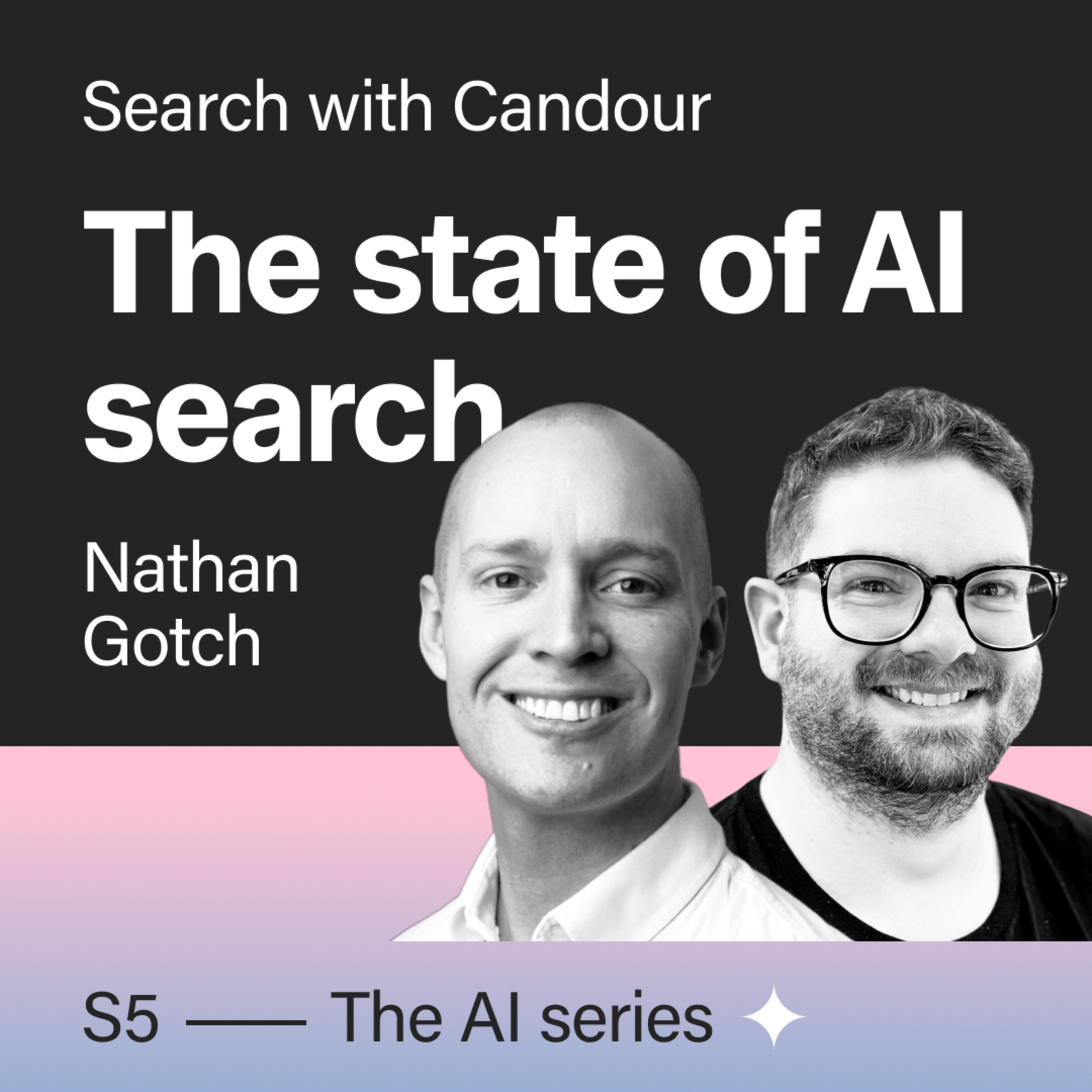
Nathan Gotch joins Search with Candour to discuss the state of AI search in 2026.
Topics include:
Follow Nathan:
Chapters
00:00 The state of AI search
01:48 Introduction
03:34 Welcome, Nathan Gotch
05:55 Study methodology
07:57 ChatGPT citations don’t match the SERPs
12:03 one category marketing playbook
15:17 UGC and agent-led outreach
19:48 The demand shift
24:13 How to sell AI SEO to clients
28:11 Is SEO still SEO?
28:46 Do backlinks still matter?
30:00 Why AI needs more than traditional search
32:17 Authority and inventory gaps
37:18 AI vs Google quality filters
39:23 Taking the kitchen sink approach
41:59 Do title tags still matter?
46:21 Reviews as a top priority
49:08 Recommendations
53:18 Wrap up