Ask ChatGPT

 Search with Candour
2 Nov 2026 · 1h 8m · 23 chapters
Debunking AI search measurement myths, including how AI overview/citation “volume” is modeled, why GA4 “direct” traffic doesn’t equal AI traffic, and how to analyze AI-driven visibility by location using GSC/GA4/server-log signals.
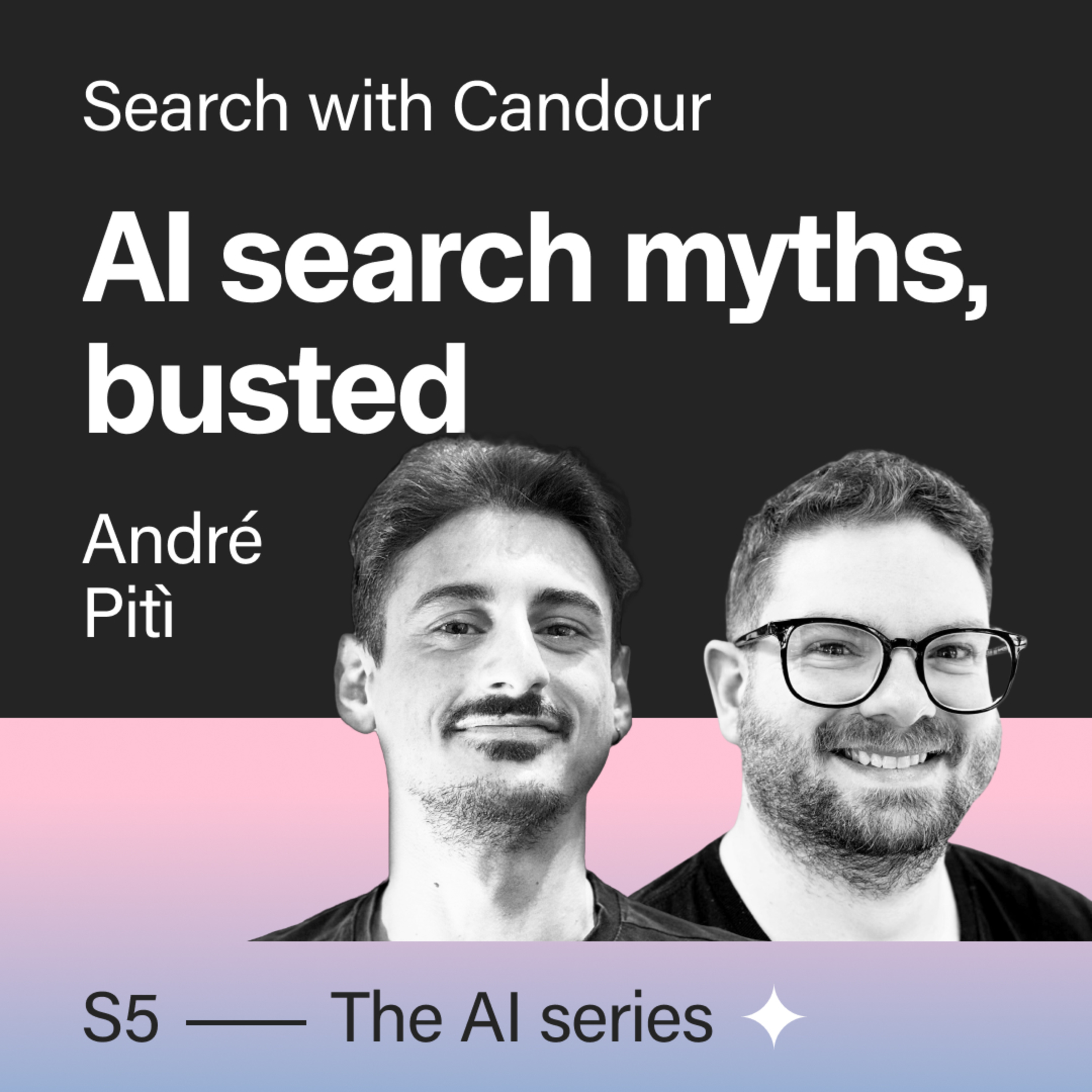
André Pitì, Spanish-born SEO consultant and organic intelligence specialist; copywriter turned SEO; martial arts black belt; tech geek; CEO/founder of SEO Ritmo. Has worked with multinational agencies, corporations, and startups; focuses on B2B and agency stakeholder communication.
Written by AI. May contain mistakes.
Understand the complexities of measuring AI search visibility and its implications.
“But one thing has to be clear, eye measurements are all estimates, are all not just estimates, but modeled results.”
Discover common myths about AI search measurement and data accuracy.
“So without any further ado, here is my conversation with Andre P.D.”
Learn about the methods used to calculate AI search visibility and their limitations.
“and you will see me probably speaking a lot about this.”
Identify the challenges and inaccuracies found in AI search metrics.
“because I think, like I said, there's a lot of information around and maybe we can hopefully clear something up for the listeners and viewers as well.”
Discuss how AI is reshaping SEO practices and the importance of updated strategies.
“we have a snapshot that might be outdated.”
Learn about the complexities of AI traffic measurement and data interpretation.
“that can use that process, or a similar process, which can change, by the way, in the sense of how they model that ratio, that multiplier, which we don't know, and so on.”
Discover the nuances of direct traffic in relation to AI and user behavior.
“that I might collect from that same tool or different sorts of tools and first-party data and every part of the attribution and tracking system that we have in place.”
Examine how URL structures can affect traffic attribution and reporting.
“So it should be coming somewhere else, from somewhere else.”
Identify common technical issues related to URL structures that impact traffic.
“You mentioned a couple of the technical side of things with redirects and canonicalization as well.”
Learn the importance of cross-referencing data from different tools to gain accurate insights.
“And obviously that, again, doesn't mean you have an increase of traffic directly.”
Learn about the importance of cross-referencing AI traffic data to avoid misinterpretations.
Discuss the need for a holistic approach when analyzing direct traffic and its sources.
“And yeah, these are a couple of good, I think, of myths that are common and that I feel it's important to debunk or to rather explain and investigate a bit more.”
Discover how to segment AI traffic by geographical location for better insights.
“And it kind of relates with something that I've been working on more I mean, experimenting at least, which is about understanding AI traffic in specific locations.”
Explore the regulatory challenges faced when expanding AI services internationally.
“I know some of the team here work on bigger, more international clients.”
Learn about analyzing traffic sources and identifying misleading impressions in reports.
“So first of all, what is the value that we want to look for is to make your client understand if a desired location is progressing well on localized AI search.”
Understand how to filter out non-relevant queries to enhance traffic analysis.
“They were receiving tons of impressions.”
Learn how to optimize traffic analysis using location data for SEO strategies.
“But yeah, once you're able to scheme out and attribute some thresholds and limits to what you're filtering, then you can make sense out of it.”
Discover best practices for measuring AI-driven traffic effectively and accurately.
“So this is another example of working with location using the data you already have and play around with the rules that you have in these tools.”
Explore the nuances of local attribution and the role of geo tools in AI search.
“Thread very carefully as well with the local attribution that you do in whatever geo tools you're using.”
Discover the shift in measuring success in AI search and its implications for SEO.
“the new mentality to someone that is not fully invested into our industry.”
Learn about the importance of consistent information across different departments and platforms.
“And that's one piece of the puzzle that I find very interesting.”
Get practical tips for SEO experts to enhance their strategy in the context of AI.
“So the final note I will drop here is that SEO was kind of departmental level and now it's organization level more and more.”
“And go to them and ask them, look, I've asked myself these questions in order for me to answer more problems.”

Get the gist, explore an idea or ask about something said.
 Claude
On Search with Candour, what are the key points of this episode?
Searching your listeningAutomatic transcript. May contain errors.
0:00Are you a bit overwhelmed with all of the information around AI search that's going around on social media at the moment? Are you unsure what's true and what's not true? Well, on this week's episode, I'm going to be busting some AI search myths and I'm joined by André Pitì. The whole industry feels like it has been inundated with good information, but also questionable information and sometimes even disinformation. The idea of imagining measurements and attribution in AI search as a puzzle. When we buy a puzzle, the box cover shows the picture of the final result, right? And let's say that until now, we've been doing SEO, looking at this final result, which let's say is the puzzle of an eye.
0:39And we're putting together all the pieces. And it turns out that puzzle was a part of a series where the unified picture is a face, it's not an eye. But one thing has to be clear, eye measurements are all estimates, are all not just estimates, but modeled results. What it is that the tool has no idea about how often people would ask ChargPT a given question, because nobody does. So it uses a proxy. And it takes the Google search volume of a keyword linked to that question, that query, and specifically to a parent keyword for that query. And it shrinks it or measures it by how big the AI platform in question is compared to Google.
1:17One multiplier per platform applied to every topic that we look for on a keyword tool. assumes that a B2B compliance question and a recipe question move in Chachapiti or AI overviews or whatever at the same rate, which they probably don't. It's also based on a proprietary data set, which obviously makes the entire information more subjective in a way. So the good old days of using those numbers as a sacred number that we can report directly are probably just going to the sunset. it.
1:51Hello and welcome to this week's episode of Search with Candor. This is season five and we're talking all about AI search. That's AI search optimization, that's AEO, GEO, all the fun things to do with people using LLMs in search and for search and around SEO and all those good things. I'm joined this week by Andre Petey and we're going to be debunking some common misconceptions and myths around AI search. I've already talked about some tactics from traditional SEO that still work with modern GEO, AI SEO. I've also talked about the state of AI search, how that has shifted and changed over the last couple of years or so.
2:31And I've also talked about how to use Claude skills to automate a lot of SEO tasks and whether you should be doing that in your SEO tasks these days. And I'm going to get into, like I said, some myth busting. I love the show Mythbusters back in the day. Shout out to Adam Savage. Absolutely love Adam Savage. He's still making some great stuff. But yeah, shout out to the team from Mythbusters. We're basically doing our own kind of myth busting. I'm going to get into some really common misconceptions that I know I had and I'm sure plenty of you have as well when it comes to AI search and how this thing actually works.
3:06Andre brings some really interesting data, brings some really interesting insights and is able to, I think, debunk these myths pretty thoroughly and explain why all this stuff is so easily misconceived and so easily misunderstood. So without any further ado, here is my conversation with Andre P.D. about debunking and myth busting some common AI search myths.
3:33my guest is a spanish-born seo consultant and organic intelligence specialist for agencies and b2b businesses he's a copywriter turned seo specialist a martial arts black belt self-confessed tech geek and has worked with multinational agencies corporations and even some startup companies he is the ceo and founder of seo ritmo welcome to search the calendar andre pt hey thank you so much jack and what thank you for the opportunity how you doing good thank you man yeah thank you so much for coming on thank you for reaching out uh shout out to canard for putting us together and hooking us up uh always very nice to get a recommendation and get a vouch for somebody in the industry and i was just saying to you before we started recording i saw you on seo office hours a couple of weeks ago so you appeared on my radar and i was like hey i know that guy we were just talking about that so i appreciate you coming on man how are you i'm super fine i'm great and thank you for shooting out to canard he's a great guy as well and yep it's been a fantastic and exciting time to work in seo definitely definitely we're gonna get into some very interesting topics i know we're gonna talk about a lot of ai search stuff we're gonna get into debunking some ai search myths and i know something you're very passionate about is actually how to communicate a lot of this stuff to clients and stakeholders as well because i know from an agency point of view i've spoken to people in-house as well this is a a big topic a lot of people are talking about at the moment so i'll start the show with why you think this is an important topic to discuss on why is communicating about seo in terms of ai search geo whatever we want to call it why is it so important to be talking about right now Right.
5:18So as you correctly said, it's really affecting both sides of the table. And AI has changed the way we work, has changed what we do, what clients ask. It has opened the doors to work much faster or even just more. And it's just been great to experiment with workflows, guard lays, setups, moderating outputs, and so on and so forth. But at the same time, it's obvious that both sides of the table, again, are affected, meaning the guys who are doing hands-on SEO work, geo work, whatever you want to call it, and search itself. So how users interact through search via AI systems. And there is the old geo narrative attached to it.
5:58So the whole industry kind of feels like it has been inundated with good information, but also questionable information. And sometimes even disinformation, if you allow me. And so I think it's important to flag at least some of the most important myths, most critical, or maybe even some of the understated myths. There are plenty of resources that I'm about to publish about this, and you will see me probably speaking a lot about this. But probably today I want to deep dive in a couple of them at least. And without lingering too much in all the guru geo stuff, I just want to tackle and jump on the throat of AI search measurement, first of all, as a general topic and to connect with some of the myths that are related to it.
6:48Yeah, definitely. I think, like you said, there's a lot of conversation happening. I'm sure all the people watching and listening have seen plenty of stuff on LinkedIn, on other podcasts, on all kinds of stuff. And there's a lot of mixed signals. And like you said, quite a lot of misinformation and miscommunication and things like that. So I think it'd be good for us to get into clearing some of that stuff up and then get into how you can actually communicate this stuff effectively. Because I think a lot of what we're finding as an agency and speaking to, you know, over the last couple of episodes, the first few episodes of this season, it's been a big conversation.
7:28Like some people are really, really hungry for this stuff. Right. I don't know if you've experienced the same thing of like new clients coming to be like, I need to sort out, I need to rank in chat, I need to rank in Gemini. They are so like, you know, new shiny AI, very exciting. And then other people you need to kind of convince in a lot of ways as well. Or, you know, you see people have seen some of the sexy looking graphs on LinkedIn and not actually knowing what they're talking about. So should we get into starting to debunking some of these myths? because I think, like I said, there's a lot of information around and maybe we can hopefully clear something up for the listeners and viewers as well.
8:09What do you think are some of the common myths? Let's start with what you think is one of the biggest myths people are misunderstanding. So one of the first ones I want to bring here, which is probably not the first one that will pop out to your mind, is about measuring Google generative results, like our reviews especially, and taking that number as if it was talking to you directly about your AI visibility. Meaning measuring our reviews in whatever tools you're using is not the same thing as saying, I now know the AI visibility coming from Google for my brand, for example. So let's deep dive a little bit into this and uncover a bit of the math behind how these scores are calculated sometimes.
8:57the metrics that we see about AI where we're using popular tools are not exact there are many great SEO tools out there the big popular guys as well as new niche solutions and so on and so forth but one thing has to be clear AI measurements, corings are all estimates are all not just estimates but modeled results and how are these numbers calculated or modeled let's take for example a tool that operates a site exploring function which means it pops out, it gets you the estimate of its organic traffic, domain authority, and other metrics. And then we also see this AI overview volume score, meaning how many times this website appears in AI overview's results.
9:39And by the way, this might also include AI mode. But sticking with AI reviews, at least one of the process that I've digged into a bit and uncovered by either public information or just asking out around from the people that work on popular tools that exist are some routes, let's say. And the first one is the tool takes a keyword from its database and crawls the SERP. And if an eye of reviews appears, it records the cited URLs. And if your URL is cited, you get one citation. And that's how the volume is calculated, right? And the volume attached to that keyword in Google search volume is also the signal that would pop out in your keyword tool, for example.
10:22But the citation that you see is just a snapshot from the last crawl that that tool did, and that can shift by country, by device, by login state, and other parameters, obviously. And what it means is, for example, if we take a B2B long tail query, which are usually the ones that matters most in B2B, usually low volume, and therefore not super important to refresh in terms of data freshness, we have a snapshot that might be outdated. It could be not reliable. It could be related to an ear. And I have a direct example of that where AI reviews didn't even exist. So for example, we are investigating a niche for a B2B client.
11:06We're popping out relevant long-term, sorry, long-term queries. And then we have data through the APIs, for example, that are from 2023 or 2024. for, and then that data is not relevant for me anymore. Right? So this is one route and one way of seeing this and one aspect in terms of limitations. And a second route can belong to the actual front measurement for AI reviews or other tools related to Google or even to other AI systems. And here it's important to introduce the concept of this, how some people in the industry call it the AI adjusted volume, which is translated. What it is, is that the tool has no idea about how often people would ask ChargPT a given question because nobody does.
11:54So it uses a proxy and it takes the Google search volume of a keyword linked to that question, that query, and specifically to a parent keyword for that query, and you shrink it or measure it by how big the AI platform in question is compared to Google. So for example, it will use a ratio, a number, a multiplier to determine that level of shrinkage. And because nobody publishes prompt volumes, the tool will need natural language questions that come with a number which prompts don't have. And so one way of finding those is using people also ask, for example. And so a PIA question gets run as a prompt and it inherits the volume of the biggest keywords whose results page shows for that question.
12:44And some tools then will scale it with these multipliers. For example, AI overview search queries can have a multiplier of one, which means it's a modified because on, let's say, 10 ,000 searches, Google will have the same, will show up for a keyword that same amount of searches that AI overview is showing. So it's kind of having a merged result. or if it's AI overviews prompts that we're talking about or AI mode, for example, the multiplier change. It can be a ratio of 0.20 or 0.10 to multiply for those 10K sample search volume. But one multiplier per platform applied to every topic that we look for on a keyword tool assumes that a B2B compliance question and a recipe question move in JGPD or AI overviews or whatever at the same rate, which they probably don't.
13:37So that's why that number can... It's global, it's averaged, and it's modeled, which is fine because we can work with what we have evidently, but it's just for us to know and keep in mind that it's not like a Bible metric that we should report directly as it is. This is just one real example of a mechanic of one tool that can use that process, or a similar process, which can change, by the way, in the sense of how they model that ratio, that multiplier, which we don't know, and so on. It's also based on a proprietary data set, which obviously makes the entire information more subjective, in a way.
14:19And other ways of other SEO tools or geo tools would, instead of using a proprietary data set, would use third-party data sets, so that data might or might not be even more dirty. And they would relate that with machine learning systems that would predict or approximate the user behavior on the click streams for a specific keywords, which means I have a completely, not completely, but a different way of estimating that score. And yet it's another tool, yet it's another model number, it's another data set. In this sense, where is the truth? The truth is probably that we should change the way we ask ourselves questions, like you were actually saying before.
15:07Yeah, I think that's a really nuanced take on it because I think you're totally right. So many people don't take the scale of each AI system in context, right? I think so many people say like, oh yeah, obviously we've talked so much about how much Google has lost its search share of the market and all that kind of stuff. but when you know we're talking about estimated value we're talking about resources time invested all that kind of stuff like you said a lot of the third party tools just kind of take this broad visibility concept right it's like oh yeah sure it's a predictive kind of thing whereas i think your model is a really great way of kind of adjusting for that is understanding in a wider context, right?
15:59Where are people searching? How are people searching? And how many of the, because we're not going to get search volume, you know, that kind of thing, like you said, with the merged volumes from so many different tools, you're not going to get that typical data that we were so used to having a few years ago for searches, right? Exactly. So the good old days of using those numbers as a, you know, sacred number that we can report directly are probably going off and just going to the sunset. And again, the core message here is that I want to compare those numbers, not to ignore them completely, but compare those numbers to other signals that I might collect from that same tool or different sorts of tools and first-party data and every part of the attribution and tracking system that we have in place.
16:50so the AI overviews number in those core will obviously not match the website label data that I have even from just GA4 or other first party data like Google Bot server activity for example which obviously doesn't define the traffic directly but it can be a signal and in that sense reporting can tilt towards defining a direction rather than a direct super straightforward metric in terms of traffic metric. And this kind of leads me to a second myth I would want to throw out right off the bat, which is how we uncover AI traffic when looking at GA4 channels. And specifically, I want to focus on the direct channel, which I think is one of the most debated ones.
17:41And what I want to state here is that high direct traffic or spikes in direct traffic do not directly mean you're having high AI traffic. And the purpose, again, here is to get to the idea of collecting signals versus having a fake way of tracking, what we can call the dark traffic. And so, for example, obviously, leaks that come from native apps and other privacy-restricted contexts will result as direct in J4 sometimes, and that same thing happens when you have a fragmented user journey, right? So if your customer, potential customer, has gotten to know your brand somewhere physically at an event or online to a third party and then will type in the URL that is associated with your website, then you are registering a direct traffic, a direct visit, a direct session.
18:41And that kind of direct traffic is known as dark again, but it kind of leads to two points I would like to highlight here, which is you can see a potential spike in direct traffic, but it doesn't mean it comes directly from AI, but you also might be undercrediting the AI-driven traffic that is now clumped inside the direction. So what do we do? What are some things that we can practically do to get around a bit this nightmare, this, this gray, foggy part of our work. From one thing, and I think it should be really intuitive, but sometimes it isn't, it's looking at the actual URLs that belong to that direct traffic channel to ask ourselves some questions like, are they first level pages?
19:34Are they core service pages? Are they deep URLs in subfolders buried down there? And that's because nobody types along slash blog, dash, et cetera, URL on a search bar, most likely. So it should be coming somewhere else, from somewhere else. And you can also might notice that your service pages URLs will overlap with AI-sided pages. And you can get this information from an external team, for example, or with your own testing. and again you will not have a you know a direct and a revocable and questionable claim about it afterwards but you will have a bunch of signals that you can kind of see how to play around with and aggregate with I will talk more about this later but I think that's exactly where a human consultant or an SEO professional comes into play to be able to discern and kind of distinguish and aggregate in the right way the signals that you have and again I will detail a bit more into this later.
20:38But that's one thing. And another thing, after checking your URLs, you want to make sure that you're not stripping off the few signals that we have, like UTM parameters, charge-up with UTM parameters in your apps, which means go and check your redirect policy or your canonicalization of configurations. And if you have that kind of maintenance policy that redirects whatever URLs with a parameter parameter pops out in its version, you're probably missing out on one of the strongest signals that we have. So instead of that, you could go right now, today, and test the URLs that you have with the parameters, with the UTM attached in the live test function in GSC and see if it returns a 200 or some other code.
21:23Because if it does, the page loads with the parameter intact. And if it doesn't, if you get a 301 or 302, for example, for that clean version, then you have a redirect policy that is kind of working against you. And it kind of strips the UTM before GA4 even fires. So, yeah, that's one thing. You kind of go and check the status of the critical URLs that you have. This doesn't mean you shouldn't create a canonical URL, obviously, to index. It's just for you to check and preserve whatever signal that is directly attributable. Yeah, definitely. Like you said, the common conversation I've had a lot with, like you said, relating to that direct traffic increase.
22:08And when we're having that kind of, obviously, the brand conversation was such a big conversation over the last year. And when you grow your brand in theory, you grow your direct traffic and stuff like that. But I think you're totally right. You need to be more nuanced and careful when it comes to, you know, just saying, oh, that means this. If correlation does not mean causation and vice versa, right? You don't necessarily have an increase in direct traffic does not necessarily mean you are ranking better or getting cited more in AI search. You mentioned a couple of the technical side of things with redirects and canonicalization as well.
22:43Have you encountered any issues there with clients where there's been issues with URL structures and things like that that have caused problems? Let's say that clients I have are working with me since the last 12, 18 months, have been working with me since the last 12, 18 months, are kind of following through good because obviously I jumped at every piece of information I had available and tried to make, you know, scheme off the stuff that didn't matter and apply the best practices immediately. But all sucks in cases when taking over new clients, especially when coming from big corporations or big, not big agencies necessarily, but like when you have clients with tens of thousands of URLs or with a lot of departments where approval for every action takes ages, then you see that the technical structure is just bad to the point that they're blocking themselves out.
23:45But even at just a robot text level, not just that, even at a page level, how it's structured and how the code is distributed. And you discover how much they paid for the website and then my heart cries out a little. So there are a bunch of specific scenarios where I found those kind of blockers and where probably even just a one hour intervention will unlock so many good results and opportunities that kind of falls in with the dominant effect into the performances that we see. And like you rightfully said, I don't want to make direct directions all the time. This means that. But when you see the organic traffic overall growing, if you see the subclicks growing, if you see a good level of citations, when you play around with tools and when you use other geo tools or when you even use just the generative AI records in WorldSearch console and hopefully we'll get something better out of it soon, you will...
24:48That would be nice. You can notice that. Yeah, exactly. And we'll talk a bit about that as well. But yeah, those are signals that reflect, that probably reflect if they come just right after the intervention, the technical intervention that you made, they will reflect a positive outcome. What I said before about the UTM parameter, for example, is just for the sake of reporting, just not to miss out on the information that you have. It doesn't mean that you are influencing the actual traffic that comes from ChagPT, right? So there are kind of two layers I want to separate, which is what you can do about it and how you report it.
25:24And again, this leads me a bit to a third action that probably we can take to mitigate the obscure area of direct or dark traffic, which is cross-comparing what you have with what is outside, like what you have in the backyard with what you have in the house, let's say. And I love this one because I love to play around these kind of metrics. And it means kind of use different SEO geosignals to determine a probable AI-driven event for that direct session. And in other words, you can go to your server logs again and check if an exact URL has a spike in terms of Google user, sorry, change-up to user bots or perplexity user bots.
26:11And obviously that, again, doesn't mean you have an increase of traffic directly. But if those bots hits are tied to a specific URL or cluster of URL or even to a specific service or folder, then you can go and check and cross-compare that information in GA4. And if the direct channel is increasing through or via those links, those same URLs, that you can start making some inference and you can start having some sort of more consistent information. Again, thread very carefully with that information when you are to report. what you use, whatever you have at your play in terms of zero-party, first-party data, and compare it with the most popular thing that you already use.
26:58I think that's a key part of it. Cross-referencing that data is something I think is hugely underrated. I think so many of us again, holding my hands up, I've totally been guilty of this in the past. I will totally admit this. You just check one tool or one piece, you look at just Search Console or just GA4 or just to whatever other tool, third-party stuff, and don't then cross-compare and contrast that with what else you're seeing. I have seen so many times when you take Search Console data and compare that to GA4, and like, hold on, this isn't lining up. Why isn't this lining up? Obviously, you have so much in terms of attribution in GA4 and cookies and all this other kind of stuff that extra complications we've had added recently.
27:43But also the way, for example, we did a test with using regex in ga4 to understand where traffic is coming from in terms of the different you know by chat gpt.com by perplexity all that kind of stuff compared to ga4's built-in ai system report traffic totally different numbers completely different numbers exactly three three or four times different not just like oh a little bit difference but like one was i think 500 one was 2000 it was like completely different numbers and if you don't cross-reference that's not exactly what you're saying there andre if you're not like paying attention to the different sets of data that you have access to especially first party stuff like search console then you could be making assumptions pulling things like you said thinking something is caused by something else but actually it's not and totally have had conversations with clients where we're like this is kind of weird and we don't know what's going on here google is kind of tricky but let's not use this as you know the gospel let's not use this as the the direct signal let's talk about this in context and have that wider conversation because you don't want to go down a rabbit hole and then realize you've been going down the wrong path right yeah exactly and i think we'll we'll leave a bit of space towards the end to talk more about that exactly that kind of allow me the term like holistic vision or approach that exactly although i i might hate that term uh so big takeaway like go to your client cmo or to your marketing leader to your agency director and so on and answer the question does all of that direct traffic represent branded search does that ai overview traffic volume or score represent our actual traffic with something else from a yes or no, which is let's investigate the URL first, cross-compare whatever we have about those URLs or those queries second, and make an estimation with the rest of the reliable data that we have, like what we can already track, for example, through an AI channel in J4.
29:49Again, like you mentioned before, if I have a regex in place to measure all the AI boats that might hit in my GA4, then I would want to use at least that tiny piece of information to make something out of it and compare it to the rest. And yeah, these are a couple of good, I think, of myths that are common and that I feel it's important to debunk or to rather explain and investigate a bit more. And it kind of relates with something that I've been working on more I mean, experimenting at least, which is about understanding AI traffic in specific locations. So when dealing with multiple locations.
30:39And one interesting type of analysis we found ourselves doing with B2B clients with multi-local presence or with large website anyway, is investigating the provenance of the clicks or the traffic that we can attribute at least partially to AI. And here I'm talking about understanding if AI search signals at all can match a business-relevant market, not just languages, like not just the language we work with a prompt, for example, but I'm talking about reallocation. I don't know if it's something that tickles your attention as well. Yeah, I think that was something that caught my attention when you added it to the show notes was segmenting by location, like having that discussion.
31:25Because I think a lot of us, like I said, talked about using filters and trying to understand where different things are coming from in terms of GA4, in terms of GSC, various other bits and pieces. But for me, the location idea, I've not really done much of it myself. I know some of the team here work on bigger, more international clients. Funny enough, one of the clients I work at the moment is talking about international expansion right now. We're having that conversation and it's a very big, like, you want to go to the US? You've got a lot of like regulations and compliances you need to worry about per state, let alone, you know, expanding from little UK to big US is going to be a big problem.
32:03And we have this kind of conversation of like, how are different people using AI in different industries, different markets, and then across different countries. when you're talking about the EU stuff a lot of the AI stuff takes a long time to get there right because of the restrictions and and credit to the European Commission for being strict on this stuff like holding these AI companies accountable for things like that but that does mean you know if you're working in Germany, Spain, France, wherever you don't get a lot of the AI stuff that is being tested in the US or rolling out in the UK for a little while what kind of things have you done to kind of segment that traffic with and get a better idea of how those different audiences are finding you?
32:49Sure. So first of all, what is the value that we want to look for is to make your client understand if a desired location is progressing well on localized AI search. And also, and this is important because I found some scenarios, avoid being misled by false negatives or false positives that can emerge in reports because of other unuseful locations that are merging with the data and misleading you. More to come up with that in a bit. So what can we do today and what can we do to do that? For example, first of all, I promised I would have talked about it. Gen.ai reporting JSC is something that is not super useful yet on certain levels, but we do have the number of impressions according to locations and to countries.
33:45And we all know how painful it is not to have clicks in these records. But this metric can be very useful if you played your cards right. Let's say that, for example, you're trying to understand the direction about Google Lab reviews and AI mode for your brand, and where are you appearing on those. and having a sense of where you are, literally where you are in terms of location, can get you a good sense of what are we doing right and why is that happening. Obviously, not all of the locations will make sense to us nor are important to investigate too much. But for example, there was this experiment with this big real estate group that we did.
34:33so you have that kind of brand where they want to appear in multiple locations because they have an international business and and they're all excited that their name is appearing in a review switches rate but other than making them understand that that result might not be stable or it might not last and it can change from one day to another you also want to check on where are those impressions coming from? Because this is something that your leaders will probably want to know. And a second case is when we had encountered a case of an anonymous brand named the same way of the brand we're working with.
35:16They were receiving tons of impressions. And I'm like, how is that possible? That doesn't match what we've seen until now, what changed and so on. And I'm looking at it and there is this company in Chile, and we're working for an Italian brand in this case where they're called the same and we have no clicks off of it. When I'm looking at the queries in the normal traditional Google search reports, we are not getting clicks from that locations because obviously that is an entirely different type of business, which is named the same way. And that is a misleading fact that we want to skim out of the reports.
35:51And it's sometimes misleading and tricky to do that. And that's one thing to pay attention to. Another one is to filter out what I've been doing in Planner on Reads, to filter out prompt-alike queries from GSC, doing that by word count and location. And now this is working like on Glass because I don't want to mean that if you're filtering out keywords from GSC that have a certain amount of words, that would mean that they are AI-driven or prompt-alike. But there are some of the keywords that are really looking like prompts and obviously falling into the prompt-alike category. And most of those queries usually have zero clicks.
36:43And you can filter them out by specific criteria to make sense of it and to tie them up again to locations. so for example we are not sure about which ai system those queries coming from the gsc reports can relate to probably i would use ai mode gemini are the best candidates there but also there has been some leaks some months ago about chagpd there's also there has been some discussion about it um using in the sense that chagpd using google for web searches and therefore affecting gsc data in a way, not directly in that sense. But yeah, once you're able to scheme out and attribute some thresholds and limits to what you're filtering, then you can make sense out of it.
37:30And I'll bring in a real example. So the first part of the work that we did for these specific ISP clients, so an internet service provider in Europe, with tens of millions of impressions every month, and we pulled about a thousand queries that fit that parameter, let's say that limits. So those queries had eight or nine words. We even found outliers like with 70 plus words. And then we clustered them by ICP fit. So two or three ideal customer profiles for those queries to fit in. Assigned a sort of relevance score in that sense and skimmed out whatever didn't make sense in terms of business relevance.
38:12like queries with impression under a certain threshold or without a semantic alignment that we wanted to investigate or just without any direct tie to the business services that we wanted to investigate. And this is regardless of the level of the funnel of the queries. We could have obviously also divided them by level of funnels, but in that specific case, we were looking at commercial queries, investigating and sniffing around for transactional queries as well. So many of those, again, were zero clicks. But before jumping to conclusions like, let's optimize the pages that hold the ranks for those keywords, or let's do it and delete some contents or update the content.
38:56And before that, we would want to divide them by geography as well, uncovering what kind of informational queries, commercial queries and transactional queries would rank out for a specific location on those specific limits. And obviously the results will always include some wrong intent, misspells, anonymous cases like before. But once we had the proper location of that, we decided to go and look at the pages that would relate to those queries. And from there on, decided to do any work at all or where to improve and whatnot in terms of SEO work and content work mainly. So this is another example of working with location using the data you already have and play around with the rules that you have in these tools.
39:51And then maybe you can drop out a couple of tricks more from GA4 and a couple of don't-do, like big no-no's, to take into consideration. So from GA4, what you're probably really doing at your agency or what you're doing with your clients is to create a custom AI channel with a Regex rule or using maybe the AI Assistant Native channel from GA4. What you want to do is probably move it above the referral layer. So you go to the admin panel and move it there to reorder it there so that you can also add a country as a secondary dimension in the report and then compare that traffic by location. And you want to do that so that you don't ignore the other AI referral traffic board sessions coming from the AI channel.
40:50And you can also cross-check your local folders in your URLs, meaning specifically the URLs that has a slash ES or slash EN, if you're running that format in the permalinks, go and look for those specific links and how they appear in your GRC reports, in your GA4 reports, using some of the tactics that we have discussed here. And yeah, see if they belong to a specific behavior in terms of traffic. And again, at the end, I would love to mention a couple of things like just to avoid people getting wrong things off of these conversations. These are all signals, and we want to rely on obviously the most qualitative information that we have, but also pay attention not to hit the wrong target.
41:50Like, for example, don't rely on AI both locations tracked server side, because the locations that you can track down from boats hitting your server are probably IP from data centers. So not real user there. Thread very carefully as well with the local attribution that you do in whatever geo tools you're using. So there are several geo tools out there, plenty of them. good and there are some of them that allow you to set up a location for a specific brand or for a specific website or domain even to see how it performs in for certain AI models on a specific locations but that it can be something that again you could collect as a clue but it's still a designed experiment if it's there it belongs to a proprietary framework and it's still again something that is being modeled, rightfully or not.
42:49It's something that you cannot take so directly. So bottom line, again, is a matter of collecting. This is all a matter of collecting SIPDU. And this is exactly when the human consultant, the human SEO guy, or the geo professional, whatever you want to call it, comes into play. And he must be able to make deductions and inferences without falling into a a generalization trap or being misled by this false assumption about location. That's a really interesting point. I think, like you said, there's that. The tricky thing for a lot of us to fall into those traps in so many ways, right? But like you said, because as helpful as the little bits of data we're getting from GSC, like you said, we've just got impressions.
43:39It's not really actually that helpful in terms of, you know, having that attribution, having that kind of value discussion and things like that. But separating by locations and understanding how different users. And I think your point about separating out the things that could be prompts but might not be prompts is a really interesting one as well. Because I think we've seen a lot of people on the opposite side of that see the follow-up conversations. where I know if you've seen in your search console data, you just see like, yes, please go ahead and things like that. It's like, well, nobody's actually searching for that, but that's coming up in my search.
44:16Oh, right. Yeah, that's an AI mode thing. Like people are having that conversation. So yeah, I really appreciate that kind of the insights and the tips and tricks that make. I think you can so easily, like we said, spend a lot of time going in the wrong direction and then end up realizing, oh, I've wasted so much time fiddling around with this thing or trying to work out this thing. So yeah, I will definitely appreciate some specific recommendations there for sure. Right. And I think that helps a lot of that communication as well, right? Both internally and externally. Yes, absolutely. And honestly, I could spend all day talking about any of these points, right?
44:52Because it kind of is a temptation to go down the rabbit hole. It's just if you want to value your work and be appreciated and be successful, will probably you have to find a format that works for you or for your clients. At least a way of working, a way of conveying your mentality, the new mentality to someone that is not fully invested into our industry. Which leads me to this shift of mentality that we should adopt. And again, signals versus tracking should be a mantra to repeat to all our leadership. It will become a mantra by the end of this episode, I think. we'll all be chancing by the end that's what I hope so and in this era we're seeing you know this past 12-18 months we've seen zero clicks we've seen surpranking decreasing in their importance we're seeing super fragmented user journeys especially in B2B they already knew did that kind of business model know the nightmare more than retail or B2C for example but they're getting more of that more and more of that.
45:59And I kind of like the idea of imagining measurements and attribution in AI search as a puzzle, where when we buy a puzzle, usually the box cover shows the picture of the final result, right? And let's say that until now, we've been doing SEO, looking at this final result, which let's say is an eye, right? The puzzle of an eye. And we are putting together all the pieces and paint that eye. And it turns out that puzzle was a part of a series where the unified picture is a face, it's not an eye. And that face is now partially blurred or it's obscure, it's totally obscure, you know, or it's a bit grayish or the color doesn't match so much.
46:47So thanks to the great people in the industry, we are now working on different parts of the SEO and geo process. we are now able to make some inferences, some deductions, or maybe best guesses at what that picture that we're painted is or could be. It could be that those lips in the face, they really look like this. They really look reddish. So it only makes sense that the pieces of the puzzle will fit that way. And there is probably a certain greater position in there. But let's say that some of the other pieces of that puzzle are still related to the old way of working and some others are not.
47:26And one is rankings in SERP. In my opinion, SERP's rankings should not disappear from the conversation that we have internally and externally. it's just that probably instead of where in the SERP you are appearing now it's about when and how when meaning how many times, how consistently under which triggers and how meaning how accurately are we well represented in terms of correctness of the facts, in terms of business answers, in terms of how outdated or updated is the information about us and that for a certain industry, for a certain type of business model as well. And I'm sure we all have at least one example where the brand service or product was factually incorrect or misrepresented or outdated at best.
48:24And so the question becomes, how can we influence that? And that's one piece of the puzzle that I find very interesting. And another one is understanding that the assets that we own, the digital assets that we own, are now giving a bit more and more power to external sources. So it's kind of like we're seeing the power decentralization of the industry, whether your website is now one source, but then the rest of the world is talking about you, is becoming increasingly more important. Because those external sources most of the time creates literally the corpus of an AI answer. so you might want to make sure that what you're saying and what you're saying is aligned and so possibly the outdated or wrong information about your IT consulting service is appearing because of an old affiliate link that lives up there on a listicle or some bad reviews on Capterra or G2 or Clutch whatever and then there is a third point third part of the puzzle, which I like, which is the technical readiness because I like because I think it's a point where we have much more control, where we can influence the outcome.
49:41And knowing that AI invisibility can happen by accident is knowing that there are several places where we can block out AI crawlers, where we can find ourselves treaching our content in the wrong way technically so that google is not able to to crawl it and index it correctly for example in terms of ai boats there are at least four core places uh where you can influence uh the capability of an ai system to retrieve your content uh if an ai body is not able to to hit your content is pro the blocker probably lives in your server or in your edge layer or in a plugin an application that you have installed it can be in a robot text although that That is a signal, not an enforcement law.
50:30But also, how is your website structured? Is it made on JavaScript? Is it made with WordPress? How is it made? Because that, again, can influence how the AI crawler will be able to see your content. If it is JavaScript and if your content is not in the responsibility now because an AI system is not able to render JavaScript, filter probably will be invisible, even though you're doing everything else right. Again, that's a third piece of the puzzle. I don't want to go overboard here. I'm almost finished. But what I want to make clear is that in B2B, we should apply a mentality that we should know well.
51:12And in general, with website, we should apply that same mentality of knowing that we should not apply the paid ads mentality to AI search. We weren't applying it into SEO. I don't see why people are now asking for perfection when dealing with AI search or when talking about how to appear in JGPT. And is all of this new to SEO? Probably not at all. Most of the things we've already been doing and the users in the industry knew it already. But the change is in how our decision makers need to accept a different kind of answer based on our capability as consultants. So the final note I will drop here is that SEO was kind of departmental level and now it's organization level more and more.
52:01So before it was maybe developers and webmasters and content working from the marketing team. And now we want to touch at least four departments to make sure that the information is consistent across the line. So sales, product, marketing, customer service too. because maybe an AI is interrogating a help center and getting information from there instead of from your service page. So why is that happening? And how consistent is that information? Yeah, I think that was the conversation. I think it was the 2024 season of this show. It was like the theme was very much the destroy the silos, get out of the silos, speak to your other teams, SEO people, you need to be talking to your brand, your product team your developers your everybody needs to kind of work like you said working on an organizational level rather than oh we're the with the seo team which can be over here doing our own thing and not worrying about what other people are doing and i think that also speaks to something you said that it really resonated was that decentralization of everything as well where again we talked about on on the show a couple years ago that the owned asset nature of it all and actually having your website do stuff rather than just having it in this place or just having it in that place but I think your point there Andre was really uh really hit home was knowing where to post and where to share everything and keep everything consistent and you know across different places across different things and ensure that your website is saying the same thing as your social media as your youtube channel as your you know your press releases whatever it is like all this stuff needs to be saying the same thing and singing from the same group and that happens through that organizational communication right that happens through those different teams and the brand team having that conversation with marketing and product and development that only happens when you can have those kind of conversations and i think that is something you know a lot of us are finding now from an agency side but also from an in-house side of this is the kind of status you need to be in to keep up.
54:07You need to be having these conversations and be involved, right? That's correct. You're absolutely right. And I think you've answered the point about that. So these are my two cents. And I think we can work on some practical recommendation to finish this up. Definitely. Let's get into some recommendation. The last segment of the show. Yeah. What is one actionable tip you would recommend for people to start doing right now, Andre? Andre Bilyeu So one thing I would recommend to any SEO guy to do is to list out a series of questions and to try and answer those, and then to go to your leadership and report them under a new umbrella.
54:54For example, is AI a relevant channel for our market and for our revenue? Is AI relevant at all in terms of the numbers and signals that we can collect? And if so, can we bring in more results? Can we contract SEO or geo work for that scope knowing that we need, again, cross-departmental alignment? What's the single piece of information about the brand that can survive not just our web pages, but also commercial decks, external sources, help centers, and other third-party sources that will cite us. Because that piece of information, if it is consistent, it's a valuable asset to reuse and to work around with when talking about AI search.
55:44And then group up all the SEO and AI search signals that you have to determine what KPIs can fit better with the clients or within your own organization. and go to your CMO or marketing leaders or whatever and kind of distance yourself from the chilling question, do we show up in JGPT? Are we showing up in our videos? And go to them and ask them, look, I've asked myself these questions in order for me to answer more problems. And yeah, this is more or less the change of mentality that I want to push today. Do it not tomorrow, not next month. Don't do it today if possible. And this is one actual recommendation I would give.
56:30Awesome. Next up is a piece of software or a tool you'd recommend people check out. And it's something that deserves a little bit more attention. I have plenty. I will throw in a couple of them if you allow me. One is a very useful and cheap tool if there is also a free version, which is actually a Google extension called Lippy from a big SEO consultant from the Netherlands which I love, Bob Willem. And this allows you to scan rapidly any web page and understand if you pass some check marks about AI retroability in terms of technical factors only. And probably it's something that you want to pair up with something else in your workflow but it's something from the the speed and the simplicity of usage and the resonance that had and everything that came out after using that, I would highly recommend it.
57:26It's called Lippy again. And then I think YK is one of the early birds of the geo tools that I also use a lot. I'm an early adopter as well. Looking at the geo panorama, you see all of these tools of any kind. And I think YK from Dixon Jones was one of the first, if not probably the only one with a unique approach that focuses only on not only but mainly on entity mapping and factual correctness based on knowledge graph and so it kind of associates your brand and your domain with the topics and checks the what certain models knows about your brand for those topics and they've been modeling on that data before or other popular tools.
58:12So that's why I love them. And yeah, these are a couple of tools I promise on issue to recommend. Amazing. Thank you, man. Appreciate that. And I will put links for both of those in the show notes, folks. You want to go and check those out. Go check out WK and Plippi for sure. And last but not least, Andre, what have you been enjoying recently? Something that's not AI, not SEO, not work related. What have you been having fun with that you'd recommend people check out? I think apart from my girlfriend, nobody has asked me that question about my personal personal life in Asia no man I'm back at playing music I took a like a couple of months break because of traveling a lot but I'm a guitar player it's been about 20 years of that and I'm back at doing jam sessions with friends here in Barcelona and when pausing for me I work I love to experiment with music and what we like doing is kind of joining up with other fellow musicians and create like experiment with other instruments that you wouldn't usually see in a jam like violins or traverse flutes, for example, and create cover variants off of them or own sounds as well, improvisation.
59:27Another thing I love to do is to pair up with a DJ and play with a plastic instrument and follow along by ear and improvise just on its mood, you know? And this gives me a lot of satisfaction. And it's a big, big punch in your stomach in terms of creativity and in terms of inspiration. And this is one thing. The other big passion I have is martial arts. Obviously, I'm a black belt, as you said, in a couple of traditional martial arts, which turns out to be useful when clients are particularly hostile. and i think both of the things are are something that can inspire and fulfill some of the unexplored sides of your being uh pure creativity from one side and probably deep psycho physical connection with yourself and the others in terms of when speaking about martial arts so yeah those are two great i as as a fellow musician and martial artist i totally agree with i think those two things in particular have really kind of like help ground you in that way to get away from a lot of the the stuff we deal with with ai and seo and stuff right like i find i'm i'm uh practicing brazilian jiu-jitsu at the moment and there's that moment of like you put your phone in the locker and for 90 minutes there is no screens no nothing it's just you the people the mat like that is it and there is no, you know, there's no BS, there's no extra like, oh, you need to focus on this data or whatever.
1:01:02It's like, it is that real kind of ground to think. And I feel the same way with music. I love you mentioned jam sessions. And I remember doing that so much when I was younger. Unfortunately, I haven't got any like, you know, jamming friends at the moment. But I remember doing that so much and just like, yeah, somebody creates a loop or creates a beat or whatever it is, or we have a drummer with us, whatever it is. And we just kind of jam around that. And that is so feels so yeah so creative though therapeutic and so like energizing in a lot of ways for sure by the way you meant you meant you mentioned a couple of martial arts what you yeah i started i started my martial career with kung fu and started doing kung fu and tai chi at the same time i was doing two different completely different styles of kung fu there are i think more than 200 there are like a crazy amount of nice skills uh but i was doing due specifically which were Shaolin and Wing Chun, so northern part and southern part of China, and pairing that up with Tai Chi.
1:02:04And then I switched, or let's say not switched, but paired it up with boxing, kickboxing, and then going slowly but surely to Muay Thai. And I ended up doing a lot of Muay Thai as well. Now I have to condense a lot more those efforts. Like before, when i was a kid i was training every day for two three hours a day so it was fantastic it was a fantastic experience and i even did some competition uh but now it's not the case anymore i just train for myself and i try to focus on the traditional ones i think if you start with the traditional ones you have plenty of good things to do with combat sports as well and it's a lot of fun and it's a way of connecting with people that it's irreplaceable like sometimes i even i didn't even know the name of the guy i was partying with and afterwards you hug you know and and you know them yeah and it's amazing and i didn't know you were a ground guy like you were in jiu-jitsu oh yeah yeah yeah so for context some of the listeners might know but i did a charity mma fight last year um so i lost 20 kilos got in like better shape not great shape but better shape but still heavyweight um and yeah i've been training jujitsu for just over a year or so uh done some boxing some i did back in my university i did a lot of my time kickboxing and stuff as well um had all this build up and was like okay a lot of the guys knew i was kind of one of the better grapplers in the group and all that kind of stuff like the guy i was training we all trained together and it's like oh we're the two heavyweights we're probably going to get paired up right chances are uh the poor kid you know i'm for context i'm 36 i was 35 at the time he was 22 and like fresh out of university like didn't know what the hell he was doing and i was like oh no i'm gonna kick this kid's ass i feel really guilty um and he was like he was worried he outweighed me a little he was tall and big but like okay yeah i think if i can i remember him saying to someone else in the gym and i overheard him like if i can keep it on the feet maybe i won't let he won't beat me um and then i absolutely smashed him on the feet and did funny i trained boxing with mark because mark has been boxing for yeah five or six years and he was my boxing uh instructor for that whole time so we did a lot of sparring together nice and mark is a much better box than the people that i was training with so it's kind of like yeah i think i'm prepared for this and i won in like 70 seconds of the first round so i was like i'll take that i'll take that i'm looking i'm looking to get into competition as well like i know a lot of the guys do you know jiu-jitsu uh competitions and stuff we have some local ones here so yeah definitely into that funnily enough you mentioned wing chung and uh tai chi as well my dad did those so i grew up with my dad kind of teaching me some of that stuff growing up he was a big martial arts guy when he was younger and uh yeah growing up as a as a nerdy kid he was just like you need to get out you need to do some physical stuff he loved wing chung and loved tai chi so i started off doing those when i was really really young as well so fantastic appreciate the martial arts glad to hear it stay yeah super glad to hear it like fantastic fantastic awesome well thank you so much for joining man where can people find you where can people find seo ritmo where can people keep up with what you're doing and all the cool stuff you're experimenting with and talking about at the moment.
1:05:32Yes, of course. So we have a website, Ceritmo, and ceritmo.com. And you can find me on LinkedIn, of course, if you look for Andre Piri, my name. And what we're launching is a founding agents program to release our new platform. And by the time this postcard will come out, probably we'll have it already going in its beta version. so that will be accessible as well through landing pages at beta.seorytmo.com and some of the other sources and references about meaning tools that I've mentioned will be in the links as well and yeah this is pretty much all. Awesome yeah links for everything will be in the show notes folks go and check that out go and follow Andre and what he's doing he's doing some really cool stuff and if you're interested in joining the agency program go and check it out folks thank you so much for joining me Andre it's been a pleasure thank you thank you for the opportunity a pleasure
1:06:31and that wraps up this week's episode thank you so much for watching or listening wherever you're watching or listening thank you again to andre for joining me i thought that was a really really fun conversation next week i'll be joined by chris walsh and we'll be getting into a lot of e-commerce when it comes to ai search getting to agentic stuff get into what is changing and what has changed when it comes to e-commerce and what to expect going forward when it comes to how AI agents, LLMs and AI search are affecting e-commerce. It's a really interesting study Chris did, Chris and the team at IDHL, and we get into a lot of that.
1:07:06The following week, Mark Williams-Cook will be back here in the studio talking all about what he's been up to recently, his talks, his upcoming talks, previous talks, and some interesting stuff around the industry and more other cool things coming up later on as well. We tease a few future episodes as well. After that, I will be joined by Kyle Rushton-McGregor. We'll be talking all about GA4 and how to use GA4 to better understand how you're getting AI search traffic to your website as well. So stay tuned for my conversations with Chris, Mark, and of course, Kyle in the next few weeks. I'll be back here every single week, as I always am, and I will see you next week.
1:07:46Have a lovely week.
Jack is joined by SEOritmo’s André Pitì to bust common AI search myths.
Topics discussed and myths busted:
Follow André
Chapters
00:00 AI Search myth busting
01:51 Introduction
03:33 Meet André Pitì
04:45 Why these myths need busting
08:16 Myth one: AI visibility metrics
09:58 How tools model search volumes
17:22 Myth two: Direct traffic spikes = AI traffic
19:24 Practical tracking fixes
25:23 Cross referencing signals
30:21 Segmenting AI traffic by location
33:22 GSC location pitfalls
35:58 Not all long queries are prompts
39:15 GA4 location segmentation
41:27 Avoiding bad GEO signals
45:33 Completing the puzzle of AI search optimisation
49:28 Technical readiness for crawlers
51:52 Cross department alignment
54:31 Recommendation: Actionable tip
56:30 Recommendation: SEO tools for AI visibility
58:38 Recommendation: Music and martial arts
01:05:23 Wrap up