Ask ChatGPT

 Search with Candour
5 Oct 2026 · 1h 12m · 36 chapters
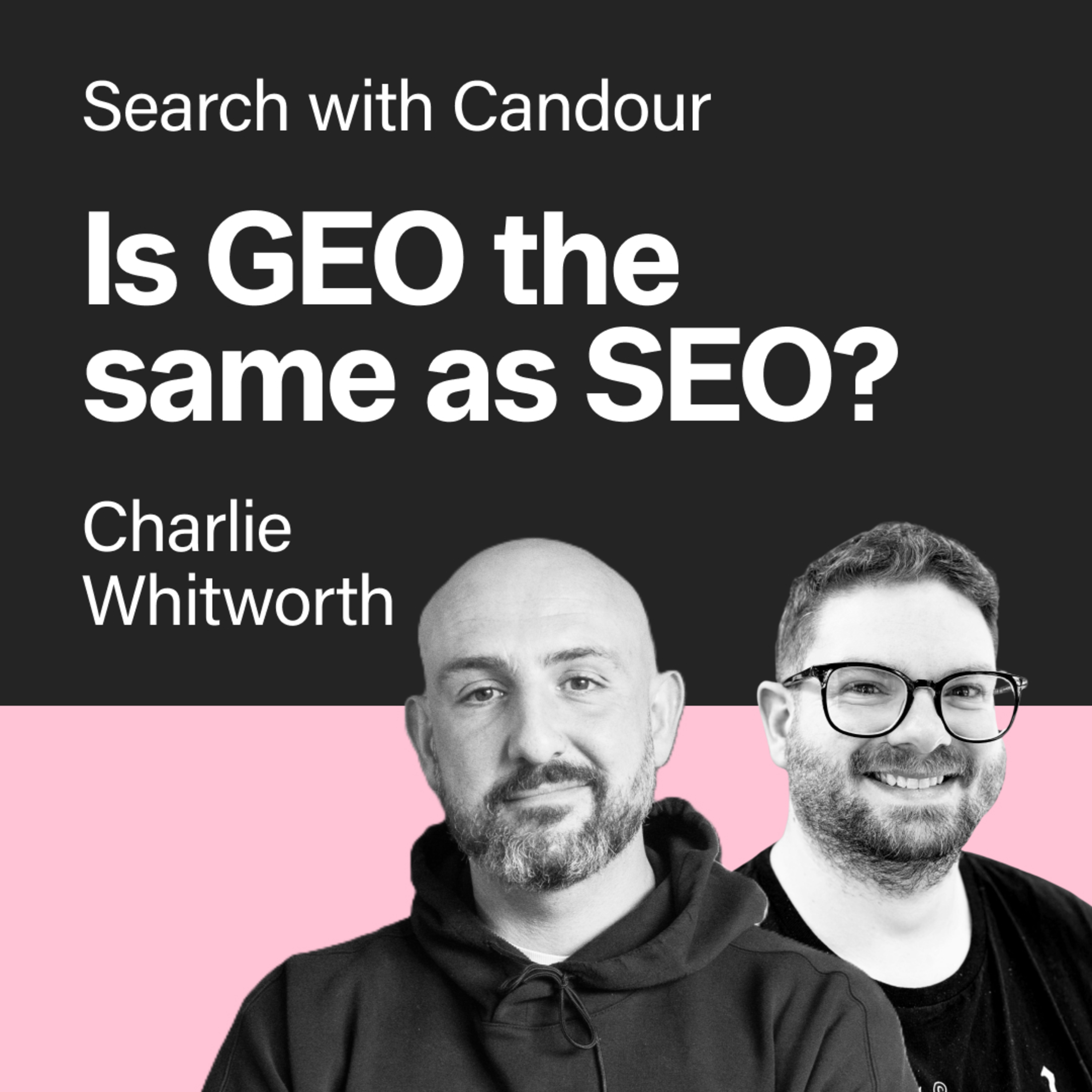
Whether traditional SEO tactics still work for AI search (GEO/AI-ready SEO), and which fundamentals matter most. The episode argues SEO and AI search optimization share the same overarching strategy, but require different “tactics” and more emphasis on technical/content clarity for LLM retrieval.
Charlie Whitworth. Over 15 years in SEO and content marketing; founder of Whitworth (authentic SEO company). Also associated with Hive MCR and has appeared at events like SEO in 2026, Brighton SEO, and Search and Stuff.
Written by AI. May contain mistakes.
Discussion on the perceived death of SEO and the importance of transitioning beyond terminology to tactics.
“I'm getting dead bored of that conversation, but I have been for the last 15 years.”
Overview of Season 5's focus on AI search and a preview of upcoming episodes.
“And they're going to be helping the ELMs, which we know are far less sophisticated than Google.”
Introduction of guest Charlie Whitworth, highlighting his experience and expertise in SEO.
“I think you'll come away with a better understanding of some of the tactics you should be using and some of the tactics you maybe should be leaving in the past if you're thinking about AI search optimization.”
Discussion on why traditional SEO tactics are important to explore in the context of AI search.
“My guest brings over 15 years of experience in SEO and content marketing.”
Insights on managing the transition from traditional SEO to incorporating AI strategies.
“with a lot of your clients in the modern AI search frame so I guess as I tend to start every episode why do you think this is an important topic for us to be talking about right now?”
Emphasis on the importance of data in validating SEO strategies and tactics.
“And then there was that period where clients were a bit unsure.”
Exploration of how SEO practices are changing and adapting to new technologies like AI.
“I don't think SEO has ever stayed static, but it was feeling a little bit...”
Discussion around the integration of AI-ready strategies within traditional SEO frameworks.
Examination of the challenges faced by the SEO industry amidst changes in AI and GEO.
“So because of that it's not been too much of a shift for me.”
Explore the ongoing debate between traditional SEO and geo-specific tactics.
“It is a layer and we'll get into the reasons why but obviously the semantic web is not a new thing.”
Discuss the changing landscape of data availability in SEO practices, especially with AI insights.
“A lot of credible SEOs have been doing that for a long time so a lot of those key principles that are driving performance that SEOs have been doing for a long time.”
Understand the current challenges faced by SEOs in utilizing AI search data effectively.
“about different results for every single person you that's what's put clients up in the first instance.”
Examine the monetization strategies being developed for AI search platforms and their implications.
“I always wondered why Google suddenly started helping us out as SEOs.”
Learn about important metrics and KPIs for AI-ready SEO strategies in the current landscape.
“I think the KPI for those we've been quite clear at the start has been referral traffic from LLMs and revenue from that as closely as you monitor that.”
Explore which traditional SEO tactics remain effective in the age of AI search.
“You know, I do have subscriptions to tools and I do use them because I want to get insights from them.”
Learn how meaningful content structure impacts SEO and AI search.
“and I'm sure we'll get into an energetic discussion in here as well, the way machines understand your site versus how humans navigate it.”
Understand the nuances between how crawlers and users navigate websites.
“And as you said, this is something the tech SEO side, I think, have been talking about for a long time.”
Explore how traditional SEO concepts are adapting for AI search.
“Keeps it nice and simple and that kind of stuff.”
Discover the fundamental SEO practices that still apply in AI search.
“distance of a mind shift towards better structured content which we've all been doing for quite a long time so yeah I think yeah the prioritization and the mindset is a little bit different.”
Learn about the surprising effects of content pruning on traffic and SEO.
“So that's not waned, but these SEO and AI strategies which overlap, such as cannibalization, such as pruning, such as content structure, are having really strong impacts from an AI search perspective.”
Understand the shifting value of linked versus unlinked brand mentions.
“If you can remove as much ambiguity from your strategy as possible, you're going to see the rewards.”
Discuss how brand marketing influences SEO in the context of AI search.
“We've touched a couple of times on brand mentions, and I've discussed it with a couple of people on the show already.”
Learn about the evolving importance of links and brand marketing in AI search.
“I think the link was still very important.”
Explore how traditional SEO tactics are changing and which are losing effectiveness.
“and more on good marketing and good product and good brand has been coming for a while, but it's just been exacerbated.”
Understand the importance of testing strategies and maintaining client trust.
“I'm not saying don't do them but the efficacy of those certainly seems to have waned because it's more about the content now and the structure, the page structure.”
Debunk the myth of quick fixes and silver bullets in SEO and AI visibility.
“I think we've all kind of seen the data now that, you know, for the time and effort to implement it, then it's not the worst thing to do, but it's not going to be a sort of bullet for AI traffic.”
Discover the connections between journalistic principles and effective SEO.
“So by creating that separate product, I think that creates an issue whereby you could end up hurting your organic performance.”
Learn why focusing on revenue-generating metrics is essential in SEO.
Explore the importance of impressions in SEO and how to focus on effective tactics.
“I think I've done a few LinkedIn posts that have gone down fairly well recently about it.”
Understand the implications of Cloudflare settings on website visibility.
“actually this stuff really does still work.”
Discover how traditional SEO strategies are adapting to AI advancements.
“from Tony publishers and like you said, Cloudflare pushing back, potentially going to get caught out.”
Learn how log file analysis can enhance your SEO strategy and track bots.
“There's more user agents than ever, there's more agents calling the web than ever.”
Get insights into effective SEO tools and their applications in AI.
“Yeah, I know when I spoke about SEO last year in my track session, Peter Sirius was talking about log file analysis and being able to track things like WhatsApp and Discord and stuff.”
Hear about personal interests and recommendations outside of SEO.
“I need to train myself up to say it, but yeah.”
The hosts discuss the conclusion of the episode and future plans.
“Have I been calling it Hive MCR and it's actually Hive Manchester this time?”
Encouragement for audience interaction and sharing of the video.
“And that wraps up the first episode of Season 5.”

Get the gist, explore an idea or ask about something said.
 Claude
On Search with Candour, what are the key points of this episode?
Searching your listeningAutomatic transcript. May contain errors.
0:00Are SEO and GEO basically the same thing? Do all of the strategies and tactics we've been using for over 10 years in SEO still apply to GEO when you're optimizing your website and your client's website? That is exactly what I'm here to discuss today with my very special guest, Charlie Whitworth. The SEO is dead thing wasn't created by AI search, but it certainly exacerbated it brought it back. I'm getting dead bored of that conversation, but I have been for the last 15 years. the time is to move on and get past the terminology conversation and talk about the tactics. There's the kind of geo-brows.
0:34Whenever something changes, there's an initial clamor by the industry of how can we go and sell a new product to our clients to make money. That's what's put clients off in the first instance. First of all, they wanted to see that actually this whole AI thing was going to last and it's not just a fad, but then also a lot of what you're telling me is just your perception. Can you show us some data? If the site's slow, LLMs are going to give up. If you're using JavaScript, these ELMs aren't going to render it. Your size structure is still ridiculously important because they're using H1s and H2s.
1:04And then you've got to think about things such as your context windows. So these things are technical SEO fundamentals, right? These attack SEO fundamentals, aren't they? And they're going to be helping the ELMs, which we know are far less sophisticated than Google. So you need to give them even more of a helping hand than you would Google, who have been developing their algorithms over 20, 30 years. These are brand new. Knowing what to ignore is probably more useful than knowing what to listen to. I think one of the best skills you can have right now as an SEO or even a GEO is to try and ignore the noise.
1:36Hello and welcome to the first episode of Season 5 of Search with Canada. This season we're talking all about AI search, GEO, AEO, optimising for things like ChatGBT, Gemini, AI mode, perplexity and everything else. I have got a fantastic lineup of guests throughout the season covering everything from tracking traffic from AI search to how to optimize your website for AI search, what the differences are between traditional SEO and the new AI search optimization and loads of other specific guidance, advice and great conversations coming up over the next few months throughout this season. And we're kicking off this season with somebody who I've been trying to have on the podcast for a very long time, Charlie Whitworth.
2:23I hinted at the topic just now. We're going to talk about what strategies and tactics from traditional SEO still work and still apply when optimizing for AI search engines. Charlie has been doing SEO for a very long time. He has a lot of experience and has actually done a lot of study and case studies and client data around this exact topic. It's a really great conversation. I think you'll learn a lot. I think you'll come away with a better understanding of some of the tactics you should be using and some of the tactics you maybe should be leaving in the past if you're thinking about AI search optimization.
3:02So, yeah, it's a great conversation. It's a brilliant way to kick off season five. I'm very excited for so many future comments and future discussions. Next week's guest is also someone I've been trying to get on the podcast for a very long time. You'll probably see a theme of that throughout the season. is Nathan Gotch. And Nathan and I are doing essentially like a state of AI search discussion. The team at Rankability and Nathan did a really interesting case study, got a load of data and had some really interesting facts about what has changed, what is happening right now in AI search, what's growing, what's declining, all this kind of stuff.
3:41We get into all the details and it's a brilliant follow up to this initial conversation with Charlie. So that'll be next week's episode coming out on Monday, October the 12th. Of course, please stay tuned for all of that. Please do subscribe and like if you haven't already, you know, like the YouTube channel, subscribe to the YouTube channel, like the video, drop us a comment down below, follow us on Spotify and all those other places. I hugely appreciate every single one of you who leaves comments and says hello in the chat. It's very, very cool to see you all down there discussing SEO, giving feedback and all that kind of stuff.
4:17So without any further ado, here is my conversation with Charlie Whitworth, all about what traditional SEO tactics are still working for AI search optimization. My guest brings over 15 years of experience in SEO and content marketing. You may recognize him from places such as SEO in 2026, Brighton SEO, Search and Stuff. He is the founder of Whitworth, the authentic SEO company and the brains behind Hive MCR, which is one of the coolest SEO conferences I've ever been to. Welcome to Search with Candor, Charlie Whitworth. Hi Jack, how's it going? Good mate, yeah, lovely to have you on. I thought this has been a long time coming and we've crossed paths many times at conferences and it's lovely to finally sit down and pick your brains about traditional SEO, GEO, AI search, whatever we're calling it these days, because we did a brilliant talk at Search and Stuff London recently and I really wanted to kind of take the opportunity to kind of pick your brains and expand upon that about what you think is working from traditional search and is still working for what we're seeing now with AI search and maybe some things that aren't working as well I guess and I know you've got a lot of experience in traditional SEO and now working with a lot of your clients in the modern AI search frame so I guess as I tend to start every episode why do you think this is an important topic for us to be talking about right now?
5:42I think it's really important for us to have these conversations and to kind of then as an industry put a pin in it and crack on. I think these conversations have been taking place a lot and we're finally seeing the data to back up what a lot of us have been saying which you know when things are quite anecdotal at the start and quite new that's great and we all know that we trust each other's judgment you know within the community but now we're starting to see the data and the stats and the impact from the activity, we kind of approve in a lot of these concepts. So I think it's important. I think the terminology conversation probably isn't going to go away.
6:18You know, the SEO is dead thing wasn't created by AI search, but it was certainly exacerbated. It brought it back. I'm getting dead ball of that conversation, but I have been for the last 15 years. So I think, yeah, the time is to move on and get past the terminology conversation and talk about the tactics. but yeah I think certainly now we've got a good few years of well I call them air SEO AI ready strategies under our belts we can we can dig into that for data now and kind of prove what's working and what isn't with a little bit more yeah a bit more science and a bit more data. Absolutely yeah I think you're totally right we've been in this sort of like limbo-y kind of period of everyone's talking about it but nobody's actually doing anything and you get obviously the classic grifters on LinkedIn being like, I can make you rank in 10 seconds and all that kind of stuff.
7:11But what I really appreciated about you bringing this topic and what you touched on in your search and stuff was you've got the data to back it, you've got the actual strategies and tactics you're using with clients in the real world to show what is working or what isn't working. I think that is really the next step that, as you were saying, us as an industry kind of need to be discussing right rather than just doesn't matter what it's called like let's actually talk about what's working i mean it's been it's been a strange time because obviously we had that you know when it kind of all blew up a few years ago and then you had the naysayers that are like you know and certainly what i didn't want to be and what a lot of people don't want to be is look like we were sticking our heads in the sand and being like this is not a thing this is fine because we weren't but we were also not wanting to have this knee that reaction would be like, right, we need to change everything to geo or whatever.
8:01And then there was that period where clients were a bit unsure. They were like, should we still be investing in SEO? And what we've done is obviously tried to create a product where they don't have to choose one or the other. They were like, look, we can continue with the SEO and make sure it's AI ready and evolve. And then there was that period of uncertainty, as you mentioned. And now we're certainly in a period now where we've managed to get clients on board, execute the campaigns, and then they've started to mature. and now we're seeing that data which is exciting because hey guess what this stuff does still work or and we've established the things that don't and being our clients are seeing the return on that which is the name of the game so hopefully we're through that we're not through it it's going to continue to change and there'll be more events in the future which will mean we have to pivot again but that pivoting thing's not been anything new and we've been pivoting certainly i've been pivoting ever since penguin and panda and things like that but this has been a really exciting time i mean as a techie as a guy who came into us who was as a journalist and then became quite techie the recent developments have been that exciting so i've been able to to use both those skill sets but um this is the exciting time now because i think we're set with one is settling into our processes and starting to enjoy enjoy this period now rather than this apprehension that was there at the start yeah i think that's a really nice way of thinking about like the way we are maturing about it right and i think again so many people like yourself have been in the industry long enough to talk about the pre and post panda pre and post penguin those kind of eras of seo that so many people talk about it does feel like this is kind of that next step but like you said that's nothing new for this industry there's nothing new for tech in general that's nothing me for a lot of what we do.
9:48We kind of needed it, really. I don't think SEO has ever stayed static, but it was feeling a little bit... For me, I would say I was bored, but our processes have been set for a few years. I think it was a welcome disruption and a welcome... These tools, I mean, it's fun, right? I mean, SEOs have always loved their job, I think, because most of us find it fun. So, although it was maybe a pain because we had to evolve and pivot, change our website on our processes and even some of our tactics um which you know it can cannot be a pain but it's added work i think yeah it's it's been for me certainly a a nice improvement to to daily kind of work to how we go about our job and then and made it a lot more interesting yeah yeah definitely i think that's where we'll kind of get stuck in is that initial question i think that we'll start pretty broad before we get into the tactics and the strategies even more specifically in general do you think the good seo is good geo is broadly true or are you finding it's you know 50 50 a bit more the other way what is your overall feeling about that kind of blanket statement we see so often on in the industry i'm cool with it the tactics it's a difference between tactics and strategy right the strategy is over archingly the same but the tactics behind those are different and the nuts and bolts then as you go more granular behind those tactics are different but the overall strategy of a good SEO strategy is a good geo strategy in my opinion for the reasons that I'm sure you're familiar with I mean it depends what your perception of good SEO was in the first phase right because everyone's perception of that was very different and there wasn't a right or wrong there was different ways you could you could approach it you know you mix between technical SEO your content strategy even UX and CRO and the impact that can have engagement and things so I don't want to say that necessarily I was completely right it was completely wrong but my perception of good SEO was was what it was and therefore that isn't too different to what I think a good geo strategy is and I don't call it geo as you know I like to call it AI ready SEO where I don't think geo is not a separate channel it's a layer of organic search in my opinion and an evolution of that so it didn't change things too fundamentally also I came into SEO 15 16 years ago as a journalist and a lot of principles that are working for geo are quite good journalistic principles and we'll get into why and how we'll get to nuts and bolts of that but they correlate quite strongly in terms of how to keep the reader engaged are too dissimilar power of what you have to consider when your content's being retrieved by an agent and as I say we're getting to that.
12:38So because of that it's not been too much of a shift for me. Obviously there are things that aren't as effective anymore from a technical perspective and that good content has shifted but then also we're not putting all our eggs in the GEO basket because we still want that SEO performance so that's been quite that's been something to keep an eye on is like okay don't just focus on what's good for GEO because at the moment is that even the majority of the traffic it might be but that's probably the same cost all sectors so doing influencing things in a way that's going to drive you to your your ai search performance without breaking your seo is the key bit probably yeah yeah i love what you said though that this ai ready seo isn't a new channel because i think that is often how it's discussed but we often talk about the different surfaces and touch points things like that people talk about you know your content or your paid or your social or whatever and all this kind of stuff and obviously a big discussion in the industry over the last couple of years was breaking down those silos and working better with those other marketing teams and other brand teams and all that kind of stuff.
13:42Do you think that is something the industry needs to sort of be aware of that it is just that extra layer on top of it? You're still using that Google data, you're still relying on the kind of initial seo data and and understanding there before not treating it as a totally separate sort of process of optimization and doing the tactic but there's two elements to this there's the kind of i don't really want to be too critical but there's the kind of geo braves as they're referred to but there is this whenever something changes there's initial clamor by the industry of how can we go and sell a new product to our clients to make money which which i understand that's the name of the game but it needs to be necessary it needs to be prudent um yeah for the client well once they we've realized that actually that's not necessary it's created a bit of a divide in the industry and that the geo um i keep saying bros because that's okay feeling a bit nasty but the the pro geo is have had to stand by their guns and say no it's separate channel here's why and that's fine and that won't necessarily be having a negative impact for those people from a geo perspective but it could be having a negative impact on their SEO performance.
14:53It is a layer and we'll get into the reasons why but obviously the semantic web is not a new thing. Entities are not a new concept. A lot of credible SEOs have been doing that for a long time so a lot of those key principles that are driving performance that SEOs have been doing for a long time. Obviously we're doing it a little bit differently now. So you know the retrieval layer for instance it is a layer. So I think it's dangerous to look at as two different channels because then they can start to work against each other and do you really need to be charging the client twice when you can have a holistic strategy which favors all those services.
15:29I know what the right thing to do is personally. So there's the kind of ethical perspective but then there's also the strategic perspective which is what's going to drive ROI from organic search and AI search is organic search fundamentally And they've paid all the part of that sooner rather than later and already started to be. But from an organic search perspective, our AI search optimization is a layer of that strategy. Yeah, and I think that's the right way forward. Yeah, definitely. I think that is, especially as we're seeing more data become available, because I think there was a real struggle for us as SEOs in the very, very early days, you know, until pretty much earlier this year or late last year, where Google gave us absolutely nothing nothing Bing gave us really kind of nothing and yeah shout out to Bing credit to Bing for what they're doing with so much of their webmaster tools and all the insights they're giving there if you haven't set that up already folks and you want AI insights not sponsored but it is very cool we've been discussing this for our clients recently of like even if you don't have that much you know search volume or an audience that is particularly using Bing webmaster tools is giving insights into that kind of stuff that nowhere else is we've just got the generative ai report in search console which is just impressions just like url level impressions and that's it so do you think there is a maybe a hesitancy or a kind of i don't know a reluctancy to really kind of get stuck in because we simply don't have the data for it in terms of you know clicks impressions yeah conversions all that usual stuff that we're so used to in traditional SEO or do you think that can still prove that with the data we have that that's where this shift from anecdotal you know this is what you should be doing because I because we've done loads of research and we're dead clever and that you know we're the experts to actually clients want to see numbers of you know how do you do a forecast for instance it's really hard what prompts you tracks but do we even know that's the part to use is going to be performing and that pops me bring about different results for every single person you that's what's put clients up in the first instance.
17:35First of all, they wanted to see that actually this whole AI thing was going to last and it's not just a fad, but then also it's like, well, a lot of what you're telling me is just your perception. Can you show us some data? So I welcome, I mean, yeah, the Bing functionality is really, really good. I'm enjoying getting stuck into that data. The Google improvements in Search Console, they've made me giggle a bit because I thought it was great, but I can't really go to a client with a bunch of impressions. quite yeah it does kind of show that they listen to us in a way maybe because i think a lot of people have been asking for that that feature for a while and they're like well we'll give you something whether or not it's because they don't have that data yet or because they don't there's reasons why it's not prudent for them to share it all quite yet um obviously advertising and pay is going to be part of any kind of ai search um platform obviously chat gbt already started that and you know it's difficult isn't it because obviously i started seo in a time where you know, SEO wasn't really, I didn't really get much assistance from Google SEOs.
18:34It was very much paid search. And then the community became a lot more collaborative and people like Matt Cutts and John Mueller and all those guys obviously started giving us a lot more information. But when I started SEO, there was none of that. We kind of had to just guess as we went. But the key was the data. We were using Keyword Planner and things like that, which said it was a paid search tool because you needed to give that information to paid search professionals so that they could do their job and that was what we had. How that's going to translate to AI search we'll see, but obviously up until now we haven't had any data.
19:06It has all been kind of, I'm going to say it's finger in the air, we've got to use our intuition and our experience of marketers and we've done some great third-party tools which we can discuss which have helped out. But at the moment, yeah, even now from Google certainly, our data wouldn't allow us to do an AI search forecast for instance. So yeah, Bing's definitely leading the way I think there in terms of that in those insights. But then it's a tricky thing isn't it because you know you're going to optimize for that proportion of traffic. But yeah I think we're kind of still in beta with a lot of with AI you know it's still only a few years which is no time at all so I'm sure that will change but it will just be how those platforms can monetize that I suppose which will be the name again.
19:51yeah i think monetization and the growth of these platforms is obviously something the people behind the scenes are thinking about a lot right i know that's something people like sundar pitch i and like sam altman and you know the team behind and anthropic and claude and perplexity and all this kind of stuff they are discussing we've seen ads being added to chat gpt we're seeing ads coming into uh ai mode and ai overviews as well i think a lot of us when you know i'm sure you've had the similar conversations with the the paid folks and the pbc folks of like they often leave the charge in a way or they they get the stuff from google first i'm like yeah this is this is on the horizon this is what's happening because as you said google don't really care about us doing the organic stuff they make their money from the paid side of things so they're going to prioritize them and really focus on that side of things rather than...
20:46Exactly. Exactly. I always wondered why Google suddenly started helping us out as SEOs. I kind of think they just needed our help to clean up the web and get websites faster and things like that. Because, you know, Google doesn't really want to monetize or doesn't want to support SEOs because they want people to send their money on paid search. But I think, I mean, I'm very much organic, very much SEO. I haven't doubled much from paid search at all. I don't get that passionate about it, but I kind of welcome ChatGBT doing paid activity because to me I was like, right, there must be some analytics now, surely.
21:22You know, if we can get some analytics, then great. It's more data. So whether or not Google FollowSuit there, I'm not sure. But yeah, as we get more and more data, I think it's really interesting. How much we get and from who and what that looks like is going to be quite interesting because there's got to be an incentive to share that data with us so oh that'll be interesting to see how that sounds yeah definitely definitely and like you said there's a lot of third-party tools doing cool stuff i know we've got yeah a lot of sort of brand mentioned stuff and prompt tracking and share of voice kind of discussions going on which again as you said at the top of the show is nothing new in the industry we we've been tracking that kind of stuff for a while but do you think there has been a shift for certain pieces of data certain metrics that now feel more important than they did two years ago three years ago four years ago uh before like ai's things like citations and things like that for a yeah yeah yeah um i mean we we rolled out our kind of air seo our seo package is not as our so so they're they're ai ready seo packages which essentially drive organic growth across all services.
22:35I think the KPI for those we've been quite clear at the start has been referral traffic from LLMs and revenue from that as closely as you monitor that. I mean you know if it's a transactional website that's quite easy to do, if it's different kind of campaign it can be quite tricky to establish exactly what revenue you've driven from it but you you can monitor LLM for referral traffic and the reason for that is the citation counts are all well and good but if they're not driving traffic they're kind of vanity and then the third party tools with like AI visibility scores and I was immediately a bit dubious of because you know SEO visibility again doesn't always correlate with traffic quite as clearly but you can see where how that calculation has been made it's been increasing rankings presumed click through rate therefore we can attribute a score which which makes sense right you are more if you've got a higher SEO visibility score you are getting more more impressions and what any rankings improve.
23:32With the AI stuff, if it's based, it's a third party tool and it's based on prompts for instance, that's where it starts to get a bit murky for me because like we've got no analytics to prove that these are the prompts people are using and not everyone's going to be getting those same results depending on even the same person can get a different result if they do the same prompt twice. So obviously I know we're all fairly united in that and these third-party tools can only use the data they have. But yeah, I think I've been quite, I've tried to distance myself from the AI visibility scores so far, because I think A, we're kind of in beta, B, they don't necessarily translate to what we're after from any organic search campaign, which is traffic and revenue.
24:17So yeah, I think for me, for our RSEO campaigns, it's all been, it's very much been LLM referral traffic and the revenue from that. I mean, I'm not saying that they're pointless at all. You know, I do have subscriptions to tools and I do use them because I want to get insights from them. But it would probably be more from a strategy perspective than using those scores as a KPI. Yeah, I think that leads us nicely into what you think is still working, right? Those kind of tactics and things that are still translatable, I guess, directly from traditional SEO to AI-ready SEO. I think a lot of people have tried to kind of reinvent the wheel.
25:00Like you said, they try and treat it like a totally separate thing. But we've found from working with our clients and we've found doing testing and lots of other things that there is still plenty of crossover. What are kind of the main things and the sort of primary, I guess, tactics you've noticed that still work now for this new era of AI search? It's great timing actually. We've just, I don't know if you might have seen my LinkedIn post, we reviewed our technical SEO, our SEO auditing templates recently. I haven't done it for three or four years. There's things in there that we knew that we didn't really spend that much time off, but we thought, well, let's give these documents a good refresh.
25:37And then other things that are now kind of more AI focused, things aren't having impact. And it's interesting, you know, the conversation has very much been in certain parts of the sector, the tech SEO is on its last legs because you can just get AI to do it all. That's probably a separate podcast in terms of whether or not you use AI to do your actual auditing. But obviously, aside from the hallucination things, obviously it's only going to be, yeah, you won't get the results of going to be as good as what you're asking. But obviously, recently, there's been clear proof around a lot of technical SEO fundamentals, such as site speed, for instance, if the site's slow, LLMs are going to give up.
26:18If you're using JavaScript, LLMs aren't going to render it, your site structure is still ridiculously important because they're using H1s and H2s and the passages within those to, you know, and then you've got to think about things such as your contact windows. So these things are technical SEO fundamentals, right? They're a clean, well-structured site that's using semantic HTML that is going to give responses nice and quickly, rather than the server side, you know, these are all technical SEO foundations. So although I've made something quite complex on, very simple there, there's a lot more to it.
26:53These are tech SEO fundamentals, aren't they? and they're going to be helping the LLMs which we know are far less sophisticated than Google so you need to give them even more of a helping hand than you would Google who have been developing their algorithms over 20, 30 years these are brand new so they're not going to be sophisticated enough to get that context quickly and easily so you've got to give them a helping hand with structure with speed, why not using too much JavaScript by making sure you're rendering things by the server and not in the client and all these things that have been good solid technical SEO checks for some time and that's just the technical side you know and then there's the content side which again as I said at the start of the show really has lent into my journalism training back in the day which is that you know keep a reader engaged in the first few sentences they're gonna give up this is very much how LLMs are behaving now if they can't understand what you're trying to say within that within that chunk then they're probably not gonna return it because they don't understand it or it's not past the context window not too dissimilar to how you should write for humans really and that's what I was always taught certainly if you look at how Wikipedia structure their content and have them for years you know that is quite similar really in essence to how you should be structuring your content now in terms of every passage needing to have a meaning and a point no filler content because you essentially will get taxed on that so yeah all these things across tech SEO across content strategy all these new principles which have become more important because of llms are good you know a journalistic fundamentals a good content marketing fundamental the good technical seo fundamentals so although there's things now that are less effective and perhaps the prioritization has changed fundamentally those things have all should have all been part of your auditing for the past yeah decade at least so yeah i think crawlability is a big discussion I think it's maybe wake up callers a bit of a strong phrase, but I think a lot of people have, like you said, reprioritized that kind of discussion, understanding the actual information architecture of your site and understanding how crawlers navigate across.
29:08and I'm sure we'll get into an energetic discussion in here as well, the way machines understand your site versus how humans navigate it. And as you said, this is something the tech SEO side, I think, have been talking about for a long time. If something can't crawl your site, it's not going to index your site and people aren't going to find your site. It's a pretty key part. If anything, it's become more important because you've got less sophisticated crawlers now who want to access your site. Google did a pretty good job getting good contacts from pretty awful sites over the last few decades.
29:43And obviously we've then become better at our jobs and help us become more efficient. And these kind of less sophisticated ones, I'd still have no chance if the site is riddled with bloated code or is dead slow or is using some funky JavaScript that's really hard to pass. So yeah, if anything, certain elements of tech SEO become more important some elements have become a little bit kind of deprecated but um yeah certainly and then yeah the content content um thing is a different conversation but that's succinctness and explain yourself well and think about engagement and not having filler content and obsessing over word counts although that is good practice for ai search you know this these things have been favored by algos helpful content updates over the years um for some time it's not it's not a new thing yeah there was a probably my favorite talk at hive mcr earlier this year was jonno's talking about how bloated and over how redundant so much of what sites are these days in 2026 everything is built that kind of feels like an app not really a website it's all yeah javascript everywhere and all this kind of stuff and it was such a like some of the numbers as Jono was pulling out, just like, you can do the same thing that 25 megabytes of JavaScript does in three lines of CSS.
31:07There you go. Keeps it nice and simple and that kind of stuff. And I think we've seen so many, you know, we've seen people freaking out about Markdown or like LLNs.txt and like, oh, I need to create a whole separate AI version of my website. And I think as you just said, Charlie, as a lot of people say, I'm like, well, why can't it crawl it in the first place? What's wrong with your normal site? Like why? Why would that be if you can't crawl your original site, then you've already got a problem? You probably need to sort that out first. Yeah. You know, that is just a good way to practice. Right.
31:39And it's less obsession of a right. What else do I need to do to make sure that I can not manipulate these LNs, but rank them highly? But we still need to think about the same fundamental thing, which is the user, which is about actually intent. And are we actually answering the user's queries effectively? do we still need to be thinking about these antiquated kind of concepts such as you know hue identity and word counts which you know yeah there is massive massive crossover but apart from some of the technical bits which we might have time to get on to and nuances like fundamentally there's nothing brand new in this kind of AI search strategies which is like I've had to go and learn a whole new skill set or a whole new I think people think there's this whole new kind of coding language which is just for AI which we all need to go out and learn a bit like as soon as back in the day here we're a little bit hesitant to get stuck into JavaScript.
32:32There isn't obviously it's a distance of a mind shift towards better structured content which we've all been doing for quite a long time so yeah I think yeah the prioritization and the mindset is a little bit different. I think a lot of us just talk about fundamentals a lot. The fundamentals are the key things especially when you're trying to explain to a client what the strategy is. Well, I'm explaining what the strategy is for a campaign in the moon. And it's not grand-breakingly different to how I was describing the strategy three or four years ago. If I've got quite a techie client who wants to get stuck into it, then fine, we'll start talking about contact windows and passage retrieval and things.
33:10But generally speaking, the fundamentals have changed. Yeah, you mentioned content structure there. And I know there's been, again, a big conversation about chunking and passage indexing and making everything as short and no more than X number of words per sentence and all that kind of stuff. And I think you touched on something really interesting there, your background in journalism being very relevant here as well. And me coming from journalism, but content writing is my background as well. So much of this advice is like, so you're describing writing here. yeah yeah and you need to clearly explain what things do in a succinct manner in a sentence like how else would you do it what what were you talking about like yeah that's writing dude like oh make sure you use like contents pages and bullet points and stuff like yeah that's writing but you're talking about page formatting what are you talking of course you're doing that are you not doing that like and we we gotta say we you and i didn't but the seo the seo community over the last kind of a few decades created a lot of this you know this obsession over word count and filler content and you know to rank for these things you need to have a you know be within this threshold and then keyword density and how close keywords were together which was which is obviously antiquated now but that mindset was created by an seo mindset essentially wasn't it back in the day which which i think we all shifted out of anyway gradually over the last kind of 10-15 years but a lot of the things that we're right now suggesting that are more suitable for AI search yeah is good practice good yeah and good practice from the content perspective anyway completely so yeah I'm here for these changes certainly there's none of these none of the things that I'm now recommending to to rank better in AI search I find jarring or you know or spam they are i think they will get positive changes certainly to be user anyway yeah definitely i think that's a like i said a kind of thing we're all kind of vaguely aware of i feel like but even we mentioned like the structure and the way things are internally linked again something we've been talking about for ages in seo and the way you know humans navigate a site versus how the crawlers and machines too have you found any sort of surprises in in the content tactics and anything that's changed in terms of what is working for your clients at the moment in terms of content so we did change loads i think from a technical perspective we did start structuring content a little bit more thinking about passage level retrieval and you know things like pruning and cannibalization these look all these things i'm saying again it will be part of our templates templates for a while, they've become more important.
36:03So obviously if you've got those duplicate pages, then LLMs are going to struggle because they're going to be trying to chunk them all. Things like internal linking, they're not going to find that content. But the thing that surprised me the most is that those kind of SEO fundamentals still have as much impact as they did. So that's not waned, but these SEO and AI strategies which overlap, such as cannibalization, such as pruning, such as content structure, are having really strong impacts from an AI search perspective. So when we clean these pages up, when we do a prune and get rid of all the deadwood, when we get rid of all the duplicate pages and sort out robots rules to stop crawling all these semi-duplicate pages, the impact on LLM referral traffic correlates with the impact on that SEO traffic almost immediately, which was quite surprising to me.
36:56I kind of knew that would happen but I thought there may be a little bit delay between seeing that impact translate into AI search but our big case would be this this year which was our first proper SEO strategy the trend lines are almost identical which vindicated strategy which was nice and again took the conversation away from anecdotal this is what we think you should do to why we've done this and we've said that it absolutely works and very quickly. So I think the surprise to me there was how quickly these changes were picked up on and honoured by the LLMs. So obviously I've talked a lot about them perhaps not being as sophisticated but we know they crawl a lot obviously, you know, they're quite aggressive so they're going to probably pick up on those changes more quickly.
37:46But yeah, I think that those kind of content related changes i've been quite surprised at how how strong an impact they can have um yeah i think i've seen obviously again not to bring up all the geo bros and the people on linkedin and stuff like that but that i deleted half of my blog posts and my traffic times 10 or whatever that kind of thing yeah that has been a thing i've seen covered a lot and obviously in certain circumstances that is the right thing to do yeah do you think that is that that kind of content audit approach to really getting rid of the pages that aren't performing at all or out of date or anything like that has that been something you're now factoring more directly into that initial kind of strategic discussions onboarding discussions with clients things like that absolutely i mean you have to be careful with it right it can be a really dangerous tactic if don't get it right and a lot I mean I've seen some audits come back where we've had to reverse that because the previous incumbents hadn't looked at things like referring domains, hadn't looked at internal linking you know they've just been like right it's had less than X sessions let's collect which isn't the way forward but a really considered prune can be so effective especially for like enterprise level sites for many reasons I mean there's one word that I keep going back to with clients which really is the crux of a lot of campaigns from an SEO perspective but also when I and has been for a long time, which is removing ambiguity.
39:16If you can remove as much ambiguity from your strategy as possible, you're going to see the rewards. And that can be translated to tech SEO, it can be translated to your content strategy, but things like cannibalization, and when you're looking now at entities and semantics on your website, removing any ambiguity is going to have that positive impact because then you are going to have passages or pages competing with each other, and you can really then optimize those pages or those passages for what you want to. But you've got to consider so many things. But it really depends on the site you've inherited.
39:50If you've inherited a 25-year-old domain which is an enterprise level which has had a really good SEO and plenty of the years but has never really had much housekeeping then that can be a really quick win because you've got a lot to go at. If you've inherited a site that's been fairly well looked after and it's been perform pretty well but then maybe the problems that they're facing are more quality based rather than kind of technical then you know you could go away and do that prudent and see very little impact so it really depends what you've inherited but certainly it will have that impact not necessarily expected but the LLM really appreciates it because there's only one page or possibly one passage for what they're trying to get that context for so yeah I think that's kind of what I was referring to in my last point really is the impact of that from an AI system that can be massive because while trying to give too much away you don't just do that pruning on its own you're complementing that pruning with restructuring the page with looking at your fan art theories with all the other kind of tactics so if they work in tandem it's not just about deleting loads of content and you're going to fly to the moon but by getting rid of that ambiguity and then optimize it properly in tandem then yeah you You see that in back to the weekend.
41:02That's good SEO. Yeah, absolutely. We've touched a couple of times on brand mentions, and I've discussed it with a couple of people on the show already. The discussion between, I guess, the weighted value of linked versus unlinked. Traditionally, previously, obviously, doing link building, doing digital PR, you want to get those backlinks coming to your site. That is still, I think, still a very important part of how Google understands the web and how sites relate to each other. Have you seen a shift in that kind of, yeah, I guess the perceived value or actually demonstrable value of unlinked mentions versus linked mentions?
41:41Yeah, I mean, this has been happening for a while. And again, this wasn't created by AI search. I think Google has been trying to be less dependent on hyperlinks, external hyperlinks for a long time. I think they tested removing it altogether when the results became terrible. So they realized it was always going to have to be a big part of the algorithm. I think the link was still very important. I mean, I've worked with some big brands over the years. I was in-house at a big fast fashion brand. You know, what links have often been a byproduct of good brand marketing. So although, you know, digital PR is hugely important because you can you get the coverage, which then correlates with the link.
42:23A lot of the links we saw weren't necessarily built, but they were earned as a result of some very good brand marketing or a good campaign or a good product, right? And this is another point. I think the advent of AI search has been great because back in the day, you could use SEO to get a pretty poor brand or a poor product to outrank the good guys, as it were, through whether or not it was over-optimization or just clever advanced SEO or just solid fundamentals. Thankfully that became less the case of SEO. AI search, you can't get away with that because if your product's poor, there's so many signals there that the LLMs are looking for, that you can't put a poor review, or your product's not good, or you can't be named.
43:06There's no way that you can appear credible because that's not gonna work. Gone off a bit of a tangent there, but I think it's the same with the link building perspective. You've got a great product, and you've got a great brand, and that's being marketed properly. A lot of those links that you were getting were a byproduct of that, and we're being earned in the right way. And a lot of times those links would correlate with good coverage and good brand. So thankfully there is less need for that actual hyperlink now. And I think that's true of traditional SEO as well as AI search. AI isn't necessarily looking for those hyperlinks, it's looking for those brand signals.
43:45And I think that's a really positive change. And it's good because digital PR agencies can still thrive because a lot of the work they do isn't, I think they've, they always had to have backlinks as their KPI. I don't think many PR agencies would be losing sleep over being KPI less against actual backlinks so they can focus on the actual PR work that they like doing. But then the impact of that work isn't so dependent on the hyperlink that work can be dependent on the campaign and on the actual PR. So yeah, hopefully that answers your question. I just think, yeah, I think it's, yeah, it's stopped those less credible brands and less credible products from being on the people that should be doing well.
44:24And the impact of good SEO and good PR now is less dependent on, on the spammy stuff, which is yeah. And those backlinks rather than the actual coverage. Yeah. I think that is Ken coming back to your fundamentals of journalism, right? But what people are saying about you, I know a lot of people are talking about a, you know, brand reputation management and stuff like that. And so much of this feeling very modern tech driven, AI driven stuff is like, isn't that marketing 101? Isn't that like the absolute, before we had electricity, you needed to be doing that kind of stuff, right? Yeah, I mean, it can be problematic for an agency because if you work with a prospect and you straight away can see that they've got bad reviews and they've got, you know, their product isn't brilliant.
45:13and you've got to have an honest conversation to say, look guys, we can probably improve performance for you, but there's going to be a glass ceiling to this until you sort your product out or sort your customer care out or improve these credibility signals which are going to be holding you back. Whereas before, you could be confident that you could SEO your way out of trouble. But then again, it creates more of an opportunity for those credible brands. If you do an audit and you can see, well, their product's awesome, but they're not talking about it well enough, there's no signals on the website to demonstrate that then you notice and some quick wins there so yeah it's a different game now but I mean personally I think it's a good if if if you're not able to promote sites that are less credible to spammy SEO I think that's gonna be a good thing for the user but yeah I think I think that less obsession over those kind of antiquated tactics and more on good marketing and good product and good brand has been coming for a while, but it's just been exacerbated.
46:13AI has certainly been a catalyst for that, which has been a good thing. Yeah, definitely. I think that's... Yeah, hopefully, like you said, the catalyst for a lot of this is kind of hopefully getting a lot of people in the industry to kind of go back to fundamentals and do good stuff in general. And it's not to say that if you've got a good product, a good brand, you don't need SEO and you don't need an AI search strategy. It's just that that's going to be a massive accelerant for you and you know our skills and expertise are invaluable to that it just means that you um yeah you're certainly looking at those marketing fundamentals and first and how you can leverage those to succeed and yeah essentially we technically we see less poor results don't we i think when we started an seo the results wouldn't want we're not great mainly because of link building so yeah exactly is there been any sort of other surprises from your case studies from your data from your experience that you were surprised it still works or has now shifted in priority in terms of the tactic so there were some prizes and things in terms of things that don't have so much impact anymore and so we found that things like no for internal no following and you know kind of no follow sculpting and things like that well all the tactics we used to have to use for like passive navigation and things so there was um an example I gave at my search of stuff talk where a poor migration went live let's say which wiped a lot of stuff out and it quickly proved that certainly even from a traditional SEO perspective those things are less effective so people doesn't need so much help for these kind of internal directives anymore which is probably more sophisticated I don't think LLM is certainly paying too much attention to those kind of things either so those kind of those kind of advanced SEO tactics certainly for enterprise sites.
48:08I'm not saying don't do them but the efficacy of those certainly seems to have waned because it's more about the content now and the structure, the page structure. Which I think they probably are going to look at kind of not old-school tactics but some classic SEO. So those kind of, and to be honest, they were very laborious you know. You work on an enterprise website, those kind of projects were hard graft. So you know, although some of the seo purists probably wouldn't like to see them go i think yeah that's like those kind of like page rack page rack sculpting tactics are less effective now yeah yeah i think that's a a big conversation where i don't necessarily people are thinking it round the wrong way but like you said i think it's all about that prioritization where you're spending your time where clients are spending their money and stuff like that.
49:03You see a lot of, you know, we talk so much about testing, I guess, is where I'm going with this. Like, is it fair to then do tests on client sites and all that kind of stuff? Like, you're spending their money to then, you know, go and do this thing. But you need the real data. And I know there's a big advocacy in the industry of, like, test on your own sites, do all this kind of stuff, right? And I think from my experience and from the team here at Canada, like, having those kind of conversations and just being honest of like we have been doing this now we need to deprioritize that now we're prioritizing this this is why as you said earlier we're still in beta we're still we're still in the early stages here not promising your client the world you kind of can have those hopefully you have a good reputation and relationship with your clients so you can have those conversations right i think it's fine i think that the client cares really if performance is adversely impacted and that you know they appreciate i mean i'm a consultant right so like my job isn't necessarily the implementation all the time it's to give them the right strategy the right advice and that might be that like this thing that we were doing six months ago we don't we i don't think we should do it anymore we're going to reprioritize based on what google's told us or some testing we're doing that's kind of what they pay us for is to give them that counsel really and and and to help with that but also you know things do evolve and do change um but going back to your point before if means switching from spending two days having to do a massive internal linking structure internal site structure document and yeah as I say like page wrapped sculpting and no follow sculpting and things like that but that's never been replaced with you know how can we champion this product better how can we talk about brand credibility more how can we get some of these EAT signals on the website how can we structure these product pages more concisely so that crawlers are getting information they need more efficiently I don't think they really care if it's the right thing to do and it's going to drive ROI and if everything stays the same they're kind of what they're paying us for anyway so exactly exactly yeah yeah has has there been anything sort of i guess that you've seen maybe debunking some myths we'll get into that the thing a lot of people talk about that they say work or you've seen people claim are working but from your experience don't actually move the needle i mean it's going to be really hard to not talk about llms.txt on a on this kind of we mentioned it earlier i mean i don't want to label that point too much.
51:27I think we've all kind of seen the data now that, you know, for the time and effort to implement it, then it's not the worst thing to do, but it's not going to be a sort of bullet for AI traffic. It's not going to catapult it. We've tested it, and some colleagues of yours have got strong opinions on it as well. But, you know, I think it's really hard because if something's not going to have an adverse impact, then it's not going to take loads of dev budget to do, then there's certainly that ethos of, you know, why not? But I still haven't seen any case studies where brands have implemented LMS.txt and then since the AI visibility goes through the roof.
52:04There's kind of evolutions of that. So obviously we've been testing Dixon's entity maps and again, no effort. We'll see how they go. They make more sense to me because there's some structure to it and certainly it plugs into entities and semantics which is all part of a good seo campaign anyway so i think there'll be that that knock-on effect but i think what kind of what i mentioned at the start of the podcast is that there's no magic ai only technical language that you know silver bullets that you go around and add to your website suddenly it's going to mean that you come up and get cited and in chat gbt and gemini and claude moroc and because that's not the way it works but are there things that you can do to accelerate that because you've already got a great brand and you make that easier to retrieve then then that stuff has more impact so i think yeah there's no silver bullets um certainly um i'm sure there'll be geo bros out there who will tell me otherwise who invented things that's catapulted their sites but you know i'd be interested to see the actual data behind that that's not anecdotal um the separate geo budget thing i think it it it doesn't would be counterproductive um not because i don't want people to to run their business in the way they want to but i do feel like having geo and seo as separate channels creates a conflict between the two and you know you could have tactics that you know if we were to go and build a website completely for llms tomorrow it would look pretty poor wouldn't work very well in your seo track you'll probably fall off a cliff.
53:45So by creating that separate product, I think that creates an issue whereby you could end up hurting your organic performance. So I think that's something to stay away from, certainly. And yeah, I think just obsessing over kind of citation counts and these kind of AI visibility metrics, I'm sure there's tools out there that would hate me for saying that. I'm not saying not to use tools, because I use those tools and they are great tools but using that citation count or that ai visibility score as a kpi for like a geo or an ai search campaign um is problematic um because you're focusing on the wrong on the wrong thing and not thinking it's gonna gonna drive revenue essentially in my opinion um yeah in our early days that that that's kind of it really i think there's been loads of tweaks we've made to our technical auditing and i've mentioned context windows and passage level retrieval quite a bit um certainly with a kind of journalist hat on cleaning up pages so they're better structured and i'm using those journalistic fundamentals that i was i had to swap back up on them a little bit probably show my age but it's like journalism degree about 20 years ago but it's actually crazy i suggest people go and actually have a read up on it because they're all they're almost perfectly aligned like best practice journalistic kind of guidance on how to structure content is almost in line with what people are saying how you should structure your content for for lms because it's about that attention like the user's attention isn't too different to the context window that an lm has you can't explain your point quickly and concisely and cheaply um then then you're going to lose them essentially so i think that that's been quite nice to see yeah definitely definitely i think that's been one of the sort of like you said looking back at the fundamentals not just of seo but of journalism and and copywriting and all this kind of copyright yeah and thinking like yeah how much we've have in a way how far we've come but how much the fundamentals still matter and i think that's also true we're saying there about bad data right i felt like we were in a nice place in seo a lot of people finally moving away from what we call these vanity metrics don't just report on impressions to your client actually talk about what moves the bottom line and then it all came back around again and now we only get impressions it's like okay yeah it's funny isn't it but i mean yeah hopefully that'll change soon but yeah that's yeah yeah i completely agree i think impressions has been a dirty word for a while now but certainly since changes to to surge a couple of years ago because you know a massive jump impressions with all this doing absolutely nothing and actually sometimes having the opposite effects on clicks the old crocodile effect things like that so yeah i think i don't get too excited by impressions these days is there anything else you want to highlight want to shout out that you think people need to be aware of when it comes to i guess pivoting and a little bit to uh geo and AI ready SEO?
56:50I think I've done a few LinkedIn posts that have gone down fairly well recently about it. I think one of the best skills you can have right now as an SEO or even a GEO, if that's the way you're going, is to try and ignore the noise. Knowing what to ignore is probably more useful than knowing what to listen to. Like, I think you probably already got a good idea of what you stand for in terms of the tactics that work and what kind of SEO you are. but if you listen to every single new tactic, new methodology, new geo kind of silver bullet, you're gonna drive yourself mad and you can't implement everything and if you do implement everything that you read online or hear about it, it's probably not gonna end up it positively.
57:32So I think learning how to just get your head down, test, prove these concepts to yourselves, look at the data and not pay too much attention to anecdotal stuff. That from a kind of soft skills perspective I would recommend because that's I was driving myself a bit crazy with it all and then when I knuckled down read different templates looked at what was working implemented to make a SEO campaign to my clients realized that my journalists and trainers stood me in good stead and actually these technical fundamentals are still working it kind of calmed me down a bit because I could see actually this stuff really does still work.
58:08So from that perspective that would be my recommendation and then just a little bit of advice that for anyone who's running campaigns that are served by Cloudflare, make sure you go and check out some changes that are happening on the 15th of September. There's a bit of scaremongering out there that's saying everyone's saying Cloudflare is blocking all AI bots. That's not quite true but there are some settings in there whereas if you've got disallow training bots that could potentially stop Googlebot, Applebot, Bingbot from getting in from those traditional crawlers. So yeah, if you've had other teams that have been in charge of your Cloudflare, if even you haven't checked your settings for a while, go and check those settings before the 15th September because you could accidentally be blocking some quite important crawlers.
58:54Because then I think what happened when this all blew up is everyone wanted to go and block AI from the corner of the site. so they're like no i don't want you calling my website how dare you steal my content which i think fair enough but also i think we all realize now we need to allow that access if we want to to be visible so i think that a lot of people might have turned that on um back in the day um so yeah a bit of a freebie there go check your car press that ends before 15th september because it might be a might be a few little red herrings in there nice yeah i think I think that's the kind of backlash from Tony publishers and like you said, Cloudflare pushing back, potentially going to get caught out.
59:32So I appreciate you highlighting that, man. Yeah, the deadline's coming up sooner than you think. Yeah, you're probably fine, but you might not have checked the box yourself and it was quite easy to do. But yeah, just worth a little sense check there because it's not really the impact on AI search. You could actually block Googlebot inadvertently as well. But yeah, I think the future is bright. I think there is massive crossover between what was working traditionally for SEO and what's working for AI Search. It all depends what your bar for good SEO was back in the day, as I mentioned at the start.
1:00:06If you are quite a good hybrid technical SEO who had a good eye for content. Actually, I think the biggest thing that it's going to get rid of is filler content, which I think has been the bane of SEO and bane of websites for a long time. And you can quite easily tell when a piece of content had been created for SEO purposes. I think that kind of approach to content, I think now will, well, it won't just not be effective, it's damaging. So I'm seeing a lot of these changes as a big cleanup, hopefully. So I have a big cleanup job across the web, hopefully. Yeah, hopefully. Hopefully we'll get, because I feel like it's been so doom and gloom recently.
1:00:46I hope we're moving in a positive direction, right? Yeah, I think we are. I think I've got my positive hat on these days. I think there was that bit of uncertainty wasn't there. Last year was a weird one for the industry. And, you know, I've got some friends who left the industry because they were just, couldn't really cope with it all. So I've stuck at it. I mean, I wouldn't be able to do much else now, unfortunately. But I think I'm excited. And this is just the start. I think there's going to be even more cool developments on the horizon. so yeah definitely definitely speaking of fun things that aren't doom and gloom let's get into the recommendations the final segment of the show and you've given us so many tactics and tips and things to do already but what is one actionable tip you think everyone should start doing today so yeah this might sound like a copal because this is probably it's been like a buzzword for a long time especially from a tech s perspective but log file analysis is is having a second birth it's definitely more important than ever.
1:01:46There's more user agents than ever, there's more agents calling the web than ever. There's more consideration for what you want calling your website and how often, but also checking that the right agents are calling your website. So I just mentioned like Cloudflare settings and things, that could be stopping some key bots and agents from accessing your website. The only way to really establish that before you get a clear view on that is to be checking your log files. so certainly after the 15th of September check your log files, check everything that you want to be accessing your site can if there's anything there that you don't want to be accessing your website obviously there's lots of ways that you can restrict and throttle that obviously Cloudflare is a great bit of kit, you've still got traditional tools like your robots.txt but I think yeah before when I started doing log file analysis about a decade ago there was probably two or three user agents there that we were concerned with, obviously there's hundreds now So I would suggest, yeah, they can be gold dust.
1:02:44Very hard to get hold of, depending on your relationship with developers. Or some sites don't even have them. I think Shopify used to have issues with it. CloudFront, I think, can be tricky. So you might not be able to get them. But there will be some kind of view within analytics, if you are using a CDN, that should be able to tell you what bots are accessing your website. But the absolute holy grail is your log files. I think checking those now and having a tool to help you to monitor those now is more than ever. So yeah, I would get back on that if you've let it slip a little bit. Nice. Yeah, I know when I spoke about SEO last year in my track session, Peter Sirius was talking about log file analysis and being able to track things like WhatsApp and Discord and stuff.
1:03:33Stuff that you cannot get in traditional analytics and stuff like that. You see some mud stuff in there. Yeah. Spotify, TikTok. Also, another point to that is it's not just about checking that those bots are crawling your site, but it's where or what they're crawling. So it could be that you've released a new category of your website or done a big push on some fresh content or a hub of subscription. If three months down the line, certain agents aren't seeing that content, then there's probably a reason for that. So it's not just about, right, are all these bots getting through? where are they going and what are they doing when they're there and I've never given one to them definitely yeah and again yeah it could be some bots that have taken the mickey a little bit and you might want to throttle or restrict and spoofing is still a big one as well so I was working with a big publisher last month who were like we don't do Google ads but we're seeing hundreds and hundreds sorry hundreds of millions and millions of hits from from ad spot it wasn't ad spot at all it was someone pretending to be ad spot so it was clearly hiding the website so yeah and that wouldn't have been possible to to to resolve without log file analysis so yeah have a good have a good check of those and yeah have a look up on the spoofing bit because that's happening a lot at the moment as well yeah i think that's uh fun to get into all the details get into the data and stuff like that apparently ads bot is really easy to spoof for some reason yeah which doesn't sound good does it well speaking of data and things what tool or piece of software have you been using recently you think deserves a bit of a shout out i'm going to pronounce it wrong because dixon always tells me off but i i started saying wi-kai and i will try to stop you sound scouse there kind of mate i've got i've got a little bit of scars in there so yeah um we're all days coming back but yeah i think it's wakey wi-kai what ai knows about you is what it stands for um but it does far more that's a really good tool to start looking at your your AI ready SEO strategy.
1:05:35It does do prompt tracking which obviously I've got my thoughts on which is just part of it but it's really good for looking at what competitors are doing, it's really good for looking at your brand topic map, topic level topic maps, recommendations for you know for extractability and things like that. It's a really good all-round AI search tool built by Dixon as Dixon Jones who's obviously behind Inlinks and you know Majestic and all sorts of amazing tools over the years so trust him implicitly but yes it's an amazing tool and it's a really good price point as well so highly recommend it. Yeah we've been using YK a lot for our clients and like you said understanding where brands are sitting and all that kind of stuff and yeah you mentioned much earlier on like you know we've been doing entity SEO for decades and like Dixon is one of the people that kind of pushed that to the forefront of the entire industry.
1:06:30Always invented it, exactly. But it's funny because there's some really good recommendations and it is such an AI tool. But honestly, the recommendations, there's not a single one that's not an SEO recommendation really. It shows that overlap between AI search and SEO. So, but yeah, no, we use it for every campaign. And it's a bit of a competitor analysis as well. If you're doing like a new business audit or a prospect that hasn't necessarily made you signed up for a time, you want to give them some nice nuggets and insights very quickly, then YK is really good for that as well. Nice, nice. I'm sure I'll get an angry message from Dixon about mispronunciations.
1:07:13I think you were right. I think it is YK. You know when you're saying something after long, I need to train myself up to say it, but yeah. It's great either way. And last but not least, something fun. What have you been enjoying recently, Charlie? Not work-related, not SEO, nothing like that. What have you been up to recently? What have you been enjoying? So I was enjoying the World Cup until we lost, but went to an amazing gig recently. Again, sure, my age, but I'm a 90s kid, and I was a big fan of the streets back in the day, still am. And I went to go and see them at Castlefield Bowl in Manchester on a hot Saturday evening, and then it was definitely probably too old to be enjoying that kind of thing still but i went anyway and it was a lovely evening and the streets were still great so yeah that was my that was my bit of fun for the last few months yeah i'm a 90s kid as well mate and i remember you know original pirate material coming out all back in the day like the real kind of and it felt like a resurgence of sort of british underground rap kind of pirate radio type stuff like yeah it was a very cool with it to be in i'm a big uk garage fan and i'm and i've still i've stayed i've stayed loyal and it's not it's not quite uk garages but it's the similar kind of genre but um yeah it was a good crowd actually it was good to see a lot of youngsters there enjoying it as well so it wasn't just wasn't just us all these yeah it's a it feels quintessentially british as well very british very british exactly well thank you so much for joining me it's been a pleasure to pick your brain get some insights into what's working and what's not working for as we're calling it now ai ready seo i'm using i'm going to use your use your proper proper phrase there proper slogan uh if people do want to keep up with as you said what you're posting about what the case studies you're sharing the strategies you're discussing where are the best places to follow you charlie whitworth so yeah i'm quite active on linkedin um the authentic seo is is my handle on linkedin or Charlie Whitworth.
1:09:11Obviously as you guys might know I run Hive Manchester as well so that the Instagram for Hive is fairly popular. I'm on Blue Sky as well under Whitworth SEO. So yeah a couple of brands there so it's either Whitworth SEO or Hive Manchester depending which hat I've got on that day but it's all SEO focused. So yeah I do share quite a bit on LinkedIn. I'm quite, I don't mind sharing tactics and techniques as you know we work in an industry where we all like to collaborate which is great and I think that's been very important over the last few years so we'll keep that going but yeah I think with a lot of this stuff there's no exact right or wrong but thankfully we're seeing that good old-fashioned SEO is working in you know in tandem with some with these new techniques and organic search has still got some fight in it, I think.
1:10:02Yeah, definitely, definitely. Have I been calling it Hive MCR and it's actually Hive Manchester this time? Have you just blown my mind? No, it is kind of both. I don't know. I should probably stick to one as well. MCR is the abbreviation for Manchester. Yeah, I got that, mate. But, yeah, no, I try to change myself, so I can't really. No, no, that's fine. 5MCR is what a lot of people across the pond call it as well, so we'll probably stick with it. Yeah, we've got Search and Origin, we're now doing Search and Origin XL, so I know the feeling of the double brand going on at the same time. Yeah, it's not good for that stuff.
1:10:39As an SEA with entities and stuff, I just stick to one and reduce the ambiguity, shouldn't I? Exactly, exactly. Thank you so much for joining me, mate. It's been an absolute pleasure. Thanks for having me, Jack. And yeah, see you soon.
1:10:56And that wraps up the first episode of Season 5. Thank you so much for joining me. I really appreciate you coming along for the ride and joining us for Season 5. Of course, I'll be here next week, like I said, with the one and only Nathan Gotch. And we've got some brilliant extra guests coming up over the next few months. This is basically the plan for at least for the rest of the year and into 2027 as well. I've already recorded the first four episodes at time of recording this. So you've got some great stuff coming up over the next few weeks as well. If you haven't already, please do like the video, share it around.
1:11:31And if you are thinking tactically and strategically in your teams at the moment, please do share this video around. We've been talking about this internally recently and how we should be using the knowledge that I gather from my podcast guests to actually influence what we're doing internally here at the agency as well. So I think there's some really valuable stuff and you can get more information by going to withcanda.co.uk. There'll be a full write-up with some tips and advice and all that kind of stuff from Charlie about the episode as well. You can click on the podcast button and find all the previous episodes of the podcast there as well.
1:12:06You go straight to withcanda.co.uk slash podcast and find everything there as well. In the meantime, have a lovely week. Thank you so much for watching and I will see you next week.
Welcome to season 5 of Search with Candour!
Jack sits down with SEO veteran Charlie Whitworth to discuss whether SEO and “GEO” are essentially the same and which traditional SEO strategies still work for AI search.
Follow Charlie
Chapters
00:00 Highlight
01:36 Introduction
04:27 Meet Charlie Whitworth
05:33 Why this matters now
10:43 Good SEO = Good GEO
14:05 GEO bro debate
15:56 Data and measurement
21:46 KPIs that still matter
25:12 Technical SEO still wins
27:28 Content structure for LLMs
35:46 Pruning and cannibalisation
38:40 Content pruning done right
41:06 Brand mentions vs backlinks
44:34 Good products beat spam
47:07 Old tactics you need to stop
49:03 Testing and reprioritising
51:03 No silver bullets for GEO
56:39 Ignore the noise
58:11 Cloudflare bot settings
01:01:18 Recommendations: Log file analysis
01:05:03 Recommendation tool: WAIKAY
01:07:22 Fun recommendation: The Streets
01:08:40 Wrap up