In short
Overview of Alzheimer’s disease—early warning signs, what causes symptoms in the brain (amyloid and tau), how diagnosis has improved (amyloid/tau PET biomarkers), and what gives hope for future treatments (including anti-amyloid and tau-targeting approaches like antisense oligonucleotides).
Guest backgrounds
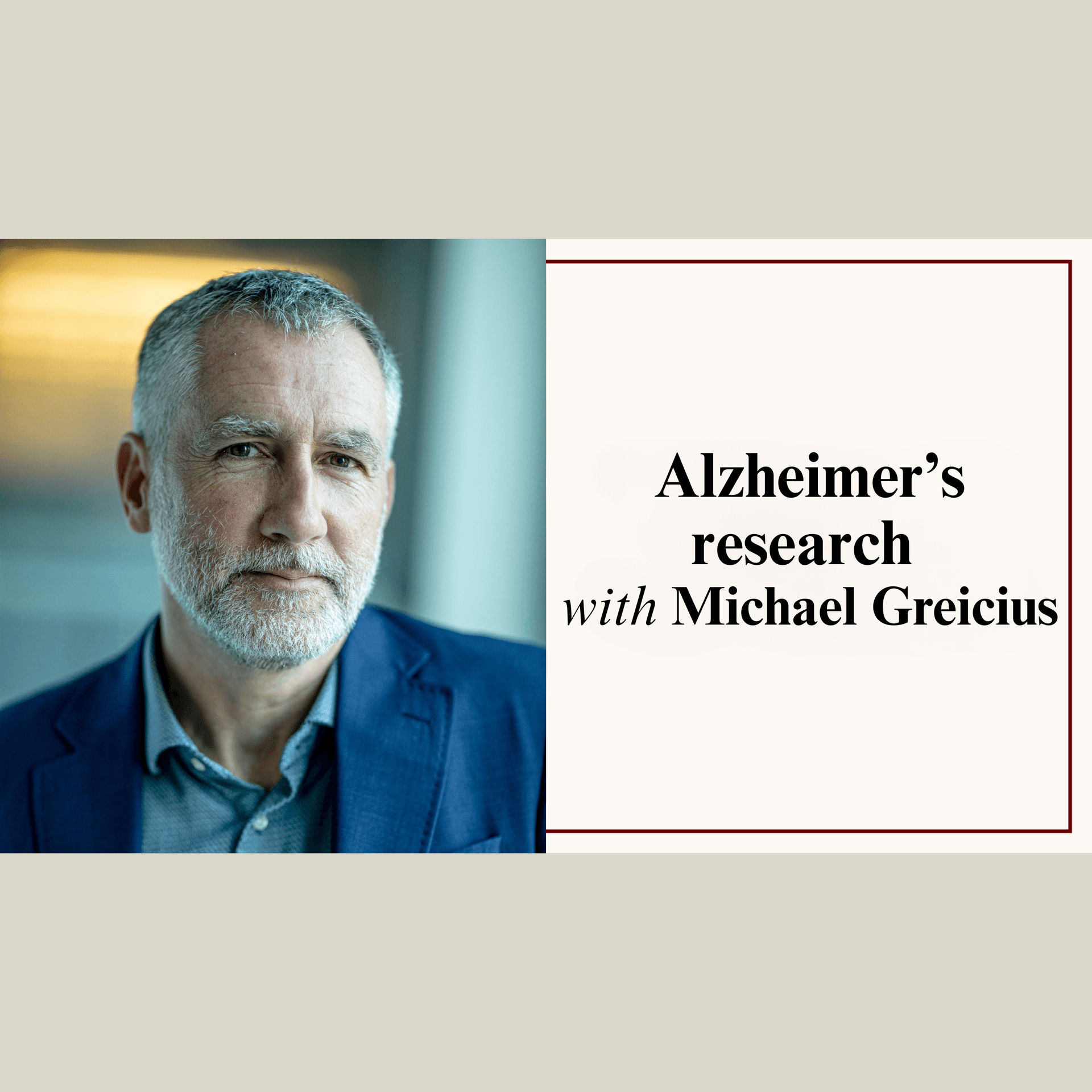
Mike Gracious, professor of neurology and neurological sciences and behavioral neurologist at Stanford; focuses on imaging brain networks and Alzheimer’s genetics. Sharon Shaw, clinical professor and Alzheimer’s research/patient-care expert (mentioned as differing slightly on anti-amyloid treatment approach).
Key claims
Repeating the same question multiple times is a worrisome early sign; first symptoms are often short-term memory problems. Amyloid plaques likely “get the ball rolling,” while tau aggregates inside brain cells and maps to affected brain regions. Amyloid PET showed that clinical diagnosis alone misses amyloid-positive disease about 25% of the time. Anti-amyloid antibodies remove plaques but clinical benefit is uncertain.
Notable examples
A “genetic trio” case—daughter with early-onset Alzheimer’s in her mid-50s had ApoE4 from healthy parents; mother had two ApoE4 copies yet stayed healthy into her 70s. ASO therapy success in spinal muscular atrophy (infants) is cited as proof gene-specific approaches can be transformative.
Written by AI. May contain mistakes. Listen to the episode to check what was said.
Chapters
Tap a time to open that second in VOUnderstanding Alzheimer's Disease
0:45 to 1:56
Overview of Alzheimer's disease, its prevalence, and ongoing research.
“you may even know someone who's been affected by this devastating illness.”
Introducing the Experts
1:56 to 2:21
Introduction of the guests, Mike Gracious and Sharon Shaw, and their expertise.
“I had the pleasure of speaking with Mike Gracious first to gain insights into the history of Alzheimer's pathology and its connection to our genetics.”
Mike Gracious's Journey into Neurology
2:21 to 3:17
Mike Gracious shares his path to specializing in behavioral neurology.
“I thought I was interested in surgery and quickly ruled that out.”
Genetics and Early Onset Alzheimer's
3:17 to 7:20
Discussion on a unique case that highlights the genetics of early onset Alzheimer's.
“Is there one story or one case that stands out in your mind that sort of impacted your career like a milestone or a moment of discovery that you'd like to share with us today?”
Differentiating Onset Types
7:20 to 8:16
Exploration of how early onset Alzheimer's differs from typical onset.
“Mike, you mentioned that, you know, late 50s is sort of considered an early onset of the disease.”
Causes of Death in Alzheimer's Patients
8:16 to 10:21
Explanation of the common causes of death related to Alzheimer's disease.
“role in Alzheimer's than a dozen people in their 50s and 60s.”
Recognizing Alzheimer's Symptoms
10:21 to 12:25
Insights into the early symptoms of Alzheimer's and when to seek help.
“And what is, can you take us through sort of what is the experience and what maybe, what should people be looking for, for signs?”
The Brain Mechanisms Behind Alzheimer's
12:25 to 14:02
Overview of the biological processes and proteins involved in Alzheimer's disease.
“And then some of it is just really quite distinct, like this repetitive question asking is a very worrisome sign.”
Understanding Tau and Amyloid in Alzheimer's
14:02 to 15:40
Learn about the roles of tau and amyloid proteins in Alzheimer's disease progression.
“tau, that also can misfold and aggregate, similarly to the amyloid protein.”
The Impact of Amyloid PET Imaging
15:40 to 17:48
Discover how amyloid PET imaging has transformed Alzheimer's diagnosis and research.
“I mean, so what's been most miraculous in my career over the last 20 years is around 2004 was the first demonstration of what's called amyloid PET imaging.”
Show all 17 chapters
Debate Among Experts on Anti-Amyloid Therapies
17:48 to 20:06
Explore the differing opinions among neurologists regarding the efficacy of anti-amyloid treatments.
“The problem is it's not clear that the patients are doing better clinically.”
Genetics and Targets in Alzheimer's Treatment
20:06 to 22:44
Examine the genetic factors and potential treatment targets in addressing Alzheimer's disease.
“Can you talk to me a little bit more about things like genetics and ancestry and how those things play a part possibly in this disease?”
Delivering Alzheimer's News to Patients
22:44 to 26:22
Learn how to deliver an Alzheimer's diagnosis with optimism and clarity to patients.
“It stands for antisense algonucleotide, kind of a mouthful.”
Preventive Measures Against Alzheimer's
26:22 to 28:00
Understand the current recommendations for preventing Alzheimer's disease in older adults.
“For older people right now, both of my parents are in their 80s.”
Exploring Alzheimer's Risk Factors
28:00 to 30:54
Learn about the genetic and environmental factors influencing Alzheimer's disease.
“I think that it's probably helpful almost more for mood than for cognition.”
Hope in Alzheimer's Research
30:54 to 32:40
Discover recent advancements in Alzheimer's diagnosis and research participation.
“The first one is, what would you say brings you the most hope in this field that you work in?”
Innovative Treatments and Future Directions
32:40 to 35:12
Hear about new gene-specific therapies that may revolutionize Alzheimer's treatment.
“I keep making it a pretty broad window because I don't want to be held to account if we don't have a treatment in two years.”
Transcript
Automatic transcript. May contain errors.0:06Welcome to Health Compass. I'm your host, Maya Adam, Director of Health Media Innovation at Stanford Medicine.
0:14Michael Greicius:As a memory disorder specialist, when I go to a faculty party or something, I pray that they have name tags. But those sorts of things are more kind of age-related. What we really worry about are repeating the same question two or three or four, or if you talk to some spouses, ten times in the course of a couple hours. So there's really no laying down of a memory for recent questions or recent things that you've said. Today we're discussing a topic that touches the lives of millions, Alzheimer's disease. With approximately 6 million people diagnosed in the United States alone, you may even know someone who's been affected by this devastating illness.
0:54And while decades of research have brought us closer to understanding the pathological changes in the brain that are associated with cognitive decline, the field is still rapidly evolving. As new findings emerge to shape our knowledge of this complex disease, scientists and physicians are continually exploring new ways in which we can halt or possibly even reverse the progression of this disease. Today, we're fortunate to be speaking with two leading experts in the field of Alzheimer's research and patient care. Mike Gracious, a professor of neurology and neurological sciences, and Sharon Shaw, a clinical professor also working in this field.
1:41Together, we'll explore the evolving landscape of Alzheimer's research, uncover what we know about the genetic roots of the disease, and share invaluable advice for navigating a diagnosis in a loved one. I had the pleasure of speaking with Mike Gracious first to gain insights into the history of Alzheimer's pathology and its connection to our genetics. Mike, thank you for being here today to share your expertise.
2:11Michael Greicius:Hi, Maya. Thanks for having me. Mike, I wonder if I can start by asking you what drew you into this line of work? Yeah, well, in medical school, I, you know, kind of bounced around between possible specialties. I thought I was interested in surgery and quickly ruled that out. It takes a very certain type of individual to go into surgery. And then I was thinking about sort of medicine-related specialties. I had a class in the neurosciences in our second year where one of my mentors, Richard Mayhew at Columbia, interviewed a patient who had suffered a stroke and had what's called a Wernicke's aphasia, where they don't really understand what's being said to them, but they can still produce language, which doesn't make a lot of sense, but sounds like normal language.
2:54Michael Greicius:And I was really taken with this disconnection between, you know, this patient's inability to understand what was being said to her, but her kind of fluid, sort of normal sounding speech, but that didn't make any sense. And I just thought, you know, this is a fascinating subspecialty. And, you know, the mind is sort of what captivated me about neurology. And that's what sort of drew me in. Is there one story or one case that stands out in your mind that sort of impacted your career like a milestone or a moment of discovery that you'd like to share with us today? Yeah, there is one case in particular, I think, that really kind of pushed me into genetics.
3:36Michael Greicius:So I'm a behavioral neurologist, right? There's neurology and then the subspecialty is behavioral neurology. And we study mostly Alzheimer's and other dementing disorders like Lewy body disease. And initially in my research, I've been seeing patients here at Stanford for about 24 years now, and my research initially focused on imaging, looking at brain networks in patients with Alzheimer's disease. But about 14 years ago or so, I met this patient who came in with early onset Alzheimer's disease, meaning she got sick, started showing symptoms in her mid-50s, which is quite early for Alzheimer's.
4:11Michael Greicius:And what was unusual about this patient is that she was brought into the clinic by her healthy father and healthy mother. And usually we refer to this in genetics as a trio, right, where we have the two parents and the child. But in this case, instead of being in a child neurology clinic, like for muscular dystrophy, where we think about trios a lot, this was in a dementia clinic. And I had not seen this situation before where, you know, these two healthy people in their 70s brought in their adult daughter who was sick with a dementing illness in her 50s. And that really sort of got me thinking about, you know, what is it that either the parents have that's protective or that the daughter, you know, maybe has an extra copy of that explains her increased risk.
4:55Michael Greicius:And we started with some basic genotyping. So APOE genotyping is something that we do pretty commonly now. APOE is an important gene. it's in all cells. It basically moves lipids, fats, cholesterol from cell to cell. And it's known, one flavor of ApoE is known to be the strongest risk factor for sort of later onset Alzheimer's disease. And so it turned out that she had one copy of ApoE4, and that might explain, you know, potentially why she got sick in her 50s. Her father also had an ApoE4 variant, just one. So we assume that he had received the variant from, or he had passed the variant on to his daughter, and maybe he wasn't sick because we think E4 has a stronger effect in women than in men.
5:38Michael Greicius:But we hadn't yet genotyped the mother, and it turns out we had a sample on the mother when we genotyped her. She had two copies of ApoE4, and this is essentially double the risk that her daughter has, and yet she was in her 70s and wasn't sick. So there was a lot kind of floating around genetically in this trio, but that made me kind of focus in on what was it about the mother who had two copies of this very powerful risk gene, but was healthy, you know, into her 70s while her daughter was already sick in her 50s. And that really got me going on this exploration of genetics in Alzheimer's disease.
6:15And what was it about, what did the mother have that was protecting her? Do we know?
6:20Michael Greicius:We haven't solved it, sadly, no. But, you know, thinking about variants that can protect against APOE4, turn my lab's energy in a new direction. We have come across a couple other variants that are very powerfully protective against APOE4. None of them are in the mother though. So she sort of, this trio got us interested in this question, but we still haven't solved, you know, cracked the case in terms of the trio. And just as a reminder, the patient who came in in her late 50s died about six years later from Alzheimer's disease. So as a reminder that this is a fatal illness, and it will kill patients, you know, provided they don't die of something else like a heart attack or another condition.
7:03Michael Greicius:So the patient here died of Alzheimer's disease, and her parents are both still living, maybe mom now with a little bit of memory trouble in her early 80s, but still, you know, double the dose of risk and 20 years more protected than her daughter. So, yeah. Mike, you mentioned that, you know, late 50s is sort of considered an early onset of the disease. How does the disease progression differ when it's early onset versus typical onset? Yeah, it's kind of an open question. People have looked into this a fair bit. There's some evidence. I think it's fairly solid. We have some papers in this domain too, suggesting that if you carry an ApoE4 allele, the one that increases risk for getting the disease in the first place, it probably also speeds the course a little bit.
7:54Michael Greicius:And so when we think about, you know, early onset is arbitrarily defined as symptoms before age 65. You'll see more ApoE4 carriers in that earlier onset group than if you look at 80-year-olds that have Alzheimer's. At some point, we think age begins to trump the genetic risk factors, right? Age itself is a very powerful risk factor for Alzheimer's. And so as we get up into our 80s, ApoE4 plays less of a role in Alzheimer's than a dozen people in their 50s and 60s. So yeah, we'll see more ApoE4 carriers in this younger group. And I think that the evidence is pretty solid that not only do they get sicker earlier, but their course is probably also revved up a little bit, you know, goes a little faster with the ApoE4 allele.
8:40And Mike, you reminded us that this is a fatal illness. And I'm just curious, I wonder if many of our listeners will also be curious, what exactly does a person die of with Alzheimer's disease?
8:54Michael Greicius:Yeah, it's a really basic question. It's not one that people think about a lot. I mean, just to bring it back to epidemiology, most of our Alzheimer's patients are in their 70s and 80s, And they have other conditions like heart disease or kidney problems or diabetes. And so if they get sick at 75, they might die at 80 from congestive heart failure, right? And so maybe in those cases, Alzheimer's isn't the primary cause of death. But particularly, it's just easier to see it when people are in their 50s and 60s without lots of other medical conditions. And what happens is at the end of the day, a patient in the last stages of Alzheimer's disease looks essentially exactly like a patient in the last stages of Parkinson's disease, in the last stages of Lou Gehrig's disease.
9:37Michael Greicius:You know, any neurodegenerative disorder, people end up bed bound. They typically can't handle their own secretions even. So they're at risk for saliva going down into the lungs. And that can seed a pneumonia, what's called an aspiration pneumonia. So at some point, Alzheimer's, in addition to affecting the memory centers, the language centers, visual spatial centers, behavioral centers, kind of the last set of brain regions to become affected are the motor centers and people become bed bound. And they succumb typically to infections that are frequent in people that can't move anymore. They get skin breakdown and infection that way.
10:11Michael Greicius:They might get a urinary tract infection or a blood clot. But it's much more straightforward, I think, in younger patients to see that this is what kills them. Yeah. And what is, can you take us through sort of what is the experience and what maybe, what should people be looking for, for signs? You know, we hear people joke all the time, oh, you know, I'm getting so forgetful. I think I might have Alzheimer's disease, but like in the real world, what should one be concerned about? Yeah. So, you know, about 70, 75 % of the time, the first symptoms that sort of pre-sage Alzheimer's disease are short-term memory related.
10:53Michael Greicius:And so this is the events of the last, you know, more than two minutes ago and less than two weeks ago, for example. That's what we think the hippocampus, the memory center of the brain is really important for, you know, remembering things that happened more than a minute ago, but less than two weeks ago. And so people worry some symptoms that we hear about that really make us, you know, pay closer attention. Not so much I went into the garage and I couldn't remember what I was going in there for, right? That is common. Or I'm not as great at names at parties as I am in my, everybody like as a memory disorder specialist, when I go to a faculty party or something, I pray that they have name tags, right?
11:28Michael Greicius:I mean, it's just such an easy thing. Like why torture people? But those sorts of things are more kind of age related. What we really worry about are repeating the same question two or three or four, or if you talk to some spouses 10 times in the course of a couple hours, that's obviously really worrisome. Or similarly telling a little anecdote, like the neighbors forgot to take out their trash cans this morning, and then 20 minutes later, the neighbors forgot to take out their trash cans this morning. So there's really no laying down of a memory for recent questions or recent things that you've said.
12:00Michael Greicius:And then the other piece to that is misplacing things, but way more than they used to. I mean, everybody, I have six pairs of glasses spread around my house, right? But these people, you know, early on will lose credit cards. They lose their car in the parking lot to the point that they have to go around with security in a car to find it, right? So some of it's sort of similar to what we think about with normal aging, but maybe a little amplified. And then some of it is just really quite distinct, like this repetitive question asking is a very worrisome sign. Okay, I'm going to dive a little bit more into the weeds with you, if that's possible, and then we'll sort of zoom back out.
12:39But can you tell us what's going on as far as we know inside the brain that causes these symptoms?
12:46Michael Greicius:Sure. Yeah. So we have a reasonably good take on some of the key protein players. So we do think that Alzheimer's, like Parkinson's, like Lou Gehrig's, there's a common theme across these neurodegenerative diseases, which is it seems that certain proteins, different ones for each disorder, start to misfold and clump and aggregate. and they can aggregate inside the brain cells or kind of next to the brain cells. So in Alzheimer's disease, you know, there's a lot of controversy about whether these anti-amyloid antibodies, for example, are working sufficiently or truly, but there's really no getting around amyloid as a key player in Alzheimer's.
13:22Michael Greicius:So even, you know, and I think you'll see Dr. Shaw and I differ a little bit in terms of our treatment approach to anti-amyloid antibodies. But, and, you know, I don't use them, but I'm still convinced that amyloid plays a key role. It's more a question of kind of how best to target amyloid. So amyloid is a protein that, you know, again, we see in all cells. Specific smaller forms of it are really prone to sticking to one another and aggregating. And so those amyloid plaques, those collections of thousands of these little peptides, these mini proteins, aggregate outside of brain cells. And then the second protein that we kind of have the most information about is a protein called tau.
14:02Michael Greicius:tau, that also can misfold and aggregate, similarly to the amyloid protein. But in this case with tau, the aggregations are actually inside brain cells. And so it's a little easier to imagine how tau aggregations might literally gum up the brain cells and their function. But amyloid, we think, really sort of gets the ball rolling all of the early, super early onset. So I mentioned my patient who got sick in her 50s. A lot of the autosomal dominant or mutations that cause Alzheimer's disease in everybody that carries them. Those people get sick in their late 30s or early 40s. And all of those mutations, they occur on three genes, and all three of those genes are tightly linked to amyloid.
14:48Michael Greicius:So, you know, whether it's in these very early onset cases where the genes are directly linked to amyloid, one of them is the amyloid precursor protein, for example, or even in later onset, like ApoE4, we know that people that carry one or two copies of ApoE4 aggregate amyloid plaques in their brain even before they get symptoms. So there's no getting around amyloid. There's a lot of questions and controversies about how best to target it. But I think amyloid gets the ball rolling. And then at some point, tau becomes involved. Inflammation in the brain probably plays a role. ApoE may play yet another role related to synapses, the connections between brain cells.
15:25Michael Greicius:So there's a lot. But, you know, we can kind of pinpoint specific proteins, but how exactly this cascade unfolds is still pretty uncertain. And we talked a bit at the beginning about how quickly this field is evolving. Can you tell us a bit about how the understanding of this plaque theory is maybe evolving or changing? Yeah. I mean, so what's been most miraculous in my career over the last 20 years is around 2004 was the first demonstration of what's called amyloid PET imaging. So previously, as one kind of harrowing example, the early clinical trials that we did before we had amyloid PET imaging, we would enroll patients based on our clinical prediction.
16:08Michael Greicius:We think this patient has Alzheimer's, they're forgetful, they have some brain shrinkage on MRI, but we couldn't see plaques in life at that time. A lot of those studies were kind of underway when amyloid PET hit the scene. And what we found is that in those studies where we had only used a clinical diagnosis, 25 % of the time patients didn't have amyloid in their brain. So we were wrong about the diagnosis in 25%. And that's, you know, these are typically referral centers, people who specialize in Alzheimer's. So we were wrong 25 % of the time. You can imagine how hard it would be to prove that your drug worked when only three quarters of the people in the trial actually have the disease to begin with.
16:47Michael Greicius:And so that was a real revelation, this capacity to take somebody, give them a little injection of a radiolabeled tracer, radioactive tracer, goes up into the brain. If they have amyloid plaques, it'll bind for a little bit and then clear out. And we can take a picture of the brain while this tracer is binding to the plaques. And so that has been really game-changing in a lot of ways. One is it allows us to make a more definitive diagnosis in life, of course. It's allowed us to enrich our clinical trials for people that were much more certain to have Alzheimer's disease because they have these amyloid plaques.
17:24Michael Greicius:And, you know, I think turning a little bit to this controversy or differences of opinion about whether amyloid plaque removing therapies are working, there's no question now that these anti-amyloid antibodies are removing amyloid plaque from the brain because we can see it coming out, essentially. You take a picture of somebody's brain before they get the treatment, and six months later, and the amyloid plaque has come out. The problem is it's not clear that the patients are doing better clinically. But for all those reasons, these new, we call them biomarkers, new ways to see if there are amyloid abnormalities or even tau abnormalities.
18:01Michael Greicius:We have tau PET now also, has really changed the field. We're really good at making the diagnosis, and now we need to get really good at treating. Mike, what is it like between leading experts in a field like this when there is this maybe slight difference of opinion? Is it very collegial? Is there tension? I mean, how does that work? What's the atmosphere like? Yeah, it's funny. I'm trying to think if I would agree that there's slight differences in opinion. I mean, it's pretty stark. So, you know, I'd say there's a reasonable minority, maybe 25 % of like behavioral neurologists, if you did a survey, would say, I really don't think these anti-amyloid antibodies are working at all.
18:45Michael Greicius:Another 20 % might say, well, it's definitely getting rid of the plaque. Actually, everybody would agree it's getting rid of the plaques. But maybe another 20 % would say, you know, it's got a very small effect, but I believe it's a real biological effect. And then maybe, you know, whatever that leaves, 40, 50 % of neurologists say, look, It's getting rid of plaques. We think plaques are what get the ball rolling. And we see a little bit of a clinical benefit. We just need to treat longer. We need to add other therapies. So they're pretty, you know, widely varying approaches or interpretations rather of anti-amyloid therapy.
19:19Michael Greicius:It's largely collegial. It's certainly collegial. Like within our division, about three of us don't use these meds and four of us do. And we meet every Friday and we all discuss patients that are being considered for it. We want to do this very carefully. So we do it as a team. And that's very collegial. At conferences, I think, especially conferences where there's a lot of pharmaceutical company participation, you know, it's hard. I still get anxious going to the microphone saying, hey, wait, I'm not sure that, you know, these findings are legitimate because of X, Y, and Z. Like it's hard, you know, to get up and sort of offer the minority opinion in these settings.
19:57Michael Greicius:It's still collegial, but you definitely feel like the odd person out a little bit. Fascinating. Okay. So what are the other pieces of the puzzle? Can you talk to me a little bit more about things like genetics and ancestry and how those things play a part possibly in this disease? Yeah. So, like I said, I think we can't get around the fact that amyloid plays a role. Amyloid comes in a bunch of different forms. So the smallest form is when the precursor protein, the big part of the protein gets cut. And it gets cut into these little, what we call peptides. They're like small parts of a protein.
20:37Michael Greicius:And the 42 kind of building block form of this peptide is the one that tends to aggregate. But it can be, you can see that peptide by itself. We call that a monomer. So one copy of the peptide. You can see four of them binding together. You can see 12 of them binding together. And when you have four or 12 together, they're called oligomers. So you can have a single peptide. You can have four or 12 of them lumping together. Then you can have protofibrils, which is hundreds and thousands. And then at the last stage, you get these big, chunky plaques that, again, are occurring outside of brain cells, not inside of brain cells.
21:13Michael Greicius:And so you can imagine there are at least six different targets along that pathway that you could try and go after. Mostly we've been going after the plaques, and I personally don't think that's working. I think those plaques might be kind of inert collections of the protein, maybe pulling these smaller species out of circulation into a sort of safe, you know, repository or something. I'm not sure. But it seems pretty clear that getting rid of the plaques hasn't helped much, if at all, in patients with Alzheimer's disease. Tau, I think, is an interesting target. I mentioned that tau tends to cluster inside of brain cells.
21:47Michael Greicius:And if you look at a brain map of PET scan, where you see the tau changes are typically the regions of the brain that are actually sick. So for example, the memory centers, the hippocampus, early on you don't see amyloid plaques in the hippocampus, even though patients are forgetful and have memory trouble. But right off the bat, as soon as people have memory problems, you do a tau pet scan, you'll see the tau aggregating in the memory centers. So tau tends to map a lot more closely with the parts of the brain that are actually affected and sick in Alzheimer's. So tau is a really interesting target and people are approaching that now in different ways.
22:26Michael Greicius:There's an antibody or a few antibodies have been tried against tau. Those haven't worked too well. The thing that I'm kind of most excited about lately is an approach that if you know that a particular gene or protein is bad, just broadly defined, there are different ways now to actually knock down that specific protein. And one of them is, the term is ASO. It stands for antisense algonucleotide, kind of a mouthful. But basically, these are very targeted little collections of nucleotides, about 18 or 20 nucleotides that very specifically target what you're sure is a bad gene. And so we've tried this.
23:01Michael Greicius:We, the field, have tried this in Alzheimer's disease to knock down the tau protein. And this is done with a little bit of an injection of this medicine into the spinal canal via lumbar puncture. Very easy to do, very safe, doesn't hurt. It sounds scary, but it isn't. And in doing this study, now kind of moving into phase two studies, it's very clear that this medicine is actually pulling the aggregated tau out of the brain. So just like the anti-amyloid antibodies pull amyloid out of the brain, these ASOs against tau are pulling tau out of the brain. It's too early to be sure if this is working clinically, but tau is such a good target because it kind of marches in step with parts of the brain that are sick, it seems like getting rid of tau should be helpful, but we'll have to see.
23:48Wow, that's exciting. Mike, let me zoom out again for a moment and ask you, what is it like to have a conversation with someone? Because, you know, you study these very small components of sort of what's going on in the brain, but then you're also caring for a human being. And I wonder what it's like to have a conversation with somebody when you have to deliver this news and whether there's a technique there or how do you approach that?
Read the full transcript
24:23Michael Greicius:Yeah, I mean, well, for one thing, I try and bring an honest level of optimism to it. I mean, even if I don't believe that these anti-embrymedic antibodies are working, I do have faith in science, faith in, for the time being, the research infrastructure in the United States that we're going to deliver, I think. I don't know if it's two years or 10 years, but I think I'll be still practicing hopefully when we get something that's a lot more potent and definitive. So I have that in my sort of back pocket as I'm beginning to lay out the findings and why I think this is most consistent with Alzheimer's disease.
25:00Michael Greicius:And what this means, I emphasize that this is not a rapidly changing disorder. Typically, it's not like Lou Gehrig's disease or other things that move pretty quickly. right? We have the sort of luxury of time. And, you know, oftentimes it's pretty uncommon these days where if, say, on the second clinic visit, the patient and the family aren't sort of anticipating that that's what's cooking anyway. I mean, people just in the lay press see and read a lot about Alzheimer's disease. And when they're, you know, presenting with a couple years of memory trouble, often it's something that they've been thinking about anyway.
25:37Michael Greicius:I like to think that, you know, some of these biomarkers that we can offer now, which provide really essentially definitive in-life diagnosis of Alzheimer's, which we didn't have, you know, 15 years ago, at least helps, you know, limit the sort of unnecessary search and unnecessary testing and lets people focus on the problem at hand. So it's some combination of those things. It comes out sort of more naturally, you know, when I don't have to deconstruct it, but it's helpful to kind of think about, you know, the information I want to convey and how to convey it in a way that isn't, you know, you know, it's serious.
26:11Michael Greicius:There's no way you can, you know, work around that, but at least that provides some hope and optimism about treatments, if not now down the line. For older people right now, both of my parents are in their 80s. Is there anything they can do to prevent the onset of this disease? No, is the short answer. You know, different people will play up the side, I think, of things differently. There are lots of studies. They're essentially all retrospective studies, meaning you kind of look back at how people have lived over the last 20 years and you sort of separate people with Alzheimer's disease from people the same age that don't have Alzheimer's.
26:52Michael Greicius:And lo and behold, they had one or two glasses of wine rather than no wine or 10 glasses of wine. or they took statins for 10 years. These guys didn't take statins at all. The problem with all of those studies, and there are tons of them, and they're always in the New York Times, Science Times, Tuesday section, is that they're retrospective. And somebody that only has one to two drinks per week over 30 years probably has lots of other characteristics that might be the protective ingredient against something like Alzheimer's disease. So those are supposed to be hypothesis-generating studies, right?
27:26Michael Greicius:You do this retrospective study, and say, oh, it looks like one to two glasses of wine is protective. The next step is to actually test that in a prospective study. And that is almost never done. It's almost something. So statins, for example, NSAIDs, things that looked in retrospective studies like they were protective haven't borne out in the definitive trial, like a placebo-controlled trial of a statin or an NSAID to try and slow Alzheimer's or prevent it. so you know I don't want to be nihilistic on this topic but I also don't want people to spend you know unnecessary amounts of money on supplements and things like that the recommendations I give are what you know any internist would give to their patient right a heart smart diet as much aerobic exercise as you can as you can do very you know minimal if any alcohol no you know illicit drugs those sorts of things but yeah I'm not you know I don't foist Sudoku or crosswords on people.
28:24Michael Greicius:I think it's important to be engaged socially, but I think kind of real world social engagement, hanging out with your family, reading books, watching a little bit of the news, but not watching eight hours of Rachel or Fox, whatever your preference is. I think that it's probably helpful almost more for mood than for cognition. Interesting. Okay. So in terms of genetics versus environment, We don't think there's a lot of environmental influence here, or is there? No, I think there probably is a fair bit. I just don't think we're very certain what accounts for that yet. So the estimates are probably 60 % or so, maybe a little bit more.
29:10Michael Greicius:60 % to 70 % of Alzheimer's has some genetic component to it, but that leaves at least 30%, maybe closer to 40 % of the variability in somebody's presentation that's probably linked to environmental factors. But that's kind of broadly defined. That could be, you know, things like going through menopause. That's broadly defined non-genetic, right? That's more environmental. It's the internal environment, right, in a woman, but still not genetically determined necessarily. In terms of risk factors, really, very few things have held up and been replicated across studies. Head trauma is probably the most reliable risk factor.
29:48Michael Greicius:But even that, is not particularly potent. You know, we've seen people that have had lots of concussions that never get Alzheimer's and plenty of people that get Alzheimer's without ever having a head injury. But of all the things that have been looked at, I'd say that head trauma is probably the best supported. Aerobic exercise, I think, is a little mixed up a little bit with vascular risk, right? So people who do more aerobic exercise might have less likelihood of developing small strokes, and those small strokes can contribute to dementia. But the evidence that aerobic exercise really protects against Alzheimer's disease pathology specifically is quite thin, actually, right now.
30:34Michael Greicius:But you'd still want to minimize vascular risk factors, right? Because vascular changes in the brain can exacerbate or make a mild dementia look worse. So, yeah, so it's tough. The environmental stuff is not well sort of sussed out yet, I don't think. Mike, we're getting near the end of the interview, and I just have a couple of last questions for you. The first one is, what would you say brings you the most hope in this field that you work in? Yeah, so I think the advances that we've made over the last 10 or 15 years in terms of really getting a definitive diagnosis in life is really helpful.
31:16Michael Greicius:It's going to make our clinical trials much more definitive, even when they're negative, right? At least we know we're trying these medicines on the right patient population. That's been a huge advance. I think patients are really motivated. Certainly at Stanford, you know, we have an Alzheimer's Disease Research Center here. A lot of our clinical patients enroll in that. So the motivation of patients and their families to participate in trials, even when the trial doesn't involve a drug, like the Alzheimer's Disease Research Center is a longitudinal study. We follow patients year in and year out.
31:48Michael Greicius:They give us their blood, their spinal fluid. At the very end of the day, they give us their brains, you know, and donation. So we're going to get there. There's a lot of data that comes with every donation like that, every blood sample, every spinal fluid sample, certainly every brain donation. And the other thing that gives me hope is that these Alzheimer's Research Centers, as they currently stand in the U.S., there are 35 of them around the country. Everybody does the same assessments and everybody deposits their data in the same repository. And so So we have this real, you know, incredibly large collection of data now that's available to researchers across the country and across the globe, actually, because we make these data available to everybody.
32:31Michael Greicius:So I think this has been, you know, massively crowdsourced now. There's tons of data and you throw AI, you know, and new approaches into the mix. And I think we're going to get to something quite definitive in terms of treatment in the next, you know, two to 10 years. I keep making it a pretty broad window because I don't want to be held to account if we don't have a treatment in two years. Yeah. When I can imagine that this is sometimes exhausting work, and when you get to a point where you're like, we have been working on this for years and years and we're still working on it, what keeps you going?
33:07Michael Greicius:It is, you know, it can be a little tough. You know, at this point, I only see patients a half day a week, in part because it is, you know, as a physician, a lot of why many of us went into medical school is to help people in a sort of a concrete and obvious way, right? You know, I think I help my patients and my families in various ways, but I can't pretend that I'm helping them in terms of a definitive treatment yet, right? And so I do need to look elsewhere for sort of inspiration sometimes. And I'll tell you, so I mentioned this ASO, antisense oligonucleotide. Just think of it as a very gene-specific approach to treatment.
33:48Michael Greicius:And what's incredible to me, and this is something I had not seen in, you know, 30 years of being in neurodegenerative diseases, was that this ASO approach was used in a disorder called spinal muscular atrophy, or SMA. This is essentially Lou Gehrig's disease in infants. It's one of the most, you know, really devastating neurodegenerative diseases you can imagine. It moves very quickly, and it doesn't just affect 40-year-olds or 50-year-olds. It affects infants, right? And this was uniformly fatal. But about five or six years ago now, the first trials using this ASO approach were completed in SMA.
34:25Michael Greicius:And now we're seeing these kids living in, you know, at age five, age six. We assume that they're cured. We've never seen kids with this disease at this age. And so that, to me, you know, really said, look, we've taken kind of the world's worst neurodegenerative disorder, and it's been cured with this gene-specific approach. This is going to work in other disorders, hopefully in Alzheimer's. And there are ASO trials now kind of underway in Alzheimer's disease targeting these various proteins. So, yeah, I mean, I think, like I said, even with all my gray hair now, I used to say, You know, when I started 30 years ago, within five years, we should have something.
35:05Michael Greicius:Now I broaden that window a little bit still, but I think we're very close to delivering more definitive treatment for patients. Well, we are so grateful to you for all the hard work and the day in and day out that you spend trying to solve these puzzles. And thank you so much for making the time to speak with me. My pleasure. Thanks for covering the topic. It's an important one. I agree with you there. Thanks, Mike. Thank you.