In short
Stanford Medicine Health Compass - Episode Notes
Episode Title
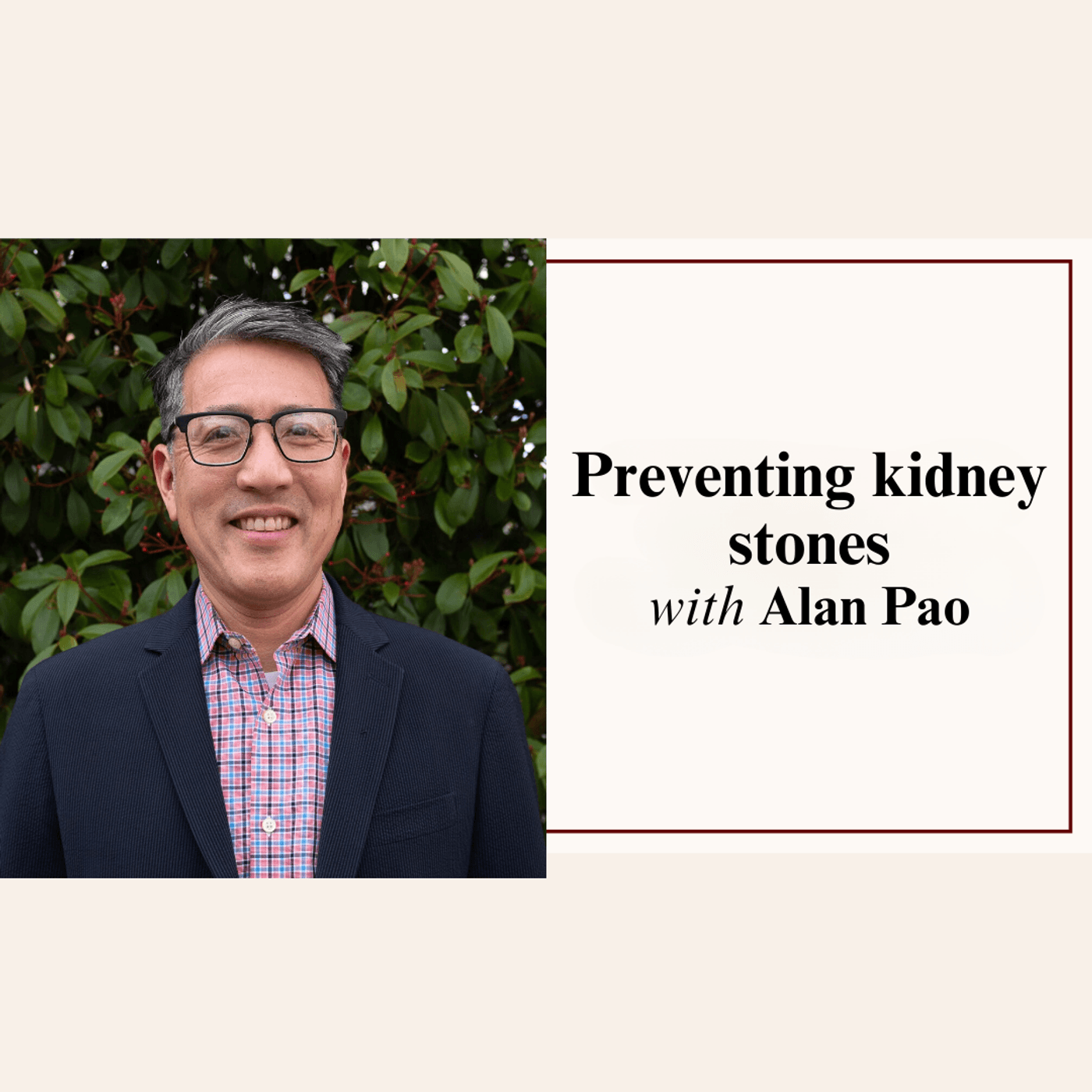
S3 Ep4: What if we could stop kidney stones before they start?
Episode Overview In this episode of Stanford Medicine’s Health Compass podcast, host Maya Adam, MD, interviews nephrologist Alan Pao, who examines the mechanisms behind kidney stone formation and discusses innovative research focused on the role of citrate in preventing kidney stones.
Key Themes and Concepts
Introduction to Kidney Stones
- Kidney stones are often perceived as a temporary nuisance; however, they can lead to severe, recurring pain impacting the quality of life.
- Millions suffer from this condition, which is frequently misunderstood and inadequately managed by healthcare systems.
Dr. Alan Pao's Background
- Dr. Pao discusses his journey to becoming a kidney specialist, highlighting:
- The influence of his father, a scientist, who sparked his interest in chemistry.
- The alignment of his academic background in chemistry with his medical career in nephrology.
- His motivation stemming from real patient experiences and the desire to improve treatment options.
Kidney Stone Formation Process
- Formation Location: Kidney stones typically develop in the renal pelvis, where they can grow larger and potentially obstruct the ureter, causing severe pain known as renal colic.
- Pain Mechanism: Obstruction leads to muscle contractions in the ureter, which results in intense pain until the stone is expelled.
Citrate's Role in Preventing Stones
- Citrate is a molecule that inhibits stone formation by binding to calcium, preventing the crystallization of calcium oxalate and calcium phosphate stones.
- Dr. Pao’s research aims to understand why some patients have low citrate levels in their urine, as low citrate increases the risk of stone formation.
Genetic and Environmental Factors
- While some families may have genetic predispositions to kidney stones, the underlying causes are typically multifactorial, involving a complex interplay of genetics, diet, and environmental factors.
- Dietary interventions are paramount in managing kidney stone risk, emphasizing the importance of hydration, sodium intake, and protein sources.
Preventive Measures
- Dietary Recommendations:
- Increase fluid intake to generate sufficient urine volume (around 2.5 to 3 liters per day).
- Reduce sodium and animal protein consumption to lower calcium levels in urine.
- Patients are encouraged to maintain detailed dietary histories to assess their risk and tailor preventive strategies effectively.
Patient Experiences
- Dr. Pao describes the psychological and physical toll of recurrent kidney stones on patients, including:
- Chronic pain and unpredictability of stone episodes significantly disrupting daily life.
- The importance of addressing root causes of stone formation rather than only treating acute symptoms.
Research Innovations
- Dr. Pao discusses ongoing research to develop targeted therapies aimed at increasing urinary citrate without adverse effects:
- The potential of inhibiting the NADC1 transporter, which regulates citrate reabsorption in the kidneys, to enhance citrate excretion.
- Collaborative experiments with animal models to ensure the safety and efficacy of these new treatment strategies.
Challenges and Rewards of Research
- Dr. Pao reflects on the challenges faced in research, including:
- High failure rates of potential compounds during in vitro testing.
- Balancing clinical responsibilities with laboratory research, which can be both demanding and fulfilling.
- The interplay between patient interactions and scientific inquiry serves as motivation for ongoing research efforts.
Conclusion
- The episode emphasizes the vital connection between patient care and scientific research, illustrating how understanding patient experiences can drive innovation in treatment.
- Listeners are encouraged to follow the podcast for more insights into medical research and personal health stories.
Key Takeaways
- The impact of kidney stones extends beyond physical pain, affecting patients' emotional well-being and daily lives.
- Citrate plays a crucial role in preventing kidney stones, and ongoing research aims to develop more effective preventative therapies.
- Dietary habits significantly influence kidney stone formation, highlighting the importance of personalized medical advice in prevention strategies.
Call to Action Listeners are invited to continue their learning by following the Health Compass podcast for future episodes that explore fascinating medical research and health insights.
Written by AI. May contain mistakes. Listen to the episode to check what was said.
Chapters
Tap a time to open that second in VOUnderstanding Kidney Stones
0:46 to 1:54
Exploring the impact of kidney stones on patients' lives and the underlying issues.
“Powell's work focuses on a little-known molecule called citrate and on a tiny transporter in the kidney that may hold clues to stopping stones before they ever form.”
Meet Dr. Alan Pau
1:55 to 4:04
Introduction to Dr. Alan Pau and his journey into nephrology and kidney research.
“kidney stones develop and what we can do to prevent them.”
The Path to Becoming a Specialist
4:05 to 6:30
Dr. Pau shares his experiences that shaped his career in treating kidney stones.
“nephrology is really sort of the field of chemistry of the human body.”
The Science of Kidney Stones
6:31 to 8:34
Understanding how kidney stones develop and the pain associated with them.
“And I think that's where I started to kind of focus on different types of therapeutics that we could develop to help prevent those stones from recurring.”
Factors Leading to Kidney Stones
8:35 to 11:28
Discussion on the genetic and environmental factors impacting kidney stone formation.
“But that doesn't necessarily sort of get at sort of the underlying reasons for why people have a kidney stone.”
Dietary Prevention Strategies
11:29 to 13:00
Exploring dietary changes that can help prevent kidney stones.
“On that note, what about preventive actions, diet, any other lifestyle changes that could be made to protect the kidneys or prevent this kind of disease?”
Hydration and Kidney Health
13:01 to 14:01
The importance of hydration in preventing kidney stones and maintaining health.
“to counsel them to lower their salt intake so that their calcium in their urine is lower.”
Understanding Kidney Stone Disease
14:01 to 17:38
Learn about the importance of hydration and the distinction between kidney stone disease and chronic kidney disease.
“And we try to recommend to patients to drink fluids that would generate about two and a half to three liters of urine a day.”
The Pain of Kidney Stones and Patient Experiences
17:39 to 22:26
Explore the psychological and physical burden of managing kidney stones from a patient's perspective.
“And for those patients, it's just almost debilitating.”
Innovative Treatments and Citrate's Role
22:27 to 27:08
Discover the science behind citrate and potential new treatments for preventing kidney stones.
“And there's no risk that the kidney will somehow sense that that's being downregulated and upregulate the production of more transporters?”
Show all 12 chapters
Challenges in Research and Patient Care
27:09 to 28:00
Understand the challenges faced in both laboratory research and patient care regarding kidney stone management.
“Alan, tell me, what are the biggest challenges?”
The Iterative Process of Research
28:00 to 29:47
Learn about the challenges and rewards in the research process for kidney stones.
“And so there's a lot of compounds that don't work.”
Transcript
Automatic transcript. May contain errors.0:06Alan Pao:Welcome to Health Compass. I'm your host, Maya Adam, Director of Health Media Innovation at Stanford Medicine. I think that's sort of the beauty of being a physician scientist is that it's not just a theoretical problem, but there are patients that you take care of who have this problem. And so I think having the human face in your mind and the social interactions that you have is really what drives a lot of what we do is to say, well, you know, we can use the science to really help people. And I think that that's probably why every physician goes into the field is to do that.
0:46Alan Pao:kidney stones might seem like a small problem something painful yes but we often think of them as being temporary and fixable in reality for millions of people kidney stones are a source of debilitating pain and they can really interfere with people's lives they come back without warning and they send people in and out of emergency rooms, often without clear answers about why they happen or how to prevent them. Today's guest, Dr. Alan Pau, is a kidney specialist and a researcher at Stanford Medicine who's devoted much of his career to understanding an overlooked corner of human physiology, how the kidneys regulate minerals and maintain chemical balance in the body.
1:40Alan Pao:Dr. Powell's work focuses on a little-known molecule called citrate and on a tiny transporter in the kidney that may hold clues to stopping stones before they ever form. His research bridges the clinic and the lab, giving him a unique vantage point on why kidney stones develop and what we can do to prevent them. Alan, thank you so much for joining us today. Thank you for having me. I like to start by asking all of our guests to share a story with me, something that sort of gives us a little glimpse into what it's like to live in your world, both as a scientist, but also as a person. Can you share an experience or something that sort of helped shape the path that you're on today?
2:34So that's a really great question. I think for me, it wasn't a particular instant or experience, singular experience that brought me into what I'm doing now, but a collection of different points in time in my life that drove me to become a kidney specialist, as well as a physician scientist. So I tried to use what we discover in the laboratory and try to apply it to patient care. I think when I was young, my father was a scientist. And I remember taking me to the science museums in St. Louis, where I grew up, and he would show me the periodic table. And I didn't know it at the time, but my father's favorite subject in school was chemistry.
3:22And so I was really fascinated by how the elements on the periodic table sort of are arranged by atomic number. And then when I got into high school, I actually really enjoyed chemistry. And I also enjoyed, you know, mixing solutions together and in lab in the lab setting. And I think that that kind of made me really excited to be in a laboratory environment. And then, you know, I think in medical school, I went through a process of trying to find what I liked about medicine. And I think a lot of times people choose a particular field or specialty based on something that they like from before.
3:58And they kind of incorporate that into the care of human patients. And for me, that was, again, chemistry. And I think nephrology is really sort of the field of chemistry of the human body. The kidneys are the organ that really controls the electrolyte composition of the blood. And so I think that really attracted me to the field. So and then fast forward to residency. I did my residency training at UT Southwestern in Dallas, and it was actually known for its nephrology historically. And I was an intern with my future mentor at the time. His name is Orson Moe. And he was doing a lot of research in the laboratory and then translating it to the care of patients with kidney disease.
4:51And so I think I kind of wanted to be like him. And I think this is where modeling of sort of people, you kind of, you go into a career sometimes by just the role models that you pick. And he was my role models. And then I think around that time, this was in the 1990s, late 1990s, molecular biology was becoming commonplace in different fields. But I think for nephrology, it was a little bit slower to adapt to sort of embracing molecular biology compared with other fields like neuroscience, oncology, and cardiology. So I really wanted to learn molecular biology and really understand the molecular basis of disease.
5:33And so I went to train with my other mentor, David Pierce at UC San Francisco, and he basically taught me how to kind of think through problems at the molecular level. So when I got to Stanford, I think I combined all of those interests to kind of study kidney stone disease through both sort of bench approaches, also translational approaches to really help my patients. But I would say, just kind of tying it together, that it was after that I started to care for patients who had recurrent kidney stone disease that I realized that there was sort of a gap in terms of what we could do for them. And there are a couple of patients that I would see who were going through a lot of pain through having obstructing stones, and they come to me for prevention and realized that we didn't have a lot of medicines or approaches that could help reduce the recurrence of the disease.
6:33And I think that's where I started to kind of focus on different types of therapeutics that we could develop to help prevent those stones from recurring.
6:43Alan Pao:So I'm curious about that, Alan. Can you tell us what's going on in the body when somebody experiences a kidney stone? What causes the pain? What causes the stone? Give us a little bit of the background there. Yeah, that's a great question. So kidney stones occur in about 10 % of the general population throughout their lifetime. So it's fairly common. And the kidney stone forms generally in this area. I'm going to show you where the kidney is. This is the kidney. and this my finger is sort of the connection between the kidney and then the bladder would be right here this is called the ureter and the kidney stone generally forms in this area called the renal pelvis is where the ureter comes out of the kidney and it'll grow there and get larger and larger generally and then at some point it will break off and when it breaks off it starts to go down the ureter and it gets stuck in generally two places in the middle part of the ureter or the junction between the ureter and the bladder.
7:51And when it gets stuck there, the ureter is actually not just a tube, but it's actually a muscle that will kind of contract and kind of push the urine kind of across the tube. And so when it gets plugged up, it starts to contract and that contraction causes what we call renal colic. It causes the pain and the pain can be very severe and usually will not stop unless if that stone is expelled. And most of the time, if the stone is small enough, it can pass. But when the stone gets really big, then it can't pass and it gets stuck. And that's when the urologists will see the patient and decide whether or not it needs to be removed.
8:31And so that's generally where people will have laser lithotripses to try to remove the stone. But that doesn't necessarily sort of get at sort of the underlying reasons for why people have a kidney stone. And so I think there are things in the urine that will predispose patients to have these stones recur over time. And so when the minerals that are too high, that can lead to stones like calcium, oxalate, or substances that are too low, like citrate, which is an inhibitor of stones, those things can actually cause people to have more stones. And so we study why people might have lower amounts of citrate in the urine and try to come up with approaches to raise the citrate so that it can kind of inhibit future stones from happening.
9:21Alan Pao:And what is that a genetic predisposition or what causes citrate to be low in people who predispose to kidney stones? You know, it's interesting, even with the Human Genome Project, we don't have a lot, we haven't identified a lot of families thus far who have an isolated decrease in citrate in the urine. There are patients who have what we call renal tubular acidosis. That is due to a defect in acidification of the urine, and they can have kidney stones. And as a byproduct of that, the citrate will be low, but it's not the primary reason. These types of diseases that are genetic that cause stones, those are generally monogenic diseases that are fairly rare.
10:06Most of the traits that lead to stone disease are generally kind of the risk factors like having too much calcium in the urine, too much oxalate in the urine, or citrate that is too low. And those are just kind of similar traits that are things like having high blood pressure. There can be a lot of genes that work together to make small changes that put people at risk.
10:30Alan Pao:And Alan, within families, is this something that runs generally within families? If my father had kidney stones, am I at a higher risk of having them as well? Yes. So generally that is the case. I think that when people come with recurrent stone disease, oftentimes they will have a family history of another person having a disease kidney stones and we know that that is a risk factor so we do ask for that in the clinic having said that that doesn't mean that you have one single gene that is responsible for that it could still be a collection of genes that put you at risk alternatively it could even be that families tend to eat similarly.
11:14And so therefore, that kind of sort of sociologic sort of environmental trait might also get passed down. But it is probably true that there are multiple genes that can still be passed down to family members. And then those over kind of that collection is heritable, and it is a risk factor. So yes.
11:34Alan Pao:And you mentioned the way families eat. On that note, what about preventive actions, diet, any other lifestyle changes that could be made to protect the kidneys or prevent this kind of disease? Yeah. So another really great question. Dietary approaches is the cornerstone for how we should treat patients with recurrent stone disease. I think before we start medicines, we always try to take a detailed dietary history and really look at the urine that the patients will give us and correlate it with the diet. And generally, the urine that is sort of excreted by the patient largely is influenced by what they put into their body that day.
12:24So we can sort of infer how the patient is eating by looking at the urine, whether it's too much salt, whether it's too much meat, those things we can actually see. and that is the sort of first part that we look at. And so we have general recommendations to have patients drink more fluids to dilute their urine down. Other more targeted effects are looking at the level of sodium intake. And so if the sodium intake is too high, that can make the calcium in the urine also high. And so we really try to ask patients to counsel them to lower their salt intake so that their calcium in their urine is lower.
13:07In terms of citrate, if one eats too much animal meat, animal meat is sort of an acid load to the body, and that can reduce citrate in the urine as well. So we also talk about animal protein intake as part of that prevention diet that we recommend to patients.
13:29Alan Pao:okay so just to summarize make sure we're well hydrated is that just plain water or i mean you know people talk with kidneys people often talk about cranberry juice and things like that are you saying just more water fluids in general is good yeah and and you want to you want to do fluids that um maybe also ideally do not um sort of increase your weight so like i think sugary fluids like soft drinks, things like that probably aren't as helpful. Just water's actually quite good. And we try to recommend to patients to drink fluids that would generate about two and a half to three liters of urine a day.
14:11So it's quite a bit actually.
14:13Alan Pao:So how many glasses a day should we be drinking? Yeah. So if you are, if you're drinking an eight ounce glass, that's basically about 10 to 12 glasses a day of fluid. Now, having said that, one of the things that we also talk about is that, you know, people think that drinking lots of fluids is actually good for the body and good for the kidneys, but there doesn't seem to be a lot of evidence that that's helpful for kidney function. But it is very helpful for people with kidney stone disease. And so that is one thing that I think is important for patients to know is just that if you have kidney stone disease, that's not the same thing as chronic kidney disease.
14:55A lot of people kind of are rightfully sort of fearful that if they have kidney stone disease, they have kidney disease. But we as nephrologists kind of differentiate the two. One is sort of a kidney function and the filtering function. Kidney stone disease is just that the urine that you excrete tends to have minerals in it that promotes kidney stones to form after it's been excreted from the kidney. So that's a bit different. But yeah, we do recommend people to drink lots of fluids so that they can dilute their urine down. That's the one group of patients where it is beneficial to drink lots of fluids throughout the day.
15:36Alan Pao:And Ellen, I watched a short video before this meeting, and you were talking with a patient about that patient's experience of struggling with this for years, and sort of the unpredictability of it, and the almost fear that it's going to disrupt their lives, you know, without any warning. Tell us a bit about what it's like for patients to manage this and this kind of psychological burden, as well as the physical implications? Yeah. So I think it starts with the fact that when you have a kidney stone, it can be extremely painful. And I think that it's one of those things that will not relent unless the stone passes.
16:25And so people who have an acute stone episode can go through days to weeks of having pain. And I think that pain is what's really, really problematic for many patients. And so I think that I had a patient this week who came to me who had a surgery every year. And I think it just grew really disruptful to patient lives. You know, the pain keeps them out of work. And then they have to go through a process of getting the stone removed. When the stone is removed, there's a stent that is left in place typically. And that stent basically sort of keeps open the ureter from the kidney all the way down to the bladder.
17:07But that tube is very irritating to the patient. So when it's in there for a week or so, it's really kind of uncomfortable. And so I think a lot of my patients who come to me are really frustrated with that whole process of taking the stone out. And so I think it's not sufficient to just remove the stone without at least addressing why the patient is forming the stone in the first place. For many patients, it may not be an issue if they only form stones once or twice in their life, but there are patients who have stones, you know, every few weeks to few months. And for those patients, it's just almost debilitating.
17:44They can't do anything else. So I think it's the preventative part that I think is an overlooked part for many clinicians who take care of kidney stone disease. And I think that's the part that we really focus on is try to help prevent that next stone.
18:02Alan Pao:Okay. So take us a little bit more into the science of what you're working on with that citrate molecule? And what are the potential better solutions that we have in the future, maybe? Sure. So yeah, so citrate is like my favorite molecule over the past few years. And it's an amazing molecule in the sense that it's an organic compound that can bind to calcium. And we actually use citrate in different contexts to bind up calcium so that it doesn't activate blood clotting. It's used in sort of the packed red blood cells to keep the blood from clotting. We use it for hemodialysis in the ICU where we prevent the filter from clotting because the citrate can bind up to the calcium and prevent clotting of the cascade, the clotting factors in the coagulation cascade.
19:00In the kidney, citrate will also bind to calcium and keep it away from oxalate and keeping it away from phosphate. So calcium oxalate and calcium phosphate are the most common kidney stones that people will develop. And so having a citrate that is too low in the urine, again, is a risk factor. About maybe a quarter to a third of patients might have that. And so the idea is that if we can increase citrate excretion into the urine, it'll bind up and keep calcium away from the stones that are comprised of calcium oxalate and calcium phosphate. So the way that we currently treat that in patients is that we give either potassium citrate or sodium bicarbonate.
19:48Both of those supplements will cause the kidney to excrete more citrate in the urine. Citrate is sort of filtered by the kidney, and then it's reabsorbed by the kidney tubules through this transporter. And this transporter is believed to be the only transporter that regulates citrate into the urine. And so when we give patients alkali, we think that we're actually turning off that transporter. And that's why the citrate goes up in the urine when we give patients either potassium citrate or sodium bicarbonate. So this is the current therapy, but the problem with it is that when you give patients either of those two supplements, what will happen is that the kidney will metabolize that in the process of metabolism, it will actually sense that there's an alkali load to the body and the kidney will excrete bicarbonate into the urine.
20:49And this raises the urine pH. And paradoxically, it increases your risk of having calcium phosphate stones. So even though when we're trying to treat somebody with a low urine citrate, in certain patients, that will be offset by a rise in the urine pH so that the patients might form more stones over time. And so this is a problem for many patients, those with what I talked about who had renal tubular acidosis. people who are taking medications like topiramate, which is used to treat seizures, and also in women too. So women tend to form more alkaline urine compared with men in general. And so patients, so female patients sometimes will have calcium phosphate stones and low urine citrate.
21:39And those patients, if their pH is too high in the urine, they shouldn't actually be place them, potassium citrate or sodium bicarbonate. So I think what our project is trying to address is if we can turn off that transporter without giving them alkali. And so that would require us to have a compound that can specifically inhibit the transport characteristics of that target. And that target is called NADC1. And so we've been trying for the past few years to find compounds that can inhibit NADC1 so that we can just directly turn off absorption of citrate from the kidney so that there's more citrate that is excreted into the urine.
22:27Alan Pao:And there's no risk that the kidney will somehow sense that that's being downregulated and upregulate the production of more transporters? Yeah, that's a great question. From what we know so far, there are no other transporters that are involved in the kidney to absorb citrate, as far as we know. I mean, this is an area that actually still needs a lot of work. And so, and I think sort of a second question, follow-up question that you're implying is whether or not it's okay to inhibit NADC1. Will there be other consequences that we don't know about? And that's a really good question, both from a scientific standpoint, but also from a clinical standpoint.
23:15If we're going to be developing these inhibitors that can inhibit NADC1, is it safe to do so in patients? And so in the past year, we've collaborated with a group in Tulane where there are mice that have the NADC1 gene knocked out. And so we are now sort of phenotyping, characterizing that knockout mouse to make sure that there's nothing that is bad happening. And so for these mice, they live normally, they behave normally, they reproduce fine. So it seems like there's some redundancy that can take away from some of the things that we're doing to the mouse so that they're not having the NADC1, and they do increase, they do have high citrate in the urine as well.
24:06So from the knockout mice, it looks like that they tend to be normal. So our hope is that that's an encouraging kind of clue that it would be okay to try to inhibit this transporter without having any bad consequences.
24:23Alan Pao:Very interesting. I have so many more questions, but I'm going to shift a little bit because I want to ask you what it's like when you are interacting with a patient that has struggled with this for years and you kind of let them know that you're working on this kind of very innovative solution that could be a long-term solution. What's that like for the patient? What's that like for you as the physician? I noticed in the video that I watched that you you mentioned that often the work, the science you're doing is motivated by a sort of flashback to these discussions you have with the patients who are struggling with this problem.
25:06I think
25:07Alan Pao:that's really wonderful and would love to hear more. Yeah. So the patient that you're referring to, he actually was one of the first patients that inspired me to go on this project. He had a problem where his citrate was too low and his urine pH was too high. And I do remember him asking me, what are there things that we can do to treat this so that he wasn't getting stones all the time? And then I did tell him that actually there wasn't anything that we had. And he asked me if there were ways that he could help to try to make that a possibility where we could develop some new treatment. And it was at that time that I was thinking about this project of inhibiting NADC1, which would benefit him if it came to fruition.
25:55And so he has been really sort of the face that I see when I think about hypostrituria. I mean, he's always in my head. There are other patients that I have also that kind of pop into my head. And I think that's sort of the beauty of being a physician scientist is that it's not just a theoretical problem, but there are patients that you take care of who have this problem. And so I think having the human face in your mind and the social interactions that you have is really what drives a lot of what we do is to say, well, you know, we can use the signs to really help people. And I think that that's probably why every physician goes into the field is to do that.
26:36And so I think he's definitely the person that I think of when I kind of go through every day to look at the data. And then every Tuesday, I come to Stanford for my clinic. And so I see him periodically. I see a lot of my other patients who have a similar thing. And so I think it's a really special thing. And I think that's something that can take a lot of time to get to where you could kind of unite what you're learning in the lab to how you can actually treat them by the bedside.
Read the full transcript
27:08Alan Pao:Wow, that's inspiring. Alan, tell me, what are the biggest challenges? like what are your toughest days what do they look like uh toughest days like in in in what context in the in the lab and the work the patient load any of the above well i think um i think in the lab many things don't pan out as you think that they will i think um for example right now um we have a lot of candidate compounds that can work in cells and what we're doing now screening for those compounds to see which ones will actually get to the urine and then also sort of increase citrate in the urine. And so right now we're at the phase of translating the sort of in vitro findings to the in vivo findings.
28:00And so there's a lot of compounds that don't work. And so I think that is disappointing when you spend all this time characterizing those compounds that they're not doing what you think they're doing. But the opportunity is to find out why it's not working and then to try to figure out how to change the compound so that it will work. And so we're at that stage right now where we have a few compounds where we think it works, but we want to make it better. And I think that that part is an iterative process that can be good on some days and sort of frustrating on other days. I used to think that, you know, going to the clinic sometimes can take away time from the laboratory.
28:45And I think that that makes for a long day when you're actually in the hospital, in the clinic, and then go back to the laboratory to kind of check up on what's happening through the day. And I think that part was tiring. But I do think like the benefits of that are twofold. One is that the day is more interesting. You're not just kind of in one place, but, you know, you're seeing patients, you're in the laboratory. And that's a really cool thing. I think it's always exciting. And so, you know, there's lots to do every day when you wake up in the morning. The other thing is that, again, seeing patients kind of reminds you of like the diseases that they have, their manifestations, and then how best to kind of help them.
29:31it kind of recharges like the drive to try to find something in the lab. So I would say, you know, some things are frustrating, but it also can be very rewarding at the same time. So it's kind of two different sides of the same coin. So.
29:48Alan Pao:Lovely. I think, I mean, that is a lovely note to end on. And I'm so happy that we got to speak. I'm so grateful to you for making the time. I learned so much. And I just wish you all the best. I hope that the experiments that you're working on come to fruition. And very grateful to you for joining us, Alan. Great. Thank you, Maya, for asking all those great questions. And to our listeners, thank you for spending part of your day with us on Stanford Medicine's Health Compass podcast. If you'd like to keep listening, just follow Health Compass on your favorite podcast app. and we'll be back with more stories and conversations that aim to help us make sense of the science around us.