In short
Stanford Medicine Health Compass Podcast
Episode Summary
S2 Ep4 - What can we learn from a scientist living with sickle cell?
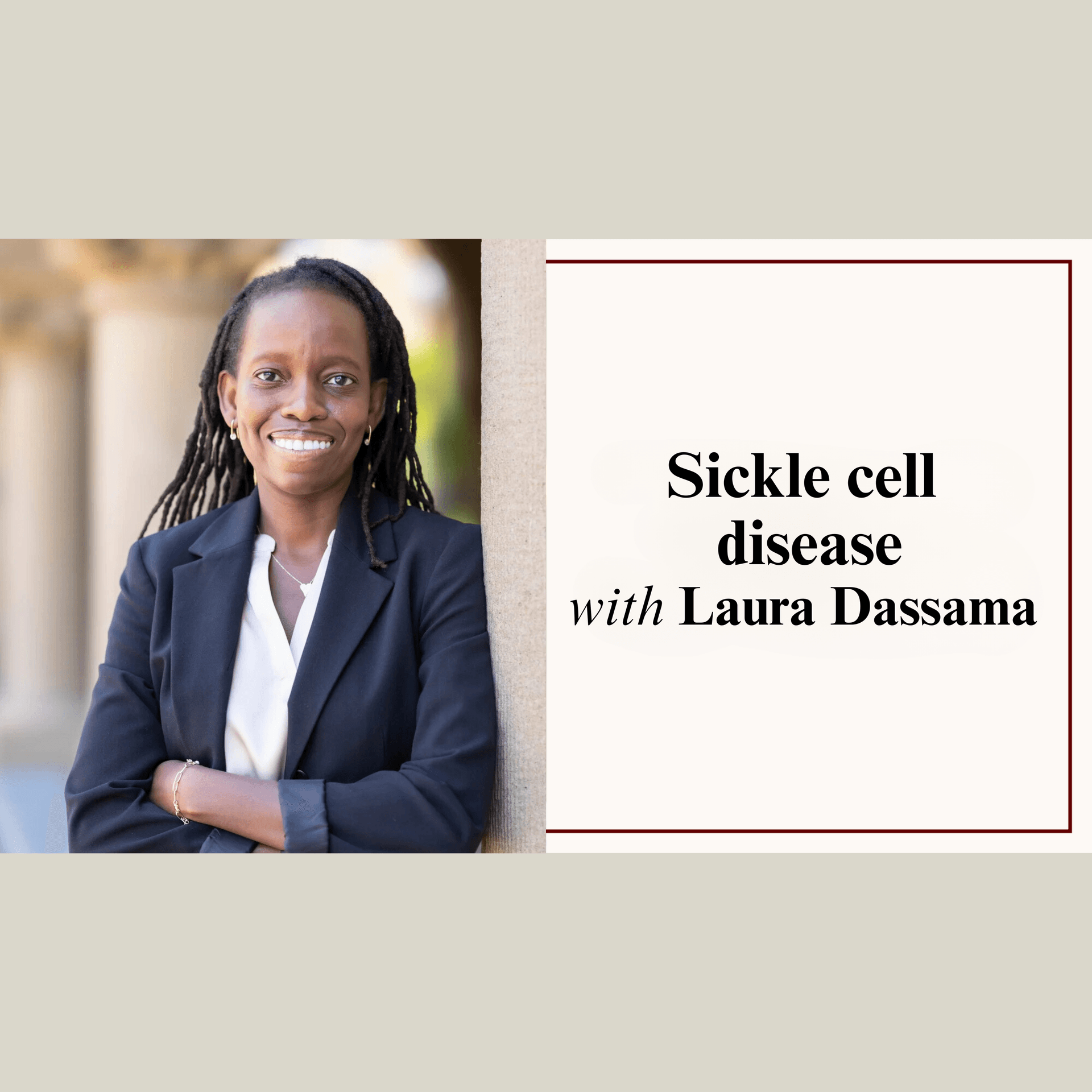
Host: Maya Adam, MD Guest: Laura Dassama, PhD, Assistant Professor of Microbiology and Immunology and Chemistry at Stanford Medicine
Episode Overview In this episode, Dr. Laura Dassama shares her personal journey as a scientist living with sickle cell disease. Her experiences as a patient have deeply influenced her research, which focuses on developing new therapies for sickle cell disease through innovative genetic approaches.
Key Themes and Discussions
Personal Journey and Motivation
- Early Diagnosis: Dr. Dassama was diagnosed with sickle cell disease at age five in Liberia. The diagnosis provided clarity about her painful episodes.
- Inspiration from Treatment: The relief experienced from medication motivated her to explore how therapies work and to help others facing similar challenges.
- Transition to Research: Initially pursuing a path in medicine, a conversation with a professor redirected her towards research, where she could contribute to therapy development.
Understanding Sickle Cell Disease
- Genetic Basis:
- Sickle cell disease is caused by a mutation in the gene coding for hemoglobin, crucial for oxygen transport in red blood cells.
- The mutation leads to the formation of sickle-shaped red blood cells, which can cause blockages and painful episodes known as vaso-occlusive crises.
- Symptoms and Complications:
- Patients often experience anemia due to the destruction of red blood cells and chronic pain from blocked blood vessels.
- Life expectancy for affected individuals is typically between 45 to 60 years.
Research Focus
- Fetal Hemoglobin (HbF):
- Dr. Dassama's research aims to enhance the production of fetal hemoglobin, which is protective against the symptoms of sickle cell disease.
- Some individuals continue to produce fetal hemoglobin into adulthood, which mitigates disease severity.
- Therapeutic Innovation:
- Current therapies include hydroxyurea, which increases HbF levels, and recent FDA approvals for gene-editing techniques targeting the transcription factor BCL11A.
- Dr. Dassama’s lab seeks to identify small molecules that can mimic the effects of gene editing without the need for complex procedures.
Challenges in Research and Treatment
- Access and Scalability:
- The hope is to develop a therapy that is easy to administer, possibly an oral medication, making it accessible to a larger patient population.
- Role of the Patient Voice:
- Emphasizes the importance of involving patients in the development of therapies to ensure their needs and preferences are considered.
Community and Collaboration
- Scientific Collaboration vs Competition:
- Acknowledges both competition and collaboration in research; the growing interest in sickle cell disease has fostered partnerships among researchers.
- Patient Engagement:
- Recognizes that patient opinions are increasingly valued in the scientific community, facilitating a collaborative atmosphere between patients and researchers.
Conclusion Dr. Laura Dassama's dual role as a patient and scientist underlines the importance of personal experience in shaping innovative medical research. Her work aims to transform the treatment landscape for sickle cell disease, with the goal of providing patients with more effective and accessible options for managing their condition.
Additional Resources
- [Read more about sickle cell disease innovations](https://stanmed.stanford.edu/innovations-help-chronically-ill-thrive/#sicklecell)
- Subscribe to Stanford Medicine’s Health Compass on platforms like Apple Podcasts and Spotify for more insightful discussions on health and medicine.
Written by AI. May contain mistakes. Listen to the episode to check what was said.
Transcript
Automatic transcript. May contain errors.0:06Welcome to Health Compass. I'm your host Maya Adam, Director of Health Media Innovation at Stanford Medicine. Once my diagnosis came through, everything became clear. I went to the hospital and I got medication to help me. And the effect that those medicines had really transformed me into wanting to understand how they worked, why they worked, and if I could spend the rest of my life figuring that out and how to help other people feel as good as I felt.
0:45Sometimes the best motivators are deeply personal. My guest today is Dr. Laura Dasama, an assistant professor of chemistry and of microbiology and immunology here at Stanford Medicine. Laura was diagnosed with sickle cell anemia as a child, and she's dedicated a large part of her academic career to studying sickle cell disease, which is a genetic disorder that hinders the ability of red blood cells to carry oxygen in the blood. As a chemical biologist, Laura combines the principles of chemistry and human physiology to probe cell function in search of new, powerful, and accessible ways of treating a disease she's lived with her whole life.
1:38Her journey as a patient and a scientist is a powerful one, and I'm looking forward to learning more about how her lived experience has informed her cutting-edge research. Laura, it's such a pleasure to have you on the podcast today. Thanks so much for being here. Thanks for having me. Laura, I'd like to always start by asking our guests to share a personal story, something that maybe motivated them. And I know that your career in many ways stems from your own experiences. Would you mind sharing that with us? Sure, I'm happy to. So, as will become clear from this story that is featured in the magazine, I was diagnosed with sickle cell disease when I was about five years old.
2:28And this was in Liberia in West Africa. And my diagnosis was really a relief for me because it explained so many of the things that had happened to me up to that point. A lot of the pain episodes I experienced that I couldn't really describe, I couldn't articulate as a five-year-old. And no one really understood why. And so once my diagnosis came through, everything became clear why I had those pains. And for me, then, the next step was what made them go away. It was often when I took drugs, when I went to the hospital and I got medication to help me. and the effect that those medicines had really transformed me into wanting to understand how they worked, why they worked, and if I could spend the rest of my life figuring that out and how to help other people feel as good as I felt, that's all I wanted to do.
3:27And so I knew at that point I was going to become some sort of scientist. I didn't know what it meant. I thought I would be a physician. but later I found out that I was more drawn towards research and so that's how I ended up studying science. And how did that sort of pivot happen? You thought at first maybe medicine but then was there somebody instrumental in helping you pivot or what changed that direction for you? Yeah so in Liberia if you were interested in science or math you were going to go to medical school. Those were your options. And so when I came to the U.S. for college, I was studying to go to medical school.
4:08I was a pre-med student. And it wasn't until around my sophomore year when I had an organic chemistry teacher ask me what I wanted to do. And I said, well, I'm very interested in understanding how, you know, therapies work and how I can help people and perhaps develop new ones. And so I'm going to medical school. And he was taken aback by that because he said, that's not where you learn to do that, at least not in most traditional medical programs. If you wanted to figure out new therapies, you'd probably go to graduate school and do research. And I didn't know what research was. And so he walked over with me to a biochemistry lab and said, Yeriz's student was interested in research, but she doesn't know anything about it.
4:53And it took me in, and I learned so much. So that was the pivot. And I'm so, you know, really glad that someone asked me what I really wanted to do, I suppose, what was the next thing that was on my list of things to do. Wow, what a good story. Laura, tell us a little bit about sickle cell disease. What causes it? What's the experience like for somebody who has sickle cell disease? Yeah, so sickle cell disease arrives from a mutation in the gene that codes for a protein called hemoglobin. So hemoglobin might be familiar to some people because it is responsible for transporting oxygen throughout the body, throughout the blood vessels.
5:37So all of your organs need oxygen to survive, and hemoglobin is the oxygen carrier. In people with sickle cell disease, you have a mutation that prevents hemoglobin from functioning properly, especially when it's in low oxygen environments. So hemoglobin will usually become oxygenated in the lungs when you breathe in air, and then it transports that oxygen throughout the body, right, so the organs and tissues that are not exposed to oxygen as the lungs are. And what this mutation does is that it prevents the protein from maintaining its integrity when it's in those low oxygen environments. So after it's delivered oxygen, the protein aggregates, which changes the shape of the red blood cells that hemoglobin is in as it's transporting oxygen.
6:32And then those red blood cells go from being a nice spherical shape to a sickle shape, right? And that's what gives the disease its name. And these sickle-shaped red blood cells are sticky, they get stuck to each other, and they can clog the blood vessels. And when that happens, it leads to these really painful episodes that are called vaso-occlusive crises. And so patients can have this systemically through pretty much every organ that, again, that is being oxygenated by hemoglobin. The other thing that happens too is that as hemoglobin begins to aggregate in these cells, the cells will burst and die.
7:15And so these patients will have fewer molecules of red, fewer red cells in their bodies, and that leads to anemia. And so you have the vaso-occlusive crises that, you know, results in these pain episodes. You have the hemolysis, the lysing of these red cells that lead to anemia. And over time, you have poor oxygenation of organs and tissues. And so most adults will have, you know, organ damage later in life. And so approximately 100 ,000 people in the United States suffer from sickle cell disease. And the life expectancy of many patients is around 45 to 60 years of age. Oh. Wow. And at what age is it typically diagnosed?
8:07So in the U.S. and in most Western countries now, it's diagnosed even pre-birth, right? You can do genetic screening. But then in the U.S., at birth, most infants are diagnosed. This was not the case always and certainly not where I was born. And that was part of the reason for my late diagnosis at five years old. So not everywhere around the world these early diagnoses are possible. And Laura, you mentioned that, you know, the hemoglobin binds differently in different oxygen environments. Does that impact sort of the presentation of this disease in, let's say, high altitude parts of the world?
8:54and how does that play a role? Yes, so it is quite interesting. Yes, at higher altitudes, you're going to have less oxygen in the air, right? And so if you have less hemoglobin, right, already due to the fact that you have fewer red blood cells, if you have this disease, you could have problems oxygenating well. And so it is not uncommon for people with sickle cell disease to have crises when they're in high-altitude environments. And so not even anywhere spectacular like the top of a mountain, but even somewhere as high as Denver or Lake Tahoe can cause problems for people with sickle cell disease.
9:39Okay, tell us a little bit about your research, which, as I understand it, sort of capitalizes on a natural phenomenon that occurs during fetal development. Absolutely. Yeah, so when we're developing as fetuses, our primary means of getting oxygen is through the mother's hemoglobin, right? And so because of that, fetuses produce a hemoglobin that is slightly different than the maternal hemoglobin. And it's slightly different because it binds onto oxygen a little more tightly than the mother's hemoglobin will. that allows transfer of oxygen from the weak oxygen binder that the mother has to the tight oxygen binder that is in the fetus, right?
10:27And so this is a natural phenomena and after in the first year of life you stop making this strong oxygen binder fetal type hemoglobin and start to make the adult type hemoglobin. So there are some people who, rather than turning off this fetal hemoglobin, continue to make low amounts of it. And it's been observed that if patients with sickle cell disease are making anywhere around 9 % or so of their total hemoglobin, continue to make this fetal hemoglobin, they have a lot of protection from many of the symptoms of the disease. And it turns out, like, when I talk to you about how hemoglobin works and what the mutation does that causes sickle cell disease, many of the problems with the diseased protein occurs when it's in poor oxygen environments.
11:21But because fetal hemoglobin binds into oxygen more tightly, the red blood cells that the hemoglobin is present in can remain oxygenated for some time, right? So even in poor oxygen environments, it offers protection, and that protection then keeps this mutated hemoglobin from aggregating. And so people produce, there are people who have mutations or naturally occurring phenomena that allow them to make 30%, up to 30 % of their total hemoglobin is this fetal kind. and they're fine, right? And when they have sickle cell disease, they don't have the sickling that leads to the aggregation and the, you know, hemolysis that leads to anemia and the vaso-occlusive crises that are all symptomatic of the disease.
12:12And so what my lab is trying to do, and we're not the only ones doing this, but we're asking if we can turn off this switch, you know, within the first year of life you stop making this fetal type hemoglobin and you make adult hemoglobin. What if we were to find that switch and turn it off so that patients can continue to make fetal type hemoglobin into adulthood? We already know that this is safe because there are people who naturally do this, right? So if we can understand that phenomena well enough to be able to reproduce that in a very targeted manner in patients, we can offer many of them the protection that you would get from keeping the cells oxygenated.
12:55And so we know the gene that is responsible for this. It's been tested, it's been validated in the clinic with genetic editing. The only problem is that it's available to a small number of patients because there are no inhibitors, there are no drugs that target this, right? So at the moment, you have to go in with CRISPR therapy or other genetic modification tools to prevent this gene from working. And we know that if you prevent the gene from working, you make higher levels of fetal hemoglobin. So we're trying to ask, can we make molecules that can have a similar effect such that patients don't have to undergo the extensive, you know, medical intervention that is necessary for gene therapy today, but can we find molecules that they can simply take, right, whether it's orally available or via a transfusion that can have the same impact?
13:49And can we turn on the production of fetal hemoglobin to give these patients, you know, a chance of having some sort of a normal life, right, by producing this alternate type of hemoglobin? And Laura, let me ask you to back up a minute there. You mentioned that, you know, some people will continue producing small amounts of fetal hemoglobin. Is that variation responsible for differences in the severity of the presentation of the disease? It certainly contributes to it in patients with sickle cell disease, yes. Okay, and are there other factors? Like is this a kind of either you have it or you don't, or are there degrees to which you can inherit the mutation?
14:35There are degrees to which you can inherit it, And it's not even clear if there is one particular factor that allows you to continue to make this. So we know now of one of the most important factors, but there are a number of things that are responsible for higher levels of hemoglobin, of fetal hemoglobin in patients. And so we think that, you know, we know that if you make as little as 9 to 10 percent of fetal hemoglobin, you see the protective effects. and up to 30 % is naturally occurring in people, right? And so there is a large window of opportunity there. And so what we're hoping to do is find molecules that are tunable, right, and completely reversible.
15:19So if someone needs to produce higher levels of fetal hemoglobin, you can certainly turn that on. And if you need to reverse it for whatever reason, you can turn it off. And that is not currently possible. And what is the current treatment for this disease? Okay, so up until last year, the only FDA-approved therapy was a small molecule drug known as hydroxyurea. And that also works by increasing levels of fetal hemoglobin. However, we don't know exactly the mechanism by which it does this, right? So it works in some patients, but not in others. And for people that are not responsive to it, there is not much you can do, right?
16:07Until this year, that was the only small molecule, the only way to induce fetal hemoglobin. Recently, there was FDA approval for gene editing methods, either be a CRISPR or SHRNA that allows you to go in and now deplete or silence a single gene, the same gene that we're trying to target. We know this is the most important factor. Of all the factors that contribute to increasing levels of fetal hemoglobin, this appears to be the most important one and have the most dramatic effect. And that's this transcription factor known as BCL11A. And so there are now therapies targeting BCL11A. But part of the challenge with targeting BCL11A is that it has important roles elsewhere in the body.
17:02So you can't just develop a drug to target BCL11A everywhere. It has to be done in a particular organ, in the bone marrow. And getting to the bone marrow, access to the bone marrow, is pretty hard at this point. And so what these patients have to do is have their stem cells harvested, extracted from the bone marrow, edited somewhere in the lab, right? And then before those edited cells are transplanted back to patients, they have to deplete all of the existing stem cells in the bone marrow. And that can be problematic for patients, right? But if that is successful and it happens, you can now transplant these edited cells that lack this transcription factor known as BCL11A.
17:48And those patients can now make new red blood cells, and those new red blood cells all have fetal hemoglobin because that switch, BCL11A, is no longer there. So you are now just making fetal type hemoglobin like it was never turned off. And Laura, could your approach have other applications outside of sickle cell anemia? Yeah, so the strategy, I can tell you why BCL-11A doesn't have any drugs that target it other than this really convoluted gene therapy method. It's considered one of the undruggable proteins, and by undruggable proteins, we mean that the traditional molecules that you use, really small molecules that will find crevices and pockets in the protein and block the function by binding to those crevices and pockets are lacking because VCL-11A looks like a spaghetti, right?
18:45It looks like a noodle. It's floppy. It's disordered. And so finding those nice binding pockets is really challenging. And my approach has been to be inspired by the native function. how does this protein work in the cell? It interacts with other proteins. It's part of large complexes. It has friends. Can we be inspired by how it interacts with those other proteins to find ligands that maybe don't look like your traditional drug, but mimic the natural interactions that this protein has? And once we have those ligands that are now selective, can we functionalize them to do something to BCL11A? And so my work has been, can we, rather than trying to just prevent its function, can we just destroy it?
19:30So what we've done is found these large ligands that will bind to BCL lemonade. They don't look like traditional drugs, but they do bind to BCL lemonade because they look like the nice native binding partners, right? And then what we do is we instruct it upon binding, why don't you decorate BCL lemonade to look like it needs to be destroyed by the cell? So the normal machinery of the cell has to destroy proteins is now used to deplete all of this protein. And so this is a strategy we're looking to try to expand to other proteins that also are so-called undruggable. They have all of these floppy regions that you can get nice small molecule inhibitors to bind to, but we can be inspired by their native interactions and use those native interactions to now decide to either destroy the protein or change its function in some other way.
20:24And we're applying this now to a wide variety of other targets. That is brilliant. Wow. So much to take in. And I'm so impressed by how you explain it because I almost followed you all. Okay. So let's say that you're successful. You did mention that, you know, the standard of care is different in different parts of the world. How accessible and how scalable is this solution if it's in its perfect form? In its perfect form, the way I imagine it, it will be something that you either acquire once every three or four months at your physician's office. And then you're set for a few months, right? Rather than taking a pill perhaps every day.
21:13or having this really, you know, expensive gene editing method that has other risks associated with it. So we're very far away from that. But my hope is that no one with sickle cell disease will walk into their doctor's office and be told you have only one option. You will have a variety of options for therapies. and they will all have challenges and very positive aspects and attributes to them. So what I'm hoping for is that our efforts will inspire a lot of other people to also go after this target, to think about how can we make our therapies effective, efficient, but also accessible, right?
21:59And how can we give patients the options? Laura, that brings me to another question, sort of a behind the scenes question. You mentioned that other groups are also trying to study this. And I wonder, in the scientific community, do you find a sense of collaboration between these research groups? Or is it a competitive kind of relationship? How does that work? It's a little bit of both. I think we all would love to be you know at the forefront of you know a major discovery but I think the fact that I mean over the years it's been surprising to me both as a researcher and as a patient how much interest has grown in sickle cell disease I think part of the reason is we've now had a lot of new tools that we can apply to these disorders that were maybe very rare diseases and perhaps not very tractable before or not also attractive because for whatever reason they were not seen as things that would benefit a large amount of people or the right population, the right demographic.
23:06But there's been sort of a rallying cry, I think, over the last few years to really go back, use some of the modern tools that we have today, you know, tools in genetics, tools in chemical biology to tackle some of those problems. And I think that's been very heartwarming to me both as a patient you know because whoever gets there first i get to benefit right and people like me will benefit from new therapies and ultimately that's what we want um so to that extent there is a lot of collaboration there is like consensus around let's do this this is the right time we have everything in place um but then there is also competition we would love to get there first we would love to inspire others um and so i think we're trying to do both right Yeah.
23:52So on that note, you talk about sort of your role as a patient and a scientific researcher in this space. Yeah. What is the role of the patient voice, you know, voices like yours in shaping research and medical treatments? Yeah. I would say traditionally the patients had no say in this, right? You were just hoping that when you showed up to your physician's office, they had something that they could do about whatever disorder you had. But I think it's become clear, especially now with some of the new therapeutic modalities that are doing things that have never been done before. It's really important to understand what do patients want, right?
24:41We can go ahead and develop the most effective therapy if patients are not willing to take it for whatever reason.
24:51It's going to sit on shelves and not be used. So I think ultimately patients are saying we want options. We want more options. We don't want to be told this is it. This is all we have. You need to irreversibly change your DNA if you are going to or live with the symptoms of your disease. And so I think it's been really important. And I think some of the companies that have been pioneering these genetic editing methods have done a lot to engage with the communities to which they're targeting their therapies. And I think that's a good sign because you need to bring people to the table. patients are not always you know uninformed or misinformed right and even if they are I think it's part of our jobs to let them know that what we're doing what to at least you know reveal what happens behind the curtain what we're doing and how we're hoping these therapies are going to be helpful and how they're going to be used and so I think there's more of that these days than has been in the past certainly than when I was growing up right and so I am fortunate to have you know a team, a medical care team at Stanford that is fantastic.
26:02And I speak with my hematologist as if we're colleagues, right? And she values my opinion and I value her opinion. And I think that's a wonderful collaboration between physicians and patients. And I would love to see more of that, particularly for disorders that are, you know, rare diseases or target a certain demographic. big. Do you ever get discouraged or frustrated with this work? And if so, what do you do to keep going? Do I ever? That's with all of my work. I don't think I've ever met a scientist who has not been frustrated or discouraged at some point. I often have to remind myself that it's not always about me.
26:57I am motivated to do this, not just for myself, right? So I always have to think of who might benefit from this, perhaps in the next, you know, 20 years, 30 years, right? And is it going to be worthwhile if we manage to advance something even a little bit or even encourage someone else to have an idea that can, you know, be transformative in, you know, a few decades, would it be worthwhile? I think so. So a lot of what we're doing has not been done before. It's hard. We're, you know, discovering new things. We're engineering new things. We're building things. We're building knowledge. And we're doing it with a small group of people.
27:42I have a group of, you know, 10, 11 scientists in the lab, and many of them are in various stages of their training. No one comes in knowing the perfect solution and we're trying to figure this out together. So there's the educational aspect that you know the scientists in the lab are learning to become independent scientists and build something new but also working towards you know developing a product or multiple products that could help others beyond ourselves later. And I think waking up and knowing that okay I am not the only one who stands to benefit from this. If we manage to advance this even a little bit to a point where someone can benefit in the future, it's worth it, right?
28:25And so that keeps me going through the days and weeks of disappointing results and things that just absolutely make no sense. Laura, thank you so much for making the time to speak with us today, for sharing your story and your work. I learned so much and I really appreciate this time that you've spent with us. Grateful to you and your team for everything that you're doing. Thank you. Thank you, Maya. This has been a pleasure. I hope it was not too dense. I appreciate you guiding the questions and talking to me about this work that I'm so passionate about. Thank you. I can hear that. Thank you so much, Laura.
29:10Bye-bye. Bye. Thank you for listening to Stanford Medicine's Health Compass podcast. If you like what you heard today and want to keep up with Health Compass, you can subscribe on Apple Podcasts, Spotify, the Stanford Medicine YouTube channel, or wherever you listen.
29:38Thank you.
From the publisher
Read more in Stanford Medicine magazine: https://stanmed.stanford.edu/innovations-help-chronically-ill-thrive/#sicklecell