In short
Stanford Medicine Health Compass: Episode Summary
Podcast Overview Title: Stanford Medicine Health Compass Host: Dr. Maya Adam Description: The podcast explores the latest medical research, featuring compelling stories that connect with everyday health experiences. Dr. Maya Adam interviews leading experts on various health topics, emphasizing breakthroughs and innovations in medicine.
---
Episode Details Title: S3 Ep3: What can collaboration across disciplines unlock for the future of stroke care? Description: This episode discusses the urgent need for precise and timely care in stroke emergencies and highlights a groundbreaking collaboration between an engineer and a physician at Stanford, resulting in the development of the Millie Spinner—an innovative device designed to assist in the removal of blood clots.
---
Key Themes
- Importance of Timely Intervention in Stroke Care
- Strokes caused by blocked arteries are time-critical medical emergencies where every minute counts.
- Early removal of blood clots is crucial for patient recovery and reducing the risk of paralysis.
- Interdisciplinary Collaboration
- Participants:
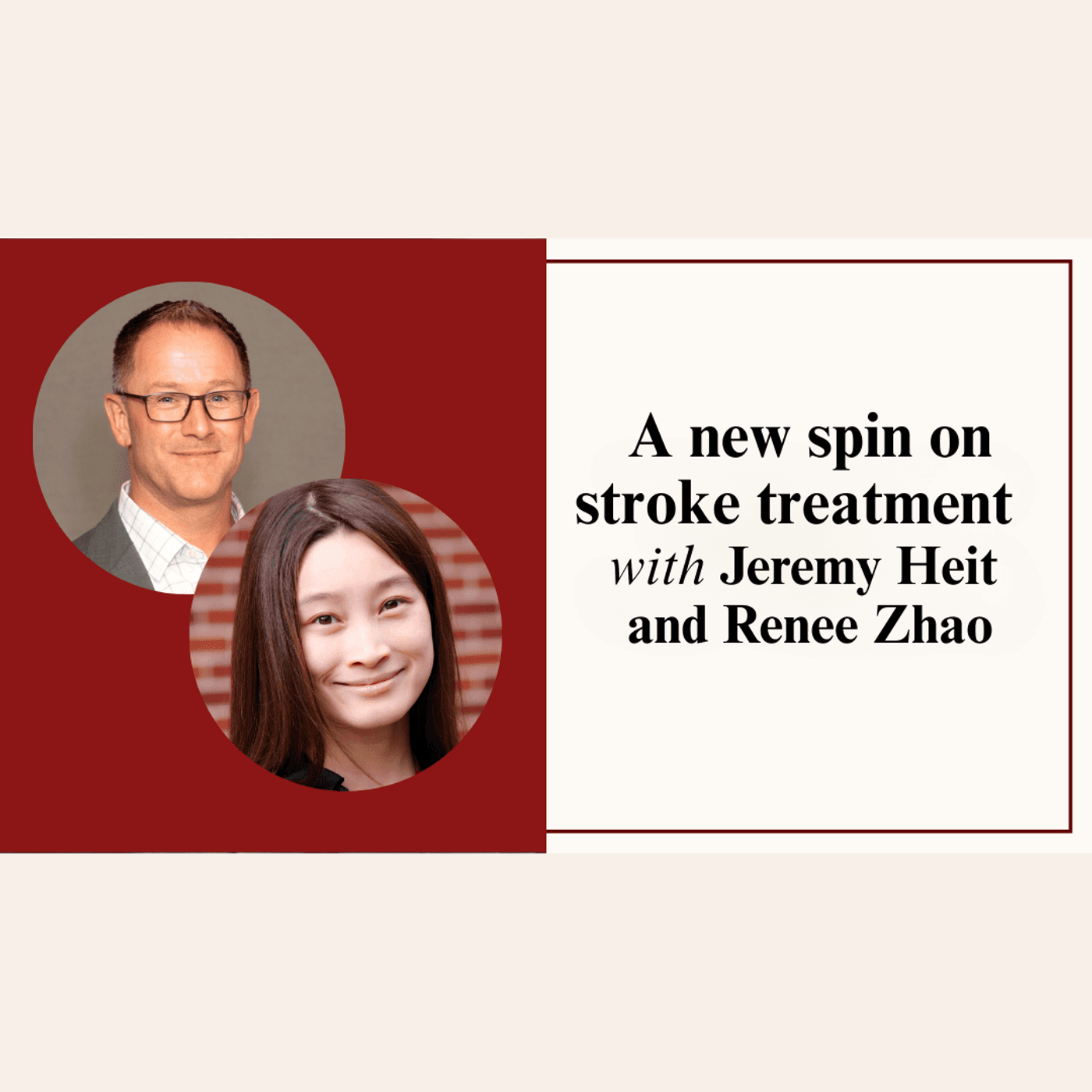
- Dr. René Zhao: Mechanical engineer specializing in tiny origami-inspired robots.
- Dr. Jeremy Height: Neurointerventional radiologist focused on treating stroke patients.
- The unique proximity of engineering and medical campuses at Stanford facilitates collaboration.
- Development of the Millie Spinner
- A device that utilizes a spinning mechanism to compress and shrink blood clots, making them easier to remove.
- The technology represents a shift from traditional methods that focus on aspiration and retrieval of larger clots.
- Journey of Innovation
- Both researchers shared personal stories that led them to their respective fields and ultimately to this collaboration.
- Their partnership emerged from curiosity, exploration, and willingness to tackle complex problems together.
---
Discussion Points
Personal Journeys in Medicine and Engineering
- Dr. Zhao's Journey: Transitioned from industry back to academia to engage in challenging and exploratory work.
- Dr. Height's Experience: Emphasized the non-linear paths of careers in medicine, highlighting the importance of relationships and teamwork in discovering new fields of interest.
Technical Details of Millie Spinner
- The spinner operates through a mechanism that densifies the fiber network in blood clots, reducing their volume significantly.
- Unlike traditional methods that involve larger devices, the Millie Spinner focuses on making clots smaller for easier removal.
Challenges and Iterations
- The development process involved creating hundreds of prototypes and addressing safety concerns.
- Both researchers noted the importance of curiosity and persistence in overcoming setbacks and engineering challenges.
---
Key Takeaways
- Embrace the Unexpected: Surprising results can lead to transformative opportunities in research.
- Interdisciplinary Collaboration: Effective communication and mutual respect between disciplines can lead to groundbreaking innovations.
- Curiosity and Tenacity: Maintaining an open mind and perseverance are critical traits for success in scientific endeavors.
Final Reflections
- Both Dr. Zhao and Dr. Height expressed gratitude for their collaboration and the friendships formed during the development of the Millie Spinner.
- They encouraged others in their fields to seek out interdisciplinary partnerships to foster innovation.
---
Conclusion The episode highlights the power of collaboration across disciplines in advancing medical technologies. The discussion underscores the importance of curiosity, the need for timely interventions in stroke care, and the exciting potential for future innovations that can arise from unexpected results.
Listen More For further insights and discussions on health and medicine, follow the Stanford Medicine Health Compass on various podcast platforms.
Written by AI. May contain mistakes. Listen to the episode to check what was said.
Chapters
Tap a time to open that second in VOThe Importance of Collaboration in Stroke Care
0:45 to 2:30
Exploration of how collaboration between engineering and medicine can advance stroke care.
“Strokes that are caused by blocked arteries are among the most time-critical emergencies in medicine.”
Meet the Innovators: Dr. René Zhao and Dr. Jeremy Height
2:30 to 6:00
Introduction to the guests and their backgrounds in engineering and medicine.
“I often ask our guests to share a story, like a moment in their careers or their personal lives that shaped where they are today.”
Personal Journeys: Motivations and Inspirations
6:00 to 9:00
Renee and Jeremy share pivotal moments in their careers that shaped their paths.
“That's a big artery in the back part of the brain.”
The Birth of the Millie Spinner
9:00 to 12:20
Discussion on how the Millie Spinner device was developed and its significance in stroke treatment.
“incredible pictures of this robot literally dissolving a blood clot.”
Mechanics Behind the Millie Spinner
12:20 to 14:01
Understanding the science of how the Millie Spinner works to treat blood clots.
“So you're hoping that the low pressure, the vacuum pressure, will be able to remove or pull the clot into the catheter or using a stand retriever to pull on the clot.”
Prototyping and Iteration in Stroke Treatment
14:01 to 16:25
Learn about the challenges and processes involved in developing medical prototypes for stroke treatment.
“So to see a device when Renee was showing me what they could do where, whoa, you're changing the clot.”
Overcoming Challenges and Safety Concerns
16:26 to 19:05
Discover how the team addressed initial setbacks and safety concerns in their device development.
“So talk to me about those hundreds of prototypes.”
Cross-Disciplinary Collaboration Insights
19:06 to 23:04
Explore the importance of interdisciplinary collaboration in medical advancements.
“And is that something that happens very frequently or tell us a bit more about that?”
Lessons from Unexpected Results
23:05 to 25:41
Understand the value of embracing unexpected results in research and innovation.
“But the two people that can work really well together, you've got to find each other and then make it happen.”
Lessons from Unexpected Research Outcomes
28:00 to 30:01
Discover the importance of curiosity and relationships in research.
“So oftentimes, those things are not following what you thought about or it went wrong.”
Transcript
Automatic transcript. May contain errors.0:05Welcome to the Health Compass Podcast. I'm your host, Maya Adam, Director of Health Media Innovation at Stanford Medicine. This is the beauty of Stanford, right? There's very few medical centers in this country where the engineering campus is on this side of the street and the medical campus is on this side of the street. So we got connected, you know, I went over to Renee's lab and she's showing me these just incredible pictures of this robot literally dissolving a blood clot. And so then I flip open my laptop and I'm like, well, here's what I do in stroke patients and kind of show her how we're dragging blood clots out and kind of looking at each other like, yeah, we have to do this.
0:46Strokes that are caused by blocked arteries are among the most time-critical emergencies in medicine. In stroke care, minutes matter, and so does precision. The difference between paralysis and recovery often comes down to how quickly and how completely a blood clot can be removed. At Stanford, an engineer and a physician came together to rethink that problem entirely. Dr. René Zhao is a mechanical engineer who studies tiny origami-inspired robots designed to move through the body to investigate and deliver medication. Dr. Jeremy Height is a neurointerventional radiologist who treats stroke patients every day and sees that better tools are urgently needed.
1:40Together, they developed something unexpected, the Millie Spinner, a tiny device that spins a clot, compresses it, and makes it easier to remove. It's a breakthrough born out of curiosity, proximity, and collaboration across disciplines. Today, we're talking with Renee and Jeremy about how this discovery happened, why it matters for stroke care, and what it can teach us about innovation at the intersection of engineering and medicine. Here's what they had to say. Renee and Jeremy, welcome. Thank you so much for joining us today. Thank you for having us. Yeah, thanks for having us. This will be fun.
2:25It's unusual for me to have two of you in one discussion. It's going to be very exciting. I look forward to it. Renee, can I start with you? I often ask our guests to share a story, like a moment in their careers or their personal lives that shaped where they are today. Can you share something like that with us? Of course. I think I share a lot of experiences with my students. And one story I always share with my students and younger researchers is that when I was doing my PhD, it was close to my finishing point to get a PhD degree. I was always telling myself that's the end of my academic career.
3:09I want to go to the industry 100%. And I want to do something that is real and is like creating things that you can actually see and touch. And it has something that is relevant, very relevant to our daily life. So that was what I decided to do. I went to industry, spent some time as a developer in a software company. And I learned really a lot. and it was a great experience, but I also decided, okay, that's time to go back to academia. The reason was that, to my personality, I really enjoy challenges and then being able to define the problem you want to solve instead of being told of what you really need to do to get the work done.
3:52So I enjoy challenges. I enjoy the exploratory environment where we can create problems, exciting problems to solve. I love that. Jeremy, what about you? Was there a pivotal moment or decision that you made that sort of shaped where you've ended up? It's an interesting question. So number one, I'm really glad Renee came back to academics because that would have been a travesty to ask that. So thank you. I think, you know, your career when you're younger, especially for people going into medicine, I think people feel that it's very linear, right? Because you go to medical school, then you go to residency, then maybe do a fellowship, then you get a job.
4:34And if you kind of look at that, it just looks like you're graphing a here's your path and you just get on the escalator and you keep riding it. But I think that's definitely not how life plays out. It's actually, there's a tremendous amount of zigzagging that goes on and how you march through that path can be very circuitous. Who you bump into can really change your direction substantially. And so just for, you know, young folks listening to this, keep in mind that this is the journey and you're not on an automated, you know, ride that's going to get you to the top. It's, there's a lot of forks in the road.
5:09So when I came out of doing my MD PhD at Stanford, I thought I was going to go be an internal medicine subspecialist, you know, I was going to be a pulmonologist or cardiologist, and I was going to have a basic science lab that was studying, you know, development of one of those two organs. And then I'd be seeing patients at the same time. And here I am, like, doing things in the brain. So it's not what you think you're going to necessarily do. And a lot of that's who you bump into. And so when I started my clinical rotations, I just clicked with one of the chief residents in neurology, who we just personality wise, we got along, we had a lot of fun together.
5:50And he was really interested in this field I'd never heard of called neurointerventional radiology. And so when I was a med student on the neurology rotation, we actually saw a patient who had a basilar stroke. That's a big artery in the back part of the brain. That's arguably the most important artery in your body because if you lose the brain that supplies, you cannot be alive. And I saw one of my, who later became partners, go up and pull that blood clot out and you saw the blood flow. And you're sitting here looking, this is pretty cool. And, you know, I was very captivated just by the endographic anatomy of the brain.
6:26It was a part of the human body I'd never thought I'd be interested in. And then here I am, you know, so many years later, this is what I do. So the escalator I thought I was on definitely was not the one. And so just encouraging people to keep an open mind and keep an open mind to who you run into and where that can take you. And I I think that has certainly been the case for Renee and I as well. I would love to hear more about that. Renee, can you tell me what you were working on when you first met Jeremy? Of course. So we all started from a work we published now. So three years ago, we published a paper.
7:06It was about a magnetically activated soft robot that was six, seven millimeter big. And we were thinking about it created a very interesting suction mechanism. And we thought if we can downsize the system so that it swims in a blood vessel and can suck the claw. That was an initial thought. So we did some preliminary testing and downsize the system and tested in a tube that's with a similar size of blood vessel, like four, three millimeter size. and there was one time my student was presenting a poster it was in at an internal event and a common friend connected uh me and Jeremy and Jeremy was all very interested in that so he visited my lab and we showed the demonstration to him and that's all everything started it was like we didn't know each other by that time it was really a lot of fun just by the way that we were connected and how much time that Jeremy later on committed to the project without, I mean, knowing there, because there was a huge risk, right?
8:15We, both of us, we didn't know where the project would be heading and we didn't have any funding to start it. We were just working together and started to apply for inertial, internal grants to support a project. So that was completely unexpected. It was super fun. Yeah, what was that moment like for you? No, so this is the beauty of Stanford, right? There's very few medical centers in this country where the engineering campus is on this side of the street and the medical campus is on this side of the street. Not many people can walk across the street very easily. And here, you know, when it's 70 degrees out in the middle of December, you can go do that anytime you want.
8:59So we got connected, you know, went over to Renee's lab and she's showing me these just incredible pictures of this robot literally dissolving a blood clot. And so then I flip open my laptop and I'm like, well, here's what I do in stroke patients and kind of show her how we're dragging blood clots out. And we're kind of looking at each other like, yeah, we have to do this. That was amazing. I have to say that we didn't have a lot of confidence in the very early prototype that we developed in the lab. we were questioning us a lot because we didn't know what was the clinical pinpoint. We had completely no idea what was the technology used to treat stroke patients nowadays.
9:40And we didn't know what the spinner would be doing to change the field. And we're hoping that it would change the space, right? But we had absolutely no idea. We were just having something that's spinning. It shrinks the size of the clot. That's it, that we had the demonstration. And then the germy came, and then we started to really developing the real prototype for stroke treatment. And how does that work exactly? Does it have to do with centrifugal force, or what is it that causes the clot to actually shrink? That's a very good question. A lot of people would think that's a centrifugal force.
10:18And we actually did a lot of very careful study to prove that the way that those millispiners works is to densify the fiber network through the compression and shear. I know this is probably a little bit difficult to be understood by a general audience. So I will explain. So in our paper, we showed a very close or very similar replicate to what the blood clot is, which is the cotton fiber. If you have a cotton ball, right, so that's everybody will know what a cotton ball is. It has a very loosely distributed fiber network, which is very similar to the fiber and fiber network in the clot. So it all depends on the clot.
11:02It's kind of driven by or it's about it's relevant to the micromechanics of a blood clot. And let's talk about the composition of the blood clot, which is pretty much all the fiber network constraining red blood cells. That's what is a composition and a red blood clot. So what the spinner is doing is that when it spins, it generates a flow field to compress the blood clot. And in the meantime, it generates this high friction so that you're rubbing the blood clot, like you're rubbing a cotton ball. So you can imagine that if you put a cotton ball between your palms and rub it, and you are applying compression force and a very high friction, and eventually you will get a very densified fibrin network core and with extremely small size.
11:53So that's a tiny little core. That's eventually what we're removing from the blood vessel. So we can shrink the clot to only 5 % of its initial volume, really shrink it in place. And comparing to the existing technology that's out there to treat stroke, I mean, Jeremy can talk more about this, but it's really just based on aspirations like pumping. You're turning on the pump, right? So you're hoping that the low pressure, the vacuum pressure, will be able to remove or pull the clot into the catheter or using a stand retriever to pull on the clot. But, I mean, a lot of the devices, they're in larger and larger dimension, right?
12:43So they're making these devices larger and larger and bigger and bigger. So we are approaching the problem from a completely different or opposite direction. So instead of making the device larger, we're making the cloth smaller, shrinking the size of a cloth to remove it, which is really very, very different from what's out there. Interesting. And Jeremy, how does one as a clinician go from like seeing this invention and thinking this could really be interesting in my field? What are the next steps then to actually testing it and getting it to patients? Yeah, this is what was so compelling, right?
13:24As like Renee's saying, the stroke is, it's sort of a, it's like a heart attack, but it's a heart attack of the brain. So if you block an artery going to the brain with a blood clot, you cut off the blood flow. So that's not good. So you have to get the blood clot out and get blood flow back to the brain. And as Renee described, sort of my job is to be a plumber. I'm going up and I got to get that clot out. But as Renee said, I can try to suck it out. I can try to put a little device up to grab it and yank it out. But neither of those changes the clot. It's just the size and the composition of the clot that's there.
13:58I just have to deal with that. I don't have any way to change it. So to see a device when Renee was showing me what they could do where, whoa, you're changing the clot. And by changing it and making it smaller, that would make my job easier to get that thing out of there. This is a really good idea. And that's what we kind of ran with. So, you know, how do you go from that? in Renee's incredible lab with her students that they can show that this works in tubes and build fancier models that mimic human anatomy and show that it works in there. What do you have to do next? Well, number one, how many prototypes did we go through, Renee?
14:34I lost track. Hundreds, definitely hundreds. I can't count this a lot. So you have to iterate. You got to find what doesn't work. It breaks for a mechanical reason. And there's a safety concern that I raise like, oh, we cannot do that in a patient. We need to fix this. And Renee's got to go and like come up with a super clever way to make it safer that I'm going to be like, oh, that looks good. I just get to be the like problematic guy. Like, oh, no. And then she goes and I'm like, oh, OK. But you have to get all these different variations and say, we think this works. Then you put it back into these flow models in Renee's lab where we had basically we would pick the toughest anatomy cases we could think of.
15:15that I would encounter in a patient. Does it work in those? Great, it does. But that's all in a very artificial setting, and it's good, but it's literally on a bench top. The next thing you want to do is say, well, what about in a biologic system? So then you start to do some animal testing, and usually we use pigs for these sorts of tests because now you're in a situation where, okay, what about moving blood? What about an actual artery wall instead of a plastic tube? Those are very different structures. Does it still work? and so we were able to show yes it still works in an animal setting so then once you kind of do those things then you're starting to say this is looking like it could work in a patient and then what you got to do is you have to move you know generally get as far as you can in an academic setting which we did and then you have to try to move it out to you know a company that can commercialize the technology or a variation of the technology and try to get it into patients, which is a whole other long process.
16:13It was really fun to be able to do all that we did together in the Stanford system, which again, not a lot of places can do this because we're very lucky to be in a center with a lot of resources. Okay. So talk to me about those hundreds of prototypes. Maybe, Jeremy, this is a question for you. Was there a moment where you felt like this is just not working? How does a scientist keep going through that? And what does that feel like? We definitely had, I think, a few moments, Renee, where we were like, ooh, okay, this is going to be a problem. I feel like Jeremy is always a cheerleader on this.
16:57I was the person that, oh my God, will this actually work? Jeremy was always there cheering me up. I love that. Jeremy, how did you keep that positivity? Well, you just, you got a sense something can work. And actually it was great. Every time we had a failure early on, which was a lot, it's just a new problem you have to address. And, you know, Renee's, you know, persistence is not to be underestimated. She will figure it out. and her students are so good together they always figure it out so my big thing was twofold and when we first started looking at this my concerns were number one okay we're shrinking the clot but we're just going to send a bunch of small clots flying away in the brain and that's not good so that was big concern number one and then number two i was like okay you're showing me this spinning thing renee that looks like a drill i don't want a drill and an artery in the brain like we can't have a drill and so renee said okay and then they solved both of those problems and we had to come up with um first we had to do experiments to show that as you shrink the clot you're not just sending smaller bits of flying and that's what we found and i was like oh okay well that's really good this is great i was wrong on what i thought would happen um and that's still the number one question i get asked by by physicians by the way and then uh then the drilling part, you know, we actually had to do experiments to say, well, is this a problem?
18:20Because the first bit, the first device was actually, Renee would print it in her lap, so it was a plastic, and she'd be like, it's fine, and you can push it in her hand, it was fine. But then we started pushing it against blood vessels, and it was not fine. So it did act like a drill. So we had to make sure we had a big safety component, that this thing couldn't actually stick out. It would be confined in a catheter for safety. And the engineering fix was just so, so clever, so, so clever. And as you see these setbacks and then successes, then suddenly you get to a point where you're marching forward.
18:51Sometimes it's, you know, two steps back, three forward. But then as things get refined, you're just stepping forward every time you do something. And that was really exciting to see. And that's when we were really roaring forward very quickly. And are there other applications of this in other disease states? it's um so the spinner is a platform technology it treats claws the clock can be in a lot of different places in human um so we work together for a stroke indication but it can also work for heart attack and pulmonary embolisms and diglington buses and also it works for kidney stone so those are different things that we've tried i'm fascinated by this coming together of disciplines And I wonder if you can talk to either of you can talk about other experiences you might have had where collaboration between two fields, you know, catapulted you forwards.
19:50And is that something that happens very frequently or tell us a bit more about that? I can start. So it doesn't happen enough. And that's just 100 % the case. it is so critical. And that's where really major steps forward happen. It's sort of, it's sort of if you read, for example, like we're all very tempted to just read literature in our own field. You have to be very intentional about looking outside your field because that's where you really put together really unique connections. And that's the same thing as talking to people outside of your discipline. And again, I give Stanford as an institution a ton of credit because, you know, Renee's students and other students in engineering come over to the medical side and see what we do.
20:44And then we do our best to go over to that side and see what the engineering folks can do. And that's effort, right? Everyone's busy. You've got to take time out of your day to see that. But when you do that and you cross-pollinate, you really get a sense of, wow, I could do that for this in my practice. And that's where it starts. But that's step one. I mean, just making a connection doesn't make any of this happen. Then you've got to have people come together and do the work. And I think that's where Renee and I really excelled, is we both can work hard, we can work efficiently, we can write, we can seek funding, we can execute.
21:20And I think the two of us together do that really well. But you also have to have the right personalities. There's a lot of big ego in medicine. There's a lot of big ego in engineering. to do this kind of stuff, you need two people that can check their ego and work together. And I think that was just, we had all of these little bits between the two of us come together that really made this work in a spectacularly effective way. Jeremy, how could one more formally sort of increase the likelihood of these interdisciplinary projects coming about? Would there be, do you have any ideas for maybe cross-disciplinary conferences or meetings or ways in which other institutions might be able to facilitate bridges like this?
22:07That's a great question, Maya. And I think, Renee, I'm sure we'll have some thoughts on this too. So things that are done that I do think help are you really purposely promote multidisciplinary collaboration. So you can do that by holding a meeting and saying, we want engineering and medicine to come to this. Let's get everyone in the same room and talk. There are buildings on this campus where the lab space is intermixed between very different disciplines so that when students are walking past each other and saying, hi, hey, what do you do? Here's what I do. And that can try to generate ideas.
22:42And I think there's something to that. I think that those are helpful. But again, it's not, you need more than that. What I don't know how to solve is how do you solve the chemistry part? Right. It's kind of like dating. You've got it like there's got to be a spark that's going to make sure that you've got all the pieces there. It's got to work together. And that that's a little bit trickier thing to solve. So you can kind of do everything to maximize that that interaction happens. But the two people that can work really well together, you've got to find each other and then make it happen. And it told me like you probably have a bunch of other thoughts on this, but it's complicated.
23:19It is complicated and it's also difficult. I would say, I mean, well, the collaboration between Malav and Jeremy, this is really this very unique. And I didn't expect this. And I learned a lot through our collaboration because you need to be very open minded to expose yourself to new opportunities. A lot of everybody at Stanford is busy. We all have our own thing to do. And what I really appreciate is that Jeremy came and really actually put a lot of time and effort on this, something that he had nothing to do before. And he joined us and then we really started to develop this technology together to get to where we are today.
24:07So that needs a lot of courage. And well, courage in the sense that they were willing to take the risk. The risk is that eventually you spend a lot of time and effort, it may turn into nothing, right? So not everybody can take that risk. So being very open-minded and also respect other people's understanding of specific problems, that is also what I learned a lot through this collaboration because from the very beginning, I feel like we speak completely different language. And what we care as engineers, Germany doesn't care at all. And I was like, how come you don't care about this? This is so important.
24:47And eventually I realized that we need to really be able to talk to doctors and know the clinical pain points and know what we need to address. We need to address real problems instead of artificial problems that are engineering, from engineering aspect can be very important. But from clinical aspect, it might not be that important at all. So a lot of understanding other people's way or from other aspects to approach the problem and eventually converge, I think that is very, very important. So open-minded and also trust each other. Those are all very important things to consider when we come up with ideas that require multidisciplinary efforts.
25:35and learning the problems, you know, because again, it's very easy. Renee has no shortage of creativity and the ability to build anything you want, but you can build a tool. It's got to have an application. So it really takes effort to understand like what really are the problems you are facing? You know, what problem do you run into in patients that is not solved right now? And then can you design something that addresses it? And I don't think it always happens that way, I think there's a lot of things where a tool's developed and then you go looking for a problem to fit the tool. And that can work sometimes.
26:11You can get lucky. But it's far better if you say, here's the specific problem and then you innovate the tool to address the problem. And that worked really well for us. Excellent. Okay. I have a nearing the end of our conversation type of question. And that is, if you reflect back on this whole chapter, what will be the one thing that stays with you, the one moment that really you'll never forget? I can start. I think because when we started developing the millispinner technology for clock treatment, we were not expecting the fibrin densification and clock shrinkage functionality. It was just the spinner creating a localized section and we wanted to use that to suck blood clot.
27:03We were not thinking about changing its size or changing its microstructure. It was all unexpected. And I think the one thing I really value through this experience is that always embrace the unexpected results and uncertainties. because these are where the most transformative opportunities are born. I think this is really important because our very common or normal mindset, especially for my students, when you start a project, right, so you have some expectations or some results that you're expecting, some goals that you want to achieve. But if you focus too much on that, things will always go wrong.
27:50Nothing will go 100 % as expected. If you get a 100 % expected result, that means that your problem is not that exciting. You already know what you're expecting. So oftentimes, those things are not following what you thought about or it went wrong. And instead of focusing on, oh, it's not the thing that I expected, think about what actually opened up, something that's very new. I think that's the most exciting part of doing research. Great points. Jeremy, what about you? Any moment that stands out as one that will remain unforgettable? I think it's, for me, it's lessons learned and experiences.
28:34So first off, just to, I completely agree with Renee. I mean, this is a project and I think a success story that emphasizes the importance of curiosity. because it's very easy for an unexpected result to say, well, it didn't work and walk away. And that's not what she did. It's not what her students did. They were curious at what they were seeing. And that really took us down the path to figuring this out. So you've got to have that curiosity and then you've got to have the tenacity to keep following through. And I think there are innumerable stories in science of this nature, right? And I don't know how many Nobel Prizes start with the same kind of story.
29:07So that is a well-learned lesson that I think for any young physicians, any young scientists listening to this that's really critical um so that was super fun to be a part of and that's something that i'll always remember um you know and then there's the whole project there's so many kind of ups and downs and high points and low points but kind of the best part of this is having gotten to work with renee having gotten to know renee really well like we became such good friends doing this together and those sort of interactions and relationships that's the best part right i I mean, you come to the end of this and you've got a companion and a friend that you didn't have before and you did this really fun thing together and we'll get to keep doing fun things together.
Read the full transcript
29:51That's the best part. So who you meet along the way is not to be underestimated. And I hope everyone can keep that in mind for their own careers, too. Well, that seems like a wonderful place to end. I'm so grateful to both of you for your time and congratulations on this exciting discovery. and I wish you both all the best in the future. Thank you so much, Maya. Thank you for having us. It was a lot of fun. Special thanks to Rene and Jeremy for joining us today and for giving us a look at how innovation happens when clinicians and engineers push each other to dream beyond what either thought was possible.
30:33Thank you for listening to Stanford Medicine's Health Compass podcast. If you'd like to hear more conversations like this one, you can follow Health Compass on the Stanford Medicine YouTube channel or any podcast platform you use. Stay well and see you next time.
From the publisher
A stroke caused by a blocked artery is one of the most time-critical emergencies in medicine. In stroke care, minutes matter — and so does precision. The difference between paralysis and recovery often comes down to how quickly, and how completely, a blood clot can be removed. At Stanford, an engineer and a physician partnered up to rethink that problem entirely.