In short
Stanford Medicine Health Compass - Episode Summary
Podcast Information
- Title: Stanford Medicine Health Compass
- Host: Maya Adam, MD
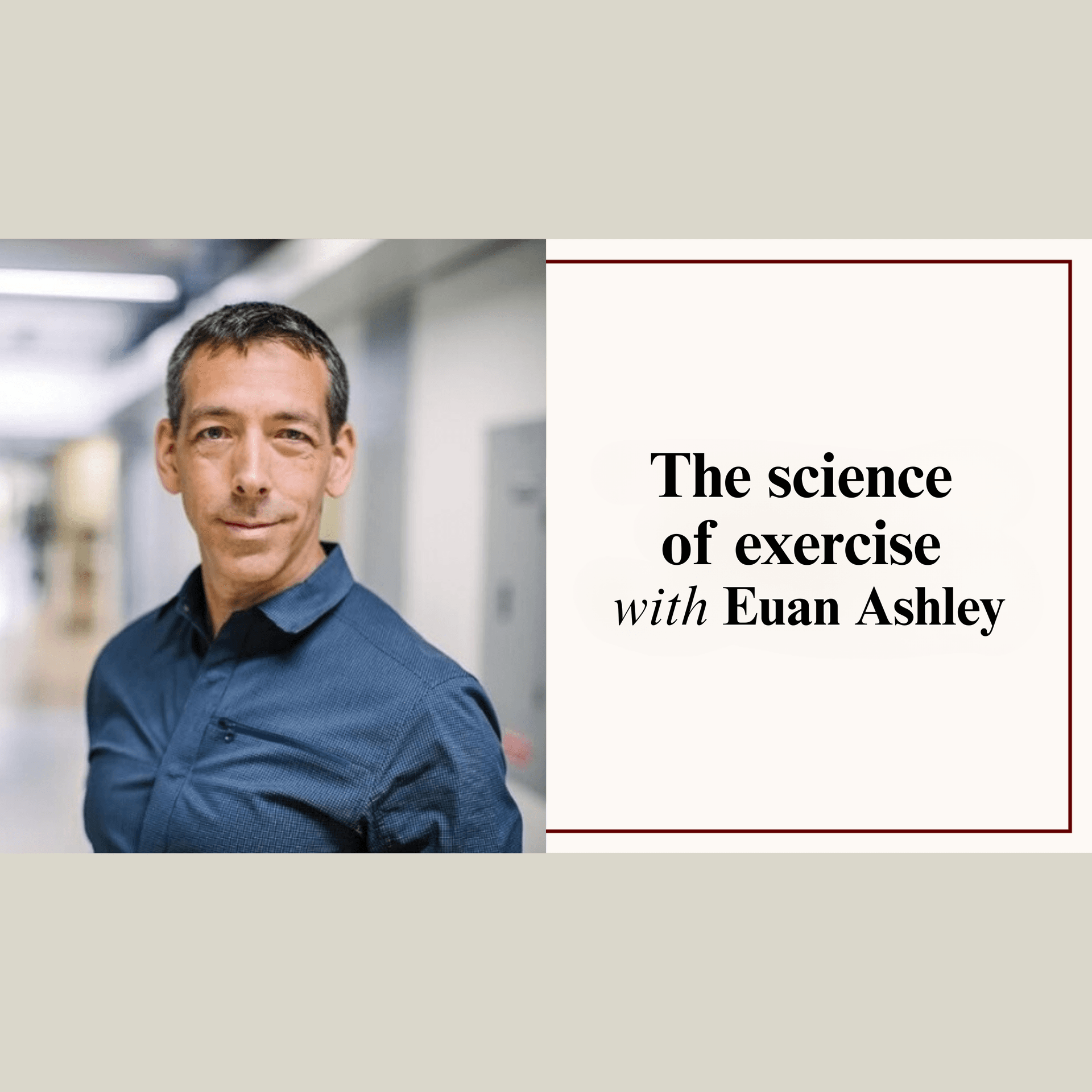
- Guest: Euan Ashley, MB ChB, DPhil
- Episode Title: S2 Ep2: Is Exercise the Health Hero We All Need?
- Description: This episode explores the profound effects of exercise on health, featuring insights from Euan Ashley, who discusses the benefits of exercise on a molecular level, practical tips for incorporating movement into daily life, and its role in preventing diseases.
Key Themes and Concepts
Exercise as Medicine
- Exercise is Powerful: Euan Ashley describes exercise as the most potent drug available, emphasizing its wide-ranging health benefits and accessibility.
- Lifespan and Exercise: A minute of exercise can potentially add five minutes to one’s life, underlining the importance of even short bouts of physical activity.
Benefits of Exercise
- Disease Prevention: Regular exercise significantly lowers the risk of heart disease, diabetes, multiple cancers, and mental health issues like depression and anxiety.
- Whole Body Impact: Exercise positively affects nearly every organ system, showcasing its holistic benefits.
Types of Exercise
- Intensity Levels: Exercise can be categorized as low, moderate, or vigorous. The host and guest encourage a mix of all intensities.
- Duration Recommendations: Traditionally recommended is 30-40 minutes of exercise three to five times a week, but developing a habit is emphasized as key.
Tailoring Exercise to Individual Needs
- Varied Types of Exercise: A combination of endurance, strength training, and flexibility exercises is ideal for overall health and to address specific goals, such as aging or muscle preservation.
- Gender Differences: There are subtle differences in how men and women respond to exercise at a molecular level, highlighting the importance of considering gender in exercise studies.
The Science Behind Exercise
- Molecular Changes: Exercise impacts various tissues and organs at a molecular level, activating stress response systems that enhance overall health.
- Immune System Benefits: Regular exercise leads to significant changes in immune system genes, which potentially bolsters the body’s defense against diseases.
Practical Tips for Incorporating Exercise
- Creating Habits: Choosing a consistent time for exercise (e.g., after dinner or in the morning) helps in forming a routine.
- Social Support: Exercising with friends or in groups can provide accountability and make it easier to stick to plans.
- Motivation Techniques: Reflecting on personal goals and reminders can keep motivation high on challenging days.
Conclusion
- Final Takeaway: The episode concludes with a simple yet powerful message: "Move more." Regardless of the form or intensity, the act of moving provides substantial health benefits. Exercise doesn’t need to be complicated; just increasing daily movement can lead to significant improvements in health and longevity.
Resources
- Follow Up: Listeners are encouraged to subscribe to the podcast on various platforms such as Apple Podcasts and Spotify to stay updated on health topics.
---
This summary encapsulates the essential discussions and insights from the episode, reinforcing the pivotal role exercise plays in maintaining health and well-being.
Written by AI. May contain mistakes. Listen to the episode to check what was said.
Transcript
Automatic transcript. May contain errors.0:07Euan Ashley:Welcome to Health Compass. I'm your host, Maya Adam, Director of Health Media Innovation at Stanford Medicine. Exercise is the most potent drug we've ever known, except it's not a drug, and it's free, and it's available to all of us. It does miraculous things. there are benefits across your entire body. And so when you start to stack those up, maybe it's a little bit less surprising that a minute of exercise could buy you five minutes of extra life.
0:41Euan Ashley:We hear it all the time. Exercise is good for you, but it's not always easy to do. Many people have long days at work or families to take care of, or sometimes we just don't feel like it. But studies are showing that exercise just might be the most potent natural medicine we can give to ourselves. So what does that actually mean? How should we incorporate exercise into our daily lives? And how exactly does it change our bodies? Today, you and Ashley, chair of the Department of Medicine, will help us unravel these questions and give us practical tips on how to get moving and sustain an active, healthy lifestyle.
1:26Euan Ashley:We'll talk about what makes exercise such an important component of health, creative ways to sneak in some activity even when you're busy, and what exactly is happening in our cells when we rev our body's engine. Ewan, I'm excited to dive into these fascinating topics with you today. Thank you so much for joining me. Oh, thank you for having me. I'm so happy to be here. You know, I always ask my guests to start by telling us a story, something that has been meaningful for you in a personal or professional capacity that sort of had an impact on your lives. Would you mind sharing something with us?
2:10Certainly. You had warned me that you might ask this question. So I was thinking a little bit before I came in about some of the moments over my life that have led me to kind of where I am today. You know, I've spent so much of my life thinking about the heart. And I know that the heart itself is only part of our conversation today. But I always think back to the moment when I first realized I was going to dedicate my life to trying to understand that organ. And I was a medical student pretty early on. It was a physiology class. It was old buildings, 500-year-old medical school in Glasgow in Scotland.
2:51We were sitting on little wooden stools. And the experiment that we were doing on that day was to look after a heart. So they basically would take the heart out of an animal, in this case a rabbit. They did that behind the scenes, so we never saw any of that. And they would bring this essentially petri dish, a little glass dish, with a heart in it that was isolated and still beating. And we had to hang it on a cannula and then keep it alive for hours. You basically had to feed it, give it fuel, give it oxygen, and try and keep this heart alive. And you could make it go faster, give it adrenaline, you could block the adrenaline, make it go slower.
3:31And I just remember in that physiology room, that sort of something, it's almost like something out of history, it seems so long ago, just watching this beautiful organ beat, like in time, sort of almost like a symphony, making sounds and moving. In this case, there's no circulation, so there wasn't moving blood around the body, but doing its thing, you know, over and over again. And I think of human hearts beating three billion times in a lifetime. And just the coordination of that and the beauty of that organ, I just knew I was going to spend my life dedicated to understanding everything I could about how that worked.
4:11And yeah, it was a really kind of pivotal moment for me. And that's, I think, become larger in my brain over time. But it really was an amazing moment for me. And I often think back to that many years later, now having spent a lot of time thinking about the heart, I still have a lot to understand and a lot more to understand about it.
4:32Euan Ashley:Oh, that's fascinating. And today we're talking about how to keep that fascinating organ healthy. And one of the ways I hope we're going to hear from you is about the importance of exercise and how regular exercise can help. I read a fascinating statistic that even a minute a day of exercise can add minutes to your lifespan. Can that be true? Absolutely. Yeah. No, I mean, exercise is the most potent drug we've ever known, except it's not a drug and it's free and it's available to all of us. It does miraculous things. And then really, if you compared what exercise can do to any drug that we have, you'd find that it has so many greater benefits.
5:21And there are ones that we're pretty aware of, you know, thinking about individual diseases first, then we'll get back to your statistics. But yeah, think about the benefit for heart disease. You can cut your risk of a heart attack down in half by regular exercise. And people are used to hearing that. You can reduce your risk of diabetes, high blood pressure. So maybe we're used to hearing that as well. But not everybody understands that you can also reduce your risk of multiple cancers by 50 % through exercise. And as you go through each organ system, whether it's the heart or the lungs or the GI system or your brain, think about the effectiveness of exercise for preventing and treating depression and anxiety, then you realize that there are benefits across your entire body.
6:09And so when you start to stack those up, maybe it's a little bit less surprising that a minute of exercise could buy you five minutes of extra life. My favorite thing about that statistic though is in fact if you do higher intensity exercise, which is safe for most people, many of our patients, we might not recommend high intensity exercise, but if you're fit and healthy and able to do higher intensity exercise, you might get seven or eight minutes of extra life from that. So I always tell my patients that when they tell me they don't have enough time to exercise, and I think they find me quite annoying when I say that, but they're like, oh, it's so hard to exercise.
6:44I would say, look, you're going to have more life. You exercise for one minute, you've got five minutes of extra life. So that doesn't make juggling three kids and a dog and all jobs and everything about life, it doesn't make that any easier, but hopefully it gives them some inspiration to get up and move about.
7:02Euan Ashley:So you mentioned impact, sort of intensity. Talk to me about the differences between high intensity versus low intensity and what the implications are for our health. Yeah. Well, most exercise when you hear it recommended by public health bodies or by doctors, we often talk about moderate to vigorous activity. It sounds like a TV ad or something, doesn't it? How many minutes of moderate to vigorous activity have you performed? But in reality, although it sounds a bit complicated, it's really, it's not that much. I think the first thing I always tell people, though, is thinking about what they should do that something is always better than nothing.
7:45So they should stand up and move around. Like if you're used to sitting, just standing is going to get you benefits. If you stand and walk a bit, then walk some more. If you want to take the next step, then we could do moderate to vigorous activity. If you think about on a scale of one to 10, where sitting really doing nothing is one and sprinting as hard as you possibly can, something you could only keep up for a few seconds is 10, then when we talk about moderate to vigorous activity, it's somewhere in the four to seven range. So, you know, it's definitely a brisk walk. It's not a saunter. That would be moderate activity.
8:22If you want to push, you would be walking briskly. And the fact that you're a little short of breath as you're talking while you're walking, but you still could be talking to someone while you're walking. That's moderate activity. I think as you start to move up, beyond that, you might be starting to think about a jog, or if you're on a bike, you'd be more short of breath. Maybe it's a lot harder to have a conversation. Maybe you're starting to sweat because your body's thinking about regulating your temperature. That's taking you up into that vigorous range. But I usually emphasize, regardless of how we classify the exercise, I usually emphasize anything is better than what you're doing now.
8:59So everybody should exercise more. And it needn't be something complicated. You don't need a gym membership. You don't need complicated weight machines. You can do a lot just with moving more and even using your body weight. So we might talk about strength things in a little bit too.
9:16Euan Ashley:And talk to me about duration. How long should we be aiming for? Well, traditionally, most people would, most doctors, again, would recommend something like 30 or 40 minutes of exercise three to five times a week. That's a very kind of standard exercise recommendation. And I think for people who are looking to set a target for themselves, that's pretty good. I think I find most people do well when they get into a habit. So they find a time during the day when you can really do something recurrently. It might be after dinner. There's great benefits to exercising after a meal, especially the largest meal of the day.
9:53For many people, that is dinner. Really significant benefits in controlling blood sugar if you go after dinner. But if that's a good time, that's great. For some people like me, the best time for me is getting up in the morning. I'm going to be tired no matter what time I wake up in the morning. So I might as well get up, wake up 45 minutes earlier and pull on some shorts and go run around my neighborhood, which is what I do. But I think the key thing is choosing something that you can do recurrently. And then it becomes a habit. And so for some people, actually, then six or as long as it's not too vigorous, even seven days a week might even be easier because you're just going to do that every single day.
10:33And I think that the major thing is habit. So although traditionally doctors say three to five times a week, I think if you're only doing something three times a week, then there's always a question of is today the day or today not the day? And there's always a temptation to push it to tomorrow. So I often talk to some of my patients, especially if they're going, if they're doing walking, that that's something you should basically just do every day. Just make it part of your routine. You know, you get up, you go take a walk 30 minutes. If you have a dog, even better, you don't need the dog, but if you have one, even better.
11:03And then it's built into your day and you've got it done. And there's a lot of benefits to exercising in the morning.
11:09Euan Ashley:And Ewan, you mentioned a few different types of exercise. Are there different types of exercise for different goals? Like, is one type better for heart health and one for weight loss and one for, what about aging? What would you recommend? Yeah, great question. And certainly people have done a lot of studies over the years aimed at answering kind of exactly that question. Is there a specific kind of exercise that's better for a specific disease prevention or, as you say, for healthy aging? And I think the simplest answer to that is no, actually. The simplest answer is that all exercise is good and you should make the exercise as varied as possible.
11:51And it should include both endurance elements like walking, like running, like jogging, like biking, and strength training. So like lifting weights or bodyweight exercises, we could talk about what they might look like. Squats might be an example, or push-ups might be another example. And also flexibility. And so a lot of people, of course, do that at the end. It's best not to do too much stretching before you're warm. But I think people tend to neglect the flexibility element. And in fact, a lot of people suffer back pain in our society. And in many cases, it can be significantly helped with exercise and the flexibility element can help dramatically too.
12:30And so when you think of all those things, they have benefits, strength training, endurance training, flexibility. They have benefits for cardiovascular disease, for cancer, some of those benefits I talked about earlier. But thinking in particular about healthy aging, there's some focused exercises that can be very helpful. So if we think about someone who's in their senior years and maybe they haven't exercised as much, so they don't have a great baseline strength. Think about the sorts of things that are going to make a huge difference to their life. Getting up and out of a chair or in and out of a car are two really important things.
13:04And there are particular movements, for example, hip flexion, so the bending of your hip, and then the ability to push up with your triceps from a chair, and at the same time, use your quadriceps and the legs to push up. Those are you could do focused exercises to make sure that the last thing that goes is your ability to push up out of a chair or get in and out of a car. And it's worth it because you may only have a certain amount of time to exercise. And so you may want to focus on those strength elements if that is a particular goal for you. But for most people through most of life, a mixture of these different kinds of exercises plus flexibility is going to be the best advice that I would give.
13:46Euan Ashley:And you talk about sort of aging on that topic. I've had a lot of people say to me that as women get older, we need to focus more on maintaining our muscle mass. Are there sort of gender differences in what people need as they age? I think broadly speaking, no. I mean, I think bone health in particular is something obviously that is, I mean, muscle strength is, I think we all have muscles and we age in slightly different ways according to the lives we've lived. I think we think of bone health as something, of course, because of the hormonal component that is more important for women and osteoporosis being a critical element to that.
14:27The great thing about exercise, of course, is it helps with your bones too. I mean, you actually, every time you pound a pavement, even if it's just walking, you're sending shockwaves up through your bones and that those signals actually are sensed by your bones and allow them to keep healthy and basically realize the bones, realize they need to build strength because they're receiving these recurrent kind of shock waves coming up. So we do particularly emphasize that kind of activity in women of a certain age. Otherwise, though, it's remarkable how consistent our advice can be. I have to spend so much time talking about personalized medicine I feel like this is one of these situations where some personalization is for sure personal trainers or physical therapists can help with that particularly if you have a specific intent in mind but for most people making sure you have a mixture of endurance, aerobic exercise strength training and flexibility will actually cover you for all things
15:29Euan Ashley:So when we are doing strength training I'm familiar with that feeling of the burn. I'd love to hear more from you about what's causing that. How much should we push beyond that burn? What do you recommend? Yeah, so it is an important factor to remember that I always, I know she doesn't mind me saying this, and I certainly won't name her, but I had a patient once who was describing her exercise regimen to me. And we were going through the different things she did. And I had the impression that she was doing some work, but maybe not pushing it very hard. And I asked her this question about sweating.
16:07I said, well, so do you sweat? And she said, oh, I wouldn't want to sweat. And I suddenly realized that we're having this whole conversation exercise, but her exercise was a very limited exercise in this case. And I think about that in particular because I had been talking to her about muscle and thinking about muscle strength. And there is an element of no pain, no gain. I mean, there's a reason that these cliches exist. And I wouldn't want to recommend anyone experience actual pain. But the intent of that phrase is that, particularly for muscle building, if you want your muscles to respond, they have to realize that you are making demands of them.
16:48And so that burn that you're describing is actually a really important part of signaling to your muscles that they need to build. And so if you're doing strength exercises and you're not feeling any burning sensation in the muscles that you're working on, then you will not be sending those signals appropriately to the muscles and certainly the muscles will not grow. Now, it doesn't need to be to the point, people who do a lot of weight training will talk about failure. So where you try, maybe you hold a push-up position until you just can't hold it anymore and then you collapse in a heap. It's pretty clear now that you do not need to go to failure in order to get the maximum benefit, not least because if your muscles are failing and you're falling on your face, that's not a good thing for other reasons.
17:35But you don't need to push your muscles to the point where they are shaking and you literally have to give up. But you do need to push your muscles to the point where they burn a little bit. And then, of course, you recover and your muscles recover and you go back and do it again. And that's what you do. So I think if you were doing, let's say, SWAT exercises or push-up exercises where you weren't feeling any muscle burn, then you need to ramp up the intensity a little bit more and do a few more. And you should get to the point where you really do feel that you're pushing your muscles hard. And that's the kind of stress that will allow your muscles to stay healthy and respond by building them up.
18:14Mm.
18:16Euan Ashley:So are there other, you kind of went a little bit into the cellular level there of what makes muscle cells grow and get stronger. Are there other sort of at the cellular level, things that we should know about the importance of exercise for our health? What's going on there at the cellular level? Well, the remarkable thing is that for so many years, we really had not a lot of idea. I mean, we had some idea, but we hadn't studied exercise for all its potency and reducing the risks of all these diseases I mentioned and extending your life. We haven't really known exactly how it works because we really haven't studied exercise at the molecular level.
19:00The classic studies demonstrating that exercise could extend your life and reduce your risk of heart attacks in particular were done in the 1950s, like the late 1940s, 1950s. A couple of classic studies, one done on London bus drivers and comparing their risk of heart disease to London bus conductors. So in the same environment, basically breathing the same air, working for the same company, in many cases working the same hours, one is sitting the whole time, one is walking up and down stairs the whole time. They found that the bus drivers had double the heart attack risk of the bus conductors.
19:34So that was a really important study from the late 1940s. And then And another study done here in the early 1950s in San Francisco by Ralph Paffenberger showed that the longshoremen who had more strenuous activities as part of their daily life had a much lower risk of heart disease. And so that was the beginning of our understanding, you know, 70 years later now as to just how important exercise could be for reducing risk of heart attack. Interesting story. actually, when I first came to Stanford, I came to work with a world expert in exercise in the heart, a professor still here, emeritus called Vic Frohlicher.
20:14And we were working at the VA hospital here in Palo Alto. And it was all new to me. I'd just come from Scotland. I was, you know, white eyed, bushy tailed, excited for everything California had to offer. And I went in on the first day to do these exercise studies because I was really interested in exercise. And the first patient who came up was Ralph Paffenberg. He died now, but he was in the lab having an exercise test. And it was just, he's this like legend in exercise physiology and exercise epidemiology because of these long-term studies he did in the 1950s. And then here was me in the late 90s meeting him for the first time.
20:53Just amazing. But 70 years later, until recently, we really had no idea what was happening at molecular level because it's expensive to study that. And we tend to study things that might become drugs, but here's our most important drug that we have. So it's time to study that, not just because we should learn how it works, but because there might be, we might learn something there about how to build a drug that might have these much broader benefits. So there's many reasons to study it beyond just working out how and why it works. So we've been part for the last few years and really been a privilege to be at the center of the study with one of the coolest names that of any consortium I've been involved in.
21:35It's called MotorPak, which I think was something that Francis Collins himself, prior NIH director, was even involved in helping choose that name. Molecular Transducers of Physical Activity is what it stands for. It's a big, long bunch of words. I prefer motor pack because it's basically us trying to work out what is happening in your muscles when you exercise. And it's a big consortium of multiple sites across the US where we take both animals, so rats and people separately, different studies. And we train them, essentially, we take them from sedentary life to exercise life over 12 weeks, and we take samples of their tissues.
22:18And so in the case of the rats, obviously we can sample all their tissues after they pass on. With the humans, they've been brave enough and kind enough to offer muscle biopsies and fat biopsies, which is just a little sample of tissue and blood. So imagine that study, you're training hard, and then you come into the lab and we take a little piece of muscle, a little piece of fat, and the blood sample. So we're very grateful to those participants for doing that. But what it has allowed us, and so far just the data from the first rat study has been published. We have some more data on human studies coming soon.
22:55It's been amazing, even to me as somebody who for three decades has been fascinated by exercise, in particular its effect on the heart, because we learned some things that just weren't that obvious. And I can share a couple of them. The first thing, thinking about the rats, is that as we looked at each tissue, we realized that these animals had almost turned into different beings. I mean, literally every tissue was completely different. And we're here where it's a particular study where we don't just measure one thing. We're measuring something called omics. And that's a word that just means we use lots of different molecular techniques to measure lots and lots of molecules.
23:34and each particular class of molecule has omic at the end. So proteome, metabolome, genome. So it gets called omics. That's another little sort of funny thing. So it's an omics study where we measure all these things in these different tissues after the training. And they really look like different beings. Every single tissue was changed dramatically. And again, we might not be that surprised that the heart was changed a lot or that the skeletal muscle was changed a lot. or maybe even the lungs or the blood was changed a lot, but the adrenal gland looked completely different. Like why is your adrenal gland like produces adrenaline and does some other things to do with salt and water and control of fluids.
24:17So maybe that's the key. Every time we looked, every tissue was different. The other thing, and this speaks to one of the questions you asked earlier, where I was in the end saying that our advice to men and women is quite similar, the response to exercise is not similar. Like what we saw was completely different changes when we looked at men and women. And this is men and women rats in this case. And you can actually use a special computer method to ask the data, like, tell me what you're, it's a bit like standing back and looking at a painting instead of seeing the broad strokes, but none of the details.
Read the full transcript
24:52Computers can basically be asked to do that. And when we ask those computers to kind of step back, take a look at all our data, what were the big signals? Then time and again, the big signal was that the male rats and the female rats were responding differently. And so we've been digging into that a lot. And also, I've been ever since recommending it to anyone who would listen to make sure that they always do male and female animals in every study that they do, because you're missing a lot of important information. And of course, the history of medicine, you know this well, has been a focus on many more studies featuring males than females.
25:29And we've been missing a massive amount of data and important expertise. And in our study, we can see that at the molecular level in our rat study. So very different, in particular, for example, fat, the fat metabolism is different between men and women, rats in this case. And then I'd say one more thing about that that really struck us was that I mentioned this earlier when we were talking about building muscle and you'd asked about burning. And so you need a little bit of stress to create the benefit. And that's something that has a fancy name, hormesis is the name, the idea that you can have a stress and a recurrent stress can end up providing protective benefits.
26:13And that's kind of a fascinating element because when you go running, you're pounding the pavement, right? You're actually stressing your body. But the overall benefit of that is dramatic. So how does that work? And we were trying to get a clue towards that mechanism with the study, and we actually found it. So there are stress systems in cells at the cellular level that help basically deal with proteins that get damaged. And then they sort of mop them up and put them in the recycling bin. They go by the name heat shock proteins, which is kind of a cool name. But basically, it's a system in cells for kind of mopping up, taking out the trash, keeping everything in line and in order, making it look like Switzerland.
26:53That's what I usually think in my head. Everything's lined up beautifully. So that's what that system does. And that was dramatically upregulated with exercise. So it really does seem like the stressor is enough to say to your cells, hey, you need to respond to this. And that somehow gives you this protective armor around the disease process because you're now, your body's like training itself to deal with stress. And the exercise stress doesn't cause lasting harm, causes lasting benefit, but it's doing it partly by sort of training your stress systems all the way down to the molecular and cellular level.
27:27Wow.
27:28Euan Ashley:I mean, it's so interesting to hear that even, you know, that exercise can actually help our adrenal glands function better. But what about on that note, what about the immune system? What's the impact of exercise on immune function? Yeah, yeah, no, that's a really important question. Because, again, I think we think of athletes and people who exercise regularly as among the healthiest in our society. And when we think of the diseases that most of us get, most often we think about colds and flus and the infectious diseases and our response to them. So, yeah, I would say that it was not surprising to us that we saw in the study significant changes to immune system genes in different tissues.
28:14I guess some of the tissues where we saw those were a little surprising to me. For example, we saw an immune system signal in the small intestine. And you think about when you're exercising, you just think we've traditionally taught that your GI system kind of shuts down when you exercise because you're not going to be eating. You're doing the opposite. You're fight or flight, but you're running away from the bear. You're not thinking about resting and relaxing and eating a steak. And those two systems are kind of in balance in your body. One is activated, the other is sleeping. And so to see changes in the GI system in the small intestine was, to me, pretty interesting.
28:55but it was part of a multi-tissue response that we saw in demonstrating again some degree of immune activation and I think although we don't really understand it well some part of that is the same principle where we're kind of stressing the system a little bit to make it more robust towards disease or it's kind of the real stress or it's like it's like a dress rehearsal for the play where you're sort of working through the motions, the stakes are lower, but you're getting yourself ready in case, you know, for the moment when you actually have to respond to disease.
29:32Euan Ashley:And do we see those changes, Ewan? Are they the same? All of these molecular changes you're talking about, are they the same in kind of casual athletes versus elite athletes, or are there differences there? Yeah, I think that I suppose we only all have to watch the Olympics to realize that we're not quite the same level of being as those superhumans. But they are the same species, right? We are all human. So we do have a study of much of fitter individuals that is part of our human study. And we'll be quite interested to see what we see there and see if these are, broadly speaking, the same changes.
30:15But your question makes me think of another study that we haven't published yet, that we have, that we also work on here at Stanford that we call Elite. And the name is, the key is in the name. And this is essentially us using genome sequencing. So it's not the full multi-omics, not all those measurements, but it is the genome, which is the basically the recipe book for how all your genes work. Your genome is basically compressed into almost every cell in your body. And it's like the recipe book from which all your cells basically make recipes. So your liver cell can do the liver stuff and your heart cell can do the hard stuff.
30:48But it is something that helps determine who you're going to be, how tall you're going to be, what color your hair is, how far you can jump, how high you can jump, how fast you can run. And so we also had this idea, not unrelated to motor pack, but focusing on the really elite, the very high end athletes in our world, because this is a global study. We thought that wouldn't it be interesting if we found the fittest people on the planet and then sequence their genomes, find out what made them so special. You know, how did they get to be someone who could run 100 meters in under 10 seconds, you know, when most of us are jogging through the line at 15 or something like that.
31:30And that's a study that's been underway for many years now at Stanford, where it's funded under our program at the WUSAI Human Performance Alliance, which is an amazing program here at Stanford and UCSD and Harvard and some other centers, where we study a whole variety of elements of human performance. So it includes biomechanics and includes things like, I mentioned, we run a part of that program called Molecular Athlete. And under that program is this study called Elite, where we sequence the genomes of the fittest people in the world. And we've been finding just fascinating things as we start to push through and look at that data, you know, just that help distinguish some of these really, really fit athletes.
32:09Because there's no doubt, I think we watch the Olympics, that they have an ability to persist, an ability to focus, an ability to spend hours every day practicing. Of course, you don't get into the Olympics without that. But you also don't get into the Olympics unless your genes got you to the point where it was worth doing that. And you need both things. It's nature and nurture, as it always is. It's always both things.
32:36Euan Ashley:Okay, so for us casual athletes, what would you suggest in terms of sort of techniques for getting us to stick with something? I mean, personally, you and I have found like you, that like, if I find something that works for me that I enjoy, and that I can do at the same time every day, that for me has been very sustainable, just because it becomes a habit. But are there sort of tricks to choosing a kind of exercise or, you know, talking to yourself maybe on those days when you feel like, should I really be doing this? What do you recommend? Yeah, I think that it's like we said, I think the first thing is trying to get into a habit.
33:23And then the question so that you've sort of decided in advance you're going to do it. What you don't want to do, and this was when I was talking about every day versus three times a week, you don't want to make it a choice you might make in the morning while lying warm in your bed. You know, it has to be something you decide in advance and you commit yourself to it and you hold yourself accountable to it. And at the end of the day, it does it takes willpower. Now, there are some people for whom doing that with a group is very helpful because they might be willing to kind of let themselves like lie in bed.
33:54But if they're supposed to meet four of their four of your friends, you know, at 7 a.m. for the run or for the walk or whatever it is, maybe you're in a team where the team are relying on you. That can really help as well. And that's something, again, you can do kind of in the cold light of day and say, OK, I'm going to organize with these three friends to go for this walk at this time and they're going to expect me. So I know I'm going to have to go. And so that that can be very effective. and you know and I think thinking about the thing that motivates you so for some people they they're focused on maybe their wedding and they want to look good for that or they're going to the beach this summer they want to look good for that or they have a relative or friend or maybe one member of their family had a heart attack at a certain age and so they're really focused on that I think keeping hold of your motivating factor and having it ready for you to remind yourself in those moments when you're thinking twice about going, I think is really important.
34:50And we've actually been studying this a little bit as well, the idea of your mindset and whether you're in the mindset that will make you able to make a change in behavior. Because for some people going from being sedentary to being a regular exerciser, it's more than just something you do. You're really changing the wiring of your brain, both in order to do it, And then after you do it, that helps in a positive way. And so thinking specifically about that is something that we've been we've been wondering about whether digital tools can help with that. So we may not have a purse because not everyone can afford a personal trainer.
35:25Of course, I didn't mention that you could, if you had the means, organize a personal trainer is going to expect you at 7 a.m. And also you've paid the money and you're going to you're going to be there. But again, that's not available to everyone. But most of us have a phone. And these days, we're all very aware of AI and the ability of many of the models like ChatGPT and Gemini and others to speak in a very human-like way and in a very empathetic way and in a very encouraging way. So we've been exploring whether we have a study called My Heart Counts, a cardiovascular health study that is a mobile health study.
36:01So it's carried out on phones and watches. And we've been looking at what were the triggering factors for people to exercise. And in the past, we've tried personalization, finding that that works, building on many decades of work from Abby King here at Stanford. And what we're thinking of is trying to put Abby basically and her work into a large language model, into an AI that can then be deployed at essentially very minimal cost to encourage people to exercise. Now, according to the way they design it and want it done, but it can then, of course, speak their language. And I mean that both literally and figuratively.
36:38It can be done in Spanish and Chinese and multiple other languages. But then it can also speak to them in the way that is most likely to trigger them to both start and then maintain exercise. And so I do think that it's very scalable. And we're very interested to see if we could make a difference. Because, as you said, one minute of exercise, five minutes of life. Well, 1 million people doing one minute of extra exercise, you know, is 5 million minutes of life. And so we think about what is the benefit that we can have on the world, then where we often think about that, when we're thinking about how to spend our time, then that could be a pretty impactful intervention.
37:19Euan Ashley:Amazing. Okay, just as one of my last questions for you, what is your takeaway message for our listeners today? I think my message, if I could give just one, is move more and don't worry about what it is or when it is. Just move more because the benefits are there. I think a lot of people feel kind of intimidated by the exercise construct because there's a lot of advertising around or they watch athletes on TV and it doesn't have to be like that. If you're sitting, stand. If you're standing, walk. If you're walking, run. Just move more. That I think is the takeaway message and there are massive health benefits that can be gained from doing that.
38:07Euan Ashley:Ewan, thank you so much for making the time to speak with us and I'm going to go and get my steps in and make sure that I take your advice. Excellent news. Thank you so much for having me. It's really been a pleasure. Thanks. Thank you for listening to Stanford Medicine's Health Compass podcast. If you like what you heard today and want to keep up with Health Compass, you can subscribe on Apple Podcasts, Spotify, the Stanford Medicine YouTube channel, or wherever you listen.
38:48Thank you.