In short
Stanford Medicine Health Compass - Episode Summary
Podcast Overview The Stanford Medicine Health Compass podcast is hosted by Dr. Maya Adam, who brings the latest medical research and health topics to life through interviews with leading experts. The series aims to make complex medical science accessible and relatable to everyday health experiences.
---
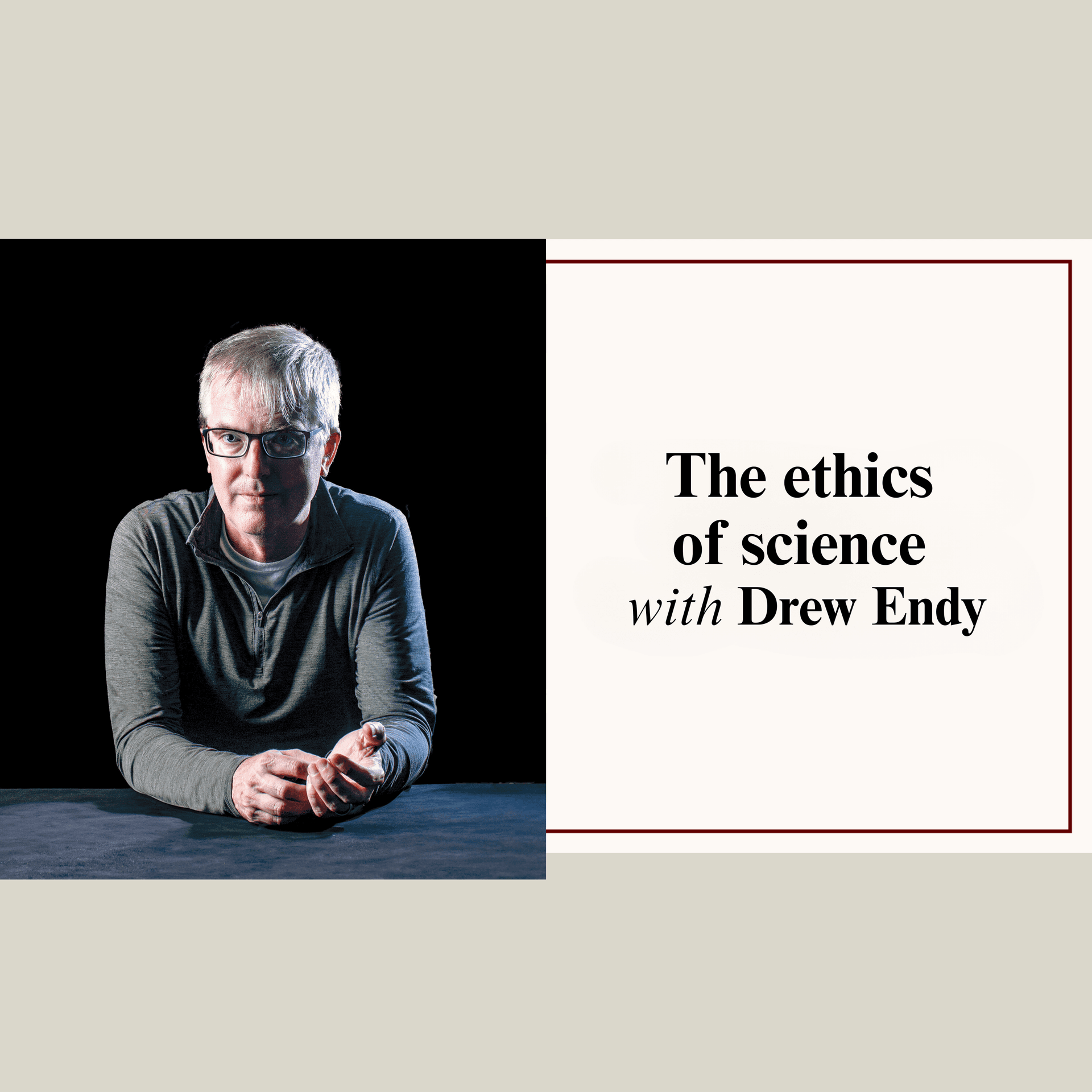
Episode Details Episode Title: S2 Ep3: The Ethics of Science: How Do We Balance Progress with Safety?
Guest
[Drew Endy, PhD](https://profiles.stanford.edu/drew-endy), Associate Professor of Bioengineering Episode Focus: Discussion on the ethical responsibilities in science, particularly regarding artificial intelligence (AI) and synthetic biology.
Key Themes and Discussions
- Ethical Considerations in Science
- Rapid advancements in technology often lead to ethical dilemmas akin to those experienced with the advent of the internet and gene editing technologies.
- The central question posed: How can we leverage scientific discoveries ethically?
- Understanding Synthetic Biology
- Definition by Drew Endy: Synthetic biology involves combining biological components (from molecules to cells) to solve problems or improve processes.
- Analogy of Building: Endy compares synthetic biology to building with Lego bricks, emphasizing the need for structured components to aid in assembly.
- Personal Journey of Drew Endy
- Endy shares his background in civil engineering and the transition to bioengineering, driven by a fascination with the complexities of biology.
- He describes a transformative moment in his career where fear of biological complexity shifted to empathy and curiosity.
- Challenges of Complexity in Biology
- Complexity in biology can be intimidating; however, understanding individual cellular behavior is crucial to bioengineering.
- The anecdote of a simple project involving DNA flipping demonstrates the iterative process of scientific discovery, emphasizing resilience and persistence.
- Applications of Bioengineering
- Current and Future Applications: Endy discusses how advancements in DNA synthesis can lead to developments in drug therapies, diagnostics, and even environmental applications.
- Endy illustrates the dual nature of bioengineering — foundational work versus immediate health applications.
- AI and Its Role in Science
- AI is viewed as a tool that can enhance research productivity but also raises ethical questions, particularly regarding decision-making in healthcare.
- The relationship between AI and human oversight is critical to ensure ethical standards are maintained.
Ethical Research Practices
- Education: Endy emphasizes the importance of integrating ethics into bioengineering education to prepare the next generation of scientists.
- Open Dialogue: Encouraging discussions about fears and concerns related to bioengineering fosters a collaborative environment for addressing ethical dilemmas.
Final Thoughts
- Endy reflects on the urgency of ethical discussions surrounding emerging technologies, particularly AI and synthetic biology.
- He encourages a proactive approach towards a flourishing future, emphasizing that every day counts in achieving significant advancements.
Key Takeaways
- Fear of complexity in biology can transform into empathy and curiosity, encouraging innovative solutions.
- Ethical considerations in science are paramount, as rapid advancements can lead to unforeseen consequences.
- Education and open dialogue are essential in preparing future scientists to navigate ethical challenges responsibly.
---
Conclusion The episode provides a profound exploration of the ethical responsibilities that come with scientific advancements, particularly in synthetic biology and AI. It encourages listeners to engage with these crucial discussions to ensure a future that aligns scientific progress with societal well-being.
For further insights, listeners are encouraged to subscribe to the podcast on platforms like Apple Podcasts and Spotify.
Written by AI. May contain mistakes. Listen to the episode to check what was said.
Transcript
Automatic transcript. May contain errors.0:07Welcome to Health Compass. I'm your host, Maya Adam, Director of Health Media Innovation at Stanford medicine. It's been an irresistible attraction to the living world for me to understand it, which I'm still working on. We're all still working on, but to marvel at its ability to build by growing and to learn how to partner with biology at a more foundational level to help us build the things we need in partnership with the rest of the planet.
0:37If you think back to any monumental leap in science or technology, it's almost always accompanied by a kind of ethical reckoning, mistrust, skepticism, or dilemmas about whether the research or tool could have an unanticipated negative effect on society. Those questions are sensible and crucial. Think of the Internet. When it was first launched, there were threats of malware and lack of privacy, or when gene editing technology enabled scientists to start precisely editing genomes, people worried that some might use it to produce designer babies. With advances like artificial intelligence and synthetic biology poised to reshape our world, scientists are again met with a timeless challenge.
1:29How do we use today's most promising scientific and technological discoveries safely and ethically? I had the pleasure of speaking with Drew Endy, an associate professor of bioengineering who specializes in synthetic biology, to learn more about rapid advancement of modern science and how he thinks about prioritizing ethics and responsible innovation. information. Drew, it's such a delight to have you on the podcast. Thanks so much for being with us today. Maya, good morning. Really grateful to be here with you. Drew, I want to start by asking you what for you is maybe a simple question, maybe not for me and not for some of our listeners.
2:12What exactly does a synthetic biologist do? It depends. Start with the word. It's a good question. Start with the word synthesis. What does the word synthesis mean? And my favorite answer to that is it means putting things together, right? So composition or in the ancient definition, a putting together, a putting together of things. So when you put the word synthesis in front of biology, you're putting things together. For me, that means at the molecular to cellular scale, molecules, the gizmos that make up life and cells, the fundamental unit of life. But a different synthetic biologist could be working at the level of microbes to a microbiome, the organisms that comprise what's in our guts, or an ecology, an ecosystem.
3:05So synthesis is a general word, a very pluripotent word. In a different context, you could think of synthesis of music, a musical synthesizer or a dance, the composition of a dance or a novel even. So it's one of the reasons I'm in love with synthetic biology. As much as I love biology, I also love the word synthesis. And so the day job of a synthetic biologist is to put biology together. And then there's different flavors. One last thing just to quickly calibrate. It could be that you're putting things together to solve a problem. I have a disease I'd like to help with, and so I'll put molecules together, I'll put biology together to help with the treatment of a disease or the prevention of a disease.
3:50There's another type of work in synthetic biology which is more foundational, which is to get better at putting things together. So the very act of composition is itself a puzzle. And so how do you make it easier for people to put biology? Think of Legos and how structured and how much care has gone into the design of a Lego brick, right, to make it easier for everybody to build with Legos. So there's a type of foundational work in synthetic biology, which is just making it easier for people to compose biology. Does that make sense? Absolutely. I've never heard it described like that. That's fascinating.
4:28How did you find your way into the space you are right now? I grew up in Pennsylvania, and the cliche of a kid who likes to build stuff works for me. It's true. My undergraduate degree is in civil engineering, so construction, reinforced concrete, steel, literally building things. My summer internship in college was with Amtrak out at 30th Street Station in Philadelphia doing construction management or learning, I should say more honestly, or learning to do construction management. If you fast forward, for somebody who likes to build things, on our planet Earth, the most powerful way of building is growing, which is what biology does.
5:13And so any engineer who's paying attention to how things get built on planet Earth, it's just irresistible. It's smitten with biology. This is the way to build stuff. Look at all the stuff behind me. It's just building itself. Right. And and so it's been an irresistible attraction to the living world for me to understand it, which I'm still working on. We're all still working on. But but to marvel at its ability to to to build by growing and to learn how to partner with biology at a more foundational level to help us build the things we need in partnership with the rest of the planet. So that's that's the nickel nickel story.
5:51I can hear your passion for what you do. And that leads me to another question. I always ask our guests to tell me a story, something that impacted them, that really, you know, like a milestone or a moment of discovery, something that's been really meaningful for you as a scientist. hmm one of the things that um i hear a lot as an engineer i don't want to be pedantic but i'm just gonna i'm just gonna like double click on that word engineer as an engineer working in biology i hear a lot about how complicated biology is and it is complicated it's it's unbelievably complicated. But the way I experienced that story of the complexity of biology was very intimidating, very off-putting, very, oh, no, no, no, no, you know, you can't do that.
6:51And the points in my journey that have been profoundly impactful for me has been when encountering that complexity of biology to go from fear of complexity to empathy. I'll give you the abstract version, then I'll give you a couple specifics, but I have to give the context. This fear of complexity becomes a curiosity of complexity, becomes empathy for complexity and the unwinding of it so that we can put it back together, right? So think of it more simply. You know that nursery rhyme, Humpty Dumpty. Like Humpty Dumpty sat on a wall, had a great fall. All the king's horses and all the king's men couldn't put Humpty Dumpty back together again.
7:37There's a fear in that, that something, when it falls apart, when we take it apart, when it's apart, it's so complex, you could never put it back together again. So hidden in that simple rhyme is this fear of complexity and also entropy, things falling apart. So these will be, I'll have to give you specific examples, right? But they get a little, well, I have to just give you the details, right? So it turns out cells are really tiny. These objects that make up life, they're super tiny little objects. And then the stuff that makes up cells, the molecules are smaller still. and there are not very many molecules of each type of molecule in a cell.
8:27And so it's hard to predict exactly what they'll do. Think about your house and you might have a dog or two, you know, or not, or you might have a cat or two or not. You might have a kid or two or three or not, right? And so, you know, if you looked at a neighborhood and you could say, Well, on average in this neighborhood, there's four people in each house and one dog and one and a half cats on average. But if you looked at any given – and that would be like looking at a population of cells and taking an average of what was going on inside them. But it wouldn't tell you the stories of what was going on in any individual house, right?
9:08And so if you went to any one specific house at any moment, there may or may not be four people in it. There may or may not be one dog or one and a half cats in it. It's going to be random. Because it's going to be depending on how those people are doing in that moment, in that house, exactly then. And so biologists about 20 to 30 years ago, and bioengineers, we really started to appreciate that on average, it's easy to get a simple story for what's going on inside cells on average. But when we looked at the individual cells, each individual cell's got its own story, right? It's telling its own molecular reality and dealing with it.
9:47And it's random. at the basic level. You couldn't exactly say, hey, in that cell over there, is there going to be four copies of this molecule or three or five? And then does that matter? And so now I'm a synthetic biologist. I'm a would-be engineer of biology that's trying to get good at putting biology together. But how do you put things together when you can't even tell how many molecules are going to be in the thing because they're just going around randomly and changing random imagine if you're a kid building a lego set and the the number of lego pieces you're working with on your table is changing you know by a factor of two randomly and you're like i got to build i got to build the space shuttle right but like suddenly i i have half as many or twice as many of this this piece that i want so so so so this is being presented to me and and my students and colleagues and it's like you're never going to be able to engineer biology because it's like too complicated.
10:43Not only is it complicated, but it's tiny, but it's also random in its implementation. And it was just this paralyzing terror. Well, it turned out at Stanford when we first set up the lab, we set up the lab in the basement underneath Kupa Cafe, and we were working on this one simple project. We just wanted to be able to take a piece of DNA and take a little section inside a cell and flip it and then flip it back. Kind of like a light switch. Get the piece of DNA that's pointing in this direction. Flip it so now it's pointing in this direction. And then flip it back. And then flip it. What could be more boring than that?
11:26Flip, flip, flip. But when you think about that little move, we're basically making, if it's pointing in this direction, it's a zero. And if it's pointing in the other direction, it's a one. It's like a digital data register. And to do this, We had to make molecules inside the cell that control the flipping, right? But the making of these molecules is noisy and random, right? And so we had to figure out how to get the control of these molecules just right. And I remember Jerome was working on this. And it took us over 700 attempts to tweak the way we were controlling the making of the molecules to turn it right and left and right and left.
12:12And it finally worked. And it worked because we figured out the various thresholds, basically, below which it wouldn't flip and above which it would flip. And then we figured out how to stay away from that threshold point so that things would be well behaved. And I remember I was giving a talk at the law school about this work to the law school faculty. One of the great things about Stanford, it's such a diverse and full service university. You can talk to anybody. So the law faculty invited me over to talk about our work. And I remember the dean of the law school. The dean of the law school said to me, from all the law faculty, he's like, you're telling me it took you 700 attempts to get this to work?
12:54Like, how long would you have kept going? Right. And I was like, that's a good question. I hadn't really thought about that. There was no way we were going to stop. The answer was until we ran out of money, right? Like we would just keep going until we got it to work. But once we got that experience under our belts, once we navigated this expectation that it is impossible to get better at composing biology, it's impossible to do this, once we had that little switch working, that was very emboldening. It gave us a lot of courage to keep going. There's a lot of tiny, tiny experiences like that. I'll give you one more just for consideration.
13:35About a year later, we had taken these flippers, these abilities to flip DNA back and forth. And we had made a full family of logic, computational logic and or like what you would think of as computer logic, but it was in DNA. And I went over, I was giving a talk in another department, the electrical engineering department, about our, wow, this guy's in bioengineering. He's making logic. Must have something to do with electronics. No, it has to do with biology. But they were curious about it. And after I gave my talk, there's this very distinguished professor. He puts his hand up and has the first question.
14:12Yes, sir. What is it? And it turns out he didn't have a question. He had a statement to make. And his statement was, you're not doing engineering. And I was like, what are you saying? He's like, you're not doing engineering. And he had a lot more to say about it. I didn't understand what he was saying. But after he spoke for three minutes or so, he finally said something that made his point in a way I could understand. He said, nobody is buying what you're doing. The work that you're doing is not for sale. You know, I can't go by your DNA logic. And I said, oh, okay, that's a fair comment. But, you know, like, be patient with us.
14:54Nobody on earth had this working six months ago, like ever, right? Whereas electronics have been around for 60 years, you know, we're a little bit behind you guys and gals over in electrical engineering. So I still remember that. And that for me, in bioengineering, it's very hard to do work that's down in the foundations, trying to get better at bioengineering for everybody, because the applications of bioengineering are so important. If I could help somebody with the disease right now, by God, we have to go do that. And so the idea that you would take a step back and work in the foundations of the field is challenging.
15:34And so as I've had these experiences and we've made progress in the foundations that level up all applications, it's given us confidence to keep going, even though there's an urgency in the application layer. Does that make sense? Absolutely. I was going to ask, like, in the future, where are those applications? Where do you see them heading? Is it towards drug development or towards other kinds of patient? I mean, at what point does what you're doing intersect with the care of human beings? Yeah, I mean, the work's already having those impacts, but they're underneath impacts, right? So in a different context, with other colleagues, we worked on building DNA.
16:23You know, DNA, the molecule that encodes what biology does. And so imagine that you can build DNA from scratch, right? That's incredible. Just like you could make music from scratch with a musical synthesizer, you could build DNA from scratch with a DNA synthesizer. When I started work, the cost of building DNA, DNA has four letters, A-T-C-G. The cost of adding one letter to a thing you were building was$4, right? Now it's 10 cents or less, right? So anybody who needs to build DNA to do anything benefits from that improvement. So that could be for vaccines. That could be for recombinant production of a drug for treating diabetes.
17:07When we get better at building, what is the use of a little memory register or a logic gate that works inside a cell? Oh, it means you could put that on the bacteria that live in your skin and use that to sense glucose levels in your blood and control the production of insulin. so you have a skin cream for treating diabetes maybe. Or if you wanted to see what's going on in your gut, you could have sensors that detect the disease state of your elementary canal and then record that such that it's easier to use another tool, DNA sequencing, to read it out. So the value of a computer is not only how fast it is and how affordable it is, but it's also where you can use it and what it can compute on.
17:47So you think about your iPhone or your Android phone or your laptop. It's like, we're used to computers like that. But what's the value of a computer that operates inside every cell in your body? It doesn't have to count to a trillion. It just has to count to 100 or 200. That's worth a lot. So sometimes it's hard to make the connection between these low-level advances because they impact all possible applications. The other thing I want to mention, two things I'd like to add. Biology is a general-purpose technology. um gpt not like chat gpt but but let me just slow down i'll say that biology is a general purpose technology what that means is anything we can learn anything bioengineers can learn to encode in dna program in dna we can grow right wherever we need to grow it um now we think of it today as food and fuel and materials and medicines those are the three three and a half big categories of applications but it's much broader than that um you can encode pathways inside yeast, instead of making a medicine or wine or beer, you could make an explosive.
18:53Does that sound good? It depends who you are. There are plans for 20 years of foundational work that on the other side of that, you could do a bottom-up assembly of computer hardware. Now, that's technically impossible today because we don't have the foundations mature, but is physically imaginable. Biology organizes atoms with tremendous precision from the bottom up. This is the opposite and complementary to how computers are built today, where it is basically like a kid at the beach with a stick making a pattern in the sand that's called lithography. So it's like, huh. So just remember this.
19:34Biology is a general purpose technology. Anything we can learn to encode. Now, there's one more thing. I think what's going on in bioengineering today is like what was happening in computing in 1975. We thought of computers looking back in time like the IBM mainframe only. Big computers in rooms far away that you have to share access to. But if you were paying attention at Stanford and other places in 1975 to what was going on, you could see computing was changing. The packet switching network that became the internet was getting prototyped. The basic programming language that had been developed earlier that made computing accessible and fun was being installed on tiny little computers that were being distributed.
20:21And you go, huh, the future of computing is going to be about pervasive computing that's all around us, and the computers are going to be connected by a network that doesn't care what the data is going between. So if we remember that history and we look to bioengineering in biology today, we can see those same opportunities right in front of us. So we think of biotechnology as being somewhere else, right? But no, no, no, biotechnology could be on us and in us and around us. Last year, for example, I bought three bioengineered systems off the internet, not as a fancy Stanford researcher, but just as somebody ordering off the internet.
20:57I bought a tomato that's a purple tomato that makes antioxidants like a blueberry, right? I bought a petunia that's a nightlight. It's a petunia that emits light like a firefly, just barely. Your retina has to be acclimated to the dark. And then I bought a little jar of a microorganism that you're supposed to drink before you have a glass of wine because it's supposed to degrade the byproduct of alcohol metabolism, so you're less likely to have a hangover. Now, to be fair, I didn't try that one, but I have it in my kitchen. But I grew the tomatoes and I gave the petunias to our kids as nightlights they have to water and take care of.
21:46So there's another thing to think about, which is the future of biotechnology is not only more of the same, right um but it's also in in my expectation going to change in qualitative ways that could be wondrous if if we get it right and develop it responsibly yeah talk to me a little bit more about that drew when you say we have to do it responsibly what does that mean what does it mean to sort of practice this kind of research ethically and what are our responsibilities and how can we really raise the next generation of scientists as well to have those foundational principles of ethical research?
22:31Maya, thanks so much. I mean, it's a good question and I won't represent, I have all the answers. I'll just say, here's what we're doing. And I'd welcome your feedback or anybody's feedback because it's not only my responsibility. The answer to your question is a responsibility we share across all of society. The first thing we do on campus as an example, Jen Brophy and I and others teach introduction to bioengineering. And so we have undergraduates, you know, up to 200 of them, both on campus and high school students. And when we teach introduction to bioengineering, we're not only talking about the science and engineering of biology, we're talking about the ethics and practice and the policy aspects.
23:11And one of my favorite things to do with the students is I'm telling them when I retire, like, I will not be doing the work I'm doing no later than 2034. I hope I'm lucky enough to get that far. And the students don't pay attention at first. They don't believe me. And then I slow down and I say it again like, no, no, no. When we're talking about these topics, like a topic of biosecurity or biosafety or bioethics, I say, I'm done with this work in nine years. I just slow down and repeat it. And then you can see their faces change. Some of them get a little bit pale. And then they pay a lot more attention.
23:53And then after class, about 60 % of the class emails me and says, I want to work on these policy matters or these ethics matters. How do I get involved? So the first thing I want to represent is in answering to your question, we have to talk about it. We have to open up these puzzles. I can't pretend that I'm the all-knowing scientist who has the answer. Instead, we have to have an honest conversation about what the curiosity is, what the excitement is, what the fears are, and then get those out in the open so that we have the courage to work on them together. So just to start with that, then within the context of the work we're doing, the research we're doing, we think about the appropriateness of it from an ethics perspective.
24:38We think about, is it safe or not? We have committees on campus that review research before it's conducted, right? We have oversight from the government at different levels, depending on the type of work. Could be Sacramento, could be Washington, D.C., could be international. And so the whole research framework at Stanford and beyond within the U.S. is governed in a non-trivial way, we have experienced as a society the limitations of this governance framework. So if I jump all the way to a big example, how many times have you been asked the question or asked yourself the question, where did SARS-CoV-2 come from?
25:23Remember this pandemic thing? It's a good question. I've probably been asked that 20 times by members of Congress, right? And the answer is, we don't know. And so it turns out, as good as that question is, I have a better question. Why have we made it hard to know where SARS-CoV-2 came from? Why have we made it hard to know where the pandemic came from? Now, that turns out to open up a whole set of opportunities around policy, right? Because we've chosen to govern research in certain ways. And depending on those choices, it becomes easier or harder to answer other questions. One of my service activities is I work on a committee for the World Health Organization.
26:11And this committee oversees research not with coronaviruses, but with smallpox. So smallpox was a human pathogen, a scourge of the 20th century and before, that was eradicated through an extensive public health bottom-up global vaccination campaign. So no human has had smallpox in decades, right? And it's such a good success of public health that young people aren't vaccinated against smallpox anymore because it's just not out there, most young people. Now, how do we govern work with smallpox? That's a choice. But the choice is an interesting one. The answer is you can't do it. Like, no, don't do that research.
26:55unless you can come to an international body that reviews your proposal, and then we'll say, no, you can't do it, unless you can convince us that the work has to be done to make a better test, treatment, or vaccine. And we need a better test, treatment, or you can't just do it out of curiosity. Like there has to be an urgent need, right? And then we'll, and then we're still going to say, no, you can't do it, unless you can convince us that you have to do the experiment, not with a fragment of the virus, but the full live virus. And only if you can convince a group of 20 experts from 20 different countries, right, that all of these things are absolutely required, then you'll get a permission slip to do just that experiment.
27:41And oh, by the way, we're coming to inspect your laboratory, right? And it's not one country coming. No, it's a multilateral party coming to inspect the lab. Now, this has been in place for, gosh, 20 years now. And so isn't that an interesting choice? It's somewhat expensive. It's somewhat cumbersome. If you're a scientist, it's very annoying because you have to get permission from a whole other group of people through this very torturous path. But wow, reduces the chance of a laboratory accident, reduces um uh uh erosion of trust right all sorts of good things so so you know it starts it starts with talking about it you know and then it it bring these puzzles out into the open so that it's not just held by quote-unquote the public or the scientist you know but it's this yeah one one of my favorite lessons is um um so something about me i'll just share um i'm afraid of falling from heights i am i was terrifying right um i remember going up to the top of yosemite falls with my wife and and my father-in-law and and brother-in-law like they're all they're all going to the edge at the railing like no way right like i'm not i'm not going within 20 feet of that right or or when we drive across the golden gate bridge um even though i'm long ago a structural engineer right i i can estimate the likelihood the bridge is going to fall down it's low right But what I'm thinking about is the bridge is going to fall down, and then we're all going to perish in the ocean.
29:14There's no chance we're surviving that. But what's interesting is I'll still drive across the bridge. So what's going on there? And by the way, I cannot explain to you why I'm afraid of falling from heights. I have no idea where this comes from. I cannot rationalize it. It's what I think of as an instinctive fear. But the aha is, see how I can talk about this out loud? and you're not laughing at me that I have this cowardly fear of falling. Like you're just, you're accepting my admission of being afraid. What you're doing is incredibly important because it's letting me get my fear out in the open.
29:51And then that reveals the following. The gift of fear is the chance to become courageous together, right? Just like some people are afraid of flying and we will help them. Or somebody like me who's afraid of falling from heights, we will help them by creating a profession of structural engineering that gives us confidence and courage that the bridge won't fall. However, something strange happened 50 years ago when genetic engineering got invented, and people were, perhaps some people were excited about it because of all the things you could do, right? You can see my excitement for bioengineering.
Read the full transcript
30:28But others might have been skeptical or concerned or, wait for it, instinctively afraid. This insight comes from a different colleague at Stanford, Paul DeMarinis. Paul is a professor of art. He's an artist. He was auditing Introduction to Bioengineering, and we were talking about mistakes in labs and the threat of bioterrorism and biowarfare. He said, oh, you skipped over one thing. You skipped over what he called bioscarer, that this bioengineering stuff is just scary. I'm like, how could that be? He had to explain this to me three times. I simply could not imagine that what I'm doing is scary, but no, it's obvious once you see it.
31:11So how do we let people express that fear, if they have it, an instinctive fear of bioscience or of medicine or of bioengineering, and bring that out into the open and then get to the gift, which is a chance to become courageous. So that's part of it too. And I'm actually really excited about that. That's fascinating. It makes me think about AI and all of the conversations. Is there a similar thing going on with AI, that kind of fear? And how do you feel about AI in science? That's a great question. I have so much to say about AI. Please do.
31:56So one of the things I encounter is the PhD students in bioengineering, some of them, the ones I work with, they're skeptical of AI. They prefer a different type of AI. So what does AI mean? Artificial intelligence? Okay. If you're in a computer science department, but if you were in an anthropology department, maybe AI means ancestral intelligence. And in bioengineering, my favorite type of AI is called actual intelligence. So I just want to acknowledge, maybe I'm not going to cede the territory of the acronym to computer science alone. But I know you mean chat GPT and stuff like that. Right.
32:39So the PhD students I work with are skeptical of artificial intelligence. And the tool I use with them is the tool of metaphor and of a piano and to think of chat GPT like a piano. If you just go into it and start hitting the keys on the piano randomly, you'll get a bunch of noise back. But if you have a teacher and you learn how to practice playing the piano, you can get incredible compositions coming back. So getting people to a positive mindset to engage constructively with an alien technology that's just appeared. But think about it like a piano for a second. right and then i offer to pay their subscriptions you know if they want to access the higher end tools and so getting into that constructive engagement mindset is important um another thing another thing about ai that i like personally is its extraordinary capacity to generate possibilities right and so when we think about all the things biology could be it mostly most of the biology that could be doesn't exist and we'll never see it And so AI is this extraordinary tool for quickly generating and sampling possibilities of biology more than I could ever imagine.
34:01So that is – let me say it this way. I mentioned in passing you can print DNA or you can synthesize DNA. It's kind of like a printer. If you had a printer in your office for making a piece of paper with text on, it just prints it out. right so so imagine having a printer for dna but you don't have a you don't have a word processor you don't have a dictionary you don't have grammar like any anything you're trying to write into dna requires artistry on your part extraordinary effort just to come up with the the sequence you want to try out but then all of a sudden you've got this tool called artificial intelligence and it amplifies your ability to search and compose these strings of dna that you might want to try out.
34:46This is very exciting. Drew, that brings me to kind of the intersection of two things we've talked about. When we're thinking about integrating AI into scientific research, what are the ethical considerations there and how can we do that safely? I don't think it is. So two things to think about. First, is it any different than research to begin with? Meaning, does AI trigger special additional considerations in biological research that are distinct and not covered by the existing approaches we have? I think the answer is yes, but I don't think it's dramatically yes. Meaning the framework we already have for research that's handling, is this good or bad?
35:39Is this the right thing to be doing or not, like that still has to hold. I think where it gets interesting is when people, people, who's the researcher, right? Like who, and who gets to make the decision? Is this, is this an ethical, you know, is this an ethical research activity or ethical application of scientific knowledge, right? So is there, is there a human, you know, is there, is there a human scientist, a human engineer, a human doctor in the loop as the AI tools get, get, get used? For basic research, I think it's going to be pretty straightforward to see AI applied to help automate a lot of basic scientific research.
36:21And frankly, I think a lot of classically trained scientists are going to find themselves competing with AI laboratories, basically. And I wouldn't want to compete with an AI laboratory. I'd rather augment it or have it augment me or do something more challenging. But I do think there's going to be a change in the practice of science, and so there'll be some disruptions in who's doing science of certain types. And so there's a type of ethical consideration around that transition. But then for other things, if you were to see AI move into the patient-doctor relationship or into the clinic in a different context or into public health decision-making, that's where you'd want to have additional consideration.
37:07And I'll point out this is not specific to bioscience and biomedicine. These same types of puzzles show up with respect to other categories of AI impacting things in society, right? Like who gets to make decisions about what happens? um yeah i i will i didn't i do want to say something that you can edit this out if you want um i want to say two other things um i i hear a lot of conversations about how i'll just i'll give an example i hear people who are not working in biology or say things like this they're very powerful people. They have tremendous accomplishments and they can speak with absolute authority on other topics, but then they'll say something like this in passing with equal authority to everything else they hold forth on.
38:01Soon, soon, ChatGPT will let anybody anywhere make killer chickenpox. Right? I was just like, well, that's interesting. Is that true? Right? And the answer is no, right? But it gets, in my view, but it gets said with such authority that it amplifies these concerns that arise at this intersection and convergence of two frontier technologies, artificial intelligence and synthetic biology. And we should pay attention to these claims because if they're true, we're going to have to figure it out. And on some time scale, we have a puzzle of how to secure biology. I'll admit to that. We spend a lot of time on that.
38:42But the hyperbole around some of this stuff is mind-blowing to me. I'll give you another example. I was watching, I think over the weekend, there was a Nobel laureate who works in AI, and they were interviewed by 60 Minutes. And they made a claim, to paraphrase, that was, you know, within a decade, we'll cure all disease. Like, who wouldn't want that? You know, and the 60 Minutes fellow was just like, wow. Wow. As opposed to, that sounds amazing. Which disease is first? Or have you cured one yet? Who wouldn't want to cure all disease? If we could do that, all in. But at some point, we have to be careful about when you're navigating a frontier defined by an emerging technology, the focus tends to be on the technology itself as opposed to the word emerging.
39:42I just want to slow down and remind myself and share, what does the word emerging mean? And it means we don't know yet. It means it's the thing that's emerging from below your carpet. What did I put under the carpet or what's under the blanket or what's coming out of the ocean? It's like we don't know what that thing is yet. And we have to admit to that, that ambiguity, that ambiguity of what it will be. And when you have emerging domains, frontier biotechnology, frontier computer science, you can peer in each direction. But when the two domains converge, I think it's now you have double emerging or emerging squared.
40:27You got to be, I'm not going to dial back my enthusiasm and like, let's figure it out. But I do think it's important to not become overwhelmed in either direction, the positive or the negative. And let's just figure it out by keep going along the frontier. So it's interesting being alive at this time and working in this area and experiencing these convergences and trying to help people make sense of it and trying to help myself and students make sense of it. Well, it's fascinating what you've said, and you've given us so much to think about today, Drew. I especially am going to take away with me that the gift of fear is the chance to become courageous.
41:07Are there any other takeaways like that that you want to leave us with? Yeah. Thank you, Maya. I really enjoyed our conversation. There's about 9 ,000 days left until the year 2050. We think of the year 2050 as being far away because it is, right? It's like two and a half decades away. But when you think about it as being 9 ,000 days away, that's not that long. And so what do we want to be true in the year 2050? And when we adopt that mindset, this helps me understand the cost of time and how every day matters. Because when I think about the year 2050 and what's possible, I can imagine a flourishing planet with 10 billion people, if we have that many, able to secure everything they need to have a good life and to do that in ways that are compatible with the rest of life on Earth, literally a flourishing planet.
42:06And I'd like to get there. And if you gave me a napkin or a blackboard, I could work out all the math to justify and support my imagination and statement. It's not a frivolous possibility. And so I'd like to just share what I think about, which is this physics of flourishing and that it's possible that we could make this real soon enough to matter. We could make this real together within a human generation. And then the doing of that, it really forces my attention on this cost of time, that every day matters. I'm really grateful for your questions and conversation. Thank you so much for making the time.
42:51And I'm so grateful to our audience for making the time to listen today. If you like what you heard, audience members, please remember to subscribe on Apple Podcasts, Spotify, or the Stanford Medicine YouTube channel. And Drew, thank you so much again for making time to be with us today. Thank you, Maya. Have a great day. You too. Thank you.
From the publisher
Read more in Stanford Medicine magazine: https://stanmed.stanford.edu/ethical-genetic-engineering-benefit-society/